1 151 résultats
1970réf. 172017Pasadena: Pasadena Art Museum 1970. First Edition. Softcover. First Edition. Published in conjunction with an exhibition held at the Pasadena Art Museum from March 16 through April 26 1970. Illustrated primarily in black-and-white. Supplement included. Very Good plus in perfect-bound wrappers with a Very Good plus dust jacket. Pasadena Art Museum unknown books
2014réf. 153535Seoul: National Museum of Modern and Contemporary Art 2014. Softcover. Text in English and Korean. 2015 calendar with twelve whimsical cut-out reproductions of figurine design illustrations created by Oskar Schlemmer for the Triadisches Ballet. Near Fine. Unbound. National Museum of Modern and Contemporary Art unknown books
1990réf. 82071Cambridge: MIT Press 1990. First US edition. 4to. 362 pp w/appendixes. Fine in fine dust jacket. Over 400 images drawn from the Bauhaus-Archiv a wealth of essays and documentary biographies of every Bauhaus photographer. Cambridge: MIT Press unknown books
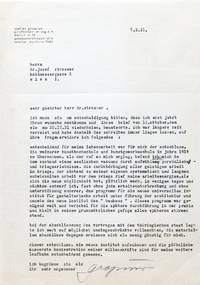
1931réf. 3085Wien Vienna: np 1931. first edition. Very Good/Very Good. WALTER GROPIUS ON THE FOUNDING OF THE BAUHAUS. Historical Significance & Context: In 1919 Walter Gropius issued the founding manifesto of the Bauhaus proclaiming a radical reorientation of modern creative practice. Rejecting the isolation of the fine arts the manifesto called for the unification of architecture art and craftsmanship the return to the workshop and the dissolution of hierarchies between artist and artisan. Visionary and programmatic in tone it articulated what modern art and architecture ought to become and announced the Bauhaus as the institutional vehicle for that transformation. The present 1931 letter stands as a unique and illuminating complement to that manifesto. Written more than a decade later it sheds direct light on how and under what conditions the Bauhaus program was conceived. Where the manifesto speaks publicly and declaratively the 1931 letter looks inward and backward offering a first-person account of the psychological intellectual and institutional circumstances that made its issuance possible. Written at a moment of professional maturity the letter reflects Gropius's considered judgment rather than youthful idealism. By 1931 he had already served as Bauhaus director for nearly a decade 1919-1928 achieved international recognition and emerged as one of the central figures of modern architecture. The depth of Gropius's reflection was prompted by a formal scientific inquiry from Dr. Josef Strasser in Vienna October 1930. Strasser was conducting research into the "inner psychological happenings" and "decisive resolutions" of "leading personalities of modern civilization" placing Gropius in a study alongside titans like Albert Einstein Sigmund Freud and Thomas Mann. Writing to Strasser Gropius recalls that when he was called in 1919 to assume leadership of the Weimar Academy of Fine Arts and the School of Applied Arts he was in a state of emotional emptiness following wartime and personal upheaval and had been cut off from the systematic gradually developed work of his prewar career. The opportunity he writes abruptly reawakened his creative energies. Gropius in this letter states that working "for a few days and nights almost without interruption and without the support of others" he personally drafted the program for a "new universal institute for creative work under the leadership of architecture" and that he himself named the new institution the Bauhaus. He emphasizes that the program was conceived to be sufficiently broad and adaptable for later practical implementation and notes with retrospective confidence that its fundamental structure withstood all subsequent challenges. Of particular importance is his discussion of institutional governance. In negotiating with the Thuringian state Gropius insisted on the broadest possible powers Vollmachten underscoring his conviction that artistic and pedagogical innovation required institutional autonomy. He concludes by identifying this decision-to found a new kind of institution and the extraordinary concentration of will it demanded-as decisive for the remainder of his career. Founded in 1919 the Bauhaus became the single most influential school of art design and architecture of the 20th century redefining the relationship between fine art craft industry and modern life. Its integrated approach to architecture typography furniture graphic design and pedagogy reshaped modern visual culture worldwide. Although forced to close by the Nazis in 1933 the Bauhaus exerted lasting global influence through the emigration of its faculty and students shaping modern architectural and design practice across Europe and the United States including at institutions such as the Harvard Graduate School of Design where Gropius later taught. Seen in this context the 1931 letter functions as an interpretive key to the 1919 manifesto. It does not restate Bauhaus ideals; rather it deepens our understanding of them by revealing the lived experience deliberate authorship and institutional strategy behind their formulation. As such it stands as a rare foundational document offering exceptional insight into one of the decisive moments in the history of modern architecture and design. The letter in full English translation: Very honored Dr. Strasser I must ask your forgiveness for only now complying with your request and replying to your letter of October 12 which you repeated on February 20 1931. I was traveling for a long time and therefore repeatedly had to set writing aside. To your questions I reply as follows: Decisive for my life's work was my decision to take over the Weimar Academy of Fine Arts and the School of Applied Arts in the year 1919. When the call reached me I found myself in a state of emotional emptiness. Through the upheaval of personal and wartime experiences the suppression of all intellectual work during the war and the distance from my own prewar work which had been developed systematically and gradually my creative energies suddenly reawakened when the new opportunity presented itself. In just a few days and nights working almost without interruption and without the support of others I drafted the program for a new universal institute for creative work under the leadership of architecture and named the new institute the "Bauhaus." This program was sufficiently broad and adaptable for later practical implementation and in its fundamental structure withstood all subsequent challenges. In concluding the contract with the Thuringian state I insisted on having the broadest possible powers Vollmachten; the material financial terms on the other hand proved to be little in my favor. This decision to build a new institute and the sudden extreme concentration of my will proved decisive for my further career. I greet you as your very devoted Gropius Scarcity: Public auction records underscore the extreme rarity of foundational Bauhaus material. Only a single copy of the 1919 printed manifesto-Manifest und Programm des Staatlichen Bauhauses in Weimar formulated by Walter Gropius as the school's first director-appears in documented auction history. Even this surviving example is a printed programmatic statement intended for circulation rather than reflection; no manuscript draft is known to have entered the market and the manifesto itself offers no contemporaneous insight into the personal or institutional conditions under which the Bauhaus was conceived. Letters by Gropius that have appeared at public auction are logistical social or technical in nature: travel notes professional courtesies responses to criticism or generalized pedagogical advice written decades after the founding of the Bauhaus. None approach the intellectual density or historical function of the present 1931 letter which stands apart as a rare first-person account explaining how the Bauhaus program was conceived authored and structurally implemented. While the Bauhaus manifesto is widely cited and endlessly reproduced the present letter occupies a singular complementary position as the interpretive document that explains its genesis. Typed letter signed "Gropius" in German one page 7 × 9 3â„4 in. on personal letterhead dated March 7 1931 addressed to Josef Strasser in Vienna. Signed in pencil. A hint of toning; otherwise fine. Housed in custom presentation folder. np unknown books
réf. 1283London. Thames and Hudson. 1984. 4to. With 154 illustrations and 16 in color. Softcover. In fine condition. unknown books
réf. 1284New York. Barry Friedman Ltd. 1988. 4to. Masters and Students. Dealer catalogue. unknown books
réf. BN156503Berlin Eigenverlag 2002. Softcover. Bauhaus-Möbel. Eine Legende wird besichtigt./ Bauhaus furniture. A Legend Reviewed. Bauhaus-Möbel. Eine Legende wird besichtigt./ Bauhaus furniture. A Legend Reviewed. Bauhaus Archiv Hgg. Berlin, Eigenverlag 2002. paperback
1993réf. BN257921Erfurt Verlag und Druckerei Fortschritt Erfurt GmbH 1993. 1993. Bauhaus Künstler - Malerei und Grafik aus den Beständen der Kunstsammlung zu Weimar und der deutschen Bank Siebenbrodt Michael Emese Doehler und Thomas Föhl Autor Bauhaus Künstler - Malerei und Grafik aus den Beständen der Kunstsammlung zu Weimar und der deutschen Bank Siebenbrodt Michael Emese Doehler und Thomas Föhl Autor Bauhaus - Siebenbrodt Michael Erfurt, Verlag und Druckerei Fortschritt Erfurt GmbH unknown
1999réf. BN311968Birkhäuser Verlag 1999. 1999. Hardcover. Das Bauhausgebäude in Dessau Das Bauhausgebäude in Dessau Stiftung Bauhaus Dessau Stiftung Birkhäuser Verlag hardcover
2012réf. BN332756DuMont Buchverlag 2012. 2012. Hardcover. Bauhaus Travel Book. Weimar. Dessau. Berlin Bauhaus Travel Book. Weimar. Dessau. Berlin Bauhaus-Archiv Berlin Bauhaus-Archiv; Stiftung Bauhaus Dessau Stiftung; Klassik Stiftung Weimar Klassik DuMont Buchverlag hardcover
réf. BN373300Kunstverlag Weingarten. Kandinsky-Teaching at Bauhaus Jan 01 1995 Kandinsky-Teaching at Bauhaus Jan 01 1995 Kandinsky-Teaching at Bauhaus Jan 01 1995 Kunstverlag Weingarten unknown
1992réf. BN449608Taschen GmbH 1992. 1992. Bauhaus 1919-1933 Big art series Bauhaus 1919-1933 Big art series Archiv Bauhaus und Magdalena Droste Taschen GmbH unknown
1989réf. BN497056Wilhelm Ernst & Sohn - Verlag für Architektur und technische Wissenschaft Berlin. / Bauhaus Archiv Berlin. 1989. 1989. Hannes Meyer 1889-1954. Architekt Urbanist Lehrer. Ausstellungskatalog. Hannes Meyer 1889-1954. Architekt Urbanist Lehrer. Ausstellungskatalog. Bauhaus Archiv Berlin Wilhelm Ernst & Sohn - Verlag für Architektur und technische Wissenschaft, Berlin. / Bauhaus Archiv, Berlin. unknown
1980réf. BN497064Gebr. Mann Berlin. 1980. 1980. Georg Muche. Das künstlerische Werk 1912-1927. Kritisches Verzeichnis der Gemälde Zeichnungen Fotos und architektonischen Arbeiten. Bearbeitet von Magdalena Droste unter Mitwirkung von Christian Wolsdorff und Bauxi Mang. Georg Muche. Das künstlerische Werk 1912-1927. Kritisches Verzeichnis der Gemälde Zeichnungen Fotos und architektonischen Arbeiten. Bearbeitet von Magdalena Droste unter Mitwirkung von Christian Wolsdorff und Bauxi Mang. Muche Georg. - Bauhaus Archiv Berlin Hrsg. Gebr. Mann, Berlin. unknown
1996réf. BN544200Dessau ex pose verlag 1996. 1996. Bauhaus Dessau. Industrielles Gartenreich Dessau - Bitterfeld - Wittenberg. Mit Texten von Regina Bittner Heike Brückner Harald Kegler Gerhard Lenz Martin Stein und anderen. Mit zeitgenössischen Fotografien von Axel Boesten und Kai-Olaf Hesse. Bauhaus Dessau. Industrielles Gartenreich Dessau - Bitterfeld - Wittenberg. Mit Texten von Regina Bittner Heike Brückner Harald Kegler Gerhard Lenz Martin Stein und anderen. Mit zeitgenössischen Fotografien von Axel Boesten und Kai-Olaf Hesse. Stiftung Bauhaus Dessau und Rolf Kuhn Hrsg. Dessau, ex pose verlag unknown
2014réf. BN702488Leipzig Spector Books 2014. 2014. Mensch - Raum - Maschine. Bühnenexperimente am Bauhaus. Anlässlich der Ausstellung Mensch - Raum - Maschine. Bühnenexperimente am Bauhaus Stiftung Bauhaus Dessau 6. Dezember 2013 bis 21. April 2014 ; Henie Onstad Kunstsenter HÃvikodden Norwegen 22. Mai bis 21. September 2014 ; National Museum of Contemporary Art Seoul Korea 15. Oktober 2014 bis 11. Januar 2015. Edition Bauhaus. Mensch - Raum - Maschine. Bühnenexperimente am Bauhaus. Anlässlich der Ausstellung Mensch - Raum - Maschine. Bühnenexperimente am Bauhaus Stiftung Bauhaus Dessau 6. Dezember 2013 bis 21. April 2014 ; Henie Onstad Kunstsenter HÃvikodden Norwegen 22. Mai bis 21. September 2014 ; National Museum of Contemporary Art Seoul Korea 15. Oktober 2014 bis 11. Januar 2015. Edition Bauhaus. Blume Torsten Christian Hiller und Stiftung Bauhaus Dessau Hg. Leipzig, Spector Books unknown
1994réf. BN68352Dessau : Stiftung Bauhaus Dessau 1994. 1994. Es gab nicht nur das Bauhaus : Wohnen und Haushalten in Dessauer Siedlungen der 20er Jahre Bauhaus Dessau ; Das Oberstufen-Colleg Dessau : Stiftung Bauhaus Dessau unknown
2013réf. BN71578Spector Books 2013. 2013. Raumpioniere in ländlichen Regionen. Neue Wege der Daseinsvorsorge: Edition Bauhaus 35 Edition Bauhaus 35 Spector Books unknown
réf. 6i3966Hatje Cantz Berlin 2019. 316 Seiten Pappband. - neuwertig / ungelesen - unknown
réf. 45754367-nnew. unknown
réf. DADAX3836565544New unknown
réf. SONG3836572826Used: Good unknown
réf. DADAX1568981759New unknown
réf. SONG3848002760Used: Good unknown
réf. DADAX3777438464New unknown