Bauhaus EarthBiblio.com

1 151 résultats
réf. 45754367like new. unknown
réf. DADAX0415475821New unknown
réf. DADAX0415778360New unknown
réf. DADAX0415778352New unknown
réf. SONG0810960133Used: Good unknown
2014réf. 153535Seoul: National Museum of Modern and Contemporary Art 2014. Softcover. Text in English and Korean. 2015 calendar with twelve whimsical cut-out reproductions of figurine design illustrations created by Oskar Schlemmer for the Triadisches Ballet. Near Fine. Unbound. National Museum of Modern and Contemporary Art unknown
1968réf. 47305Stuttgart 1968. 4to. Orig. printed wrappers in colour. Light wear along edges. 370 pp. Richlyillustrated in b/w and colour. unknown
1980réf. 63692New York: Pantheon Books 1980. 4to. 77 1 pp. plus 150 photo plates text illustrations. Gray publisher’s boards silver lettering on spine discrete publisher’s stamp on upper fore-edge of textblock w/ d.j. cover art photo by Laszlo Moholy-Nagy 1895-1946 still NF/NF copy from the library of Los Angeles photographer Bill Bronstein b. 1949. First American edition stated of this splendid volume exploring the unorthodox series of photographs and photograms by the famed Bauhaus photographer. Pantheon Books, hardcover
1983réf. 32473AB1983. Koeln Dr.Cantz'sche Druckerei 1983. Quarto 21.4 cm wide x 29.7 cm high. 95 pages. Illustrated. Illustrated Softcover. Einband mit kleineren Einrissen unterhalb des Einband-Fotos. Sonst sehr gut erhalten. Mit Photos von Georg und El. Muche von Florence Henri / Mit fotografischen Beispielen vom Fotogramm zu Peterhans Albert Henning Eugen Batz Max Enderlin Gertrud Arndt Georg Muche etc. paperback
1986réf. 19009AB1986. Hannover Kestner-Gesellschaft 1986. 21 : 205 cm. 234 pages with many photographic plates 6 pages advertising. Coloured illustrated original boards. The important catalogue of this famous exhibition on Bauhaus and Photography. hardcover
réf. 55022Dessau Bauhaus 1993. Gr.8° 143 S. m. Textabb. 40 s/w Tafeln. Brosch. Min. gebrauchsspurig sonst tadell. EA. Erschienen anlässlich der gleichnamigen Ausstellung. 010 Dessau, Bauhaus, 1993 unknown
réf. DADAX3791382535Prestel 2017-07-20. Revised. perfect. New. 5.44x0.96x9.13. Buy with confidence. Excellent Customer Service & Return policy. Prestel unknown
réf. 580188VEB BIK Dessau 1989. original Kartonbogen mit 2 Seitenflügeln und Lochstanzung beiliegend in der Breite eines der Seitenflügel Blatt mit Angaben zur Produktion. Zustand: gut am unteren Rand Ablagelochung 12 Gelenkstücke. Regie und Autor: Jo Fabian. Dramaturgie: Petra Ramer. Kostüme: Petra Schlosser. Animation: Olaf Mokansky. Mitwirkende: Heidemarie Fabian Heidrun Schweda Uwe Schroeder Anette Felber Volker Herold Silke Umlauft Jörg Steinberg Hagen Henning ------- Program booklet for the world premiere of Jo Fabian's EXAMPLE No. P Theater Dessau Bauhaus 1989 - Original cardboard sheet with two side panels and die-cut holes enclosed with a sheet the width of one of the side panels containing production information. Condition: good with a filing hole at the bottom. - 12 Joint Pieces. Directed and written by Jo Fabian. Dramaturgy by Petra Ramer. Costumes by Petra Schlosser. Animation by Olaf Mokansky. Featuring: Heidemarie Fabian Heidrun Schweda Uwe Schroeder Anette Felber Volker Herold Silke Umlauft Jörg Steinberg Hagen Henning Programmheft Theater Oper Ballett Musical Theatre Program Playbill programme de théâtre VEB BIK Dessau, 1989 unknown
1990réf. 82071Cambridge: MIT Press 1990. First US edition. 4to. 362 pp w/appendixes. Fine in fine dust jacket. Over 400 images drawn from the Bauhaus-Archiv a wealth of essays and documentary biographies of every Bauhaus photographer. Cambridge: MIT Press unknown
réf. SONGB00RWTR76CEric Bauhaus 0000-00-00. 5th. paperback. Used: Good. 0.00x0.00x0.00. Buy with confidence. Excellent Customer Service & Return policy. Eric Bauhaus paperback
2023réf. __3035626979Birkhauser Architecture 2023. Paperback. New. 304 pages. 9.06x6.69x0.87 inches. Birkhauser Architecture paperback
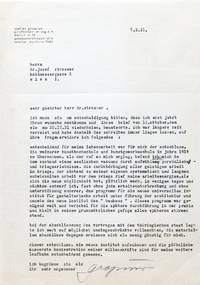
1931réf. 3085Wien Vienna: np 1931. first edition. Very Good/Very Good. WALTER GROPIUS ON THE FOUNDING OF THE BAUHAUS. Historical Significance & Context: In 1919 Walter Gropius issued the founding manifesto of the Bauhaus proclaiming a radical reorientation of modern creative practice. Rejecting the isolation of the fine arts the manifesto called for the unification of architecture art and craftsmanship the return to the workshop and the dissolution of hierarchies between artist and artisan. Visionary and programmatic in tone it articulated what modern art and architecture ought to become and announced the Bauhaus as the institutional vehicle for that transformation. The present 1931 letter stands as a unique and illuminating complement to that manifesto. Written more than a decade later it sheds direct light on how and under what conditions the Bauhaus program was conceived. Where the manifesto speaks publicly and declaratively the 1931 letter looks inward and backward offering a first-person account of the psychological intellectual and institutional circumstances that made its issuance possible. Written at a moment of professional maturity the letter reflects Gropius's considered judgment rather than youthful idealism. By 1931 he had already served as Bauhaus director for nearly a decade 1919-1928 achieved international recognition and emerged as one of the central figures of modern architecture. The depth of Gropius's reflection was prompted by a formal scientific inquiry from Dr. Josef Strasser in Vienna October 1930. Strasser was conducting research into the "inner psychological happenings" and "decisive resolutions" of "leading personalities of modern civilization" placing Gropius in a study alongside titans like Albert Einstein Sigmund Freud and Thomas Mann. Writing to Strasser Gropius recalls that when he was called in 1919 to assume leadership of the Weimar Academy of Fine Arts and the School of Applied Arts he was in a state of emotional emptiness following wartime and personal upheaval and had been cut off from the systematic gradually developed work of his prewar career. The opportunity he writes abruptly reawakened his creative energies. Gropius in this letter states that working "for a few days and nights almost without interruption and without the support of others" he personally drafted the program for a "new universal institute for creative work under the leadership of architecture" and that he himself named the new institution the Bauhaus. He emphasizes that the program was conceived to be sufficiently broad and adaptable for later practical implementation and notes with retrospective confidence that its fundamental structure withstood all subsequent challenges. Of particular importance is his discussion of institutional governance. In negotiating with the Thuringian state Gropius insisted on the broadest possible powers Vollmachten underscoring his conviction that artistic and pedagogical innovation required institutional autonomy. He concludes by identifying this decision-to found a new kind of institution and the extraordinary concentration of will it demanded-as decisive for the remainder of his career. Founded in 1919 the Bauhaus became the single most influential school of art design and architecture of the 20th century redefining the relationship between fine art craft industry and modern life. Its integrated approach to architecture typography furniture graphic design and pedagogy reshaped modern visual culture worldwide. Although forced to close by the Nazis in 1933 the Bauhaus exerted lasting global influence through the emigration of its faculty and students shaping modern architectural and design practice across Europe and the United States including at institutions such as the Harvard Graduate School of Design where Gropius later taught. Seen in this context the 1931 letter functions as an interpretive key to the 1919 manifesto. It does not restate Bauhaus ideals; rather it deepens our understanding of them by revealing the lived experience deliberate authorship and institutional strategy behind their formulation. As such it stands as a rare foundational document offering exceptional insight into one of the decisive moments in the history of modern architecture and design. The letter in full English translation: Very honored Dr. Strasser I must ask your forgiveness for only now complying with your request and replying to your letter of October 12 which you repeated on February 20 1931. I was traveling for a long time and therefore repeatedly had to set writing aside. To your questions I reply as follows: Decisive for my life's work was my decision to take over the Weimar Academy of Fine Arts and the School of Applied Arts in the year 1919. When the call reached me I found myself in a state of emotional emptiness. Through the upheaval of personal and wartime experiences the suppression of all intellectual work during the war and the distance from my own prewar work which had been developed systematically and gradually my creative energies suddenly reawakened when the new opportunity presented itself. In just a few days and nights working almost without interruption and without the support of others I drafted the program for a new universal institute for creative work under the leadership of architecture and named the new institute the "Bauhaus." This program was sufficiently broad and adaptable for later practical implementation and in its fundamental structure withstood all subsequent challenges. In concluding the contract with the Thuringian state I insisted on having the broadest possible powers Vollmachten; the material financial terms on the other hand proved to be little in my favor. This decision to build a new institute and the sudden extreme concentration of my will proved decisive for my further career. I greet you as your very devoted Gropius Scarcity: Public auction records underscore the extreme rarity of foundational Bauhaus material. Only a single copy of the 1919 printed manifesto-Manifest und Programm des Staatlichen Bauhauses in Weimar formulated by Walter Gropius as the school's first director-appears in documented auction history. Even this surviving example is a printed programmatic statement intended for circulation rather than reflection; no manuscript draft is known to have entered the market and the manifesto itself offers no contemporaneous insight into the personal or institutional conditions under which the Bauhaus was conceived. Letters by Gropius that have appeared at public auction are logistical social or technical in nature: travel notes professional courtesies responses to criticism or generalized pedagogical advice written decades after the founding of the Bauhaus. None approach the intellectual density or historical function of the present 1931 letter which stands apart as a rare first-person account explaining how the Bauhaus program was conceived authored and structurally implemented. While the Bauhaus manifesto is widely cited and endlessly reproduced the present letter occupies a singular complementary position as the interpretive document that explains its genesis. Typed letter signed "Gropius" in German one page 7 × 9 3â„4 in. on personal letterhead dated March 7 1931 addressed to Josef Strasser in Vienna. Signed in pencil. A hint of toning; otherwise fine. Housed in custom presentation folder. np unknown
réf. 61283Institut Stuttgart 1983 In-4 30 cm 95pp. illustr. texte allemand Nb-0361 Catalogue de photographies - Bahaus 1922-1936 Paul Citroen - Josef Albers - Gertrud Arndt - Irene Bluh - Kttina Both - Marianne Brandt - Edmund Collein - Erich Consemuller - Coop - Alfred Ehrhardt - Max Enderlin - Andreas Feininger - T. Lux Feininger - Werner David Feist - Walter Funkat - Werner Graeff - Albert Henning - Florence Henri - Ludwig Hirschfeld-Mack - Irene Hoffmann - Hilde Hubbuch - Kurt Kranz - Heinz Loew - Laszlo Moholy-Nagy - Lucia Moholy - Georg Muche - Richard Oelze - Walter Peterhans - Hajo Rose - etc. unknown
réf. ria9783110620122_inpHardcover. New. New Book; Fast Shipping from UK; Not signed; Not First Edition; Olof Rudbeck der Jüngere 1660-1740 führt die Vision seines Vaters auf sprachlicher Ebene fort. Seine etymologischen Spekulationen nehmen eine Eigendynamik an die letztlich zu einer Synthese aus gotizistischem und orthodoxem Sprachver hardcover
réf. A9783037787465Paperback / softback. New. paperback
2017réf. 130590Prestel. New. Perfect. FREE UPGRADE to Courier/Priority Shipping Upon Request - IN STOCK AND IMMEDIATELY AVAILABLE FOR SHIPMENT - Flawless copy brand new pristine never opened -- with a bonus offer--; 5.44 X 0.96 X 9.13 inches; 304 pages . 2017. 3791382535 . Prestel unknown
2016réf. 123898DOM Publishers. New. Paperback. FREE UPGRADE to Courier/Priority Shipping Upon Request - IN STOCK AND IMMEDIATELY AVAILABLE FOR SHIPMENT - Flawless copy brand new pristine never opened – with a bonus offer-- . 2016. 3869223715 . DOM Publishers paperback
2015réf. 115063Spector Books. New. Paperback. FREE UPGRADE to Courier/Priority Shipping Upon Request - IN STOCK AND IMMEDIATELY AVAILABLE FOR SHIPMENT - IN STOCK AND IMMEDIATELY AVAILABLE FOR SHIPMENT - Flawless copy brand new pristine never opened - Text in English French and German. -- with a bonus offer--; German Edition . 2015. 3944669584 . Spector Books paperback