78 risultati
1532rif. 4763Naples: per maestro Ioanne Sulsbach Giovanni Sultzbach Alemano 1532. FIRST EDITION. Hardcover. Fine. Bound in contemporary vellum a bit wrinkled small defects to spine with a contemporary Sicilian gift inscription occupying the full length of the lower cover: "Al mio padre Giacomo Battista Serabone della Compagnia del Giesu. Messina." Inscription on title scored through "Collegii Messiniensis Soc. Jesu."; 16th or 17th c. ownership inscription on title: "Custodia Caraffa" and associated ownership inscription on leaf B1 verso "Questo libro è dela Suor Custodia et Suor Ginobia Carrafe" with the subscription "Vittoria Caraffa". 19thc. book ticket on front pastedown: "Jacob Manzoni" 1816-1889 whose library was dispersed in various auctions between 1892 and 1894; 20th c. book ticket "Libreria Rappaport"Rome. Contents in overall good condition but with several gatherings browned and other minor faults: title page foxed and lightly soiled with small marginal chips and a couple of stains; several gatherings as well as the margins of a few other leaves with damp-stains to margins. With a large title page woodcut see below and unusual intricate woodcut initials. A search of KVK OCLC EDIT16 and Universal STC finds only a single copy Biblioteca nazionale Vittorio Emanuele III Naples. An extremely rare Neapolitan printing this copy once owned by nuns of a life of Saint Agnello "Aniello the Abbot" co-patron saint of Naples b. ca. 535- d. ca. 596 responsible in life and in death for numerous miraculous healings. The title page woodcut depicts the Saint towering over Naples carrying a banner protecting the city from the Lombard invasion of 581. The book is replete with accounts of miraculous healings including exorcisms performed by the saint. The book is listed in EDIT16 under the name of "Petrus Subdiaconus" 10th c. monk of Monte Cassino and sub-deacon of St. Januarius in Naples. However the text is not in fact a translation of Peter's life of Sant'Agnello "Libellus Miraculorum" but rather a new composite work by the 16th c. Augustinian Canon Giovanni da Napoli who cites several sources for the saint's vita f. 4v-5r. The title page tells us that this Vita has been translated from the Latin original which I have thus far failed to trace. The dedication -to the Neapolitan noblewoman Vincenza Montalto the content of the book and the provenance indicate the book's strong appeal for women. An early inscription see provenance note above indicates that the book was owned by the nuns suore Custodia and Ginobia Genovia Carrafa possibly daughters of the woman who penned the inscription Vittoria Caraffa. The Vita begins with the story of Sant'Agnello's conception which strongly mirrors the birth of Christ. The first chapter focuses on the experience of the Saint's mother Giovanna a barren "sterile" woman who prayed before an image of the Virgin Mary for 30 days in the hopes of conceiving a child. On the 30th day the image of the Virgin glowed and from it emanated a voice that announced to Giovanna that she would give birth to a boy. Soon thereafter women began to flock to the image of the Virgin still preserved in the author's time in the Church of Sant'Agnello in the hope of conceiving children. The Saint: Born in Naples Agnello was the scion of a prosperous family of Sicilian origin and perhaps a relation of Saint Lucy with whom he is still closely associated. Agnello spent his youth living as a hermit first in a cave and later in the church of Santa Maria Intercede now Sant'Agnello Maggiore. The story that he saved the city of Naples from the Lombards in 581 while widely-known is not found in Pietro's life of the saint. He died at the age of 61 while a priest in the church of Santo Gaudioso which had been founded by African clergy fleeing the Vandals. Agnello's jawbone is preserved as a relic in a 17th c. reliquary in the Naples cathedral. His body is buried in Sant'Agnello Maggiore in Caponapoli. The saint's cult is still active. His feast day is December 14th. per maestro Ioanne Sulsbach [Giovanni Sultzbach] Alemano hardcover
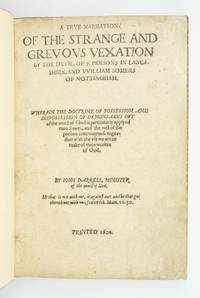
1600rif. ST21089England: Printed by the English secret press 1600. FIRST EDITION. 187 x 128 mm. 7 3/8 x 5". 4 p.l. 24 106 2 pp. Very pleasing early 20th century grained calf gilt covers with French fillet border and rosette cornerpieces raised bands spine panels with small daisy centerpiece gilt lettering densely gilt turn-ins marbled endpapers all edges gilt. STC 6288; ESTC S109297. See also Freeman "Demons Deviance and Defiance: John Darrell and the Politics of Exorcism in Late Elizabethan England" in Conformity and Orthodoxy in the English Church c. 1560-1660 ed. P. Lake and M. Questier Boydell Press 2000 pp. 34-63. Short faint scratch to front board extremities lightly rubbed text washed and pressed title and final two leaves somewhat grayed and grubby margins trimmed a bit close occasionally grazing headlines or shoulder notes but a perfectly readable copy in an attractive binding. This scarce clandestine imprint is a central publication in of one of the strangest religio-political controversies of the turn of the 17th century involving demonic possession witchcraft accusations and an anti-Puritan crusade by a Church of England bishop. Our author Puritan exorcist John Darrell ca. 1562 - ca. 1607 was educated at Cambridge and briefly dabbled in law and farming before establishing himself as a preacher and spiritual healer. In 1586 he began conducting exorcisms resulting in a level of local fame partly because some of them resulted in the convictions of witches. In the following decade he achieved national notoriety. First in March of 1597 he exorcised a group of seven demoniacs in the household of Lancashire landowner Nicholas Starkey. Then in November of the same year he conducted a dramatic public exorcism of Nottingham apprentice musician William Somers whose claim of having been magically possessed led to the arrest of 13 people on witchcraft charges. One of these individuals was the sister of a city alderman who immediately took action to protect his kinswoman. The resulting legal tangle--which included the arrest of Somers on charges of witchcraft later changed to fraud and an investigative commission led by the Archbishop of York--attracted widespread attention to Darrell's activities by both supporters and detractors. The Church of England was highly concerned about Puritan exorcisms: in the words of historian Thomas S. Freeman "exorcism magnified those aspects of Puritan worship which the ecclesiastical authorities most feared--its anti-hierarchical tendencies its strong sense of communal solidarity and its potential as a vehicle for protest." No doubt with an understanding of this threat Bishop of London Richard Bancroft and his chaplain Samuel Harsnett led a vicious campaign against Darrell publishing multiple works smearing his character and theology stripping Durrell of his license to preach and imprisoning him for more than a year. Darrell did not go quietly. Over the next four years he and his supporters penned multiple defenses of his actions and of Puritan exorcism more generally published either abroad or illegally by secret English presses. The present work is significant not only for its detailed retelling of Darrell's final two exorcisms in his own words but also because it includes Darrell's detailed "doctrine of possession" which discusses the difference between his exorcisms and those of the apostolic age an important theological clarification in the debate. STC indicates that our book was one of the works published clandestinely in England; this is backed up by the October 29 1600 Stationers' Company order to burn all copies of "mr Darrell's book lately printed concerning the casting out of Devilles" which Freeman asserts refers to the present publication. This order to be burned on top of the clandestine publication could explain the present scarcity of the work which appears on the market very infrequently. We have been able to trace just a single copy at auction this century and only five since 1964 several lacking the final errata leaf which does appear here. Printed [by the English secret press?] unknown
1706rif. 20083Germany 1706. Manuscript in brown ink on paper in Latin and German written in two highly legible secretary hands by one scribe one for Latin and one for German single- and double-column 27 lines to a full page. Contemporary blind-ruled black morocco red edges. Authorial inscription on the pastedown dated 1706 ex-libris inscription on the title verso “J.M. Herré Presbyt. 1802.” In excellent condition. A unique and curious manuscript manual for pharmaceutical exorcisms highlighting a pivotal moment in Enlightenment Era Europe when scientific innovation collided with deeply rooted religious traditions. Divided into four parts the first and longest section of the text provides the necessary incantations psalms and prayers for exorcising evil spirits and putting protections over the body and home. It lists specific saints to invoke for assistance and biblical excerpts to read in different situations. It also includes recipes for holy water talismanic salt and anointing oil as well as holy baths for dunking witches purgatives for vomiting up demons and potions for expelling evil spirits from the house. The recipes for holy water differ according to the intended use: menstruating women plague victims gardens and building foundations. There are also illustrated instructions for making cross talismans. The second part of the manuscript is more proscriptive listing practical instructions for conducting exorcisms and equipment necessary such as vessels herbs and fire. It is about setting the stage for the ceremony: arranging furniture restraining the cursed victim administering medications and ointments and creating cleansing smoke. It includes numerous recipes for pharmaceutical implements which are written in German as opposed to Latin for the clerical text presumably because the compounds would be prepared by a layman pharmacist or healer who did not read Latin and because the recipes incorporate contemporary metals and plants that did not have Latin names. The section concludes with an alphabetic glossary of pharmaceutical terms with their definitions in Latin. The third part focuses specifically on exorcising demons sent by Satan. The text describes the steps to identify a demonic possession and invoke the help of angels to expel it. The final section comprises an alphabetic materia medica sorted according to ailment. Each entry lists ingredients for medications to treat the illness incorporating pharmaceutical symbols for amounts and dosage. As with the previous section the directions for mixing the compounds are written in German. The manuscript concludes with two alphabetic indices—one for prayers and exorcisms the other for medicine. It is perhaps worth note that this bookseller has handled dozens of grimoires that were placed on the Index of banned books and used as evidence to convict healers of witchcraft and I find few differences between those texts and this manuscript. This text demonstrates how the essential elements of faith and medicine were at play in very similar ways both within the Church and in the communities of its supposed enemies. unknown