2 631 résultats
1964réf. LFA007e1N° 771 - 18 janvier 1964 - numéro complet - bon état
1967réf. LFA007f5N° 948 - 10 juin 1967 - numéro complet - bon état
1967réf. LFA007f6N° 949 - 17 juin 1967 - numéro complet - bon état
réf. 467Paris Chez Bossange , Masson et Besson an XI 1803 2 vol. in-8 ( 22,5 x 14,5 cm ) ( poids = 1,7 kg ) Fx. t. , frontispice , t. , LXXXVI , 353 pp. + fx. t. , t. , 354 , (1) pp. . Frontispice dessiné par Chasselas d' après le tableau original et gravé par R. Delvaux . 20 gravures avant la lettre HT et HP , une au début de chaque chant : ces figures d'après Le Barbier l' Aîné ont été gravées par N. Thomas , J. L. Delignon , R. Delvaux , Dupréel , Ph. Frière , Bovinet , E. de Ghendt , A. Romanet , L. M. Halbou , Villerey , Vinc. Langlois , N. Courbe , Dambrun ; serpentes en papier de soie légendées . Avec : Préface de l' édition de 1774 ; Notice sur la vie et le caractère du Tasse ; Jugement sur L' Arioste et Le Tasse traduit d' une lettre de P. Metastasio à Don D. Diodati ; Appendice . Plein veau glacé marron foncé . Dos lisse orné doré , titre et tomaison . Roulettes et doubles filets dorés sur les plats , roulettes sur les coupes , roulettes à motif de grecque sur les chasses . Toutes tranches dorées . Gardes marbrées . Ex-libris contrecollé au contreplat du vol. I : Bibliothèque de Mr Beaupré , conseiller à la Cour de Nancy . Ex-libris au contreplat du vol. 2 représentant un phénix avec l' inscription I.N.R.I. . Coins émoussés . Des rousseurs acceptables , notamment en marge des gravures . Vol. 1 : mors sup. partiellement fendu , mors inf. frotté ; les pp. LXXXI à LXXXVI et un feuillet ( Notice sur le portrait ) sont intercalés entre les pp. LXIV et LXV . Vol. 2 : mors sup. fendu , mors inf. partiellement fendillé .
1841réf. M165591841 P , Mallet , 1841 , petit in4° , 1/2 chagrin noir à coins , caissons ornés de motifs dorés , tranches dorées , XX - 525 pp . Un frontispice , 20 planches gravées hors texte tirées sur chine, très nombreux bois gravés dans le texte . Inégales rousseurs . Reliure de qualité . Langue: Français
réf. c2237London,W.&A.K.Johnston Limited,sans date (vers 1910); in-4°,pleine toile éditeur beige illustrée et imprimée en noir et or au 1er plat,dos muet; 2ff.,6pp.(de texte,dont Index des noms).Avec 16 planches hors texte en couleurs : cartes et plans.On a joint de chez le même éditeur une carte " Palestine in time of Christ " en noir, carte volante in-4°,repliée.
réf. 32711Sans Lieu, ni Date ( Circa 1920 ) 0 in 12 oblong (10,5x16,5) 1 volume reliure de l'éditeur, dos de percaline marron (brown cloth spine), plats faits d'ais de de bois d'olivier poli (original polished wooden boards), plat supérieur titré en noir dans un bel encadrement de marquetterie de paille, 12 vues photographiques en couleurs tirées sur carton fort, et 12 fleurs séchées sous serpentes (12 pressed flowers on opposite pages protected with tissue guards). légendes en Allemand, Français, Anglais, Russe (French, German, English, Russian). Album souvenir de Jérusalem. Bel exemplaire, bien conservé ( Photographies sur demande / We can send pictures of this book on simple request )
1979Fine Turkish Paperback. Pbo. Roy. 8vo. (24 x 17 cm). Reprint in Arabic; large introduction, and annotations in Turkish. [4], [xLvi], 236 p. El-Bark el-Sâmî. [= Kitab al-Barq al-Shami]. Abridged by Al-Bundârî. Published, prepared and introduction by Ramazan Sesen. Muhammad ibn Hamed Isfahan was a Persian historian, scholar, and rhetorician. He left a valuable anthology of Arabic poetry to accompany his many historical works and worked as a man of letters during the Zengid and Ayyubid period. He was born in Isfahan in the year 1125, and studied at the Nizamiyya school in Baghdad. He graduated into the bureaucracy, and held jurisdiction over Basra and Wasit. He then became a deputy of the vizier ibn Hubayra. After the death of ibn Hubayra, he went to Damascus in 1166 CE (562 Islamic Calendar) and entered the service of the qadi of Damascus, Kamal ad-Din. The qadi presented him to the Zengid Nur ad-Din, who appointed him a professor in the school he had established there, which then became known as the Imadiyya school in his honour. Nur ad-Din was later appointed to be his Chancellor. After the death of Nur ad-Din in 1174, Imad ad-Din was removed from all his bureaucratic duties, and was banished from the palace. He went to live in Mosul and later entered the service of Saladin, the Kurdish Sultan of Egypt during that time. When Saladin took control of Damascus, Saladin's vizier, al-Qadi al-Fadil, appointed him chancellor, and he also became al-Fadil's deputy. Saladin had been unsure of his talent because he was only a scribe, Imad ad-Din soon became one of the sultan's favourites. As chancellor he did not have to perform the everyday duties of the chancery scribes, and he had a lot of leisure time in Egypt. From then on he accompanied Saladin on all his campaigns. After a certain raid, he was chosen to kill one of the prisoners, but the prisoner was a child and was instead exchanged for a Muslim prisoner held by the Crusaders. Imad ad-Din was present at the Battle of Marj Uyun, the Battle of Hattin, and the subsequent campaign to expel the Crusaders from the Holy Land. At Acre, he criticized Saladin for giving away the city's treasure instead of spending it on the reconquest. At Beirut, he became ill, but was the only scribe capable of writing the terms of surrender. He had recuperated in time to see the aftermath of the Siege of Jerusalem (1187), where he again criticized Saladin's generosity; he was also disgusted by those in charge of the ransom who took bribes, and the rich Crusader nobles who took their treasures with them rather than ransoming the poor. He was present at Acre again during the Third Crusade when the Christians retook the city of Acre, and was among those who fled after the defeat. After Saladin's death in 1193, he began writing his biographies of the sultan. He wrote the Kitab al-Barq al-Shami, which is lost, but was abridged by al-Bundari. This study contains just 5th volume of manuscript abridged by Al-Bundârî.
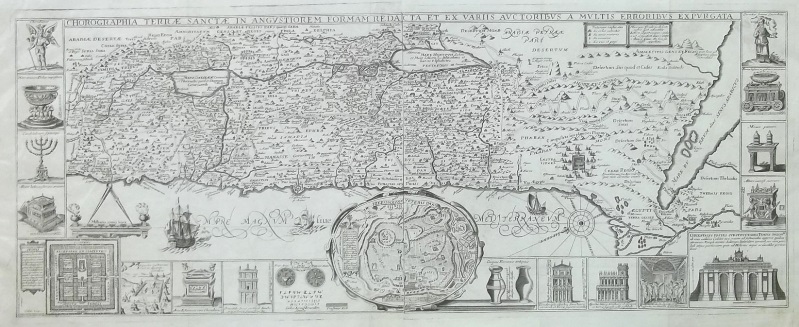
1632réf. 15826Antwerpen, Martinus Nutius, 1632 ff. Ca. 32 cm x 82 cm (Bild), ca. 40 cm x 89 cm (ganze Blatt).
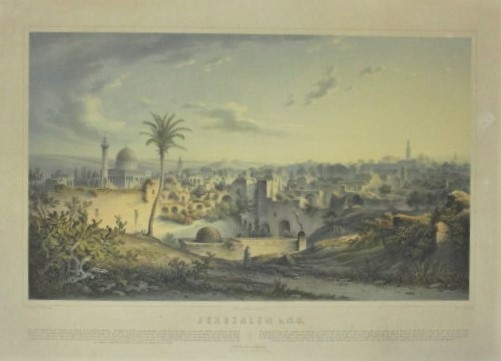
1840réf. 2873AG1840 ca. altkolorierte Lithographie n. Wegelin, 23,5 x 17; Blatt: 32,5 x 25 cm, Blattränder gering stockfleckig, gut erhalten. Auf Wunsch Digitalaufnahme in jpg-Format erhältlich- photo in jpg-format available. Je nach Versandart können die Portokosten bis zu 2 ? weniger als angegeben betragen.+
1865réf. 19360München, Bernatz, o. J. (um 1865). Ca.36 cm x 59 cm (Bild); ca. 49 cm x 67 cm (ganze Blatt).
1620réf. 17874Ausgburg, Custos, um 1620. Ca. 39,5 cm x 25 cm (Platte); 43 cm x 29 cm (ganze Blatt). [3 Warenabbildungen]
IN HEBREW AND ENGLISH. 24x21 cm. 13+11 pages. Softcover. In good condition.
1920circa, 31x26 cm (album), rilegatura in tela, titolo in oro al piatto. p. 96 di fotografie in bianco e nero a piena pagina in cornice rossa, didascalie in inglese, francese, italiano, spagnolo e tedesco. Fuori testo una grande tavola d'insieme di ripiegata della città. Abrasioni lontano dalla foto alle ultime 3 carte
145x95mm 192pp. hard cover with ornaments and gilt letterings on spine. cover worn. with golden-edged pages edges. pages slightly yellowing. else in a good condition.
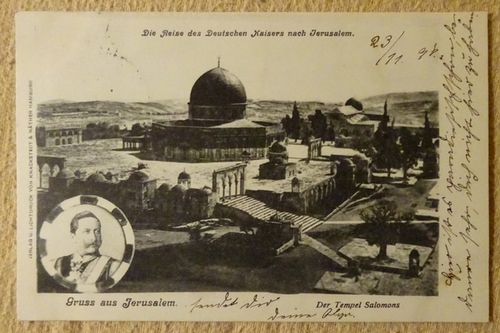
1898réf. 46412Hamburg: Knackstadt & Näther. 1898. Karte mit l. Gebr.spuren, gelaufen, beschrieben, sonst gut
1898réf. 46413Hamburg: Knackstadt & Näther. 1898. Karte mit l. Gebr.spuren, gelaufen, beschrieben, sonst gut
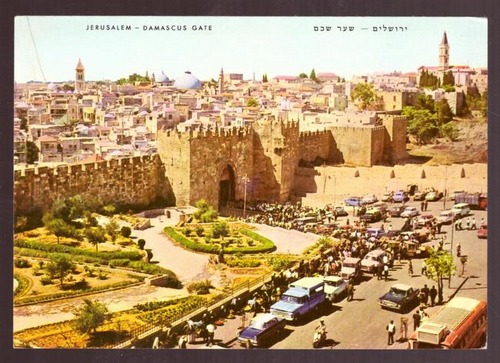
1950réf. 452741950. Karte mit leichten Gebr.spuren, gelaufen, beschrieben, sonst gut
1731réf. 901484AGAmsterdam:, Westersteins en Smith, 1731. Kupferstich 29,5 x 43,5 cm, Blattgröße 39,5 x 47 cm.
1731réf. 901483AGAmsterdam:, Westersteins en Smith, 1731. Kupferstich 28 x 43 cm, Blattgröße 39,5 x 47 cm.
22x24 cm. No pagination. Softcover. Cover edges slightly rubbed. Spine worn. Else in good condition.
Paris, Genève, Droz, 1995. Un volume broché de format in 8° de 250 pp. Bel état. Sommaire: Statuts du chapitre de la cathédrale de Lyon; Croisade des enfants(1212); les Lignages d'outremer; le Palais Mazarin; abbaye de Loroy; Antoine de La sale.
1843réf. 4386AGWien, Ziegler, 1843. getönte Lithographie, schlichter Zierrahmen mit umlaufenden Titel in 4 Sprachen: deutsch (unten), italienisch, ungarisch, tschechisch) 24 x 17 (incl. Zierrahmen) Auf Wunsch Digitalaufnahme in jpg-Format erhältlich- photo in jpg-format available. Je nach Versandart können die Portokosten bis zu 2 ? weniger als angegeben betragen.+
1920réf. 103791Jerusalem ohne Jahr., ca. 1920. 14 kartonierte Blätter (Vorsatz, Titelblatt und 12 Seiten mit getrockneten und gepressten filigranen Blumen mit verschiedenen gepressten Pflanzen, Gräsern und Farnen arrangiert)., quer Kl.-8°. Lederrücken mit Olivenholzdeckel, Voderdeckel mit appliziertem Kreuz.,
1933réf. 28050Le Caire Imprimerie De L'institut Français 1933 202 pp