Martin Luther King JrBiblio.com

8900 risultati
rif. 042232New York: The Limited Editions Club 2007. Limited Edition. Hardcover. Fine. Faith Ringgold. Signed by the artist. Illustrated by Faith Ringgold with eight color serigraph prints. Limited to 420 numbered copies signed by the illustrator. This is number 77 of 420. Beautifully printed on thick textured paper with deckled edges. 54 pp. Bound in full red linen with leather title label. Housed in matching clamshell box. Introduction by Ringgold and an afterword by Dr. C. T. Vivian a friend and colleague of King. Monthly LEC Newsletter is missing. An outstanding production. Fine condition in fine clamshell case. Please note: Due to the size and weight of this item an additional shipping charge may apply and will be delivered with "signature required" upon delivery. Full refund if not satisfied. The Limited Editions Club hardcover
1928rif. 149609Boston and New York: Houghton Mifflin Company 1928. First edition of this foundational work of Native American autobiography. Octavo original publisher's pictorial orange cloth top stain brown frontispiece of Chief Standing Bear at council illustrated with black and white photographs and drawings by the author. Presentation copy inscribed by the author on the front free endpaper "To Lowell Groves from Chief-Standing Bear Mato Najin Ohivi nitohola May 12th 1928." In near fine condition with light toning. Edited by E.A. Brininstool. Introduction by William S. Hart. Bookplate to the front pastedown. Rare and desirable signed and inscribed. Chief Luther Standing Bear Oglala Lakota ca. 1868–1939 was an influential writer educator and cultural advocate whose autobiographical works and public activism played a crucial role in challenging early twentieth-century narratives about Native American identity and history. A graduate of the Carlisle Indian Industrial School Standing Bear used his fluency in both Lakota and Euro-American cultures to critique U.S. assimilation policies and to articulate a Lakota-centered understanding of land education and sovereignty. His books—including My People the Sioux 1928 and Land of the Spotted Eagle 1933—offer a rare Indigenous perspective on the profound social political and spiritual disruptions brought by U.S. assimilation policies while also preserving detailed accounts of Lakota customs values and community structures. Houghton Mifflin Company hardcover
1526rif. 92291526 Colophon: gedruckt durch Gabriel Kantz [in Zwickau], 1526. Un volume petit in-8° (105 x 145 mm) de 51 (sur 52) feuillets non numérotés, le dernier blanc (signatures A-E8, F4,G7); le second feuillet blanc (G8) manque. Reliure de la fin de XIXe ou du début du XXe siècle en plein parchemin, étiquette de titre en maroquin rouge. Discrets soulignements et notes marginales à la plume dans le texte, datant probablement du XIXe siècle. Grand ex-libris gravé (58 x 101 mm) au premier contreplat: «Bücher Sammlung Johannes Merck», soit Johannes Theodor Merck (Manchester, 1855-Hambourg, 1934), commerçant international, directeur de la Hamburg-Amerika Line en 1896). Ex-dono manuscrit, au bas de cet ex-libris,à un certain Fritz Sieveking, par «Herbert Merck, Hamburg, 21. II. 1949», soit le Dr. phil. nat. Herbert Theodor Merck (Hambourg, 1900- Hambourg, 1982), troisième enfant de Johannes Theodor Merck.
2007rif. 022457New York: Limited Editions Club 2007. First Illustrated Edition. hardcover. Fine in a Fine clamshell box. Faith Ringgold. Folio 12-1/4" x 14-1/2" hand bound in full red linen with the same fabric covering the felt-lined clamshell box housing the book. Gilt-lettered black morocco title label inset on the front cover of the book with a black morocco label with the author's name on the spine of the box. Printed letterpress on rectos only on handmade paper. Illustrated with 8 serigraph prints by Faith Ringgold who has also written an introduction to the book. Afterword by Dr. C. T. Vivian a friend of King's who marched beside him. Copy #109 of 420 SIGNED by the illustrator on the colophon page. Limited Editions Club hardcover
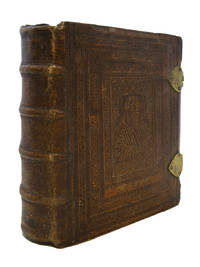
1575rif. 68885Wittenberg: Gedruckt Durch Hans Lufft 1575. Die Fürnemsten vnd besten Schrifften des Hocherleuchten vnd Geistreichen Mannes . Herrn Doctoris Martini Lutheri von den beiden Sacramenten des Newen Testaments nemlich von der Heiligen Tauff vnd dem Abendmal des Herrn. Itzt aus Christlichen vnd groswichtigen ursachen von newes in druck verordnet und den Sacramentsfeinden und Schwermern der Carlstadischen Zwinglischen und Caluinischen Secte alten und newen entgegen gesatzt zu schutz und erklerung der Warheit und zu dempffung der meuchlinge schleichenden gifft und Schwermerey. Durch die Theologen der Vniversitet Witteberg. Wittenberg: Gedruckt Durch Hans Lufft 1575. Full Description: LUTHER Martin. Die Fürnemsten vnd besten Schrifften des Hocherleuchten vnd Geistreichen Mannes . Herrn Doctoris Martini Lutheri von den beiden Sacramenten des Newen Testaments nemlich von der Heiligen Tauff vnd dem Abendmal des Herrn. Itzt aus Christlichen vnd groswichtigen ursachen von newes in druck verordnet und den Sacramentsfeinden und Schwermern der Carlstadischen Zwinglischen und Caluinischen Secte alten und newen entgegen gesatzt zu schutz und erklerung der Warheit und zu dempffung der meuchlinge schleichenden gifft und Schwermerey. Durch die Theologen der Vniversitet Witteberg. Wittenberg: Gedruckt Durch Hans Lufft 1575. First edition of these collected works of Martin Luther. Quarto 7 3/4 x 6 1/8 inches; 196 x 155 mm. 20 424 leaves. A few page numbers misprinted but collates complete. Title-page printed in red and black. Printed in black letter. Engraved initials. Full contemporary pigskin over wooden boards. Boards heavily stamped in blind. With a central device portrait of Martin Luther embossed to front board and another unknown person's portrait to back board. With two brass clasps fully intact. Boards beveled. All edges dyed brown. Some chipping to head and tail of the spine and some minor cracked to top of spine hinges but still very strong. Preliminary leaves with some fraying and toning to edges but not affecting text. Pastedowns not fully complete. Front free endpaper with old ink manuscript notes. Lacking rear free endpaper. A few other leaves with neat marginalia. Some minor dampstaining and toning throughout. Leaves 5M3-5N2 with some holes to outer blank margin not affecting text. Leaves 5N3 and 5N4 with small paper repair to outer upper corners not affecting text. Overall a very good copy in a wonderful binding. A collection of Martin Luther's writings disputing the sacraments of Holy Baptism and the Lord's Supper. "Theological and doctrinal disputes were to persist for the rest of Luther's career on issues such as the Eucharist or Lord's Supper: Heiliges Adendmahl and baptism both within the evangelical movement involving figures such as the sacramentarian Karlstadt and the Swiss reformers Ulrich Zwingli 1484-1531 and Johannes Oecolampadius 1482-1531 and outside it with the Anabaptists. On both issues Luther resisted the accounts of these sacraments as having a mere symbolic value often arguing that this viewpoint comes from an urge to put reason above the authority of scripture. The Stanford Encyclopedia of Philosophy. HBS 68885. $3750. Gedruckt Durch Hans Lufft unknown books
1519rif. 4574Basel: Adam Petri 1519. FOURTH PRINTING in the year of the first. Hardcover. Fine. Modern marbled wrappers. Lightly damp-stained a few side-notes shaved. With an ornamental woodcut title border. A German translation attributed to Spalatin of an early Latin work by Luther on confession. In 1518 Spalatin had requested that Luther write a short instruction on how to confess. Luther sent him a Latin version of the present tract on January 24 1519. The Latin original apparently untitled was not published. Luther later developed the text into his "Confitendi ratio" “A Rationale of Confession” which was issued in March 1520. “Luther wrote a series of tracts after posting the 95 Theses on October 31st 1517 and before his final breach with Rome. In them is clearly traceable the progress that he was making in dealing with the practical problems offered by the confessional and which had started the mighty conflict in which he was engaged. They open to us an insight into his own conscientious efforts during the period when as a penitent he was himself endeavoring to meet every requirement which the Church imposed in order to secure the assurance of the forgiveness of sins as well as to present the questions which as a father confessor and spiritual adviser he asked those who were under his pastoral care. First of all we find therefore tables of duties and sins reminding us of the lists of cardinal sins and cardinal virtues in which Roman Catholic books abound. “In the “Kurze Unterweisung wie man beichten soll” of 1519… he has advanced so far as to warn against the attempt to make an exhaustive enumeration of sins. He advises that the confession be made in the most general terms covering sins both known and unknown. “If one would confess all mortal sins it may be done in the following words; 'Yea my whole life and all that I do act speak and think is such as to be deadly and condemnable.' For if one regard himself as being without mortal sin this is of all mortal sins the most mortal." According to this view the purpose of the most searching self-examination is to exhibit the utter impossibility of ever fathoming the depth of corruption that lies beneath the surface… “Luther’s main effort is to promote the most searching self-examination and the most complete enumeration of the details of sins since from the Mediaeval standpoint the completeness of the absolution is proportioned to the exhaustiveness of the confession. Although the tract closes with its note of warning that the value of the confession is not to be estimated by the enumeration of details but that it rests solely in the resort that is had to the grace of God and the word of His promise the transition from the one mode of thought to the other is very apparent… “The Lutheran conception is centered upon the person of the sinner rather than on his sins. It is the person who is forgiven his sins. Where the person is forgiven but one sin all his sins are forgiven; where the least sin is retained all sins are retained and none forgiven for “there is no condemnation to them that are in Christ Jesus” Roans 8:1. The value of the confession lies not in the confession itself but in that through this confession we turn to Christ and the word of His promise.”Jacobs Luther’s Discussion of Confession in Works of Martin Luther Vol. I p. 73 ff. Benzing 287; WA 2 58C. Adam Petri hardcover books
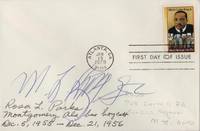
rif. v2151Rosa Parks & Martin Luther King Sr. Signed First Day Cover PSA/DNA Slabbed & Graded NM 7.5. First Day Cover with a unique Martin Luther King Jr. Stamp measuring 4.125" x 6.125" and encapsulated to a size of 6.5" x 10". Signed by Martin Luther King Sr. as "M.L. King Sr." and signed & inscribed by Rosa Parks "the mother of the Civil Rights Movement" as "Rosa L. Parks Montgomery Ala bus boycott Dec. 5 1955 - Dec 21 1956". Postmarked Atlanta GA and dated Jan 13 1979. Encapsulated and PSA/DNA graded NM 7.5. This item comes with a Certificate from John Reznikoff a premier authenticator for both major 3rd party authentication services PSA and JSA James Spence Authentications as well as numerous auction houses. Book #v2151. $3900. We specialize in Rare Ayn Rand history and science.
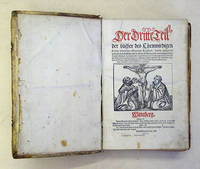
rif. 74375Wittenberg Hans Lufft 1550. 4° 31 x 21 cm zweifarbiges Titelblatt mit Holzschnitt 7 Bl. 276 Bl.; 318 Bl. zahlreiche Holzschnitt-Initialen. Schweinslederband der Zeit blindgeprägt ohne Schliessen. Handschriftliches Bibliotheksschild a. Rücken Deckel min wurmstichig Vorsätze etwas fleckig u kleinen Randläsuren. innen sauber Marginalien von alter Hand. VD16 L 3312. Namenszug a. Titelblatt Johannes Minnenius Dank an die Frau Kollegin Oberacker-Pilick für die Uebersetzung. Vorwort von Philipp Melanchthon. Dritter Band der ersten deutschen Gesamtausgabe von Luthers Schriften Wittenberger Ausgabe die noch von Luther selbst begonnen wurde 1548-1573. Der Titelholzschnitt Luther u. Kurfürst Johann Friedrich von Sachsen neben dem Kruzifix kniend ist eine Kopie nach Lucas Cranach d. J. An der Herausgabe waren u. a. Kaspar Creutziger Georg Maior u. Georg Rörer beteiligt. Philipp Melanchthon schrieb Vorreden zu 8 Bänden. 010 Wittenberg, Hans Lufft, 1550 unknown
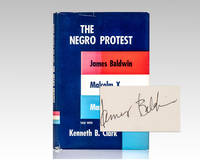
1963rif. 149928Boston: The Beacon Press 1963. First edition of this collection of interviews done by Kenneth B. Clark. Octavo original half cloth. Boldly signed by James Baldwin on the title page. Fine in a near fine dust jacket with a small closed tear to the front panel. With a talk with Kenneth B. Clark and with a note about the interviews by Henry Morgenthau III. Interviews recorded for National Educational Television in May-June 1963. Conversations with James Baldwin Malcolm X and Martin Luther King with Kenneth B. Clark as the moderator. The Beacon Press hardcover
1753rif. 53654Wittemberg, Vidua Scheffler, 1753. 4to. Contemporary full calf with five raised bands to richly gilt spine. Edges of boards blindtooled. Boards slightly warped and with lsigns of wear. Internally very nice and clean with only a few scattered brownspots. A nice, tight, clean, and completely unrestored copy. Title-page printed in red and black. (4), 18, (6), CCLII, (2) pp. + two folded engraved plates.
1753rif. 53654Wittemberg Vidua Scheffler 1753. 4to. Contemporary full calf with five raised bands to richly gilt spine. Edges of boards blindtooled. Boards slightly warped and with lsigns of wear. Internally very nice and clean with only a few scattered brownspots. A nice tight clean and completely unrestored copy. Title-page printed in red and black. 4 18 6 CCLII 2 pp. two folded engraved plates. The exceedingly rare first edition of the first published biography of Aldus Manutius including "the first real attempt at an Aldine bibliography" Grolier Aldus. This legendary publication constitutes not only the earliest but also one of the most important sources on Aldus and his publications. Written by Christian Gottlieb Unger 1671-1719 presumably in the early 1700'ies it circulated in manuscript-form for decades until 1753 when Samuel Luther Geret German theologian lawyer and politician took upon himself to edit the manuscript and have it published. Renouard mentions a 1729-edition but this is a ghost See "Grolier Aldus Manutius: No. 135".Grolier Aldus Manutius: No. 135.Renouard pp. iv-v. hardcover
1926rif. 1211270031Bremer Presse 1/1/1926. Hardcover. Very Good. The masterpiece of the Bremer Presse printed in 14-point German type and accompanied by Anna Simons' calligraphic initials 5 volume set. No. 244 of 365. Folio. Bound in vellum. Gilt spine. TEG. Vellum slightly soiled faint white paint smear to spine of Vol. I rear cover of Vol IV scuffed and with few tiny gouges. Interiors in fine condition. Limited edition 244 of 365 sets. Anna Simons' gorgeous typography. Published on the 400th anniversary of the first Lutheran bible. The text however is based on later editions of 1545 and 1546. Contents: t.1. Die Bucher Mose. t.2. Das 2. Teil des Alten Textaments. t.3. Das 3. Teil des Alten Testaments. t.4. Die Propheten. t.5. Das Neue Testament.Tysk. This is an oversized or heavy book that requires additional postage for international delivery outside the US. Bremer Presse hardcover
1522In-4°, 48cc, frontespizio in cornice figurata, gotico corsivo, illustrazioni xilografiche, capilettera, legatura in piena pergamena, buone condizioni. Prima edizione. Si tratta del diffuso Catalogus scritto dal Domenicano Bernardo di Lussemburgo come continuazione di quello di Nicola Eymerich, e che tratta delle più diffuse eresie del tempo, includendo ovviamente quella luterana. In-4 °, 48cc, frontispiece in ornated frame, gothic text, woodcut illustrations, inital letters, full vellum binding, good condition. First edition. This is the widespread Catalogus written by the Dominican Bernard of Luxembourg as a continuation of that of Nicola Eymerich, and which deals with the most common heresies of the time, obviously including the Lutheran one.
1929rif. 36266Munich: Bremer Presse 1929. Hardcover. Near Fine. Hardcover. 365 copies. This is a magnificent production from the famed Bremer Presse of Germany - probably their masterpiece. They published books from 1911 to 1939 interrupted only by World War I. It was founded by Willy Wiegand and like England's Doves Press rejected ornament except for splendid initials draw by Anna Simons and relied upon carefully chosen types and painstaking presswork to produce its limited edition hand printed books. The colophon states that this edition was printed to commemorate the 400 year anniversary of the publication of Martin Luther's German bible. The text was based on the editions published in 1545 and 1546. The Bible German: Lutherbibel was the first German language Bible translation from Latin sources. The New Testament was first published in September 1522 and the complete Bible containing the Old and New Testaments with Apocrypha in 1534. Luther continued to make improvements to the text until 1545. The five volumes are: Die Bucher Mose; Teil des Alten Testaments; Teil des Alten Testaments; Die Propheten; Das Neue Testament. Each volume has a different copy number. They are bound uniformly in blue paper boards with linen spines with the title written in calligraphy. The volumes are housed in gray paper board slipcases. In near fine condition in very good slipcases. Measures 10 x 14 inches. Unpaginated each volume about 250-300 pages PRI/011623. Bremer Presse hardcover books
rif. 751Wittenberg 1532. Quarto 8 1/4 X 6 1/2 inches . First edition A-Z4 a-z4 aa-nn4 oo2 pp4 241 Leaves Bound in full modern calf a very nice copy. Luther proceeds line by line some times giving one line from Matthew five pages of commentary! Here is a shortened example: from the greek. And His commentary. Benzing Luther 3011;VD 16; L 4754; Pegg Swis; 2988;. Here is a shortened example: from the greek. And His commentary. V. 3. Blessed are the poor in spirit for theirs is the kingdom of heaven. This is a delightful sweet and genial beginning of his sermon. For he does not come like Moses or a teacher of law with alarming and threatening demands; but in the most friendly manner with enticements and allurements and pleasant promises. And indeed if it had not been thus recorded and if the first uttered precious words of the Lord Christ had not been given to us all an over-curious spirit would tempt and impel everybody to run after them even to Jerusalem yes to the end of the world if one might hear but a word of it all. Then there would be plenty of money forthcoming to build a good road and every one would boastingly glory how he had heard or read the very words that the Lord Christ had spoken. O what a wonderfully happy man would he be held to be who should succeed in this! That is just the way it surely would be if we had none of our Savior's words written although much might have been written by others; and every one would say: Yes I hear indeed what St. Paul and his other apostles have taught but I would much rather hear what he himself said and preached. But now that it is so common that every one has it written in a book and can read it daily nobody regards it as something special and precious. Yes we grow tired of them and neglect them just as if not the high Majesty of heaven but some cobbler had uttered them. Therefore we are duly punished for our ingratitude and contemptuous treatment of these words by getting little enough from them and never feeling or tasting what a treasure force and power there is in the words of Christ. But he who has grace only to recognize them as the words of God and not of man will surely regard them as higher and more precious and never grow tired or weary of them. Kindly and sweet as this sermon is for Christians who are our Lord's disciples just so vexatious and intolerable is it for the Jews and their great saints. For he hits them a hard blow in the very beginning with these words rejects and condemns their doctrine and preaches the direct contrary; yes he denounces woe against their way of living and teaching as is shown in the sixth chapter of Luke. For the substance of their teaching was this: If it goes well with a man here upon earth he is happy and well off; that was all they aimed at that God should give them enough upon earth if they were pious and served him; as David says of them in Psalm 144: "Our garners are full affording all manner of store; our sheep bring forth thousands and ten thousands in our streets; our oxen are strong to labor; there is no breaking in or going out; there is no complaining in our streets.". Wittenberg ,1532 unknown
1564rif. 15908Kiøbenhaffn, Lorentz Benedict, 1564. 4to. Senere helldrbd. 188,156,114 blade. Titelblad og fortale samt sidste blad i smuk lystryk faksimile ( 3 blade ialt). de sidste 10 blade kantrepareret. Lettere brugsspor. 3 træskårne titelblade, tæt beskåret foroven. Talrige større træsnitillustrationer i teksten.
1564rif. 15908Kiøbenhaffn Lorentz Benedict 1564. 4to. Senere helldrbd. 188156114 blade. Titelblad og fortale samt sidste blad i smuk lystryk faksimile 3 blade ialt. de sidste 10 blade kantrepareret. Lettere brugsspor. 3 træskårne titelblade tæt beskåret foroven. Talrige større træsnitillustrationer i teksten. Første danske udgave af Luthers Postil og af største sjældenhed i komplet stand. Kun ganske få bevarede på private hænder. De fleste eksemplarer i de offentlige biblioteker er ukomplette Lauritz Nielsen anfører kun 7 komplette eksemplarer. En af de mest betydningsfulde bøger fra Benedichts trykpresse og det største i omfang.Extremely scarce first Dansih edition of Luther's "Hauspostille" with only af few copies still on private hands.Thesaurus I 104. - Birkelund 24. - Lauritz Nielsen 1084. - Paulli 20. unknown
1550rif. 1503130064Gedruckt zu Wittemberg : Durch Hans Lufft 1550-01-01. Hardcover. Acceptable. Folio. 380 of 383p. Collation: A1-Z6 A1-Z6 Aa1-Aa2 lacking Aa3-Aa4 Aa5-Rr4 Lacking Rr5 Rr6 Ss1-Ss5 in 6's. Bound in contemporary pigskin. Bindings decorated in blind. 5 raised bands. Contemporary brass corners and latches. Woodcut title page and 62 woodcuts throughout most by Hans Brosamer and some by Georg Lemberger. Good binding. Shelfwear. Chipping and loss to head and tail of spine. Loss to board edges. Lacking clasps. Lacking first and final blank. Top of title page missing from signature removal. Cracking to hinges. Soiling to pages. Loss to tail of leaf 33 affecting last 2 sentences of text. Marginal loss to f209. Tear to halfway of leaf 216. Contemporary marginal notation to the Gospels. Contemporary underlining to select pages throughout. Repairs to leaf 229 and 277. Tanned pages with some staining. The Prophets of the Old Testament with the New Testament and Apocrypha from Martin Luther's translation of the Bible. Gedruckt zu Wittemberg : Durch Hans Lufft hardcover
1522rif. 140948314Wittemberg Wittenberg: Nickell Schyrlenz Schirlentz 1522. First edition. Near Fine. First edition of Martin Luther's riposte to King Henry VIII's pamphlet "In Defense of the Seven Sacraments" preceding the Latin edition by one month. Unpaginated 47 pp blank A-F4. Laid paper text in German woodcut title illustration featuring cupids. Collated complete. Small quarto recently bound in brown speckled paper-covered boards. Near Fine with tape marks to rear board perceptible in raking light light toning and thumbing and occasional foxing to contents. Title page repaired with backing paper to margins soiling to first and last pages faint dampstain to upper right corner of first few leaves. Binding solid interior overall clean and bright. A well-preserved copy of a treatise by one of the most famous men in history. In 1521 Henry VIII of England published an attack on Martin Luther and defense of the Catholic Church that earned him the title "Defender of the Faith" from Pope Leo X. Henry's Assertio Septem Sacramentorum was swiftly translated into German and sold well on the Continent. Luther perceived a threat and published this furious response the following year mocking Henry''s new title and his qualification for the role. Henry himself would soon defy the Catholic Church after his demand for the annulment of his first marriage was rejected but he and Luther continued their acrimonious correspondence and never reconciled. Nickell Schyrlenz [Schirlentz] unknown
1522rif. 140948314Wittemberg Wittenberg: Nickell Schyrlenz Schirlentz 1522. First edition. Near Fine. First edition of Martin Luther's riposte to King Henry VIII's pamphlet "In Defense of the Seven Sacraments" preceding the Latin edition by one month. Unpaginated 47 pp blank A-F4. Laid paper text in German woodcut title illustration featuring cupids. Collated complete. Small quarto recently bound in brown speckled paper-covered boards. Near Fine with tape marks to rear board perceptible in raking light light toning and thumbing and occasional foxing to contents. Title page repaired with backing paper to margins soiling to first and last pages faint dampstain to upper right corner of first few leaves. Binding solid interior overall clean and bright. A well-preserved copy of a treatise by one of the most famous men in history. In 1521 Henry VIII of England published an attack on Martin Luther and defense of the Catholic Church that earned him the title "Defender of the Faith" from Pope Leo X. Henry's Assertio Septem Sacramentorum was swiftly translated into German and sold well on the Continent. Luther perceived a threat and published this furious response the following year mocking Henry''s new title and his qualification for the role. Henry himself would soon defy the Catholic Church after his demand for the annulment of his first marriage was rejected but he and Luther continued their acrimonious correspondence and never reconciled. Nickell Schyrlenz [Schirlentz] unknown books
1737rif. 761686Erfurt: heirs of Carl Friedrich Jungnicols 1737. Vellum. Quarto Five volumes Text in German with Latin Captions above engravings. Vellum shows normal aging spine labels intact. Paper aged-tanned bindings sound. Photos available. Copperplate engravings throughout the original text AT Vol I: Frontispiece 2 pages of King Portraits Illustration on 114 Extendable page near 127 4 pages of illustrations around 129 illustration on 180. AT Vol II: 3 prints between 470 and 471 One after 472 Print depicting Moloch after 734. AT Vol III: Temple illustration around 1119. NT Vol I: Two illustrations after page 42 Fold-out page after 47. NT Vol II No original engravings. There are 844 total added engravings on quarto pages with a single page per leaf that come from the Biblia Ectypa of Christoph Weigel which are unnumbered 840 total AT Vol I: 133 AT Vol II: 176 AT Vol III: 83 NT Vol I: 291 NT Vol II: 156. Notes on the Biblia Ectypa engravings: they appear to be in very good condition with only slight staining on a select few ~12. In AT Vol II there is a print error on the border of plate 73 and plate 88 is slightly tilted. The engravings in the New Testament are occasionally signed either by J.J. Sandrart 44 times or by G. C. Eimmart 33 times. Sandrart’s signatures are concentrated in the second volume and a select cluster in the first while Eimmart’s make up most of the first volume. Not all engravings are signed and none of the engravings in any of the Old Testament volumes have signatures. In NT Vol I some of the etchings are numbered at the top of the border these appear in the scenes of the crucifixion in the final chapters of Luke Ordering of numbering is 6 13 12 16 27 36 37 38 40 41 42 49 47 48 in that order and John 8 14 18 26 31 33 34 43 46 49. The volumes are uniformly bound in vellum binding with only one section with around 7 pages in NT Vol II that is loose. Page 743 in AT Vol II has a small rip on the upper right side around an inch long. The plates are most likely from the 1730 Augsburg reprinting of the Biblia Ectypa which was done after the death of Christoph Weigel. Even though there are some plates at the beginning of NT Vol II that show Weigel’s extant signature Christ. Weigel excudit those plates were reused rather than being remade. Photos available. Erfurt: heirs of Carl Friedrich Jungnicols hardcover
1523rif. 4923Augsburg: Heinrich Steiner 1523. One of 3 printings by Steiner in the year of the first edition. Hardcover. Fine. A very nice copy stab-stiched in drab 20th c. wrappers. With an attractive woodcut title border Pflugk-Hartung 23. Light maginal fingersoiling to title blank verso of final leaf lightly soiled. . Two early marginal notes in ink in the blank margin of the title. With a duplicate stamp from the Stadtbibliothek Nürnberg on the rear inner cover. The "Eight Sermons by Dr. M. Luther preached by him at Wittenberg in Lent dealing briefly with the masses images both kinds in the sacrament eating of meats and private confession etc." document Luther's efforts to counteract the chaos in Wittenberg that had been caused by Andreas Rudolff-Bodenstein von Karlstadt ca. 1480-1541 who had instituted radical reforms while Luther was in hiding at the Wartburg. During Luther's stay in Wartburg Castle Karlstadt became the head of the reform movement at Wittenberg. Over the course of a year Karlstadt instituted radical changes in all aspects of religious life. As the leader of the Wittenberg movement and the head of the Wittenberg theological faculty Karlstadt was in a unique position to both pronounce and enact changes within the church. He instituted most of his larger reforms with the support of the theologians and the city magistrates. These changes to established forms particularly the institution of the reformed mass displeased the Elector of Saxony however and by March 6th 1522 Luther would return at the Elector's request to take control of the Wittenberg movement. Prior to Luther's return however Wittenberg would see troubling public manifestations of the new reforms as a radicalized populace took to the streets in the infamous "Wittenberg disturbances." "In December 1521 Luther returned secretly to Wittenberg from the Wartburg for a three day conference on how to meet the turbulence and confusion caused by the radical reformers. Soon after his return to the Wartburg Karlstadt put himself at the head of those who favored immediate abolition of Roman practices. At Christmas Karlstadt administered communion "in both kinds"i.e. by giving both the consecrated host and the wine to the laity for the first time in the parish church. This had been done as early as September in the Augustinian monastery where Gabriel Zwilling conducted mass in the vernacular and abolished private masses. Karlstadt also declared that confession before communion was unnecessary that images were not allowable in the church and that rules of fasting were not binding and this led to outbreaks of actual destruction of images and altars. He also taught the doctrine of direct illumination by the Spirit which made scholarship and learning unnecessary for the understanding of the Scriptures. The consequence was that the city schools were closed and the university threatened with collapse. Allied with Karlstadt's followers were the Zwickau prophets Storch Drechsel and Stübner adherents of Thomas Münzer. "Luther who hitherto had relied upon Melanchthon's leadership to keep order returned to Wittenberg on March 6. On March 8 he conferred with Melanchthon Justus Jonas Nicholas Amsdorf and Hieronymus Schurf. On March 9 Invocavit Sunday he mounted the pulpit in the parish church and preached each day from the ninth to the sixteenth. This remarkable series of sermons which are powerful inspired preaching of the gospel had the effect of restoring tranquility and order almost at once. His task was to lead his congregation away from fanatical enthusiasm back to the spirit of the gospel and to answer the questions that were agitating his people in the light of the gospel. Further details may be found in an excellent introduction to the sermons in PE 2 387-390 and in the biographies of Luther and the church histories. The sermons were transcribed by an unknown amanuensis."Doberstein Luther Works Vol. 51. [Heinrich Steiner] hardcover
1520rif. 5387Wittenberg: Melchior Lotter 1520. SECOND EDITION printed in the year of the 1st ed. Hardcover. Fine. A very fine copy on sturdy paper with wide margins and just a faint bit of marginal soiling and an almost imperceptible bit of paper fill in the lower blank margin of the title. On June 15th 1520 Pope Leo X issued the bull "Exsurge Domine" condemning 41 of Luther's 95 theses and threatening Luther with excommunication unless he recants his "errors" within sixty days. Faced with the grim prospect of excommunication and unwilling to be condemned without a hearing Luther issued the present appeal for the convening of a general church council. The basis for the text is Luther's first appeal to a council which he had issued in 1518 after his audience with the papal legate Cardinal Cajetan. As Luther tells us in this new appeal of 1520 even though he had maintained readiness to be shown his errors and to revoke certain statements if proven wrong he was ignored and proceedings continued against him in Rome. He now appeals to Emperor Charles V the Imperial Electors and German Christian magistracy to adhere to his appeal for Catholic truth God's glory the faith and Church of Christ and the right of a legitimate Council. He asks them to turn away from the Pope's actions resist his tyranny or at least defer executing the papal bull until Luther has been legitimately summoned proven by impartial judges and convicted by scriptures. In making his appeal for a general council to settle the indulgence controversy Luther sought both to dilute the pope's authority and to strengthen his own theological position. In 1418 the Council of Constance had decreed that the supreme power of the church in matters of faith and practice resided in regularly convened councils. Yet by the early sixteenth century the popes had wrested away much of that power. By appearing before a church council rather than the Roman Curia Luther could effectively switch judges by appealing to the authority of Scripture to adjudicate his dispute with the pope. Luther makes his bold appeal in the most inflammatory language. He denies the authority of the pope who behaves like the Antichrist whom Scripture condemns. Ultimately Luther's appeal to a council would never be heard. No such council would meet until the Council of Trent 1545-1563 long after the Protestant Reformation had become an irreversible fact. Melchior Lotter hardcover
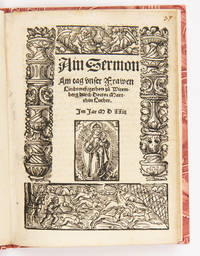
1523rif. 3029Augsburg: Melchior Ramminger 1523. One of five editions all printed in 1523. Hardcover. Fine. Modern boards. A fine copy with a beautiful four-part title page border the lower register of which shows a stag hunt. There is also a small woodcut of the Virgin balancing on the crescent moon and holding the infant Christ. A sermon for Lichtmeß Candlemas the feast of the presentation of the infant Jesus in the temple and the purification of Mary February 2. Jesus takes as his text Luke 2:22-39. For the complexities of Luther’s evolving Mariology see Thomas O'Meara Mary in Protestant and Catholic Theology 1966. “Luther's attitude toward the theology of Mary and toward the devotion which a Christian should have to the Mother of God is a small-scale representation of his entire religious accomplishment. During any discussion of Luther and the Blessed Virgin we must keep uppermost in our minds that there was a development in his ideas a change more or less drastic in each aspect of Marian theology. This development has its beginning in Catholicism; it passes through contradictions struggles and uncertainties and terminates in a new Marian viewpoint one which Luther decided was Christocentric biblical unexaggerated and edifying.”p. 123. Melchior Ramminger hardcover
1523rif. 4923Augsburg: Heinrich Steiner 1523. One of 3 printings by Steiner in the year of the first edition. Hardcover. Fine. A very nice copy stab-stiched in drab 20th c. wrappers. With an attractive woodcut title border Pflugk-Hartung 23. Light maginal fingersoiling to title blank verso of final leaf lightly soiled. . Two early marginal notes in ink in the blank margin of the title. With a duplicate stamp from the Stadtbibliothek Nürnberg on the rear inner cover. The "Eight Sermons by Dr. M. Luther preached by him at Wittenberg in Lent dealing briefly with the masses images both kinds in the sacrament eating of meats and private confession etc." document Luther's efforts to counteract the chaos in Wittenberg that had been caused by Andreas Rudolff-Bodenstein von Karlstadt ca. 1480-1541 who had instituted radical reforms while Luther was in hiding at the Wartburg. During Luther's stay in Wartburg Castle Karlstadt became the head of the reform movement at Wittenberg. Over the course of a year Karlstadt instituted radical changes in all aspects of religious life. As the leader of the Wittenberg movement and the head of the Wittenberg theological faculty Karlstadt was in a unique position to both pronounce and enact changes within the church. He instituted most of his larger reforms with the support of the theologians and the city magistrates. These changes to established forms particularly the institution of the reformed mass displeased the Elector of Saxony however and by March 6th 1522 Luther would return at the Elector's request to take control of the Wittenberg movement. Prior to Luther's return however Wittenberg would see troubling public manifestations of the new reforms as a radicalized populace took to the streets in the infamous "Wittenberg disturbances." "In December 1521 Luther returned secretly to Wittenberg from the Wartburg for a three day conference on how to meet the turbulence and confusion caused by the radical reformers. Soon after his return to the Wartburg Karlstadt put himself at the head of those who favored immediate abolition of Roman practices. At Christmas Karlstadt administered communion "in both kinds"i.e. by giving both the consecrated host and the wine to the laity for the first time in the parish church. This had been done as early as September in the Augustinian monastery where Gabriel Zwilling conducted mass in the vernacular and abolished private masses. Karlstadt also declared that confession before communion was unnecessary that images were not allowable in the church and that rules of fasting were not binding and this led to outbreaks of actual destruction of images and altars. He also taught the doctrine of direct illumination by the Spirit which made scholarship and learning unnecessary for the understanding of the Scriptures. The consequence was that the city schools were closed and the university threatened with collapse. Allied with Karlstadt's followers were the Zwickau prophets Storch Drechsel and Stübner adherents of Thomas Münzer. "Luther who hitherto had relied upon Melanchthon's leadership to keep order returned to Wittenberg on March 6. On March 8 he conferred with Melanchthon Justus Jonas Nicholas Amsdorf and Hieronymus Schurf. On March 9 Invocavit Sunday he mounted the pulpit in the parish church and preached each day from the ninth to the sixteenth. This remarkable series of sermons which are powerful inspired preaching of the gospel had the effect of restoring tranquility and order almost at once. His task was to lead his congregation away from fanatical enthusiasm back to the spirit of the gospel and to answer the questions that were agitating his people in the light of the gospel. Further details may be found in an excellent introduction to the sermons in PE 2 387-390 and in the biographies of Luther and the church histories. The sermons were transcribed by an unknown amanuensis."Doberstein Luther Works Vol. 51. [Heinrich Steiner] hardcover books