2,221 results
ref. 23829Paris Chez Méquignon-Marvis, Libraire 1818 in 8 (21x13,5) 12 volumes reliures pleine basane fauve racinée de l'époque, dos lisses très ornés, filets et roulettes dorés, pièces de titre et de tomaison de maroquin rouge, filet doré sur les coupes, tranches teintées jaunes, V et 271 pages, 251 pages, 23 pages et 3 pages manuscrites anciennes insérées in fine; 383 pages, XXIV et 506 pages [1], 503 pages, 458 pages, 393 pages, 474 pages [1], XLVIII et 382 pages, 444 pages, 459 pages, 508 pages [1], et 692 pages [1]; rares rousseurs éparses. Première édition collective en partie originale, illustrée d'un portrait de Bernardin de Saint-Pierre par Girodet et de 26 planches hors-texte gravées par Dupont, Sixdeniers, Toschi, Roger, Danbrum, Delignon, de Longueil d'après Desenne, Lafitte, Moreau le Jeune, Prudhon, Vernet et Isabey. Tomes 1 (Essai sur la vie les ouvrages de Bernardin de Saint-Pierre, par L. Aimé-Martin; portrait de l'auteur gravé par Lignon en frontispice, V et 271 pages, 251 pages) et 2: Voyages à l'Ile de France (avec 12 planches hors-texte); Tomes 3 à 7: Etudes de la nature (Bien complet de sa planche dépliante et des 13 planches gravées hors-texte); Tomes 8 à 10: Harmonies de la nature; Tome 11: Voeux d'un solitaire; Tome 12: Mélanges. Est reliée à la fin de notre tome 1 la rare brochure publiée sans nom d'auteur pour défendre la famille Didot: LA VÉRITE EN RÉPONSE AUX CALOMNIES répandues dans un écrit intitulé: Essai sur la vie les ouvrages de Bernardin de Saint-Pierre, par L. Aimé-Martin, Paris, Lelong 1821, 23 pages (avec la mention sur la page de titre : "Prix : 1 franc 25 cent., et 75 centimes seulement pour les souscripteurs aux Oeuvres de Bernardin de Saint-Pierre", le faux-titre porte en plus du titre la mention: "Interprétation nécessaire devant faire suite à cet essai''. Enfin notre tome 1 est enrichi de 3 pages manuscrites de l'époque, et insérées in fine reproduisant le jugement du tribunal de police correctionnelle dans l'affaire de M. Leger Didot contre Aimé Martin, et contre le libraire Méquignon-Marvis, qui condamne Aimé Martin à plusieurs amendes, et qui ordonne que les pages 230 (pour l'épithéte insultante de: misérable) et 231, ainsi que la note au bas de cette page seronts supprimées dans tous les exemplaires encore dans les magasins de Méquignon-Marvis et Cellot (une copie manuscrite similaire insérée au début du tome 2. Notre exemplaire est donc bien indemne des suppressions démandées par ce jugement. Superbe exemplaire ( Photographies sur demande / We can send pictures of this book on simple request )
1818ref. 810A5Paris: Mequignon-Marvis 1818. Leather. Very Good Indeed. 8.5" by 5.5". Various. A complete collection of the works of Jacques-Henri-Bernardin de Saint-Pierre some lovely uniform bindings in the original French. Jacques-Henri-Bernardin de Saint-Pierre was a French author known for his 1788 novel Paul and Virginie; considered the author's finest work it studies the corruption of a child by the artificial sentimentality of the French upper classes in the late eighteenth century. He was also a skilled botanist producing numerous works of natural history and was admired by fellow naturalist Alexander von Humboldt. The present set is a complete collection of the works of Bernardin de Saint-Pierre in twelve volumes in the original French. Containing his botanical as well as fictional work. Compiled by L. Aime-Martin with a biographical sketch of the author's life first edition thus. Including a preface by the editor dated 1820 despite the volumes being dated 1818. Each volume is complete with half titles. Illustrated with a frontispiece portrait of the author to vol. I and twenty seven full page gravure plates of which one folding engraved by Dupont Sixdeniers Toschi Roger Danbrum Delignon de Longueil after Desenne Lafitte Moreau the Younger Prudhon Vernet and Isabey. Collated complete. Comprised of:A Voyage a l'Ile-de-France in two volumes; Etudes de la Nature in five volumes including Paul and Virginie; Harmonies de la Nature in three volumes; Voeux d'un Solitaire; Melanges. In uniform full calf bindings with gilt tooling to the spine and embossed decorations tot he spine and boards marbled edges and endpapers. Externally generally very smart with minor shelf wear only minor rubbing to the boards and spine. Light scuffing to the front board of vol. XI. Some loss to the front board of vol. I. Internally firmly bound. Light spotting scattered to the pages. Illustrated with a frontispiece portrait of the author and twenty seven full page engravings of which one folding. Very Good Indeed Mequignon-Marvis hardcover
1775ref. AAIVo[SA84London: Printed for W.Griffin 1775. 1775. 8vo. pp. 6 p.l. 291. contemporary calf gilt back joints cracked spine ends chipped occasional stains. armorial bookplate of John Peachey. First Edition of the English Translation abridged from the original French. An epistolary account of the French military engineer and writer's travels in Mauritius 1769-70. Included are observations on the voyage out flora and fauna meteorology manners of the white inhabitants the Indian and negro populations agriculture &c. Part II pp. 183-291 relates his return voyage with visits to and descriptions of Île Bourbon Réunion the Cape of Good Hope and Ascension Island. Mendelssohn IV p. 119. F. Hardcover. London: Printed for W.Griffin, 1775. Hardcover
ref. 50134Paris, impr. Crapelet, Deterville, an XII-1804, in-8, 5 volumes de I. VI, 478, (2)pp, 2pl. - II. (4), 480pp, 7pl. (3 à 10). - III. (4), 504pp. - IV. (4), 440, (2)pp. - V. (4), 418, (2)pp, veau blond, dos lisse orné, double filet et roulette en encadrement sur les plats, roulette sur les coupes et les chasses, tranches dorées, exemplaire sur papier velin (P. Bozerian Jeune), 10 planches gravées par Simonet, Pierron, Marchand d'après Moreau, Pretre. Les Etudes de la nature, inspirées de Rousseau, ont été publiées pour la première fois en 1784. Cette édition comporte aussi les textes de Paul et Virginie, L'Arcadie, Voeux d'un solitaire, La chaumière indienne. Ecrivain et botaniste, Bernardin de Saint-Pierre (1737-1814) connut un immense succès avec les Etudes. Qqs coiffes et coins émoussés, qqs rousseurs. Bel exemplaire. Quérard, VIII-364. Couverture rigide
1930ref. 2045Ambroise Vollard, Paris 1930. Fort in-4 (330 x 255 mm) en feuilles sous couverture papier japon impérial illustrée d'une gravure à pleine page, chemise et étui de papier vélin. 94 EAUX-FORTES ORIGINALES DE RAOUL DUFY dont une à pleine page pour la couverture et 16 en hors-texte. Table des gravures entièrement gravée. 1 des 245 exemplaires numérotés sur grand vélin d'Arches (n° 279). EXEMPLAIRE DANS SA CONDITION D'ORIGINE. "Un hymne au port de Marseille et à la mer". Une réussite majeure de l'artiste et de l'éditeur Ambroise Vollard. -- ENGLISH DESCRIPTION: Ambroise Vollard, Paris 1930. Fort in-4 (330 x 255 mm) in loose sheets under Japanese imperial paper cover illustrated with a full-page engraving, folder and vellum/parchment slipcase. 94 ORIGINAL ETHINGS BY RAOUL DUFY including one full-page for the cover and 16 inset. Table of engravings entirely engraved. 1 of 245 numbered copies on large Arches vellum (no. 279). EXEMPLARY IN ITS ORIGINAL CONDITION. "A hymn to the port of Marseille and to the sea". A major achievement by artist and publisher Ambroise Vollard.
1961ref. 002933Paris: Pierre de Tartas 1961. Book. Fine. Hardcover. 1st Edition. Loose sheets in lithographed wrappers in blue cloth clamshell box with white lettering. Original lithographs by Raoul Dufy. Number V of 20 roman numbered copies reserved for collaborators of the edition with an extra suite of the lithographs. The total edition was limited to 325 copies. This copy and the extra suite are printed on Grand Velin D'Arches. Lithographed wrappers 5 lithographs in color of which 4 double page. 12 black & white lithographs of which 9 double page of which 2 partly with text and 5 in text illustrations. The extra suite in white paper wrappers contains 4 double page color lithographs and 9 black & white lithographs of which 6 double page. All full page lithographs protected by tissue guards. The text by Michel de Saint-Pierre was set by hand in Paganini Romain. 38 x 275 cm. Very fine set in box with lightest wear one corner with repaired split. . Pierre de Tartas Hardcover
1998ref. 71480Les 400 Coups; Et Al. New. Paperback. FREE UPGRADE to Courier/Priority Shipping Upon Request - IN STOCK AND IMMEDIATELY AVAILABLE FOR SHIPMENT - Flawless copy brand new pristine never opened -- Text in French. 110 pp. With 85 ills. 73 col. . 28 x 22 cm. -- with a bonus offer-- . 1998. 2551189691 . Les 400 Coups; Et Al paperback
1997ref. 100857The Centre. New. Paperback. FREE UPGRADE to Courier/Priority Shipping Upon Request - IN STOCK AND IMMEDIATELY AVAILABLE FOR SHIPMENT - Flawless copy brand new pristine never opened -- Text in French and English. 60 pages; 25 illustrations including 12 in color. -- with a bonus offer-- . 1997. 2920825143 . The Centre paperback
1891ref. 52357Philadelphia: Henry Altemus. As New. Hardcover. FREE UPGRADE to Courier/Priority Shipping Upon Request – – IN STOCK AND IMMEDIATELY AVAILABLE FOR SHIPMENT - Text pristine clean & unmarked - Text in English with lovely black and white illustrations by Leloir. 296 pages. Includes a brief biographical essay on Saint-Pierre. -- with a bonus offer-- . 1891. Henry Altemus hardcover
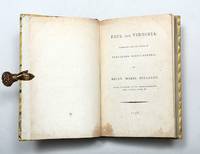
1795ref. 144669London: G. G. and J. Robinson 1795. First separate edition in English translated by the celebrated bluestocking Helen Maria Williams 1759-1827 "amidst the horrors of Robespierre's tyranny" as she explains colourfully in her Preface; it became "the standard English edition well into the nineteenth century" Deborah Kennedy Helen Maria Williams and the Age of Revolution 2002 p. 122. The circumstances under which Williams completed her translation were trying to say the least "she was subject to frequent house searches and on several occasions had parts of the translation and other papers seized and taken to 'the Municipality of Paris in order to be examined as English papers; where they still remain mingled with revolutionary placards motions and harangues; and are not likely to be restored to my possession'" ibid. Paul and Virginia was first published in French as part of Bernardin de Saint-Pierre's Études de la nature in 1788 and received its first English translation the same year. "ESTC shows 17 English forms of this work between 1795 when Helen Maria William's Paul and Virginia was published and 1800" Garside Raven and Schöwerling. Though published without an imprint this edition was almost certainly issued by the radical and printer John Hurford Stone 1763-1818 with whom Williams was involved. Another edition was published in London the same year by G. G. and J. Robinson. Precedence has not been established. "Although excessively sentimental this little work contains many charming passages especially the descriptions in which Rousseau's influence can be seen of an idyllic life in strange surroundings. It had an immense vogue was translated into many languages and still retains its popular fame. Bonaparte considered it the language of the soul and he pensioned and decorated the author" The Oxford Companion to French Literature. Octavo in fours 205 x 133 mm. With 6 engraved plates by Clément after drawings by Dutailly. Recent quarter calf and marbled boards to style spine ruled in gilt red morocco label. Small rust hole to one leaf touching one letter; a very good copy. See Garside Raven and Schöwerling 1788:71 hardcover
ref. 65944Amsterdam Villard & Changuion 1719. 12mo. 265 19 pp. Title printed in red and black. The title-leaf with browning and a large stain spot a minor stain mark in upper margin throughout. Somewhat worn contemporary calf blindstamped spine with raised bands marbled edges. From the library of Ericsberg. Einaudi 931. Second enlarged edition. The first printed in Paris in 1718 was supressed and banned.Detta är ett viktigt idelologisk arbete som pläderar mot enväldiga ministerstyrelser och för oligarki. Idealet är ett aristokratiskt välde en ”aristomonarchie”. Förslagets revolutionära radikalitet underströks t.o.m. av Rousseau. I Sverige blev hans ideéer givevis intressanta vid frihetstidens början och bl.a. Nikodemus Tessin var influerad av honom. Se Lennart Thanner ”Revolutionen i Sverige efter Karl XII:s död” 1953 s. 345ff. Abbé de Saint Pierre 1658-1743 var redan känd genom ett förslag till ett folkens förbund i samband med freden i Utrecht. Första upplagan av ”Discours sur la polysynodie” utkom i april 1718 och väckte stort uppseende. Den konfiskerades författaren uteslöts ur Franska akademien och boktryckaren kastades i fängelse. Denna andra utökade upplaga kom ut i Amsterdam 1719. hardcover
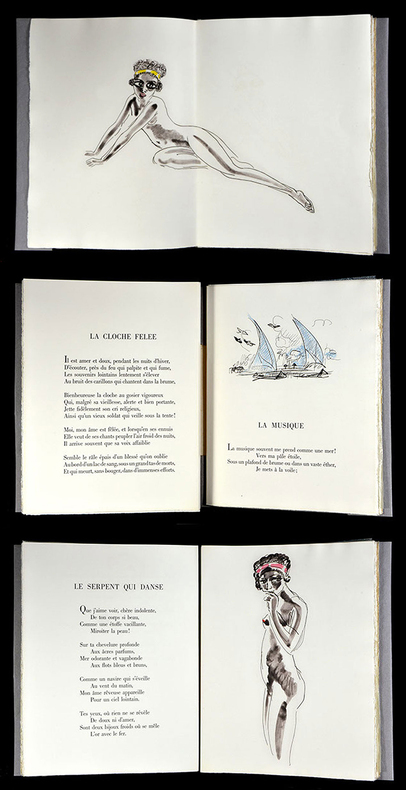
1968ref. 3122Paris Pierre de Tartas 1968. 1 volume in-folio (37,5 x 28 cm), en feuilles, sous couverture papier d'Auvergne grise rempliée et coffret éditeur de toile bordeaux. Avec 15 EAUX-FORTES ORIGINALES DE VAN DONGEN DONT UN FRONTISPICE TIRÉ EN NOIR, 2 DOUBLE-PAGE, 2 HORS-TEXTE ET 10 COMPOSITIONS DANS LE TEXTE, L'ENSEMBLE EN COULEURS. - Tirage limité à 270 exemplaires, celui-ci le n° 257 sur vélin d'Arches, signé par l'artiste, l'éditeur et portant bien le cachet d'authenticité requis. Note : Cette sélection de "poèmes immortels" des Fleurs du Mal, avec une préface de Jean-Paul Sartre, constitue le dernier livre illustré par Kess Van Dongen. -- ENGLISH DESCRIPTION: Paris Pierre de Tartas 1968. 1 folio volume (37.5 x 28 cm), in loose sheets, in an Auvergne paper cover and the burgundy cloth publisher's box. With 15 ORIGINAL ETCHINGS BY VAN DONGEN INCLUDING A FRONTISPIECE PRINTED IN BLACK, 2 DOUBLE PAGES, 2 OUF-OF-TEXT AND 10 COMPOSITIONS IN THE TEXT, ALL IN COLOR. - Limited edition of 270 copies, this one number 257 on Arches paper, signed by the artist, the publisher and bearing the required stamp of authenticity. This selection of "immortal poems" from Les Fleurs du Mal, with a preface by Jean-Paul Sartre, constitutes the latest book illustrated by Kess Van Dongen. The copy offered here is in mint condition.
ref. 74557Paris F. Klincksieck 1855. Folio 43.2 x 30.4 cm. Half-title title page viii 12 pp.; 12 lithographed plates of which six colour-printed. Contemporary blind quarter vellum over marbled boards. Marbled endpapers. Speckled edges. = A seldom-seen work by the French botanist Ernest Germain de Saint-Pierre 1814-1882. The illustrations by the author are well-executed and finely detailed. The second suite of six plates is printed in colour. This publication was never completed. The plates remained unnumbered. The text stops mid-sentence on page 12. With author's dedication to Etienne Geoffroy Saint-Hilaire which he called the Goethe of France and Goethe which he called the German Geoffroy Saint-Hilaire!. The preface is dated December 1855 so publication may have run into 1856. OCLC reports just seven copies in all of which five in France four in Paris and two in the U.S.A. Boards a bit rubbed at edges; one plate with some very light spotting otherwise very good clean and unmarked. Pritzel 3290. Neither in Nissen BBI nor in Stafleu and Cowan. hardcover
1818ref. 86072Méquignon - Marvis | Paris 1818 | 14 x 21.50 cm | 12 volumes reliés
1927ref. 421031927 Paris. La Roseraie. 1927. 1 volume in-4 non rogné, plein veau bleu canard partiellement poncé, créant des figures géométriques bleu-turquoises sur les plats se prolongeant sur le dos, dos lisse avec titre en queue à l’oeser bleu, doublure en veau bleu canard à motifs, gardes de peau de velours bleu, couvertures et dos conservés, sous chemise en demi-veau bleu à bandes et étui. Reliure signée Anick Butré, 2007.
1943ref. 11388Paris: F. Guillot 1943. One of only 3 copies on Japon imperial numbered 23 to 25 this no.24 the total edition was 525. With an original watercolour signed by Brunelleschi. 12 full page illustrations 3 headpieces and 3 initials by Brunelleschi vibrantly coloured in pochoir by Vairel. 4to. original printed wrappers housed in the original chemise with blue lettering on spine and card slipcase. An extremely good bright and unopened copy the slipcase has a little wear.A tale of two childhood friends set on the Ile de France Mauritius which was published in 1788 and supported the philosophy of Rousseau. Although Paul and Virginie do own slaves the book does argue for the emancipation of slaves. The watercolour is particularly striking being a strong full length portrait of a Mauritian slave. A fine display of pochoir with an original signed watercolour of a Mauritian slave by Brunelleschi F. Guillot unknown
1801ref. 90455Sans nom d'éditeur | Paris s. d. [1801] | 19.3 x 25 cm | Relié
1730ref. 41454A Paris, Chez Briasson, 1730. 2 tomes en 1 vol. in-12 de (22)-317-(5) pp. ; (2)-295-(13) pp., basane blonde, dos orné à nerfs (reliure de l'époque).
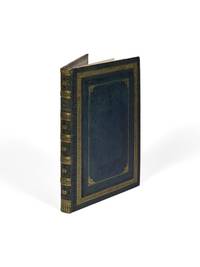
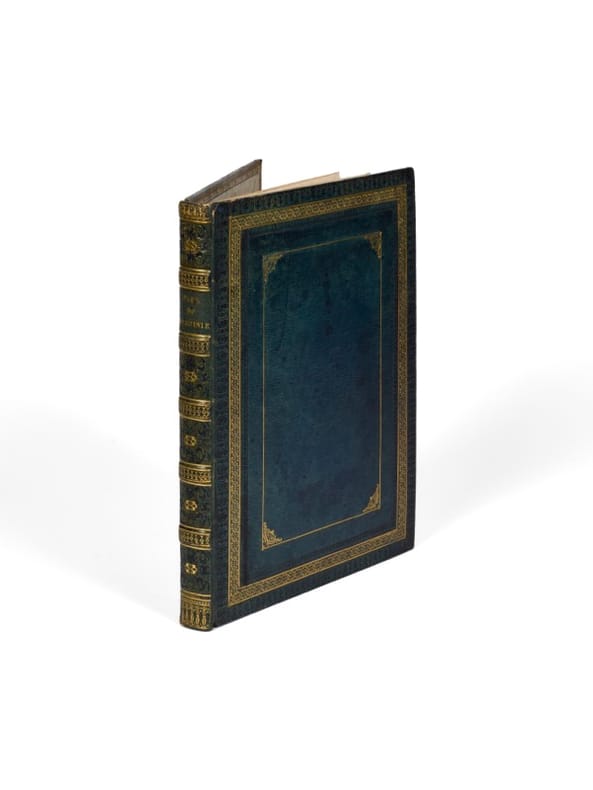
ref. 30088Paris De l'Imprimerie P. Didot l'aîné 1806. 1 vol. 235 x 320 mm de faux-titre front. titre xcii 194 p. et 3 f. Maroquin bleu à long grain plats à encadrements ornés de larges roulettes et filets à froid et dorés dos richement orné roulette intérieure tranches dorées reliure signée de Simier R. du Roi. . La plus luxueuse édition illustrée de Paul et Virgnie en partie originale et qui fixe le texte définitif. Elle est illustrée d'un portrait de l'auteur et de 6 planches hors texte gravées sur cuivre par Bourgeois de la Richardière Bovinet Mecou Prot Ribault Roger et Tillement. . Les éditions de Paul et Virginie sont nombreuses : c'est le best-seller de l'époque dès le XVIIIe siècle. Si l'édition la plus célèbre est évidemment la fameuse édition Curmer de 1838 richement illustrée et destinée à un large public la plus luxueuse et la plus belle des éditions est éditée trente ans auparavant par l'imprimerie de Firmin Didot en 1806 sur un beau papier d'Essone. Une édition à l'opposé de la Curmer : peu d'illustrations un tirage très limité un grand format et un prix élevé. Les exemplaires en sont le plus souvent luxueusement reliés par les meilleurs ateliers de l'époque. Cette édition est supervisés par l'auteur y adjoignant un préambule inédit où il revient sur la création des gravures oeuvre de Lafitte « Enfance de Paul et Virginie » Girodet « Le Passage du torrent » Baron Gérard « Arrivée de M. de la Bourdonnais » Moreau le jeune « Les Adieux de Paul et Virginie » Isabey « Les tombeaux » et Prudhon pour la plus célèbre d'entre elles : « Le Naufrage de Virginie ». « Comment M. Prud'hon a-t-il pu renfermer de si grands objets dans un si petit espace où a-t-il trouvé les modèles de ces mobiles et fugitifs effets que l'art ne peut poser et dont la nature seule ne nous présente que de rapides images . Si M. Prud'hon réussit par la pureté de ses crayons et l'élégance de ses formes à rendre des divinités il intéresse encore davantage selon moi en représentant des mortelles . Il est selon moi le La Fontaine des dessinateurs. » C'est la dernière édition parue du vivant de l'auteur et revue par ses soins. Cachet armorié au faux-titre non identifié ; ex-libris Joël Dupont ancien conservateur du Musée Barbey d'Aurevilly. Bel exemplaire très frais. Cohen 993 ; P. Thoinet « Répertoire bibliographique et iconographique de Paul et Virginie » Bulletin du bibliophile n° 41 1961 p. 167 « rien n'égale la noblesse de cette composition in-4. . C'est à mon avis une très belle réussite de l'art du livre ». Paris, De l'Imprimerie P. Didot l'aîné, 1806. 1 vol. (235 x 320 mm) de faux-titre, front., titre, xcii, 194 p. et [3] f. Maroq unknown
1806ref. 30088La plus luxueuse édition, en reliure de Simier Paris, De l'Imprimerie P. Didot l'aîné, 1806. 1 vol. (235 x 320 mm) de faux-titre, front., titre, xcii, 194 p. et [3] f. Maroquin bleu à long grain, plats à encadrements ornés de larges roulettes et filets à froid et dorés, dos richement orné, roulette intérieure, tranches dorées (reliure signée de Simier R. du Roi). La plus luxueuse édition illustrée de Paul et Virgnie, en partie originale et qui fixe le texte définitif. Elle est illustrée d'un portrait de l'auteur et de 6 planches hors texte, gravées sur cuivre par Bourgeois de la Richardière, Bovinet, Mecou, Prot, Ribault, Roger et Tillement.
1838ref. 16110Paris, L. Curmer (25 rue Sainte-Anne), 1838. In-8 de LVI-458 pp. 1 f. (table des matières) et 6 ff. (table des noms, placement des gravures), cuir de Russie bleu nuit, jeu de sept filets dorés et à froid, gras et maigres encadrant les plats, fleurons rocailles dorés au centre des plats, ex-dono sur le premier plat, dos lisse richement orné de fers rocailles et d’un mascaron dorés, contreplats et gardes de papier moiré bleu azur à cadres ornés dorés, coiffes et coupes filetées dorées, chemise en papier marbré et étui cartonné (reliure de l'époque).
1818ref. 86072Paris: Méquignon - Marvis 1818. Fine. First Collected Edition of Bernardin de Saint-Pierre in 12 Untrimmed Volumes Méquignon - Marvis Paris 1818 14 x 21.50 cm 12 volumes reliés First collected edition partly first edition of the works of Bernardin de Saint-Pierre published in Paris by Méquignon-Marvis in 1818 four years after the authors death. Twelve octavo volumes printed by L.-T. Cellot. The illustration comprises a frontispiece portrait of Bernardin drawn by Girodet-Trioson and engraved by Frédéric Lignon together with 26 hors-texte plates after Girodet Desenne Lafitte Moreau le Jeune Prudhon Vernet and Isabey; these include a folding map of the Atlantic hemisphere and several botanical plates. As is often the case with this edition the engravings have been bound in a somewhat irregular order several suites having their own numbering; the set is nevertheless complete. Contemporary Bradel-style bindings in red half Russia leather smooth spines ruled in gilt boards covered with paper imitating Russia leather green paper endleaves. Untrimmed. Scattered foxing and some soiling to a few boards. A handsome uniformly bound set the bindings well preserved. By 1818 Bernardin de Saint-Pierre was already far more than simply the author of Paul and Virginia: around the novel that had made his reputation were now gathered his travel writings the Études de la nature the Harmonies political texts essays fragments and several works that had remained in manuscript. Across twelve volumes Aimé-Martin thus presented an oeuvre far broader than the one preserved in the public imagination by the success of the novel. Paul and Virginia nevertheless remains at the heart of the collection. Aimé-Martin follows la belle édition in-4° publiée par lauteur en 1806 while reusing several compositions originally devised for the illustrated editions of 1789 and 1806. Around this already celebrated text however he adds the Harmonies de la nature first published posthumously in 1815 together with a body of manuscript material brought into this large collected edition for the first time. At the beginning of the final volume Bernardin returns to one of the decisive encounters of his life: Au mois de juin de 1772 un ami mayant proposé de me mener chez J.-J. Rousseau il me conduisit dans une maison rue Plâtrière. The Essai sur J.-J. Rousseau thus opens a sequence in which education Socrates the Jardin des Plantes and several of Bernardins scientific projects soon follow; as the volume progresses the author of Paul and Virginia gives way to a much broader figure - moralist traveller observer of nature and man of projects. These twelve volumes thus bring Bernardin de Saint-Pierre out from the shadow of his own masterpiece: around Paul and Virginia finally unfold the voyages nature Rousseau the manuscripts and projects of a writer whom the nineteenth century could now read in the full breadth of his work. Méquignon - Marvis hardcover
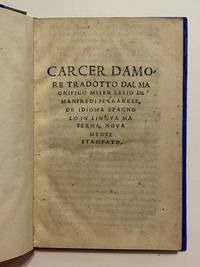
1525ref. 4542Venice: Gregorio di Gregorii 1525. Very good. Small 8vo 143 x 95 mm. 44 ff. Collation: A-E8 F4 COMPLETE title-page with light toning fols. A1-2 with unimportant wormholes in blank gutter margin. Very attractive late 19th- or early 20th-century blue embossed boards gray cloth spine. In excellent condition the paper crisp and fresh. ITALIAN POST-INCUNABLE EDITION OF THE CARCEL DE AMOR ONE OF THE MOST ENDURING OF ALL LATE MEDIEVAL ROMANCES. Written in Spanish in the late 15th century the work is a key example of the "star-crossed lovers" romance tradition. It combines allegory with chivalric narrative while its epistolary form intensifies the themes of distance miscommunication and emotional crisis. Widely popular it was quickly translated and circulated across Europe as is attested by this Italian translation published in Venice in 1525. The story continues to be celebrated for its emotional intensity and its refined articulation of courtly love. The romance was first translated into Italian by Lelio de Manfredi of Ferrara in 1514 and represents a moment when literature language and print culture intersected across political and cultural borders. For years the story was reshaped and redistributed in Renaissance Europe and contributed to a shared literary tradition. On the title-page of our edition we find only Manfredi's name and the dedicatee is Isabella d'Esta his former pupil. The translator has added his own closing epistle to the Carcel de Amor which praises Isabella; the author's name Diego de San Pedro is nowhere to be found. The Carcel de amor is told almost entirely through letters speeches and monologues rather than dialogue. It centers on Leriano a young nobleman in love with Laureola daughter of the King of Macedonia. His condition is figured as an allegorical "PRISON OF LOVE" and he communicates with her only through a mediator. A rival Persio sometimes Theseus/Perseus accuses Laureola of having an affair leading to her imprisonment. Leriano rescues her and kills his rival but Laureola ultimately rejects him in a letter. In despair he chooses to starve himself to death but not before delivering a speech in praise of women. CATALOGUER'S NOTE: Italian translations of the Carcel de Amor "Carcer Damore" are uncommon. We have located just three copies of ANY Italian language post-incunable edition at auction in the last century: 1518: sold at Ader Paris 2024 1521: sold at Sotheby's London 1970 1518: sold through Quaritch Catalogue 494 1934. EDIT16 CNCE 44982. See. Gregorio di Gregorii unknown
1525ref. 4542Venice: Gregorio di Gregorii 1525. Very good. Small 8vo 143 x 95 mm. 44 ff. Collation: A-E8 F4 COMPLETE title-page with light toning fols. A1-2 with unimportant wormholes in blank gutter margin. Very attractive late 19th- or early 20th-century blue embossed boards gray cloth spine. In excellent condition the paper crisp and fresh. ITALIAN POST-INCUNABLE EDITION OF THE CARCEL DE AMOR ONE OF THE MOST ENDURING OF ALL LATE MEDIEVAL ROMANCES. Written in Spanish in the late 15th century the work is a key example of the "star-crossed lovers" romance tradition. It combines allegory with chivalric narrative while its epistolary form intensifies the themes of distance miscommunication and emotional crisis. Widely popular it was quickly translated and circulated across Europe as is attested by this Italian translation published in Venice in 1525. The story continues to be celebrated for its emotional intensity and its refined articulation of courtly love. The romance was first translated into Italian by Lelio de Manfredi of Ferrara in 1514 and represents a moment when literature language and print culture intersected across political and cultural borders. For years the story was reshaped and redistributed in Renaissance Europe and contributed to a shared literary tradition. On the title-page of our edition we find only Manfredi's name and the dedicatee is Isabella d'Esta his former pupil. The translator has added his own closing epistle to the Carcel de Amor which praises Isabella; the author's name Diego de San Pedro is nowhere to be found. The Carcel de amor is told almost entirely through letters speeches and monologues rather than dialogue. It centers on Leriano a young nobleman in love with Laureola daughter of the King of Macedonia. His condition is figured as an allegorical "PRISON OF LOVE" and he communicates with her only through a mediator. A rival Persio sometimes Theseus/Perseus accuses Laureola of having an affair leading to her imprisonment. Leriano rescues her and kills his rival but Laureola ultimately rejects him in a letter. In despair he chooses to starve himself to death but not before delivering a speech in praise of women. CATALOGUER'S NOTE: Italian translations of the Carcel de Amor "Carcer Damore" are uncommon. We have located just three copies of ANY Italian language post-incunable edition at auction in the last century: 1518: sold at Ader Paris 2024 1521: sold at Sotheby's London 1970 1518: sold through Quaritch Catalogue 494 1934. EDIT16 CNCE 44982. See. Gregorio di Gregorii unknown books
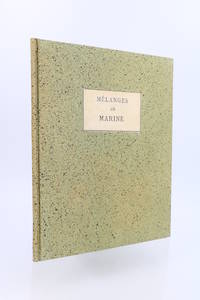
1801ref. 90455Paris: Sans nom d'éditeur 1801. Fine. Sans nom d'éditeur Paris s. d. 1801 19.3 x 25 cm Relié Rare group of six fascicules all in the original edition.Bradel-style binding in green mottled boards smooth unlettered spine printed title label mounted at the centre of the upper cover; modern binding.Not recorded by Polak. Apparently no copy located in the CCFr.A stain at the head of the title page.This curious compilation bearing almost no identifying information appears to be particularly rare.It contains:- 1. A notice to mariners concerning the change in the lighting of the lighthouse in the Bay of the Somme scheduled for 25 Pluviôse Year IX 14 February 1801.- 2. An instruction on filters for purifying water signed by the health officers Dubrueil Thaumur Dupré and Billard.- 3. A notice on naval provisions signed by Rivoire.- 4. A description of the sillomètre an instrument for measuring longitude at sea addressed to the editor of the Moniteur by the former journalist Charles Mozard 17551810 who had served as Commissioner of Frances commercial relations in Boston from 1794 to 1799 and was at that time among the contributors to the Moniteur.- 5. A discourse by Bernardin de Saint-Pierre delivered at the Institut Nautical experiments and dietary and moral observations proposed for the benefit and health of sailors on long-distance voyages. This contribution had already been printed in La Décade philosophique littéraire et politique of 30 Vendémiaire Year IX 22 October 1800.- 6. Two practical notices on means of preserving ships from fire water and rats. The nature of these texts and their immediate sources suggest that this publication was probably conceived as a trial maritime periodical intended to make available sea-related articles previously published in other journals. For reasons unknown the experiment was not continued a circumstance that is fairly common in the history of periodicals. Sans nom d'éditeur hardcover