22 799 résultats
1996réf. 40705Peabody:: Hendrickson Publishers. Near Fine in Near Fine dust jacket. 1996. Hardcover. 1565632435 . First edition. Near fine in a near fine dust jacket. . Hendrickson Publishers, hardcover books
1697réf. 18733Regensburg: C. Weigel 1697. Hardcover. Very good-. Four volumes small quarto 19.7 by 14.8 cm. Captions in Latin biblical book and chapter and German biblical book chapter and verses with quote. Copperplate engravings throughout: 1 title 175 plates; 1 title 225 plates; 1 title 288 plates; 148 plates. Total = 836 unnumbered plates 3 engraved title pages. Uniformly bound in contemporary sheep with ruled borders; spines with raised bands blindstamped ornaments and letterpress titles on heavy paper labels. Lacks fourth volume title page. Covers rubbed/lightly worn at extremities; slight loss to labels; light almost exclusively marginal foxing throughout all volumes; dampstains in first volume affecting first seven plates and top margin through first third of the volume else a very good copy with clean plates. Second printing of this pictorial Bible Bilderbibel published by the engraver and art dealer Christoph Weigel 1654-1725. The grand biblical story from the Seven Days of Creation to the Vision of a New Jerusalem here unfolds in 836 beautifully engraved plates. The designs were chiefly drawn by Johann Jacob von Sandrart 1655-1698 and Georg Christoph Eimmart the Younger 1638-1705. The engravings were made by Elias Christian Heiss J. U. Kraus L. Heckenauer and Weigel himself among others. Weigel had earlier collaborated with J. J. von Sandrart on the Passio Domini Nostri Iesu Christi Neo-coelatis Iconibus Expressa Augsburg 1693 a pictorial Gospel harmony depicted in 100 engraved plates. Christoph Weigel first trained as a goldsmith and later apprenticed to his cousin Erhart Weigel a famous instrument maker in Jena. He journeyed to Augsburg in 1693 where he learned the art of engraving from Andreas Wolfgang and later from Matthäus Küsel. His published works tended to serve didactic and edification purposes including illustrated chronicles and a compendium of notable political events of the early eighteenth century. Among his notable cartographic works is the Descriptio orbis antiqui in XLIV tabulis exhibita A Description of the Ancient World in 44 Maps - Nürnberg 1720. The Biblia Ectypa was first published in a large folio format at Augsburg in 1695 with four engraved plates appearing on each leaf. In 1697 the plates were re-issued at Regensburg in two formats: a smaller oblong folio with two plates per leaf and a quarto with a single plate per leaf. Wildly successful the Biblia Ectypa enabled Weigel to establish his own print publishing company in Nürnberg where he was soon joined by his younger brother Johann Christoph Weigel and worked closely with the prominent map publisher Johann Baptist Homann. Annotations: Plates numbered by hand in black ink at top corner though sometimes slightly out of order with occasional corrrections in the first two volumes. An old German hand has noted a correct count for each volume at the rear endleaf e.g. Enthält 288 Küpfern. A notably complete set of this uncommon edition lacking only the fourth title page. The total count of 836 engraved illustrations is confirmed via the online catalogue Das Verzeichnis der im deutschen Sprachraum erschienenen Drucke des 17. Jahrhunderts VD17. References: Paul Johannes Rée "Weigel Christoph" in: Allgemeine Deutsche Biographie 41 1896 pp. 464-465 Online-Version; Thieme-Becker XXV 227-228; VD17 23:659088P vol. 1; 23:659089W vol. 2; 23:659091S vol. 3; 23:659092Z vol. 4. C. Weigel hardcover books
1965réf. 6075Frankfurt am Main: Ars librorum Gotthard de Beauclair 1965. #338 of 475 copies signed by the artist. 41 cm; 13 leaves including nine full-page color woodcuts by Felix Hoffmann printed from original blocks. Bound in pictorial boards in cloth-bound slipcase. About fine. Ars librorum Gotthard de Beauclair hardcover books
1632réf. 49165Paris: J. Wuensel 1632. First edition. Hardcover. Nearly Fine. Octavo. Collation: á4 é4 A-T4 = 84 leaves. 16 149 i.e. 145; error in pagination: pp. 81-84 skipped in numbering sequence register continuous 7 pp. Woodcut title page vignette; head- and tail-pieces initials. Contemporary limp vellum. Title a bit dusty and lightly stained else a nearly fine clean copy. Rare first edition by the French jurist Edmond Mérille 1579-1647 of these notes on the passion accounts in each of the four Gospels: John Matthew Mark and Luke. Provenance and annotations: Entry at title copy from the library of the Oratorians. Errors corrected throughout per errata at a4 verso in an an old hand. J. Wuensel hardcover books
1726réf. 54199Berlenburg: n.p. 1726. First edition. Hardcover. Good. Six volumes of eight folio published between 1726 and 1737. All volumes with letterpress title page; sectional half titles; woodcut headpieces; engraved frontispiece often not present in first volume. Text in two columns. Contemporary mottled calf rubbed and chafed. Spines with raised bands elaborately tooled in gilt gilt morocco and vellum lettering pieces; edges tinted red; marbled endleaves. Spine ends worn. Occasional mild embrowning. A good sturdily bound set with clean crisp text. Vol. 1 1726: 12 804 pp; engraved frontispiece - Vol. 2 1728: 8 880 pp. - Vol. 3 1730: 8; 784 pp. - Vol. 4 1732: 6 858 pp. - Vol. 5 1735: 8 820 pp. - Vol. 6 1737: 8 792 pp. First edition of this rigorous revision of Luther's version in the spirit of mystical Pietism edited by Johann Heinrich Haug d. 1753 and other scholars as is reflected in the main title: Welchem allem noch untermängt Eine Erklärung die den inneren Zustand des geistlichen Lebens oder die Wege und Wirckungen Gottes in der Seelen zu deren Reinigung Erleuchtung und Vereinigung mit Ihm zu erkennen gibt. Underlying everything is an explanation that reveals the inner state of the spiritual life or the ways and effects of God in in souls for their purification enlightenment and union with Him. A theologian and orientalist Haug was expelled from Strasburg for holding an assembly of Philadelphians and other mystic Separatists. He fled to the castle of Casimir Graf von Sayn-Wittgenstein-Berlenburg which had become a refuge for radical pietiests. Remaining there until his death Haug directed a Philadelphian organization that extended throughout western Germany. "He is said to have been a man of great piety and charming personality and was regarded by Count Casimer as a prophet of God" Schaff-Herzog. "The new spirit of mystical Pietism. was fully revealed in the Marburg Bible 1712. The interpretation of type and prophecy in this follows the federal theology of Cocceius that of Canticles and Revelation Madame Guyon. It was the forerunner of a larger work in the same spirit the Berleburg Bible of 1726-42. projected and prepared chiefly by Johann Heinrich Haug. The text is a revision of Luther's with comparison of the English and French versions; the commentary reflects the views of the Philadelphian communities and quotes the mystical books current among them especially Madame Guyon's but its teaching goes back beyond Dippel and Petersen to Jakob Böhme or even to Origen in some points. It lacks unity of belief and of treatment; it is the work not of a single mystic giving voice to his inner convictions but of a propagandist sect with radical tendencies. It is not without value however from different points of view; it edifies by its continual application of Scriptural works to the spiritual life and it prepares the way for historical criticism by an appendix containing apocrypha Old and New Testament pseudepigrapha and postapostolic writings." Schaff-Herzog. Christopher Sauer the agent for the sale of the Berlenburg Bible in the United States used the text as a model for the first German-American Bible 1743. Provenance: Bookplates of Library of Union Biblical Seminary Bishop Mills Estate; entries at front endleaf "Bequeathed by Bishop J. S. Mills to Bonebrake Seminary. 1909." References: D&M 4239. Jackson S. M. ed. The New Schaff-Herzog Encyclopedia of Religious Knowledge 1908 vol. 2 p. 157; vol. 5 p. 170. Lacks Volume 7 Epistles to the Hebrews; Jacob; Peter 2; John 3; Judah; Revelation; Wisdom of Solomon; Jesus ben Sirach - Volume 8 Appendix Old and New Testament Apocrypha pseudepigrapha and post-apostolic writings. Main title and imprint vol. 1: Die Heilige Schrift Altes und Neues Testaments nach dem Grund-Text aufs neue übersehen und übersetzet: Nebst Einiger Erklärung des buchstäblichen Sinnes Wie auch der fürnehmsten Fürbildern und Weissagungen von Christo und seinem Reich und zugleich Einigen Lehren die auf den Zustand der Kirchen in unseren letzten Zeiten gerichtet sind; Welchem allem noch untermängt Eine Erklärung die den inneren Zustand des geistlichen Lebens oder die Wege und Wirckungen GOttes in der Seelen zu deren Reinigung Erleuchtung und Vereinigung mit Ihm zu erkennen gibt. Gedruckt zu Berlenburg im Jahr unsers Erlösers und Ursprungs der heiligen Schrifft JEsu Christi. [n.p.] hardcover books
1540réf. 49324Paris: F. Gryphius 1540. Two parts in one volume 16mo in 8s. 199 1 blank; 136 16 indexff. "Novvm testamentum" in cartouche vignette at title-page along with Gryphius' griffin device Renouard 413; 90 three-quarter page including repeats and 15 smaller woodcut illustrations including repeats; 21 historiated initials and woodcut lettrines; cartouche vignettes with book titles; printed marginalia; half-title for the second part Epistles and the Book of Revelation. Text not divided into verses; occasional quotations in Greek. Later vellum over boards; manuscript title at the spine faded; speckled paper endleaves; edges stained red. Light dampstain at bottom margins extending up into text and gutter at the later leaves; small puncture at leaf 140 resulting in slight loss of text. A good complete copy of a very scarce illustrated New Testament with clean woodcut illustrations throughout. Collation: a-z8 &8 Aa8 A-T7 blank leaf 200; lacks final blank T8. Third Gryphius New Testament in 16mo format. Arranged in two parts with the Epistles and the Book of Revelation presented separately it reproduces the Vulgate text edited by Robert I Estienne for his Latin Bible edition of 1532. While some of the woodcuts appear in Gryphius' complete octavo Bible of 1541 this separate Testament is even more lavishly illustrated. Based upon Mortimer's description of the 1541 Bible we can ascertain that at least some of the Apocalypse woodcuts in the present volume are based on Holbein while most of the other illustrations whose blocks had been completed by 1539 "are relatively independent of earlier sets" Mortimer. An important shift in Bible illustration occured in the Netherlands in the late 1520s as printers began to focus on copiously illustrated small format editions of the New Testament to better explain the text and assist private devotion. The subtitle in our volume "cum ad ueritatem historiae tum ad uenustatem singulari artificio expressis" with the truth of history as well as beauty expressed by a singular artifice is clearly suggestive of this shift. Adopting this new format François Gryphius became the "first Paris printer to illustrate a Bible in the Renaissance style" Johnson quoted in Mortimer. These illustrations first appeared in the Acts of the Apostles and the Book of Revelation in Gryphius' pocket New Testament edition of 1537 Novum Testamentum additis picturis in Acta Apost. et Apocalipsin quibus miracula et visiones exprimuntur The New Testament with added illustrations in the Acts of the Apostles and the Book of Revelation depicting miracles and visions. Subsequent editions would include an expanding suite of woodcuts and were published at Paris by Gryphius under the present title in 1539 1540 1541 and 1542; Antwerp editions appeared in 1542 and 1545. The suite of illustrations in the present work is identical in placement and inventory with the data cited by Mortimer for the 1541 edition 90 cuts by repetition of 58 blocks from the larger set and 15 cuts by repetition of 6 small blocks and confirmed by inspection of the digitized version of the 1541 edition at the Bibliothèque de la Ville de Lyon. The only notable differences in graphic materials between the two editions appears occasionally in the selection of woodcut initials; the later edition also has several more unset initials indicated by guide letters than appear in our 1540 edition. All editions are quite scarce with only a handful of copies of each surviving. Provenance and annotations: Old entries at paste-down and front endleaf of George Woodhouse with his note about prior provenance dated May 1875; E. Holwell noting "This curious edition published in A.D. 1540" References: Cf. Deleveau & Hillard Bibles imprimées Paris 1539 and 1542; Antwerp 1542; Le Long/Masch 2.3 1783 p.279 Paris ed. 1542; R. Mortimer French 16th Century Books no.70 ed. 1541 illustrating woodcuts on a3 recto and P3 recto as per our copy and no. 69 8vo Bible 1541. For a discussion of the development of the woodcut series in these Gryphius pocket bibles see: A.F. Johnson "Some French Bible illustrations" Gutenberg Jahrbuch 1935 p.190. Full title and imprint: Novvm testamentum illvstratum insignium simulacris cum ad ueritatem historiae tum ad uenustatem singulari artificio expressis. Excudebat Fran. Gryphius An. M.D.XL. Cum priuelegio Regio. Typeface: Gryphius's own Brevier Roman or Petite-Text with scattered Greek. U. Aberdeen note via OCLC. F. Gryphius unknown books
1729réf. 49183Paris: Rollin 1729. First edition. Hardcover. Fine. Two works jointly issued 12mo 16.2 cm x 9.9 cm: 24 102 2; 32 311 9 table approbation and erratapp. Each work with full dated title-page. Roman italic and Hebrew letter; printed side-glosses in Latin; woodcut decorations and initials. Contemporary green morocco covers and spine elaborately tooled in gilt red morocco gilt label marbled pastedowns and endleaves all edges gilt. A touch of rubbing at the extremities else fine copies handsomely bound. First editions of these French-language paraphrases of the books of Ecclesiastes and Job. It includes an essay on the urim and thummim the Hebrew terms first appearing in the biblical book of Exodus that had been and are interpreted to refer to elements of the breastplate of the High Priest. Hardouin argues that the words refer to nothing material and solid and mean ‘lights’ and ‘perfections’. The text of the Latin Vulgate is printed at the side-margins alongside Hardouin’s French-language versions of the biblical texts with notes in French below. The chapters of Ecclesiastes also have French-language introductions. The French Jesuit Hardouin 1646-1729 who was the son of a bookseller is a very interesting scholar because he developed an extreme view on literary forgery. He held for example that most of the Greco-Roman classics had been written in the thirteenth century. References: Conlon 29: 531; 530. De Backer & Sommervogel 4:104 nos. 85; 86. Uncommon in libraries of mainland Europe OCLC shows no copies outside. Rollin hardcover books
1522réf. 53365Mainz: J. Schöffer 1522. First Mainz edition. Octavo. 562 2: colophon blankpp. Collation: A-Z8 Mm8 chi2 O4/O5 reversed complete. Title within historiated woodcut border. Woodcut initials throughout. Text in italics. Printed side-glosses. Errata at final text leaf. Contemporary beveled wooden boards backed in tooled pigskin; spine with raised bands. Brass catch and clasp with expert restoration of leather thong. Contemporary manuscript musical scores used as pastedowns at front and back. Seven leather stubbs affixed at front edge as indexes. Occasional faint smudging mostly at margins else text crisp and fresh. A very good copy in a well-preserved sixteenth-century binding with a notable provenance. Scarce very early collective edition of the Latin "Paraphrases" of the Pauline Epistles prepared by the celebrated humanist scholar theologian and educational writer Desiderius Erasmus of Rotterdam 1466-1536. Preceded by the Froben collective editions of 1520 and 1521 this first and only edition of the Pauline Epistle Paraphrases to be printed at Mainz was issued by Schöffer in two parts each with full title and separate register and pagination; our volume contains the first part only: the Epistles to the Romans; Corinthians 2; Galatians; Ephesians; Philippians; Colossians; and Thessalonians 2. "In the vast and sustained labour he devoted to the New Testament Erasmus saw the culmination of his commitment to scholarship. and nothing else he wrote not even the Moriae encomium was to have so great an influence on posterity. The first edition of the New Testament appeared in 1516 and was followed in his lifetime by four more 1518/10 1522 1527 1535 each newly revised. Each consisted of the Greek text Erasmus' translation thereof and a copious apparatus of notes Annotations published as a separate volume. Beginning in 1517 he also published a Paraphrase of all parts of the New Testament save Revelation. Written in smooth and comprehensible Latin it was usually fuller than the original text. If offered his own interpretatiton but often avoided the provocative statements found in the Annotations. From the outset the translation the Annotations and to a lesser degree the Paraphrases drew criticism originally from conservative theologians who found heresies in his humanist philology but soon also from Lutherans and Catholics who denounced him for departures from their respective doctrines" Bietenholz. The Paraphrases were composed between May 1517 and January 1524. "Erasmus began with the Pauline Epistles. The paraphrase of Romans was published in quarto by Dirk Martens in Louvain in November 1517 and reprinted by Erasmus's friend Johann Froben in January of the following year; it sold well and was soon reprinted in octavo. Corinthians was published by Martens in February 1519 and reprinted in Basel by Froben in March; Galatians appeared later that year with editions from both publishers. The remaining Epistles followed in 1520 and 1521 the last to appear being Hebrews. In the autumn of 1521 Erasmus moved from Louvain to Basel and from that time Froben published the first editions of the remaining Paraphrases" Mynors. Our edition was printed by Johann Schöffer the son of Peter Schöffer who was the principal workman of Johannes Gutenberg. Apart from those of the Pauline Epistles the only other complete Paraphrase of Erasmus to be published by Schöffer was that on the Gospel of Matthew also in 1522. He did in 1521 however issue a series of four brief excerpts from the Paraphrases in German translation which appear to highlight provocative exegesis by the great scholar of Rotterdam concerning for example the hypocracy of the Pharisees Matthew 23 or the exhortation to "Take My yoke upon you and learn from Me" Matthew 11.29. Provenance and annotations: Contemporary manuscript entry at the title-page of the Benedictine monastery library at Amorbach; contemporary 50-word manuscript note in Latin at the free endleaf facing the title which discusses the present work. Early manuscript note in German at the final blank endleaf. Early leaves with light rubrication in red ink; about twenty leaves with contemporary annotations throughout. Later stamps of the Leiningen Palace Library at the bottom margin of the title and very faintly at the pigskin covers. Bookplate of United Theological Seminary Dayton Ohio noting the gift of Dr. Walter N. Roberts with their vertical entry stamp Mar 28 1963 at the dedication leaf lightly over the left-hand edge of the text but not impairing legibility. Full title and imprint: Paraphrases Eras. Rot. In omnes epistolas Pauli apostoli germanas : et in eam quae est ad Hebraeos incerti autoris cum ijs quae Canonicae uocantur diligenter recognitae excusaeque & ita binos in tomos digestae ut cuique secare in formam enchiridij siuelit liberum sit. References: P.G. Bietenholz Encounters with a Radical Erasmus Univ. Toronto 2009 p.13; R.A.B. Mynors "The Publication of the Latin Paraphrases" in: R.D. Sider ed. New Testament Scholarship: Paraphrases on Romans and Galatians University of Toronto Press 1984 pp. xx-xxix; USTC 682534; Vander Haeghen p.145: Paraphrases in omnes epistolas Pauli. Moguntiae Io. Schoeffer m. augusto 1522 octavo; VD16 E-3379 Berlin; Halle; Leipzig; Wittenberg; Wolfenbüttel. This first part not in Adams but cf. E-795 the second part 378pp. J. Schöffer unknown books
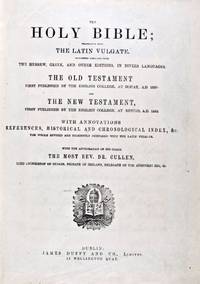
1865réf. 30602Dublin: James Duffy & Co 1865. Later edition. Hardcover. g to g. Large quarto. 2 764 222pp. Finely gold-stamped and gold-tooled contemporary black leather. All gilt edges. Striking fore edge painting of landscape with antique church complex. Silk-moire endpapers. Handwritten family registry in front. Frontispiece of Old Testament reproduction of a painting in monochrome by W. & A. K. Johnston. Frontispiece engraving in New Testament. "This New Edition of the English Version of the Bible printed with our permission by James Duffy.carefully collated by our direction with the Clementine Vulgate; likewise with the Douay Version of the Old Testament of 1609 and with the Rhemisch Version of the New Testament of 1582 and with other approved English Versions." Illustrated with 12 full-page monochrome plates in sepia-tone 2 full-page engravings as well as many b/w in-text illustrations. Some age wear and staining on binding. Wear along front joints and corners. Gutters at front and rear endpapers reinforced with fine red cloth band. Inscription on blank leaf following front endpaper: "Gift from Stephanie to Tom on the eve of their marriage October 3rd 1983." Sporadic foxing throughout. Overall good condition. James Duffy & Co hardcover books
1735réf. ST18632Amsterdam: Petrus Shenk 1735-38. First Edition in Dutch. 415 x 264 mm. 16 3/8 x 10 3/8". Entirely complete with continuous pagination but with a jump in page numbering from the end of book XIII to the beginning of XIV as usual. 15 parts in eight volumes. Translated by Florentius H. J. van Halen. HANDSOME CONTEMPORARY VELLUM covers with large gilt entrelac centerpiece framed with gilt floral rule with bouquet-like cornerpieces gilt floral border raised bands compartments richly gilt titles and volume numbers handwritten in ink on spines all edges gilt. With head- and tailpieces 15 engraved titles printed in red and black with engraved vignettes and complete with frontispiece two engraved portraits of the author and the engraver the latter with shorter margins probably tipped-in and 760 OFTEN STRIKING COPPER ENGRAVINGS on 758 plates one with partial hand coloring a few double-page. Front pastedown of first volume with handwritten note in French on lined paper; with additional black & white title to first work erroneously dated 1728. Nissen ZBI 3661; see also: Faber du Faur "German Baroque Literature" p. 472. Trivial soiling to the vellum the seventh volume with a faint marginal dampstain affecting a few quires but not touching engravings the odd negligible blemish but AN OUTSTANDING SET the very attractive original bindings showing only insignificant wear and THE CONTENTS ESPECIALLY FRESH AND CLEAN THROUGHOUT WITH VERY FINE IMPRESSIONS OF THE PLATES. This is the first Dutch translation of Scheuchzer's "Sacred Nature" one of the most splendid German illustrated books of the 18th century presenting what surely is the most impressive combination of biblical exegesis and scientific illustration to be found in any printed book. First published in 1731-35 as the "Physica Sacra" in Latin and as the "Kupfer-Bibel" in German so-named for the amazing array of copperplate engravings this work is arranged according to the progression of books in the Bible citing passages from those chapters where phenomena from the natural world are mentioned. The typical pattern here includes a textual citation followed by the author's often lengthy remarks on the passage and in many cases a dramatic engraving to illustrate what is said. The plates are identical to the earlier editions retaining the inscriptions in Latin and German and are the work of Johann-Melchior Fuseli of the well-known Zurich family of 18th and 19th century artists. The engraved scenes are always executed with great skill are generally very animated and are often fascinating. Of the 760 images meant to illustrate the text many are strictly or primarily depictions of biblical scenes; several are simply illustrations of specimens of nature; and a large number perhaps half offer a kind of combination. An example of this last type includes a wonderful scene showing the birth of Man as related in Genesis 1:26-27 depicting not only a startled Adam in his fecund paradise but also 10 images of fetuses placentas and the skeletons of children attached like mounted specimens to the architectural frame of the illustration. According to Faber du Faur it is in this work that "the Baroque attains philosophically as well as artistically its high point and its conclusion. It is the last of those elegant works which do not really contain illustrations to a text but which are in effect composed of splendid plates with a text to accompany them." Scheuchzer 1672-1733 was a prolific naturalist who promoted at every opportunity the most modern scientific ideas though without wanting to risk the accusation of being irreverent. He says that the present work represents an attempt at finding a harmony between reason and revelation though it can also be seen as an effort to promulgate progressive theories under the venerable cloak of biblical commentary. The bibliographies disagree about the number of plates that ought to be present in this work and in other editions but ours corresponds to copies previously sold at auction as complete. Copies of the "Physica Sacra" and its translations show up regularly for sale but almost never does one see the work both complete and as here with a clean and fresh text in remarkably well-preserved and attractive contemporary bindings. Petrus Shenk unknown books
1633réf. 156London: Robert Barker.by the Assignes of John Bill 1633. Very Early Jacobean Printing. Tooled leather. Very Good /Custom Case. 12mo original full leather 17th century tooled and inlaid binding engraved frontispiece closely cut borders all edges gilded green silk page divider decorative marbled endpapers viii blank ~ 524 vi blank pages. THE NEW TES_/ TAMENT / Of our Lord and / S A V I O V R / - Jesus Christ Newly translated out of the / Originall Grrek : and / with the former transla- / tions diligently compared / and revised by his Maie- / sties special commande- / ment. ---------------------------- Imprinted at London / By Robert Barker Printer / to the Kings most Excel- / lent Majesty and by / the Assignes of John Bill 1633. Cum privilegia. A GEM! In an original tooled leather binding in remarkably well preserved condition . Beautiful clear and crisp type. Moderate and quite uniform age-toning to paper with the occasional smudge. Pages closely cropped by the printer so some chapter headings at the top have been partially excised though not the text. Endpapers renewed. Generally minimal wear. Finely bound in contemporary tan gilt-embossed calf over wooden boards richly gilt to spine and covers. four hubs and boards. Marbled pastedowns & endpapers renewed a.e.g. and gauffered. Spine very slightly rubbed with partial loss of caps at head and foot restored and slightly visible. Edges of engraved title page reinforced with Japan paper. Previous owner's ink inscriptions on two front free endpapers naming "Edmund James Gore" & his London addresses. Housed in a protective clam-shell box custom made for this Rare and Precious 1633 edition of the Authorized King James version of the New Testament. Overall a VG copy. The continental binding on this small format Authorized version MAY be a pirated edition of the English Bible from Amsterdam. For example the Stam printing family were printing small format Bibles in 1673-- after our publication see Cambridge History of the Book in Britain IV p.467. Herbert 713-14 Wing B2511A. Robert Barker...by the Assignes of John Bill hardcover books
1876réf. 004044New York: American Bible Society 1876. First Edition. Very good. First edition; 5 3/4 x 4; pp. 2-48; beige self-wraps decorated with engravings and ruled with an elaborate border; illustrated with large engraving frontis; text in numerous typographical designs; small nicks and cuts to corners else minor wear; in very good condition. A scarce work of beautiful typography linguistics and religion it was jointly created and published by the American- and British and Foreign- Bible Societies for the World's Fair in 1876 and featured an engraving of the "book-case containing specimen copies of the publications of the American Bible Society and the British & Foreign Bible Society at the Centennial Exhibition." The booklet contained transations of John III 16 "For God so loved the world ." into 164 world languages and dialects including very early appearances of various Native American transcriptions - Ojibwa Dakota Nez Perce Choctaw and so on. American Bible Society paperback books
1975réf. 33966Stuttgart: Wurttembergische Bibelanstalt. Very Good. 1975. Second Revised Edition; First Printing. Hardcover. Very good with light spotting and wear to boards. Text in German. ; 8vo 8" - 9" tall; 1980 together pp . Wurttembergische Bibelanstalt hardcover books
1895réf. 7527New York: American Bible Society 1895. Hard Cover. Very Good. First edition of this Bible volume I only; folio 14" x 13" 164 leaves embossed in the New York Point Alphabet for the Blind which is a system of tactile raised dots similar to Braille. Contemporary 3/4 calf over tan cloth covered boards spine ruled in gilt; spine label is absent. New York Point for the Blind was invented by William Bell Wait 1839-1916 educator for the Blind as an alternative to the "Line Letter" system consisting of raised letters of the standard alphabet which was in use in the late 19th Century and lasted for several decades. But Braille had been invented by Louis Braille in 1824 but fell into disuse only to be revived in the early 20th Century and Braille remains today the standard in reading and writing for the Blind throughout the world. Internally quite clean with the embossed dots in very good condition; small loss at head of spine and corners worn through; a very good copy now quite scarce on the market. American Bible Society unknown books
réf. 07821London from Thur. May 2 to Sat. May 4 1765. Unbound. Very Good. Folio vol. XVII No. 1306 pages 425-432. News of interest about Great Britain and elsewhere including advertisments "This Day was Published" stock prices and much more. Very good with light soiling to front page. unknown books
réf. 07822London from Sat. April 27 to Tues. April 30 1765. Unbound. Very Good. Folio vol. XVII No. 1304 pages 409-416. News of interest about Great Britain and elsewhere including Bankrupts "This Day was Published" a beautiful old Scottish ballad entitled "Edom O'Gordon" and some stock prices. Very good. unknown books
réf. 07819London Sat. Nov. 24 to Tues. Nov. 27 1764. Unbound. Very Good. Folio vol. XVI No. 1238; pages 505-512. News of interest about Great Britain from 1764 including Bankrupts Ship News This Day was Published some stock prices and a list of stolen items including a horse. Very good. unknown books
1765réf. 07820London from Sat. May 4 to Tues. May 7 1765 1765. Unbound. Very Good. Folio vol. XVII No.1307 pages 433-440. News of interest about Great Britain and elsewhere including "For Gout and Rheumatism" sections on "To Be Sold" and "To Be Lett" and marriages. Very good with light soiling to front page. unknown books
1765réf. 07818London from Tues June 25 to Thurs June 27 1765 1765. Very Good. Folio vol. XVII No.1329; pages 609-616. News of interest about Great Britain and elsewhere including an article "An Experiment to make Potatoes thrive without Dung" by Mr. Tichiffeli. On final leaf are some stock prices Christenings numbers of dead by disease and by casualty. Very good. unknown books
1832réf. 1341Ravena Ohio: Printed by William Coolman Jr. 1832. 12mo. 165 x 100 mm.6 1.2 x 4 inches. xii 14-348 pp. Bound in contemporary American sheep red leather label; joints and edges rubbed text with sporadic spotting in the margins paper stock browned with age. With faults a good sound copy in a contemporary American binding. The books of The Apocryphal New Testament are not generally accepted as part of the New Testament by most religious denominations. Its contents include writing from the first four centuries after Christ that document events from the life of Jesus and biographies of those who were supposedly witness to His life or recorded the activities of the Apostles and other followers of Christ. This edition is taken from the one made by William Wake and Jeremiah Jones in the 18th century and published by William Hone in London in 1820. “William Hone's edition first published 1820 under title "The apocryphal New Testament" incorporating the translations of Jeremiah Jones for the apocryphal books and of Archbishop Wake for the Apostolic fathers. cf. M.R. James The apocryphal New Testament p. xv./ "Table I. A list of all the apocryphal pieces not now extant mentioned by writers in the first four centuries of Christ." By Jeremiah Jones p. 343-4/ "Table II. A list of the Christian authors of the first four centuries whose writings contain catalogues of the books of the New Testament." by Jeremiah Jones p. 345-8.” Note found in OCLC Ravenna Ohio is south of Cleveland near Kent and Akron. It was right in the path of the Second Great Awakening and in 1831 the First Methodists Church was built in the Ravenna fsoon followed by the first Catholic Church. This The Apocryphal New Testament apparently the only title printed by William Coolman may have been a reaction to the establishment of Christian sects that refused to recognize these additional sources of the New Testament. There is no indication of who many have funded this publication other than the printer a name cannot be traced. . Printed by William Coolman, Jr. unknown books
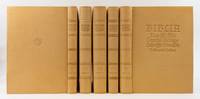
1926réf. ST16973Munich: Bremer Presse 1926-28. ONE OF 365 COPIES. 360 x 250 mm. 14 1/4 x 10". Five volumes. Edited by Carl von Kraus. VERY FINE TAN MOROCCO BY WERNER G. KIEßIG stamp-signed with his "K" mark at foot of lower cover upper covers lettered in blind lower cover with small round book stamp of former owner Martin Wandersleb smooth spines divided into panels by blind rules blind-stamped titling marbled endpapers leather hinges top edges black other edges untrimmed. In the original brown dust jackets with paper title labels to spines. Housed in the original slightly worn matching marbled paper slipcases. With titles and initials drawn by Anna Simons. Front pastedown with bookplate of Martin Wandersleb. Eyssen 88; Ransom p. 257. ◆One or two faint spots of foxing one small marginal smudge but A CHOICE COPY with no signs of use inside or out. This is a superb copy of the signal achievement of the Bremer Presse in a restrained but impressive binding produced by Berlin master bookbinder Werner G. Kießig. Printed on Zander handmade paper with a typeface specially cut by Louis Hoell and initials designed by Anna Simons this set was issued to celebrate the 400th anniversary of the completion of the Lutheran Bible. Rodenberg tells us that this work had for years been the highest goal of the press and Eyssen proclaims "a better and more textually reliable re-creation of this national monument is hardly conceivable." Colin Franklin noted in "The Private Presses" that the Gutenberg Museum in Mainz described the Bremer Presse as "the Queen of the Private Presses." According to Ransom the press offered the Bible in three different bindings: in boards for $310 in vellum for $420 and in morocco for $470. Because she was a woman Anna Simons 1871-1951 was barred from studying at the Prussian Arts and Crafts School so she travelled to England to learn from Edward Johnston at the Royal College of Art. Johnston's biographer Priscilla Johnston writes "She was one of the best students Johnston ever had and certainly one of those who exercised the greatest influence afterwards for she disseminated his teaching throughout Germany where it was perhaps more fruitful even than in England." She designed some 1400 initials and title pages for the Bremer Press. Binder Werner G. Kießig 1924-2014 apprenticed with German master binder Kurt Grünewald and studied with Bruno Scheer before attaining the rank of Meister in 1948. Although he lived in East Germany for much of his career his status as a master craftsman afforded him more freedom than usual--to exhibit internationally and to join organizations like Meister der Einbandkunst MDE and Designer Bookbinders. He was the preferred bookbinder for volumes produced by Wolfram Benda's Bear Press. From the 1970s on Kießig signed his bindings with the stamp of a "K" in a stylized book designed by Herbert Prüget. Our bindings also bear the stamp of former owner Martin Wandersleb 1924-2005 designed by Otto Rohse. The bookplate designed for this bibliophile and theologian by the artist Gerhard Marcks is on the front pastedown. This set was also part of the collection of Hamburg collector Barbara Achilles d. 2010 who put together an impressive library of private press books. Bremer Presse unknown books
1900réf. 22955Np: Np 1900. leather_bound. Orig. brown leather. Very good. 185 unnumbered pages. 3 x 2 cm. Illustrated. As miniature as one can possibly imagine. Np unknown books
1970réf. 08611Nashville TN: Thomas Nelson 1970. Hard Cover. Near Fine. Bound in white limp faux leather all edges silver stamped in silver ribbon book mark. Near fine brides bible with "Presented to" page and witnesses filled in otherwise unused. In original box. 245 pp. Thomas Nelson hardcover books
1867réf. 33999London: Fred. Pitman Phonetic Depot; Bath: Isaac Pitman Phonetic Institute 1867. Octavo. 7 15/16 x 4 15/16 inches. 2 811 1pp. Text in shorthand in two columns. Manuscript notes in shorthand on the rear endpapers. Contemporary blindstamped morocco bound by David Chivers of Bath with his blindstamp on the rear endpaper. Provenance: W. P. Coleborn small inked stamp Bible in phonetic shorthand. Isaac Pitman developed his shorthand system in 1837 rapidly becoming the most commonly used shorthand system in the English-speaking world and still in use today. He would first publish the Bible in shorthand in 1850 with editions following in 1867 1872 1890 and 1891. Fred. Pitman, Phonetic Depot; Bath: Isaac Pitman, Phonetic Institute unknown books
1982réf. 23170Santa Cruz: The Good Book Press 1982. First edition. Hardcover. Orig. quarter brown calf spine and marbled boards. Fine. 6 leaves. 23 x 17 cm. Limited edition copy 99 of 100 hand printed using Centaur type and hand bound. Five wood engravings by Donna Thomas on hand made paper by Peter Thomas. As new copy. The Good Book Press hardcover books