25 386 résultats
1868réf. 800821868. MCGUIRE Judith White. Diary of a Southern Refugee during the war. By a Lady of Virginia. New York: E.J. Hale & Son 1868. 360pp. Orig. blindstamped cloth rebacked spine label laid down else very good. HOWES M-107. In Tall Cotton 120. Coulter 310. An important female view on the hardships that stuck the south during the Civil War. McGuire captures the shortages of basic necessities in the south like food clothing and housing. She writes on the adversities with particular focus of how the war impacted women which left many penniless widows orphans and refugees. "Detailed on conditions in Richmond where the writer served for a time as a clerk in the commissary department" Nevins II p. 196. unknown
réf. 113981London T. & W. Boone 1846. . First edition; 8vo 18 x 13 cm original blind-stamped brown cloth with gilt title old ownership inscriptions to inner front cover neat repairs to joints and extremities closed tear to title professionally repaired a few small marginal tears and mild staining to pages pp.181-188 bottom margin trimmed slightly shorter than the rest; 224 10 pp. last 10 pages mis-paginated. Scarce kosher cookery book anonymously published by Lady Montefiore. When first published in 1846 the identity of 'the Lady' to whom the work is accredited was unknown. Only later after much scholarly research was the identity of the author discovered. Judith Cohen was known for her social influence and generosity throughout the Jewish community. She married Moses Montefiore in 1812 and together they became two of the most well-known members of the British-Jewish elite. The pious Montefiores observed the Mosaic dietary laws and kept a strictly kosher kitchen. This required that their meat be ritually slaughtered and that they observe the biblical injunctions in Exodus XXIII: 19 and Deuteronomy XIV: 21 'You shall not seethe a kid in its mother's milk' which was interpreted as to never mix dairy with meat in cooking. Eating dairy and meat in the same meal was also prohibited as was serving pork shellfish hares rabbits and swans as well as the consumption of the blood of any animal. Due to their strict observance Judith set about creating substitutions for these ingredients as favoured by their gentile guests. Supplies of kosher smoked beef and 'chorisa' sic: Spanish style beef chorizo as a spicy substitute for ham and bacon; of olive oil to replace dripping or lard for cooking meatless meals; of almond-cream as a substitute for dairy cream in puddings and sweet dessert dishes are all substitutions that Lady Montefiore proposes. Whilst the Montefiores participated in upper-class Christian society in London they also spent much of their time and earnings on Jewish causes. They helped to fund the first settlement for farming in the Holy Land and travelled to Israel several times where they were always well received. Lady Montefiore herself was acknowledged even by the most observant of rabbis and was honoured by taking part in their Shabbat services. She was also a member of the board of the Jews' Orphan Society and the Ladies' Loan and Visiting Society becoming 'Lady Montefiore' when her husband was knighted by Queen Victoria in 1837. When she died in 1862 Sir Moses opened the Judith Lady Montefiore College at Ramsgate England. She is remembered as a generous philanthropist and inspiring leader among the Jewish community and especially within the State of Israel. The Manual of Jewish Cookery was one of the first British cookbooks devoted to the Hebrew kitchen; the recipes are simple clear and economical for the time. After the section on cooking the author has added several chapters on the feminine toilette. London, T. & W. Boone, 1846. hardcover
1846réf. 42820875FIRST EDITION. The first Jewish cookery book in English this book is a landmark in Jewish social history. Judith Cohen the anonymous author married Moses Montefiore in 1812. Her sister was married to Nathan Mayer Rothschild Moses Montefiore's business partner. Montefiore retired from business in 1824 at the age of 40 and he and Judith devoted the rest of their lives to humanitarian efforts on behalf of distressed Jews around the world. Together they became perhaps the most prominent members of the Jewish community in both England and throughout the world. Judith Montefiore played a key role in the emergence of the modern women's movement through the example she set in the Jewish community in England. She actively promoted social integration of the leading members of the Jewish community into the larger secular society by presiding over sophisticated parties. Inspired by her Christian counterparts Lady Montefiore began to attend synagogue services even though women's attendance at prayers was strongly discouraged. While the male members of her family encouraged her to remain at home in the traditional role of Jewish women she insisted: "Surely at a place of devotion the mind ought to testify due respect and gratitude towards the Almighty." In light of her social prominence her visibility at synagogue services encouraged other Jewish women to attend. Lady Montefiore was also active in philanthropic causes and in fostering her husband's support of the nascent Jewish community in Palestine. The Jewish Manual was not only the first English Jewish cookbook it was also the first published book of social guidelines for the Anglo-Jewish woman. It instructed Jewish housewives on how to preside over a household conforming to the standards of the English middle and upper classes at a time when the Jewish population was attaining new status and wealth. Lady Montefiore stressed modesty and tasteful restraint. As she wrote in the introduction: "The Cuisine of a woman of refinement like her dress or furniture is distinguished not for its costliness or profusion but for a pervading air of graceful originality." "Among the numerous works on Culinary Science already in circulation there have been none which afford the slightest insight to the Cookery of the Hebrew kitchen. Replete as many of these are with information on various important points they are completely valueless to the Jewish housekeeper not only on account of prohibited articles and combinations being assumed to be necessary ingredients of nearly every dish but from the entire absence of all the receipts peculiar to the Jewish people" Preface. This is a landmark book in Jewish social history. Finely bound in half blue morocco spine gilt. Original cloth bound in at the end. Light foxing. Near fine. Boone hardcover
réf. GF22353Photographie format 40 x 30 cm - beau tirage plastique noir et blanc - années 1980 pour l'émission "Apostrophes"-
2012réf. 9786East Burke VT: Plowboy Press 2012. Wrappers. Fine binding. Square octavo. 74 pp. Limited edition one of 100 numbered copies. Letterpress printed in light blue and black on cream colored Hahnemuhle Gutenberg with seven section titles on variously colored Hahnemuhle Bugra with matching ink. Sewn in the Japanese retchoso style bound in Barcham Green Hayle handmade paper with an acrylic wash and housed in a folder covered in stained Tyvek with title letterpress printed in black on spine and cover in Japanese and English respectively. A fine copy. Born and educated in Tokyo Oishi settled and raised her family in Vermont. She writes in the Author's Note that her haiku and tanka began "as daily message to my parents trying to give them a picture of my life in Vermont. Gradually I began using that daily practice as a way to make sense of living in two worlds." These poems printed in Japanese with Chalmer's graceful English translation are beautiful evocative and as Chalmer writes in the Translator's Notes "open a path to memory and fresh discovery of the here and now." Andrew Miller-Brown presents them in this elegant volume a poem per page with English translation set in Legacy Sans on the inner half of the page and the Japanese set in Kozuka Mincho Pro in the outer half. Everything about this work is thoughtful and understated from the sewing method that leaves the spine exposed but sewing invisible to the simple acrylic wash depicting a snow field on the cover; all the elements come together creating a powerful book. Plowboy Press unknown
réf. 201307301Paris, Pocket, 2000 ; in-12, 209 pp., br. Très bon état.
réf. 201309246Paris, Pocket, 2000 ; in-12, 433 pp., br. Ouvrage en bon état.
réf. 201901945Paris, Editions Odile jacob, 1991 ; in-8, 290 pp., br.
réf. 201808152Paris, Editions Odile jacob, 1991 ; in-8, 290 pp., br.
1992réf. 84865NY: Twayne Publishers 1992. First edition. xiv 229 pp. Light foxing to page edges else near fine in very near fine dust jacket. NY: Twayne Publishers unknown books
réf. 1240711 photographies de Judith Turner. Texte de léditeur. Très bon état.
réf. 9035L'ANE. " Le Magazine freudien ". // N° 2. Eté 1981. Alain Badiou, Paul Bercherie, Catherine Clément, Judith Miller, Serge Cottet, Paul-Laurent Assoun, Christian Jambet, Charles Méla Bon état.
réf. 12237Logos Anankè, N°1, 1999. In-8, broché.
réf. 2095Année 1994 complète. 4 volumes in-4° en feuilles sous chemise transparente en plastique, sous étui de carton orange imprimé. N° 23, 24, 25, 26. Etat neuf.
réf. 10123LE POINT. N° 6. (Décembre 1937). " La Sculpture ". Jean Charbonneaux, George Besson, Judith Cladel (" Rodin "), etc. Lettres de Rodin et de Maillol en fac-simile. Nombreuses photographies de sculptures. Numéro rare. Bon exemplaire.
réf. 12463TRAVERSES, n° 7, Centre Georges Pompidou / Editions de minuit, février 1977. In-8 carré, broché, illustrations.
réf. 8925SORGUE. " Poésie. Arts. Littérature ". // N° 1. Mars 2000. " Le Retrait dans la création poétique ". Judith Chavanne, Pierre Dubrunquez, Eve Duperray, André Gence, Philippe Jaccottet, Claire Malroux, Martin Melkonian, Roger Munier, André Ughetto Très propre.
1978réf. 9849Argyle NY: Spinsters Ink 1978. Pamphlet. 24p. 5.5x8 inches footnotes small neat ownership signature otherwise very good first edition booklet in stapled wraps. A critique of Rich's poetry by a feminist poet and teacher at Skidmore College. Spinsters, Ink unknown books
1978réf. 76098Argyle: Spinsters Ink. 1978. First edition. 24 pp. Fine in stapled wrappers. Argyle: Spinsters, Ink. unknown books
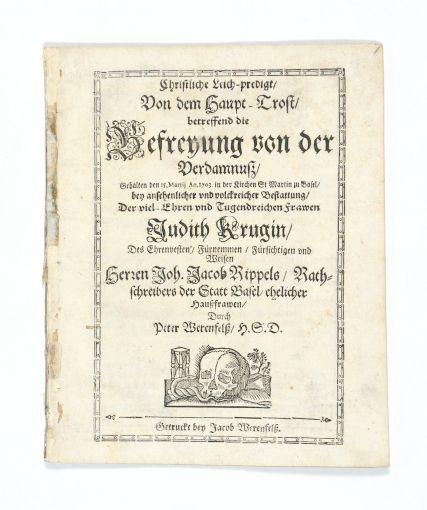
1703réf. 63085[Basel], Getruckt bey Jacob Werenfelß, (1703). 4°. Mit kl. Holzschn.-Titelvignette. 32 S., Geheftet (ausgebunden).
1842réf. 4944Philadelphia: Lea & Blanchard 1842. First Edition. i - viii 9 - 301 pp.; 14 pp. publisher's catalog bound in at rear of volume. 1 vols. 8vo. Original cloth; spine a trifle soiled occasional light foxing; else fine. Inscription: "C.L. Ewing. Cameron St. Alexandria. 1842" on front pastedown. First Edition. i - viii 9 - 301 pp.; 14 pp. publisher's catalog bound in at rear of volume. 1 vols. 8vo. Includes a gothic tale of about 160 pages MM#95. Wright I 2124 Lea & Blanchard unknown
1842réf. 4944Philadelphia: Lea & Blanchard 1842. First Edition. i - viii 9 - 301 pp.; 14 pp. publisher's catalog bound in at rear of volume. 1 vols. 8vo. Original cloth; spine a trifle soiled occasional light foxing; else fine. Inscription: "C.L. Ewing. Cameron St. Alexandria. 1842" on front pastedown. First Edition. i - viii 9 - 301 pp.; 14 pp. publisher's catalog bound in at rear of volume. 1 vols. 8vo. Includes a gothic tale of about 160 pages MM#95. Wright I 2124 Lea & Blanchard unknown books
réf. 201504927Paris, Stock, 2013 ; in-8, 155 pp., br.
1992réf. 86302NY: Rizzoli/Gagosian Gallery 1992. First edition. 106 pp w/selected bibliography & index of illustrations. Near fine in glossy illustrated wrappers. Features an interview with Rosenquist by Goldman. NY: Rizzoli/Gagosian Gallery unknown
1992réf. 86302NY: Rizzoli/Gagosian Gallery 1992. First edition. 106 pp w/selected bibliography & index of illustrations. Near fine in glossy illustrated wrappers. Features an interview with Rosenquist by Goldman. NY: Rizzoli/Gagosian Gallery unknown books