5589 risultati
1959rif. 48378(No place), The Association for Symbolic Logic, 1959. Lev8vo. Bound in red half cloth with gilt lettering to spine. In ""Journal of Symbolic Logic"", Volume 24. Barcode label pasted on to back board. Small library stamp to lower part of 6 pages. A very fine copy. Pp. (1) - 14. [Entire volume: VI, 374 pp.).
1959rif. 48378No place The Association for Symbolic Logic 1959. Lev8vo. Bound in red half cloth with gilt lettering to spine. In "Journal of Symbolic Logic" Volume 24. Barcode label pasted on to back board. Small library stamp to lower part of 6 pages. A very fine copy. Pp. 1 - 14. Entire volume: VI 374 pp. The seminal first printing of Kripke's debut article which provided the basis for his logic and for the model theory for modal logic in general. The work constitutes the very beginning of Kripke Semantics often called possible world semantics. Kripke's works in general are rare in fist editions. Many of them remain unpublished and are only known in privately circulated manuscripts.The American philosopher Saul A. Kripke born 1940 is an exceedingly important logician and philosopher of language and one of the most powerful and influential thinkers of analytic and Anglo-American philosophy. He is considered the greatest living philosopher and perhaps the greatest since Wittgenstein. In 2001 he was awarded the Schock Prize in Logic and Philosophy which is considered the philosopical equivalent of the Nobel Prize.Kripke who grew up in Omaha in a religious Jewish family was somewhat of a prodigy child. During grammar school he got intimately acquainted with and mastered to perfection algebra geometry and calculus and very early on he took up philosophy which later became his career. Still a teenager in high school he wrote a work that was to change the face of philosophical logic forever namely the groundbreaking paper "A Completeness Theorem for Modal Logic" which was printed a few years later in 1959 in the Journal of Symbolic Logic while he was in his first year at Harvard University. This seminal debut work proposed what later came to be known as Kripke models for modal logic. The story goes that the paper earned a letter from the department of mathematics urging Kripke to apply for a job there to which he is said to have written an answer explaining "My mother said that I should finish high school and go to college first."In 1962 he graduated from Harvard University where he remained until 1968 first as a member of the Harvard Society of Fellows and then as a lecturer. During these years he developed the logical theories founded in the "Completeness Theorem" further and made seminal contributions to the field of logic and semantics. Kripke Semantics is a formal semantics for non-classical logic systems that Kripke began developing in his teenage years first published something on in 1959 the present work and further developed in the 60'ies and. The development of Kripke Semantics was no less than a breakthrough in the making of non-classical logics of which no model theory existed before Kripke's. With this work Kripke laid the foundation for proving completeness theorems for modal logic and for identifying the weakest normal modal logic which is now named K after him. hardcover
1959rif. 46888No place The Association for Symbolic Logic 1959. 8vo. Wrappers blank with printed title on spine. Entire issue No. 1 of vol. 24 offered. Fine and clean. The seminal first printing of Kripke's debut article which provided the basis for his logic and for the model theory for modal logic in general. The work constitutes the very beginning of Kripke Semantics often called possible world semantics. Kripke's works in general are rare in fist editions. Many of them remain unpublished and are only known in privately circulated manuscripts.The American philosopher Saul A. Kripke born 1940 is an exceedingly important logician and philosopher of language and one of the most powerful and influential thinkers of analytic and Anglo-American philosophy. He is considered the greatest living philosopher and perhaps the greatest since Wittgenstein. In 2001 he was awarded the Schock Prize in Logic and Philosophy which is considered the philosopical equivalent of the Nobel Prize.Kripke who grew up in Omaha in a religious Jewish family was somewhat of a prodigy child. During grammar school he got intimately acquainted with and mastered to perfection algebra geometry and calculus and very early on he took up philosophy which later became his career. Still a teenager in high school he wrote a work that was to change the face of philosophical logic forever namely the groundbreaking paper "A Completeness Theorem for Modal Logic" which was printed a few years later in 1959 in the Journal of Symbolic Logic while he was in his first year at Harvard University. This seminal debut work proposed what later came to be known as Kripke models for modal logic. The story goes that the paper earned a letter from the department of mathematics urging Kripke to apply for a job there to which he is said to have written an answer explaining "My mother said that I should finish high school and go to college first."In 1962 he graduated from Harvard University where he remained until 1968 first as a member of the Harvard Society of Fellows and then as a lecturer. During these years he developed the logical theories founded in the "Completeness Theorem" further and made seminal contributions to the field of logic and semantics. Kripke Semantics is a formal semantics for non-classical logic systems that Kripke began developing in his teenage years first published something on in 1959 the present work and further developed in the 60'ies and. The development of Kripke Semantics was no less than a breakthrough in the making of non-classical logics of which no model theory existed before Kripke's. With this work Kripke laid the foundation for proving completeness theorems for modal logic and for identifying the weakest normal modal logic which is now named K after him. unknown
1988rif. 45839HEYNE WILHELM 1988. 3. softcover. Deutsche Erstausgabe! HEYNE, WILHELM paperback
rif. 113114Vienna Bamberger & Wahrman 1933. . First edition. Small 4to publisher's vellum backed marbled boards with Hebrew title pastedown to spine corners rubbed; slight browning to first few leaves pages crisp and clean; text in Hebrew and Yiddish; XIV 335 1 10 5 66 pp. Index of pen-names in Hebrew and Yiddish literature; an unnumbered copy out of a limited edition of 250. Vienna, Bamberger & Wahrman, 1933. hardcover
rif. DADAX0670911380Viking 2006 0000-00-00. hardcover. New. 6.30x1.89x9.49. Buy with confidence. Excellent Customer Service & Return policy. Viking, 2006 hardcover
1986rif. 45554HEYNE WILHELM 1986. 1. softcover. Deutsche Erstveröffentlichung! HEYNE, WILHELM paperback
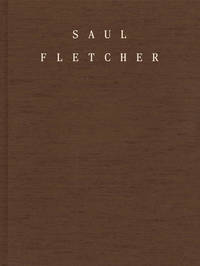
2019rif. 010459Inventory Press. A self-taught photographer from the northeastern coast of England Berlin-based Saul Fletcher born 1967 has been working for more than two decades to create images of fragmented bodies found-object assemblages and most famously the artist's own studio wall. Neither staged nor real neither fast-moving nor static neither intimate nor detached Fletcher's images create distinct ruptures in everyday temporalities. This substantial volume reproduces more than 300 photographs alongside essays by Ralph Rugoff and Kirsty Bell that touch on the haunting feeling produced by Fletcher's imagery - fitted with a removable clear mylar sleeve - All my books are always securely packed with plenty of bubblewrap in professional boxes and promptly dispatched within 2-3 days - SIGNED BY SAUL FLETCHER - Pictures available upon request. . Fine. Hardcover. 1st Edition. 1st Printing. 2019. Inventory Press hardcover
2006rif. 132582Steidl 2006-01-15. hardcover. Like New. 8x8x4. Brand new gift quality hardcover in jacket. 2016 Seventh edition. Please email for photos. Steidl hardcover
1730rif. 8578London: Printed for A. Bettesworth. and C. Hitch 1730. 1730 12 100 p. First edition. Contemporary panelled calf binding neatly rebacked with the original spine re-laid and a replacement label. The text is clean and crisp. An informed review of the early history of the barometer examining the contributions of Galileo Torricelli Boyle and Halley to its development. London: Printed for A. Bettesworth. and C. Hitch, unknown
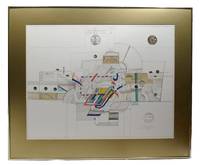
1970rif. 218036New York: Saul Steinberg 1970. First Edition; First Printing. Other. Near Fine in a Near Fine frame. Saul Steinberg 1914-1999 TICKET VIA AIR MAILChromolithograph on paper. Image size: 21 x 28 inches. A striking chromolithograph after an original composition by renowned Romanian-American artist Saul Steinberg titled Ticket Via Air Mail. Created from Steinberg's celebrated 1970 design the print exemplifies the artist's unmistakable visual language blending drawing typography postal imagery and collage-inspired forms into a richly layered composition. The image features an intricate arrangement of international travel tickets postal cancellations labels seals and geometric architectural elements interwoven with Steinberg's signature ribbon-like linear motifs. Delicate tonal passages are complemented by vibrant bands of color creating a dynamic balance between abstraction and recognizable imagery. The work reflects Steinberg's enduring fascination with communication travel and the graphic vocabulary of everyday life. Best known for his groundbreaking illustrations for The New Yorker Steinberg was one of the twentieth century's most influential graphic artists whose work bridged the worlds of fine art illustration and design. His works are represented in the collections of major institutions including The Museum of Modern Art The Metropolitan Museum of Art the Whitney Museum of American Art and the Art Institute of Chicago. This 21 x 28-inch chromolithograph offers collectors an attractive example of one of Steinberg's most engaging and visually complex compositions. Beautifully matted and framed it displays exceptionally well and is ready for presentation. Condition: Please see photographs for the condition of the print and frame.; 21x28. Saul Steinberg unknown
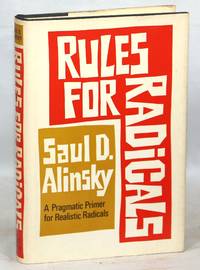
1971rif. 000014453New York: Random House 1971 1971. First edition. Hardcover. Very Good/Very Good. 8vo. 14 xiv-xxvi 3 4-196 2 pp. Black cloth with red lettering on the front board and gold lettering on the spine. Price of $6.95 on the front flap of the dust jacket. Jacket design by Jay J. Smith. Vox Dylan Matthews "Who is Saul Alinsky and why does the right hate him so much". This was Alinksy's final publication before his death in 1972. The author was a hugely influential American social activist and his methods for community organizing influenced later activists like Dolores Huerta and Cesar Chavez. According to Matthews the Vox journalist Alinsky's tactics would also influence the organizational methods of the American Tea Party movement. Alinksy was proud to help working people and people living in poverty demand better living and working conditions from political leaders and from corporations. A ripple to the paper on the front pastedown foxing to the pastedowns endpapers and top textblock; light foxing to the jacket. Random House [1971] hardcover
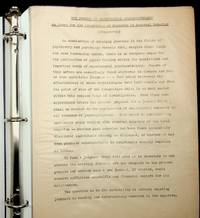
1930rif. 27588various: various 1930. First Edition. Three Ring Binder. Very Good. First Edition. An archive of material which documents the attempted founding of a new journal "The Journal of Experimental Psychopathology" by American psychologist Saul Rosenzweig. The three page initial Prospectus explains the need for a journal focused on the "specialized but important domain of experimental psychopathology." A list of proposed consulting and corresponding editors and their addresses in 10 different fields is included and letters were sent out many acceptances from known names were received. Unfortunately another competing proposal was received by the National Research Council N.R.C. Committee from the Macy Foundation which was eventually accepted. A letter dated August 1 1938 communicates the bad news that Dr. Rosenzweig's proposal will be dropped. A second group of letters follows from contributing editors back to Rosenzweig expressing their condolences. Often this sort of activity happens behind the scenes - in this case we get to see both the timeline and some of the inner workings of the process. Three Ring Binder. "Saul Rosenzweig 1907–2004 was an American psychologist and therapist who studied subjects such as repression psychotherapy and aggression. Rosenzweig who with a co-author has been credited with being the first to attempt to "elicit repression" in a laboratory setting became well known after publishing a paper discussing "common factors" underlying competing approaches to psychotherapy.In the 1930s Rosenzweig studied repression. With G. Mason Rosenzweig criticized H. Meltzer's survey of studies of repression in an article published in the British Journal of Psychology. Rosenzweig and Mason argued that the studies reviewed by Meltzer worked with sensory stimuli unrelated to the theory of repression and "failed to develop under laboratory control the experiences which are subsequently to be tested for recall." Donald W. MacKinnon and William F. Dukes credit Rosenzweig and Mason with being "the first to make an explicit attempt to elicit repression under conditions of laboratory control and observation." Sigmund Freud was sent reprints of Rosenzweig's attempts to study repression but replied to Rosenzweig that while he had examined his "experimental studies for the verification of the psychoanalytic assertions with interest" he could not "put much value on these confirmations because the wealth of reliable observations on which these assertions rest make them independent of experimental verification." Rosenzweig became well known after publishing a paper discussing "common factors" underlying competing approaches to psychotherapy. He argued that all models of therapy could be equally successful due to competent therapists sharing common factors that aided their patients. His premise became known as the Dodo Bird Verdict or Dodo Bird Hypothesis — a reference to Lewis Carroll's Alice's Adventures in Wonderland 1865 in which a dodo bird declares at the end of a race designed to dry everyone off: "Everybody has won and all must have prizes." Rosenzweig's study of aggression led to the development of the Rosenzweig Picture-Frustration Study a test of latent hostility. The Rosenzweig Picture Frustration Study is usually considered a semi-projective technique and involves an examinee responding verbally to a semi-ambiguous picture scenario. Each of the three forms child adolescent and adult consists of 24 comic strip pictures that portray a situation that might induce frustration. The overall purpose of the study is to assess how the examinee responds to frustration and frustrating situations. The test assumes that the way that the examinee responds to each frustrating situation depicts how they behave in the face of frustration. The worth of this test is based on how aggression is conceptualized into three types. The first direction of aggression can be extragressive meaning that it is turned onto the environment. The second direction is intraggressive meaning that it is turned by the examinee onto the self. The final direction is imaggressive which means that it is evaded in an attempt to gloss over the frustration. In terms of reliability and validity the P-F Study interscorer reliability is in the range of .80 to .85. The test-retest reliability is fair to marginal. The test became popular in Europe and was featured in Stanley Kubrick's film A Clockwork Orange 1971. A collection of Rosenzweig's papers has been maintained in the Archives of the History of American Psychology at the University of Akron." Wikipedia. various unknown
1930rif. 27588various: various 1930. First Edition. Three Ring Binder. Very Good. First Edition. An archive of material which documents the attempted founding of a new journal "The Journal of Experimental Psychopathology" by American psychologist Saul Rosenzweig. The three page initial Prospectus explains the need for a journal focused on the "specialized but important domain of experimental psychopathology." A list of proposed consulting and corresponding editors and their addresses in 10 different fields is included and letters were sent out many acceptances from known names were received. Unfortunately another competing proposal was received by the National Research Council N.R.C. Committee from the Macy Foundation which was eventually accepted. A letter dated August 1 1938 communicates the bad news that Dr. Rosenzweig's proposal will be dropped. A second group of letters follows from contributing editors back to Rosenzweig expressing their condolences. Often this sort of activity happens behind the scenes - in this case we get to see both the timeline and some of the inner workings of the process. Three Ring Binder. "Saul Rosenzweig 1907–2004 was an American psychologist and therapist who studied subjects such as repression psychotherapy and aggression. Rosenzweig who with a co-author has been credited with being the first to attempt to "elicit repression" in a laboratory setting became well known after publishing a paper discussing "common factors" underlying competing approaches to psychotherapy.In the 1930s Rosenzweig studied repression. With G. Mason Rosenzweig criticized H. Meltzer's survey of studies of repression in an article published in the British Journal of Psychology. Rosenzweig and Mason argued that the studies reviewed by Meltzer worked with sensory stimuli unrelated to the theory of repression and "failed to develop under laboratory control the experiences which are subsequently to be tested for recall." Donald W. MacKinnon and William F. Dukes credit Rosenzweig and Mason with being "the first to make an explicit attempt to elicit repression under conditions of laboratory control and observation." Sigmund Freud was sent reprints of Rosenzweig's attempts to study repression but replied to Rosenzweig that while he had examined his "experimental studies for the verification of the psychoanalytic assertions with interest" he could not "put much value on these confirmations because the wealth of reliable observations on which these assertions rest make them independent of experimental verification." Rosenzweig became well known after publishing a paper discussing "common factors" underlying competing approaches to psychotherapy. He argued that all models of therapy could be equally successful due to competent therapists sharing common factors that aided their patients. His premise became known as the Dodo Bird Verdict or Dodo Bird Hypothesis — a reference to Lewis Carroll's Alice's Adventures in Wonderland 1865 in which a dodo bird declares at the end of a race designed to dry everyone off: "Everybody has won and all must have prizes." Rosenzweig's study of aggression led to the development of the Rosenzweig Picture-Frustration Study a test of latent hostility. The Rosenzweig Picture Frustration Study is usually considered a semi-projective technique and involves an examinee responding verbally to a semi-ambiguous picture scenario. Each of the three forms child adolescent and adult consists of 24 comic strip pictures that portray a situation that might induce frustration. The overall purpose of the study is to assess how the examinee responds to frustration and frustrating situations. The test assumes that the way that the examinee responds to each frustrating situation depicts how they behave in the face of frustration. The worth of this test is based on how aggression is conceptualized into three types. The first direction of aggression can be extragressive meaning that it is turned onto the environment. The second direction is intraggressive meaning that it is turned by the examinee onto the self. The final direction is imaggressive which means that it is evaded in an attempt to gloss over the frustration. In terms of reliability and validity the P-F Study interscorer reliability is in the range of .80 to .85. The test-retest reliability is fair to marginal. The test became popular in Europe and was featured in Stanley Kubrick's film A Clockwork Orange 1971. A collection of Rosenzweig's papers has been maintained in the Archives of the History of American Psychology at the University of Akron." Wikipedia. various unknown books
2021rif. Discovery-9780357122846CENGAGE NP 2021. Hardcover. New. CENGAGE NP hardcover
2003rif. 12036New York: The Library of America 2003. First edition of the Library of America release of the author's first three novels. Octavo original maroon cloth. Signed by both Saul Bellow and James Wood on the title page. James Wood served as editor. Fine in a fine dust jacket. Rare signed as the author was aged at this point and did not attend booksignings for the release of this edition. Looking back at his first two novels later in his career Bellow "distanced himself from them by calling Dangling Man his M.A. and The Victim his Ph.D." Like many of his works the protagonist is a young Jewish man. In a New York heat wave he is accosted in the park by a stranger who accuses him of ruining his life. "The best novel to come out of America-or England-for a generation" The New York Review of Books. The Library of America hardcover
1946rif. 190London: John Lehmann 1946. First British edition of the author's first book. Octavo original cloth. Signed by Saul Bellow on the title page. Fine in a near fine dust jacket with the lightest of wear. Jacket design by Robert Medley. Saul Bellow is the only author to have received three National Book Awards for The Adventures of Augie March Herzog and Mr. Sammlers Planet in addition to both the Pulitzer and Nobel prizes. The Sunday Times praised these achievements when it revered "Bellows oeuvre as both timeless and ruthlessly contemporary. John Lehmann hardcover
1959rif. 430938New York: Viking Press 1959. Hardcover. Fine/Near Fine. First edition first issue. Fine in just about fine dustwrapper. A curious and possibly unique variant or anomaly with the text block clearly bound directly to the front board presumably no other preliminary matter was gathered with the rest of the text block it is intriguing to conjecture whether this constitutes a state or issue point with this seemingly representing a very early copy a notion reinforced because the text block has the first issue topstain. Bellow's seriocomic novel of an eccentric American millionaire on a quest in Africa. A very nice copy very scarce in this condition in what is likely a rare or unique state. Viking Press hardcover
1959rif. 430938New York: Viking Press 1959. Hardcover. Fine/Near Fine. First edition first issue. Fine in just about fine dustwrapper. A curious and possibly unique variant or anomaly with the text block clearly bound directly to the front board presumably no other preliminary matter was gathered with the rest of the text block it is intriguing to conjecture whether this constitutes a state or issue point with this seemingly representing a very early copy a notion reinforced because the text block has the first issue topstain. Bellow's seriocomic novel of an eccentric American millionaire on a quest in Africa. A very nice copy very scarce in this condition in what is likely a rare or unique state. Viking Press hardcover books
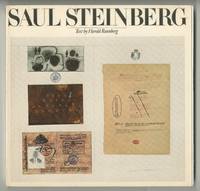
1978rif. 511765New York: Alfred A. Knopf in association with the Whitney Museum of American Art 1978. Softcover. Fine. First edition wrappered issue. Quarto. 256pp. Illustrated with the art works of Steinberg. Pictorial wrappers. Slight rubbing on the wrappers very near fine. Inscribed by Steinberg to author Mary McCarthy on the half-title page in the year of publication: "For Mary and Jim from Saul and the dear memory of Harold. Oct 78." Jim is Jim West McCarthy's fourth and final husband. Alfred A. Knopf in association with the Whitney Museum of American Art unknown
1978rif. 511765New York: Alfred A. Knopf in association with the Whitney Museum of American Art 1978. Softcover. Fine. First edition wrappered issue. Quarto. 256pp. Illustrated with the art works of Steinberg. Pictorial wrappers. Slight rubbing on the wrappers very near fine. Inscribed by Steinberg to author Mary McCarthy on the half-title page in the year of publication: "For Mary and Jim from Saul and the dear memory of Harold. Oct 78." Jim is Jim West McCarthy's fourth and final husband. Alfred A. Knopf in association with the Whitney Museum of American Art unknown books
1953rif. 28407New York: The Viking Press 1953. Fourth printing 8vo pp. 6 536; original black and gray cloth stamped in orange on upper cover and spine top edge stained orange; dust jacket chipped at top of spine along top edge and at top outer corner never any loss of letterpress else very good. This copy inscribed: "To Phil Miller in him I didn't specially try to recruit with affection and good wishes Saul Bellow." The Adventures of Augie March was the winner of the National Book Award in 1954. The Viking Press unknown
1953rif. 28407New York: The Viking Press 1953. Fourth printing 8vo pp. 6 536; original black and gray cloth stamped in orange on upper cover and spine top edge stained orange; dust jacket chipped at top of spine along top edge and at top outer corner never any loss of letterpress else very good. This copy inscribed: "To Phil Miller in him I didn't specially try to recruit with affection and good wishes Saul Bellow." The Adventures of Augie March was the winner of the National Book Award in 1954. The Viking Press unknown books
1981rif. 314BASTEI-LÜBBE 1981-82. 1. softcover. Stahlauge 2300223004 BASTEI-LÜBBE paperback