Charles Perrault, Isaac BenseradeBiblio.com
31 744 résultats
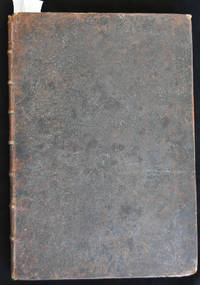
1679réf. 032848A Paris: De L'Imprimerie Royale 1679 A fair copy of the 1st edition of the Description de la Grotte de Versailles bound with a very good copy of the 2nd edition of Labyrinte de Versailles in contemporary elephant folio full leather binding. La Grotte has had 5 of the 20 plates cut out but Labyrinte is complete. The binding is sound with raised bands and title label to spine. It is very worn with a lot of wear to corners with leather loss and to spine joints spine ends and edges. The surface of the boards is a little rough. All page edges red. There is an old bookplate to the front pastedown endpaper - Earl Vane from the Library of the Rev. John Vane. Contents: 3 blanks; title 1679; blank verso; Description pp 1-11; Imprimerie to verso p 11; plates 13 single and 2 double; title to Labyrinte 1697; blank verso; Description pp 3-34; blank recto with Explication du Plan du Labyrinte to verso; plate 1; fables quatrains by Isaac Benserade and plates Sebastien Leclerc on opposing pages - 78 pp 39 plates; table 3 pp with L'Imprimerie to verso final leaf; 4 x final blanks. The binding is 50 cm x 35 cms; the page size in Labyrinte matches that of the Grotte but the actual text and plate size is 15.8 x 10.2 cm. Contents are in very good clean condition. Please enquire if you would like to see further images. De L'Imprimerie Royale hardcover
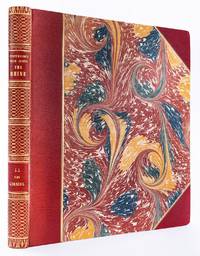
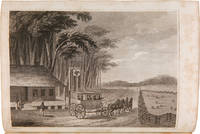
réf. 57598London: R. Ackermann 1820. FIRST EDITION. Folio 33.5 x 28 cm. Title verso blank; Dedication 1 leaf; List of Subscribers pages v to viii; Preface by the Translator pages ix to xii; Preface of the Author pages xiii and xiv; Contents 1 leaf verso with List of Plates; Text pp. 1-178. Period style half red morocco over marbled boards spine with raised bands and intricate gilt tooling all edges gilt. 24 aquatinted plates D. Havell and T. Sutherland after C.G. Schutz with original hand-colouring engraved folding map with colour highlights at rear entitled "Map of the Course of the Rhine from Mentz to Cologne; And of the Course of the Maine and the Lahn". Minor scattered spotting slight offsetting to map generally an excellent copy. One of Ackermann's major colour plate books and apparently the first in his "Picturesque Tours" series others of which explore the Seine the Ganges and the Thames. The book describes a trip down the Rhine on that part of the river generally considered most romantic and charming "from Mentz to Cologne and of the Bathing-Places of Wiesbaden and Embs". The account contains not only topographical descriptions but considerable historical information and details of popular traditions the book being written "with a view chiefly to the information of travellers of cultivated minds who may be induced to visit this interesting portion of Germany Preface of the Author". The original German edition was published in Wiesbaden in 1819 as Die Rheingegenden von Mainz bis Cölln without illustrations. The third issue with the plates numbered in top right corner. Abbey Travel 217; Tooley 234. London: R. Ackermann, 1820. hardcover
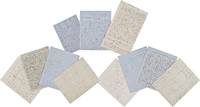
1850réf. 68036Northumberland NY and Tuolumne County CA. 1850–1857. New Yorker in the "Land of Gold" A scattered but intriguing collection of manuscripts related to New York native Isaac Vanderwerker or Vanderwarker who made for the California gold mines in 1850 and remained out west until at least 1857. This group consists primarily of letters written to Isaac by his brother at home in Northumberland inquiring after Isaac's activities in the gold fields and commenting on matters at home though it also contains a detailed letter from Isaac himself a letter from his ill-fated sister Joann and two letters written by business partners in California. The earliest letter here written by Isaac's brother who signs only with initials is dated October 7 1850 shortly after Isaac arrived in California. Isaac was apparently one of many gold-seekers who elected to take a slow sailing ship from Panama rather than wait on the heavily delayed steamships though he weathered the journey better than most. Isaac's brother also notes several acquaintances who "have returned without making their fortune" and still more who are leaving regularly for the mines including a "Justus" who "made a vendue and sold his personal property" in order to fund the journey. Everyone in town it seems either wants to head to California or has an excuse not to. "I hope you will be one of the lucky ones and get well paid for all your toil sufferings and anxieties" he writes to his brother. "We have most of the California news every month. I saw in the last paper an account of the riot and burning of Sacramento City it spoke of some large lumps of gold being taken out weighing from one to forty pounds at Carsons new diggings on the Stanislaw another instance where a man took out four thousand dollars in two days at Murphy diggings but these cases are something extra John L. Cramer is at the Northern Mines on the Yuba…." The Vanderwerkers were early settlers of upstate New York and appear to have done well for themselves – Isaac and his brother are involved in several substantial properties and much of their correspondence relates to the management of their farms. The next letter in the group comes from the following summer written by Isaac's sister Joann. Joann discusses more details of the family's properties and notes that her health is poor enough that she is not sure to see the end of the week. Regardless news of California remains at front of mind: "There is a story in circulation that Aron Bliss Jaines Brother in law has stoll 15 thousand dollars at San Francisco and the owner has followed him here and there a going to take him back and hang him. John Cramer is on the yube never his Father said he guest by his writing he was not doing very well." From here we skip two years to October 16 1853 when Isaac's brother writes to tell him that large numbers are still heading for California. Joann has been holding on the last two years and "Old Frank" who used to work with them before moving to Canada would like to know if Isaac has work for him in California. He also goes on to discuss a bit of contentious New York politics: "We shall have five state tickets this fall viz whig Barnburner or soft hunker Adamantine or hard Temperance & abolition. The whigs no dout will carry the Election. The Barnburners had quite a majority in the State Convention….the Canal board are Barnburners & they are making a clean sweep of the hunkers." The letters continue over the next few years regarding more transcontinental legal matters real estate dealings Joann's eventual death in 1855 and the usual litany of deaths and marriages at home. The most content rich letter in the group is the only one written by Isaac himself sent to New York from Tuolumne County on May 18 1857. As Isaac describes his life in the west he also reveals himself to be a talented writer: "Dear Brother I will again endeavour to correspond with you by a few rude caught characters on paper which may put you in mind that you have a Brother Still in the land of gold…." He sends some gold home not present describes a chance meeting with the aforementioned John Cramer remarks on the high cost of goods in the mines and recent fires in San Francisco and Stockton. Business isn't cheap in the "land of gold" and he claims he "can do as much business in the States for 10 Dollars as I can Here for one Hundred." With that in mind he adds a postscript stating that he has sold out his plot and mining apparatus for $1500 and will try to go into business burning lime or supplying bricks and lumber in Benicia. He describes the new town and the rapid pace of development in California: "Benicia is situated about thirty miles up the Bay from San Francisco and about Six miles from the present Capital of the state named Vallejo. About three months ago the first building was erected which is a Hotel about two weeks ago they commenced building there is now about twenty small houses up and one three story Hotel. The government officers reside at Vallejo after the 10 of this month. I had an introduction to the governor at Vallejo last week he is a clever sort of man but not Dignified hardly fit for the Station…." Isaac's brother responds to this letter a few months later curious about his sibling's new business ventures. He also comments that "by what I can learn of the character of the Mexicans and Indians I should hate to travel alone without being well armed. I see by our papers that Lynch Law is that that governs all the mines I saw an account of a man being hung at San Francisco by Mr. Lynch at short notice." Unsurprisingly more and more are returning home by 1857 including a man named Wells " come in the same steamer your letter did he was sick but made out to keep up till he got home and died less than a week after he was not very successful in California." A heartfelt letter from a friend about the health of Isaac's mother also present seems to have convinced him and Isaac returned home for a visit to New York in the latter part of 1857. A September 3rd letter from his business partner John W. Kelly sent from Sawmill Flatt is addressed to Isaac in Saratoga and discusses business dealings in California. It would appear Isaac never pulled completely out of mining as the letter regards efforts to secure mortgage payments for Isaac's "ditch." The final letter in this collection is dated December 17 1857 and is addressed to Isaac from the offices of A.C. Goodrich in Columbia California. Goodrich describes a large flume his company has built 180 miles long and twelve feet wide by three feet deep "exclusive of the artificial embankment or five hundred ton stream capacity this day and night as we have reservoirs in abundance to hold the night & Sunday water. Would give 1000 ton streams which sold at the precent price viz $4.00 per day would pay ten per cent on a Capital of $1000.000. This would give a large basis for waste and reduction in price and still leave room for handsome profits on our Capital stock of $450000. The present cost of the work we can only approximate to but it is not far from 100000$." They hope that Isaac can become their agent and help them find investors. An interesting group of letters sent between brothers in California and New York during the Gold Rush stretching across seven long years of separation. Old folds occasional light tanning and staining. Very good. unknown
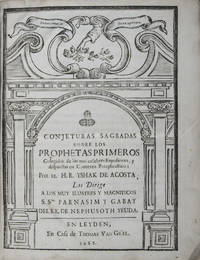
réf. 43872Leyden Leiden: Thomas van Ge'el 5482. First edition. Hardcover. f to vg. Quarto 9 3/4 x 8". 8 426 1 blank leaf 1 leaf Second title 427-906pp. Contemporary full calf with gold lettering and tooling to spine. Raised bands. Contemporary previous owner's inscription on front free endpaper: "Ce livre appartient à moi Isaac de Mozes. Celui qui le trouvera aura à bonté de moi le . en lui donnant une pièce de six sols pour la peine. Le 4 février 1730." Signed Eliez de Mozes. This book belongs to me Isaac de Mozes. The one who finds it and returns it to me will be given a coin of six sols. Dated February 4 1730. Illustrated titles within woodcut order. Decorative head- tailpieces and initials. Published by Isaac de Acosta "Conjecturas Sagradas sobre los Profetos primeros" Sacred Conjectures on the First Prophets is a commentary in Spanish on the Early Prophets based on the classical Hebrew commentators and the Midrash. It contains a new translation and a paraphrase of Joshua Judges Samuel and Kings. Binding heavily rubbed with tail of spine missing. Sporadic clear water staining at upper margin of a few pages never affecting lettering. Some minor worming along inner margin of pages 635 on not affecting lettering. Fly leaf at rear partly disbound. Text in Spanish. Binding in overall poor to fair interior in good to very good condition. About the author: Isaac Yhsak de Acosta - d. 1728 was a French Sephardi rabbi. Probably a native of Amsterdam Acosta became hazzan of the Jewish community of Peyrehorade near Bayonne formed by Marrano fugitives from the Iberian Peninsula. His "Historia Sacra Real" 1691 dedicated to the wardens of the community is one of the earliest manifestations of Judaism in this place. Later apparently after an interlude in Biarritz he succeeded R. Hayyim de Mercado as hakham at Bayonne where he composed his handbook for the administration of the last rites to the dying "Via de Salvacion" 1709; reprinted by M. Kaplan Bayonne 1874 and his major work "Conjeturas Sagradas" Leyden 1722 a commentary in Spanish on the Early Prophets based on the classical Hebrew commentators and the Midrash. Thomas van Ge'el hardcover
1950réf. 25105New York: Gnome Press 1950. Cloth. Near Fine. An unusually bright well-preserved copy of the 1950 stated 1st edition of Isaac Asimov's 2nd published work preceded only by "Pebble in the Sky" also published in 1950. Clean and Near Fine in its dark-red cloth with no writing or markings of any kind internally. Lacking its original dustjacket but still truly a collector's copy in such superb condition. Gnome Press unknown
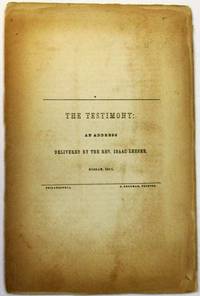
1851réf. 36329Philadelphia: C. Sherman Printer 1851. Original front title wrapper stitched. 2 19 1 blank pp lacking the rear wrapper. Toned some shallow blank edge chipping and light wear. Good with some Hebrew printing in text. The caption title reads: 'An Address Delivered at the Schoolhouse of the Hebrew Education Society of Philadelphia at the First Opening of Their School on Sunday the 4th of Nissan 5611 April 6th 1851 by Isaac Leeser.' "This address celebrated the opening of the day school launched by the Hebrew Education Society of Philadelphia the first of its kind in the city" Swann Catalog September 2019 Lot 120. "Leeser was the driving force behind the founding in 1846 of the Hebrew Education Society of Philadelphia chartered for 'the establishment of a school or schools within . Philadelphia in which are to be taught the elementary branches of education together with the sciences and modern and ancient languages always in combination with instruction in Hebrew language literature and religion.' In his address at its official opening delivered at the Society's schoolhouse on Sunday the 4th of Nissan 5611 April 6th 1851 Leeser expressed great hopes for the new Philadelphia Day School. 'We propose to combine elementary and afterwards scientific education with a gradual and progressive acquirement of Hebrew Hebrew literature and religion. It is not to be as in other schools a secondary matter whether the children learn Hebrew and religion or not but they are to acquire these even if nothing else can be imparted' p. 12." Sotheby catalog 2014 09239-20. Singerman 1195. Not in Goldman. OCLC 21968696 5- JTS U PA AJHS Hebrew Union College 1340131282 1- Princeton as of August 2023. C. Sherman, Printer unknown
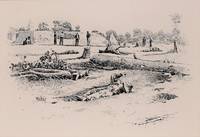
1884réf. W2434New York: The Century Co. 1884. The image is 4 5/8 inches by 7 1/4 inches on artist board measuring 14 1/2 inches by 12 1/4 inches. Original ink drawing by Walton Taber 1857-1933 after a post-battle photograph. The scene shows dead Confederate soldiers in front of Battery Robinette on October 5 1862 the morning after the battle at Corinth Mississippi. Civil War historians J. Matthew Gallman and Gary W. Gallagher attributed the photograph to Ohio born and Corinth based photographer George Washington Armistead . However the Library of Congress has a virtually identical photographic negative that is attributed to Nicholas D. Brown. Although the photographer's identity remains uncertain it is clear that the drawing is by Walton Taber and is signed by him in the lower left corner of the image. Taber did the drawing for the Century Company who published it on page 751 of volume 2 of Battles and Leaders of the Civil War. This drawing along with others by Taber that were included in the Century Collection of Civil War Art was auctioned by Christie's in New York in 1988. Born in New Bedford Massachusetts Taber was one of the most important American illustrators during the late nineteenth and early twentieth centuries. His pen and ink drawings provided the Century Company almost 250 illustrations for Battles and Leaders. The drawing offered here is in near fine condition: clean and bright on artist board that is lightly and uniformly toned on the recto; there is some minor soiling on the verso along with notations made by Century editors and a later framer. The drawing is now archivally matted and ready for a 16" by 16" frame. SIGNED. Original. Single Sheet. Near Fine. Illus. by Isaac Walton Taber. 4 5/8" by 7 1/4". Fine Art Print. The Century Co.
1799réf. 58181London: Printed for John Stockdale 1799. Travels in the United States and Canada in the 1790s Weld an Irishman arrived in Philadelphia in late 1795 at the age of nineteen. His observations during two years of travels through eastern North America and Canada told through a series of letters comprise one of the most popular narratives of the day. Story wrote that "his account of Canada letters 21-25 is a clear and sustained description of an area and a way of life that pleased him more than had the United States." Weld made one trip south as far as Virginia as well as crossing Pennsylvania and New York. He said that he left the United States "without a sigh and without entertaining the slightest wish to revisit it." The engraved plates are after sketches by the author. The map with its borders and those of the states colored by hand shows the East Coast of America south through North Carolina with an inset map of South Carolina and west through the Great Lakes region. Quarto. Contemporary tree calf spine gilt in compartments with green morocco gilt label. Wear to extremities and edges of boards joints just starting but still strong. One-inch closed tear to right margin of folding map no loss of text a few fingerprints occasional light foxing heavier in margins of plates. Very good. CLARK II:132. ESTC T110539. GAGNON I:3701. HOWES W235. LANDE 890. JCB II:4062. SABIN 192541. SCHEIDLEY 170. TPL 708. REESE FEDERAL HUNDRED 78. hardcover
1859réf. 82600Cincinnati: Bloch & Co 1859. First edition of American Reform Rabbi Isaac Mayer Wise's historical account of the era of Herod I. Octavo contemporary cloth over boards lacking the front free endpaper library bookplate to the front pastedown later collector's stamps to the title page with some rubbing and wear to the extremities. In good condition. Rare. American reform rabbi editor and author Isaac Mayer Wise established the first synagogue in the United States to include a mixed-gender choir family pews and count women in forming a quorum. Published in 1847 his Manhag American prayer-book was adopted and became the standard prayer book in most congregations throughout the Western and Southern states. He additionally published over two dozen works on the history of Judaism and Christianity including The Martyrdom of Jesus of Nazareth Judaism and Christianity: Their Agreements and Disagreements and The Cosmic God. Bloch & Co hardcover
1850réf. 68036Northumberland NY and Tuolumne County CA. 1850–1857. New Yorker in the "Land of Gold" A scattered but intriguing collection of manuscripts related to New York native Isaac Vanderwerker or Vanderwarker who made for the California gold mines in 1850 and remained out west until at least 1857. This group consists primarily of letters written to Isaac by his brother at home in Northumberland inquiring after Isaac's activities in the gold fields and commenting on matters at home though it also contains a detailed letter from Isaac himself a letter from his ill-fated sister Joann and two letters written by business partners in California. The earliest letter here written by Isaac's brother who signs only with initials is dated October 7 1850 shortly after Isaac arrived in California. Isaac was apparently one of many gold-seekers who elected to take a slow sailing ship from Panama rather than wait on the heavily delayed steamships though he weathered the journey better than most. Isaac's brother also notes several acquaintances who "have returned without making their fortune" and still more who are leaving regularly for the mines including a "Justus" who "made a vendue and sold his personal property" in order to fund the journey. Everyone in town it seems either wants to head to California or has an excuse not to. "I hope you will be one of the lucky ones and get well paid for all your toil sufferings and anxieties" he writes to his brother. "We have most of the California news every month. I saw in the last paper an account of the riot and burning of Sacramento City it spoke of some large lumps of gold being taken out weighing from one to forty pounds at Carsons new diggings on the Stanislaw another instance where a man took out four thousand dollars in two days at Murphy diggings but these cases are something extra John L. Cramer is at the Northern Mines on the Yuba…." The Vanderwerkers were early settlers of upstate New York and appear to have done well for themselves – Isaac and his brother are involved in several substantial properties and much of their correspondence relates to the management of their farms. The next letter in the group comes from the following summer written by Isaac's sister Joann. Joann discusses more details of the family's properties and notes that her health is poor enough that she is not sure to see the end of the week. Regardless news of California remains at front of mind: "There is a story in circulation that Aron Bliss Jaines Brother in law has stoll 15 thousand dollars at San Francisco and the owner has followed him here and there a going to take him back and hang him. John Cramer is on the yube never his Father said he guest by his writing he was not doing very well." From here we skip two years to October 16 1853 when Isaac's brother writes to tell him that large numbers are still heading for California. Joann has been holding on the last two years and "Old Frank" who used to work with them before moving to Canada would like to know if Isaac has work for him in California. He also goes on to discuss a bit of contentious New York politics: "We shall have five state tickets this fall viz whig Barnburner or soft hunker Adamantine or hard Temperance & abolition. The whigs no dout will carry the Election. The Barnburners had quite a majority in the State Convention….the Canal board are Barnburners & they are making a clean sweep of the hunkers." The letters continue over the next few years regarding more transcontinental legal matters real estate dealings Joann's eventual death in 1855 and the usual litany of deaths and marriages at home. The most content rich letter in the group is the only one written by Isaac himself sent to New York from Tuolumne County on May 18 1857. As Isaac describes his life in the west he also reveals himself to be a talented writer: "Dear Brother I will again endeavour to correspond with you by a few rude caught characters on paper which may put you in mind that you have a Brother Still in the land of gold…." He sends some gold home not present describes a chance meeting with the aforementioned John Cramer remarks on the high cost of goods in the mines and recent fires in San Francisco and Stockton. Business isn't cheap in the "land of gold" and he claims he "can do as much business in the States for 10 Dollars as I can Here for one Hundred." With that in mind he adds a postscript stating that he has sold out his plot and mining apparatus for $1500 and will try to go into business burning lime or supplying bricks and lumber in Benicia. He describes the new town and the rapid pace of development in California: "Benicia is situated about thirty miles up the Bay from San Francisco and about Six miles from the present Capital of the state named Vallejo. About three months ago the first building was erected which is a Hotel about two weeks ago they commenced building there is now about twenty small houses up and one three story Hotel. The government officers reside at Vallejo after the 10 of this month. I had an introduction to the governor at Vallejo last week he is a clever sort of man but not Dignified hardly fit for the Station…." Isaac's brother responds to this letter a few months later curious about his sibling's new business ventures. He also comments that "by what I can learn of the character of the Mexicans and Indians I should hate to travel alone without being well armed. I see by our papers that Lynch Law is that that governs all the mines I saw an account of a man being hung at San Francisco by Mr. Lynch at short notice." Unsurprisingly more and more are returning home by 1857 including a man named Wells " come in the same steamer your letter did he was sick but made out to keep up till he got home and died less than a week after he was not very successful in California." A heartfelt letter from a friend about the health of Isaac's mother also present seems to have convinced him and Isaac returned home for a visit to New York in the latter part of 1857. A September 3rd letter from his business partner John W. Kelly sent from Sawmill Flatt is addressed to Isaac in Saratoga and discusses business dealings in California. It would appear Isaac never pulled completely out of mining as the letter regards efforts to secure mortgage payments for Isaac's "ditch." The final letter in this collection is dated December 17 1857 and is addressed to Isaac from the offices of A.C. Goodrich in Columbia California. Goodrich describes a large flume his company has built 180 miles long and twelve feet wide by three feet deep "exclusive of the artificial embankment or five hundred ton stream capacity this day and night as we have reservoirs in abundance to hold the night & Sunday water. Would give 1000 ton streams which sold at the precent price viz $4.00 per day would pay ten per cent on a Capital of $1000.000. This would give a large basis for waste and reduction in price and still leave room for handsome profits on our Capital stock of $450000. The present cost of the work we can only approximate to but it is not far from 100000$." They hope that Isaac can become their agent and help them find investors. An interesting group of letters sent between brothers in California and New York during the Gold Rush stretching across seven long years of separation. Old folds occasional light tanning and staining. Very good. unknown books
réf. 43872Leyden Leiden: Thomas van Ge'el 5482. First edition. Hardcover. f to vg. Quarto 9 3/4 x 8". 8 426 1 blank leaf 1 leaf Second title 427-906pp. Contemporary full calf with gold lettering and tooling to spine. Raised bands. Contemporary previous owner's inscription on front free endpaper: "Ce livre appartient à moi Isaac de Mozes. Celui qui le trouvera aura à bonté de moi le . en lui donnant une pièce de six sols pour la peine. Le 4 février 1730." Signed Eliez de Mozes. This book belongs to me Isaac de Mozes. The one who finds it and returns it to me will be given a coin of six sols. Dated February 4 1730. Illustrated titles within woodcut order. Decorative head- tailpieces and initials. Published by Isaac de Acosta "Conjecturas Sagradas sobre los Profetos primeros" Sacred Conjectures on the First Prophets is a commentary in Spanish on the Early Prophets based on the classical Hebrew commentators and the Midrash. It contains a new translation and a paraphrase of Joshua Judges Samuel and Kings. Binding heavily rubbed with tail of spine missing. Sporadic clear water staining at upper margin of a few pages never affecting lettering. Some minor worming along inner margin of pages 635 on not affecting lettering. Fly leaf at rear partly disbound. Text in Spanish. Binding in overall poor to fair interior in good to very good condition. About the author: Isaac Yhsak de Acosta - d. 1728 was a French Sephardi rabbi. Probably a native of Amsterdam Acosta became hazzan of the Jewish community of Peyrehorade near Bayonne formed by Marrano fugitives from the Iberian Peninsula. His "Historia Sacra Real" 1691 dedicated to the wardens of the community is one of the earliest manifestations of Judaism in this place. Later apparently after an interlude in Biarritz he succeeded R. Hayyim de Mercado as hakham at Bayonne where he composed his handbook for the administration of the last rites to the dying "Via de Salvacion" 1709; reprinted by M. Kaplan Bayonne 1874 and his major work "Conjeturas Sagradas" Leyden 1722 a commentary in Spanish on the Early Prophets based on the classical Hebrew commentators and the Midrash. Thomas van Ge'el hardcover books
1950réf. 25105New York: Gnome Press 1950. Cloth. Near Fine. An unusually bright well-preserved copy of the 1950 stated 1st edition of Isaac Asimov's 2nd published work preceded only by "Pebble in the Sky" also published in 1950. Clean and Near Fine in its dark-red cloth with no writing or markings of any kind internally. Lacking its original dustjacket but still truly a collector's copy in such superb condition. Gnome Press unknown books
1851réf. 36329Philadelphia: C. Sherman Printer 1851. Original front title wrapper stitched. 2 19 1 blank pp lacking the rear wrapper. Toned some shallow blank edge chipping and light wear. Good with some Hebrew printing in text. The caption title reads: 'An Address Delivered at the Schoolhouse of the Hebrew Education Society of Philadelphia at the First Opening of Their School on Sunday the 4th of Nissan 5611 April 6th 1851 by Isaac Leeser.' "This address celebrated the opening of the day school launched by the Hebrew Education Society of Philadelphia the first of its kind in the city" Swann Catalog September 2019 Lot 120. "Leeser was the driving force behind the founding in 1846 of the Hebrew Education Society of Philadelphia chartered for 'the establishment of a school or schools within . Philadelphia in which are to be taught the elementary branches of education together with the sciences and modern and ancient languages always in combination with instruction in Hebrew language literature and religion.' In his address at its official opening delivered at the Society's schoolhouse on Sunday the 4th of Nissan 5611 April 6th 1851 Leeser expressed great hopes for the new Philadelphia Day School. 'We propose to combine elementary and afterwards scientific education with a gradual and progressive acquirement of Hebrew Hebrew literature and religion. It is not to be as in other schools a secondary matter whether the children learn Hebrew and religion or not but they are to acquire these even if nothing else can be imparted' p. 12." Sotheby catalog 2014 09239-20. Singerman 1195. Not in Goldman. OCLC 21968696 5- JTS U PA AJHS Hebrew Union College 1340131282 1- Princeton as of August 2023. C. Sherman, Printer unknown books
1799réf. 58181London: Printed for John Stockdale 1799. Travels in the United States and Canada in the 1790s Weld an Irishman arrived in Philadelphia in late 1795 at the age of nineteen. His observations during two years of travels through eastern North America and Canada told through a series of letters comprise one of the most popular narratives of the day. Story wrote that "his account of Canada letters 21-25 is a clear and sustained description of an area and a way of life that pleased him more than had the United States." Weld made one trip south as far as Virginia as well as crossing Pennsylvania and New York. He said that he left the United States "without a sigh and without entertaining the slightest wish to revisit it." The engraved plates are after sketches by the author. The map with its borders and those of the states colored by hand shows the East Coast of America south through North Carolina with an inset map of South Carolina and west through the Great Lakes region. Quarto. Contemporary tree calf spine gilt in compartments with green morocco gilt label. Wear to extremities and edges of boards joints just starting but still strong. One-inch closed tear to right margin of folding map no loss of text a few fingerprints occasional light foxing heavier in margins of plates. Very good. CLARK II:132. ESTC T110539. GAGNON I:3701. HOWES W235. LANDE 890. JCB II:4062. SABIN 192541. SCHEIDLEY 170. TPL 708. REESE FEDERAL HUNDRED 78. hardcover books
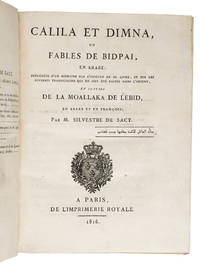
1816réf. ABC_50110Paris 1816. 4to. Imprimerie Royale 19th-century purple-ish cloth with the title lettered in gold on the spine. The cloth around the spine is faded and browned. 2 parts in 1 volume. 2 VIII 140; 8 315 1 pp. The complete text of the Arabic version by Ibn al Muqaffa of this collection of animal fables with didactic overtones designed to illustrate wise conduct printed in the beautiful types of the "Imprimerie Royale" with an introduction and critical notes in French. The typeface based on Arab or Turkish specimens of calligraphy and cut in Rome in the early 17th century for Savary "was the mainstay of Arabic typography in France until the late 19th century; it also provided a model for others" Roper p. 145.The spine is sunned occasional browning and foxing. Otherwise in good condition.l Blois "Kalila wa-Dimna" in: Meisami & Starkey Enyclopedia of Arabic literature pp. 423-425; Chauvin II p. 11f. no. 17; Keith-Falconer Kalilah and Dimnah pp. xvi-xvii; cf. G. Roper Early Arabic Printing in Europe in: Middle Eastern Languages and the Print Revolution. A Cross-Cultural Encounter Westhofen 2002 pp. 129-150. hardcover
réf. 8863Amsterdam, J. Frédéric Bernard, 1734-1739. 2 volumes in-8 (196 x 242 mm), 2 ff. n. ch., LXXVI pp., 594 pp. ; VIII pp., XXXIV pp., 806 pp. Maroquin rouge, triple filet d'encadrement avec fers, dos à nerfs orné, pièce de titre en maroquin citron, filet sur les coupes et les coiffes, roulette intérieure, tranches dorées sur marbrure, rares rousseurs (reliure de l'époque).
1740réf. 102648?Paris, Debure?, 1740, in-4, XXX-[2]-148-[2] pp, Veau havane marbrée, dos à nerfs orné de caissons dorés, pièce de titre rouge, tranches rouges, Édition originale de la traduction française par Buffon dont le nom n'est mentionné que dans les Extraits des registres de l'Académie royale des sciences, in fine. Elle est traduite sur la traduction anglaise de John Colson parue en 1736 (sans son commentaire), elle-même traduite sur l'édition originale en latin de Newton qui ne fut jamais publiée. Elle est illustrée de figures en noir dans le texte. Dans sa longue préface, il explique vouloir donner un "Newton clair, plus traitable, & à la portée du commun des géomètres", donne une courte notice historique des mathématiques pré-newtoniennes, critique sévèrement ses rivaux, notamment lorsqu'il évoque la controverse avec Liebniz et expose la méthode de calcul de Newton. Dans cet ouvrage le célèbre physicien anglais expose sa méthode de calcul infinitésimal dans sa première partie, lui donne une notation propre et propose ses applications dans la seconde. Bien que cet ouvrage fut relativement confidentiel lors de sa rédaction et sa première circulation via manuscrits, il est aujourd'hui reconnu comme fondamental dans l'histoire des mathématiques. Petits manques et épidermures, quelques taches. Complet de son errata. Gray, 236; Babson, 173. Couverture rigide
1815réf. 275647New York: New-York Courier 1815. First. pamphlet. 21 pages printed with text in double columns. Original pamphlet sewn dampstain at upper corner and rough at edges but well inside the ample margins; some pages still un-opened. New York: At the Office of the New-York Courier 1815. First edition. A very good copy of this exceedingly scarce pamphlet. OCLC lists only 13 copies including those at Columbia Cornell Yale Harvard and the New York Historical Society. Attributed to Isaac Bronson by F. Redlich in "The Molding of American Banking" 1868 volume 1 page 308. "Isaac Bronson was a highly successful financier of the Jacksonian era who was also one of the period's most original and influential banking theorists. Bronson accumulated his very considerable fortune in New York primarily by judicious personal money-lending operations on long-term bonds and mortgages at a cautious 7 per cent annual return supplemented by successful ventures in land speculation. In addition to wealth he had by the 1830's acquired a weighty reputation for sober financial conservatism and was regarded as an authoritative exponent of sound banking principles. Prominent in the financial community he had long thrown his weight as a sound banking theorist against the "wild-cat" practices of the then rampant state banks." --Venit A. 1945. The Journal of Economic History New-York Courier unknown
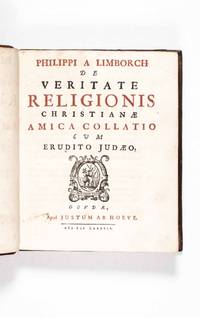
1687réf. 48832Gouda: Justus van der Hoeve 1687. First edition. Hardcover. Fine. Three parts quarto. asterisk-2 asterisk4 A-3A4 3B = 197 leaves; K2 signed H2. 16 364 14 indexpp. Title in red and black printed marginalia woodcut tailpieces. Contemporary paneled calf expertly rebacked to style gilt lettering piece. Occasional touch of mild foxing else a fine crisp amply-margined copy. First edition of this remarkable collection modeled on a work of Hugo Grotius with the same title including the transcription of an epistolary debate between the Dutch theologian Phillip van Limborch 1633-1712 and the Jewish scholar Isaac Orobio de Castro ca.1617-1687. Jonathan Israel views the work as "a key exemplum of the new 'enlightened' method of upholding Christianity." Limborch was a leading Dutch theologian aligned with the Arminians and professor in the Seminary of the Remonstrants at Amsterdam. Orobio de Castro had been Professor of Theology at Salamanca who was imprisoned by the Inquisition on account of his sympathy with the Jews of Spain. He fled the country going first to France and then to Holland where he abjured Christianity and became deeply involved in the philosophico-religious controversies in the Low Countries. In the present work Limborch publishes three letters written by Orobio de Castro along with his own detailed responses. In arguing against the "truth" of the Christian religion "Orobio retorted that the advent of Christ has done nothing to render mankind less sinful or to lessen suffering that the rise of Christianity far from being unparalleled was surpassed by the expansion of Islam. and that far from being unchallengeable Christ's miracles had not been performed publicly like the miracle at Mount Sinai but virtually in secret a circumstance which renders them entirely dubious. These responses and his further claims that the New Testament is unreliable providing no basis for trust in Christ's miracles since the text exists only in Greek a language neither Jesus nor the Apostles had the slightest knowledge of. made no impact on Limborch Le Clerc or Locke who were convinced of their triumph over Orobio. Nevertheless Orobio's arguments were fully and objectively reported in the text and subsequently widely read across Europe and some of those who read it were not so sure that Orobio was 'vanquished'. Boulainvilliers who meticulously examined the text concluded that Limborch's arguments were less securely grounded on reason than he and his allies supposed and that even without their realizing it it was Orobio who won the contest a verdict echoed in other anti-Christian clandestine philosophical literature of the early eighteenth century" Israel. Edited from a manuscript formerly in the possession of the Leiden professor of theology Simon Episcopius and now in the University Library Amsterdam the Exemplar Humanae Vitae is the autobiography of the Portuguese Jew Uriel da Costa ca.1585-1640 who was excommunicated from the Sephardi Jewish community of Hamburg in 1618 after addressing a polemical broadside to the leaders of the Sephardi congregation of Venice in which he criticized rabbinic Judaism as incompatible with the Torah. He later settled in Amsterdam where he submitted to a public recantation of his views before the Portuguese Jewish congregation and committed suicide shortly thereafter. A radical freethinker who here makes an imposing plea against dogmatics da Costa may be viewed as a forerunner of Spinoza. An English translation was published at London in 1740; a complete edition of his few works was edited in 1922 by Carl Gebhardt Schriften des Uriel da Costa and published as the second volume of the Bibliotheca Spinozana. At the conclusion Limborch offers his refutation of da Costa's challenge to revealed religion. References: Bamberger no. 67. Fürst 1:17. De Graaf Cat. 70: Spiritualists Nonconformists & Dissenters no. 360. J. Israel Radical Enlightenment OUP 2001 esp. pp. 464-466. Oscott Catalogues: Recusant Books part 2 no. 2286; The Old Library part 2: Bible Collections no. 895. For Da Costa's Exemplar cf. Roth B18.30 citing the English version of 1740. The work was already scarce and much sought after in the early modern era as evidenced by: DeBure Theology no. 583: "ouvrage estime & recherche les exemplaires en sont peu communs" and Osmont Dictionnaire vol. 1 p.406: "rare et estimé." In his 1694 catalogue of Christian Hebraic works Bibliotheca Latino-Hebraica Carlo Imbonati offers a surprisingly long discussion of De Veritate on pp. 201-209. Justus van der Hoeve hardcover
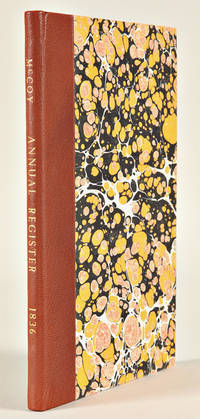
1836réf. 43669Shawanoe Baptist Mission Ind. Ter. KS: J. Meeker 1836. Early Survey of Native Tribes in the West and an Early Kansas Imprint The second number of McCoy's The Annual Register of which only four numbers were ever printed containing valuable first-hand particulars regarding the western Indian tribes. McCoy first visited the Prairies in 1828 with follow-up tours during the next three years. In 1831 he settled at the Shawanoe Mission in 1831 which had been founded by Lykins earlier that year. During the following years McCoy travelled widely in the western country. In 1835 he had Jothan Meeker who had established a press at the Mission a year earlier print the initial number of The Annual Register. McCoy's works are full of information regarding the Indian emigrant's introduction into the new country and provide details concerning many tribes e.g. Pawnee Otoe Omaha Cherokee Delaware Kickapoo Osage Kansas etc. Also included are descriptions of the military posts within Indian Territory conditions of various tribes etc. Complete sets of the four numbers are rarely met with; even the Streeter set lacked the first number. Printing began in Kansas in 1834 and McCoy's Annual Registers are the first works of any substance printed in the state. Modern half morocco and marbled boards spine gilt. A bit of light foxing. Very good. SABIN 43111. HOWES M67 "aa." FIELD 983. GRAFF 2586. STREETER SALE 544 ref. McMURTRIE & ALLEN Meeker 41. hardcover
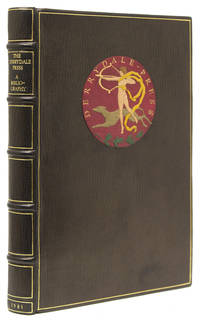
réf. 309874Goshen CT: The Angler's & Shooter's Press 1981. Letter S of 26 copies of the Large Paper De Luxe Edition on handmade Crown & Sceptre paper. With photoengraved frontispiece and an additional engraved title page specially produced by Richard Benson with calligraphy by Stephen Harvard and illustrations printed by The Meriden Gravure Company. 1 vols. 8vo. Original full black morocco with a six-color morocco onlay on upper cover panelled spine with gilt title t.e.g. others uncut by Gray Parrot with his label on rear pastedown. Very fine in original morocco-backed folding case. Letter S of 26 copies of the Large Paper De Luxe Edition on handmade Crown & Sceptre paper. With photoengraved frontispiece and an additional engraved title page specially produced by Richard Benson with calligraphy by Stephen Harvard and illustrations printed by The Meriden Gravure Company. 1 vols. 8vo. The beautiful deluxe issue of the standard essential bibliography. The Angler's & Shooter's Press unknown
1740réf. 39297Paris, De Bure, 1740. 4to. Contemporary half calf, raised bands, richly gilt spine and and red speckled edges. Leather title-label to spine. Corners neatly repaired. Title in red/black. (2), III-XXX, (2) Errata, 148 pp., many diagrams. The ""Preface"" and the first 18 leaves of the text with a foxing to lower margin and right corners. The ""Preface"" is an historical account of Newton's method ""la sublime méthode"", written by Buffon. Without the leaf ""Extrait des Registres"".
1740réf. 39297Paris De Bure 1740. 4to. Contemporary half calf raised bands richly gilt spine and and red speckled edges. Leather title-label to spine. Corners neatly repaired. Title in red/black. 2 III-XXX 2 Errata 148 pp. many diagrams. The "Preface" and the first 18 leaves of the text with a foxing to lower margin and right corners. The "Preface" is an historical account of Newton's method "la sublime méthode" written by Buffon. Without the leaf "Extrait des Registres". The influential first French edition of Newton's important work which constitutes the most extensive description of the mathematical method he used in his famous "Principia" the method of infinitesimals which was already written about 1671 but not published until 1736 i.e. posthumously with the title "Method of Fluxions and Infinite Series.". In this work "Newton stated clearly the fundamental problem of the calculus: the relation of quantities being given to find the relation of the fluxions of these and conversely. In conformity with this problem and the new notation Newton then gave examples of his method.In this book Newton introduced his characteristic notation and conceptions. He regarded his variable quantities as generated by the continuous motion of points lines and planes rather than as aggregates of infinitesimal elements the view which had appeared in "De analysi".The rate of generation Newton called a "fluxion" designating it by means of a letter with a dot over it a "pricked letter" the quantity generates he called a "fluent". Boyer The History of the Calculus.Colson in his preface to the first edition from 1736 says: "I gladly embraced the opportunity that was put into my hands of publishing this posthumous work because I found it had been composed with that view and design. And that my own Country-men might first enjoy the benefit of this publication I resolved upon giving it an English translation with some additional remarks of my own I thought it highly injurious to the memory and reputation of the real Author as well as invidious to the glory of our own Nation that so curious and useful a piece should be any longer suppress'd and confined to a few private hands which ought to be communicated to all the learned World for general Instruction.It was through the French translations of his works that Newton came to play the seminal role as the most important of mathematicians that he did in France and particularly the years around 1740 when the present work appeared in French for the first time were seminal to the scientific development in France where the likes of Voltaire had only just made the nation acquinted with the work of the great mathematician. Gray No 236. Babson No 173. hardcover
1815réf. 275647New York: New-York Courier 1815. First. pamphlet. 21 pages printed with text in double columns. Original pamphlet sewn dampstain at upper corner and rough at edges but well inside the ample margins; some pages still un-opened. New York: At the Office of the New-York Courier 1815. First edition. A very good copy of this exceedingly scarce pamphlet. OCLC lists only 13 copies including those at Columbia Cornell Yale Harvard and the New York Historical Society. Attributed to Isaac Bronson by F. Redlich in "The Molding of American Banking" 1868 volume 1 page 308. "Isaac Bronson was a highly successful financier of the Jacksonian era who was also one of the period's most original and influential banking theorists. Bronson accumulated his very considerable fortune in New York primarily by judicious personal money-lending operations on long-term bonds and mortgages at a cautious 7 per cent annual return supplemented by successful ventures in land speculation. In addition to wealth he had by the 1830's acquired a weighty reputation for sober financial conservatism and was regarded as an authoritative exponent of sound banking principles. Prominent in the financial community he had long thrown his weight as a sound banking theorist against the "wild-cat" practices of the then rampant state banks." --Venit A. 1945. The Journal of Economic History New-York Courier unknown books
1687réf. 48832Gouda: Justus van der Hoeve 1687. First edition. Hardcover. Fine. Three parts quarto. asterisk-2 asterisk4 A-3A4 3B = 197 leaves; K2 signed H2. 16 364 14 indexpp. Title in red and black printed marginalia woodcut tailpieces. Contemporary paneled calf expertly rebacked to style gilt lettering piece. Occasional touch of mild foxing else a fine crisp amply-margined copy. First edition of this remarkable collection modeled on a work of Hugo Grotius with the same title including the transcription of an epistolary debate between the Dutch theologian Phillip van Limborch 1633-1712 and the Jewish scholar Isaac Orobio de Castro ca.1617-1687. Jonathan Israel views the work as "a key exemplum of the new 'enlightened' method of upholding Christianity." Limborch was a leading Dutch theologian aligned with the Arminians and professor in the Seminary of the Remonstrants at Amsterdam. Orobio de Castro had been Professor of Theology at Salamanca who was imprisoned by the Inquisition on account of his sympathy with the Jews of Spain. He fled the country going first to France and then to Holland where he abjured Christianity and became deeply involved in the philosophico-religious controversies in the Low Countries. In the present work Limborch publishes three letters written by Orobio de Castro along with his own detailed responses. In arguing against the "truth" of the Christian religion "Orobio retorted that the advent of Christ has done nothing to render mankind less sinful or to lessen suffering that the rise of Christianity far from being unparalleled was surpassed by the expansion of Islam. and that far from being unchallengeable Christ's miracles had not been performed publicly like the miracle at Mount Sinai but virtually in secret a circumstance which renders them entirely dubious. These responses and his further claims that the New Testament is unreliable providing no basis for trust in Christ's miracles since the text exists only in Greek a language neither Jesus nor the Apostles had the slightest knowledge of. made no impact on Limborch Le Clerc or Locke who were convinced of their triumph over Orobio. Nevertheless Orobio's arguments were fully and objectively reported in the text and subsequently widely read across Europe and some of those who read it were not so sure that Orobio was 'vanquished'. Boulainvilliers who meticulously examined the text concluded that Limborch's arguments were less securely grounded on reason than he and his allies supposed and that even without their realizing it it was Orobio who won the contest a verdict echoed in other anti-Christian clandestine philosophical literature of the early eighteenth century" Israel. Edited from a manuscript formerly in the possession of the Leiden professor of theology Simon Episcopius and now in the University Library Amsterdam the Exemplar Humanae Vitae is the autobiography of the Portuguese Jew Uriel da Costa ca.1585-1640 who was excommunicated from the Sephardi Jewish community of Hamburg in 1618 after addressing a polemical broadside to the leaders of the Sephardi congregation of Venice in which he criticized rabbinic Judaism as incompatible with the Torah. He later settled in Amsterdam where he submitted to a public recantation of his views before the Portuguese Jewish congregation and committed suicide shortly thereafter. A radical freethinker who here makes an imposing plea against dogmatics da Costa may be viewed as a forerunner of Spinoza. An English translation was published at London in 1740; a complete edition of his few works was edited in 1922 by Carl Gebhardt Schriften des Uriel da Costa and published as the second volume of the Bibliotheca Spinozana. At the conclusion Limborch offers his refutation of da Costa's challenge to revealed religion. References: Bamberger no. 67. Fürst 1:17. De Graaf Cat. 70: Spiritualists Nonconformists & Dissenters no. 360. J. Israel Radical Enlightenment OUP 2001 esp. pp. 464-466. Oscott Catalogues: Recusant Books part 2 no. 2286; The Old Library part 2: Bible Collections no. 895. For Da Costa's Exemplar cf. Roth B18.30 citing the English version of 1740. The work was already scarce and much sought after in the early modern era as evidenced by: DeBure Theology no. 583: "ouvrage estime & recherche les exemplaires en sont peu communs" and Osmont Dictionnaire vol. 1 p.406: "rare et estimé." In his 1694 catalogue of Christian Hebraic works Bibliotheca Latino-Hebraica Carlo Imbonati offers a surprisingly long discussion of De Veritate on pp. 201-209. Justus van der Hoeve hardcover books