Soyer, Moses; Et AlBiblio.com

8 316 résultats
1977réf. 83678New Republic Books. As New. Hardcover. FREE UPGRADE to Courier/Priority Shipping Upon Request - IN STOCK AND IMMEDIATELY AVAILABLE FOR SHIPMENT - AS NEW THE TEXT BLOCK IS PRISTINE CLEAN UNMARKED AND IN EXCELLENT CONDITION - - xiv 2 316 pages 39 illustrations; 4to. -- with a bonus offer-- . 1977. 0915220334 . New Republic Books hardcover
1972réf. 62166Art Center. As New. Paperback. FREE UPGRADE to Courier/Priority Shipping Upon Request – – IN STOCK AND IMMEDIATELY AVAILABLE FOR SHIPMENT - AS NEW THE TEXT BLOCK IS PRISTINE CLEAN UNMARKED AND IN EXCELLENT CONDITION - - 48 pp. With 40 ills. 28 x 22 cm. -- with a bonus offer-- . 1972. Art Center paperback
réf. 16267New York: G. P. Putnam's Sons. As New. Hardcover. FREE UPGRADE to Courier/Priority Shipping Upon Request - IN STOCK AND IMMEDIATELY AVAILABLE FOR SHIPMENT - Text pristine & unmarked - Corresponds to / earlier edition of ISBN: 0781298539 -- with a bonus offer--; 016267; Tyler Moses Coit Three Men of Letters : George Berkeley and His American Visit; A Great College President and What He Wrote; The Literary Strivings of Mr. Joel Barlow . 1895. G. P. Putnam's Sons hardcover
1970réf. 52421Cranbury New Jersey U. S. A.: A. S. Barnes & Co. . As New. Hardcover. FREE UPGRADE to Courier/Priority Shipping Upon Request – – IN STOCK AND IMMEDIATELY AVAILABLE FOR SHIPMENT - Text pristine clean & unmarked tight to the spine - 48 page mongraph of text followed by plates with 127 illustrations many in color -- with a bonus offer-- . 1970. 0498064611 . A. S. Barnes & Co. hardcover
1996réf. 68400University of California Press. New. Paperback. FREE UPGRADE to Courier/Priority Shipping Upon Request - IN STOCK AND IMMEDIATELY AVAILABLE FOR SHIPMENT - Flawless copy brand new pristine never opened -- 132 pp. With 79 ills. 75 col. . 31 x 23 cm. -- with a bonus offer--; 0.4 x 11.8 x 8.9 Inches . 1996. 0914357425 . University of California Press paperback
réf. X03OS-00049Z. Tehinka. Collectible - Acceptable. New York: Z. Tehinka 1943. Reprint of 1680 edition. Volume 1. Folio. 28pp. Maps. Fair book. Spine cover missing. Board covers considerably chipped though without text loss. Front board detached. Preface through p. 26 detached. Poland maps history travel Inquire if you need further information. Z. Tehinka unknown
réf. X03OS-00050Z. Tehinka. Collectible - Acceptable. New York: Z. Tehinka 1943. Reprint of 1680 edition. Volume 1. Folio. 28pp. Maps. Fair book. Bottom 6" of both boards dampstained. Poland maps history travel Inquire if you need further information. Z. Tehinka hardcover
réf. X03OS-00049Z. Tehinka. Collectible - Acceptable. New York: Z. Tehinka 1943. Reprint of 1680 edition. Volume 1. Folio. 28pp. Maps. Fair book. Spine cover missing. Board covers considerably chipped though without text loss. Front board detached. Preface through p. 26 detached. Poland maps history travel Inquire if you need further information. Z. Tehinka unknown books
réf. X03OS-00050Z. Tehinka. Collectible - Acceptable. New York: Z. Tehinka 1943. Reprint of 1680 edition. Volume 1. Folio. 28pp. Maps. Fair book. Bottom 6" of both boards dampstained. Poland maps history travel Inquire if you need further information. Z. Tehinka hardcover books
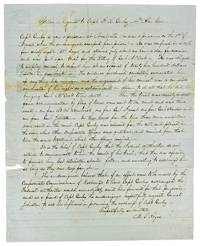
1864réf. 49788N.p. 1864. Very Good. N.p.: 1864. Manuscript letter written in ink signed by Royce at the end and on the verso. Single leaf 26.5x21cm; chips and rubbing; a few closed tears with archival tape repairs; Very Good. An unusual insightful document highlighting the laws of war and murder during the Civil War. Royce's petition seeks justice for Confederate Captain Frank R. Gurley sent to the Confederate Commission of Exchange. Its author Confederate Captain Moses Strong Royce was captured in Tennessee and imprisoned at Nashville. Gurley Royce's cell-mate had killed Union General Robert McCook of Ohio near Huntsville Alabama in August 1862. In October 1863 Union forces captured Gurley and charged him with murdering McCook. Gurley Union officials claimed was a guerrilla who shot McCook while the General was lying in an ambulance. Southerners claimed that Gurley was not a guerrilla but a regular soldier in the Confederacy's 4th Alabama Cavalry and that he killed McCook according to the laws of war. Harper's Weekly and Frank Leslie's Illustrated Newspaper fanned the flames claiming that lawless Confederate guerrillas murdered the general; feelings ran high. "US General Grant wrote CS General Hardee in December of 1863 and said that although Gurley was a member of the Confederate army that did not preclude him from being tried for having committed a foul murder" online Huntsville-Madison County Public Library essay 'Frank B. Gurley's 1866 Diary'. Having escaped from prison in March 1864 Royce plead Gurley's case. "He was confined in a cell for sixty-eight days and allowed only about one hour a day for exercise and was put upon trial for the killing of Genl. McCook. He was obliged to employ counsel to defend himself at an expense of 2500 dollars in greenbacks. The evidence produced completely exonerated him of anything like murder and the argument of his counsel was a complete vindication of his right as a soldier and an officer to do all that he did in bringing Genl. McCook to his death. "When the trial was nearly ended four communications by flag of truce were sent to the court and were there read - one from Lt. Col. Hambrick one from Genl. Forrest one from Genl. Hardee and one from Genl. Johnston" assuring that Gurley was not a guerrilla but a duly enrolled member of the Confederate military forces. Nevertheless Gurley was found guilty and sentenced to death. "The undersigned believes that if an effort were to be made by the Confederate Commission of Exchange to have Capt. Gurley exchanged the Federal authorities would immediately send him forward for that purpose and as a friend of Capt. Gurley the undersigned respectfully requests General Johnston to use his influence in procuring the exchange of Capt. Gurley. Respectfully submitted M. S. Royce." Even after War's end the dispute continued. Gurley having been released from prison in an administrative snafu was re-arrested charged but finally released and placed on parole in April 1866. . unknown
1864réf. 49788N.p. 1864. Very Good. N.p.: 1864. Manuscript letter written in ink signed by Royce at the end and on the verso. Single leaf 26.5x21cm; chips and rubbing; a few closed tears with archival tape repairs; Very Good. An unusual insightful document highlighting the laws of war and murder during the Civil War. Royce's petition seeks justice for Confederate Captain Frank R. Gurley sent to the Confederate Commission of Exchange. Its author Confederate Captain Moses Strong Royce was captured in Tennessee and imprisoned at Nashville. Gurley Royce's cell-mate had killed Union General Robert McCook of Ohio near Huntsville Alabama in August 1862. In October 1863 Union forces captured Gurley and charged him with murdering McCook. Gurley Union officials claimed was a guerrilla who shot McCook while the General was lying in an ambulance. Southerners claimed that Gurley was not a guerrilla but a regular soldier in the Confederacy's 4th Alabama Cavalry and that he killed McCook according to the laws of war. Harper's Weekly and Frank Leslie's Illustrated Newspaper fanned the flames claiming that lawless Confederate guerrillas murdered the general; feelings ran high. "US General Grant wrote CS General Hardee in December of 1863 and said that although Gurley was a member of the Confederate army that did not preclude him from being tried for having committed a foul murder" online Huntsville-Madison County Public Library essay 'Frank B. Gurley's 1866 Diary'. Having escaped from prison in March 1864 Royce plead Gurley's case. "He was confined in a cell for sixty-eight days and allowed only about one hour a day for exercise and was put upon trial for the killing of Genl. McCook. He was obliged to employ counsel to defend himself at an expense of 2500 dollars in greenbacks. The evidence produced completely exonerated him of anything like murder and the argument of his counsel was a complete vindication of his right as a soldier and an officer to do all that he did in bringing Genl. McCook to his death. "When the trial was nearly ended four communications by flag of truce were sent to the court and were there read - one from Lt. Col. Hambrick one from Genl. Forrest one from Genl. Hardee and one from Genl. Johnston" assuring that Gurley was not a guerrilla but a duly enrolled member of the Confederate military forces. Nevertheless Gurley was found guilty and sentenced to death. "The undersigned believes that if an effort were to be made by the Confederate Commission of Exchange to have Capt. Gurley exchanged the Federal authorities would immediately send him forward for that purpose and as a friend of Capt. Gurley the undersigned respectfully requests General Johnston to use his influence in procuring the exchange of Capt. Gurley. Respectfully submitted M. S. Royce." Even after War's end the dispute continued. Gurley having been released from prison in an administrative snafu was re-arrested charged but finally released and placed on parole in April 1866. . unknown books
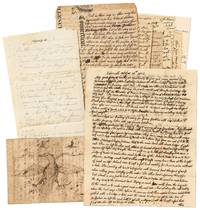
1834réf. 436962Connecticut New York Ohio 1834. Very Good. A small archive consisting of one two-page narrative letter and 10 loose sheets about 20 holograph pages of miscellaneous writings by Moses Kimball including one page with pen and ink illustrations. Modest toning and a few tiny tears three manuscript sheets are partially split at the folds including one with a neat Japanese paper tape repair about very good overall. Born in Connecticut in 1741 Moses Kimball served in the Revolutionary War as a soldier under Brigadier General Samuel McClellan 1781-82. A devout Universalist he taught navigation and civil engineering and was a prosperous land owner in Norwich Connecticut. The letter and miscellaneous writings of poetry and short sermons retained here date from the last two years of his life when he left Connecticut to live with a grandson in Norwalk Ohio. In the letter written to a friend in Connecticut Kimball describes in detail his 15-day journey undertaken in May 1835 from Poquetanuck to Norwalk: He left via sloop for Albany then traveled along the Erie Canal and completed the last leg of the trip by steamer on Lake Erie. In his verse and short sermons he lays out his strong Universalist beliefs and philosophy of life. He died happy at the age of 93 in December 1835 just a few weeks after his arrival in Norwalk. A few extracts from the letter together with a sample of his verse follows: 1. ALS. 2pp. Small quarto. Norwalk October 14th 1835. Addressed to John Harkness at Preston Connecticut: "My good friend having an opportunity to give you some account of my journey to this place I gladly embrace it. It is a beautiful country suitable for farming a rich soil . We have an academy of learning for young gentlemen with 108 scholars and another for young ladies with 98 female scholars . We left Poquetanuck the 11 day of May & arrived at my Grandson Moses Kimball's the 25 of May. We went in a sloop . to Albany there I saw great improvements . They have made an Island in the river half a mile long . forming a basin between that & the main land with draw bridges at each end. There we left the sloop and entered on board a canal boat and past on our way drawn by horses day and night. Thus we past on up to Little Falls . and so on to Fort Stanwix . there at the height of land we left the Mohawk River and past a flat level country for 60 or 70 miles without a lock. The country all low and intersected with drowned land . and all along this wet country where the land rose a little . there would be some inhabitants settled with a bridge or two over the canal . when we got to Lake Erie at Buffalo we left the canal boat and got into a steam boat the largest vessel that I ever saw . this boat that cost thirty-five thousand dollars my grandson Moses owns one-tenth part . When we came over the lake . there were seven hundred passengers in her . So you see it is no wonder she earns money . ." 2. Miscellaneous Verses and Short Sermons 1834-35: 10 octavo sheets/about 20 holograph pages including one page with pen and ink illustrations. The following is quoted from a poem written by Kimball on his ninety-third birthday "May 17 A.D. 1834": This day my years are Ninety-three The time is past & gone from me Brought into being here to stay To wait for time to pass away . And when my earthly body dies To God my spirit will arise And live with him and there remain Till Souls to bodies join again . A compelling and historically important small archive of writings that also serve as a testament to Kimball's remarkable physical health and mental acuity. unknown
1834réf. 436962Connecticut New York Ohio 1834. Very Good. A small archive consisting of one two-page narrative letter and 10 loose sheets about 20 holograph pages of miscellaneous writings by Moses Kimball including one page with pen and ink illustrations. Modest toning and a few tiny tears three manuscript sheets are partially split at the folds including one with a neat Japanese paper tape repair about very good overall. Born in Connecticut in 1741 Moses Kimball served in the Revolutionary War as a soldier under Brigadier General Samuel McClellan 1781-82. A devout Universalist he taught navigation and civil engineering and was a prosperous land owner in Norwich Connecticut. The letter and miscellaneous writings of poetry and short sermons retained here date from the last two years of his life when he left Connecticut to live with a grandson in Norwalk Ohio. In the letter written to a friend in Connecticut Kimball describes in detail his 15-day journey undertaken in May 1835 from Poquetanuck to Norwalk: He left via sloop for Albany then traveled along the Erie Canal and completed the last leg of the trip by steamer on Lake Erie. In his verse and short sermons he lays out his strong Universalist beliefs and philosophy of life. He died happy at the age of 93 in December 1835 just a few weeks after his arrival in Norwalk. A few extracts from the letter together with a sample of his verse follows: 1. ALS. 2pp. Small quarto. Norwalk October 14th 1835. Addressed to John Harkness at Preston Connecticut: "My good friend having an opportunity to give you some account of my journey to this place I gladly embrace it. It is a beautiful country suitable for farming a rich soil . We have an academy of learning for young gentlemen with 108 scholars and another for young ladies with 98 female scholars . We left Poquetanuck the 11 day of May & arrived at my Grandson Moses Kimball's the 25 of May. We went in a sloop . to Albany there I saw great improvements . They have made an Island in the river half a mile long . forming a basin between that & the main land with draw bridges at each end. There we left the sloop and entered on board a canal boat and past on our way drawn by horses day and night. Thus we past on up to Little Falls . and so on to Fort Stanwix . there at the height of land we left the Mohawk River and past a flat level country for 60 or 70 miles without a lock. The country all low and intersected with drowned land . and all along this wet country where the land rose a little . there would be some inhabitants settled with a bridge or two over the canal . when we got to Lake Erie at Buffalo we left the canal boat and got into a steam boat the largest vessel that I ever saw . this boat that cost thirty-five thousand dollars my grandson Moses owns one-tenth part . When we came over the lake . there were seven hundred passengers in her . So you see it is no wonder she earns money . ." 2. Miscellaneous Verses and Short Sermons 1834-35: 10 octavo sheets/about 20 holograph pages including one page with pen and ink illustrations. The following is quoted from a poem written by Kimball on his ninety-third birthday "May 17 A.D. 1834": This day my years are Ninety-three The time is past & gone from me Brought into being here to stay To wait for time to pass away . And when my earthly body dies To God my spirit will arise And live with him and there remain Till Souls to bodies join again . A compelling and historically important small archive of writings that also serve as a testament to Kimball's remarkable physical health and mental acuity. unknown books
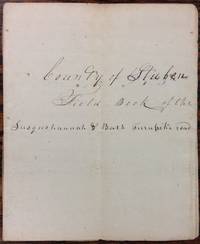
1805réf. BOOKS288628--/No Dustjacket. 1805. 8vo. self wraps 6 leaves. A survey beginning at an oak tree on the line of Tioga County. This is for mile 82 going west to mile 104 and to a post in Morris Street in Bath. The ink records on 6 pages show Bearings Distance and Remarks. Most of the remarks are from trees. This is certified by Moses Van Campen and T. N. Miller Commissioners on August 30th. 1805. . paperback
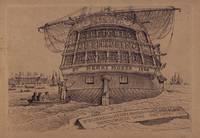
1824réf. 55402London: Henry Moses 1824. First edition. Hardcover. Very good to fine condition. Oblong Octavo. 20 etchings plus original illustrated wrappers. Bound in Royal blue leather retaining original wraps; gilt lettering and ruling on leather label mounted to spine. Cream endpapers. Tan wrappers with etching and brown lettering on front back cover plain. Our collection of "Sketches of Shipping" on the River Thames appears to be the earliest state published by Henry Moses with front wrappers dated Dec. 1 1824 and all twenty etchings dated in plates Oct. 1 1824. An 1826 advertisement in the Quarterly Review indicated that six parts of the Sketches with five engravings each had been published up to that time and announces the publication of two additional issues. The front wrapper stating publication date as Dec. 1 1824 as in our copy appears to have been used in various editions including some containing eleven plates dated March 1 1825 in plates or lettered in ink "Nos. 5 & 6" corresponding to the 1826 Quarterly Review advertisement. The irregularities and/or contradictions in tracing the publication of these Moses etchings suggest that due to the constrictions of the medium these popular etchings were published in limited numbers in variant editions as identified by the dates in these plates to satisfy the public demand of the time. In our copy all 20 etchings are dated in plates Oct. 1 1824 with two of the plates containing additional dates etched into the plates as indicated below: 1. Sailing Match Aug. 16 1824 2. An Indianian in Barnard's Yard Deptford 3. Trafalgar 120 G 125 4. Midway 5. Midway Aug. 9 1824 6. Blackwall. Dutches of M. 7. Blackwall Basin 8. Trafalgar P - 120 Guns 9. Sheerness Yard from a Window of the Fountain Inn 10. Sheerness 11. Sheerness Yard from a window of the Fountain Inn variant motif 12. Trafalgar 120 Guns 13. Trafalgar in the Basin Sheerness 14. Hulks at Sheerness 15. Blackwall 16. Untitled 17. City Canal 18. Basin at Blackwall 19. Blackwall - Wellington Indiaman 20. Surat Castle All etchings but plate 12 with H. Moses printed to plate. Plate twelve with Henry Moses. Printed by Chatfield and Coleman. Inked name and date on front free endpaper. "12/." inked to upper foredge corner of cover; this with a few small damp stains on front and back covers. OCLC lists an 1837 copy with 57 plates incl. 2 engraved title pages published in London by Ackermann a 1824 copy with nineteen plates 1825 and 1837 copies with thirty plates the latter published by Ackermann an 1837 copy titled "The Marine Sketch Book" with twenty-eight plates an 1826 copy with nine plates titled Sketches of Shipping: View in Portsmouth Harbour" and an 1827 copy with thirty plates titled "Shipping at Portsmouth and Spithead" publisher W. B. Cooke. Henry Moses hardcover
1824réf. 55402London: Henry Moses 1824. First edition. Hardcover. Very good to fine condition. Oblong Octavo. 20 etchings plus original illustrated wrappers. Bound in Royal blue leather retaining original wraps; gilt lettering and ruling on leather label mounted to spine. Cream endpapers. Tan wrappers with etching and brown lettering on front back cover plain. Our collection of "Sketches of Shipping" on the River Thames appears to be the earliest state published by Henry Moses with front wrappers dated Dec. 1 1824 and all twenty etchings dated in plates Oct. 1 1824. An 1826 advertisement in the Quarterly Review indicated that six parts of the Sketches with five engravings each had been published up to that time and announces the publication of two additional issues. The front wrapper stating publication date as Dec. 1 1824 as in our copy appears to have been used in various editions including some containing eleven plates dated March 1 1825 in plates or lettered in ink "Nos. 5 & 6" corresponding to the 1826 Quarterly Review advertisement. The irregularities and/or contradictions in tracing the publication of these Moses etchings suggest that due to the constrictions of the medium these popular etchings were published in limited numbers in variant editions as identified by the dates in these plates to satisfy the public demand of the time. In our copy all 20 etchings are dated in plates Oct. 1 1824 with two of the plates containing additional dates etched into the plates as indicated below: 1. Sailing Match Aug. 16 1824 2. An Indianian in Barnard's Yard Deptford 3. Trafalgar 120 G 125 4. Midway 5. Midway Aug. 9 1824 6. Blackwall. Dutches of M. 7. Blackwall Basin 8. Trafalgar P - 120 Guns 9. Sheerness Yard from a Window of the Fountain Inn 10. Sheerness 11. Sheerness Yard from a window of the Fountain Inn variant motif 12. Trafalgar 120 Guns 13. Trafalgar in the Basin Sheerness 14. Hulks at Sheerness 15. Blackwall 16. Untitled 17. City Canal 18. Basin at Blackwall 19. Blackwall - Wellington Indiaman 20. Surat Castle All etchings but plate 12 with H. Moses printed to plate. Plate twelve with Henry Moses. Printed by Chatfield and Coleman. Inked name and date on front free endpaper. "12/." inked to upper foredge corner of cover; this with a few small damp stains on front and back covers. OCLC lists an 1837 copy with 57 plates incl. 2 engraved title pages published in London by Ackermann a 1824 copy with nineteen plates 1825 and 1837 copies with thirty plates the latter published by Ackermann an 1837 copy titled "The Marine Sketch Book" with twenty-eight plates an 1826 copy with nine plates titled Sketches of Shipping: View in Portsmouth Harbour" and an 1827 copy with thirty plates titled "Shipping at Portsmouth and Spithead" publisher W. B. Cooke. Henry Moses hardcover books
réf. Z1-F-061-00166Nabu Press. Used - Like New. Used - Like New. This is a reproduction of an out of print title. This book may have occasional imperfections such as missing or blurred pages poor pictures errant marks etc. that were either part of the original artifact or were introduced by the scanning process. Ships from UK in 48 hours or less usually same day. Your purchase helps support Sri Lankan Children's Charity 'The Rainbow Centre'. 100% money back guarantee. We are a world class secondhand bookstore based in Hertfordshire United Kingdom and specialize in high quality textbooks across an enormous variety of subjects. We aim to provide a vast range of textbooks rare and collectible books at a great price. Our donations to The Rainbow Centre have helped provide an education and a safe haven to hundreds of children who live in appalling conditions. We provide a 100% money back guarantee and are dedicated to providing our customers with the highest standards of service in the bookselling industry. Nabu Press unknown
1661réf. 116711Leiden: Jean Elsevier 1661. Iron Arm First edition of the first significant - and conspicuously scarce - biography of the "Huguenot paladin" François de La Noue 1531-1591 one of the great Protestant captains of the 16th-century Wars of Religion; an attractive copy with an appealing naval provenance. The distinguished American historian John Lothrop Motley described La Noue as "not only one of the most experienced soldiers but one of the most accomplished writers of his age" Motley p. 480. At the siege of Fontenay in 1570 his left arm was shattered by a bullet and a mechanic fitted an iron limb that earned him the sobriquet of "Bras-de-fer" - "Iron Arm". He was a correspondent of Sir Philip Sidney and acknowledged by Montaigne in the Essais "for his goodness gentleness of manner and scrupulous courtesy. He is an important figure with regard to his political and religious affiliations as well as with regard to his Discours politiques et militaires 1587" Heitsch p. 134. The author Moïse Amyraut 1596-1664 was one of the leading French Protestant theologians of his day who numbered William Penn among his many students. The book is decidedly uncommon commercially and thinly represented institutionally: Library Hub cites 10 copies in British and Irish institutional libraries we have also located a copy at the Royal Collection; WorldCat locates no copies outside of European libraries. Provenance: armorial Elden Hall bookplate of Augustus Viscount Keppel 1725-1786 naval officer and politician: "a sailor from the age of 10 Keppel served actively throughout the Seven Years War 1756-63. In 1762 he served under Admiral Sir George Pocock in the British expedition that took Havana and he received £25000 in prize money as a result. He became a rear admiral in 1762 and vice admiral in 1770" Encyclopaedia Britannica online. ODNB describes him as an "outstanding" naval officer "especially in combined operations". Also with the 20th-century bookplate of Robert J. Hayhurst Lancashire retail chemist and bibliophile whose main library of naval history was complemented by a subsidiary collection of 18th-century literature in well-preserved contemporary bindings. Small quarto 190 x 144 mm. With 2 folding genealogical tables; Elsevir's device on title page. Early 18th-century English speckled calf decorative gilt spine with red morocco label red speckled edges. Head of spine chipped front joint split but sound corners a little worn one or two slight scrapes or abrasions. A very good copy. STC French A426. Dorothea B. Heitsch Practising Reform in Montaigne's Essais 2000; John Lothrop Motley The Rise of the Dutch Republic vol. III 1855. unknown
1936réf. 29494M. Arct | Warszawie 1936 | 18 x 25.50 cm | broché
1932réf. 89945Georges Crès, coll. "Les oeuvres représentatives" | Paris 1932 | 12 x 19 cm | Broché
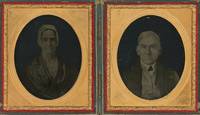
1854réf. List1708Philadelphia 1854. Ninth plate ambrotypes in a union case measuring 2 ½ x 2 ⅛ inches visible in larger case. With the identification of Isaac Rehn with his imprint and "Patented July 4 & 11 1854" imprinted on the case. A fine pair. A striking pair of ambrotypes of Mary and Moses Pennock who were members of the Kennett Square Underground Railroad network as well as active members of the Kennett Square abolitionist and Quaker community. Moses was one of the founders of the Longwood Progressive Meeting. In R.C. Smedley's History of the Underground Railroad in Chester and Neighboring Counties of Pennsylvania Lancaster Office of the Journal 1883 the Pennocks are mentioned on p. 301 as working as part of the network surrounding Isaac and Thamazine Meredity. Their son Samuel who would go on to secure important agricultural patents is also mentioned twice. The images are notable from a photographic history perspective as well as being early examples of the ambrotype process that had been patented in part by fellow Quaker and spiritualist Isaac Rehn. Rehn held a partial patent on ambrotypes along with James Ambrose Cutting of Boston and became unpopular among other photographers for his efforts to extend his patent. He later practiced spiritual photography and was a Professor of Chemistry at Pennsylvania Medical University in Philadelphia. Rehn was also involved in radical politics as a founder and leader of the Philadelphia section of the International Workingmen's Association which was later disenfranchised by Karl Marx along with several other American sections. Examples of Rehn's work are held at the National Gallery of Art the Library Company of Philadelphia and Yale's Sterling Memorial Library. Overall a very fine and significant pair of images. unknown books
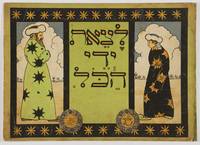
1920réf. 52940Moscow/Odessa: Omanut 1920. First edition. Softcover. g- to g. Oblong octavo. Unpaginated 8 double-sided leaves front and back wrappers printed on both sides. Stiff tan paper wrappers with beautiful chromolithographic illustrations in hues of green blue black and brown. Issued by the pioneering Hebrew-language published house Omanut. This lavishly illustrated work is a version of the Aesop's fable often known as "The Miller His Son and the Donkey" in a version said to have been adapted by Leo Tolstoy with Hebrew translation attributed to the acclaimed Hebrew-language writer and essayist Ahad Ha-Am Asher Zvi Ginsberg 1856-1957 although the work is completely uncredited. Here the work's title has been humorously translated into Hebrew as "To Please Everyone". The text is accompanied throughout by 8 large and vibrant chromolithographic images including the front and back wrappers. The illustrations are credited collectively to "Havurat Tsayarim" The Group of Painters a group of four young artists from the Odessa Art Academy who illustrated works for Omanut during the period comprised of Yakov Apter 1899-1941 Moses Mutselmakher 1900-1961 Aaron Keravatsov 1896-1942 and Efim Khiger 1899-1955. This work is part of the Gamliel Library series of beautiful picture books for children introduced by Omanut co-founder Shoshana Zlatopolsky Persitz and named after her son Gamliel. Persitz took inspiration from the rich tradition of Russian children's literature lavishly illustrated in chromolithographs produced by the likes of Ivan Bilibin and the publishing house of Iosif Knebel to create some of the earliest examples of comparable works in Hebrew. No publication date is given but the fact that this is one of a smaller number of earlier titles issued before the move of the publisher Omanut to Frankfurt points to the fact it could not have been published after 1921. Text throughout in Hebrew. Wrappers with some foxing and staining. Some rubbing and creasing to extremities. Back cover lightly soiled with a light vertical crease in the center. The binding has been re-cased with a sting-binding along the spine to secure the book block. Water staining and light foxing to pages throughout predominantly in the margins. Images still vibrant. Wrappers in good- interior in good condition overall. Quite scarce. Hebrew title: ‌לצ×ת ידי הכל Author/contributors: חבורת-×¦×™×¨×™× ×פטר מוצלמכר קרבצוב חגר ×יזופוס לב טולסטוי ×חד ×”×¢× Publication: מוסקבה-×ודיסה הוצ×ת ××ž× ×•×ª Series title: ספריה גמלי×ל Alternate transliteration: La'tset Yede Ha'kol. Omanut unknown
1920réf. 52940Moscow/Odessa: Omanut 1920. First edition. Softcover. g- to g. Oblong octavo. Unpaginated 8 double-sided leaves front and back wrappers printed on both sides. Stiff tan paper wrappers with beautiful chromolithographic illustrations in hues of green blue black and brown. Issued by the pioneering Hebrew-language published house Omanut. This lavishly illustrated work is a version of the Aesop's fable often known as "The Miller His Son and the Donkey" in a version said to have been adapted by Leo Tolstoy with Hebrew translation attributed to the acclaimed Hebrew-language writer and essayist Ahad Ha-Am Asher Zvi Ginsberg 1856-1957 although the work is completely uncredited. Here the work's title has been humorously translated into Hebrew as "To Please Everyone". The text is accompanied throughout by 8 large and vibrant chromolithographic images including the front and back wrappers. The illustrations are credited collectively to "Havurat Tsayarim" The Group of Painters a group of four young artists from the Odessa Art Academy who illustrated works for Omanut during the period comprised of Yakov Apter 1899-1941 Moses Mutselmakher 1900-1961 Aaron Keravatsov 1896-1942 and Efim Khiger 1899-1955. This work is part of the Gamliel Library series of beautiful picture books for children introduced by Omanut co-founder Shoshana Zlatopolsky Persitz and named after her son Gamliel. Persitz took inspiration from the rich tradition of Russian children's literature lavishly illustrated in chromolithographs produced by the likes of Ivan Bilibin and the publishing house of Iosif Knebel to create some of the earliest examples of comparable works in Hebrew. No publication date is given but the fact that this is one of a smaller number of earlier titles issued before the move of the publisher Omanut to Frankfurt points to the fact it could not have been published after 1921. Text throughout in Hebrew. Wrappers with some foxing and staining. Some rubbing and creasing to extremities. Back cover lightly soiled with a light vertical crease in the center. The binding has been re-cased with a sting-binding along the spine to secure the book block. Water staining and light foxing to pages throughout predominantly in the margins. Images still vibrant. Wrappers in good- interior in good condition overall. Quite scarce. Hebrew title: ‌לצ×ת ידי הכל Author/contributors: חבורת-×¦×™×¨×™× ×פטר מוצלמכר קרבצוב חגר ×יזופוס לב טולסטוי ×חד ×”×¢× Publication: מוסקבה-×ודיסה הוצ×ת ××ž× ×•×ª Series title: ספריה גמלי×ל Alternate transliteration: La'tset Yede Ha'kol. Omanut unknown books
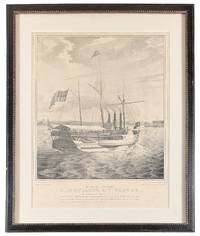
1828réf. 42606Boston: Pendleton's Lithography 1828. Uncoloured lithograph. Framed size: 19 1/4 x 15 5/8 inches. An early American marine lithograph depicting the steam packet Chancellor Livingston entering Newport Harbor issued at the outset of steam navigation on the New England coast. Published in Boston by Pendleton's Lithography after a design by Moses Swett this print presents the Chancellor Livingston under way as it enters Newport Harbor with passengers visible along the decks and flags flying from the rigging. The composition combines a detailed vessel portrait with a wider harbour view situating the steamer within a recognizable coastal setting and emphasizing both its scale and activity. The vessel itself held a prominent place in early American steam navigation. Originally associated with Robert Fulton's Hudson River operations the Chancellor Livingston was rebuilt in 1827 for service between New York and Providence. The lithograph records this later phase of its career when coastal steam travel was expanding rapidly and such vessels were becoming a familiar presence along the northeastern seaboard. The printed text beneath the image reinforces the promotional aspect of the print listing the vessel's dimensions horsepower boilers and fittings as well as its passenger capacity and accommodations. This combination of technical specification and visual representation places the image at the intersection of ship portraiture and commercial advertisement reflecting the contemporary interest in steam technology and its practical advantages. As a product of Pendleton's Lithography the print also belongs to the earliest phase of lithographic production in the United States. Established in Boston in the 1820s the firm was among the first to adopt the medium on a sustained basis and works such as this illustrate both the technical possibilities of lithography and its application to subjects of current interest. The present impression reflects that early moment when lithography was emerging as a flexible and effective means of producing images of modern life and technology. Pendleton's Lithography unknown
1828réf. 42606Boston: Pendleton's Lithography 1828. Uncoloured lithograph. Framed size: 19 1/4 x 15 5/8 inches. An early American marine lithograph depicting the steam packet Chancellor Livingston entering Newport Harbor issued at the outset of steam navigation on the New England coast. Published in Boston by Pendleton's Lithography after a design by Moses Swett this print presents the Chancellor Livingston under way as it enters Newport Harbor with passengers visible along the decks and flags flying from the rigging. The composition combines a detailed vessel portrait with a wider harbour view situating the steamer within a recognizable coastal setting and emphasizing both its scale and activity. The vessel itself held a prominent place in early American steam navigation. Originally associated with Robert Fulton's Hudson River operations the Chancellor Livingston was rebuilt in 1827 for service between New York and Providence. The lithograph records this later phase of its career when coastal steam travel was expanding rapidly and such vessels were becoming a familiar presence along the northeastern seaboard. The printed text beneath the image reinforces the promotional aspect of the print listing the vessel's dimensions horsepower boilers and fittings as well as its passenger capacity and accommodations. This combination of technical specification and visual representation places the image at the intersection of ship portraiture and commercial advertisement reflecting the contemporary interest in steam technology and its practical advantages. As a product of Pendleton's Lithography the print also belongs to the earliest phase of lithographic production in the United States. Established in Boston in the 1820s the firm was among the first to adopt the medium on a sustained basis and works such as this illustrate both the technical possibilities of lithography and its application to subjects of current interest. The present impression reflects that early moment when lithography was emerging as a flexible and effective means of producing images of modern life and technology. Pendleton's Lithography unknown books