Mendelssohn, MosesBiblio.com

8 316 résultats
réf. 81390Berlin Christian Friedrich Voss beides 1755. Kl.8° 1 Bl. Titelvignette 108 S.; Titelvignette 210 S. Paginierungssprung von Seite 143 auf 145 3 Bl. HPerg. d. Zeit Berieben mit handschriftlichem verblasstem Schild a. Rücken. Auf Vorsatz Bibliothekskleber Bibliotheksstempel Bibliothek des Rabbiner-Seminars Berlin a. Titelblatt verso. Etwas angeschmutzt u. fingerfleckig min. wasserrändig u. stockfleckig. Der Band umfasst die ersten beiden Schriften des jüdisch-deutschen Philosophen. «Philosophische Gespräche» Goed. IV/1 488 6. Meyer Mendelssohn 112; «Ueber die Empfindungen» Goed. IV/1 487 1. Meyer Mendelssohn 79Auf dem Vorsatz zwei hübsche Marginalien von alter Hand: «Der Verfasser Herr Moses solle ein gelehrter Jude und Buchhalter bey einem jüdischen Kaufmann in Berlin seyn.»Und von anderer Hand: «Zustehende Bücher sind von Herrn Moses Mendelssohn.»«Ueber die Empfindungen» Erste Ausgabe der zweiten Veröffentlichung Mendelssohns ein theoretisches Hauptwerk zur Ästhetik der Aufklärungsepoche. Bekannt geworden ist vor allem die ausführliche Diskussion des Selbstmordes und die Problematik seiner theatralischen Inszenierung auf der "Schaubühne". - Moses Mendelssohn 1729 in Dessau; gestorben 1786 in Berlin deutscher Philosoph der Aufklärung und gilt als Wegbereiter der jüdischen Aufklärung - Haskala. 010 Berlin, Christian Friedrich Voss, beides 1755 unknown
réf. 048-Ao.J. Folge von 5 Blatt Kupferstichen, 1606, auf Bütten, Blatt 3 mit Wasserzeichen: Lilienwappen und anhängendem HP (ligiert). Je ca. 26,1:36,6 cm. Literatur: Bartsch 2-6; Wurzbach 2-6 ; Hollstein 30, III (von III): mit Saenredams Adresse. Schöne kontrastreiche Drucke, meist knapp auf die Einfassungslinie geschnitten oder mit winzigem Rändchen um diese. - Kleine Fehlstellen und Einrisse sorgfältig restauriert, vertikale Falten geglättet.
réf. 52511New York City 1808. Fine. Folio 16 by 10 in. - lightly folded once horizontally and twice vertically. 4pp; approx. 1000 words of text on first three pages with address at final page; ruled in light brown ink. A few oxidation spots small tear along central fold at final page above dress no loss of text else clean and fine written in a strong neat hand. Dated November 2 1808 New York City: Moses Gomez 1744/45-1826 son of Rebecca Gomez née De Lucena; the second wife of Mordecai Gomez and a manufacturer of chocolate here acknowledges receipt of $1852.17 from the executors of his mother's estate thereby releasing any additional claim on the estate. This payment was prompted by the death two months earlier of Moses' brother Abraham the eldest living son of Rebecca. The proceeds from the sale of her Nassau property are to be equally divided with Moses' half-sister Rachel Waage the daughter of Mordecai Gomez by his first wife. Moses Gomez refers to the death of his widowed mother Rebecca who in her lifetime had published a last will and testament dated July 21 1798 and died in 1801. In her will she appointed her grandsons Abraham Gomez Jr. and Herman Henricks and friend attorney Henry Kermit executors. Her property on Nassau Street was to be divided among her heirs. Moses Gomez states that according to Rebecca's will during the lifetime of her eldest son Abraham the Nassau property should be leased out from year to year with the monies going to his support and ultimately to pay his funeral expenses. Upon his death the house was be sold. One of the executors of Rebecca's estate Herman Harmon Henricks 1771-1838 was Moses' nephew the son of his sister Eve and was a prominent member of the Henricks copper mining family. Signatures: Moses Gomez twice the second after a brief addendum; Witnesses: John Severidge jun.; Daniel Mack jun. for the addendum. J.R. Rosenbloom A Biographical Dictionary of Early American Jews Univ. Kentucky 1960 p.46; cf. L. Hershkowitz Wills of Early New York Jews pp. 84-91 the will of Mordecai Gomez. unknown
réf. 52511New York City 1808. Fine. Folio 16 by 10 in. - lightly folded once horizontally and twice vertically. 4pp; approx. 1000 words of text on first three pages with address at final page; ruled in light brown ink. A few oxidation spots small tear along central fold at final page above dress no loss of text else clean and fine written in a strong neat hand. Dated November 2 1808 New York City: Moses Gomez 1744/45-1826 son of Rebecca Gomez née De Lucena; the second wife of Mordecai Gomez and a manufacturer of chocolate here acknowledges receipt of $1852.17 from the executors of his mother's estate thereby releasing any additional claim on the estate. This payment was prompted by the death two months earlier of Moses' brother Abraham the eldest living son of Rebecca. The proceeds from the sale of her Nassau property are to be equally divided with Moses' half-sister Rachel Waage the daughter of Mordecai Gomez by his first wife. Moses Gomez refers to the death of his widowed mother Rebecca who in her lifetime had published a last will and testament dated July 21 1798 and died in 1801. In her will she appointed her grandsons Abraham Gomez Jr. and Herman Henricks and friend attorney Henry Kermit executors. Her property on Nassau Street was to be divided among her heirs. Moses Gomez states that according to Rebecca's will during the lifetime of her eldest son Abraham the Nassau property should be leased out from year to year with the monies going to his support and ultimately to pay his funeral expenses. Upon his death the house was be sold. One of the executors of Rebecca's estate Herman Harmon Henricks 1771-1838 was Moses' nephew the son of his sister Eve and was a prominent member of the Henricks copper mining family. Signatures: Moses Gomez twice the second after a brief addendum; Witnesses: John Severidge jun.; Daniel Mack jun. for the addendum. J.R. Rosenbloom A Biographical Dictionary of Early American Jews Univ. Kentucky 1960 p.46; cf. L. Hershkowitz Wills of Early New York Jews pp. 84-91 the will of Mordecai Gomez. unknown books
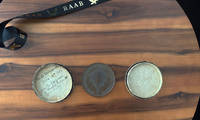
1509réf. 3366415/09/1866. Acquired from the direct descendants of the commander of the vessel that received the medal in Russia it was not known to have survived and has never before been offered for sale Emperor Alexander II issued the Emancipation Manifesto on March 3 1861 which granted freedom to over 23 million serfs. This reform is known as the Emancipation Edict. The Emancipation Proclamation was issued by President Abraham Lincoln on January 1 1863. It declared that all persons held as slaves within the rebellious Confederate states ""are and henceforward shall be free."" The Union victory in the Civil War finalized in 1865 ensured this would become the law of the land. Lincoln and Alexander had something else in common. Lincoln was assassinated in April 1865 by John Wilkes Booth in an act of political violence. The attempted assassination of Alexander II in 1866 was a failed act of political violence by Dmitry Karakozov a young revolutionary. Karakozov's aim was to kill the Tsar and spark a revolution believing the Emperor had betrayed the people's expectations after his emancipation of serfs in 1861. Another attempt around 20 years later would be successful. In 1866 President Andrew Johnson sent Assistant Secretary of the Navy Gustavus Vasa Fox who had played a leading role in the expedition to relieve Fort Sumter in April 1861 on a mission to Russia primarily to deliver a resolution from Congress congratulating Emperor Alexander II on his survival of the assassination attempt. The mission also aimed to gather information on European naval capabilities and explore potential trade opportunities including the sale of the ironclad monitor USS Miantonomoh. The mission was a major event marking a high point in Russian-American friendship and was met with grand receptions in St. Petersburg and Moscow. In the process Johnson sent the ironclad Miantonomoh itself on a world tour with the destination of Russia - first across the Atlantic and through the North Sea the Baltic and then through the Mediterranean in 1866 and 1867. The commander of this vessel was Moses Stuyvesant graduate of the Naval Academy and hero of the Civil War. He had been on two sunk vessels including one taken down by a Confederate Ironclad. But the mission had two messages: to congratulate Russia on the freeing of the serfs and the Tsar on surviving the assassination attempt. The resolution read: “JOINT RESOLUTION relative to the attempted assassination of the Emperor of Russia. “Be it resolved by the Senate and House of Representatives of the United States of America in Congress assembled That the Congress of the United States of America has learned with deep regret of the attempt made upon the life of the Emperor of Russia by an enemy of emancipation. The Congress sends greeting to his Imperial Majesty and to the Russian nation and congratulates the twenty millions of serfs upon the providential escape from danger of the sovereign to whose head and heart they owe the blessings of their freedom. “Sec. 2. And be it further resolved That the President of the United States be requested to forward a copy of this resolution to the Emperor of Russia. “Approved May 16 1866.” In mid Summer the Miantonomoh arrived in the harbor of Cronstadt on the 17th of August and the Tsar sent an address acknowledging the visit of Mr Fox. On Saturday September 15 the fleet went to push off from Russia. Mr. Fox left Petersburg after a farewell breakfast given on Russian yacht Rurik at which the Russian Lieutenant Greig presented the Americans with a symbol of their newly instituted freedoms from slavery in both countries: a medal struck in memory of the enfranchisement of the serfs in Russia. Grieg said ""The friendship of the two nations. among the causes to which is due this mutual spirit is the great event emancipation which has been accomplished almost simultaneously in the two countries - there by a sanguinary struggle here by the path of peace."" He then presents the ""medal struck in memory of the enfranchisement of the peasants.He will see on it the likeness of our sovereign and the effigy of a nobleman and of peasant."" This is that very medal given by the Russians to the Americans to commemorate the freedom of their former slaves presented to the Americans depicting the scene of Alexander II on one side as Grieg says in a case on the inside of which Stuyvesant as commander of the expedition has signed his name and dated it September 15 1866 the day of the presentation of the medal and Grieg's speech and written ""From the Emperor of Russia Alex III"" instead of II. The bronze medal reads: ""FEBRUARY 19 1861 Cut to N. Kozin from the model of count F. Tolstoy. Engraver: Nikolai Kozin"" It is not known how many were made. A small number have reached the market but none akin to this: with the important symbolism of a state gift congratulating a nation on emancipation. This was a gift of one slave-freeing nation to another in the immediate aftermath of those actions. This medal was not known to have survived and comes from the direct descendants of Stuyvesant who received it September 5 1866. <img class=""alignnone wp-image-25018 size-post-window"" src=""https://cdn.raabcollection.com/wp-content/uploads/20231204144051/Folder-site-11-1600x1327.jpg"" alt="""" width=""1600"" height=""1327"" /> unknown
1509réf. 3366415/09/1866. Acquired from the direct descendants of the commander of the vessel that received the medal in Russia it was not known to have survived and has never before been offered for sale Emperor Alexander II issued the Emancipation Manifesto on March 3 1861 which granted freedom to over 23 million serfs. This reform is known as the Emancipation Edict. The Emancipation Proclamation was issued by President Abraham Lincoln on January 1 1863. It declared that all persons held as slaves within the rebellious Confederate states ""are and henceforward shall be free."" The Union victory in the Civil War finalized in 1865 ensured this would become the law of the land. Lincoln and Alexander had something else in common. Lincoln was assassinated in April 1865 by John Wilkes Booth in an act of political violence. The attempted assassination of Alexander II in 1866 was a failed act of political violence by Dmitry Karakozov a young revolutionary. Karakozov's aim was to kill the Tsar and spark a revolution believing the Emperor had betrayed the people's expectations after his emancipation of serfs in 1861. Another attempt around 20 years later would be successful. In 1866 President Andrew Johnson sent Assistant Secretary of the Navy Gustavus Vasa Fox who had played a leading role in the expedition to relieve Fort Sumter in April 1861 on a mission to Russia primarily to deliver a resolution from Congress congratulating Emperor Alexander II on his survival of the assassination attempt. The mission also aimed to gather information on European naval capabilities and explore potential trade opportunities including the sale of the ironclad monitor USS Miantonomoh. The mission was a major event marking a high point in Russian-American friendship and was met with grand receptions in St. Petersburg and Moscow. In the process Johnson sent the ironclad Miantonomoh itself on a world tour with the destination of Russia - first across the Atlantic and through the North Sea the Baltic and then through the Mediterranean in 1866 and 1867. The commander of this vessel was Moses Stuyvesant graduate of the Naval Academy and hero of the Civil War. He had been on two sunk vessels including one taken down by a Confederate Ironclad. But the mission had two messages: to congratulate Russia on the freeing of the serfs and the Tsar on surviving the assassination attempt. The resolution read: “JOINT RESOLUTION relative to the attempted assassination of the Emperor of Russia. “Be it resolved by the Senate and House of Representatives of the United States of America in Congress assembled That the Congress of the United States of America has learned with deep regret of the attempt made upon the life of the Emperor of Russia by an enemy of emancipation. The Congress sends greeting to his Imperial Majesty and to the Russian nation and congratulates the twenty millions of serfs upon the providential escape from danger of the sovereign to whose head and heart they owe the blessings of their freedom. “Sec. 2. And be it further resolved That the President of the United States be requested to forward a copy of this resolution to the Emperor of Russia. “Approved May 16 1866.” In mid Summer the Miantonomoh arrived in the harbor of Cronstadt on the 17th of August and the Tsar sent an address acknowledging the visit of Mr Fox. On Saturday September 15 the fleet went to push off from Russia. Mr. Fox left Petersburg after a farewell breakfast given on Russian yacht Rurik at which the Russian Lieutenant Greig presented the Americans with a symbol of their newly instituted freedoms from slavery in both countries: a medal struck in memory of the enfranchisement of the serfs in Russia. Grieg said ""The friendship of the two nations. among the causes to which is due this mutual spirit is the great event emancipation which has been accomplished almost simultaneously in the two countries - there by a sanguinary struggle here by the path of peace."" He then presents the ""medal struck in memory of the enfranchisement of the peasants.He will see on it the likeness of our sovereign and the effigy of a nobleman and of peasant."" This is that very medal given by the Russians to the Americans to commemorate the freedom of their former slaves presented to the Americans depicting the scene of Alexander II on one side as Grieg says in a case on the inside of which Stuyvesant as commander of the expedition has signed his name and dated it September 15 1866 the day of the presentation of the medal and Grieg's speech and written ""From the Emperor of Russia Alex III"" instead of II. The bronze medal reads: ""FEBRUARY 19 1861 Cut to N. Kozin from the model of count F. Tolstoy. Engraver: Nikolai Kozin"" It is not known how many were made. A small number have reached the market but none akin to this: with the important symbolism of a state gift congratulating a nation on emancipation. This was a gift of one slave-freeing nation to another in the immediate aftermath of those actions. This medal was not known to have survived and comes from the direct descendants of Stuyvesant who received it September 5 1866. <img class=""alignnone wp-image-25018 size-post-window"" src=""https://cdn.raabcollection.com/wp-content/uploads/20231204144051/Folder-site-11-1600x1327.jpg"" alt="""" width=""1600"" height=""1327"" /> unknown books
1916réf. 78127Paris 12 août 1916 | 6.30 x 8.60 cm | une feuille
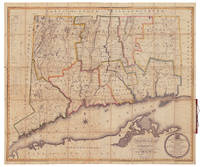
réf. 3387Hartford: Published under the Authority of The General Assembly By Hudson & Goodwin 1812 or 1813. Engraved By Abner Reed E. Windsor. Hand-colored engraving 36.5" x 44.25" plus margins dissected and mounted on linen folding into original 8vo covers half red leather and marbled paper boards gilt title "Connecticut" and gilt rules at spine. CONDITION: Good spotting mainly in the lower left quadrant which seems to be endemic to case map examples as evident in copies at Harvard and the Library of Congress which can be viewed online. The first state of this scarce important and very fine map of Connecticut offered here in desirable case map form with beautiful original color. This large and impressive map depicts the entire state of Connecticut as well as narrow portions of adjacent states the whole of Long Island Sound and part of Long Island. A circular cartouche incorporating the Connecticut coat-of-arms appears in the lower right corner along with a fine calligraphic dedication to Governor Roger Griswold. A handsome compass rose with a fleur-de-lis directional is situated in Long Island Sound near New Haven. A key in the upper left margin identifies some thirty-five points of interest including churches academies court houses gun & pistol factories paper mills distilleries glass works ore beds light houses etc. The last item listed is "Humphrysville - The first extensive successful woolen mill in the country." According to Thompson there is an apparently later state of the map in which this note had been transferred to the site of present day Seymour. Also noted by Thompson are the turnpike roads a recent development and apparently the first to appear on an American map. Warren & Gillett undertook the first survey of the state since William Blodget's map of 1792 carrying out much of the field work themselves but also as Ristow points out likely incorporating manuscript maps from local surveyors as well as other locally provided data. "Though the publication of this map was a private venture the survey had an official sanction. At the May session 1811 of the Connecticut legislature a resolution was passed authorizing Hudson & Goodwin 'at their own expense to prepare and publish from actual survey a map of this state and for that purpose the petitioners are authorised.to pass over the land of individuals in the state.and empowered to examine the records of the state'" Thompson. As the authoritative map of the state the Warren & Gillet map served as the prototype for other maps of Connecticut into the 1840s. Although cataloged by Thompson and others as 1812 the date of publication of this map is somewhat unclear. The inscription to Governor Griswold reads in part "Respectfully Inscribed By the Publishers. Hartford February 1812" but the copyright date is 1813. Also the last governor listed is John Cotton Smith who succeeded Griswold in 1813. Moses Warren 1762-1835 was born in Hopkinton Rhode Island but soon moved with his family to East Lyme Connecticut. He served as a sergeant in the Revolutionary War and surveyed the Western Reserve in 1796. Warren's partner George Gillet 1771-1853 was born in Hebron Connecticut. He was appointed surveyor general of Connecticut following publication of this map. A splendid early map of Connecticut. REFERENCES: Thompson Maps of Connecticut 52; Ristow American Maps & Mapmakers pp. 96-98. Hartford: Published under the Authority of The General Assembly, By Hudson & Goodwin, 1812 [or 1813]. Engraved By Abner Reed, E. unknown
réf. 3387Hartford: Published under the Authority of The General Assembly By Hudson & Goodwin 1812 or 1813. Engraved By Abner Reed E. Windsor. Hand-colored engraving 36.5" x 44.25" plus margins dissected and mounted on linen folding into original 8vo covers half red leather and marbled paper boards gilt title "Connecticut" and gilt rules at spine. CONDITION: Good spotting mainly in the lower left quadrant which seems to be endemic to case map examples as evident in copies at Harvard and the Library of Congress which can be viewed online. The first state of this scarce important and very fine map of Connecticut offered here in desirable case map form with beautiful original color. This large and impressive map depicts the entire state of Connecticut as well as narrow portions of adjacent states the whole of Long Island Sound and part of Long Island. A circular cartouche incorporating the Connecticut coat-of-arms appears in the lower right corner along with a fine calligraphic dedication to Governor Roger Griswold. A handsome compass rose with a fleur-de-lis directional is situated in Long Island Sound near New Haven. A key in the upper left margin identifies some thirty-five points of interest including churches academies court houses gun & pistol factories paper mills distilleries glass works ore beds light houses etc. The last item listed is "Humphrysville - The first extensive successful woolen mill in the country." According to Thompson there is an apparently later state of the map in which this note had been transferred to the site of present day Seymour. Also noted by Thompson are the turnpike roads a recent development and apparently the first to appear on an American map. Warren & Gillett undertook the first survey of the state since William Blodget's map of 1792 carrying out much of the field work themselves but also as Ristow points out likely incorporating manuscript maps from local surveyors as well as other locally provided data. "Though the publication of this map was a private venture the survey had an official sanction. At the May session 1811 of the Connecticut legislature a resolution was passed authorizing Hudson & Goodwin 'at their own expense to prepare and publish from actual survey a map of this state and for that purpose the petitioners are authorised.to pass over the land of individuals in the state.and empowered to examine the records of the state'" Thompson. As the authoritative map of the state the Warren & Gillet map served as the prototype for other maps of Connecticut into the 1840s. Although cataloged by Thompson and others as 1812 the date of publication of this map is somewhat unclear. The inscription to Governor Griswold reads in part "Respectfully Inscribed By the Publishers. Hartford February 1812" but the copyright date is 1813. Also the last governor listed is John Cotton Smith who succeeded Griswold in 1813. Moses Warren 1762-1835 was born in Hopkinton Rhode Island but soon moved with his family to East Lyme Connecticut. He served as a sergeant in the Revolutionary War and surveyed the Western Reserve in 1796. Warren's partner George Gillet 1771-1853 was born in Hebron Connecticut. He was appointed surveyor general of Connecticut following publication of this map. A splendid early map of Connecticut. REFERENCES: Thompson Maps of Connecticut 52; Ristow American Maps & Mapmakers pp. 96-98. Hartford: Published under the Authority of The General Assembly, By Hudson & Goodwin, 1812 [or 1813]. Engraved By Abner Reed, E. unknown books
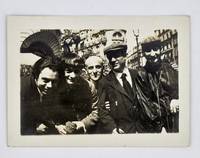
1916réf. 78127Paris 1916. Fine. Paris 12 août 1916 6.30 x 8.60 cm une feuille Original photograph likely unique taken by Jean Cocteau showing Pablo Picasso and Co in Montparnasse in front of the café La Rotonde the 12 August 1916 Paris 12 august 1916 63 x 86 cm one photograph Original photograph by Jean Cocteau taken on 12 August 1916 showing Manuel Ortiz de Zárate Moïse Kisling Max Jacob Pablo Picasso and the model Pâquerette his girlfriend at the time posing in front of the famous café La Rotonde on Boulevard du Montparnasse in Paris. Contemporary silver print probably unique from Jean Cocteau's personal archives then the Maurice Sachs collection. This image was published in Billy Klüver's book entitled A day with Picasso: twenty-four photographs by Jean Cocteau 1997. However Klüver states that he didn't know the original photograph and used a modern reprint from the negative in the Cocteau archives for his work. We have not found any other copy of our original photograph in international public collections. Billy Klüver has assembled and commented on the twenty-one photographs taken by Jean Cocteau on 12 August 1916 in Montparnasse close to this intersection of the Boulevard Raspail and the Boulevard du Montparnasse which was named Place Pablo-Picasso in 1994. They take us to the café La Rotonde before which a beaming Picasso in a cap speaks with Max Jacob whose baldness shines in the sun behind them Henri-Pierre Roché in uniform and Manuel Ortiz de Zarate sit at a table on the terrace of the same café where Pablo is next to the glowing Pâquerette and the young Polish painter Moïse Kisling. Pâquerette with her hair in a headband a chic dress is the queen of the encounter. . It's the relaxed life at the back. Pâquerette or rather Émilienne Pâquerette Geslot was then a star model of the fashion designer Poiret who was all the rage at the time. A real one-day film of Picasso outside of his studio. Pierre Daix Picasso In his book Klüver questions the presence of all these artistic authorities in the making in a Paris that is deserted by war. The answer is according to him to search in the direction of the Salon d'Antin an exhibition organized by André Salmon in July 1916 in which all the protagonists of our photograph took part with the exception of Pâquerette. It is also on this occasion that Picasso reveals his Demoiselles d'Avignon to the public. This extremely rare image taken by Jean Cocteau with his mother's Kodak camera immortalizes a moment of joy that depicts the artistic all-Montparnasse of the early 20th century. Provenance: Jean Cocteau's personal archives then the Maurice Sachs collection and Max-Philippe Delatte. unknown
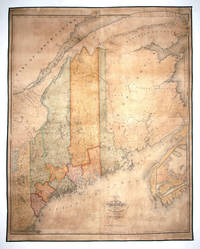
1829réf. 8887Portland 1829. No Binding. Very Good. 50 ¾ x 40 ¼ inches. Steel engraving. Original wash color refreshed; expertly conserved re-mounted on new linen; a few cracks & marginal mends but fine for this kind. The very rare three copies cited in OCLC first edition of this excellent map of Maine by the state's first mapmaker. An exceptionally well-preserved example. Unlike many early American state maps that struggled to get completed Greenleaf's received a warm commendation from the state legislature even before it was published and the mapmaker was granted $1000 to aid him in finishing the map. Greenleaf later received $640 from the legislature for 40 copies of the map that were obtained for state use a remarkable $16 per copy. Perhaps the large number of copies sold for official rather than private use helps account for the map's present rarity. The map was originally intended to accompany an atlas and survey of the state that Greenleaf published the same year but very few complete sets of the three items are known to have survived. Greenleaf appears to have taken special care in the production of this map. Although published in Portland Maine Greenleaf employed as engravers for this work the estimable J. H. Young and F. Dankworth both of whom produced major works for the firms of S. A. Mitchell and others. This precisely detailed map which shows ten counties in different colors provides state county town and township boundary lines. The state's many rivers lakes ponds and even falls are shown as are roads and elevations. The map was re-published in 1844 by Greenleaf's son and namesake from the same plates but with emendations and several times thereafter. Greenleaf published two earlier maps of the state in 1815 and 1820 but the present work was by far his finest. Ristow W. American Maps and Mapmakers pp. 95-96; Catalogue Raisonne Important Maine Maps. Auction Catalogue for Thompson Collection Auction Robert E. Croul 2003 lot 119. unknown
1829réf. 8887Portland 1829. No Binding. Very Good. 50 ¾ x 40 ¼ inches. Steel engraving. Original wash color refreshed; expertly conserved re-mounted on new linen; a few cracks & marginal mends but fine for this kind. The very rare three copies cited in OCLC first edition of this excellent map of Maine by the state's first mapmaker. An exceptionally well-preserved example. Unlike many early American state maps that struggled to get completed Greenleaf's received a warm commendation from the state legislature even before it was published and the mapmaker was granted $1000 to aid him in finishing the map. Greenleaf later received $640 from the legislature for 40 copies of the map that were obtained for state use a remarkable $16 per copy. Perhaps the large number of copies sold for official rather than private use helps account for the map's present rarity. The map was originally intended to accompany an atlas and survey of the state that Greenleaf published the same year but very few complete sets of the three items are known to have survived. Greenleaf appears to have taken special care in the production of this map. Although published in Portland Maine Greenleaf employed as engravers for this work the estimable J. H. Young and F. Dankworth both of whom produced major works for the firms of S. A. Mitchell and others. This precisely detailed map which shows ten counties in different colors provides state county town and township boundary lines. The state's many rivers lakes ponds and even falls are shown as are roads and elevations. The map was re-published in 1844 by Greenleaf's son and namesake from the same plates but with emendations and several times thereafter. Greenleaf published two earlier maps of the state in 1815 and 1820 but the present work was by far his finest. Ristow W. American Maps and Mapmakers pp. 95-96; Catalogue Raisonne Important Maine Maps. Auction Catalogue for Thompson Collection Auction Robert E. Croul 2003 lot 119. unknown books
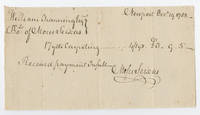
1788réf. 25418Seixas' 1790 letter of welcome elicited the first president's most compelling statement on religious liberty "to bigotry no sanction." In this 1788 receipt Seixas signs a receipt documenting payment for carpet by William Channing the state's new attorney general. MOSES SEIXAS. Manuscript Document Signed to William Channing December 18 1788. Receipt for carpeting. 1 p. 7¼ x 4 in. Complete Transcript Newport Decr 19 1788 William Channing Esq Bot Bought of Moses Seixas / 17 yds Carpeting . . . . . . . . . . .4/1 yd. £3.9. 5. Received payment In full / Moses Seixas Docketing on verso in another hand: Moses Seixas Moses Mendes Seixas 1744-1809 was born in New York into a Jewish family. His father immigrated from Portugal to New York about 1730 and became a merchant. The family moved to Newport Rhode Island in 1765. Moses Seixas married Jochebed Levy in 1770 and they had eight children. He was one of the organizers and first cashier of the Bank of Rhode Island which conducted business in his house until 1818. After the British occupied Newport during the Revolutionary War Seixas remained in Newport but was among the signers of a document supporting the patriot cause. In 1790 he was the president of the Congregation Yeshuat Israel later Touro Synagogue in Newport. He was also a charter member and first grand master of St. John's Lodge of Free and Accepted Masons in Newport. William Channing 1751-1793 was born in Newport Rhode Island and graduated from the College of New Jersey Princeton in 1769. In 1773 he married Lucy Ellery daughter of William Ellery a Newport lawyer who signed the Declaration of Independence and they had nine children. Channing was elected Attorney General of Rhode Island in 1777 and when Rhode Island ratified the U.S. Constitution in 1790 Channing became the first federal District Attorney. One of his sons was the famous Unitarian preacher William Ellery Channing 1780-1742. Historical Background From 15 Sephardic families who arrived in 1658 Newport Rhode Island's Jewish community grew to be the largest in the colonies. Many Jews left during the Revolutionary War when Newport was occupied by the British. A significant number returned when the British left in 1779. By the time Rhode Island became a state there were approximately 300 Jews in the thriving Newport community. Starting while on his way to New York to assume the presidency in April of 1789 George Washington received many messages from civic fraternal and religious organizations offering congratulations praise of his deeds in war peace and politics prayers on behalf of congregations or constituents. Washington's replies justly count among his most famous pronouncements setting a boldly inclusive tone that helped our new nation survive and expand. After the first session of the first Congress Washington set out on a tour of the New England states except for Rhode Island which had yet to ratify the Constitution. It finally did so in May of 1790 and three days after the second session of Congress adjourned Washington Jefferson and others set out to visit Newport. On August 18 Washington and his entourage were greeted with four addresses written as open letters and read in a public ceremony. First the town then from all the Christian clergy then the Masonic order and finally from the Hebrew Congregation. Moses Seixas on behalf of the Congregation Kahal Kadosh Yeshuat Israel congratulated Washington on his ascendancy to the Presidency. He invoked the language of the Revolution in arguing that Jews should be entitled to the same privileges as an American of any other religious denomination. Having been previously "deprived…of the invaluable rights of free Citizens" Seixas expressed his hopes for the success of the new "government erected by the majesty of the people a government which to bigotry gives no sanction—to persecution no assistance; but generously affording to all liberty of conscience." Seixas' letter moved President Washington who echoed Seixas' words and built on them to make his most celebrated statement on religious freedom. He responded as soon as he returned to the capital New York assuring the Hebrew congregation that "happily the Government of the United States which gives to bigotry no sanction to persecution no assistance requires only that they who live under its protection should demean themselves as good citizens in giving it on all occasions their effectual support. It would be inconsistent with the frankness of my character not to avow that I am pleased with your favorable opinion of my Administration and fervent wishes for my felicity. May the Children of the Stock of Abraham who dwell in this land continue to merit and enjoy the good will of the other Inhabitants; while every one shall sit in safety under his own vine and fig tree and there shall be none to make him afraid." Washington's addresses responding to religious congregations included those of Baptist Congregational Dutch Reformed Episcopalian German Lutheran German Reformed Jewish Protestant Presbyterian Quaker Roman Catholic and other denominations. Today we understand that Washington and his fellow Founding Fathers were oblivious to the realities of other kinds of oppression. Knowing what we know now how can we still value these slave-owners' declamations on freedom While acknowledging Washington's ownership of his full share of the universal biases of his age we can and should still treasure his "to bigotry no sanction" letter as a powerful testament to the promise of America. In the 218 years since Washington responded to Seixas' address has anyone come up with a better definition of the benefits and responsibilities of American citizenship Washington's original letter was acquired by the Morris Morgenstern Foundation in 1948 and is on long-term loan to the National Museum of American Jewish History in Philadelphia. Seixas' letter to Washington is in the Library of Congress and Seixas' retained copy was acquired by the Morgenstern Foundation in 1949 and is with Washington's letter. Condition Fine condition with intersecting folds and slight bit of foxing.
1788réf. 25418Seixas' 1790 letter of welcome elicited the first president's most compelling statement on religious liberty "to bigotry no sanction." In this 1788 receipt Seixas signs a receipt documenting payment for carpet by William Channing the state's new attorney general. MOSES SEIXAS. Manuscript Document Signed to William Channing December 18 1788. Receipt for carpeting. 1 p. 7¼ x 4 in. Complete Transcript Newport Decr 19 1788 William Channing Esq Bot Bought of Moses Seixas / 17 yds Carpeting . . . . . . . . . . .4/1 yd. £3.9. 5. Received payment In full / Moses Seixas Docketing on verso in another hand: Moses Seixas Moses Mendes Seixas 1744-1809 was born in New York into a Jewish family. His father immigrated from Portugal to New York about 1730 and became a merchant. The family moved to Newport Rhode Island in 1765. Moses Seixas married Jochebed Levy in 1770 and they had eight children. He was one of the organizers and first cashier of the Bank of Rhode Island which conducted business in his house until 1818. After the British occupied Newport during the Revolutionary War Seixas remained in Newport but was among the signers of a document supporting the patriot cause. In 1790 he was the president of the Congregation Yeshuat Israel later Touro Synagogue in Newport. He was also a charter member and first grand master of St. John's Lodge of Free and Accepted Masons in Newport. William Channing 1751-1793 was born in Newport Rhode Island and graduated from the College of New Jersey Princeton in 1769. In 1773 he married Lucy Ellery daughter of William Ellery a Newport lawyer who signed the Declaration of Independence and they had nine children. Channing was elected Attorney General of Rhode Island in 1777 and when Rhode Island ratified the U.S. Constitution in 1790 Channing became the first federal District Attorney. One of his sons was the famous Unitarian preacher William Ellery Channing 1780-1742. Historical Background From 15 Sephardic families who arrived in 1658 Newport Rhode Island's Jewish community grew to be the largest in the colonies. Many Jews left during the Revolutionary War when Newport was occupied by the British. A significant number returned when the British left in 1779. By the time Rhode Island became a state there were approximately 300 Jews in the thriving Newport community. Starting while on his way to New York to assume the presidency in April of 1789 George Washington received many messages from civic fraternal and religious organizations offering congratulations praise of his deeds in war peace and politics prayers on behalf of congregations or constituents. Washington's replies justly count among his most famous pronouncements setting a boldly inclusive tone that helped our new nation survive and expand. After the first session of the first Congress Washington set out on a tour of the New England states except for Rhode Island which had yet to ratify the Constitution. It finally did so in May of 1790 and three days after the second session of Congress adjourned Washington Jefferson and others set out to visit Newport. On August 18 Washington and his entourage were greeted with four addresses written as open letters and read in a public ceremony. First the town then from all the Christian clergy then the Masonic order and finally from the Hebrew Congregation. Moses Seixas on behalf of the Congregation Kahal Kadosh Yeshuat Israel congratulated Washington on his ascendancy to the Presidency. He invoked the language of the Revolution in arguing that Jews should be entitled to the same privileges as an American of any other religious denomination. Having been previously "deprived…of the invaluable rights of free Citizens" Seixas expressed his hopes for the success of the new "government erected by the majesty of the people a government which to bigotry gives no sanction—to persecution no assistance; but generously affording to all liberty of conscience." Seixas' letter moved President Washington who echoed Seixas' words and built on them to make his most celebrated statement on religious freedom. He responded as soon as he returned to the capital New York assuring the Hebrew congregation that "happily the Government of the United States which gives to bigotry no sanction to persecution no assistance requires only that they who live under its protection should demean themselves as good citizens in giving it on all occasions their effectual support. It would be inconsistent with the frankness of my character not to avow that I am pleased with your favorable opinion of my Administration and fervent wishes for my felicity. May the Children of the Stock of Abraham who dwell in this land continue to merit and enjoy the good will of the other Inhabitants; while every one shall sit in safety under his own vine and fig tree and there shall be none to make him afraid." Washington's addresses responding to religious congregations included those of Baptist Congregational Dutch Reformed Episcopalian German Lutheran German Reformed Jewish Protestant Presbyterian Quaker Roman Catholic and other denominations. Today we understand that Washington and his fellow Founding Fathers were oblivious to the realities of other kinds of oppression. Knowing what we know now how can we still value these slave-owners' declamations on freedom While acknowledging Washington's ownership of his full share of the universal biases of his age we can and should still treasure his "to bigotry no sanction" letter as a powerful testament to the promise of America. In the 218 years since Washington responded to Seixas' address has anyone come up with a better definition of the benefits and responsibilities of American citizenship Washington's original letter was acquired by the Morris Morgenstern Foundation in 1948 and is on long-term loan to the National Museum of American Jewish History in Philadelphia. Seixas' letter to Washington is in the Library of Congress and Seixas' retained copy was acquired by the Morgenstern Foundation in 1949 and is with Washington's letter. Condition Fine condition with intersecting folds and slight bit of foxing. books
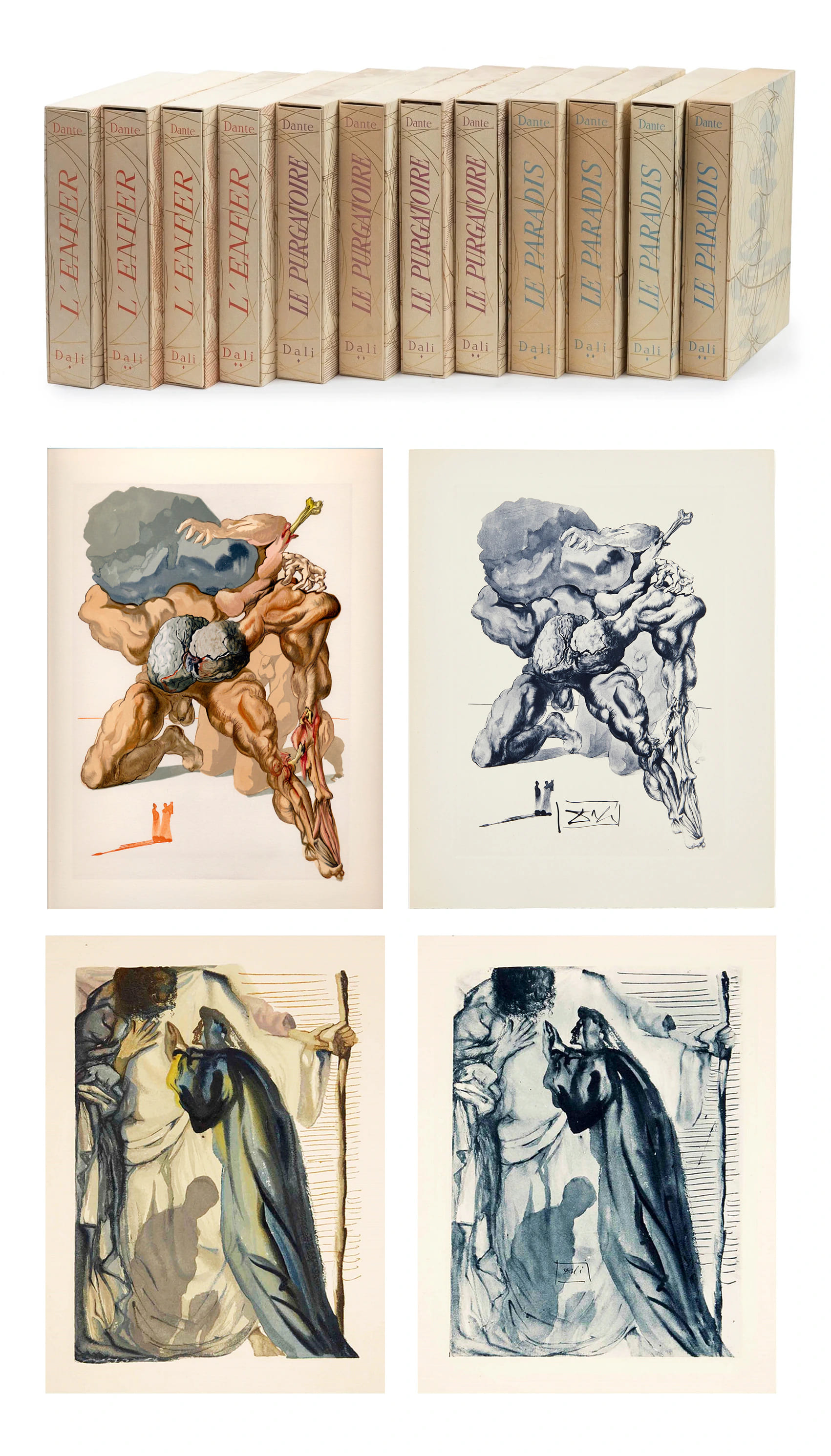
1963réf. 3909Les Heures Claires, Paris 1959-1963. 12 volumes in-folio en feuilles (34 x 26 cm) sous couvertures imprimées rempliées, chemises et étuis décorés de l'éditeur. - 100 AQUARELLES ORIGINALES HORS-TEXTE DE SALVADOR DALI GRAVÉES SUR BOIS EN COULEURS par Raymond Jacquet. Exemplaire de grand luxe : 1 des 150 ex. numérotés sur pur chiffon de Rives filigrané comprenant : Les 6 volumes du texte illustré des 100 aquarelles gravées sur bois en couleurs en hors-texte + LA SUITE COMPLÈTE DES 100 BOIS EN COULEURS.+ LA SUITE COMPLÈTE DU TRAIT GRAVÉ SUR CUIVRE TIRÉ EN BLEU + UNE SUITE DE LA DÉCOMPOSITION DES COULEURS D'UNE PLANCHE POUR CHAQUE VOLUME. Les 6 ouvrages sont en parfait état et bien complets des 100 gravures et des 3 doubles-feuillets de justification numérotés. Les 6 volumes de suites sont collationnés et bien complets en parfaite condition. Les planches belles aux couleurs lumineuses. Les 12 emboîtages sont en parfait état de conservation. Très bel exemplaire du tirage de luxe de cette monumentale et célèbre édition. ÉTAT DE NEUF. (Références : Michler & Lopsinger, 1039 à 1138 ; Field pages 189 à 200). Provenance : acquise en 1963 directement auprès de Joseph Foret et conservée dans la même famille jusqu'à aujourd'hui. Photographies supplémentaires sur demande. - ENGLISH DESCRIPTION: Dante : LA DIVINE COMÉDIE. 100 wood-engraved plates in color. Les Heures Claires, Paris 1959-1963. 12 folio volumes in loose sheets (34 x 26 cm), under folded printed covers, original decorated slipcases of the publisher. Including THE 100 WATERCOLORS OUT OF TEXT BY SALVADOR DALI ENGRAVED ON WOOD IN COLORS by Raymond Jacquet. This one is 1 of 150 deluxe copies numbered on Rives with watermark : The 6 volumes with the Dante's text illustrated with 100 color wood engravings + THE COMPLETE SUITE OF THE 100 COLOR WOOD ENGRAVINGS + THE COMPLETE SUITE OF THE COPPER ENGRAVED LINE ART PRINTED IN BLUE + A SUITE OF THE COLOR "DECOMPOSITIONS" OF ONE PLATE FOR EACH VOLUME. The 6 volumes are in perfect condition and complete with all 100 engravings and the 3 numbered double-page justifications. The 6 volumes of suites have been collated and are complete and in perfect condition. The plates are beautiful with luminous colors. The 12 slipcases are in perfect condition. A very fine and scarce deluxe copy of this monumental and celebrated edition. MINT CONDITION. (References: Michler & Lopsinger, 1039 to 1138; Field pages 189 to 200). More pictures on request.
1923réf. ABE-1596011369565First edition. Octavo 24.517.5205 cm LWH wt: 55 kg. 35 volumes bound into 35 books Volume I to Volume XXXV 214 issues. Collection of Ernest Ketcham Smith a founding member of the faculty at Tsinghua College and Yenching University of Peking with a typed letter from the editor addressed to him regarding the subscription of the journal SIGNED by Nan L. Horan the secretary on the letter paper of "The China Journal of Science & Arts". As always advertisement pages including some front and back covers of a number of issues were removed before rebinding. The green calico bindings slightly differ a couple of volumes with faded spines some very slightly worn with usual defects. Some marginal damp stains to a few leaves of Volume I. Also included are memorabilia by or related to the Journal such as ballot slips order forms bookmarks attention readers. More photos available upon request. Shanghai: North China Daily News and Herald, 1923-1941 hardcover