11 156 résultats
2021réf. 1-1543838537Wolters Kluwer Law & Business 2021. Hardcover. New. 8th har/psc edition. 1408 pages. 10.75x8.25x2.00 inches. Wolters Kluwer Law & Business hardcover
1897réf. 7630New York: King's Handbooks 1897. First Edition. Hardcover. Very Good. Folio. Pp. 96. Illustrated throughout with over 950 portraits and 90 views of Lower Manhattan and its architecture most of these black & white photographs. Index. Bound in olive-colored cloth with gilt titles stamped on cover black titles printed on spine and decorative motifs printed on cover with original yellow wrappers bound within. Minor wear to original boards. Hinge beginning to loosen at rear. Original prospectus laid in rear see last three photos has wear to edges and a closed tear along fold. "A history and description with articles on financial topics" presented at the height of Gilded-Age Robber Barons many pictured here. Among them Cornelius Vanderbilt Jay Gould Hartwig Baruch John Rockefeller and others. A remarkable encapsulation of the era presented here in a well preserved copy. Cover is now protected within a clear removable archival jacket. King's Handbooks hardcover
1825réf. 002288New York by H. Spear n.d. c.1825 1825. 1 vol. 8-1/4" x 5" 36pp. library stamps to first two pages occasional foxing pages rumpled bound in a full black leather card folder title gilt to cover amateurish rebacking in black cloth black cloth to inner hinge/title-page all things considered still in acceptable condition. REFRENCE: McDade 726 RBH locate only 2 copies ever to appear at auction the last 2004. The deceased with some complications was assaulted while walking near "Sailors' Snug Harbour" in New York City and died of a blow. The defendants were convicted of manslaughter. New York, by H. Spear, n.d., (c.1825) hardcover
réf. 4318Magnum. New. Description: 6"x 6" limited edition Fuji Crystal Archival Matte paper print. Image size is 5.5" on the longest side and the paper size is 6" x 6". The Print is SIGNED by Moises Saman on the recto. Condition: Brand New/Mint. The prints were issued in an un-numbered Limited Edition limited to the number of prints purchased during the days in which the sale was open to the public. They were then carefully printed to the highest standards and signed by the photographers. As such these are sure to become highly collectible photographs given the provenance linking them directly to the Magnum collective and each of the photographers who chose to participate in the event. Magnum unknown
réf. 4320Magnum. New. Description: 6"x 6" limited edition Fuji Crystal Archival Matte paper print. Image size is 5.5" on the longest side and the paper size is 6" x 6". The Print is SIGNED by Moises Saman on the recto. Condition: Brand New/Mint. The prints were issued in an un-numbered Limited Edition limited to the number of prints purchased during the days in which the sale was open to the public. They were then carefully printed to the highest standards and signed by the photographers. As such these are sure to become highly collectible photographs given the provenance linking them directly to the Magnum collective and each of the photographers who chose to participate in the event. Magnum unknown
2014réf. 4458Magnum 2014. New. Description: 6"x 6" limited edition Fuji Crystal Archival Matte paper print. Image size is 5.5" on the longest side and the paper size is 6" x 6". The Print is SIGNED by Moises Saman on the verso. Condition: Brand New/Mint. The prints were issued in an un-numbered Limited Edition limited to the number of prints purchased during the days in which the sale was open to the public. They were then carefully printed to the highest standards and signed by the photographers. As such these are sure to become highly collectible photographs given the provenance linking them directly to the Magnum collective and each of the photographers who chose to participate in the event. Magnum unknown
1680réf. 27407Oxford: Moses Pitt 1680-83. Other. In ausgezeichnetem Zustand. 415 by 530mm 16 by 20 inches. Hand-Colored Original Copperplate Engraving by Janssonio Waesbergios & Moses. Pitt depicting Ducatus Sleswicensis Nova Descriptio. Published Oxford Moses Pitt 1680. Sheet: 415 by 530mm 16 by 20 inches. A fine and original hand-colored example of Waesbergios's celebrated cartographic work documenting this region of Germany with the precision and decorative artistry characteristic of the 16800s. Janssonio Waesbergios & Moses. Pitt was a cartographer active in the 1600s working in the tradition of European copper-engraved cartography. Their maps are valued by collectors for their historical accuracy and decorative quality.This original copperplate engraving with original hand coloring depicts the region of Ducatus Sleswicensis Nova Descriptio. published in Oxford Moses Pitt 1680-83. The map records the political and geographic boundaries of the region as understood in 1680-83 offering a fascinating window into the history of German territorial organization. Sheet measures 415 by 530mm 16 by 20 inches. In good condition overall with minor signs of age appropriate for a 17th-century engraving. Ready to frame. Koeman I 1600:1.2 Moses Pitt unknown
1985réf. BN424608Stuttgart-Bad Cannstatt : Friedrich Frommann Verlag Günther Holzboog 1985. 1985. Schriften zum Judentum IV Gesammelte Schriften; Teil: Bd. 102. Schriften zum Judentum IV Gesammelte Schriften; Teil: Bd. 102. Moses Mendelssohn Stuttgart-Bad Cannstatt : Friedrich Frommann Verlag (Günther Holzboog) unknown
réf. 1616897260-8-1Princeton Architectural Press. First Edition. Very Good. It's a well-cared-for item that has seen limited use. The item may show minor signs of wear. All the text is legible with all pages included. It may have slight markings and/or highlighting. Princeton Architectural Press unknown
2004réf. STM-9780080445090United States: Elsevier 2004. Hardbound. Brand New. Book Condition:- Brand New. Secured Packaging. Fast DeliveryBookseller Inventory # 9780080445090 Elsevier hardcover
1824réf. 443353London : Septimus Prowett 1824. 1st edition. Hardcover. Very good copies in marbled boards backed in gilt-blocked full calf. Spine and boards dust-toned bumped and rubbed as with age. Somewhat nicked pages. Stretched hinges with loose pages with binding detaching from text block. Scattered foxing. Physical description; 2 volumes frontispiece portrait plates. Subjects; Canova Antonio 1757-1822. Canova Antonio 1757-1822 Criticism and interpretation. Canova Antonio 1757-1822 ; Portraits. Canova Antonio 1757-1822. Sculpture Italian. London : Septimus Prowett hardcover
1997réf. 1-0132584190Prentice Hall 1997. Paperback. New. 1st edition. 319 pages. 9.50x7.25x1.00 inches. Prentice Hall paperback
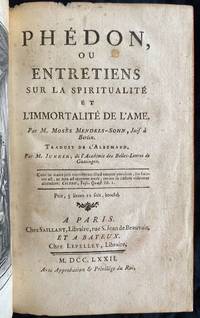
1772réf. 43257Paris et Bayeux chez Saillant et Lepelley 1772. 1st French-language edition. Period full leather binding with gilt spine and red edges with original marbled endpapers 8vo. Includes frontis copperplate etching. XXIV 342 1 pages. “Traduit de l’Allemand par M. Junker de l’Académie des Belles-Lettres de Goettingen.” This first French edition appeared 5 years after the first German edition of 1767 "Phaedon or On the Immortality of the Soul" Phaedon Oder Ueber Die Unsterblichkeit Der Seele In Drey Gespraechen is one of Mendelssohn's 1729-1786 most famous publications establishing his reputation as the "German Socrates of Berlin." It is a philosophical interpretation of the Platonic dialogue "Phaedo" and is preceded by a biography on "The Life and Character of Socrates." The important German-Jewish philosopher was one of the most important representatives of the Enlightenment in Prussia and throughout Germany. Mendelssohn's Phaedon is a “classic of rational psychology on the immortality of the human soul a defining work by this leading enlightenment philosopher who launched the Jewish thinking of the modern age" with his tribute to Socrates modeled on Plato's dialogue the Phaedo. Mendelssohn used Plato's famous dialogue the Phaedo as a model to publish Phädon oder über die Unsterblichkeit der Seele. With this seminal work "he reached the heights of fame" Wigoder Dictionary of Jewish Biography 342. The work unites Mendelssohn's "paean to Socrates with an elaboration of the dreadful personal moral and political implications if a person's life is her 'highest good'… This 'classic of rational psychology' as Dilthey put it also contains an argument for the simplicity and immortality of the human soul explicitly singled out for criticism by Kant in the 2nd edition of the Critique of Pure Reason. Mendelssohn supports the notion that the soul is simple and thus indestructible by noting that certain features of the soul namely the unifying character of consciousness and the identity of self-consciousness cannot be derived from anything composite whether those composite parts be capable or not of thinking… As for the human soul's fate after death Mendelssohn appeals to divine goodness and providence which perhaps explains why following the publication of the Phaedo he finds himself needing to revisit the proofs for God's existence" Stanford Encyclopedia. According to Mendelssohn’s modern biographer Alexander Altmann “The work that would establish Mendelssohn's world-wide renown and win him the title 'the German Socrates' was the dialogue Phaedon which was published in 1767. In this work he presented Socratic wisdom from the mouth of the ancient philosopher but in the language of the Enlightenment that is in his own words as a modern philosopher. The work drew both praise and criticism but was on the whole popular in intellectual circles. It demonstrates Mendelssohn's unique ability as a Jew to be comfortable in the realm of both classical and enlightened philosophy not to mention languages. David Sorkin remarks ‘What is ironic is that Mendelssohn was known and revered as much for the quality of his prose as for his thought.” Mendelssohn was himself often referred to as the German Plato or the German Socrates. And “As a Jew living in Germany Moses Mendelssohn 1729-1786 stands at a pivotal point in the history of Jewish emancipation in Europe. There were Jews before him who had access to the corridors of power in Germany and elsewhere in Europe but Mendelssohn represents the first to be socially accepted to a significant extent within enlightened German culture without converting. He not only conformed to the culture of the German Enlightenment in many ways but also helped shape the culture through his philosophical contributions. At the same time Mendelssohn refused to turn away from traditional Judaism. He attempted to become a full- fledged member of society during the emergence of modern Europe while remaining a proponent of Judaism as a revealed religion. Moreover he sought to use his place of influence to encourage Jewish acculturation in Germany and to speak on behalf of the emancipation of Jewish people…. The traditional mentality of the European Jews prior to Mendelssohn's time included a kind of resignation to the incompatibility of Jewish learning and 'worldly' philosophy. This resignation contributed to Jewish cultural isolation. Alfred Jospe describes the conundrum in which a Jew found himself if he wished to enter the culture of the non-Jewish world: The Jew could gain access to the culture of the world only by rebelling against the traditional repudiation of all mundane wisdom. It is just at this point that Mendelssohn broke the mold. He not only acquired modern German culture but did so by means of his understanding of and contributions to the philosophy that shaped that culture. In his monumental biographical study Alexander Altmann focuses as much on Mendelssohn's philosophy and his answers to contemporary critics as he does on the details of the events and influences of his life. Altmann states with appropriate admiration that “Considering the state of degradation in which the Jewish population lived in eighteenth-century Germany. Mendelssohn's rise to fame and his acceptance into the republic of letters was an amazing feat of personal achievement.” The amazing feature of Mendelssohn's achievement is that he accomplished it as an avowedly traditional Jew. Mendelssohn has been rightly described as a rabbinic scholar but he made his reputation in non-Jewish intellectual circles as a literary critic and philosopher….with the help of both Gotthold Lessing and the Berlin publisher Friedrich Nicolai he was accepted into the inner circle of the Berlin Aufklärung. His essays reviews and translations earned him tremendous status among German intellectuals. The favorable comparison made by Lessing between the quintessential German poet Goethe and Mendelssohn is a mark of the esteem in which he was held. ‘Lessing told Friedrich Heinrich Jacobi that once Goethe regained his reason he would be hardly more than an ordinary man. At the very same time he said of Mendelssohn that he was the most lucid thinker the most excellent philosopher and the best literary critic of the century’" Clark 2005. P. 57-58. OCLC: 19939219. Very light edgewear to front endpapers touch of spotting a gorgeous copy in the original leather binding with tooled gilt spine with raised bands and leather label. Beautiful and scarce. B KH-10-30-RLB-’e. Paris et Bayeux, chez Saillant et Lepelley unknown
2025réf. x-1032897856Routledge 2025. Hardcover. New. 1st edition. 802 pages. 9.25x6.25x1.75 inches. Routledge hardcover
1930réf. 158481930 Jerusalem The Palestine Art Publishing Co. Ltd,, 1930 Fort volume in folio, en feuillets sous emboîtage cuir exemplaire bien complet des 47 lithographies tirage total a 600 exemplaires, ici un des 35 exemplaires sur verge des papeteries d'arches,( numéro xdIII.)Rare exemplaire de lédition en français.Quarante-sept lithographies in-folio, légendées montées sous serpentes, précédées dun f. de titre et dun f. de préface
1983réf. 71048Wien Bernthaler & Windischgraetz 1983 1 in huit à l'italienne reliure d'éditeur en plein veau 123 pp 1/950 copies ( ex : 933 ) ,complete colour facsimile edition of the Illuminated-pentateuch by Moses Dal Castellazzo, Venice , 1521 ,jewish historicale institute Warsaw ,codex "1164"
1690réf. 18526A Paris, chez Audran, s.d. [circa 1690]. Dimensions (à vue) : 653 x 562 mm.
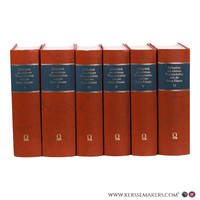
1979réf. 79015Hildesheim / New York: Olms 1979. Hardcover. Reprint of the 1764-1767 Leipzig edition in 14 volumes here reissued in 12 volumes plus appendix and register bound in 6 books. Text in German. In very good condition. See picture. ISBN 1: 3487066602 2: 3487066610 3: 3487066629 4: 3487066637 5: 3487066645 6: 3487066653 Olms hardcover
1893réf. 209576Boston: Moses King 1893. Second Edition. Hardcover. Fair in boards. Text block detached from binding. Moses King hardcover
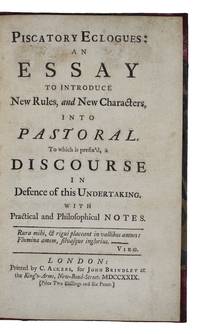
1729réf. AQ26633London: Printed by C. Ackers for John Brindley 1729. 14 129pp 1. Later red straight-grain half-morocco marbled paper boards ruled and lettered in gilt. Lightly rubbed and marked. Marbled endpapers title page browned. The first edition of poet and Church of England clergyman Moses Browne's 1704- 1787 highly naturalistic angling pastorals that include the first avowed imitation of Milton's 'Lycidas'. The didactic portions are adapted from Izaak Walton's Compleat Angler a work which Browne was to edit and republish for the first time since 1676 in 1750 at the suggestion of his friend Samuel Johnson. The nine poems were reprinted under the title Angling Sports in 1773. ESTC records copies at five locations in the British Isles BL Cambridge Leeds NLS and Oxford and a further 11 in North America California Harvard Huntington Illinois NYPL Newberry North Carolina Pennsylvania Princeton Virginia and Yale. ESTC T55150. First edition. 8vo. Printed by C. Ackers, for John Brindley hardcover
1821réf. 158589London: Henry Setchel and Son c. 1821. A finely printed collection in an attractive contemporary binding. The exquisite illustrations by Henry Moses depicting fashionable Neoclassical-style dress and furniture were praised by the English art critic Sacheverell Sitwell as "probably the finest and neatest engravings that have ever made their appearance between the covers of a book" quoted in Watkin p. 52. Henry Moses 1781-1870 a printmaker and engraver who specialized in classical design was distinguished by his "neatness and purity of outline" ODNB. Designs of Modern Costume was commissioned by Thomas Hope art collector and patron and all the scenes in the volume are depicted against the background of his museum-residence in Duchess Street. Hope himself was involved in the design and composition of the suite. "The persons shown throughout the book - in what are effectively a series of conversation pieces - are dressed in modernized versions of the ancient Greek costumes which Hope had recreated from antique sculpture and vase-paintings. The women's costumes are an enchanting compromise between the fashions of the fifth century B.C. and of 1810; and as such they appear to be unique in the history of Regency costume" Watkin pp. 219-220. This work first appeared in 1812 with only 20 plates. The present copy is an enlarged edition containing all the plates from the first edition and nine additional designs; multiple impressions of this edition with variant titles and imprints are known though the order of their publication is debated. Savage in his catalogue of early printed books in the British Architectural Library states that the present undated variant is quite possibly "the first to have been published with 29 plates. issued between around 1820 and 1822"; he assigned a date of c.1821 on the basis of the imprint as Henry Setchel died or retired in 1822. Octavo 218 x 160 mm. Engraved title page and 29 plates. Contemporary red straight-grain morocco spine with gilt ruled raised bands lettering and floral decoration gilt in compartments covers bordered with a double gilt fillet and a blind foliate roll small ornaments blind stamped to corners gilt decoration to board edges and turn-ins marbled endpapers edges gilt. Extremities slightly rubbed short split at head of rear joint but firm some marks and scuffs to boards contents foxed the engravings remaining sharp. A very good copy. Savage 2207. David Watkin Thomas Hope 1769-1831 and the Neo-Classical idea 1968; Nicholas Savage Early Printed Books 1478-1840: M-R 1994. hardcover
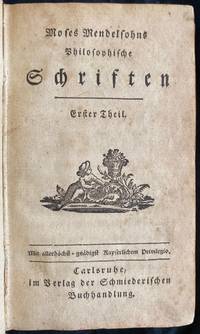
1780réf. 43258Carlsruhe: im Verlag der Schmiederischen Buchhandlung 1780. No Date 1780s. Period laquered boards with leather spine label. 12mo. XXIV 278; 283 pages. In German. Title translates as “Writings.” Includes 2 different title vignettes 1 on each title page. Goedeke IV 1 488 6. Meyer 108; Dorn 105-107; Holzmann/Bohatta Deutsches Anomymen-Lexikon IV no. 1559. Early printing of Mendelssohn’s second work in which he "began his formulation of a new psychological theory that stressed the autonomy of aesthetics logic and ethics relative to each other." Merriam-Webster's Encyclopedia of World Religions p. 710. Contents: Vol. 1. Vorrede. I. Ueber die Empfindungen. II. Gespräche; Vol. 2. I. Rhapsodie oder Zusätze zu den Briefen über die Empfindungen. II. Ueber die Hauptgrundsätze der schönen Künste und Wissenschaften. III. Ueber das Erhabene und Naive in den schönen Wissenschaften. IV. Ueber die Wahrscheinlichkeit. Also includes bibliographical references. Included within these is a series of writings on aesthetics which influenced Lessing and Schiller with Lessing noting“We have to thank him Mendelssohn for the true theory of mixed sensations.” Moses Mendelssohn Moses of Dessau; 1729–1786 was a philosopher of the German Enlightenment in the pre-Kantian period early Maskil and a renowned Jewish figure in the 18th century. Mendelssohn was fluent in German and Hebrew and learned Latin Greek English French and Italian. His early teachers were young broadly educated Jews and he met the writer and dramatist G.E. Lessing 1754 and a deep and lifelong friendship developed between them. Throughout his life he worked as a merchant while carrying out his literary activities and widespread correspondence in his free time. In 1754 Mendelssohn began to publish – at first with the assistance of Lessing – philosophical writings and later also literary reviews. He also started a few literary projects for example the short-lived periodical Kohelet Musar in order to enrich and change Jewish culture and took part in the early Haskalah. In 1763 he was awarded the first prize of the Prussian Royal Academy of Sciences for his work Abhandlung über die Evidenz in metaphysischen Wissenschaften "Treatise on Evidence in Metaphysical Knowledge". However when the academy elected him as a member in 1771 King Frederick II refused to ratify its decision. In 1769 he became embroiled in a dispute on the Jewish religion and from then on he confined most of his literary activity to the sphere of Judaism. His most notable and enduring works in this area included the translation into German and commentary on the Pentateuch Sefer Netivot ha-Shalom "Book of the Paths of Peace" 1780–83 and his Jerusalem: oder Ueber religiöse Macht und Judenthum "Jerusalem or On Religious Power and Judaism" 1783 this work the first polemical defense of Judaism in the German language and one of the pioneering works of modern Jewish philosophy. An active intermediary on behalf of his own people in difficult times and a participant in their struggle for equal rights he was at the same time a forceful defender of the Enlightenment against the opposition to it which gained strength toward the end of his life. In the midst of a literary battle against one of the leading figures of the counter-Enlightenment he died in 1786 EJ. SUBJECTS: Philosophy -- Early works to 1800. Philosophie -- Ouvrages avant 1800. Philosophy. OCLC: 1352546328. Light wear to original boards more so at spine but solid and attractive light spotting as expected About Very Good- Condition an attractive 18th Century copy. B KH-10-31. Carlsruhe: im Verlag der Schmiederischen Buchhandlung unknown
1695réf. 045340Amsterdam: Chaim ben Rabbi Judah Lieb 1695. Hardcover. Good Condition. Early marbled paper covered wooden boards backed in vellum. Spine perished and vellum largely lacking paper chipped and torn from boards corners cracked with some loss of wood. Binding structure still more or less intact browning to page edges old stamp to title and final leaf. 1 33ff. Scarce Cabalistic commentary on Ecclesiastes. Size: Octavo 8vo. Quantity Available: 1. Shipped Weight: Under 1 kilo. Category: Religion & Theology; Inventory No: 045340. Chaim ben Rabbi Judah Lieb hardcover
1893réf. 460705Chicago: W.B. Conkey Company 1893. Hardcover. Very Good. First edition. Stout quarto. 1120pp. Illustrated. Folding map affixed to rear pastedown advertisements. Blue decorative cloth stamped in black and gilt. Modest soiling on the boards a very good copy. W.B. Conkey Company hardcover
1893réf. 460705Chicago: W.B. Conkey Company 1893. Hardcover. Very Good. First edition. Stout quarto. 1120pp. Illustrated. Folding map affixed to rear pastedown advertisements. Blue decorative cloth stamped in black and gilt. Modest soiling on the boards a very good copy. W.B. Conkey Company hardcover books