8.292 resultados
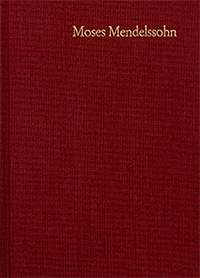
ref. Frommann-9783772812026frommann-holzboog Verlag e.K. German Hebrew. Hardcover. New. 570 p. 156 x 209 cm. These are previously unpublished philosophical fragments and Judaica by Mendelssohn as well as letters from and to Mendelssohn. Among other things the volume contains comments on the concepts of time and space in Kant a note on the concept of eternal truths poems written during and about the Seven Years War Herr! der du die Welt mit deiner Allmacht regierest annotations on Johann David Michaelis' review of Dohms Über die bürgerliche Verbesserung der Juden On the Civil Improvement of the Jews letters from and to Abbt Iselin Lessing Friedrich II. Gleim Joh. J. Engel Lavater Penzel Nicolai Dohm Kuh Lowth Carmer Ramler among others. frommann-holzboog Verlag e.K. hardcover
ref. Frommann-9783772815225frommann-holzboog Verlag e.K. German. Hardcover. New. 622 p. 175 x 25 x 53 cm. Due to the long history of this edition it can only really be made accessible through the complete indexes which replace missing cross references in the commentaries in volumes published first to later volumes and provide an overview of texts which are presented in various places but whose subject matter does belong together. Deutschsprachiger Teil: German-language section: index of terms index of persons index of titles for all the books and essays mentioned catalogue of works for all the letters from and to Mendelssohn as well corrigenda as well as complete table of contents. Hebräischer Teil: Hebrew section index of terms index of persons index of titles for all the Hebrew texts in the edition. Inhalt: Werkverzeichnis nach Bänden geordnet Werkregister Verzeichnis wiederaufgefundener Handschriften Briefverzeichnis Personenregister Begriffsregister Titelregister Stellenregister Bibel und rabbinische Literatur Corrigenda Verzeichnis der anhand von wiederaufgefundenen Handschriften korrigierter Texte Konjekturen frommann-holzboog Verlag e.K. hardcover
ref. 2242161unknown
ref. 13888New York: McGraw-Hill 1970. First Edition First Printing. Full leather. Fine/very good. Signed first edition of Public Works: A Dangerous Trade by Robert Moses. Octavo xxxvi 952pp. Full navy blue morocco title in gilt on red label affixed to spine. Top edge gilt four gilt illustrations on the front cover. Marbled endpapers. No additional printings listed. Solid text block a fine example. In the publisher's glassine dust jacket. Signed by the author "To Annette and George / Robert Moses" on the dedication page. Robert Moses 1888-1981 was an urban planner in New York City and served as the 49th Secretary of State of New York from 1927-1929. Throughout his forty-year career Moses oversaw construction and function of Jones Beach State Park and the New York State Parkway System and was acting head of the Triborough Bridge Authority. Despite his accomplishments in public affairs Moses's reputation was diminished with the publication of Robert Caro's biography The Power Broker which described Moses as a racist official who cut corners on budgeting and restricted access to city parks for lower-class families. McGraw-Hill unknown books
1859ref. GD013464BC12S4L.C. Zamarski & C. DittMarsch 1859. Viienna: L.C. Zamarski & C. DittMarsch 1859 First Edition of commentary. Five volumes complete in folio approx. 11-12 inches tall. Text in Hebrew and Judeo-German German printed in Hebrew characters. An attractive Mid 19th century printing of Moses Mendelssohn's historic Netivot ha-Shalom The Paths of Peace a foundational monument of the Haskalah Jewish Enlightenment This momumental edition features the Chamishei Chumshei Torah Five Books of Moses accompanied by Mendelssohn's pioneering German translation Bi'ur printed in traditional Hebrew type alongside the classic commentary of Rashi and the Bi'ur grammatical/philosophical commentary. Each volume features an elaborate highly detailed architectural engraved title page depicting Moses holding the Tablets of the Law Aaron the High Priest and various biblical vignettes. Set bound in a quarter black leather spine with dark boards blind stamped design on each board marbled endpapers. Pages show typical browning and foxing with some damp staing to title pages else set very good. Photo's upon request. Hard Cover. Very Good/No Dust Jacket. 4to - over 9¾" - 12" tall. L.C. Zamarski & C. DittMarsch Hardcover
2002ref. SBBIH-J6OZJL7GSOLRFranklin Watts 2002. hardcover. Acceptable. Please see the condition note after this for details if this is missing please consider Acceptable to mean poor quality that could include major staining water damage writing missing dustjacket etc etc. Our books are dispatched from a Yorkshire former cotton mill. We list via barcode/ISBN so please note that the images are stock images and may not be the exact copy you receive furthermore the details about edition and year might not be accurate as many publishers reuse the same ISBN for multiple editions and as we simply scan a barcode or enter an ISBN we do not check the validity of the edition data when listing. If you're looking for an exact edition please don't order at least not without checking with us first although we don't always have time to check. We aim to dispatch prompty the service used will depend on order value and book size. We can ship to most countries see our shipping policies. Payment is via Abe only. Franklin Watts hardcover
1969ref. SBBIH-IDJ7K53TWCAXGeoffrey Chapman An imprint of 1969. paperback. Acceptable. Please see the condition note after this for details if this is missing please consider Acceptable to mean poor quality that could include major staining water damage writing missing dustjacket etc etc. Our books are dispatched from a Yorkshire former cotton mill. We list via barcode/ISBN so please note that the images are stock images and may not be the exact copy you receive furthermore the details about edition and year might not be accurate as many publishers reuse the same ISBN for multiple editions and as we simply scan a barcode or enter an ISBN we do not check the validity of the edition data when listing. If you're looking for an exact edition please don't order at least not without checking with us first although we don't always have time to check. We aim to dispatch prompty the service used will depend on order value and book size. We can ship to most countries see our shipping policies. Payment is via Abe only. Geoffrey Chapman (An imprint of paperback
2004ref. DADAX3772813534Frommann-Holzboog 2004-03-01. hardcover. New. 6.10x2.48x8.50. Buy with confidence. Excellent Customer Service & Return policy. Frommann-Holzboog hardcover
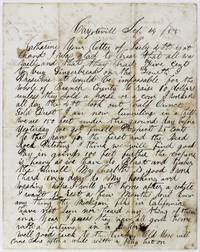
1855ref. 3206Coyoteville: September 12 1855. Very good. 2pp. plus integral blank. Original mailing folds moderate toning staining and ink spotting but still easily readable. Bottom fourth of integral blank excised. An informative Gold Rush letter about mining in the long-vanished ghost town of Coyoteville which was an extraordinarily rich gold area for a couple of years in the early 1850s. A noted tunneling method nicknamed "coyoteing" was developed in the town and subsequently inspired the name of the town. In the present letter Moses Pine writes to "Catherine" in Branch County Michigan and signs his name simply as "Mose Esq" at the conclusion. The author informs Catherine presumably his wife or sister of his activities some of the economic realities and some of the practical details of prospecting for gold in California. Presuming that "it would be impossible for the whole of Branch County to raise $10 unless they sell a horse" Pine comments that he had ginger bread on the Fourth of July after working all day and yielding a "half Ounce Gold Dust." He then provides a detailed description of his mining: "I am now tunneling in a hill. We are 150 feet under the ground. Day before yesterday we got small respect 25 cents to the pan for the first and the bed rock pitching. I think we will find good pay in the going 100 feet further the expense is heavy as we have to blast and timber the tunnel." Pine also talks of his health and that "I work hard every day do my cooking and baking." He then expresses his hope to get back to Michigan to "rest a few months" but knows nothing of other Michigan folks in California: "Have not seen nor heard anything of them in a year. I guess they have all gone home with a fortune in a horn. Well good luck to the lucky. Old Mose will come home after a while with a pretty hat on." A nicely-detailed letter from an unusual and obscure Gold Rush location. September 12 unknown books
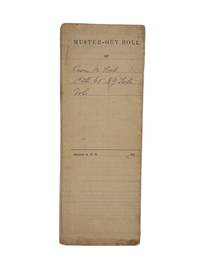
1863ref. 215941863. Medal of Honor Recipient Moses Veale Signed Civil War muster out roll dated June 8 1863 documents the discharge of 1st Lieutenant Orson Foot of the 60th New York Volunteer Infantry so he could accept a commission as Captain during the opening phase of the Gettysburg campaign. Issued at Aquia Creek Virginia the document bears the signature of Captain Moses Veale as mustering officer a Union officer later awarded the Medal of Honor for extraordinary gallantry during the Civil War. Veale's citation records that during the Battle of Wauhatchie Tennessee he continued directing his men after being struck by four enemy bullets and having his horse shot from under him. The presence of Veale's signature transforms the document from routine military administration into a signed record connected to one of the war's most decorated acts of battlefield courage. At the same time the roll records Foot's discharge to accept promotion during the Gettysburg Campaign. Foot Orson. Civil War muster out roll. Aquia Creek Virginia June 8 1863. One manuscript sheet completed in official Union Army muster format and signed by Captain Moses Veale as mustering officer. The document certifies that the officer "carefully examined this Roll. and mustered the said Orson Foot for discharge; and I hereby honorably discharge him from the service of the United States." It records Foot's enrollment at Ogdensburg New York on September 16 1861 identifies his rank as 1st Lieutenant in the 60th New York Volunteer Infantry and notes in the remarks that he was mustered out "to accept Commission of Captain." The sheet therefore documents the administrative transition by which an officer left one commission to assume another within the wartime command structure. The document's date and place situate it at the evacuation of Aquia Creek Landing one of the Army of the Potomac's principal logistical bases. Established during earlier campaigns in northern Virginia Aquia Creek served as a major supply depot linking Washington with Union forces in the field. As Robert E. Lee advanced north in June 1863 the Union command dismantled and abandoned the installation to support the army's rapid movement toward Pennsylvania. By the very day this roll was issued June 8 Federal forces were evacuating and destroying the depot to prevent its use by Confederate troops. Foot's promotion therefore occurred amid the redeployment that would culminate at the Battle of Gettysburg. Single manuscript sheet measuring approximately 32 x 11 inches when unfolded. Some age toning scattered ink staining and edge wear consistent with large-format wartime administrative documents; overall good condition. A substantial Civil War military document combining Gettysburg campaign context with the signature of Medal of Honor recipient Moses Veale whose later battlefield heroism makes his autograph particularly desirable within Civil War military manuscripts. A substantial Civil War military document produced during the evacuation of Aquia Creek and the opening phase of the Gettysburg campaign. unknown
1863ref. 215941863. Medal of Honor Recipient Moses Veale Signed Civil War muster out roll dated June 8 1863 documents the discharge of 1st Lieutenant Orson Foot of the 60th New York Volunteer Infantry so he could accept a commission as Captain during the opening phase of the Gettysburg campaign. Issued at Aquia Creek Virginia the document bears the signature of Captain Moses Veale as mustering officer a Union officer later awarded the Medal of Honor for extraordinary gallantry during the Civil War. Veale's citation records that during the Battle of Wauhatchie Tennessee he continued directing his men after being struck by four enemy bullets and having his horse shot from under him. The presence of Veale's signature transforms the document from routine military administration into a signed record connected to one of the war's most decorated acts of battlefield courage. At the same time the roll records Foot's discharge to accept promotion during the Gettysburg Campaign. Foot Orson. Civil War muster out roll. Aquia Creek Virginia June 8 1863. One manuscript sheet completed in official Union Army muster format and signed by Captain Moses Veale as mustering officer. The document certifies that the officer "carefully examined this Roll. and mustered the said Orson Foot for discharge; and I hereby honorably discharge him from the service of the United States." It records Foot's enrollment at Ogdensburg New York on September 16 1861 identifies his rank as 1st Lieutenant in the 60th New York Volunteer Infantry and notes in the remarks that he was mustered out "to accept Commission of Captain." The sheet therefore documents the administrative transition by which an officer left one commission to assume another within the wartime command structure. The document's date and place situate it at the evacuation of Aquia Creek Landing one of the Army of the Potomac's principal logistical bases. Established during earlier campaigns in northern Virginia Aquia Creek served as a major supply depot linking Washington with Union forces in the field. As Robert E. Lee advanced north in June 1863 the Union command dismantled and abandoned the installation to support the army's rapid movement toward Pennsylvania. By the very day this roll was issued June 8 Federal forces were evacuating and destroying the depot to prevent its use by Confederate troops. Foot's promotion therefore occurred amid the redeployment that would culminate at the Battle of Gettysburg. Single manuscript sheet measuring approximately 32 x 11 inches when unfolded. Some age toning scattered ink staining and edge wear consistent with large-format wartime administrative documents; overall good condition. A substantial Civil War military document combining Gettysburg campaign context with the signature of Medal of Honor recipient Moses Veale whose later battlefield heroism makes his autograph particularly desirable within Civil War military manuscripts. A substantial Civil War military document produced during the evacuation of Aquia Creek and the opening phase of the Gettysburg campaign. unknown books
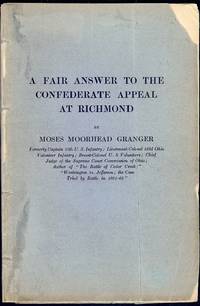
1907ref. 46511907. Granger Moses Moorhead. A FAIR ANSWER TO THE CONFEDERATE APPEAL AT RICHMOND. Self-published 1907. 12mo. printed blue wraps; 32 pages. First- and only- edition. A treatise debunking many claims made by Southern states and politicians that led to the Civil War. "Richmond" in the title refers to the unveiling of a statue of Jefferson Davis on June 3 1907 in that city and speeches at the time stating that Davis and the Southern states will eventually be vindicated for their actions leading to and during the Civil War. Granger 1831-1913 was born and also died in Zanesville Ohio where he was a lawyer and a judge. He served with Company S of the 122nd Regiment of the Ohio Volunteer Infantry during the Civil War where he earned the ranks of Lt. Colonel and Colonel. With an autograph note signed by Granger inside the front cover discussing some copyright confusion over the book's publication and with a "Publisher's Weekly" ink stamp on the same page. With another lengthy autograph note on the last page by Granger discussing the politics and various historic events that led to the war mentioning The Missouri Compromise The Nebraska Bill etc. Very rare with the only copies I have been able to locate in institutional libraries. Good condition some chipping covers but contents clean & tight; some repair to covers spine & inside front cover with clear archival tape. $1250.00. unknown
1907ref. 46511907. Granger Moses Moorhead. A FAIR ANSWER TO THE CONFEDERATE APPEAL AT RICHMOND. Self-published 1907. 12mo. printed blue wraps; 32 pages. First- and only- edition. A treatise debunking many claims made by Southern states and politicians that led to the Civil War. "Richmond" in the title refers to the unveiling of a statue of Jefferson Davis on June 3 1907 in that city and speeches at the time stating that Davis and the Southern states will eventually be vindicated for their actions leading to and during the Civil War. Granger 1831-1913 was born and also died in Zanesville Ohio where he was a lawyer and a judge. He served with Company S of the 122nd Regiment of the Ohio Volunteer Infantry during the Civil War where he earned the ranks of Lt. Colonel and Colonel. With an autograph note signed by Granger inside the front cover discussing some copyright confusion over the book's publication and with a "Publisher's Weekly" ink stamp on the same page. With another lengthy autograph note on the last page by Granger discussing the politics and various historic events that led to the war mentioning The Missouri Compromise The Nebraska Bill etc. Very rare with the only copies I have been able to locate in institutional libraries. Good condition some chipping covers but contents clean & tight; some repair to covers spine & inside front cover with clear archival tape. $1250.00. unknown books
1842ref. 69781Buffalo NY 1842. Four manuscript documents 4 pp. each approx. 31 cm. each docketed on verso. All in very good condition legible one document more toned. A record of moneys collected by Joy and Bristol as Commissioners for the State of New York for distribution to the Niagara Sufferers. The documents include: 1 "Amts collected including what is due & collectable." caption title. This document signed by Joseph Clary and Moses Bristol Dec. 31 1830 records amounts collected by the commissioners plus the costs for the state less assignments sent to the comptroller dividends due Joy and Bristol etc. a "statement of the affairs of the Niagara Sufferers in a/c with the Comms. J & B." 2 "Statement of the affairs of the Niagara Suffers with Joy & Bristol." caption title. Calculations on the second document signed by Clary and Bristol on Dec. 16 1833 record the total amount collected by Joy and Bristol to be $69205.30 with cash paid out to the sufferers amounting to $62913.69 plus expenses of $350. Left in the hands of Joy was $2511.30; Bristol $1649.72; Clary $1396.36; plus smaller amounts to three other people. 3 "Statement of the affairs of the Niagara Suffers with Joy & Bristol." caption title. Document dated Buffalo Feb. 1 1836 and signed by Clary and Joy. The total amount collected by Bristol and Joy amounted to $69281.39 including $42464.60 assigned to the comptroller Nov. 30 1825; plus $16955.40 on Dec. 27 1833; and $2900.50 on March 28 1835. Additional amounts were left to be distributed or recorded as expenses or paid in commissions to Joy & Bristol. A detailed breakdown of how the "Niagara suffer business stands between T. Joy M. Bristol & J. Clary" is also given. 4 "Statement of the affairs of the Niagara Sufferers with Joy & Bristol." caption title. This fourth document is a neater copy of the Feb. 1 1836 document docketed on verso: "copied from J. Clary's statement March 7 1842" and signed by M. Bristol. During the War of 1812 incursions by the British on American soil had resulted in the burning of towns the loss of property and the impoverishment of citizens. On the Niagara frontier this included the village of Buffalo which was nearly burned to the ground on Dec. 30 1813. In a letter written by members of the Committee of Safety and Relief at Canandaigua on Jan. 8 1814 it was reported that "Niagara county and that part of Genesee which lies west of Batavia are completely depopulated. All the settlements in a section of country forty miles square and which contained more than twelve thousand souls are effectually broken up. Our roads are filled with people many of whom have been reduced from a state of competence and good prospects to the last degree of want and sorrow." see: Louis Babcock's book "The War of 1812 on the Niagara Frontier" Buffalo NY: 1927 pp.253-4 These "Niagara sufferers" were among the citizens of several states who petitioned the federal government for redress of losses suffered during the conflict. President Madison and Congress responded by establishing an Office of Claims in 1816 with Richard Bland Lee as its adminstrator "to solicit claims appraise lost property adjudicate cases and award restitution." According to a "Report of the Committee of Claims on the petition of the inhabitants of Niagara county New York sufferers by the enemy during the last war" dated Jan. 15 1821 and submitted to Congress these same "sufferers" in anticipation of federal relief began in 1816 to apply for loans from a newly established bank in the village of Buffalo. These citizens "being at that time in great want of means to rebuild their houses and repair their devastated estates were induced to apply to this bank for loans of money for that purpose and which loans they generally obtained by giving mortgages on their farms accompanied by honorary engagements that they should be repaid out of the moneys received by them under the law for their relief." New York also passed a law on April 15 1815 granting state loans to the sufferers. On Jan. 29 1822 the State of New York passed "An Act Granting relief to the sufferers on the Niagara frontier whose property was destroyed by the enemy during the late war." By this act the state trusting that the U.S. Congress would ultimately repay the sufferers in full for their losses as well as repay the state for their expenditures transferred to the commissioners 'the several debts due to the people of this state for monies loaned to the sufferers. also all monies due to this state on securities taken for the payment of the debt due from the Bank of Niagara. and all interest due on said several debts and on said bills." The commissioners were authorized to extend the term of five years for the debtors to repay their debts and to "take and receive the title to any lands or tenements mortgaged to the people of the state. and it shall be lawful for the commissioners to sell and in their own names convey any lands or tenements which under this act they may acquire." Once the federal monies were received by the state the residual due to the sufferers would be calculated. The commissioners were charged with accounting to the comptroller for the execution of the trust confided to them. Record is found in the New York newspapers of the day of several sales of mortgages taken out by "sufferers" in the years following the conclusion of the War of 1812 and transferred to Thaddeus Joy and Moses Bristol Acting Commissioners. Meanwhile the federal Office of Claims under Richard Lee was closed down for a time while investigations of its awards were carried on. Sectional rivalries also interfered with settlement claims by the federal government for the losses of private citizens. Citizens from the southern states whose slaves had been liberated by British forces had managed to get a proposal for their return or compensation included in the Treaty of Ghent which ended the war. Northern states appealed for some sort of equal calculations for their losses. According to Craig Hollander in his article "The Citizen Complains: Federal Compensation for Property Lost in the War of 1812" Law and History Review Vol. 38 No. 4 Nov. 2020 pp.659-698 the civilian sufferers "deftly created a sense of sectional aggrievement to garner additional support from their Northern colleagues." By as late as 1840 however many of the claims remained unresolved. In a letter to Thaddeus Joy written by Joseph Clary on Dec. 28 1840 Clary remarks that Dr. Moses Bristol "is very anxious to have the old Niagara Sufferers affairs brot to a close. It is now near seventeen years since the law authorizing a transfer of the debts to the sufferers was passed and it would seem very much like a neglect of duty for us to let the matter run this length of time without any effort to close it with the Comptroller." Clary continued to be concerned that Joy and Bristol would not be compensated for their work as commissioners. In Louis Babcock's book on the war he notes that "documents supplying further information on this aspect of the Niagara Sufferer's Claims are lacking so that for the present the matter is left untold." Babcock pp.318-19. unknown
1842ref. 69781Buffalo NY 1842. Four manuscript documents 4 pp. each approx. 31 cm. each docketed on verso. All in very good condition legible one document more toned. A record of moneys collected by Joy and Bristol as Commissioners for the State of New York for distribution to the Niagara Sufferers. The documents include: 1 "Amts collected including what is due & collectable." caption title. This document signed by Joseph Clary and Moses Bristol Dec. 31 1830 records amounts collected by the commissioners plus the costs for the state less assignments sent to the comptroller dividends due Joy and Bristol etc. a "statement of the affairs of the Niagara Sufferers in a/c with the Comms. J & B." 2 "Statement of the affairs of the Niagara Suffers with Joy & Bristol." caption title. Calculations on the second document signed by Clary and Bristol on Dec. 16 1833 record the total amount collected by Joy and Bristol to be $69205.30 with cash paid out to the sufferers amounting to $62913.69 plus expenses of $350. Left in the hands of Joy was $2511.30; Bristol $1649.72; Clary $1396.36; plus smaller amounts to three other people. 3 "Statement of the affairs of the Niagara Suffers with Joy & Bristol." caption title. Document dated Buffalo Feb. 1 1836 and signed by Clary and Joy. The total amount collected by Bristol and Joy amounted to $69281.39 including $42464.60 assigned to the comptroller Nov. 30 1825; plus $16955.40 on Dec. 27 1833; and $2900.50 on March 28 1835. Additional amounts were left to be distributed or recorded as expenses or paid in commissions to Joy & Bristol. A detailed breakdown of how the "Niagara suffer business stands between T. Joy M. Bristol & J. Clary" is also given. 4 "Statement of the affairs of the Niagara Sufferers with Joy & Bristol." caption title. This fourth document is a neater copy of the Feb. 1 1836 document docketed on verso: "copied from J. Clary's statement March 7 1842" and signed by M. Bristol. During the War of 1812 incursions by the British on American soil had resulted in the burning of towns the loss of property and the impoverishment of citizens. On the Niagara frontier this included the village of Buffalo which was nearly burned to the ground on Dec. 30 1813. In a letter written by members of the Committee of Safety and Relief at Canandaigua on Jan. 8 1814 it was reported that "Niagara county and that part of Genesee which lies west of Batavia are completely depopulated. All the settlements in a section of country forty miles square and which contained more than twelve thousand souls are effectually broken up. Our roads are filled with people many of whom have been reduced from a state of competence and good prospects to the last degree of want and sorrow." see: Louis Babcock's book "The War of 1812 on the Niagara Frontier" Buffalo NY: 1927 pp.253-4 These "Niagara sufferers" were among the citizens of several states who petitioned the federal government for redress of losses suffered during the conflict. President Madison and Congress responded by establishing an Office of Claims in 1816 with Richard Bland Lee as its adminstrator "to solicit claims appraise lost property adjudicate cases and award restitution." According to a "Report of the Committee of Claims on the petition of the inhabitants of Niagara county New York sufferers by the enemy during the last war" dated Jan. 15 1821 and submitted to Congress these same "sufferers" in anticipation of federal relief began in 1816 to apply for loans from a newly established bank in the village of Buffalo. These citizens "being at that time in great want of means to rebuild their houses and repair their devastated estates were induced to apply to this bank for loans of money for that purpose and which loans they generally obtained by giving mortgages on their farms accompanied by honorary engagements that they should be repaid out of the moneys received by them under the law for their relief." New York also passed a law on April 15 1815 granting state loans to the sufferers. On Jan. 29 1822 the State of New York passed "An Act Granting relief to the sufferers on the Niagara frontier whose property was destroyed by the enemy during the late war." By this act the state trusting that the U.S. Congress would ultimately repay the sufferers in full for their losses as well as repay the state for their expenditures transferred to the commissioners 'the several debts due to the people of this state for monies loaned to the sufferers. also all monies due to this state on securities taken for the payment of the debt due from the Bank of Niagara. and all interest due on said several debts and on said bills." The commissioners were authorized to extend the term of five years for the debtors to repay their debts and to "take and receive the title to any lands or tenements mortgaged to the people of the state. and it shall be lawful for the commissioners to sell and in their own names convey any lands or tenements which under this act they may acquire." Once the federal monies were received by the state the residual due to the sufferers would be calculated. The commissioners were charged with accounting to the comptroller for the execution of the trust confided to them. Record is found in the New York newspapers of the day of several sales of mortgages taken out by "sufferers" in the years following the conclusion of the War of 1812 and transferred to Thaddeus Joy and Moses Bristol Acting Commissioners. Meanwhile the federal Office of Claims under Richard Lee was closed down for a time while investigations of its awards were carried on. Sectional rivalries also interfered with settlement claims by the federal government for the losses of private citizens. Citizens from the southern states whose slaves had been liberated by British forces had managed to get a proposal for their return or compensation included in the Treaty of Ghent which ended the war. Northern states appealed for some sort of equal calculations for their losses. According to Craig Hollander in his article "The Citizen Complains: Federal Compensation for Property Lost in the War of 1812" Law and History Review Vol. 38 No. 4 Nov. 2020 pp.659-698 the civilian sufferers "deftly created a sense of sectional aggrievement to garner additional support from their Northern colleagues." By as late as 1840 however many of the claims remained unresolved. In a letter to Thaddeus Joy written by Joseph Clary on Dec. 28 1840 Clary remarks that Dr. Moses Bristol "is very anxious to have the old Niagara Sufferers affairs brot to a close. It is now near seventeen years since the law authorizing a transfer of the debts to the sufferers was passed and it would seem very much like a neglect of duty for us to let the matter run this length of time without any effort to close it with the Comptroller." Clary continued to be concerned that Joy and Bristol would not be compensated for their work as commissioners. In Louis Babcock's book on the war he notes that "documents supplying further information on this aspect of the Niagara Sufferer's Claims are lacking so that for the present the matter is left untold." Babcock pp.318-19. unknown books
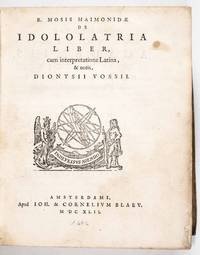
1642ref. 48836Amsterdam: Joan and Cornelis Blaeu 1642. Second edition. Hardcover. Very good. Sammelband of two works jointly issued the latter in two parts quarto. 12 174 1 errata 1 blank; 12 732 pp. 353-360 repeated xvii addenda 19 index x addenda 28 index 1 emendanda 1 blankpp. All four addenda and indices to the De theologia gentili bound following the second part. Each work with woodcut printer's device at title; occasional woodcut lettrines; printed marginalia. De idololatria with Hebrew text and Latin translation in parallel columns interspersed with Latin notes. Contemporary vellum lightly soiled manuscript title at spine intermittant light dampstain largely confined to first work else crisp clean and amply margined. Collation: I. asterisk4 2asterisk2 A-Y4 = 94 leaves; II. asterisk4 2asterisk2 A-2P4 2Q-4Y4 4Z2 asterisk-4asterisk4 5asterisk2 cross-5cross4 = 414 leaves 2Y-2Y4 repeated. Re-issue of the first edition 1641 of the first two books of four of G. J. Vossius' De theologia gentili with new preliminaries including an Elegy written by Caspar Barlaeus on the occasion of the death of Gerhard's son Dionysius dated IV Kal. Novembris MDCXXXIII 1633 and a preface by another of Vossius' sons Isaac; along with an edition of the Hebrew text of Maimonides' treatment of the laws of idolotry in the first book of the Mishneh Torah with accompanying Latin translation by Dionysius Vossius. "The work has a two-fold aim. In the first place it is a Theologia gentilis. Of this the subtitle says that the work treats. the origin and history of heathen mythologies and cult forms. But at the same time the book is a Physiologia christiana a study 'de naturae mirandis quibus homo adducitur ad Deum' an account as complete as possible of the rich diversity of all creation that in the inention of the creator must serve to reveal to man the greatness of God. It is simultaneously an ambitiously arranged textbook of mythology a summary of what was written about nature in all its manifestations up until Vossius' time and finally also a first specimen of what would be done profusely in the eighteenth century a book on the natural knowledge of God" Rademaker. Provenance: The manuscript entry "Jan de Wind. 17 april An. 1697.". References: J. I. Dienstag "Christian Translators of Maimonides' Mishneh Torah into Latin" in: Salo Wittmayer Baron Jubilee Volume 31 De idololatria. Fuks/Fuks-Mansfeld 202 De idololatria ed. 1641 noting that there exist copies without the Hebrew text. The 1641 ed. contains no preliminaries after the title. Katchen Christian Hebraists and Dutch Rabbis esp. pp.24-25. Rademaker Life and Work of G.J. Vossius Assen 1981 no. 24: "In his last large work the Theologia gentilis. he dared to make full use of Scaliger's chronological innovations" 185. For more detailed commentary see: pp. 306-310. For Dionysius see 163f. Joan and Cornelis Blaeu hardcover
1642ref. 254936Amsterdam: Jioh & Corneium Blaeu 1642. Second edition of each title. Publisher's device on title pages; woodcut tailpieces ornamental initials. Maimonides text in Hebrew with facing Latin translation by Vossius. 12 1-174. 2; 12 304; xvii 19 305-732 x 30. 1 vols. 4to. Contemporary vellum with ms. spine title covers slightly soiled upper joint cracked. Institutional shelfmark in ink on title-page ; bookplae of HENRY FERGUSON of Stamford Connecticut "Henry Ferguson from the Library of Rev. FREDERIC GARDINER" and signed by Gardiner on the front pastedown "Leipzig 1854. Second edition of each title. Publisher's device on title pages; woodcut tailpieces ornamental initials. Maimonides text in Hebrew with facing Latin translation by Vossius. 12 1-174. 2; 12 304; xvii 19 305-732 x 30. 1 vols. 4to. Scarce second edition of Maimonides' tract on idolatry with an important new foreword "to the Reader" by Isaac Vossius brother of the recently deceased translator Dionysius Vossius 1612-1642 as well as a new dedicatory poem by Caspar Barlaeus. Maimonides' text is usually accompanied as it is here by the massive commentary by Gerardus Vossius father of Isaac and Dionysius DE THEOLOGIA GENTILI . a book said to have been an iinfluence on Isaac Newton; his library contained an "extensively dog-eared" copy of the book John Harrison THE LIBRARY OF ISAAC NEWTON Cambridge University Press p. 258. This particular copy has a very distinguished provenance. Dr. Frederic Gardiner was an Episcopal clergyman Biblican scholar founder of the American Exegetical Society and author of several books including a Harmony of the Gospels. Henry Ferguson of Stamford Ct. "studied theology in the Berkeley Divinity School. In 1872 he was made rector of Christ Church in Exeter N. H. and in 1878 rector of Trinity Church Claremont in the same state. In 1883 he became professor of history and political economy in Trinity College a position he filled with distinguished credit until commencement in 1906 when he resigned to become rector of St. Paul's School Concord N. H. In 1873 he married Emma J. Gardiner daughter of Professor Gardiner of the Berkeley Divinity School . His original specialty was Hebrew." Norris Galpin Osborn ed. MEN OF MARK IN CONNECTICUT Vol I p. 132. OCLC: 37317703 one copy in US; Vossius: Brunet V col. 1373 for editions of 1641 and 1668 Jioh, & Corneium Blaeu unknown
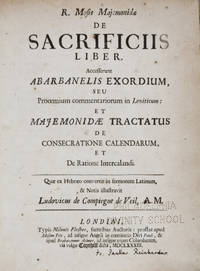
1683ref. 14061London: Typis Milonis Flesher sumptibus auctoris prostat apud Mosem Pitt & apud Brabazonum Aylmer 1683. First edition. Hardcover. g. 8vo. 10 450pp. 3/4 Vellum over marbled boards with brown lettering and library plate to spine. Age wearing throughout binding.Some tears discoloration scuffing and rubbing to boards and spine. Some browning and foxing to pages not affecting the script. Welling to pages. Ex library. Library card pocket pasted to inside of front board. Perforation to title page: Philadelphia Divinity school. Inscribed by owner with pencil: "to Paullus Reinhardus." This first Latin translation contains texts from Moshe ben Maimon aka Rambam aka Maimonides 1135-1204 and Yitzchak ben Yehuda aka Abravanel Isaac Abrabanel1437-1508. In Latin with some writing in Hebrew. Cover in fair book in good condition. freely translated: Rabbi Moses Maimonides' volountary sacrifice: An approach to Abarbanel's introduction and commentary on Leviticus and Maimonides' Tractate on the consecrated calendar and the rational calendar change R. Moses Maimonides Rambam was a 12th century Jewish philosopher and halachic legal scholar. A highly controversial figure both during his lifetime and after his death but generally acknowledged as the preeminent Jewish thinker of the Middle Ages. He was born in Córdoba Spain but fled as a child from the Almohad persecution. He eventually settled in Egypt where he served as a rabbi physician and philosopher. His fourteen-volume Mishneh Torah his only work not in Arabic still carries canonical authority particularly within the Yemenite Jewish community as the codification of Talmudic law. His other work includes a commentary on the Mishnah entitled Kitab al-Siraj Kitab al-Fara'I a book on precepts and the philosophical work Dalalat al-Ha'irin known in Hebrew as the Moreh Nevukhim The Guide to the Perplexed. The major premise is an attempted philosophical/theological reconciliation of the Hebrew Bible and Greek knowledge. This work came to play a central role in all subsequent major controversies over philosophy within the Jewish community during the Middle Ages. Typis Milonis Flesher, sumptibus auctoris, prostat apud Mosem Pitt, & apud Brabazonum Aylmer hardcover
1642ref. 254936Amsterdam: Jioh & Corneium Blaeu 1642. Second edition of each title. Publisher's device on title pages; woodcut tailpieces ornamental initials. Maimonides text in Hebrew with facing Latin translation by Vossius. 12 1-174. 2; 12 304; xvii 19 305-732 x 30. 1 vols. 4to. Contemporary vellum with ms. spine title covers slightly soiled upper joint cracked. Institutional shelfmark in ink on title-page ; bookplae of HENRY FERGUSON of Stamford Connecticut "Henry Ferguson from the Library of Rev. FREDERIC GARDINER" and signed by Gardiner on the front pastedown "Leipzig 1854. Second edition of each title. Publisher's device on title pages; woodcut tailpieces ornamental initials. Maimonides text in Hebrew with facing Latin translation by Vossius. 12 1-174. 2; 12 304; xvii 19 305-732 x 30. 1 vols. 4to. Scarce second edition of Maimonides' tract on idolatry with an important new foreword "to the Reader" by Isaac Vossius brother of the recently deceased translator Dionysius Vossius 1612-1642 as well as a new dedicatory poem by Caspar Barlaeus. Maimonides' text is usually accompanied as it is here by the massive commentary by Gerardus Vossius father of Isaac and Dionysius DE THEOLOGIA GENTILI . a book said to have been an iinfluence on Isaac Newton; his library contained an "extensively dog-eared" copy of the book John Harrison THE LIBRARY OF ISAAC NEWTON Cambridge University Press p. 258. This particular copy has a very distinguished provenance. Dr. Frederic Gardiner was an Episcopal clergyman Biblican scholar founder of the American Exegetical Society and author of several books including a Harmony of the Gospels. Henry Ferguson of Stamford Ct. "studied theology in the Berkeley Divinity School. In 1872 he was made rector of Christ Church in Exeter N. H. and in 1878 rector of Trinity Church Claremont in the same state. In 1883 he became professor of history and political economy in Trinity College a position he filled with distinguished credit until commencement in 1906 when he resigned to become rector of St. Paul's School Concord N. H. In 1873 he married Emma J. Gardiner daughter of Professor Gardiner of the Berkeley Divinity School . His original specialty was Hebrew." Norris Galpin Osborn ed. MEN OF MARK IN CONNECTICUT Vol I p. 132. OCLC: 37317703 one copy in US; Vossius: Brunet V col. 1373 for editions of 1641 and 1668 Jioh, & Corneium Blaeu unknown books
1683ref. 14061London: Typis Milonis Flesher sumptibus auctoris prostat apud Mosem Pitt & apud Brabazonum Aylmer 1683. First edition. Hardcover. g. 8vo. 10 450pp. 3/4 Vellum over marbled boards with brown lettering and library plate to spine. Age wearing throughout binding.Some tears discoloration scuffing and rubbing to boards and spine. Some browning and foxing to pages not affecting the script. Welling to pages. Ex library. Library card pocket pasted to inside of front board. Perforation to title page: Philadelphia Divinity school. Inscribed by owner with pencil: "to Paullus Reinhardus." This first Latin translation contains texts from Moshe ben Maimon aka Rambam aka Maimonides 1135-1204 and Yitzchak ben Yehuda aka Abravanel Isaac Abrabanel1437-1508. In Latin with some writing in Hebrew. Cover in fair book in good condition. freely translated: Rabbi Moses Maimonides' volountary sacrifice: An approach to Abarbanel's introduction and commentary on Leviticus and Maimonides' Tractate on the consecrated calendar and the rational calendar change R. Moses Maimonides Rambam was a 12th century Jewish philosopher and halachic legal scholar. A highly controversial figure both during his lifetime and after his death but generally acknowledged as the preeminent Jewish thinker of the Middle Ages. He was born in Córdoba Spain but fled as a child from the Almohad persecution. He eventually settled in Egypt where he served as a rabbi physician and philosopher. His fourteen-volume Mishneh Torah his only work not in Arabic still carries canonical authority particularly within the Yemenite Jewish community as the codification of Talmudic law. His other work includes a commentary on the Mishnah entitled Kitab al-Siraj Kitab al-Fara'I a book on precepts and the philosophical work Dalalat al-Ha'irin known in Hebrew as the Moreh Nevukhim The Guide to the Perplexed. The major premise is an attempted philosophical/theological reconciliation of the Hebrew Bible and Greek knowledge. This work came to play a central role in all subsequent major controversies over philosophy within the Jewish community during the Middle Ages. Typis Milonis Flesher, sumptibus auctoris, prostat apud Mosem Pitt, & apud Brabazonum Aylmer hardcover books
1642ref. 48836Amsterdam: Joan and Cornelis Blaeu 1642. Second edition. Hardcover. Very good. Sammelband of two works jointly issued the latter in two parts quarto. 12 174 1 errata 1 blank; 12 732 pp. 353-360 repeated xvii addenda 19 index x addenda 28 index 1 emendanda 1 blankpp. All four addenda and indices to the De theologia gentili bound following the second part. Each work with woodcut printer's device at title; occasional woodcut lettrines; printed marginalia. De idololatria with Hebrew text and Latin translation in parallel columns interspersed with Latin notes. Contemporary vellum lightly soiled manuscript title at spine intermittant light dampstain largely confined to first work else crisp clean and amply margined. Collation: I. asterisk4 2asterisk2 A-Y4 = 94 leaves; II. asterisk4 2asterisk2 A-2P4 2Q-4Y4 4Z2 asterisk-4asterisk4 5asterisk2 cross-5cross4 = 414 leaves 2Y-2Y4 repeated. Re-issue of the first edition 1641 of the first two books of four of G. J. Vossius' De theologia gentili with new preliminaries including an Elegy written by Caspar Barlaeus on the occasion of the death of Gerhard's son Dionysius dated IV Kal. Novembris MDCXXXIII 1633 and a preface by another of Vossius' sons Isaac; along with an edition of the Hebrew text of Maimonides' treatment of the laws of idolotry in the first book of the Mishneh Torah with accompanying Latin translation by Dionysius Vossius. "The work has a two-fold aim. In the first place it is a Theologia gentilis. Of this the subtitle says that the work treats. the origin and history of heathen mythologies and cult forms. But at the same time the book is a Physiologia christiana a study 'de naturae mirandis quibus homo adducitur ad Deum' an account as complete as possible of the rich diversity of all creation that in the inention of the creator must serve to reveal to man the greatness of God. It is simultaneously an ambitiously arranged textbook of mythology a summary of what was written about nature in all its manifestations up until Vossius' time and finally also a first specimen of what would be done profusely in the eighteenth century a book on the natural knowledge of God" Rademaker. Provenance: The manuscript entry "Jan de Wind. 17 april An. 1697.". References: J. I. Dienstag "Christian Translators of Maimonides' Mishneh Torah into Latin" in: Salo Wittmayer Baron Jubilee Volume 31 De idololatria. Fuks/Fuks-Mansfeld 202 De idololatria ed. 1641 noting that there exist copies without the Hebrew text. The 1641 ed. contains no preliminaries after the title. Katchen Christian Hebraists and Dutch Rabbis esp. pp.24-25. Rademaker Life and Work of G.J. Vossius Assen 1981 no. 24: "In his last large work the Theologia gentilis. he dared to make full use of Scaliger's chronological innovations" 185. For more detailed commentary see: pp. 306-310. For Dionysius see 163f. Joan and Cornelis Blaeu hardcover books
1678ref. 52858Paris: G. Caillou 1678. First edition. Hardcover. Good. Quarto. 16 384pp; 3 unnumbered double-suite engraved plates with legends in the margins. Engraved printer's device at title. Woodcut head- and tailpieces lettrines. Text in Latin with some key terms in Hebrew; printed marginalia. Contemporary calf rubbed and lightly worn at extremities; spine with raised bands gilt-tooled compartments old manuscript title on paper in upper compartment. Text lightly toned throughout else clean and crisp. A good or better copy. Collation: atilde6 etilde2 e2 signed e3 A-3B4 = 200 leaves First edition of this Latin version of Sefer Avodah The Book of Divine Service being the eighth book of the Mishneh Torah Moses Maimonides' systemic treatment of Talmudic and post-Talmudic Jewish law halakhah. The nine chapters of Sefer Avodah comprise a legal digest of Israelite cult practices at the Jerusalem Temple: The Chosen Temple; Vessels of the Sanctuary and Those Who Serve Therein; Admission into the Sanctuary; Things Forbidden on the Altar; Sacrificial Procedure; Daily Offerings and Additional Offerings; Sacrifices Rendered Unfit; Service on the Day of Atonement; Trespass. "Whereas Christian interest in Maimonides' thought was focused on his philosophic work the Guide of the Perplexed during the Middle Ages -- the so-called Age of Faith -- this interest shifted during the Renaissance the Reformation and the Enlightenment to his Halakic work the Mishneh Torah. It was through the Mishneh Torah that Christian thinkers and theologians viewed normative Judaism" Dienstag. Born Daniel de Weil in the Jewish quarter of Metz Louis-Compiègne de Veil d. c.1710 was the son of the town's rabbi David Weil d. 1645 and a descendant of the Nürnberg rabbi Jacob Weil. Both he and his brother Charles Marie de Veil converted to Catholicism under the influence of the new Catholic archdeacon Jacques-Bénigne Bossuet who arrived at Metz in 1652. The archdeacon "shared in the current apocalyptic excitement of both Christians and Jewish cabbalists and the conviction of the former of an imminent large-scale conversion of the Jews" ODNB. He was sponsored at his baptism by Louis XIV as reflected in his new Christian name and went on to study theology at the Sorbonne. Both Louis and his brother subsequently converted to Calvinism and immigrated to England. "Designated sub-keeper of the Royal Library in 1678 de Veil was licensed 'ad docendum litteras in et per totam urbem Londinensem' in 1685" Massil. As noted by Dienstag de Veil "devoted himself to the interpretation of Maimonides' code Mishneh Torah." The present work was dedicated to the son of Minister Jean-Baptiste Colbert the churchman Jacques Nicolas Colbert 1655-1707 who later become Archbishop of Rouen in 1691 and was one of the first members of the Académie des Inscriptions et Belles-Lettres. Provenance and annotations: With the 19th-century bookplate of "Mr. F. Theremin Ministre du S. Evangile" at the front paste-down and his stamp at the bottom margin of the title-page. The opening blank end-leaf contains detailed bibliographical lists in French. The first notes thirteen authors and their works which discuss de Veil including Richard Simon Pierre Daniel Huet and Job Ludolf; the second notes seven bibliographies which include the present work followed by a list of later printings. References: J. I. Dienstag "Christian Translators of Maimonides' Mishneh Torah into Latin" in: Salo Wittmayer Baron Jubilee Volume NY: Columbia Univ. 1974 pp.288; 303 no. 4; S.W. Massil "Immigrant Librarians to Britain: Huguenots and Some Others" 69th IFLA General Conference and Council and Council 1-9 August 2003 Berlin; S. Wright "Charles Marie de Veil" in: ODNB. Full title and imprint: De cultu divino ex R. Mosis Majemonidae Secunda lege seu Manu forti liber VIII. Dividitur in IX. tractatus quorum seriem pagina è regione Elenchi posita declarabit. Accesserunt tabulae aere incisae in quibus exprimitur Hierosolymitanti templi forma accuratissimè & eleganter descripta. Hunc librum ex hebraeo latinum fecit & notis illustravit Ludovicus de Compiegne de Veïl D.A. Parisiis apud Guidonem Caillou Bibliopolam viâ Jocabaeâ sub Constantia. M.DC.LXXVIII. G. Caillou hardcover books
1845ref. 37452Leipzig: F. A. Brockhaus 1845. First edition. Hardcover. g. Small Octavo ca. 4200pp. Original half leather over dark green pebbled cloth. Marbled endpapers and edges. Portrait lithograph of Mendelssohn by Frisch with tissue guard. Edited by Prof. Dr. G. B. Mendelssohn based on original prints and handwritings in seven volumes. Vol. 1: Biography and philosophical writings Vol. 2: Metaphysical writings Vol. 3: Correspondence and smaller writings Vol. 4.1: Smaller writings and correspondence Vol. 4.2: Correspondence. Vol. 5: Correspondence. Vol. 6: Ritual Laws of the Jews and various translations. Vol. 7: Mendelssohn's translation of the Five Books of Moses. Moses Mendelssohn was a German Jewish philosopher and practicing orthodox Jew. His ideas are credited with contributing significantly to the 'Jewish enlightenment' of the 18th and 19th centuries the Haskalah. Text in German fracture. Binding rubbed. Some volumes with professional repair at gutters starting a back gutter of volume 2 and 3. Volumes dusty and marbled edges faded. Moderate sporadic foxing of book blocks. Bindings and interior in overall good condition. F. A. Brockhaus hardcover
1845ref. 37452Leipzig: F. A. Brockhaus 1845. First edition. Hardcover. g. Small Octavo ca. 4200pp. Original half leather over dark green pebbled cloth. Marbled endpapers and edges. Portrait lithograph of Mendelssohn by Frisch with tissue guard. Edited by Prof. Dr. G. B. Mendelssohn based on original prints and handwritings in seven volumes. Vol. 1: Biography and philosophical writings Vol. 2: Metaphysical writings Vol. 3: Correspondence and smaller writings Vol. 4.1: Smaller writings and correspondence Vol. 4.2: Correspondence. Vol. 5: Correspondence. Vol. 6: Ritual Laws of the Jews and various translations. Vol. 7: Mendelssohn's translation of the Five Books of Moses. Moses Mendelssohn was a German Jewish philosopher and practicing orthodox Jew. His ideas are credited with contributing significantly to the 'Jewish enlightenment' of the 18th and 19th centuries the Haskalah. Text in German fracture. Binding rubbed. Some volumes with professional repair at gutters starting a back gutter of volume 2 and 3. Volumes dusty and marbled edges faded. Moderate sporadic foxing of book blocks. Bindings and interior in overall good condition. F. A. Brockhaus hardcover books