Richardson, Moses AaronBiblio.com

11.169 resultados
ref. 1024874451.Ghardcover. Good. Access codes and supplements are not guaranteed with used items. May be an ex-library book. hardcover
ref. 3563217807.Gpaperback. Good. Access codes and supplements are not guaranteed with used items. May be an ex-library book. paperback
ref. 1023961962.Ghardcover. Good. Access codes and supplements are not guaranteed with used items. May be an ex-library book. hardcover
ref. 6208541573.Gpaperback. Good. Access codes and supplements are not guaranteed with used items. May be an ex-library book. paperback
ref. 6208541654.Gpaperback. Good. Access codes and supplements are not guaranteed with used items. May be an ex-library book. paperback
ref. 6208541611.Gpaperback. Good. Access codes and supplements are not guaranteed with used items. May be an ex-library book. paperback
ref. 620854162X.Gpaperback. Good. Access codes and supplements are not guaranteed with used items. May be an ex-library book. paperback
ref. 620854159X.Gpaperback. Good. Access codes and supplements are not guaranteed with used items. May be an ex-library book. paperback
ref. 6297760Short description: In Russian. Kahana Moses. Hungarian-Russian Dictionary. Moscow: Soviet Encyclopedia 1964. Please feel free to contact us for a detailed description of the copies available. SKU6297760 unknown
ref. 6373900Short description: In Russian. Eltsufin Moses Abramovich. Installation adjustment and repair of turbocompressor and turbogenerator units. Moscow; Leningrad: Mashgiz. Leningrad Branch 1960. Please feel free to contact us for a detailed description of the copies available. SKU6373900 unknown
ref. 1023467542.Ghardcover. Good. Access codes and supplements are not guaranteed with used items. May be an ex-library book. hardcover
ref. 6208743168.Gpaperback. Good. Access codes and supplements are not guaranteed with used items. May be an ex-library book. paperback
ref. 6203889792.Gpaperback. Good. Access codes and supplements are not guaranteed with used items. May be an ex-library book. paperback
ref. 6203889784.Gpaperback. Good. Access codes and supplements are not guaranteed with used items. May be an ex-library book. paperback
ref. 9562914259.Ghardcover. Good. Access codes and supplements are not guaranteed with used items. May be an ex-library book. hardcover
ref. 6203889768.Gpaperback. Good. Access codes and supplements are not guaranteed with used items. May be an ex-library book. paperback
1845ref. 73532Firenze: A spese dell'autore 1845. Cm. 19 pp. 508. Bell'antiporta incisa in rame con la raffigurazione dell'interno della chiesa di S. Croce. Brossura originale ornata. Qualche arrossatura sparsa peraltro esemplare genuino e ben conservato. A spese dell'autore unknown
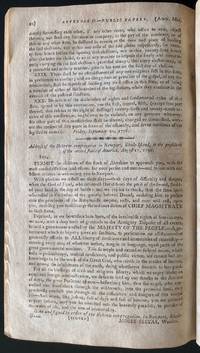
1791ref. 43202Philadelphia: Mathew Carey; Carey Stewart and Co. No. 188 Market-street 1791. Original Sewn Binding without outer wrappers or boards 8vo pages 285-344 1-48 1-40 1-48 total 196 pages with different sections correctly paginated for this issue. With Moses Seixas’ famous letter to President George Washington Seixas wrote to President Washington on behalf of the Newport congregation whose home is the Touro Synagogue the oldest synagogue still standing in America. This letter which appears on p 40 of Appendix II and Washington's reply comprise one of the most famous statements on religious freedom of this period. Here published in America’s first literary magazine George Washington’s famous phrase describing a government that "gives to bigotry no sanction and to persecution no assistance" was originally coined by Seixas in this very letter. It is a moving Biblically toned greeting to the president and was repeated by Washington in his reply assuring it a place among the most cherished in the American historical vocabulary. George Washington's visit to Newport Rhode Island August 17-18 1790 ranks among the seminal episodes in the history of American Jewish religious liberty. Washington left Rhode Island off his travel itinerary the previous year in response to the state's failure to ratify the Constitution. By 1790 after becoming the last state to ratify Washington visited Newport along with members of his administration including Thomas Jefferson. Moses Seixas 1744-1809 a Newport merchant warden of Kaal Kadosh Yeshuat Israel Newport Hebrew Congregation and a prominent Mason was one of the civic leaders who met with Washington. Seixas had a long history as a revolutionary patriot: he remained in the city after it was occupied by the British during the war and signed a document during the occupation pledging loyalty to the patriotic cause. Additionally his brother Rabbi Gershon Mendes Seixas minister of New York's Shearith Israel Congregation known as the "patriot rabbi" was one of fourteen clerygymen officiating at Washington's 1789 Presidential inauguration. Finally as a fellow Mason he and Washington would have had a natural connection. Seixas' eloquent message reads in part: "Deprived as we heretofore have been of the invaluable rights of free Citizens we now with a deep sense of gratitude to the Almighty Disposer of all events behold a Government erected by the MAJESTY OF THE PEOPLE – a Government which to bigotry gives no sanction to persecution no assistance – but generously affording to ALL Liberty of conscience and immunities of Citizenship: – deeming every one of whatever Nation tongue or language equal parts of the great governmental Machine: – This so ample and extensive Federal Union whose basis is Philanthropy Mutual confidence and Public Virtue we cannot but acknowledge to be the work of the Great God who ruleth in the Armies of Heaven and among the Inhabitants of the Earth doing whatever seemeth him good." Grounding religious freedom in natural rights and echoing Seixas' words Washington later replied with an echo of Seixas' language regarding religious freedom: "The Citizens of the United States of America have a right to applaud themselves for having given to mankind examples of an enlarged and liberal policy: a policy worthy of imitation. All possess alike liberty of conscience and immunities of citizenship. It is now no more that toleration is spoken of as if it was by the indulgence of one class of people that another enjoyed the exercise of their inherent natural rights. For happily the Government of the United States which gives to bigotry no sanction to persecution no assistance requires only that they who live under its protection should demean themselves as good citizens in giving it on all occasions their effectual support." See JE Vol. IX pp. 294-295; EJ. Vol. XIV p. 1117; J.L. Blau and S.W. Baron The Jews of the United States 1790-1840 A Documentary History Vol. 1 1963 pp. 8-10. Other pieces of interest include notes on the slave trade by Benjamin Franklin and notes on the Revolutionary War. “The American Museum or Repository of Ancient and Modern Fugutive Pieces &c. Prose and Poetical “title changed to “The American Museum or Universal Magazine” in January 1790 was America's first literary magazine featuring early printings of the US Constitution the Bill of Rights various State constitutions Alexander Hamilton's Report on Manufactures and parts of the Federalist Papers. Complete issue in original sewn binding. Overall condition is very good with scattered darkening and foxing though paper and binding remain nice and strong with clean crisp edges including the notable page containing the address to Washington A Cornerstone of American Judaica. BAMR-69-7A. Philadelphia: Mathew Carey; Carey, Stewart, and Co. No. 188 Market-street unknown
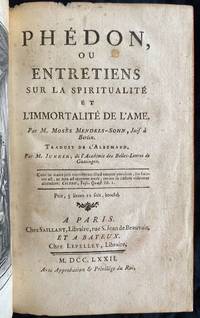
1772ref. 43257Paris et Bayeux chez Saillant et Lepelley 1772. 1st French-language edition. Period full leather binding with gilt spine and red edges with original marbled endpapers 8vo. Includes frontis copperplate etching. XXIV 342 1 pages. “Traduit de l’Allemand par M. Junker de l’Académie des Belles-Lettres de Goettingen.” This first French edition appeared 5 years after the first German edition of 1767 "Phaedon or On the Immortality of the Soul" Phaedon Oder Ueber Die Unsterblichkeit Der Seele In Drey Gespraechen is one of Mendelssohn's 1729-1786 most famous publications establishing his reputation as the "German Socrates of Berlin." It is a philosophical interpretation of the Platonic dialogue "Phaedo" and is preceded by a biography on "The Life and Character of Socrates." The important German-Jewish philosopher was one of the most important representatives of the Enlightenment in Prussia and throughout Germany. Mendelssohn's Phaedon is a “classic of rational psychology on the immortality of the human soul a defining work by this leading enlightenment philosopher who launched the Jewish thinking of the modern age" with his tribute to Socrates modeled on Plato's dialogue the Phaedo. Mendelssohn used Plato's famous dialogue the Phaedo as a model to publish Phädon oder über die Unsterblichkeit der Seele. With this seminal work "he reached the heights of fame" Wigoder Dictionary of Jewish Biography 342. The work unites Mendelssohn's "paean to Socrates with an elaboration of the dreadful personal moral and political implications if a person's life is her 'highest good'… This 'classic of rational psychology' as Dilthey put it also contains an argument for the simplicity and immortality of the human soul explicitly singled out for criticism by Kant in the 2nd edition of the Critique of Pure Reason. Mendelssohn supports the notion that the soul is simple and thus indestructible by noting that certain features of the soul namely the unifying character of consciousness and the identity of self-consciousness cannot be derived from anything composite whether those composite parts be capable or not of thinking… As for the human soul's fate after death Mendelssohn appeals to divine goodness and providence which perhaps explains why following the publication of the Phaedo he finds himself needing to revisit the proofs for God's existence" Stanford Encyclopedia. According to Mendelssohn’s modern biographer Alexander Altmann “The work that would establish Mendelssohn's world-wide renown and win him the title 'the German Socrates' was the dialogue Phaedon which was published in 1767. In this work he presented Socratic wisdom from the mouth of the ancient philosopher but in the language of the Enlightenment that is in his own words as a modern philosopher. The work drew both praise and criticism but was on the whole popular in intellectual circles. It demonstrates Mendelssohn's unique ability as a Jew to be comfortable in the realm of both classical and enlightened philosophy not to mention languages. David Sorkin remarks ‘What is ironic is that Mendelssohn was known and revered as much for the quality of his prose as for his thought.” Mendelssohn was himself often referred to as the German Plato or the German Socrates. And “As a Jew living in Germany Moses Mendelssohn 1729-1786 stands at a pivotal point in the history of Jewish emancipation in Europe. There were Jews before him who had access to the corridors of power in Germany and elsewhere in Europe but Mendelssohn represents the first to be socially accepted to a significant extent within enlightened German culture without converting. He not only conformed to the culture of the German Enlightenment in many ways but also helped shape the culture through his philosophical contributions. At the same time Mendelssohn refused to turn away from traditional Judaism. He attempted to become a full- fledged member of society during the emergence of modern Europe while remaining a proponent of Judaism as a revealed religion. Moreover he sought to use his place of influence to encourage Jewish acculturation in Germany and to speak on behalf of the emancipation of Jewish people…. The traditional mentality of the European Jews prior to Mendelssohn's time included a kind of resignation to the incompatibility of Jewish learning and 'worldly' philosophy. This resignation contributed to Jewish cultural isolation. Alfred Jospe describes the conundrum in which a Jew found himself if he wished to enter the culture of the non-Jewish world: The Jew could gain access to the culture of the world only by rebelling against the traditional repudiation of all mundane wisdom. It is just at this point that Mendelssohn broke the mold. He not only acquired modern German culture but did so by means of his understanding of and contributions to the philosophy that shaped that culture. In his monumental biographical study Alexander Altmann focuses as much on Mendelssohn's philosophy and his answers to contemporary critics as he does on the details of the events and influences of his life. Altmann states with appropriate admiration that “Considering the state of degradation in which the Jewish population lived in eighteenth-century Germany. Mendelssohn's rise to fame and his acceptance into the republic of letters was an amazing feat of personal achievement.” The amazing feature of Mendelssohn's achievement is that he accomplished it as an avowedly traditional Jew. Mendelssohn has been rightly described as a rabbinic scholar but he made his reputation in non-Jewish intellectual circles as a literary critic and philosopher….with the help of both Gotthold Lessing and the Berlin publisher Friedrich Nicolai he was accepted into the inner circle of the Berlin Aufklärung. His essays reviews and translations earned him tremendous status among German intellectuals. The favorable comparison made by Lessing between the quintessential German poet Goethe and Mendelssohn is a mark of the esteem in which he was held. ‘Lessing told Friedrich Heinrich Jacobi that once Goethe regained his reason he would be hardly more than an ordinary man. At the very same time he said of Mendelssohn that he was the most lucid thinker the most excellent philosopher and the best literary critic of the century’" Clark 2005. P. 57-58. OCLC: 19939219. Very light edgewear to front endpapers touch of spotting a gorgeous copy in the original leather binding with tooled gilt spine with raised bands and leather label. Beautiful and scarce. B KH-10-30-RLB-’e. Paris et Bayeux, chez Saillant et Lepelley unknown
ref. 1019383275.Ghardcover. Good. Access codes and supplements are not guaranteed with used items. May be an ex-library book. hardcover
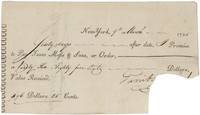
1795ref. 42478New York 1795. paperback. Single leaf 4x7 inches. Printed on one side with blanks filled in in manuscript and signature obscured by cancellation tear-off; “Isaac Moses & Sons” penned on blank side in period hand. Early American Jewish merchants Isaac Moses & Sons operated on Greenwich Street.Isaac Moses 1742-1818 was born in Giessen Germany but moved to New York in 1764 and in 1766 he became a “freeman” of New York City. He became a prominent businessman and American patriot. He worked in his uncle's Hayman Levy's mercantile firm until he established Isaac Moses & Company with two new business partners in 1775. This firm supported the revolutionary army by accepting $20000 in Continental paper dollars in exchange for $20000 in hard currency thereby financing the war effort. The firm also traded for military supplies internationally and sold guns and ammunition to the army. When the British occupied New York Isaac Moses left for Philadelphia and ran the firm from there. In 1783 he returned to New York City and continued his commercial enterprises. He was generally financially successful establishing Isaac Moses & Sons an international trading company. He was also a founder and major stockholder in the Bank of New York a Mason in New York City's Union Lodge and an important member of the New York City Chamber of Commerce. Isaac Moses was also president of Congregation Shearith Israel in New York the oldest Synagogue in American and the only Jewish congregation in New York City until 1820. He was also one of the principle organizers of the Congregation Mikveh Israel in Philadelphia. His descendants were prominent Jewish businessmen in New York who traveled internationally and served in the Union Army during the Civil War AJHS & Wikipedia. For more on Isaac Moses see the JTA’s report on the donation of his portrait by John Wesley Jarvis to the Museum of the City of New York in 1934 https://www.jta.org/archive/painting-of-isaac-moses-patriot-of-revolution- given-to-museum. Portraits of Moses can be viewed online at https://loebjewishportraits.com/portrait/isaac-moses/ and https://loebjewishportraits.com/portrait/isaac-moses-2/. An indenture signed by his heirs after his death in 1818 sold for $3500 plus commissions at auction in 2019 https://www.sothebys.com/en/auctions/ecatalogue/2019/fine-manuscripts-prin ted-americana-n10002/lot.2180.html. Promiser’s signature torn of as cancellation as often found otherwise Very Good Condition BK5 AMR-67-39. New York unknown
1895ref. 40853Chicago: S. Ettlinger Printing Co 1895. 1st edition. Original green paper wrappers 12mo 56 pages. The author Isaac S. Moses is prominently listed on the title page as Rabbi of Kehilath Anshe Mayriv KAM Chicago's first Synagogue; these were sermons he delivered there. In addition the title page lists S. Ettlinger Printing Co. in Chicago as the publisher though the wrappers list Bloch in New York. This probably means that Bloch bought the printed run or the remains of it or the plates and put their own outer label on and then continued the distribution under their own name. Singerman 4882 simply listing Ettlinger in Chicago as publisher with no mention of Bloch. In his early days in the United States Isaac Moses "was considered a radical Reformer but later he took a more moderate position. In 1884 he introduced his own prayer book Tefillat Yisrael. Moses was a founding member of the Central Conference of American Rabbis and a member of the Reform committee charged with compiling an official prayer book. The appearance of the Union Prayer Book in 1894 has been credited to his personal initiative in preparing and circulating a manuscript when the committee's work seemed to be leading nowhere. Moses also published a number of sermons and textbooks for children. His Sabbath School Hymnal first issued in 1894 ran into 14 editions. While in Milwaukee he edited the weekly Der Zeitgeist 1880-82" encyclopedia.com. In one of these sermons Rabbi Moses discusses the evils that occurred in Egypt and then goes on to say "Does not our civilization show the most alarming symptoms of the evils and the diseases of Egypt We have fought for the emancipation of the negro but the enslavement of the masses by our modern indutrial system threatens to become a plague worse than ever befell the birth-place of Moses." Subjects: Jewish sermons American. English -- United States. OCLC: 25225212. Spine rebacked coveres rubbed and worn but solid. Good Condition Overall. Somewhat scarce. B AMR-57-6-BL-'f. Chicago: S. Ettlinger Printing Co unknown
1855ref. 38528Livorno : Bi-Defus Eliyahu Ben Amozeg Va-Haverav 1855. Hardcover. Period boards. 8 vo. 202 pages 20 cm. In Hebrew and Judeo-Arabic. Yaari 743. Title translates to "Book of the Laws of Pesah. " This famous publication includes an array of revisions and commentaries on Passover. The last page features a ballad to Rav Yehudah Ha-Levi. A very early copy. SUBJECTS: Haggadot -- Texts. Seder -- Liturgy -- Texts. Judaism -- Liturgy -- Texts. Jewish Art. Judaism -- Liturgy. Seder -- Liturgy. OCLC lists one copy at JTS. Missing pages 32-35 38-41 98-9. Page 101 is folded. Heavy wear to edges. Title page is reasonably soiled. Book worm marks throughout. Staining throughout. Fair Condition. HAG-20-16. Livorno : Bi-Defus Eliyahu Ben Amozeg Va-Haverav hardcover
1929ref. 38537Jerusalem Unknown Publisher 1929. Hardcover. First edition. Original black boards with gold font. 8vo. 102 pages; 22 cm. In Hebrew. Yudlov 3183; Yaari 2127. Title translates to “Passover Haggadah with Notes from War Heh.” The title page notes that the author was Rabbi of "Peterson Ve'Amerika." Indeed Rabbi Elijah Moses ben Kaleb Zeev Luntz who was born in Siauliai Lithuania officiated as rabbi in Paterson New Jersey going up to Erez Israel in c. 1903. Among his other works is Pirhe Eliyah Jerusalem 1909 and Eben Moshe Jerusalem 1914 on the Talmud. The Haggadah was published by his widow Rivkah Reizel in his memory. Includes a small illustration. SUBJECTS : Haggadot Commentaries Liturgy. OCLC lists no holdings worldwide. Ex-library markings. Slight toning. Some dampstaining and staining. Good condition. Rare. HAG-19-34. Jerusalem, [Unknown Publisher] hardcover
ref. 6208550769.Gpaperback. Good. Access codes and supplements are not guaranteed with used items. May be an ex-library book. paperback