943 résultats
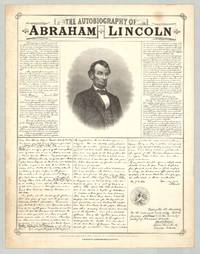
réf. 3389Boston: James R. Osgood & Co. 1872. Broadside 24.5” x 19” plus margins; portrait and text in five columns. CONDITION: Torn through upper right the tear affecting the portrait restored backed with Japanese tissue. The first separate printing and first separate facsimile of Lincoln’s famed autobiographical sketch originally composed in response to a request from his friend Jesse Fell printed with a brief account by Fell of the circumstances under which it was written and extracts from a few of Lincoln’s speeches. Lincoln and Fell became acquainted during a session of the Illinois State Legislature in the winter of 1834–35. Lincoln was serving as a representative and Fell as a lobbyist for MacLean County Illinois. The two became political friends and saw much of each other in subsequent years. In 1858 when Lincoln came to prominence as a result of his debates with Stephen Douglas Fell who had recently returned from a trip east where the public was hungry for information about Lincoln approached his friend as he came out of the Bloomington Illinois courthouse one afternoon and asked him for a biographical sketch. Lincoln initially resisted but the following year gave in composing a brief autobiography as well as a letter of explanation both of which he mailed to Fell on December 20th 1859. Delighted that Lincoln had finally complied and eager to promote his cause Fell forwarded Lincoln’s autobiography to his friend Joseph J. Lewis in Pennsylvania who used it for an article that was published in the Chester County Times PA on February 11th 1860. Lewis’s article was reprinted in many newspapers and “became the first widely read biographical sketch of Lincoln and served as a basis for the first three Lincoln campaign biographies in book form” Sage. In 1872 while preparing his biography of Lincoln for publication Ward H. Lamon wrote to Fell asking him to forward Lincoln’s sketch and its accompanying letter to his publisher James R. Osgood & Co. for consultation and facsimile publication. Placing no particular value on the original manuscripts when he first received them Fell had not requested their return but now retrieved them in response to Lamon’s request. He then forwarded the biographical sketch but not Lincoln’s letter of explanation substituting instead his own cover letter. Since Lincoln’s sketch was neither addressed to Fell nor signed Fell included with his letter clippings in Lincoln’s hand reading “Hon. J. W. Fell” and “Yours very truly/A. Lincoln” which were then pasted onto Lincoln’s sketch. Also added was an emblem and statement testifying to the authenticity of the manuscript signed by David Davis Lyman Trumbull and Charles Sumner dated at Washington D.C. March 20th 1872. The facsimile was included in Lamon’s biography and published separately in the form of the broadside offered here. Rare. OCLC records only four copies. REFERENCES: Not in Monaghan; Stern Collection 4792; Sage Harold K. Jesse W. Fell and the Lincoln Autobiography in The Journal of the Abraham Lincoln Association Vol. 3 Issue 1 1981 pp. 48–58. Boston: James R. Osgood & Co., 1872 unknown books
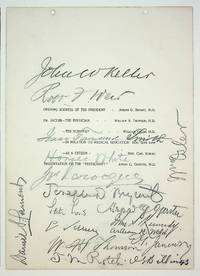
1900réf. 1680New York: Tiffany & Co. program/menu The Knickerbocker Press Festschrift 1900. First editions. RARE PROGRAM/MENU FOR DINNER IN HONOR OF ABRAHAM JACOBI'S 70TH BIRTHDAY--SIGNED BY JACOBI AND 17 NOTABLE ATTENDEES TOGETHER WITH BOUND PUBLISHED PROCEEDINGS AND FESTSCHRIFT VOLUME PRESENTED TO HONOREE. 1 Program of "Dinner in Honor of Doctor Abraham Jacobi on the Seventieth Anniversary of His Birthday Saturday May the Fifth Nineteen Hundred at Delmonico's." Three leaves 15.8x22.3 cm printed on fine card stock by Tiffany & Co. each with 2 small holes at top for binding by ribbon. Menu program cover with engraved portrait of Jacobi with his pencil signature below and program with pencil signature of 17 attendies. Framed in 41.5x66.5 cm dark wooden frame with ribbon tie in pouch attached to back of frame. Browning to page edges otherwise very good. SIGNERS OF THE PROGRAM: John Shaw Billings 1838 - 1913 was an American librarian building designer and surgeon who modernized the Library of the Surgeon General's Office in the United States Army. His work with Andrew Carnegie led to the development and his service as the first director of the New York Public Library. Billings oversaw the building of the Surgeon General's Library which was the nation's first comprehensive library for medicine. Joseph Decatur Bryant 1845 - 1914 was a surgeon New York City Health Commissioner Surgeon-General of the National Guard Surgeons and physician to Grover Cleveland and John D. Rockefeller. He also held a series of academic positions at Bellevue Hospital Medical College culminating with the title of professor of the principles and practice of surgery and professor of operative and clinical surgery at New York University and Bellevue Hospital Medical College. Arpad Geyza Charles Gerster 1848-1923 A surgeon who practiced at Mt. Sinai in New York City in the late 1890s and early 1900s. Hungarian by birth he was also a sportsman linguist and an artist. Gerster's vivid often humorous observations of nature and people his delight in the outdoors and his drawings and etchings offer a larger portrait of the Adirondack region in the age of William West Durant Great Camps railroads and the beginning of the conservation movement. Abraham Jacobi 1830 - 1919 was a German physician and pioneer of pediatrics. He was a key figure in the movement to improve child healthcare and welfare in the United States and opened the first children's clinic in the country. To date he is the only foreign-born president of the American Medical Association. He is regarded as the Father of American Pediatrics. Edward Gamaliel Janeway 1841 - 1911 was an American physician who served as Health Commissioner of New York and as president of the New York Medical Journal Association in the late nineteenth century. He was considered "one of America's premier internists in the late nineteenth and early twentieth centuries". John W. Keller 1856 -1919 was a New York newspaper man member of Tammany Hall and in 1900 was a delegate to the National Democratic Convention and his name was presented by the New York delegation for the Vice Presidency. From 1898 to 1902 he was Commissioner of Public Charities in New York city. John Stewart Kennedy 1830 - 1909 was a Scottish-born American businessman financier and philanthropist. He was a member of the Jekyll Island Club also known as The Millionaires' Club on Jekyll Island Georgia along with J.P. Morgan and William Rockefeller among others. Daniel Scott Lamont 1851 - 1905 was the United States Secretary of War during Grover Cleveland's second term. After his service as Secretary of War Lamont was vice president of the Northern Pacific Railway Company from 1898 to 1904. In August 1904 he was supported by the New York Times as a candidate for Governor of New York. Joseph Larocque 1831 - 1908 was a New York City lawyer and president of the New York City Bar Association. Larocque was a director of several companies including the American Cotton Oil Company the Commonwealth Insurance Company of New York Niagara Falls Power Company and Plaza Bank. He also served on the boards of a number of New York City institutions including the Metropolitan Museum of Art the Century Club and Columbia University. Seth Low 1850 - 1916 was an American educator and political figure who served as the mayor of Brooklyn from 1881 to 1885 the president of Columbia University from 1890 to 1901 a diplomatic representative of the United States and the mayor of New York City from 1902 to 1903. William Osler 1849 - 1919 was a Canadian physician and one of the founding professors of Johns Hopkins Hospital. In 1889 he became the first Physician-in-Chief of the new Johns Hopkins Hospital in Baltimore Maryland. In 1893 Osler was instrumental in creating the Johns Hopkins School of Medicine and became one of the school's first professors of medicine. Thomas Morgan Rotch 1849 - 1914 graduated from Harvard College in 1870 and from Harvard Medical School in 1874. He was the president of the American Pediatric Society for 1890”"91 and America's first full professor of pediatrics. Carl Schurz 1829 - 1906 was a German-American revolutionary and an American statesman journalist and reformer. He migrated to the United States after the German revolutions of 1848”"1849 and became a prominent member of the new Republican Party. In 1868 he was elected to the United States Senate from Missouri becoming the first German American in that body. He supported William Jennings Bryan's anti-imperialist campaign in the 1900 presidential election. Schurz lived in a summer cottage in Northwest Bay on Lake George New York which was built by his good friend Abraham Jacobi. Isaac Townsend Smith 1813 - 1906 was one of the incorporators of the Metropolitan Savings Bank of New York and was for many years its president. He was also Commissioner of Immigration for the state of New York and a presidential elector in 1864 when Abraham Lincoln was reelected. For the following 50 years Smith was in intimate touch with the Siamese government as its financial agent Consul and Consul General. William Hanna Thomson 1833 - 1918 was assistant physician at Quarantine Hospital in New York and physician to the Charity Hospital consulting physician to Roosevelt Hospital and Bellevue Hospital Professor of Medicine at New York University Medical College a member of the New York Neurological Society and President of the New York Academy of Medicine during 1899”"1900. Robert Fulton Weir 1837 - 1927 professor of surgery in the College of Physicians and Surgeons from 1873 to 1903 and President of The New York Academy of Medicine from 1900 to 1903. His wide experience was gained chiefly in the Civil War in which he served as surgeon in charge of the hospital of Frederick Maryland one of the largest Government hospitals from 1862 to 1865. William Henry Welch 1850 - 934 was an American physician pathologist bacteriologist and medical school administrator. He was one of the founding professors at the Johns Hopkins Hospital and the first dean of the Johns Hopkins School of Medicine. He was also the founder of the Johns Hopkins School of Hygiene and Public Health the first school of public health in the country. Horace White 1865 - 943 was a member of the New York State Senate from 1896 to 1908 and Lieutenant Governor of New York from 1909 to 1910. White who was the nephew of Cornell's first President Andrew Dickson White left three-quarters of his estate to the university and that fund had grown to $1.5 million by 1973. 2 Proceedings and Addresses at the Complimentary Dinner Tendered to Dr. A. Jacobi on the Occasion of the Seventieth Anniversary of His Birthday May 5 Nineteen Hundred. 18.5x25.5 cm hardcover black cloth binding gilt title to cover covers with beveled edges top edge gilt floral endpapers engraved frontispiece including portrait of Jacobi reproducing first leaf of dinner program 74 pp including the following: i Introductory Note by the committee of physicians and laymen convened to celebrate Jacobi's 70th birthday "a fit occasion for a hearty manifestation of the esteem in which Dr. Jacobi is held and for a recognition of the services he has rendered in various relations--during the course of almost fifty years”"as a physician educator and civic worker. It was felt also that such an occasion would afford an appropriate setting for the unusual honor to be paid Dr. Jacobi in the presentation of a 'Festschrift' comprising original contributions to medical literature dedicated to him by fifty physicians and scientists including many of the most prominent in all parts of the world." ii Address of Dr. Joseph D. Bryant Chairman; iii Poem of Dr. S. Weir Mitchell: 'Abraham Jacobi Medicus Magister Amicus'; iv Address of Dr. William H. Thomson: 'Jacobi the Physician'; v Address of Dr. William Osler: 'The Scientist'; vi Address of the Honorable Seth Low: 'In Relation to Medical Education'; vii Address of the Honorable Carl Schurz: 'The Citizen'; viii Address of Dr. Arpad G. Gerster: Presentation of the 'Jacobi Festschrift "Mr. Chairman I hold in my hand a volume containing the scientific contributions of fifty-three medical men of note men representing two continents and eleven nations"; ix Remarks of Dr. Francis Foerster presenting the address of the German Hospital; x Remarks of Dr. Emil Gruening presenting the resolutions for Mount Sinai Hospital; 10 Address of Dr. Jacobi: The Guest of the Evening; xi Letters and Telegrams Received; xii Subscribers to the Dinner. Very good in custom archival mylar cover. 3 "Festschrift" in honor of Abraham Jacobi. To Commemorate the seventieth Anniversary of his Birth May Sixth 1900. 16.5x16 cm hardcover green cloth binding with printed gray paper covers paper title label to spine top edge gilt institutional library bookplate to front paste-down engraved frontispiece portrait of Jacobi with tissue guard i-xiii 496 pp 12 plates 2 folding charts. 55 contributions by 57 authors including George Adami Theodor Escherich Eduard Henoch Luther Emmett Holt Henry Koplik William Osler Thomas Morgan Rotch and William Henry Welch. Topics include infectious diease cancer neurology seizures metabolic disease congenital heart disease urology/nephrology and toxicology. Most papers in English several in German or French language. Covers worn library numbers bottom of spine front hinge split offsetting of frontispiece to title page browning to page edges. Binding tight pages unmarked good in custom archival mylar cover. Tiffany & Co. (program/menu), The Knickerbocker Press (Festschrift) books
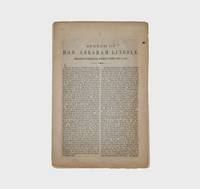
1858réf. 376861Springfield IL 1858. 8pp. printed in double columns. 8vo. Unbound. Minor toning. Housed in a cloth box. 8pp. printed in double columns. 8vo. The only separate printing of this address given by Lincoln at Springfield Illinois. Lincoln's speech which preceded his debates with Douglas puts forth the great themes that marked his political philosophy during the last ten years of his life. More importantly it firmly placed Lincoln as against the expansion of slavery and Douglas on the opposite side of the issue. By targeting Douglas a strategy that resurrected Lincoln's political career he made his fellow Illinoisan out to be the embodiment of the wicked forces safeguarding slavery's expansion . This speech is Lincoln's opening salvo against Douglas for the 1858 senate campaign: 'Free men of Illinois - free men of everywhere - judge ye between him and me'" Abraham Lincoln: His Life in Print p. 67 Urging that slavery be placed on course for "ultimate extinction" he repeats his "House Divided" warning first given at the State Republican Convention a month earlier. He insists that the Kansas-Nebraska bill was "the beginning of a conspiracy" to nationalize slavery. Attacking Douglas and defending himself against the charge that he would "invite a war of sections" he stands on "the principles of our Declaration of Independence." Though African Americans are not the equal of whites "in all respects" the Declaration "does mean to declare that all men are equal in some respects; they are equal in the right to 'life liberty and the pursuit of happiness.'" Most significantly "In the right to put into his mouth the bread that his own hands have earned he is the equal of every other man white or black." A scarce Lincoln speech. Monaghan 12; Byrd 2960 unknown books
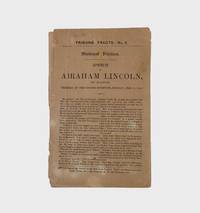
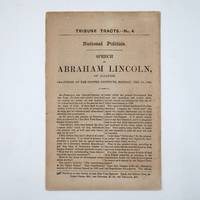
1860réf. 376855New York: Office of the New York Tribune 1860. First edition Monaghan's first issue. 1 2-15 1pp. With New York Tribune ads and subscription terms on verso of the terminal leaf. 8vo. Stitched self-wrappers toning. First edition Monaghan's first issue. 1 2-15 1pp. With New York Tribune ads and subscription terms on verso of the terminal leaf. 8vo. This address made at the Cooper Institute in New York on February 27 1860 catapulted Lincoln into the public eye and made him a viable presidential candidate. Indeed many historians have considered it the key to his success in the 1860 election and it is probably the most important speech Lincoln made after the Gettysburg Address and his inaugural addresses. The Cooper Union address was months in preparation; Lincoln was fully aware of its importance in moving himself from a regional favorite son to a viable national candidate. In the event some 1500 people including many prominent political figures attended on a snowy new York evening. The speech divides into three major parts. In the first Lincoln addressed the spread of slavery arguing that the framers of the constitution had been opposed to it and that the Federal government could regulate the question. In the second he argued that the Republicans were not a sectional Northern party and attacked the threats of southern Democrats to secede if the Republicans should win the election. Finally he addressed his fellow Republicans calling on them to act carefully and do "nothing through passion and ill temper.Let us have faith that right makes might and in that faith let us to the end dare to do our duty as we understand it." The Cooper Union speech was a resounding success. Horace Greeley described it as "one of the happiest and most convincing political arguments ever made in this City. No man ever made such an impression on his first appeal to a New York audience." Greeley quickly issued the speech in the form of this "Tribune Tract." It includes a final page of advertisements for other Tribune publications. The speech was later widely reprinted and made Lincoln nationally famous. This printing differs from other editions by its inclusion of a speech by James Doolittle Senator from Wisconsin and the message of Samuel Medary Democratic governor of the Kansas Territory vetoing the Kansas abolition bill. "The Cooper Union address tested whether Lincoln's appeal could extend from the podium to the page and from the rollicking campaigns of the rural West to the urban East. Cooper Union held the promise of transforming Lincoln from a regional phenomenon to a national figure. Lincoln knew it and rose to the occasion" Harold Holzer Lincoln at the Copper Union: The Speech That Made Abraham Lincoln President. Monaghan 50 Office of the New York Tribune unknown books
1903réf. 5344Beautiful full morocco with gilt detailing and rule; 5 raised bands. Elaborately designed doublures with gilt dentelles. Silk fly sheets. "The Delphic Edition of The Breviary Treasures consists of 475 copies printed on French hand-made paper of which this copy is Number 94." xii 214 pp. 6 3/4 x 9 1/4 inches. Nathan Haskell Dole hardcover books
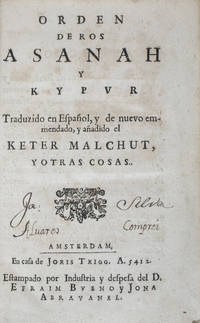
réf. 43935Amsterdam: En Casa de Joris Trigg/ D. Efraim Bueno y Jona Abravanel 5412. Hardcover. g- to vg-. Duoecimo. 7x4.5". 478pp. Original dark brown leather with blind-stamped ruling and tooling on the covers and spine. Raised bands on the spine. Metal clasps. Red-speckled edges of the book block. An early Spanish-language edition of the complete Jewish High Holiday prayer book Machzor based on the original translation by Abraham Usque originally printed in Ferarra Italy in 1553. This edition contains some added material not previously present including most prominently Solomon ibn Gabirol's famed philosophical poem "Keter Malkhut" Royal Crown which over the years has come to be read as part of the Yom Kippur service in some Jewish traditions. Published by Dr. Efraim Bueno and Jona Abravanel to serve members of the then sizable Sephardic Jewish community in Amsterdam. A significant portion of the community were former Conversos Jews who had outwardly converted to Catholicism during the inquisition in Spain who then emmigrated and were able to reestablish their Jewish identity and thus were unable to read Hebrew hence the text's publication in Spanish. As stated in the foreword this edition includes some additions to the text not included in previous versions and omits some material deemed to have been unnecessary. The prayer book starts with the penitential prayers Selichot p.3-47 which includes decorative head and endpeices. This section is followed by the Rosh Hashanah service p.48-195 and then the Yom Kippur service including the "Keter Malkhut" p.254-289. Title page is has a decorative vignette printed in woodblock and is printed with the Hebrew date "5412". Pages 305-352 are misprinted as "321-368" with their correct numbers handwritten above in ink. All text in Spanish. Binding with some rubbing and scratches to extremities and to the covers. Front hinge starting to split slightly at the head and tail of the spine. Missing one of the metal clasps on the back cover. Starting at interior covers. Some minor to light sporadic damp staining and foxing throughout the text. Period signature of the previous owner "Silva" in ink on on the title page and p.200. Name of another previous owner in ink on the interior back cover. Book block tight overall. Binding in good- interior in very good- condition overall. Quite scarce. Dr. Efraim Ephraim Bueno aka Martin Alvarez 1599-1665 was a Portuguese-born Jewish physician in Amsterdam of the famed Iberian-Jewish Bueno medical dynasty and prominent member of the city's Sephardic community. He served for many years as the personal physician to famed artist Rembrandt van Rijn who in fact depicted Bueno in two of his works one an etching and the other a painted portrait. He received his medical education and degree in Bordeaux and was known to have practiced medicine in Amsterdam until the time of his death. In addition to his medical practice Bueno was an accomplished biblical scholar who along with Jona Abravanel published numerous Jewish works the on the bible and Jewish Law. Jona Abravanel 1593-1667 was a Sephardic Jewish poet in Amsterdam from the prominent Abravanel family. He was the nephew of Famed Portueguse-Dutch Rabbi and printer Menasseh ben Israel. Together with his uncle and Dr. Efraim Bueno he was responsible for publishing numerous works of Judiaca in the 17th century. In this edition the title page was mistaken printed with the word "Kuyper" which was then correct via a scrap of paper pasted on top. References: KAYSERLING 1890 p. 7 31 61 under Abravanel Bueno and Liturgy PALAU 1923 under 202415 with an incorrect dat of 1662 PEETERS 1933 1037. This publication follows an edition with same title also from Amsterdam in 1630 but printed by David Pardo and Salom ben Yosseph Menasseh ben Israel with different pagination. En Casa de Joris Trigg/ D. Efraim Bueno y Jona Abravanel hardcover books
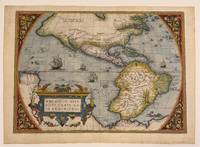
1570réf. 3381021570. unbound. Map. Engraving with hand coloring. Image measures 14 3/4" x 19 3/4" Archival frame measures 22 1/2" x 28" This stunning first state first Latin edition map by Abraham Ortelius depicts an early understanding of North and South America. At the time it was issued the coastal areas of the New World had been fairly well explored and Europeans were just beginning settlement and colonization. It is notable for depicting Spanish and Portuguese colonies in high detail for these powers were notoriously protective of their geographical surveys. As the first depiction of the Americas in an atlas this map is of fundamental importance. Abraham Ortelius 1527--1598 a Flemish cartographer and geographer is widely regarded as one of the important and influential cartographers in history. He is known for his "Theatrum Orbis Terrarum" which was the first modern atlas. van den Broecke 91 unknown books
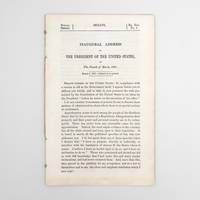
1861réf. 377680Washington D.C.: Government Printing Office 1861. Special Session Senate Ex. Doc. No. 1. 10pp. 8vo. Disbound. Housed in a cloth box. Special Session Senate Ex. Doc. No. 1. 10pp. 8vo. Lincoln began drafting his first inaugural in Springfield soon after his election hoping the speech would impart a spirit of reconciliation toward the seceded states. His speech balances his pledge to protect Federal property in the south while insisting that he would not use military force unless attacked first. In all he eloquently argues against secession presenting the United States as undissolvable. Lincoln ends his speech with the memorable lines: "We are not enemies but friends. We must not be enemies. Though passion may have strained it must not break our bonds of affection. The mystic chords of memory stretching from every battle-field and patriot grave to every living heart and hearth-stone all over this broad land will yet swell the chorus of the Union when again touched as surely they will be by the better angels of our nature." "Lincoln became President on March 4 1861. Before being sworn in he gave his First Inaugural Address devoting it entirely to the secession crisis. It was the linguistic equivalent of an optical illusion: one could view it two ways. As historians have noted he seemed to placate the South; he would not 'interfere with the institution of slavery in the States where it exists.' This language was the old Lincoln . The new Lincoln was a resolute executive who had no choice but to enforce the Constitution a contract that does not allow states to withdraw from it unilaterally. In his enforcement there would be no bloodshed 'unless it be forced upon the national authority" Mazy Boroujerdi editor Abraham Lincoln: His Life in Print p. 108. Lincoln had begun writing his inaugural the month prior before leaving Springfield and once in Washington asked William Seward to review the draft. It was Seward who suggested softening the tone so as not to appear too inflammatory suggesting "a nostalgic call for unity emphasizing the country's shared history. Lincoln embraced the idea but massaged it into near poetry. Seward's prosaic text ended up as Lincoln's oft quoted appeals to the 'mystic chords of memory' and 'the better angels of our nature.' The words did nothing to reverse disunion" Ibid. p. 97. This is the official government printing of Lincoln's first inaugural address issued as a document of a special session of the Senate printed by their order four days after its delivery being only the second printing overall of the memorable speech. Monaghan 102; Abraham Lincoln: His Life in Print p. 108 [Government Printing Office] unknown books
1860réf. 367583New York: Office of the New York Tribune 1860. First edition Monaghan's first issue. 1 2-15 1pp. Lincoln's speech comprises pages 1-11 out of a total of 16 pages. With New York Tribune ads and subscription terms on rear wrapper. 8vo. Stitched self-wrappers minor toning minor chip to terminal leaf. First edition Monaghan's first issue. 1 2-15 1pp. Lincoln's speech comprises pages 1-11 out of a total of 16 pages. With New York Tribune ads and subscription terms on rear wrapper. 8vo. This address made at the Cooper Institute in New York on February 27 1860 catapulted Lincoln into the public eye and made him a viable presidential candidate. Indeed many historians have considered it the key to his success in the 1860 election and it is probably the most important speech Lincoln made after the Gettysburg Address and his inaugural addresses. The Cooper Union address was months in preparation; Lincoln was fully aware of its importance in moving himself from a regional favorite son to a viable national candidate. In the event some 1500 people including many prominent political figures attended on a snowy new York evening. The speech divides into three major parts. In the first Lincoln addressed the spread of slavery arguing that the framers of the constitution had been opposed to it and that the Federal government could regulate the question. In the second he argued that the Republicans were not a sectional Northern party and attacked the threats of southern Democrats to secede if the Republicans should win the election. Finally he addressed his fellow Republicans calling on them to act carefully and do "nothing through passion and ill temper.Let us have faith that right makes might and in that faith let us to the end dare to do our duty as we understand it." The Cooper Union speech was a resounding success. Horace Greeley described it as "one of the happiest and most convincing political arguments ever made in this City. No man ever made such an impression on his first appeal to a New York audience." Greeley quickly issued the speech in the form of this "Tribune Tract." It includes a final page of advertisements for other Tribune publications. The speech was later widely reprinted and made Lincoln nationally famous. This printing differs from other editions by its inclusion of a speech by James Doolittle Senator from Wisconsin and the message of Samuel Medary Democratic governor of the Kansas Territory vetoing the Kansas abolition bill. "The Cooper Union address tested whether Lincoln's appeal could extend from the podium to the page and from the rollicking campaigns of the rural West to the urban East. Cooper Union held the promise of transforming Lincoln from a regional phenomenon to a national figure. Lincoln knew it and rose to the occasion" Harold Holzer Lincoln at the Copper Union: The Speech That Made Abraham Lincoln President. Monaghan 50 Office of the New York Tribune unknown books
1864réf. 25614The second in a series of four racist political cartoons published in 1864 by Bromley & Company which was closely affiliated with the Copperhead New York World newspaper. These prints sought to undermine Abraham Lincoln's chances for reelection by branding him as a "miscegenationist" and playing on white fears of "race-mixing." The cartoon scene pictures several interracial couples enjoying a day at the park eating ice cream discussing wedding plans and a woman's upcoming lecture. Two African American families have white employees a carriage driver and footmen and a babysitter. The only other example traced at auction brought $7800 in 2010. ABRAHAM LINCOLN. RACISM.Print. "Miscegenation or the Millennium of Abolitionism." Political Cartoon. New York: Bromley & Co. 1864. 1 p. 20¾ x 13â… in. American politics had long played on fears of sexual relationships between races. A powerful new word for "race-mixing" was coined in an anonymous December 1863 pamphlet entitled Miscegenation: The Theory of the Blending of the Races Applied to the American White Man and Negro published in New York. Purporting to advocate the virtues of the "blending of the white and black races on this continent" it was a literary forgery prepared by The World managing editor David Goodman Croly and reporter George Wakeman. The authors were unsuccessful in their attempt to trick President Lincoln into endorsing the work. At the far left of the image Abraham Lincoln declares "I shall be proud to number among my intimate friends any member of the Squash family especially the little Squashes." The African American woman to whom he is speaking replies "I'se 'quainted wid Missus Linkum I is washed far her 'fore de hebenly Miscegenation times was cum. Dont do nuffin now but gallevant 'round wid de white gem'men! he-ah! he-ah! he-ah!" Senator Charles Sumner says "Mr. President! Allow me the honor of introducing my very dear friend Miss Dinah Arabella Aramintha Squash." A white carriage driver complains in the background "Gla-a-ang there 240t! White driver white footmen niggers inside my heys! I wanted a situation when I took this one" while a black man in the carriage tells his companion "Phillis de_ah dars Sumner. We must not cut him if he is walking." A black woman at a table tells a white man with her "Ah! Horace its-its-its-bully 'specially de cream" and he replies "Ah! my dear Miss Snowball we have at last reached our political and social Paradise. Isn't it extatic" To the right are two couples embracing each a white woman and an African American man. The first white women tells her partner "Oh! You dear creature. I am so agitated! Go and ask Pa" to which he replies "Lubly Julia Anna name de day when Brodder Beecher shall make us one!" The second white woman says "Adolphus now you'll be sure to come to my lecture to morrow night won't you" to which he answers "I'll be there Honey on de front seat sure!" In the background are various immigrant minorities viewing the scene. One exclaims "Most hextwadinary! Aw neva witnessed the like in all me life if I did dem me!" and another adds "Mine Got vat a guntry vat a beebles!" An Irish girl complains "And is it to drag nagur babies that I left old Ireland Bad luck to me." Manton Marble the editor of The World collaborated with printmaker Bromley & Company to issue a series of four anti-Lincoln "Political Caricatures." The present example was the No. 2 in that series. No. 1 was "The Grave of the Union or Major Jack Downing's Dream"; No. 3 "The Abolition Catastrophe Or the November Smash-up"; and No. 4 "The Miscegenation Ball." Republicans responded by trying to turn the "miscegenation" charge against the Democrats. A Republican print "The Political "Siamese" Twins: The Offspring of Chicago Miscegenation" pictures McClellan and Pendleton joined together despite their very different ideas on ending the war. Although Abraham Lincoln won New York states' electoral votes in 1860 Stephen Douglas had carried New York City and its environs. Financial elites fearing that civil war would ruin business and recent immigrants fearing competition with free black labor supported Douglas. Lincoln's unpopularity in New York City during the Civil War was a factor in the deadly 1863 Draft Riots. In 1864 Lincoln again won the states' electoral votes while New York City favored his Democratic opponent McClellan. In fact Lincoln's majority dropped from 50136 votes in 1860 to only 7373 votes in 1864 with approximately 50000 more total votes cast than in 1860. Bromley and Company continued to sell the caricatures after the election as this January 1865 advertisement from an Ohio newspaper makes clear. Another advertisement assured purchasers that the set of four prints available for $1 were "sent on wooden rollers to insure safe carriage." The World 1860-1931 a daily independent newspaper was published in New York City. Alexander Cummings founded it as a religious Republican outlet in 1860. August Belmont and others purchased it in 1862 changing the editorial focus. With editor Manton Marble 1834-1917 The World soon became the country's leading Democratic newspaper. In 1864 Union authorities shut down The Worldand another paper for three days after they published forged documents purportedly written by Lincoln that were really part of a hoax to manipulate the price of gold. The paper actively supported George B. McClellan against Lincoln in 1864. Condition Fine for exhibit despite flaws. Cropped with loss of "Political Caricature No. 2" from top edge and part of printed pricing information from bottom edge publisher's name rubbed out from the copyright statement lacking ½" from lower left corners a few short tape repairs by the edges a 2" closed tear through the second dialogue bubble along the top edge and a 3" closed tear parallel to the right edge. Mount remnants on verso. books
1695réf. 55262Amsterdam: Be-veit ha-meshutafim Asher Anshil ben Eliezer ve-Yisakhar Ber ben Avraham Eliezer/ Moses Wiesel 1695. First edition. Hardcover. fair. Small folio 29 by 18.5 cm. Collation: aleph-vav4 zayin2 = 26 numbered leaves. Additional engraved title page engraved folding map at rear; main title with woodcut vignette; 14 half-page engraved illustrations in the text. Contemporary quarter calf over dark brown pastepaper boards skilfully rebacked. Images of Moses and Aaron at engraved title excised the seven small engraved vignettes along with letterpress text of engraved title and imprint mounted on old paper. Old marginal repairs at main title resulting in slight loss of initial letters along right margin and several leaves; slight strictly marginal worming and occasional tears. Stained throughout sometimes heavily though not impairing legibility. Map mounted to reinforce tears with virtually no loss of text or engraved imagery apart from printed border at right side. A fair copy at best; despite all defects the half-page engraved illustrations have survived intact with minimal staining. Housed in new maroon buckram slipcase. First edition of this gorgeously illustrated work now referred to simply as the Amsterdam Haggadah. The first such work to be illustrated with copperplate engravings it ranks among the most imitated of the Jewish manuals for the Passover seder. The popularity of these illustrations can be attested by the huge number of reprint editions over the centuries. Fourteen finely printed half-page engravings appear throughout the text. Some of these images illustrate the traditional content of the Passover seder or the Exodus story while others reference other biblical tales. Images include: the Rabbis of Bene Brak discussing the Passover story the four sons Abraham smashing the idols of his father Abraham welcoming the three angels Moses slaying the Egyptian overseer the rescuing Moses from the river Moses and Aaron coming to Pharaoh w/ staves turning to snakes the ten plagues the Egyptian army drowning in the Red Sea the Exodus the receiving of the Ten Commandments at Mt. Sinai the eating of the Pascal Lamb King David composing his psalms and finally an exterior view of the Jewish Temple with the cityscape of Jerusalem in the background. All images are captioned with relevant passages in Hebrew. The engravings were all created by Abraham ben Jacob a German convert to Judaism who had moved to Amsterdam although some sources over the years misattributed them to financier Moses Wiesel 6 of which were adaptations and/or modifications of previous images by Swiss artist Matthäus Merian 1593-1650 from his original work "Icones Biblicae" 1625-30. In addition to the in text engravings there is famously fold-out engraved biblical map of the Holy Land in a notable format. Measuring a total of 19.5 by 11.5" the map shows the land of Israel the Wilderness of Sinai and Egypt in landscape orientation looking eastward towards the top of the map. It traces the journey of the Israelites starting with the Exodus from Egypt through the Sinai and into the Land of Israel. The map is detailed showing the areas of the twelve tribes important locations and cities as well as geographic features including the Red Sea Mount Sinai the Dead Sea the Sea of Galilee and many others. Additional illustrations appear near the bottom along with a legend. This beautiful work also by Abraham ben Jacob is considered among the earliest if not the first map of its kind to be printed within a Hebrew publication. It is now known to have been heavily based on the previously printed 1620 map in Hebrew by Jacob ben Abraham Zaddiq and Abraham Goos 1590 - ca. 1643 which itself was based on the map of 1590 by Christian Kruik van Adrichom Adrichem printed in Latin. Text throughout is printed in Hebrew with smaller text in Rashi script underneath containing famous commentary on the Passover Haggadah by acclaimed Portuguese Rabbi and scholar Isaac ben Judah Abarbanel 1437-1508. The verso of the title page contains the order of the Passover seder with brief instructions in both Ladino Judeo-Spanish and Yiddish Judeo-German a nod to the subtitle which references both the Ashkenazi and Sephardi traditions. Provenance and annotations: Full page of text appx. 1500 words in neat Hebrew cursive at front endleaf which discusses aspects of the Haggadah text; inscription in German at front endleaf by Isidor Adler who mentions his friend Hermann Mechlenburg dated March 1906; old annotations throughout in at least two hands. In one notable instance the Hebrew phrase l'shana ha-ba'ah be-hamburg next year in Hamburg! has been added in fine block characters above the traditional phrase l'shana ha-ba'ah bi-yerushalayim next year in Jerusalem. Hebrew title: סדר הגדה של פסח כמנהג ××©×›× ×– וספרד Alternate transliterations: Seder Hagadah shel Pesah Seder Hagadah sel Pesah References: Friedberg 278 Fuks HTN II 521; Yudlov Haggadah 93; Vinograd Amsterdam 627; Ya'ari no. 59; Laor 876 Map; Nebenzahl pp.138-1389 Map; Yerushalmi plate 59-62; Rosenau "Vision of the Temple" p.135 146-7. Be-veit ha-meshutafim [Asher Anshil ben Eliezer ve-Yisakhar Ber ben Avraham Eliezer]/ Moses Wiesel hardcover books
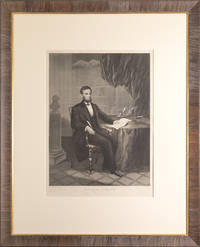
1864réf. 1296951864. LINCOLN Abraham. SERZ John engraver. Abraham Lincoln President of the United States Signing the Emancipation Proclamation. Philadelphia: John Dainty 1864. Oversized folio. Image measures 14 by 20 inches sheet measures 20 by 26 inches matted and framed entire piece measures 28 by 34 inches. $7000.Publisher's proof copy of a large and striking engraving of Abraham Lincoln engraved by Serz after a painting by Winner.President Lincoln with quill pen in hand and with a Bible a stuffed eagle and a bust of George Washington in the background has just finished signing the Emancipation Proclamation in this steel-engraved print of William E. Winner's famous painting dated 1864 and marked ""proof"" in the lower right corner. The engraving was done by John Serz 1808-1881 a German-born artist who settled in Philadelphia in 1851 and became known for his cityscapes and historical scenes. Light toning; a few short closed edge tears and one longer closed tear not touching image with tape repair to verso. An impressive example beautifully framed. unknown books
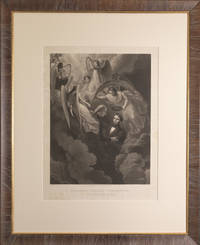
1866réf. 1296971866. LINCOLN Abraham. SARTAIN John engraver. Mezzotint: Abraham Lincoln the Martyr Victorious. Philadelphia: W.H. Hermans 1866. Oversized folio. Plate measures 22 by 17 inches sheet measures 28 by 22 inches matted and framed entire piece measures 28 by 34 inches. $7200.Publisher's proof copy with printed statement thus of a large striking tribute to Lincoln as martyr.Abraham Lincoln ascends to heaven welcomed by George Washington and a crowd of angelsÑone of the angels holding a palm branch and a laurel wreath over his headÑin this remarkable mezzotint done by John Sartain after a painting by W.H. Hermans. Sartain 1808-1897 a respected painter and printmaker was an early proponent of mezzotint engraving in the United States and the head of a family of artists including Samuel Henry William Emily and Harriet Sartain. Mounted on wove paper. Backing leaf and plate edges with pinholes in corners; minor spotting to edges very faint crease to center. Small paper label in lower left corner. An impressive print beautifully framed. unknown books
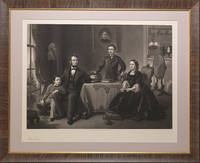
1866réf. 1296961866. Signed. SARTAIN William engraver. Mezzotint: Lincoln and His Family. Philadelphia: Bradley & Co. 1866. Oversized folio. Image measures 25 by 18 inches sheet measures 33 by 25 inches matted and framed entire piece measures 34 by 28 inches. $7500.Artist's proof copy of a remarkable mezzotint depicting President Lincoln with his wife and children ""perhaps the best print of all the 'Lincoln and his family' groups"" signed in pencil in the lower left corner by acclaimed engraver painter and art instructor William Sartain.""Perhaps the best print of all the 'Lincoln and his family' groups and there must be at least a dozen different studies is the engraving by William Sartain from the painting by S.B. Waugh"" Lincoln Lore: Bulletin of the Lincoln National Life Foundation. A publisher's advertising circular for the print proclaimed that ""Soon after the death of Abraham Lincoln Waugh our celebrated American Artist executed a National Painting of Lincoln and his Family. The Artist painted Mrs. Lincoln Robert and Thaddeus better known as 'Tad' from life. The work is considered by all who have seen it a great triumph of art. It represents the family in a private parlor in the White House a short time before the assassinationÉ For a number of months Mr. Wm. Sartain with an able corps of assistants was actively engaged in copying and engraving from this superb Painting. His engraving is now completed andÉ in accuracy of portraiture and artistic excellence of execution is acknowledged to be unsurpassed by any Engraving ever executed in America."" Printed by Irwin & Sartain without title. Mounted on wove paper. Print in beautiful fresh condition; paper backing with minor dust-soiling to edges and a few short edge tears. A very attractive signed example of this striking image. Beautifully framed. unknown books
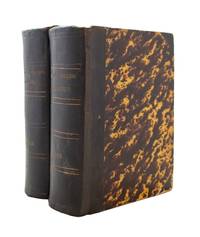
1863réf. 69520Washington D.C.: War Department 1863. CIVIL WAR. War Department General Orders 1863. Washington D.C.: War Department 1863. Full Description: LINCOLN Abraham. CIVIL WAR. Emancipation Proclamation War Department General Orders 1863. Washington D.C.: War Department 1863. The first War Department printing General Orders #1 Jan 2 1863 and fifth overall printing of the final Emancipation Proclamation. The 4 page pamphlet bound together with a nearly complete run of War Department general orders for the year 1863. Two octavo volumes 6 7/8 x 4 5/8 inches; 174 x 119 mm. Volume I comprising General Orders of the War Department Adjutant General's Office Numbers 1-221 2 January 1863 to 16 July 1863 and Volume II comprising Numbers 222-400 16 July 1863 to 28 December 1863. Nearly complete only lacking numbers 55 63 116-119 148 in volume I and 274 352 and 381 in volume II. With 5 copies of number 149 and and 3 copies of number 240. Contemporary half calf over marbled boards. Spine lettered in gilt. All edges speckled brown. Hinges repaired. Some rubbing to board edges. Previous owner's contemporary ink signature Bvt. Col. E.J. Wells on front paste down of each volume. Numerous annotations in the same old ink throughout generally noting when the order was received and dated 1863. Some glue marks to the General Order #1 not affecting text. A small tear to last leaf of text in volume I with no loss. Overall a very good copy. In addition to the very important first War department printing of the Emancipation Proclamation these volumes contain several other very important and interesting General Orders from the War Department as well as President Abraham Lincoln in relation to the military during this year in the Civil War. Notably: No. 100 April 24 "Instructions for the Government of Armies of the United States in the Field." "commonly known as the 'Lieber Code' after its main author Francis Franz Lieber. The Lieber Code set out rules of conduct during hostilities for Union soldiers throughout the U.S. Civil War. Even today it remains the basis of most regulations of the laws of war for the United States. The Lieber Code consists of 157 provisions that deal with a wide range of legal issues that must be considered in armed conflict. It contains general principles but also very detailed rules. Among the issues addressed are whether armed force is justified by military necessity the principle of humanity the distinction between combatants and civilians POW status retaliation and permissible methods and means of warfare." LOC" No. 143 May 22 the establishment of the United States Colored Troops. This authorized the establishment of a bureau regulating the recruitment training and organization of the U.S. Army's first regiments composed entirely of African-American soldiers. Numerous court cases are documented including #17- The sentenced hanging death of a "colored man" for "attempted rape". #346- The trial of George Woolfolk for "Being secretly within lines of the US forces as the same time belonging to the so-called Confederate Army." He was sentenced to be shot to death. And #396- The trial brought by Colonel John Gault against Dr. Aaron James for "Being the captain of a band of guerillas or marauders and shooting at US soldiers." He was sentenced to death but the President disapproved the sentence and directed him to be released. A number of orders of Military discharges both honorable and dishonorable as well as military promotions. #337 announces "Major General U.S. Grant U.S. Army is placed in command of the Military Division of the Mississippi Headquarters in the field." #349 announces "Major General William T. Sherman is appointed to the command of the Department and Army of the Tennessee Headquarters in the field." #194 is the appointment of Major General George Meade as commander of the Army of the Potomac who would defeat General Robert E. Lee at Gettysburg only days later. And #398 honors Ulysses S. Grant for his Mississippi River campaign and presents him a gold medal. Numerous obituaries including #71 which announces the death of Major General E.V. Sumner who fell ill and died on his way to take command of the Department of the Missouri and directs the ways that Department should give him military honors. Important presidential proclamations including #58- Calling to all soldiers who were "absent without leave" urging them to return to their regiments and would not face punishment beside loss of wages for time missed. #252- Orders regarding the treatment of prisoners of war stating that 'if the enemy shall sell or enslave anyone because of his color the offence shall be punished by retaliation upon the enemy's prisoners in our possession'. "President Abraham Lincoln issued an 'eye-for-eye' order warning the Confederacy that Union soldiers would shoot a rebel prisoner for every Black prisoner shot. It also would condemn a rebel prisoner to a life of hard labor for every Black prisoner sold into slavery. AA Registry. #315- Lincoln's suspension of the "writ of habeas corpus." "The doctrine of habeas corpus is the right of any person under arrest to appear in person before the court to ensure that they have not been falsely accused. Lincoln's suspension of the "writ of habeas corpus" was one of the most controversial acts of his administrations. Lincoln defended himself against charges that his administration had subverted the Constitution however arguing that acts that might be illegal in peacetime might be necessary "in cases of rebellion" when the nation's survival was at stake." The Gilder Lehrman Institute of American History. #340- Proclamation by the President calling for three hundred thousand volunteers. "Whereas the term of service of a part of the volunteer forces of the United States will expire during the coming year; and Whereas in addition to the men raised by the present draft it is deemed expedient to call out 300000 volunteers to serve for three years or the war not however. exceeding three years." And numerous other General Orders pertaining to soldiers and the war effort including #35- A list of items that could be sold to soliders by sutlers. #40- The establishment of a Volunteer force for Kentucky. #163- "A resolution to encourage the enlistments in the Regular Army and Volunteer forces." #323- which authorized each enlisted cook "two under-cooks of African descent who shall receive for their full compensation ten dollars per month and one ration per day." #351- This discusses the governance of "The Employment of women nurses in the U.S. General Hospitals." and #364 which discusses the cos of clothing and camp for the U.S. Army and includes a folding chart. Eberstadt 12. Grolier 100 American 71. Streeter 1751. HBS 69520. $7500. War Department unknown books
1834réf. 5037Half brown morocco; ruled raised bands marbled boards. Mouradgea d'Ohsson was a Swedish historian and diplomat of Armenian descent. This important work is a large expansion of his 1824 publication which was the first serious study of Genghis Khan. Kenneth Meyer Setton A History of the Crusades notes "among the general histories of the Mongols d'Ohsson remains unequaled. Avowedly or tacitly most later works rely on it." Two folding genealogical charts; large 1824 folding map of Asia in the thirteenth century to rear of volume four. Previous owner's bookplates removed from front pastedowns. A nice wide-margined set many pages yet uncut in a sound period binding.; lxviii452; 651; 6241; 774.; 8vo 22 x 15 cm; All shipments through USPS insured Priority Mail. Freres van Cleff hardcover books
1919réf. 18085GREAT ASSOCIATION COPY THE MOON POOL Liveright Inc. 1919 some fading to the spine else a vg copy. Inscribed by the author to fellow writer "Doc" Smith thusly "For Doc Smith You Skylarks have so often taken me on the most interesting flights thought that maybe you'd like to go to the subterranean again and in the Moonpool with Jon Hetzdorf turned Russian. May your power never lesson and the hand of God and never his fist be over you. Your Sincere Admirer A. Merritt". Adorned with original drawings by the author. Liveright Inc. unknown books
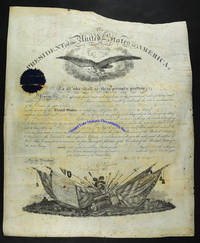
1864réf. 6509-1An Abraham Lincoln Military Commission For A Soldier Wounded At Antietam; He Was Commissioned In The Veterans Reserve Corps ABRAHAM LINCOLN 1809-1865. Lincoln was the Sixteenth President. DS. 1pg. August 1 1864. Washington. A vellum military commission signed "Abraham Lincoln" as President and co-signed "E.M. Stanton" as Secretary of War. The President appointed James Wylie Crawford a First Lieutenant in the Veterans Reserve Corps. Crawford 1832-1910 was from Maine; according to family lore he was badly wounded at Antietam I bought this directly from a descendant. This injury required his enlistment in the Veterans Reserve Corps. The Veterans Reserve Corps allowed wounded soldiers to remain active often performing small tasks and light duty; established in the middle of 1863 it was first known as the Invalid Corps until the official name was changed. The document recently underwent conservation with the vellum stretched and flattened; the top right corner of the vellum has shrunk and the document was once rolled. The Lincoln autograph is a tad light and gets lighter as the autograph gets towards the conclusion; the Stanton is also a bit faint but vellum does not hold ink that well especially compared to paper. books
réf. 6509ABRAHAM LINCOLN 1809-1865. Lincoln was the Sixteenth President.DS. 1pg. August 1 1864. Washington. A vellum military commission signed Abraham Lincoln as President and co-signed E.M. Stanton as Secretary of War. The President appointed James Wylie Crawford a First Lieutenant in the Veterans Reserve Corps. Crawford 1832-1910 was from Maine; according to family lore he was badly wounded at Antietam I bought this directly from a descendant. This injury required his enlistment in the Veterans Reserve Corps. The Veterans Reserve Corps allowed wounded soldiers to remain active often performing small tasks and light duty; established in the middle of 1863 it was first known as the Invalid Corps until the official name was changed. The document recently underwent conservation with the vellum stretched and flattened; the top right corner of the vellum has shrunk and the document was once rolled. The Lincoln autograph is a tad light and gets lighter as the autograph gets towards the conclusion; the Stanton is also a bit faint but vellum does not hold ink that well especially compared to paper. hardcover books
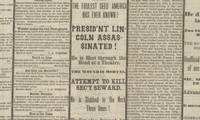
1504réf. 2913315/04/1865. The Assassination: Abraham Lincoln continues to stand as America’s most beloved President. Of our nation’s historical icons Lincoln is the quintessential embodiment of American possibility in his mythic-like rise from rail-splitter to Chief Executive and Emancipator of the oppressed. The admiration felt by Americans for Lincoln’s humble integrity his performance in office his noble statesmanship and his keen sense of justice is enduring. Lincoln is not given the highest marks just for character but for the transformation of the nation that he left behind which was both profound and long-lasting. Polls of historians generally show their belief that Lincoln faced the hardest job of any president. He had to define the issues inspire the people be steadfast in the face of losses win the Civil War free the slaves and lay the groundwork to reunite the nation. All that in the face of determined opposition. He accomplished all this in four years but was assassinated on April 14 1865 and his death left him unable to finish the job a job that quite likely he was the only one with a chance to get completed in a way that would truly bring the nation together. The end of the Civil War left the nation with two overwhelming questions: what to do with and do for the millions of freed slaves; and how to reintegrate the South into the Union. On the first point Lincoln was focused on African American access to land economic prosperity and legal rights and had just approved Gen. William T. Sherman’s order distributing parcels of former slave plantations to the slaves themselves. Lincoln wanted black Union veterans to have the right to vote which was a step to ultimately embracing full suffrage for African American males. In what proved to be his final speech three evenings before his death Lincoln had become the first president ever to support black voting. Lincoln’s successor Andrew Johnson was a Southerner uninterested in fair treatment of the liberated slaves. He opposed plans designed to guarantee the civil rights of black Americans and cancelled Sherman’s order granting land to slaves. Johnson accepted the draconian post-Civil War Black Codes which limited the rights and liberties of African-Americans something Lincoln would never have done. On the second point the readmission of the Southern states Johnson felt that once Southern states returned their loyalty to the national government they could manage their own affairs. This meant they could pass any Jim Crow laws they liked. He opposed the Republican plan for Reconstruction of the South including provisions designed to guarantee the civil rights of black Americans. The Republican Congress had no rapport with Johnson and the initial four years era of Reconstruction which was a disaster to the nation was essentially a bitter battle between a North and South that remained locked in contention presided over by a weak President Johnson and a Congress at loggerheads with him. Lincoln had enormous power and influence some of which extended into the South. He saw the end of the war as an opportunity to not simply celebrate victory but an opportunity to move the country forward. Johnson had no such feeling. Lincoln would have been much better placed to direct moderate and ease the contentions of Reconstruction. John Wilkes Booth was a member of a famous acting family and he enjoyed a phenomenally successful stage career during the Civil War: By 1864 he earned $20000 a year at a time when the average Northern family earned around $300 annually. A Marylander by birth Booth was an open Confederate sympathizer during the war. A supporter of slavery Booth believed that Lincoln was determined to overthrow the Constitution and to destroy his beloved South. After Lincoln’s reelection in November 1864 Booth devised a plan to kidnap the president and spirit him to Richmond where he could be ransomed for some of the Confederate prisoners languishing in northern jails. That winter Booth and his conspirators plotted a pair of elaborate plans to kidnap the president; the first involved capturing Lincoln in his box at Ford’s Theater and lowering the president to the stage with ropes. Booth ultimately gave up acting to focus on these schemes. Neither of the kidnapping plans bore fruit. On the evening of April 11 the President stood on the White House balcony and delivered a speech to a small group gathered on the lawn. Two days earlier Robert E. Lee had surrendered the Army of Northern Virginia at Appomattox Court House and after four long years of struggle it had become clear that the Union cause would shortly emerge from the war victorious. Lincoln’s speech that evening outlined some of his ideas about reconstructing the nation and bringing the defeated Confederate states back into the Union. Lincoln also indicated a wish to extend the franchise to some African-Americans—at the very least those who had fought in the Union ranks during the war - and expressed a desire that the southern states would extend the vote to literate blacks as well. Booth stood in the audience for the speech and this notion seems to have amplified his rage at Lincoln. “That means nigger citizenship” he told Lewis Powell one of his band of conspirators. “Now by God I’ll put him through. That is the last speech he will ever make.” Three days later Booth made good on his promise. Upon learning that Lincoln and his wife intended to see the play “Our American Cousin” at Ford’s Theater Booth used his actor’s connections there to gain access to the President’s box. He shot Lincoln at about 10 pm on April 14 1865 and Lincoln died about after 7 am on the 15th. Dr. Charles Leale was in the audience. Leale leapt over theater seats got to the president’s box and announced that he was a doctor. As he entered the President was sitting in a chair with his eyes closed and head slumped. He already looked dead Leale recalled. He felt Lincoln’s right arm for a pulse but couldn’t find one. He and some others eased Lincoln to the floor and Leale began searching for the wound. “I quickly passed the separated fingers of both hands through his blood-matted hair…and I discovered his mortal wound” Leale recalled. “The president had been shot in the back part of the head behind the left ear.” Leale stuck the little finger of his left hand into the hole in Lincoln’s skull. “I then knew it was fatal and told the bystanders” he wrote later. Leale knew he had to get Lincoln out of the theater to treat him. But he believed a carriage ride back to the White House would kill him. He and several other men lifted the president and with Leale holding Lincoln’s head they began to maneuver him outside. Across the street from the theater was the house of William Peterson and Lincoln was taken there. Lincoln was carried to a small back room stripped of his clothes and covered with blankets. His 6-foot-4-inch frame had to be placed diagonally to fit on the bed. Leale ordered the window opened and the wait began. A parade of anguished government officials and family members came and went. The President sank steadily his breathing labored and his pulse nearly undetectable. At 7:22 am on April 15 President Lincoln breathed his last. Leale smoothed the contracted muscles of Lincoln’s features placed two coins over his eyes and pulled a sheet up over his face. Famously Secretary of War Stanton saluted the fallen President and uttered “Now he belongs to the ages.” Stanton further eulogized Lincoln with the apt observation “There lies the most perfect ruler of men the world has ever seen.” Original report on the assassination printed the very day he died The public was hungry for information and the newspapers equally hungry to report the momentous news. One of these was the Binghamton Daily Republican and this is its issue of April 15 1865 with black mourning columns. The front page as was routine at the time was taken up by ads. The news then began on page two. There at top left is the headline “The Assassination of President Lincoln! A Nation in Mourning!!!” It begins “We feel too unfitted by this awful event to allude to the calamity in terms becoming its solemnity and importance! LINCOLN IS DEAD! Struck down by the hands of a brutal assassin in the midst of the triumphs which were commemorating his salvation of the country. A great man indeed has fallen! The foremost man of his time is no more…We dare not contemplate what may follow this sad and inscrutable providence.” This was followed by a proclamation of the governor of New York. On page three were dispatches from 12:30 AM to noon to 3:00. An early dispatch reports that “the President was shot… and is not expected to live” and told of the events of the assassination then available in detail. It mentioned “The screams of Mrs. Lincoln first disclosed the fact to the audience that the President had been shot.” Later it reported of Lincoln “At midnight the Cabinet…a few personal friends with Surg. Gen. Barnes and his immediate assistants were beside his bedside…The parting of his family with the dying president is too sad for description.” At noon the newspaper had more news and reported “Later concerning the President. He died this morning at 7:20. Two villains engaged in the horrible crime. The murder planned before March 4th.” At the bottom of the column is a report on the progress of the army of General William T. Sherman saying that in response to Grant’s hope Sherman would pursue the remaining Confederates Sherman said “I think we’ll do it.” At 3:00 the paper printed the latest from Washington. It contained “Full particulars of the Death of Abraham Lincoln” plus “Inauguration of President Johnson” and Johnson’s statement on taking office. Original newspapers reporting Lincoln’s assassination have become very scarce this being our first in over a decade. This one is comprehensive and with its black borders and large headlines is evocative of the moment and would be perfect for display. <img class=""alignnone wp-image-25018 size-post-window"" src=""https://cdn.raabcollection.com/wp-content/uploads/20231204144051/Folder-site-11-1600x1327.jpg"" alt="""" width=""1600"" height=""1327"" /> hardcover books
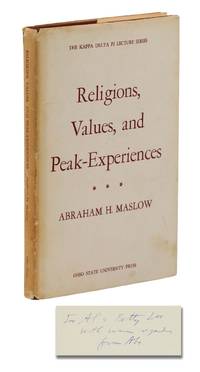
1964réf. 140948656Columbus OH: Ohio State University Press 1964. First edition. Very Good/Very Good. First edition first printing. Signed by Abraham H. Maslow on the front free end paper and inscribed to sociologist Alfred McClung Lee and his wife Elizabeth Briant Lee "For Al & Betty Lee With warm regards from Abe." xx 123 pp. Bound in publisher's brick red cloth stamped in blind on the front board with spine lettered in gilt. Very Good with trivial sunning and wear to spine ends light foxing to text-block edges and underlining and marginalia in ink on pp. 42-43. In a Very Good unclipped dust jacket with toning to spine rubbing and light chipping to ends with rubbing and finger soiling to covers. An early work that examines the human need for spiritual expression and articulation by the famed psychologist most famous for creating Maslow's Hierarchy of Needs. In a series of essays Maslow describes transcendental experiences focusing more on human condition rather than scientific rigidity. Inscribed to American sociologists Alfred McClung Lee and his wife Elizabeth "Betty" Lee who co-wrote The Fine Art of Propaganda 1939 which remained in print for the better part of the 20th century. Alfred was named the executive director of the Institute for Propaganda Analysis during WWII and would pen numerous academic texts including his best known works The Daily Newspaper in America: The Evolution of a Social Instrument 1937 and Principals of Sociology 1946 that endured for two decades as a staple text book for college students; quite uncommon signed. Ohio State University Press unknown books
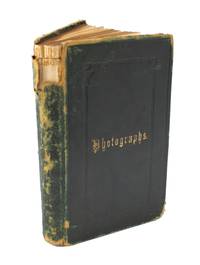
1864réf. 175101864. Abraham Lincoln and Civil War Figures Album of pasted oval portraits with signatures underneath each image. 1861. Features most notably Abraham Lincoln with a pasted signature below his image. This mid-nineteenth-century photographic album assembles oval portraits of political and military figures during the Civil War era including a pasted signature beneath an engraved portrait of Abraham Lincoln on the 15th page. Dated inscriptions from 1861 situate the compilation at the outset of national conflict. The inclusion of Lincoln Henry Clay and numerous uniformed figures reflects contemporary practices of collecting and memorializing political leadership through photographic reproduction and autograph acquisition. Photographic album measuring approximately 4.5 x 7 inches. Dark green morocco boards with gilt "Photographs" title. Contains 93 black-and-white and sepia portraits most approximately 2.5 x 2.25 inches mounted on pages. Lincoln portrait with separate pasted signature "A. Lincoln"; Henry Clay portrait with pasted signature; additional signatures written directly on album leaves. Spine chipped at head with separation; rubbing along margins; binding intact; photographs generally clear with minor age toning. Overall condition very good. he album reflects nineteenth-century commemorative culture preserving images and autographs of national figures during a transformative political moment. unknown books
1863réf. 69186Boston: Boston Daily Courier 1863. Full Description: LINCOLN Abraham. Emancipation Proclamation."President's Proclamation. Emancipation of Slaves in Rebellious States." Boston. Published in: Boston Daily Courier Volume LXXVIII no. 2. Friday Morning January 2 1863. The publication of Lincoln's Emancipation Proclamation in the Boston Daily Courier and one of if not the first official public announcements of the Final Emancipation Proclamation once it was signed and in effect as of January 1 1863. The Proclamation is featured at the top of the center column of page 3. We could find no other copies of this or any other January 2nd edition at auction and it is not mentioned in Eberstadt. Eberstadt's entry for the second edition of the "Final Proclamation" Eberstadt 9 states "Second edition. Apparently the only separate newspaper edition of the final proclamation and the earliest non-official edition. Printed on Friday evening January 2 1863 this Extra in point of chronological sequence was preceded only by the first official edition." Our present copy although not a separate newspaper edition was rushed to press and published in the Friday Morning edition of the Courier placing it's publication prior to Eberstadt 9. According to Eberstadt "A number of newspapers did not issue on January 2nd because of the previous day's holiday but most of those that did carried the final proclamation. Many of the others printed it on January 3rd." pg. 17. Broadsheet folio one large leaf folded along side to make four pages two leaves printed on recto and verso. Seven-column format. 26 x 19 inches; 655 x 490 mm. Light creases down the middle in both directions. A few minor closed tears. A large old ink signature along top margin of front page causing some bleed-through and foxing but not affecting text. Still a very good copy of this important declaration. Abraham Lincoln issued the preliminary Emancipation Proclamation on September 22 1862 stating that if the rebelling states did not cease fighting and rejoin the Union by January 1 1863 the slaves in those states would be set free. Once January 1st 1863 arrived President Lincoln signs and issues the final Emancipation Proclamation freeing the slaves in the Confederate states. The Boston Courier issued this early printing of Lincoln's Proclamation the very next morning January 2 1863. " HBS 69186. $8500. Boston Daily Courier unknown books
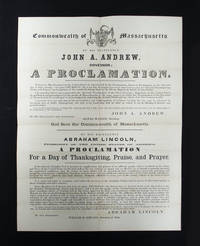
1863réf. 68373Massachusetts 1863. LINCOLN Abraham. Massachusetts: 1863. Letterpress broadside 27 3/4 x 20 in.; 708 x 508 mm on paper incorporating several display and ornamental fonts as well as the seal of Massachusetts docketed on the verso "Post Office Hanover.' Some light offsetting. Nearly invisible professional repairs to the verso along the folds. A very nice example of this rare and important broadside This original broadside produced in Massachusetts is formatted in two halves with the top half being Governor John A. Andrew's announcement of Lincoln's Proclamation endorsing the observation of this day of Thanksgiving in his state dated July 27 1863 and the bottom half being Lincoln's actual proclamation dated July 15th 1863 and announcing that August 6th shall be set aside as a National Day of Thanksgiving. Though the exact printing date is unknown it can be assumed that it was printed within the week following July 27th. Thanksgiving was observed as a Holiday since colonial times and each state would set aside its own day for celebration. This proclamation was the first time that the Holiday would be celebrated on a set day nation wide making it the first observed Thanksgiving as a National Holiday. Though later the same year on October 3rd 1863 Lincoln made a second proclamation again announcing Thanksgiving as a Holiday but this time in November a date closer to the time most states had been celebrating it in the past. This earlier proclamation is actually the first time Thanksgiving was given national status but because the second proclamation was widely accepted the knowledge of this earlier one has been somewhat forgotten making this piece a rare and important document in the annals of American history. Though this broadside is for the State of Massachusetts no other broadsides from any other states that announce this date are known to exist and only three other copies of this rare document are located through OCLC. HBS 68373. $8500. Massachusetts unknown books
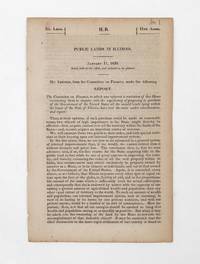
1839réf. 373003Vandalia Illinois 1839. First edition. 3 1pp. 8vo. Disbound. Housed in a morocco backed slipcase. First edition. 3 1pp. 8vo. Abraham Lincoln had yet to join the bar when he began his first stint in politics in the Illinois legislature in 1834 serving four consecutive terms in the Assembly through 1841. "This rare printing has the prestige of being the first occurrence of Lincoln's name as the sole author of a work. As a Whig lawmaker he was devoted to his party's program of public works through government financing. After the Panic of 18376 the spending he had advocated for had resulted in massive state debts. To relieve the budgetary burden Lincoln proposed that Illinois acquire land within its borders which the federal government still possessed and then sell the land at a fourfold profit to settlers and speculators resulting in both increased revenues and self-determined land ownership" Boroujerdi. Very rarethoma. Monaghan 1; Boroujerdi et. al. Abraham Lincoln: His Life in Print p. 29 unknown books