940 résultats
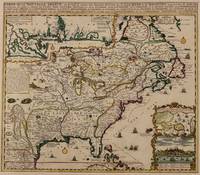
1719réf. 338195Amsterdam: Henri Abraham Chatelain 1719. unbound. Map. Engraving with hand coloring. Handsome archival frame 24 1/4 x 26 3/4" not examined out of frame. A finely engraved map of New France by Henri Abraham Chatelain depicting the inhabited regions of eastern North America and promoting French colonization. The map features excellent detail of the Great Lakes the Mississippi River and French settlements along with a striking trompe-l'oeil inset of the Mississippi Delta and Mobile Bay. A second inset includes both a plan and view of Quebec. Richly embelished with sailing ships Native American villages and explanatory notes the map is an good example of early eighteenth-century French cartography. Henri Abraham Chatelain 1684-1743 was a Dutch cartographer and pastor best known for his influential seven-volume Atlas Historique. A beautiful and decorative example of his work. Henri Abraham Chatelain unknown books
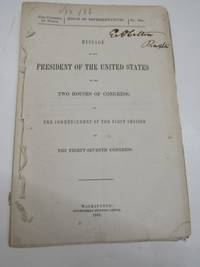
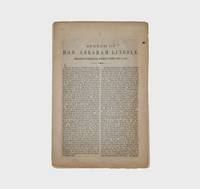
1861réf. 1391Washington: Government Printing Office 1861. 111 pp. Good condition and removed from a bound volume. Lincoln's speech of July 4 1861. Between the fall of Fort Sumter and July of 1861 President Lincoln Made decisions in response to secession of the southern states without seeking Congressional approval. Lincoln asks Congress to authorize his actions and explains why there is a need to fight the Civil War. This pamphlet is surprising scarce. Government Printing Office unknown books
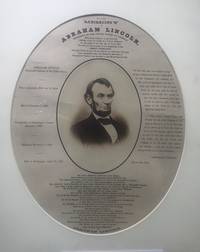
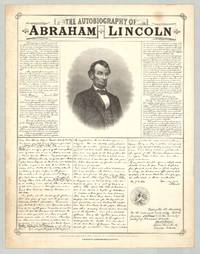
1865réf. 64317Philadelphia PA: A. Bancroft 630 Chestnut Street second story 1865. Oval albumen photograph of Lincoln 19 1/2 x 14 1/2 cm. laid down enclosed in an oval border in the center of the original rectangular sheet 50 x 38 cm. Text lines above and below the photo speak to what he gave to the nation text on the right records significant moments in his time line and on the left are two of his famous quotations all enclosed in an oval border. A lovely summation of what he had given to a nation in mourning accompanied by a strong image to remember the physical man. Some tears to the mount not reaching the oval edges a wrinkle perhaps in mounting on one side still a striking presentation. A. Bancroft, 630 Chestnut Street (second story) unknown books
1750réf. 167Etching and engraving. D.1385 Blum 203. Image: 10 x 12½. Margins: 10½ x 14. books
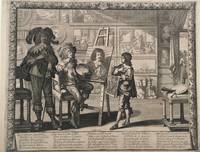
1642réf. 1661642. Etching and engraving. Duplessis 1386; Blum 204 only state. Image: 10 x 12 with small margins. Foxing traces of old fold in the legend. books
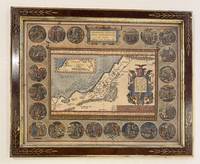
1603réf. 328971Antwerp: Ortelius Abraham 1603. unbound. Map. Engraving with hand coloring. 17 3/8 x 21 1/2" Framed in Eli Wilner carved frame. Beautiful map of the Holy Land bordered by 22 medallions depicting Abraham's wanderings. An inset map shows the path Abraham took. Ortelius used both Ptolemy and the Bible as sources for the map and based the medallion scenes on drawings by Maarten de Vos also of Antwerp. Latin text on verso. Expert repair to lower margin minor scattered stains in margins. Abraham Ortelius 1527 - 1598 a Flemish cartographer and geographer is widely regarded as one of the important and influential cartographers in history. He is known for his "Theatrum Orbis Terrarum" which was the first modern atlas. Van den Broecke 183.2 1603Lv; Laor 547C. Antwerp 1603 Ortelius, Abraham unknown books
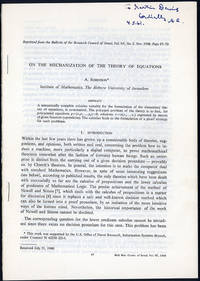
1960réf. 516851960. Robinson Abraham 1918-74. On the mechanization of the theory of equations. Offprint from Bulletin of the Research Council of Israel 9F 1960. 47-70pp. 241 x 170 mm. Without wrappers. Very good. Presentation Copy inscribed by Robinson to Martin Davis 1928-2023 on the first page: "To Martin Davis Cordially A. R. 4.5.61." First Edition Offprint Issue. Robinson is best known for developing nonstandard analysis which reincorporated infinitesimal and infinite numbers into mathematics. In the present paper which addresses "the problem of how to induce a machine more particularly a digital computer to prove mathematical theorems somewhat after the fashion of certain human beings" he constructed "a semantically complete calculus for the formulation of the elementary theory of equations" leading to "the formulation of a proof strategy for such problems" p. 47. . unknown books
1818réf. 820231818. The End of Trial by Battle in the United Kingdom Broadside. Trial. Thornton Abraham c.1793-1860 Respondent. Appeal of Murder: The Decision of the Judges in the Case of Ashford ver. Thornton Court of King's Bench April 20th 1818. Nottingham: Shorrock and Son Successors to E. Hodson Printers 1818. 12-1/2" x 7-1/2" broadside mounted to later backing sheet text in two columns separated by rule below headline and woodcut vignette of a landscape. Moderate toning light soiling to edges a few faint creases printer's flaw and clean tear to right column no loss to legibility. Rare. $3000. Ashford v. Thornton dealt with the aftermath of the murder of Mary Ashford in 1817. Abraham Thornton who had seen and been intimate with Ashford the previous night was tried for rape and murder but acquitted of both charges due to a lack of evidence and inconsistencies in the prosecutor's case. Public outcry around his acquittal led to Mary's brother William invoking an "appeal of murder." This uncommon legal practice allowed a retrial of a defendant acquitted for murder but crucially gave the defendant the right to trial by battle. Thornton invoked that right. After extensive proceedings in the Court of King's Bench the court found that he was eligible to do so. Our broadside documents the final hearing in which Ashford declined to battle with Thornton and withdrew his appeal. Thornton was given a pro forma arraignment and released. The case resulted in the abolition of appeals by murder and thus the end of trial by battle. This broadside is rare and appears to be unrecorded. No copies located on OCLC or Library Hub. Not at Harvard or the British Library. unknown books
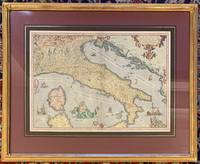
1573réf. 311532Antwerp: Ortelius Abraham 1573. framed. Map. Color engraving. Image measures 14 3/8" x 19.75". In gilt frame with empire French matting 23 x 28 1/2 inches. Gorgeous 16th century map of Italy. Elevations are beautifully colored and major towns are noted in red. Part of the Balkans Corsica and northern Sardinia are included along with part of Switzerland. Monaco is noted to the West. It was Ortelius's first map of Italy with a depiction of Neptune embracing and kissing a Neirid merwoman. A Sphinx perches atop the distance scale cartouche. Seven ships complete the composition. Some foxing and toning but otherwise a beautiful example of this uncommon edition. Abraham Ortelius 1527--1598 started his career as a Flemish map colorist eventually becoming a publisher cartographer and geographer. He widely regarded as one of the important and influential cartographers in history. He is known for his "Theatrum Orbis Terrarum" which was the first modern atlas. Van den Broecke 118. Ortelius, Abraham unknown books
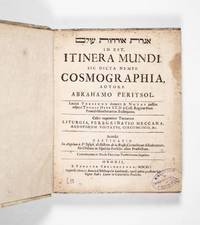
1690réf. 48858Oxford: Sheldonian Theatre; Henry Bonwick 1690. First edition. Hardcover. Very Good -. Two parts quarto published in 1690 and 1691. A-Z4 pi4 b4 Aa4 Bb/CC4 Dd-Gg4 = 124 leaves. 16 196; 4 31 1 blankpp. Text in Hebrew and Latin in parallel columns. De Turcarum liturgia with separate title page dated 1690 and pagination. Contemporary vellum neatly rebacked. Old library stamp at bottom margin title front blank endleaf detached occasional oxidation spot and mild toning else a very good copy crisp and amply margined. First Hebrew-Latin edition of the first modern Hebrew work on geography the author's most famous and important book. Abraham Farissol or Peritsol was a learned Jew from Avignon who compiled his cosmographical works at the court of the Estes in Ferrara. The present text was composed in 1524-25 and first published in Hebrew at Venice in 1586. The Latin translation and notes in the present edition were prepared by the English orientalist and librarian Thomas Hyde 1636-1703 with the assistance of R. Isaac Abendana working from a manuscript which Hyde located in the Bodleian Library. "Each of its 30 chapters deals with a certain geographical area or subject. In addition many cosmological and historical matters are also treated. The author collected all the evidence he could regarding Jewish settlements in each country. The inclusion of a description of the New World makes Farissol the first Hebrew writer to deal in detail with the newly-discovered America. The 14th chapter of Iggeret Orhot Olam which deals mainly with the settlements of the Ten Lost Tribes is of special interest. According to Farissol's introduction to this chapter it is clear that what moved him to undertake this investigation was the appearance in Italy in 1523 of David Reuveni many of whose descriptions are included in this work" EJ 6.1185. Reuveni was "an adventurer who aroused messianic hopes in the early 16th century" EJ 14.114. The appended work is a tract on Islamic customs by Albert Wojciech Bobowski a Polish Christian who converted to Islam after his capture by the Ottoman Turks. Adopting the name Ali Ufki Bey he served as translator court musician at Topkapi and as a notator of Ottoman classical music. Bell F26. Christian Hebraism Cat. Harvard 1988 no. 39. ESTC R27480. Fürst Bibliotheca Judaica 1.276. Heller 17th Century pp. 1176-1177. Sabin 60934. Smitskamp PO 372. Vinograd Oxford 4. Wing F-438. Cf. Alden European Americana 1.187 Venice 1586; Heller 16th Century pp.732-733 ed. 1586. Full title beginning in Hebrew: ×גרת ×רחות ×¢×œ× Id est Itinera mundi sic dicta nempe cosmographia. Latinâ versione donavit et notas passim adjecit Thomas Hyde. Calce exponitur Turcarum liturgia peregrinatio Meccana aegrotorum visitatio circumcisio etc. Sheldonian Theatre; Henry Bonwick hardcover books
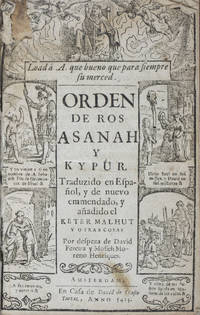
réf. 43956Amsterdam: David Fereira y Mosseh Moreno Henriques/ David de Crasto Tartaz David de Castro Tartas 5423. Hardcover. g- to g. Duodecimo. 6.5x4.5". 479pp. Original brown calf boards with gilt-stamped motifs and raised bands on the spine. Blue ribbon marker. Edges of the book block in red. Marbled endpapers. The title page is illustrated with copper plate engravings in the form of small vignettes of biblical scenes surrounding the text. This is an early Spanish-language edition of the complete Jewish High Holiday prayer book Machzor based on the original translation by Abraham Usque originally printed in Ferarra Italy in 1553. This edition contains some added material not previously present including most prominently Solomon ibn Gabirol's famed philosophical poem "Keter Malkhut" Royal Crown which over the years has come to be read as part of the Yom Kippur service in some Jewish traditions. This edition of the Machzor was published by David Fereira and Mosseh Moreno Henriques to serve members of the then sizable Sephardic Jewish community in Amsterdam. A significant portion of the community would have been ex-Marranos Jews who had outwardly converted to Catholicism during the inquisition in Spain who then immigrated and were able to reestablished their Jewish identity and thus were unable to read Hebrew hence the text's publication in Spanish. As stated in the foreword this edition includes some additions to the text not included in previous versions and omits some material deemed to have been unnecessary. The prayer book starts with the penitential prayers Selichot p.3-47 which includes decorative head and endpeices. This section is followed by the Rosh Hashanah service p.48-195 and then the Yom Kippur service including "Keter Malkhut" p.254-289. The title page is illustrated with scenes from the biblical stories of King David Saul and Goliath and contain small captions underneath with corresponding biblical passages in Spanish. There are a number of pagination printing errors including: p.45-46 are misprinted as 54 and 36 p.264 is misprinted as 164. p.450 is misprinted as 350 p.414 is misprinted as 144. Like in the case of the earlier 1652 edition of the work pages 305-352 are misprinted as "321-368" but in this copy the leaf containing p. 353-354 directly following "368" seems to be missing. Overall this edition follows very closely the 1652 edition of the same work in terms of pagination content and organization. Includes large initials throughout the text. All text in Spanish. Binding with rubbing scratches and abrasions to the covers spine and extremities. Some chipping to the head and tail of the spine. Interior front covers with some starting and the loosening of the endpapers. Title page with starting light creases stains and and light chipping on the top left corner resulting in slight loss of image. Some light water staining along the top edge of the pages with some other sporadic light staining throughout. Page 365 torn along the side edge with no loss of text. Starting at a number of pages throughout the book. Binding in good- interior in good condition overall. Binding protected with modern mylar. David ben Abraham de Castro 1630-1698 was a French-born Portuguese Jewish printer/publisher in Amsterdam. Between 1662 and 1701 his press printed the "Gazeta de Amsterdam" a newspaper for the exiled Sephardic Jewish community in Amsterdam. He started his printing career as a typesetter at the printing house of Menasseh Ben Israel a printer and leading Rabbi in community who printed the earliest Amsterdam edition of this work in 1630. Castro started his own business in 1662 making this edition among his earliest publications. References: RODRIGUEZ 1781 p. 643 KAYSERLING 1890 p. 62 PALAU1923 202416 PEETERS1933 1038. David Fereira y Mosseh Moreno Henriques/ David de Crasto Tartaz (David de Castro Tartas) hardcover books
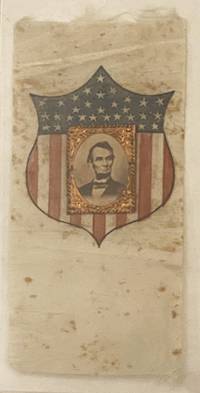
1864réf. BB_Lincoln_badgeLINCOLN Abraham 1809–1865 PHOTO BADGE in copper frame with silk Campaign Ribbon circa 1864 Framed Albumen Portrait measures 1 x ¾ inches; Ribbon imprinted Chicago: North Western Flag & Banner Co. L. 4 inches. The portrait by Anthony BERGER of Matthew Brady's Gallery the image taken in Washington DC 9 February 1864 Reference: C Hamilton and L Ostendorf: Lincoln in Photographs 109 North Western Flag & Banner Co. books
1864réf. 2547081864. very good-. This historic and rare black printed broadside presents the platforms of both parties the Republicans having convened in Baltimore in June and nominated Abraham Lincoln for President and Andrew Johnson for Vice President and the Democrats having convened in Chicago in August and nominated George B. McClellan for President and George H. Pendleton for Vice President. This copy measures 29 x 23 cm is double columned and with the imprint "For sale by all News Agents. Price $1 per 100." Very light foxing at the bottom margin more visible on the verso. Fraying at the margins as usual. Sabin 63348 Exceedingly scarce. unknown books
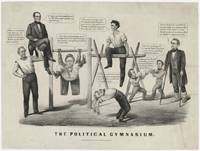
1860réf. 60001Scarce iconic & fantastic lithograph Abraham Lincoln cartoon The Political Gymnasium Abraham Lincoln Louis Mauer The Political Gymnasium. New York: Currier & Ives 1860. Lithograph broadside 18 x 13-1/2 inches. This scarce and iconic lithograph is a detailed humorous "parody on the field of presidential candidates and their supporters in the 1860 campaign." Bell and Everett for the Constitutional Union Party are there: Bell a muscle man holds Everett aloft on a barbell. Horace Greeley struggles to do a pull-up in his effort to gain the New York governorship while Lincoln is easily astride his own bar wooden rails offering helpful advice: "You must do as I did Greely get somebody to give you a boost. I'm sure I never could have got up here by my own efforts." The New York Courier's James Watson Webb does a backward somersault in the foreground. The broadside evidently issued after the parties' nominating Conventions because Seward is depicted as a cripple "on crutches and with bandaged feet." Breckinridge and Douglas "the two sectional Democratic candidates compete in a boxing match." Auction records for the last couple of years show a colored example with trimmed right margin selling for $8125 and a nice but sooty uncolored example for $5250. Both sold by Heritage. Measures 18 x 13-1/2 in. and is an ideal candidate for framing. Overall Near Fine. Professionally cleaned & mended. Closed tear crosses most of Seward's midsection. Currier & Ives books
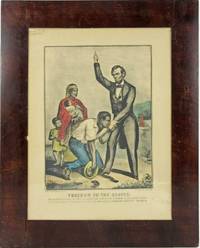
1865réf. 38499New York: Currier & Ives 1865. Color print 11-3/4" x 15-1/2" by sight. A black man newly freed from slavery kneels at Lincoln's feet his shackles broken. He kisses Lincoln's hand. His wife and babies stand behind him. Lincoln's right arm is raised and pointing heavenward. Light uniform toning but brightly colored. Two blank margin tears at lower right corner one blank margin tear at upper left corner. Framed in wood a few small dings to overall size 16" x 20." Very Good. "This commemorative print was issued soon after the assassination of President Lincoln to comfort his supporters. The semi-allegorized representation portrayed the former president as the emancipator of enslaved African Americans guided by divine principles" Description online at The Met. Entering Richmond in 1865 Lincoln was met by many former slaves who kneeled before him. Lincoln told them to stand and thank God not Lincoln for their freedom. A decade later the Colored People's Educational Monument Association headed by the African-American abolitionist Henry Highland Garnet. created a memorial to Lincoln. The result was a sculpture erected in 1876 in Lincoln Park near Capitol Hill depicting a supplicant slave and a towering Lincoln. Known as the Emancipation Memorial or the Freedmen's Memorial it generated some contemporary criticism for its depiction of the inferior position of the black man. Gale 2311. Not in LCP Reilly or Weitenkampf. OCLC 1292616124 1- OH Hist. Connection 870219805 1- IN Hist. Soc. as of May 2024. AAS also owns a copy. Currier & Ives unknown books
1523réf. 53327Venice: Daniel Bamberg 1523. Daniel Bamberg unknown books
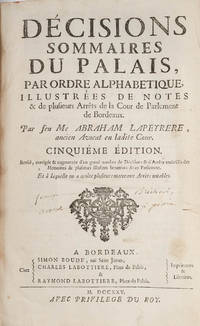
1725réf. 787371725. Bordeaux: Chez Simon Boud‚ 1725. Folio. Bordeaux: Chez Simon Boud‚ 1725. Folio. Pre-Revolutionary Law in Action: An Interleaved 1725 Bordeaux Folio Heavily Annotated by Eminent Jurist Francois Brechard Lapeyrere Abraham. Brechard Francois 1770-1843 Annotator. Decisions Sommaires du Palais Par Ordre Alphabetique Illustrees de Notes & De Plusieurs Arrets de la Cour de Parlement de Bordeaux. Par feu Me Abraham Lapeyrere Ancien Avocat en Ladite Cour. Cinquieme Edition. Revue Corrigee & Augmentee d'un Grand Nombre de Decisions & d'Arrets Recueillis des Memoires de Plusieurs Illustres Senateurs de ce Parlement. Et a Laquelle on a Ajoute Plusieurs Nouveaux Arrets Notables. Bordeaux: Chez Simon Boude Rue Saint James Charles Labottiere Place du Palais & Raymond Labottiere Place du Palais Imprimeurs & Libraires 1725. xii 539 7 pp. Interleaved. Folio 14" x 9-1/2"; 35.6 x 24 cm. Contemporary sheep blind rules and cat's-paw decoration to boards gilt spine with raised bands and lettering piece edges rouged. Negligible light rubbing and a few minor scuffs to boards slightly heavier rubbing to extremities corners bumped and somewhat worn. Light toning to interior faint dampspotting and foxing in a few places side-notes affected by trimming in a few places some text leaves have underlining corrections and brief annotations 140 interleaves have annotations main text followed by 16-pp. double-column manuscript index all annotations in a neat contemporary hand signature of annotator Francois Brechard "avocat a Poitiers" to title page. $3500. This interleaved working legal text bridges the complex world of Pre-Revolutionary French customary law coutumes and the legal landscape of the early 19th century. Digested by topic this copy of Lapeyrere's landmark compilation records the decisions of the Parlement of Bordeaux-one of the absolute highest courts of justice under the Ancien Regime. Books like this are vital artifacts of early European legal history for several key reasons: - The Battle for Regional Autonomy Before the Napoleonic Code unified French law in 1804 France was divided into a patchwork of local customary laws. Parlements like the one in Bordeaux did not just try cases; they fiercely protected regional privileges against royal overreach by centralizing local precede. unknown books
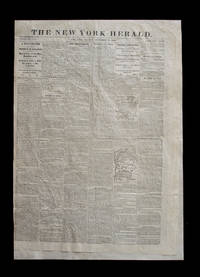
1862réf. 68870New York: The New York Herald 1862. Full Description: LINCOLN Abraham. Emancipation Proclamation."A Proclamation by the President of the United States. Operations of the Confiscation Act. All Slaves in States in Rebellion January 1 1863 to Be Free." New York. Published in: The New York Herald Tuesday September 23 1862. Whole No. 9506. The publication of Lincoln's Emancipation Proclamation in James Gordon Bennett's pro-Democratic New York Herald and one of if not the first official public announcements of the preliminary Emancipation Proclamation. Broadsheet folio one large leaf folded along top to make four pages two leaves printed on recto and verso. Six-column format. 22 x 15 1/2 inches; 560 x 395 mm. Light creases down the middle in both directions. Some nearly invisible repaird along top margin and edges. Some of the repairs just touching a few letters in the headline. Still a very good copy of this important declaration. We could only find 3 copies of this at auction and it is not mentioned in Eberstadt. Eberstadt mentions that his Third edition of the Emancipation has a publication date somewhere between September 24th and 26th therefore putting the current copy before this. Eberstadt's first and second edition are the official state department editions printed the day of the declaration September 22nd just the day before this New York Herald was printed. Abraham Lincoln issued the preliminary Emancipation Proclamation on September 22 1862 stating that if the rebelling states did not cease fighting and rejoin the Union by January 1 1863 the slaves in those states would be set free. The New York Herald issued this front-page top left corner early printing of Lincoln's Proclamation the very next day appearing under the headline: "All Slaves in States of Rebellion January 1 1863 to Be Free." "Lincoln read the first draft of what came to be known as the Preliminary Emancipation Proclamation to his cabinet on 22 July 1862. Given the criticism directed at Lincoln for moving too slowly on the issue of emancipation it is worth noting that this first reading took place just sixteen months after he had pledged not to 'interfere with the institution of slavery in the States where it exists.' He continued to revise the document throughout the summer and following the Union victory at Antietam he issued the preliminary proclamation-which managed to balance daring with prudence-on 22 September. This first proclamation essentially gave the Rebel States one hundred days to return to the Union after which period any slaves within their borders would be "then thenceforward and forever free." Any rebellious states that returned to the Union in the interim would be able to adopt immediate or gradual-and compensated-abolition of slavery within their borders." Sotheby's. The front page of this newspaper also contains two maps and reports of the campaigns in Kentucky. HBS 68870. $3500. The New York Herald unknown books
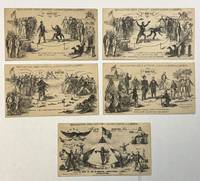
1861réf. 41884New York: J.H. Tingley 1861. Five postal covers each oblong 3-1/4" x 5-7/8." The recto of each is an engraving of a Round of the boxing match. Near Fine. From the U VA description: "Five envelopes in the Champion Prize Envelope set depict a boxing match between Lincoln and Davis in which the latter is easily defeated and Winfield Scott commands the Union armies. Smaller vignettes in the corners depict dogs guarding southern cotton and then fleeing; liberated slaves Union artillery advancing firing and marching home; Union and Confederate politicians commenting on the fight including John Minor Botts who is seen as keeping Virginia in the Union; European countries commenting on the fight; and the Union eagle and Liberty victorious with Lincoln the champion of all sections." 1st Round: Standing around a boxing ring Lincoln and Davis in the middle are a group of civilians Soldiers cannon. two dogs guarding a bale of cotton and a Confederate flag a group of slaves three men on a globe Capitol and American flag in the background. In the ring Davis cowers before Lincoln who says "I use no more force than necessary." Davis: "Let me alone!" 2nd Round: The same group encircles the ring. Lincoln: "Go back you dog to the junction I'll call on you there soon." Davis: "Beauregard Lets fall back on Richmond." From the crowd of civilians: "Secession is looking smaller" and "We shall soon strip it." Other comments are also uttered. 3d Round: Lincoln: "I will soon smother those pirates." From the same encirclement anti-Confederate comments such as "General That's secession's last kick" rebel soldiers saying "Let's go home boys." The cotton bale and Confederate flag are missing. 4th Round: Seward and Scott are in the ring. Seward: "General where is secession now" Scott : "Don't you see that greasespot" Comment: "Virginia and Kentucky may now be heard in behalf of the whole Union." 5th Round: Lincoln with "The Champion Belt": "You shall all have my impartial constitutional and humble protection." He is surrounded by the iconic Screaming Eagle; a triumphant West North East and South; and Lady Liberty who says "I still live." Not in Reilly or Weitenkampf. AAS and the University of Indiana own all five envelopes. OCLC 277634667 1- U VA 14953428 2- CT Mus. Hist. Culture U IL as of June 2026. J.H. Tingley unknown books
1877réf. 726891877. A Distinguished California Jurist's Manuscript Register of Legal Proceedings During the Constitutional Reform Era 1877-1880 Manuscript. California. Freeman Abraham Clark 1843-1911. Register of Actions and Proceedings. Sacramento County California 1877-1880. Folio 13" x 7-3/4"; 33 x 19.7 cm. 244 pp. Manuscript in a single highly legible cursive hand. Contemporary three-quarter sheep over marbled boards gilt fillets to spine marbled edges. Contemporary manuscript title "Register of Actions and Proceedings" to front pastedown. Light rubbing and minor scuffs to boards dampstain to rear board heavier rubbing to extremities with minor wear to spine ends and corners chip to foot of spine. Joints starting slightly at head hinges tender but holding. Slight offsetting to corners of first two leaves. Light toning to interior occasional light foxing and minor spots and stains. Several related contemporary documents tipped or laid in. Good to very good. $3500. An extensive manuscript register documenting the private legal practice of Abraham Clark Freeman one of California's most distinguished nineteenth-century lawyers legal authors and constitutional reformers during the years surrounding the state's Constitutional Convention of 1878-1879. Freeman arrived in California from Illinois in 1861 and was admitted to the bar in 1864. He achieved national prominence with his Treatise on the Law of Judgments 1873 described in an early history of Sacramento County as the first legal treatise of national scope written or published in California. Its exceptional reception helped establish California's reputation as a center of American legal scholarship. Freeman subsequently became an influential editor of American case-law reports assuming the editorship of American Decisions in 1879. The present register covers a particularly significant period in Freeman's career and California's constitutional development. Freeman served as a delegate to the Constitutional Convention of 1878-1879 which drafted the state's second constitution amid intense controversies over railroad monopolies corporate power taxation labor relations and political representation. Ratified in 1879 the new constitution substantially reorganized the state's legal and political institutions. Freeman also served on a commission charged. unknown books
réf. 30892 p.l. viii 236 pp. 8vo attractive antique calf double gilt fillet round sides flat spine gilt uncut. Paris: veuve Tilliard et Fils 1805. The rare sale catalogue of the library rich in oriental books and manuscripts of Anquetil-Duperron 1731-1805 French orientalist and brother of the historian Pierre Anquetil. Abraham Hyacinthe had a fascinating early life: while unsuccessfully studying for the priesthood in Paris and Utrecht he developed a passion for Hebrew Arabic Persian and other languages of the East. He travelled to India as a private soldier in 1754 in order to search for the works of Zoroaster. Granted free passage he learned modern Persian in Pondicherry and Sanskrit at Chandernagore. When war broke out between France and England Anquetil-Duperron travelled widely throughout India on foot learning further languages and studying the antiquities and sacred laws of the Hindus. He returned to Europe in an English vessel ultimately arriving in Paris in 1762 with 180 oriental manuscripts. He devoted many of the following years to scholarship editing and publishing many important oriental texts. The French Revolution seems to have greatly affected him: during that period he abandoned society and lived in voluntary poverty on a few pence a day. A fine copy. 1600 lots and priced throughout in a contemporary hand. From the library of Jean Viardot. ⧠Gustave Brunet Dictionnaire de Bibliologie Catholique col. 408–“Ce catalogue est curieux surtout pour les livres en langues étrangeres.” Grolier Club Printed Catalogues of French Books Auctions…1643-1830 458. Peignot p. 77. unknown books
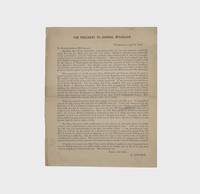
1864réf. 376854Np 1864. Broadside 9-3/4x8-3/4 inches. Remnants of prior mounting on verso small separation at horizontal fold repaired with tape. Broadside 9-3/4x8-3/4 inches. Rare broadside or handbill printing of the famous telegram sent by Abraham Lincoln to General George B. McClellan early in the Civil War expressing his frustration at McClellan's unwillingness to engage the enemy during the Peninsular Campaign and urging him in no uncertain terms to attack the Confederates. Lincoln uses a combination of reason force assessment and strategic reasoning in an attempt to draw McClellan into the fight famously concluding "you must act." This small broadside was published either in an effort to galvanize the public into pressuring the always reluctant McClellan to engage Confederate forces under General Joseph E. Johnston or perhaps as a campaign piece for the Election of 1864 to remind voters of McClellan's failures as a leader. Six months following its stinging defeat at the Battle of Bull Run the Union Army was reorganized trained and reformed into the Army of the Potomac by Major General George B. McClellan. After four months of training and reorganization however McClellan had done little more with his troops than run drills and reviews. In December 1861 President Lincoln took matters into his own hands and proposed the Peninsular Campaign March 1862 - July 1862 against Johnston's Confederate forces in which the Army of the Potomac would use a flanking attack in the nearby Occoquan Valley to capture Johnston and his army. McClellan rejected Lincoln's plan in favor of his own which consisted of a flanking movement much further south without leaving enough troops behind to protect Washington. Although Lincoln eventually acceded to McClellan's plan he held back the First Corps of the Army of the Potomac under the command of General McDowell for the protection of Washington. McClellan's plans were thwarted by Johnston who had in the interim moved the Confederate forces further south causing McClellan to march his men all the way to Yorktown deep in the Virginia peninsula. Instead of mounting a direct attack against the 17000 Confederates near Yorktown with his massive contingent of 70000 Union soldiers McClellan always overestimating Confederate forces and always fearful of failure took the safer route and laid siege to Yorktown which allowed Johnston to move his whole army down to Yorktown in opposition. In an April 7th telegram to Lincoln McClellan firm in his belief that he was always outnumbered by the Confederate forces complained that Lincoln held back too many troops for the protection of Washington which hamstrung his efforts for a successful campaign. In the present telegram to McClellan composed on April 9 Lincoln patiently responds: "Your dispatches complaining that you are not properly sustained while they do not offend me pain me very much." Lincoln continues "After you left to begin the Peninsular Campaign I ascertained that less than 20000 unorganized men without a field battery were all you designed should be left for the defense of Washington.This presented or would present.a great temptation for the enemy to turn back from the Rappahannock and sack Washington.My explicit directions that Washington sustained by the judgment of all the commanders of corps should be left secure had been entirely neglected. It was precisely this that drove me to detain McDowell." Lincoln refutes McClellan's belief that he did not have enough troops by using McClellan's own troop estimates obtained from the Secretary of War to argue McClellan into action stating that when "the whole force which has gone forward to you is with you.I think it is the precise time for you to strike a blow." Lincoln patiently tries to convince McClellan of the consequences of his inaction: "the enemy will readily gain on you; that is he will gain faster by fortifications and re-enforecments than you can by re-enforcements alone" and forcefully concludes "And once more let me tell you it is indispensable to you that you strike a blow." Lincoln then shows his brilliance as a judge of character addressing McClellan's fear of failure by holding up the public consequences of his inaction: "The country will not fail to note - is now noting - that the present hesitation to move upon an intrenched sic enemy is but the story of Manassas repeated." Then knowing by experience of McClellan's personal defensiveness Lincoln concludes in the words of Lincoln biographers John G. Nicolay and John M. Hay "with as much consideration and kindness as a father would use towards a querulous and petulant child." He ends his telegram writing "I beg to assure you that I have never written you or spoken to you in greater kindness of feeling than now nor with a fuller purpose to sustain you so far as in my most anxious judgment I consistently can. But you must act." Ultimately the Peninsular Campaign failed and the Army of the Potomac withdrew from the Virginia Peninsula in July 1862. By November of 1862 Lincoln frustrated with McClellan's lack of initiative on the field finally removed him from command and replaced him with General Ambrose Burnside as commander of the Army of the Potomac. Lincoln would later encounter McClellan as his Democratic adversary in the Presidential election of 1864 easily defeating him. OCLC lists just six copies located at New York Historical Society University of Delaware Abraham Lincoln Presidential Library Boston Athenaeum Library Company of Philadelphia and the Huntington Library. A rare and important printing of one of Lincoln's most famous messages of the Civil War. Nicolay John G. and John Hay. Abraham Lincoln: A History New York: The Century Company 1890 Volume 5 p.362 unknown books
réf. 3389Boston: James R. Osgood & Co. 1872. Broadside 24.5” x 19” plus margins; portrait and text in five columns. CONDITION: Torn through upper right the tear affecting the portrait restored backed with Japanese tissue. The first separate printing and first separate facsimile of Lincoln’s famed autobiographical sketch originally composed in response to a request from his friend Jesse Fell printed with a brief account by Fell of the circumstances under which it was written and extracts from a few of Lincoln’s speeches. Lincoln and Fell became acquainted during a session of the Illinois State Legislature in the winter of 1834–35. Lincoln was serving as a representative and Fell as a lobbyist for MacLean County Illinois. The two became political friends and saw much of each other in subsequent years. In 1858 when Lincoln came to prominence as a result of his debates with Stephen Douglas Fell who had recently returned from a trip east where the public was hungry for information about Lincoln approached his friend as he came out of the Bloomington Illinois courthouse one afternoon and asked him for a biographical sketch. Lincoln initially resisted but the following year gave in composing a brief autobiography as well as a letter of explanation both of which he mailed to Fell on December 20th 1859. Delighted that Lincoln had finally complied and eager to promote his cause Fell forwarded Lincoln’s autobiography to his friend Joseph J. Lewis in Pennsylvania who used it for an article that was published in the Chester County Times PA on February 11th 1860. Lewis’s article was reprinted in many newspapers and “became the first widely read biographical sketch of Lincoln and served as a basis for the first three Lincoln campaign biographies in book form” Sage. In 1872 while preparing his biography of Lincoln for publication Ward H. Lamon wrote to Fell asking him to forward Lincoln’s sketch and its accompanying letter to his publisher James R. Osgood & Co. for consultation and facsimile publication. Placing no particular value on the original manuscripts when he first received them Fell had not requested their return but now retrieved them in response to Lamon’s request. He then forwarded the biographical sketch but not Lincoln’s letter of explanation substituting instead his own cover letter. Since Lincoln’s sketch was neither addressed to Fell nor signed Fell included with his letter clippings in Lincoln’s hand reading “Hon. J. W. Fell” and “Yours very truly/A. Lincoln” which were then pasted onto Lincoln’s sketch. Also added was an emblem and statement testifying to the authenticity of the manuscript signed by David Davis Lyman Trumbull and Charles Sumner dated at Washington D.C. March 20th 1872. The facsimile was included in Lamon’s biography and published separately in the form of the broadside offered here. Rare. OCLC records only four copies. REFERENCES: Not in Monaghan; Stern Collection 4792; Sage Harold K. Jesse W. Fell and the Lincoln Autobiography in The Journal of the Abraham Lincoln Association Vol. 3 Issue 1 1981 pp. 48–58. Boston: James R. Osgood & Co., 1872 unknown books
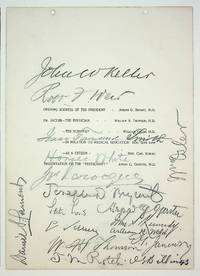
1900réf. 1680New York: Tiffany & Co. program/menu The Knickerbocker Press Festschrift 1900. First editions. RARE PROGRAM/MENU FOR DINNER IN HONOR OF ABRAHAM JACOBI'S 70TH BIRTHDAY--SIGNED BY JACOBI AND 17 NOTABLE ATTENDEES TOGETHER WITH BOUND PUBLISHED PROCEEDINGS AND FESTSCHRIFT VOLUME PRESENTED TO HONOREE. 1 Program of "Dinner in Honor of Doctor Abraham Jacobi on the Seventieth Anniversary of His Birthday Saturday May the Fifth Nineteen Hundred at Delmonico's." Three leaves 15.8x22.3 cm printed on fine card stock by Tiffany & Co. each with 2 small holes at top for binding by ribbon. Menu program cover with engraved portrait of Jacobi with his pencil signature below and program with pencil signature of 17 attendies. Framed in 41.5x66.5 cm dark wooden frame with ribbon tie in pouch attached to back of frame. Browning to page edges otherwise very good. SIGNERS OF THE PROGRAM: John Shaw Billings 1838 - 1913 was an American librarian building designer and surgeon who modernized the Library of the Surgeon General's Office in the United States Army. His work with Andrew Carnegie led to the development and his service as the first director of the New York Public Library. Billings oversaw the building of the Surgeon General's Library which was the nation's first comprehensive library for medicine. Joseph Decatur Bryant 1845 - 1914 was a surgeon New York City Health Commissioner Surgeon-General of the National Guard Surgeons and physician to Grover Cleveland and John D. Rockefeller. He also held a series of academic positions at Bellevue Hospital Medical College culminating with the title of professor of the principles and practice of surgery and professor of operative and clinical surgery at New York University and Bellevue Hospital Medical College. Arpad Geyza Charles Gerster 1848-1923 A surgeon who practiced at Mt. Sinai in New York City in the late 1890s and early 1900s. Hungarian by birth he was also a sportsman linguist and an artist. Gerster's vivid often humorous observations of nature and people his delight in the outdoors and his drawings and etchings offer a larger portrait of the Adirondack region in the age of William West Durant Great Camps railroads and the beginning of the conservation movement. Abraham Jacobi 1830 - 1919 was a German physician and pioneer of pediatrics. He was a key figure in the movement to improve child healthcare and welfare in the United States and opened the first children's clinic in the country. To date he is the only foreign-born president of the American Medical Association. He is regarded as the Father of American Pediatrics. Edward Gamaliel Janeway 1841 - 1911 was an American physician who served as Health Commissioner of New York and as president of the New York Medical Journal Association in the late nineteenth century. He was considered "one of America's premier internists in the late nineteenth and early twentieth centuries". John W. Keller 1856 -1919 was a New York newspaper man member of Tammany Hall and in 1900 was a delegate to the National Democratic Convention and his name was presented by the New York delegation for the Vice Presidency. From 1898 to 1902 he was Commissioner of Public Charities in New York city. John Stewart Kennedy 1830 - 1909 was a Scottish-born American businessman financier and philanthropist. He was a member of the Jekyll Island Club also known as The Millionaires' Club on Jekyll Island Georgia along with J.P. Morgan and William Rockefeller among others. Daniel Scott Lamont 1851 - 1905 was the United States Secretary of War during Grover Cleveland's second term. After his service as Secretary of War Lamont was vice president of the Northern Pacific Railway Company from 1898 to 1904. In August 1904 he was supported by the New York Times as a candidate for Governor of New York. Joseph Larocque 1831 - 1908 was a New York City lawyer and president of the New York City Bar Association. Larocque was a director of several companies including the American Cotton Oil Company the Commonwealth Insurance Company of New York Niagara Falls Power Company and Plaza Bank. He also served on the boards of a number of New York City institutions including the Metropolitan Museum of Art the Century Club and Columbia University. Seth Low 1850 - 1916 was an American educator and political figure who served as the mayor of Brooklyn from 1881 to 1885 the president of Columbia University from 1890 to 1901 a diplomatic representative of the United States and the mayor of New York City from 1902 to 1903. William Osler 1849 - 1919 was a Canadian physician and one of the founding professors of Johns Hopkins Hospital. In 1889 he became the first Physician-in-Chief of the new Johns Hopkins Hospital in Baltimore Maryland. In 1893 Osler was instrumental in creating the Johns Hopkins School of Medicine and became one of the school's first professors of medicine. Thomas Morgan Rotch 1849 - 1914 graduated from Harvard College in 1870 and from Harvard Medical School in 1874. He was the president of the American Pediatric Society for 1890”"91 and America's first full professor of pediatrics. Carl Schurz 1829 - 1906 was a German-American revolutionary and an American statesman journalist and reformer. He migrated to the United States after the German revolutions of 1848”"1849 and became a prominent member of the new Republican Party. In 1868 he was elected to the United States Senate from Missouri becoming the first German American in that body. He supported William Jennings Bryan's anti-imperialist campaign in the 1900 presidential election. Schurz lived in a summer cottage in Northwest Bay on Lake George New York which was built by his good friend Abraham Jacobi. Isaac Townsend Smith 1813 - 1906 was one of the incorporators of the Metropolitan Savings Bank of New York and was for many years its president. He was also Commissioner of Immigration for the state of New York and a presidential elector in 1864 when Abraham Lincoln was reelected. For the following 50 years Smith was in intimate touch with the Siamese government as its financial agent Consul and Consul General. William Hanna Thomson 1833 - 1918 was assistant physician at Quarantine Hospital in New York and physician to the Charity Hospital consulting physician to Roosevelt Hospital and Bellevue Hospital Professor of Medicine at New York University Medical College a member of the New York Neurological Society and President of the New York Academy of Medicine during 1899”"1900. Robert Fulton Weir 1837 - 1927 professor of surgery in the College of Physicians and Surgeons from 1873 to 1903 and President of The New York Academy of Medicine from 1900 to 1903. His wide experience was gained chiefly in the Civil War in which he served as surgeon in charge of the hospital of Frederick Maryland one of the largest Government hospitals from 1862 to 1865. William Henry Welch 1850 - 934 was an American physician pathologist bacteriologist and medical school administrator. He was one of the founding professors at the Johns Hopkins Hospital and the first dean of the Johns Hopkins School of Medicine. He was also the founder of the Johns Hopkins School of Hygiene and Public Health the first school of public health in the country. Horace White 1865 - 943 was a member of the New York State Senate from 1896 to 1908 and Lieutenant Governor of New York from 1909 to 1910. White who was the nephew of Cornell's first President Andrew Dickson White left three-quarters of his estate to the university and that fund had grown to $1.5 million by 1973. 2 Proceedings and Addresses at the Complimentary Dinner Tendered to Dr. A. Jacobi on the Occasion of the Seventieth Anniversary of His Birthday May 5 Nineteen Hundred. 18.5x25.5 cm hardcover black cloth binding gilt title to cover covers with beveled edges top edge gilt floral endpapers engraved frontispiece including portrait of Jacobi reproducing first leaf of dinner program 74 pp including the following: i Introductory Note by the committee of physicians and laymen convened to celebrate Jacobi's 70th birthday "a fit occasion for a hearty manifestation of the esteem in which Dr. Jacobi is held and for a recognition of the services he has rendered in various relations--during the course of almost fifty years”"as a physician educator and civic worker. It was felt also that such an occasion would afford an appropriate setting for the unusual honor to be paid Dr. Jacobi in the presentation of a 'Festschrift' comprising original contributions to medical literature dedicated to him by fifty physicians and scientists including many of the most prominent in all parts of the world." ii Address of Dr. Joseph D. Bryant Chairman; iii Poem of Dr. S. Weir Mitchell: 'Abraham Jacobi Medicus Magister Amicus'; iv Address of Dr. William H. Thomson: 'Jacobi the Physician'; v Address of Dr. William Osler: 'The Scientist'; vi Address of the Honorable Seth Low: 'In Relation to Medical Education'; vii Address of the Honorable Carl Schurz: 'The Citizen'; viii Address of Dr. Arpad G. Gerster: Presentation of the 'Jacobi Festschrift "Mr. Chairman I hold in my hand a volume containing the scientific contributions of fifty-three medical men of note men representing two continents and eleven nations"; ix Remarks of Dr. Francis Foerster presenting the address of the German Hospital; x Remarks of Dr. Emil Gruening presenting the resolutions for Mount Sinai Hospital; 10 Address of Dr. Jacobi: The Guest of the Evening; xi Letters and Telegrams Received; xii Subscribers to the Dinner. Very good in custom archival mylar cover. 3 "Festschrift" in honor of Abraham Jacobi. To Commemorate the seventieth Anniversary of his Birth May Sixth 1900. 16.5x16 cm hardcover green cloth binding with printed gray paper covers paper title label to spine top edge gilt institutional library bookplate to front paste-down engraved frontispiece portrait of Jacobi with tissue guard i-xiii 496 pp 12 plates 2 folding charts. 55 contributions by 57 authors including George Adami Theodor Escherich Eduard Henoch Luther Emmett Holt Henry Koplik William Osler Thomas Morgan Rotch and William Henry Welch. Topics include infectious diease cancer neurology seizures metabolic disease congenital heart disease urology/nephrology and toxicology. Most papers in English several in German or French language. Covers worn library numbers bottom of spine front hinge split offsetting of frontispiece to title page browning to page edges. Binding tight pages unmarked good in custom archival mylar cover. Tiffany & Co. (program/menu), The Knickerbocker Press (Festschrift) books
1858réf. 376861Springfield IL 1858. 8pp. printed in double columns. 8vo. Unbound. Minor toning. Housed in a cloth box. 8pp. printed in double columns. 8vo. The only separate printing of this address given by Lincoln at Springfield Illinois. Lincoln's speech which preceded his debates with Douglas puts forth the great themes that marked his political philosophy during the last ten years of his life. More importantly it firmly placed Lincoln as against the expansion of slavery and Douglas on the opposite side of the issue. By targeting Douglas a strategy that resurrected Lincoln's political career he made his fellow Illinoisan out to be the embodiment of the wicked forces safeguarding slavery's expansion . This speech is Lincoln's opening salvo against Douglas for the 1858 senate campaign: 'Free men of Illinois - free men of everywhere - judge ye between him and me'" Abraham Lincoln: His Life in Print p. 67 Urging that slavery be placed on course for "ultimate extinction" he repeats his "House Divided" warning first given at the State Republican Convention a month earlier. He insists that the Kansas-Nebraska bill was "the beginning of a conspiracy" to nationalize slavery. Attacking Douglas and defending himself against the charge that he would "invite a war of sections" he stands on "the principles of our Declaration of Independence." Though African Americans are not the equal of whites "in all respects" the Declaration "does mean to declare that all men are equal in some respects; they are equal in the right to 'life liberty and the pursuit of happiness.'" Most significantly "In the right to put into his mouth the bread that his own hands have earned he is the equal of every other man white or black." A scarce Lincoln speech. Monaghan 12; Byrd 2960 unknown books