943 résultats
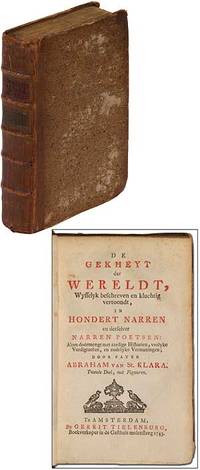
1743réf. 318179Amsterdam: Gerrit Tielenburg 1743. Hardcover. Very Good. Later edition but first by this publisher. Small octavo. Contemporary half-calf with red and green morocco spine labels gilt. 546 14pp. Engraved title Illustrated with engravings in text. Modest rubbing and wear to the extremities a handsome very good or better copy in contemporary binding. A compendium of jesters and fools. Part Two Only but apparently complete unto itself. OCLC locates a single copy of this edition in Tilburg. Gerrit Tielenburg hardcover books
1817réf. 619331817. Appeals of murder were abolished after this case. Appeals of murder were abolished after this case. "Diabolically Ravished Murdered And Thrown Into a Pit" Trial. Thornton Abraham c.1793-1860 Defendant. Horrible Rape and Murder!! The Affecting Case of Mary Ashford A Beautiful Young Virgin Who was Diabolically Ravished Murdered And Thrown Into a Pit As She Was Returning From a Dance; Including the Trial of Abraham Thornton For the Wilful Murder of the Said Mary Ashford; With the Whole of the Evidence Charge to the Jury &c. Tried at Warwick Assizes Before Mr. Justice Holroyd On the 8th of August 1817. Taken in Short Hand. To Which is Added Copious Elucidations of this Extraordinary Case; And a Correct Plan of the Spot Where the Rape and Murder were Committed &c. &c. London: Published by John Fairburn 1817. ii 60 columns 34 pp 64 1 pp. Several newspaper clippings concerning this case pasted to final leaf rear wrapper and verso of title page. Woodcut folding map of crime scene. Octavo 8-3/4" x 5-1/2". Stab-stitched pamphlet in printed wrappers untrimmed edges. Some soiling and edgewear spine and fold-lines of table reinforced fore-edge mended some toning to text. Early owner inscriptions to front wrapper "Bright" and "St John Crookes" and verso of map "St John Crookes/ Sunderland/ 1856". $950. "Third Edition." Abraham Thornton a bricklayer was accused of the rape and murder of Mary Ashford when she was found dead the morning after a dance where the two had been seen together. Thornton admitted that the two had been consensually intimate but denied the charges of rape and murder. Eyewitness accounts backed up his story and in the absence of other evidence he was acquitted of both charges. Public outcry around his acquittal led to Mary's brother William invoking an "appeal of murder." This uncommon legal practice allowed a retrial of a defendant acquitted for murder but crucially gave the defendant the right to trial by battle. Thornton invoked that right and was released after William Ashford declined the challenge. The case resulted in the abolition of appeals by murder and thus the end of trial by battle. Despite his protestations of innocence the public was thoroughly convinced of his guilt. Unable to lead a normal life Thornton moved to the United States and settled in Baltimore Maryland. One of the former owners of our copy may have been John Bright 1811-1889 a r. unknown books
1592réf. 273298Antwerp: Abraham Ortelius 1592. unbound. Map. Uncolored engraving. Sheet measures 16" x 21". This beautiful 1588 map by Abraham Ortelius depicts Holland or the Netherlands in exceptional detail. The map covers the regions near the Wadden Sea roughly covering modern day provinces of North Holland South Holland and Utrecht. The map centered on Amsterdam is oriented with north to the left. Topographical and geographical features such as mountains and cities are beautifully rendered in profile. The waters surrounding the region are shown with waves and include several illustrations of ships throughout. This is the first state of the map with later states showing a stippled sea rather than waves. Includes a large strapwork title cartouche scale of miles with a divider in the lower left. The Royal coat of arms is presented in the top left. The map also includes a 16-point compass rose. Ortelius based this map on the work of Jacob van Daventer. Published in the 1588 edition of Ortelius' famous "Theatrum Orbis Terrarum" which is historically considered the first modern atlas. Based on the text on verso only 300 copies of this particular edition were ever printed van der Broecke 79. The map is in good condition with minor wear along the original centerfold. Minor foxing at places. Original plate mark is visible. Latin text on verso. Abraham Ortelius 1527--1598 a Flemish cartographer and geographer is widely regarded as one of the important and influential cartographers in history. He is known for his "Theatrum Orbis Terrarum" which was the first modern atlas. Hard to find in black and white. Abraham Ortelius unknown books
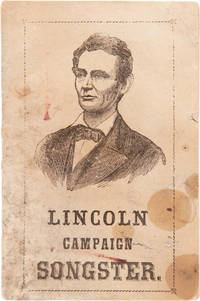
1864réf. 62679Philadelphia: Published by Mason & Co. 1864. Singing for Lincoln in '64 A pocket songster printed to support Lincoln's reelection campaign in 1864 featuring a rather youthful portrait of the president on the front wrapper and twelve spirited pro-Union songs. The titles largely military in theme include such works as "Give us Noble Leaders" "The Veteran Volunteer" "Cast Your Votes for Abraham" "For Lincoln or McClellan you'll be called on to decide/ The one to save the union the other to divide" and "We are Coming Father Abraham 600000 More." The advertisements on the rear wrapper encourage readers to purchase a wide variety of Lincoln campaign badges emblems pins and photographs from the publishers. Despite Lincoln's overwhelming electoral victory in 1864 the race was rather close in Pennsylvania where this was printed – Lincoln took Philadelphia County by a scant few percent and actually failed to secure a majority in neighboring Montgomery and Bucks counties. 16mo. Original pictorial wrappers. Wrappers soiled and stained. Largely clean internally. Advertisements on rear wrapper shaved slightly at outer edge as issued. Good plus. MONAGHAN 323. unknown books
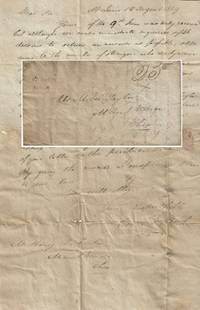
1819réf. 010456St. Louis Missouri 1819. Envelope or Cover. Very good. This stampless folded letter measures 7.5” x 12”. It is datelined “St. Louis 14 August 1819” and was sent to Moses Taylor at Mount Vernon Ohio in care of the towns postmaster Henry B. Curtis by Aaron T. Crane and Abraham Beck early St. Louis land agents whose business the Western Land Agency was located in the rear of the Bank of St. Louis at 58 South Main Street where Crane also served as the St. Louis Postmaster only the third since the position was established in 1808. The letter’s two-line typeset postmark was the earliest used in St. Louis and the Spink Shreve Auction #121 reports that only four examples are known to have survived. Taylor or Curtis for him apparently had asked Crane and Beck if they knew the whereabouts of a relative probably a son. It reads in part: “Yours . . . was duly received and we made immediate enquiries . . . to return an answer as soon aspossible still owing to the number of strangers who daily arrive & pass through this place we were unable to discover Mr. Taylor matching the name you provided. However a person answering your description by the name Moses Taylor a carpenter by trade is in this place. He is doing well & has been making some money & has good employment. We said nothing to Mr. Taylor yet. Yours Respectfully / Crane & A. Beck” . No online information is available about the Ohio Turners and little is known about Crane and Beck other than that Beck was the son of a New York physician and Crane had served as an army or militia captain during the War of 1812. For more information see Billon’s Annals of St. Louis in its Territorial Days Heritage Auctions Sale #3547 of 1 November 2017 and Horstman’s “William T. O’Hara Missouri Territorial Banker” in the “Missouri Paper Money Clip File” at Washington University Volume 1 of the American Stampless Cover Catalog and on-line genealogical records for Crane Beck and Curtis. An exceptionally scarce and important letter regarding life in early American St. Louis as the city was growing rapidly. The physical records for the Western Land Agency which have been microfilmed and digitized are held by the Library of Congress. At the time of listing only one other letter from Beck held by the St. Louis Mercantile Library at the University of Missouri in St. Louis and one document signed by Crane a 6-cent Post Office scrip note are known to have survived. . unknown books
1834réf. 35602Rochester Boston MA 1834. A collection of six letters ranging in size from 8-1/2" x 11" to 8-1/2" x 12-3/4" five complete and one partial letter. All in ink manuscript on unlined paper. Old folds light toning occasional light foxing two on untrimmed paper. Most are addressed on final blank page and have wax seal remnants with the usual tear where wax was torn open occasional loss to a few letters. Overall Very Good. Abraham Holmes was a Massachusetts legislator and attorney. Opposing ratification of the Constitution he was allied with the Anti-Federalist Otis family of Barnstable and Freeman family of Sandwich. He was an Anti-Federalist delegate from Rochester MA to the Massachusetts Ratifying Convention of 1788. He served as Sergeant in Capt. Barnabas Doty's company Col. Ebenezer Sproat's regiment during the Revolutionary War. He was admitted to the Plymouth County Bar in April 1800 at the age of forty-six. Though he had no formal legal education his admission to the Bar was permitted in consideration of his respectable official character learning and abilities and on the condition that he study three months in an attorney's office. He served as president of the Court of Sessions prior to his bar admission practiced law in Rochester until the early 1830s was a member of the State Constitutional Convention of 1820 and a member of the Executive Council from 1821 to 1823. Davis William T.: BENCH AND BAR OF THE COMMONWEALTH OF MASSACHUSETTS IN TWO VOLUMES VOLUME II. Boston: 1895. Page 235; Daughters of the American Revolution: LINEAGE BOOK VOLUME 12 1900 Page 15. William Baylies 1776-1865 and Francis Baylies 1783-1852 were brothers and partners in a Massachusetts law firm. William served as a U.S. Representative from Massachusetts in 1809 1813-1817 and 1833-1835; was a member of the Massachusetts House of Representatives from 1808-1809 1812-1813 and 1820-1821; and a member of the Massachusetts Senate from 1825-1826 and 1830-1831. Francis was a Congressman from 1821-1827; a member of the Massachusetts House of Representatives from 1827-1832 and in 1835; and the United States Charge d'Affaires Argentina in 1832. Holmes's Letters are as follows: 1 Letter to Francis Baylies Member of Congress dated at Boston January 19 1822. Holmes then member of the Massachusetts Executive Council awaits reports of the State legislative committees the incorporation of Boston "which will serve to procrastinate the session" the "suspense of the acceptance of office of the Judge of the Municipal Court" and issues such as criminal trials and the death sentence. "We pass our time here in Boston. the frequent application for appointments of both proper and improper candidates is rather an uncomfortable circumstance; but not so distressing as in affixing the time when convicts shall live no longer. to determine whether a convict shall die or not. It is probable we shall have the trial of both soon as there has been three capital convictions since I was here; one for murder and two for highway robbery. Those trials I attended; a Mr. Simmons formerly of Taunton as I am told managed the Defence; I can not record him as possessing great oratorical abilities but for integrity of arrangement and strength and argument perhaps no man of his years stands higher." Boston was incorporated March 4 1822 and the same year the Boston Police Court for criminal cases and Justice's Court for the County of Suffolk for civil claims were established. 2 Holmes's Letter to Francis Baylies dated at Boston March 28 1822. Holmes notes that the State legislative session is coming to a close. He anticipates orations which would "cause Tully to wish that he hadn't ever learned to speak; and all this for the good of the Nation." 3 Letter to William Baylies Counsellor at Law dated at Rochester MA October 24 1828 docketed October 25. An interesting three pages for lawyers anyway written in small yet legible hand on legal size paper. Holmes discusses with "great anxiety" and detail strategies and implications of the case entitled Rounseville Spooner versus Davis et ux. presentation of which had just concluded in the Massachusetts Supreme Court. Holmes and Baylies had represented Rounseville. Judge Wilde issued his decision on the following day October 25th. The case involved land in Fairhaven conveyed by Alden Spooner to Walter Spooner which later descended to Humphrey Davis's wife; but Alden Spooner later conveyed it again to Rounseville Spooner. What will be done in the case Holmes says "God only knows." Judge Wilde's Opinion reported at page 147 of Pickering's Reports Boston: 1830 gives the victory to Holmes and Baylies. 4 Letter to William Baylies Nov. 21 1828. Holmes discusses his excitement over a favorable verdict. "I rode into the yard. Mr. Bassett's son met me and informed me that the verdict of the jury was in favour of our client. Do you think I was sorry My heart jumped to my throat and with some difficulty I prevented my immortal spirit from bursting thro' the clay tenement. I am glad now that we did not use Joshua Vincent's Deposition for they would have objected and the point next word illegible for the Whole Court./ The next enquiry is Compensation. But I must stop with my hearty congratulations." Docketed on final page in part "Thomas v. D. & wife Nov. 21 1828." 5 Letter to William Baylies dated Rochester MA April 11 1834. A lengthy poignant letter discussing his advanced age and retirement. He no longer views political issues with the same interest; despite his overall good health he is troubled with lameness and currently lives with his son and his son's wife. "Some of my old customers are not willing to apply to anyone else." 6 Partial Letter to Francis Baylies December 1821. ". I dread the power of some of your colleagues. Mr. Saltonstall whose abilities are competent to make white and black synonymous terms I understand -which God forbid is strongly intrenched in a. Battery of Bankruptcy. unknown books
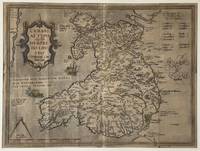
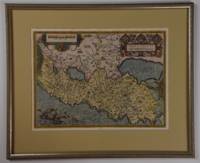
1580réf. 1396356c1580. Condition of map is Good with moderate age toning creasing and a small brown stain along right edge. Matted in metal frame measuring 24.25 in. x 19.75 in. . CW Consignment. Shelved at Rockville PS 1101 #25. Believed to be from Abraham Ortelius's "Theatrum Orbis Terrarum - Parergon - Nomenclator Ptolemaicus" published in Antwerp by Christoph Plantin Press 1579 1584. 1396356. Special Collections - Upstairs. unknown books
1917réf. 1143571917. First Edition. Signed. BERGER Samuel CAHAN Abraham. The Rise of David Levinsky. New York and London: Harper & Brothers 1917. Octavo original red cloth. $1100.First edition of Cahan's ""literary masterpiece"" a fascinating association copy inscribed by Jewish American Olympic medalist and heavyweight boxing champion Samuel Berger to Vaudeville actor and film producer Bobby North with Berger's inscription dated the year after publication ""To My Friend Bobby North Knowing that his knowledge and appreciation of the subject with which it deals will make this pleasurable reading Samuel Berger July 10 1918.""The Rise of David Levinsky is ""the first classic of Jewish American literatureÉ In it Cahan created one of the greatest characters of Jewish American fiction."" Born in a Lithuanian village Cahan fled pogroms to arrive in New York City in 1882. He became the ""great socialist leader of East Side Jewry a major spokesperson for the American Jewish community and the founder and for decades the editor-in-chief of the Jewish Daily Forward the most important Jewish newspaper in America"" Sternlicht Masterpieces of Jewish American Literature 17-23. ""The unrivalled record of a great historical experience the novel belongs not only in the genre of immigrant fiction but also among the best novels of American business"" John Higham. A ""literary masterpiece"" it tells the life of a ""Jewish boy from Russia who comes to America abandons his religious orthodoxy and plunges into the world of business only to find wealth but lose his soul"" Lipsky Rise of Abraham Cahan. Cahan infused the novel ""with his own fascination with the pitfalls and the possibilities of American life"" Sternlicht 20.As Mencken said of Cahan: ""It is a fine feat to write a first-rate novel but it is also a fine feat to steer a great newspaper from success to success in difficult times. He has done both"" ANB. First edition first issue: with code ""H-R"" on copyright page indicating publication in August 1917. With two rear leaves of publisher's ads. No known dust jacket. Serialized in 1913 in a much-abbreviated form in McClure Magazine. Bruccoli & Clark 83. Rideout Radical Novel 294. Hanna 556. This association copy contains a presentation inscription by the Jewish American athlete Samuel Berger who was ""the first Olympic Heavyweight Boxing Champion winning his gold medal at the 1904 St. Louis OlympiadÉ the first time boxing was included on the Olympic programÉ the 6'2""/200-pound heavyweight turned professional immediately after the Olympics but fought only two years"" Siegman International Jewish Sports Hall of Fame 49. His inscription is to Robert ""Bobby"" North who ""rose from the ranks of Vaudeville and the legitimate stage to be one of the film industry's leading producers in the 1930s responsible for many feature films at First National and Warner Brothers"" Slide Encyclopedia of Vaudeville 375. Prior to North's film career he was early described as a ""Jewish player"" who emerged ""from the East SideÉ and left Yiddish parlance to appear in English dramas"""" Theatre Vol. 28:156. Text very fresh mild rubbing to boards faint toning to spine of gilt-stamped cloth. A near-fine copy with a distinctive association. hardcover books
réf. CA01AA-00275Elm Press. Collectible - Very Good. Highland Park IL: Elm Press 1902. 12mo. 49pp. Limited to 110 copies. Very Good book. Fine printing and typography. essays printing typography Inquire if you need further information. Elm Press unknown books
1587réf. 239611Antwerp: Abraham Ortelius 1587. unbound. Map. Uncolored engraving. Image measures 14" x 19.5". These two maps on one sheet detail areas of western Mexico above and the Greater Antilles below. Ortelius created them from information compiled by other mapmakers such as Mercator Guttierez and Alsons de Sata Cruz. These sources allowed him to include a wealth of detailed information that is mostly if not entirely accurate. Above the map of western Mexico shows the area around Culiacan and the Spanish settlement of Villa S. Michaels which was notable in the period for its silver mines. It begins at the Yucatan and extends through the Cayman Magnus and the Caymanes. The map below illustrates the Greater Antilles including Cuba Hispaniola Jamaica St. Jois Insula St. Johns the Bahamas Virgin Islands and the Windward Islands all in impressive detail. The section of South Florida also shows suggestion of the Florida Keys which was uncommon for these period. A notable error is that the Tropic of Cancer is labelled as the Tropic of Capricorn. A highly decorative note with strapwork and foliage fills the acific Ocean to the left of Mexico and provides information about the upper map. The lower map also has a framed cartouche with birds perched atop it. Two ship illustrations float in the choppy seas around the islands. The map is a first state from the 1587 French edition of Ortelius's "Theatrum Orbis Terrarum." It is in good condition with no chips or tears. Stain at the center seam in the lower margin not affecting the image some overall stains. French text on verso. Abraham Ortelius 1527--1598 a Flemish cartographer and geographer is widely regarded as one of the important and influential cartographers in history. He is known for his "Theatrum Orbis Terrarum" which was the first modern atlas. This map is an uncommon uncolored example of this wonderful map by Ortelius. Abraham Ortelius unknown books
1598réf. 13293451598. A map of the Holy Land by Abraham Ortelius dated 1598 first issued in 1584 as a part of Theatrum Orbit Terrarium. In Very Good condition with age toning and a central crease. Matted but not framed. w 26.5 in. x h 22 in. Shelved at Rockville PS 1101 #25. Based on material collected by the Dutch Astronomer Peter Laicksteen who travelled to the Holy Land in 1556. Christian Sgrooten here written "Schrot" royal geographer to King Phillip II of Spain produced a nine-sheet map of Palestine in 1570 from Laikstain's information. This map was condensed into the present form by Abraham Ortelius. Ortelius the creator of the first modern atlas collected and edited maps from all over Europe for his book. Many of the original mapmakers rose to fame solely through Ortelius's decision to include their maps in his atlas. Laicksteen took thorough and accurate notes and the original Laicksteen and Sgrooten map contained improvements over earlier maps. For instance the River Kishon is here shown as flowing from the mountains near the Sea of Galilee not as was previously thought from the Sea of Galilee itself. However the Levantine coastline Sgrooten and Ortelius depicted is hardly recognizable to modern eyes. The map is replete with fanciful bays and peninsulas though some of the most recognizable features of the coastline such as the outcrops of land at Haifa and Beirut are absent. Ortelius had originally used another map of the Holy Land by cartographer Tilleman Stella in the early editions of the Theatrum Orbis Terrarum. It covered a far more extensive territory including part of Egypt and Syria. Oddly the coastline in this first map was much more accurate than in the Sgrooten map. Laicksteen and Sgrooten's original map included a small inset with an extended geography. However their mapping of the Dead Sea and surrounding areas was so controversial that Ortelius chose to leave out this region completely. The strange anecdote written in the Dead Sea is Ortelius's own addition. It describes how the Dead Sea was once a fertile valley but was transformed by an act of God into a barren sea to punish the wickedness of Sodom and Gomorrah. In the bottom left hand corner is a hand colored illustration of the story of Jonah. Above the luscious cartouche Ortelius has added three miniatures featuring the Crucifixion the Nativity and the Resurrection of Christ. The French text on the verso a long-winded description with little relevance to the map was changed to a more "reader-friendly" version shortly after the publication of this edition. 525 copies were made of this edition of Ortelius's map. 1329345. Special Collections - Upstairs. unknown books
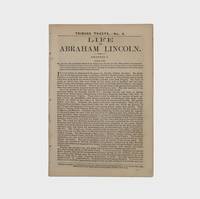
1860réf. 377692New York: Horace Greeley & Co 1860. 32pp. 8vo. Disbound. 32pp. 8vo. An early campaign biography of future president Abraham Lincoln written by John Locke Scripps of the New York Tribune. Scripps reports on the life of Abraham Lincoln in eight chapters touching on the major events of his life and career beginning with his early life and his move to Illinois through his transition from merchant to lawyer and legislator and covering his time in Congress with accounts of Lincoln's opposition to the Mexican-American War his support of the Wilmot Proviso and his involvement with the organization of the Republican Party. Wessen states that this edition was printed by Horace Greeley "from plates cast from the same type forms" as the 1860 Chicago edition which is considered the first published biography of Lincoln. An advertisement for the Tribune and the Tribune Almanac fills the bottom two thirds of the last page. "Most authentic of Lincoln campaign biographies" - Howes. Howes S247a "aa"; Managhan 79 note; Wessen Campaign Lifes of Abraham Lincoln 12 ref; Miles 418a; Abraham Lincoln: His Life in Print p. 85 Horace Greeley & Co unknown books
1865réf. 235590Boston: Oliver Ditson & Co 1865. First edition front wrapper without portrait of Lincoln appearing in later issues. Engraved title and piano score; 5 pp. 1 vols. Folio. Loose as issued; split along spine with some chipping to extremities. First edition front wrapper without portrait of Lincoln appearing in later issues. Engraved title and piano score; 5 pp. 1 vols. Folio. Donizetti died 17 years before Lincoln having gone mad from syphilis. His Funeral March gained a measure of recognition in America after it was performed during Lincoln's funeral ceremonies. It is a heavy solemn piece in a minor with droning octaves in the bass a haunting chromatic figure in the middle register and a lyrical upper voice. see Barret Sale Lot 693; Stern Collection of Lincolniana Oliver Ditson & Co unknown books
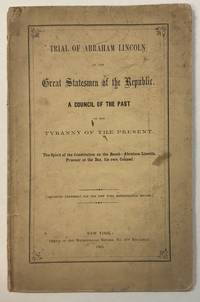
1863réf. 40887New York: Office of the Metropolitan Record 1863. Original printed wrappers. Stitched. 29 1 blank 1- advertisement for 'The Washington Despotism Dissected' 1 blank pp. Light wear and fox. About Very Good. The Metropolitan Record whose Prospectus is printed on the rear wrapper calls itself "an unswerving opponent of fanaticism in every form and an advocate of constitutional liberty and the rights of the citizens against despotic usurpation." This pamphlet is "A mock trial wherein Lincoln was charged with treasonable intent purposes and designs and of having committed among other unconstitutional acts the following: 'Declared War against Sovereign States under pretence of repossessing himself of certain forts and other property; arresting citizens without process of law; suppressed liberty of speech; stopped publication of certain newspapers; placed the military power above the civil power; overthrown State Sovereignty; forced unconstitutional acts through Congress.' At the conclusion of the trial the Court addressed the 'Criminal' as follows: 'You have been tried and found wanting. You have been given the opportunity of saving a nation but you have stabbed it to the heart. You have converted your country into a despotism'." Eberstadt. "Quotations from Lincoln and others selected to discredit his administration" Monaghan. A second edition was printed in 1867. Sabin Monaghan and LCP do not collate the advertisement at page 31. FIRST EDITION. 111 Eberstadt 332. Monaghan 252. Sabin 41234. LCP 10399. Office of the Metropolitan Record unknown books
1701réf. 33078Fulda 1701. Hardcover. fair. 4to. 185 leaves. Black cloth. Red edges. Illustrated title-page with Moses and Aaron on the sides and David killing Goliath at the bottom. Commentary on selections of the Zohar and other kabbalistic texts by Mordacai Ashkenazi published with the aid of his teacher Abraham Rovigo. These two kabbalists were both secret followers of the messianic claimant Sabbatai Sevi. Despite Sabbatai's conversion to Islam in 1666 and death in 1676 many of his followers continued to believe in him and worked to spread their particular heterodox brand of Judaism in defiance of the rabbinic establishment. As cover for his Sabbatian agenda Ashkenazi claimed that “Eshel Avraham” was simply a new interpretation of the Kabbalah based on his prophetic dreams. Ultimately this book is an important example of the success of the early eighteenth century Sabbatian underground to print books under the nose of the rabbinic authorities before it came out into the open with the printing of Nehemiah Hayon's “Migdal Oz.” Text in Hebrew. Backstrip missing but the book is still intact. Bottom corner chipped. Title-page torn and bottom strengthened. Slight worming to front leaves. Overall in fair condition. Steinschneider 4299:1. Samuel Wiener Bibliotheca Friedlandiana 991. hardcover books
1667réf. 1375442London: Francis Kirkman 1667. First Edition. Hardcover. Quarto 4 64 pages. In Good condition. Bound in 19th century half green leather with marbled paper boards spine with gilt lettering. With morderate rubbing and shelfwear middle of spine with a spot where spine is peeling away. Gutter opening at title page with lower section of text block detaching from spine. Ink math to title page I2 verso. E4 with large tear to upper fore corner some loss to text on verso. All leaves trimmed close with some minor occasional loss. With nine instances of single word ink marginalia some with matching underlining some partially trimmed away. With the bookplate of Richard Brinsley Sheridan to the front pastedown. His signature on the title page. Shelved case 0. ESTC R9308. Wing B445. Woodward & McManaway 8. Scarce with OCLC listing only 8 institutional copies of this state and no copies at auction since 1931. Another state of the edition with Thomas Dring named as publisher in imprint and with advertisement at bottom of A2v; this state lacks advertisement. Richard Brinsley Butler Sheridan 1751-1816 was an Anglo-Irish playwright writer and politician. He was the owner of the famed Theatre Royal Drury Lane in London and wrote several prominent plays including 'The Rivals' 'The Duenna' 'The School for Scandal' and 'A Trip to Scarborough.'. 1375442. Shelved Dupont Bookstore. Francis Kirkman hardcover books
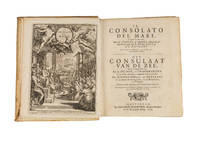
1723réf. 805501723. Amsterdam: Salomon Schouten 1723. Amsterdam: Salomon Schouten 1723. Bilingual Edition of an Important Maritime Code Consolato Del Mare. Westerveen Abraham d.1725 Translator. Il Consolato del Mare Nel Quale Si Comprendono Tutti Gli Statuti & Ordini Disposti da Gli Antichi Per Ogni Cosa di Mercantia & di Navigare. Cosi a Beneficio di Marinari Come di Mercanti & Patroni di Nave / Het Consulaat van de Zee Waar in Begreepen Zyn Alle de Keuren en Ordonnantien by de Ouden Gemaakt Aangaande Alderly Gevallen des Koophandels En Zeevaart. Amsterdam: By Salomon Schouten Boekverkooper In de St. Lucye-Steeg 1723. xxxii 533 1; 2 25 73 pp. Copperplate pictorial frontispiece dated 1704. Quarto 8-1/4" x 6-1/2"; 20.95 x 16.51 cm. Contemporary vellum later hand-lettered title to spine. Light soiling and rubbing to boards light scuff to front board spine darkened rear joint partially cracked corners bumped. Moderate toning to interior somewhat heavier in places faint dampstaining to head of text block above headlines faint spotting to sections of text. $1250. Second and final Dutch edition. Italian and Dutch on facing pages. The final section contains in the original Catalan Ordinacions de Tot Vexell qui Armara per Anar en Cors e de Tota Armada Ques Faca per Mar a code dealing with such subjects as piracy. A landmark in the development of maritime law the Consolato del Mare was first published in Barcelona in 1484. A digest of the law and practice commonly followed by the commercial judges in the chief ports around the Mediterranean it became a maritime common law of the Mediterranean and a foundation for subsequent European maritime laws and customs. Its circulation was widest in Italy especially among the Venetians but it was also influential in Western Europe. First published in 1704 Westerveen's translation appeared at a time when Holland was a dominant maritime power with interests in the Atlantic and Pacific worlds. Indeed his introduction and prefatory verse present Holland as the legitimate successor to the previous maritime leaders Spain and Italy. This is why it was time he argued to produce a translation for Dutch readers. The striking frontispiece in our edition by Pieter Sluiter Sluyter 1675-1713 features a large group of men in a classical setting who are acclaiming the Consolato which i. unknown books
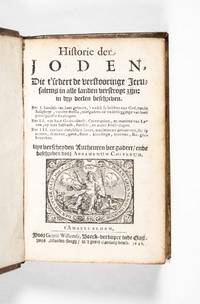
1649réf. 48861Amsterdam: For Gerrit Willemsz by Adriaan Roest 1649. Second edition. Hardcover. Very Good. Three parts small octavo. A-X8 168 leaves: G5 signed F5; I2 as H2; I4 as H4. 18 293 25 indexpp. Woodcut printer's device at title woodcut lettrines. Contemporary vellum with exposed thongs lightly soiled. Old entry at front pastedown. Occasional faint dampstain at bottom margin else a very good copy with clean text throughout. Second edition of this polemical history by "a strident condemner of the Jews" Sprunger. First published at Rotterdam by Jan van Waesberghe in 1608 the present work is the earliest reaction in print to the presence of Jews and their religion in the Dutch Republic van Rooden. Citing M. Bodian's Hebrews of the Portuguese Nation R. Po-Chia Hsia describes the cultural context: "Coming initially in the 1590s as Portuguese merchants and Christian converts the so-called 'New Christians' Sephardic Jews in fact were welcomed by the Regents of Holland but were strongly opposed by the Reformed clergy. When the conversos reverted to the open practice of Judaism reaction from the Reformed Church was fierce. The predikant Abraham Coster 1575-1620 attacked the Sephardim as an 'unclean people' who sought to build a public synagogue 'in which they can perform their evil and foolish ceremonies and spew forth their gross blasphemies against Christ and his holy gospels as well as their curses against the Christians and Christian authorities'". The present edition was later re-issued the following year with identical collation and pagination but designated as "Den 2den druck van nieuws oversien". References: R. Po-Chia Hsia "Introduction" & P. van Rooden "Jews and Religious Toleration in the Dutch Republic" in: Calvinism and Religious Toleration 3; 137. Sprunger Trumpets from the Tower 81. NNBW 8 320: "Dit werk is een poging om de Amsterdamsche vroedschap te bewegen het bouwen van een nieuwe openbare synagoge te beletten". For Gerrit Willemsz (by Adriaan Roest) hardcover books
1643réf. 178066Paris: Pierre Des-Hayes 1643. Hardcover. Good staining to boards and text block book plate inside front cover age toning throughout as expected with age. Text and illustrations are otherwise very clear!. Tan vellum boards with faded off-white title block on spine 8 28 pages 2 68 pages 34 unnumbered leaves of plates bw illustrations throughout. Text in French. The Universal Way of Mr. Desargues Lyonnois: To Lay The Axle & Place The Hours & Other Things on the Sun Dials. Added engraved illustrated title page special engraved title page with ornamental border following p. 28. The plates are mostly printed on both sides of the leaves and many appear multiple times final plate numbered '28'. Engravings by Abraham Bosse. Pierre Des-Hayes hardcover books
1686réf. 43445Nuremberg: Johann Georg Endter 1686. Linden Johannes Antonides van der 1609-64. Lindenius renovatus sive . . . de scriptis medicis libri duo . . . noviter praeter haec addita plurimorum authorum . . . a Georg. Abrah. Mercklino . . . 4to. 22 210 221-1101 55pp. Lacking Part II "Cynosura medica" approx. 170pp. containing Mercklin's subject index to Lindenius renovatus. Engraved frontispiece. Nuremberg: Endter 1686. 200 x 163 mm. Vellum ca. 1686 head of spine and hinges repaired. Occasional light foxing but fine. From the library of anthropologist Johann Friedrich Blumenbach 1752-1840 with booklabel bearing his autograph signature on the front pastedown and annotations and underlinings possibly his on at least 50 leaves. Modern bookplate of Gordon W. Jones M.D. First Edition of Georg Abraham Mercklin's considerably expanded version of van der Linden's bibliography of medicine. First published in 1637 Van der Linden's was the most complete medical bibliography of its time; it was also the most modern of early medical bibliographies both in its contents and format. Mercklin 1664-1702 supplied corrections biographical material on authors and additions that included the innovative listing of articles from the publications of learned societies. This copy is from the library of Johann Friedrich Blumenbach the founder of modern anthropology. He was the author of De generis humani varietate nativa 1775 in which he divided humanity into four races based on head shape skin color and hair type; he later added a fifth race and in the expanded third edition of De generis 1795 he introduced the famous terms "Caucasian Mongolian Ethiopian American and Malayan" to describe the "white yellow black red and brown" varieties of mankind. Brodman Development of Medical Bibliography pp. 29-33; no. 14. Fulton Great Medical Bibliographers pp. 35-36. . Johann Georg Endter unknown books
1899réf. 63536Cleburne TX: A. H. Yeager Publisher T. L. Sanders Printer 1899. First edition. 12mo. 129 pp. Autobiographical account of a Confederate soldier from Washington County Tennessee; Civil War experiences include his capture at Kennesaw Mountain in June 1864 his incarceration as a prisoner of war at Camp Douglas Illinois his journey home and after reflecting on his childhood in east Tennessee how he came to join an infantry company as the war began. Yeager 1842-1940 served with the 29th Tennessee Infantry until his capture; though not included here his post-Civil War years were spent first as a lawyer in Tennessee then as a newspaperman and farmer in Johnson County Texas. Not in Nevins Dornbusch Eicher Nicholson or Broadfoot. OCLC locates 23 copies but only one in Tennessee Knox County Public. Text pages a little toned but a very good copy. Original printed wrappers a little wear to the spine. 10020. A. H. Yeager, Publisher, T. L. Sanders, Printer unknown books
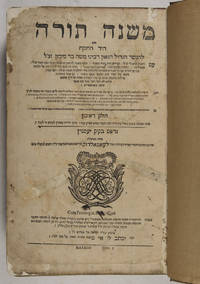
1739réf. 27896Jessnitz Saxony-Anhalt: Bi-defus Yisrael bar Avraham 1739. Hardcover. Good. Four volumes folio published between 1739 and 1742. Woodcut printer's device at titles; woodcut endpieces in first volume. Hebrew text opens from right to left; leaf numbers in Hebrew characters. Hebrew chronograms yield Jewish dates of publication 5499-5502. Brown library buckram scuffed at extremities spines lettered in gilt. Endleaves renewed. A good set. See foliation and condition notes for each volume below. Scarce eighteenth-century edition of this seminal compendium of Jewish law halakhah. Compiled between 1170 and 1180 while Maimonides was living in Egypt the Mishneh Torah is regarded as the author's magnum opus. It is the only Medieval-era work that surveys the full panoply of Jewish observance including those laws that are only applicable when the Jerusalem Temple is in existence. The present edition is the first to contain Judah Rosanes' commentary Mishneh le-melekh. "Mishneh Torah" The Repetition of the Law is an appellation originally applied to the biblical book of Deuteronomy; the subtitle "ha-Yad ha-Hazakah" The Book of the Strong Hand plays on its subdivision into fourteen books: the numerical value fourteen is represented in Hebrew letters as Yud 10 Dalet 4 which forms the word "yad" hand. Maimonides sought to provide a complete statement of the Oral Law so that a person who mastered first the Written Torah and then the Mishneh Torah would be in no need of any other book. Contemporary reaction was mixed with strong and immediate opposition focusing on the absence of sources and the belief that the work appeared to be intended to supersede study of the Talmud itself. Maimonides responded to these criticisms and the Mishneh Torah endures as an influential work in Jewish religious thought. According to several authorities a decision may not be rendered in opposition to a view of Maimonides even where he apparently militated against the sense of a Talmudic passage for in such cases the presumption was that the words of the Talmud were incorrectly interpreted. Likewise: One must follow Maimonides even when the latter opposed his teachers since he surely knew their views and if he decided against them he must have disapproved their interpretation. Vol. 1: 1 title 8 234 102 3 ff. Repairs at title page with very slight loss of text at verso following leaf and the final leaf. Text embrowned often heavily in first half with some light marginal dampstains throughout. Old manuscript entries in Hebrew at title in at least three hands. Vol. 2: 1 title 148 112 2 ff. Marginal repairs to first and last two leaves no loss of text. Moderately dampstained throughout with some mild embrowning. Old manuscript entries in Hebrew at title in at least two hands; three old stamps at title including at least one censor's approbation. Vol. 3: 1 title 221 169 ff. Repairs at bottom margin to title with loss of some text below imprint and at final lines of rabbinic approbations at verso and at bottom margin following leaf with some text loss and obscuration by translucent paper tape. Small marginal repair at final leaf. Light dampstaining in first half; remaining text with mild embrowning. Old manuscript entries in Hebrew at title in at least two hands; two old stamps at title including at least one censor's approbation. Vol. 4: 1 title 135 138-154 157 1 ff. Marginal repairs to title and final leaf no loss of text. Sporadic light embrowning and marginal stains. Old manuscript entry in Hebrew at title. A complete set with only minimal text loss in a few places -- a very usable scholar's copy. References: Vinograd Jessnitz 46; Fürst 2: p. 295; Zenker p. 583 Title in Hebrew: משנה תורה ×”×•× היד החזקה להנשר הגדול ×”×’×ון רבינו משה בר מימון זצ׳׳ל ×¢× השגת הר×ב׳׳ד זצ׳׳ל ופירוש הרב מגיד משנה וכסף משנה להג×ון המשביר רבינו יוסף ק×רו זצ׳׳ל ומגדל עוז והגהות מימונייות ופירוש רבינו עובדי והרב המוסמך מדר׳׳ל ן׳ חביב על הלכות קידוש החדש ×¢× כל הצורות השייכות להלכות ×לו ולהלכות שבת וסוכה ×•×¢× מורה ×ž×§×•× על דברי הרב המגיד וכסף משנה ×’× שתי מפתחות גדולות ורחבות ×חת על סדר ×”×¤×¨×§×™× ×•×חת על דרך ××œ×¤× ביתה ×œ× חסר דבר מכל כפי ×שר נדפס ב××ž×©×˜×¨×“× Rabbi Moses Maimonides the Rambam was a 12th century Jewish philosopher and halachic legal scholar. A highly controversial figure both during his lifetime and after his death he is generally acknowledged as the preeminent Jewish thinker of the Middle Ages. He was born in Córdoba Spain but fled as a child from the Almohad persecution. He eventually settled in Egypt where he served as a rabbi physician and philosopher. His fourteen-volume Mishneh Torah his only work not in Arabic still carries canonical authority particularly within the Yemenite Jewish community as the codification of Talmudic law. His other works include "Kitab al-Siraj" a commentary on the Mishnah "Kitab al-Fara'I" a book on precepts and the celebrated philosophical work "Dalalat al-Ha'irin" known in Hebrew as the "Moreh Nevukhim" The Guide to the Perplexed. In this latter work Maimonides attempted a philosophical/theological reconciliation of the Hebrew Bible and Greek knowledge. This work came to play a central role in all subsequent major controversies over philosophy within the Jewish community during the Middle Ages. Bi-defus Yisrael bar Avraham hardcover books
1866réf. 1009808vo one sheet printed on both sides. Even toning and aging small closed tear to the upper margin; otherwise very good. This is a rather scarce government document that informs the military that the "Thirteenth Amendment" has passed and slavery is officially abolished. Article XIII states "Neither slavery nor involuntary servitude except as a punishment for a crime whereby the party shall have been duly convicted shall exist within the United States or any place subject to their jurisdiction." This document is signed in type by William H. Seward 1801-1872 as the Secretary of State. Congress would follow with a Civil Rights Act of 1866 to give African Americans the same rights as all citizens but this small printed document presenting the essence of the "Thirteenth Amendment" is an important piece of history. ANB. books
1863réf. 22448.01New York N.Y. 1863. No binding. Fine. New York Journal of Commerce. Newspaper. New York Journal of Commerce. New York N.Y. January 3 1863. 4 pp. 24 x 32 1/2 in. An early report of the Emancipation Proclamation where the editors describe Lincoln's bold move as ""a farce coming in after a long tragedy.Most of the people regard it as a very foolish piece of business."" Historical BackgroundThe Emancipation Proclamation was the single most important act of Lincoln's presidency. Its text reveals the major themes of the Civil War: the importance of slavery to the war effort on both sides; the courting of border states; Lincoln's hopes that the rebellious states could somehow be convinced to reenter the Union; the role of black soldiers; Constitutional and popular constraints on emancipation; the place of African Americans in the United States and America's place in a worldwide movement toward the abolition of slavery. In sounding the death knell for slavery and the ""Slave power"" the President took a decisive stand on the most contentious issue in American history and the United States joined other western nations in embracing a future of free labor.In addition to the moral impact of this ""sincerely believed.act of justice"" the Proclamation aided the Union cause tangibly and decisively. Because it focused on territory still held by the Confederacy only small numbers of slaves compared to the total slave population were immediately freed. However the Proclamation deprived the South of essential labor by giving all slaves a reason to escape to Union lines. Failing that it freed slaves immediately upon the Union Army's occupation of Confederate territory. The Proclamation also encouraged the enlistment of black soldiers who made a crucial contribution to the Union war effort. Moreover England and France who had already abolished slavery were restrained from supporting the Confederacy which would have been in their own economic interests. Lincoln summed up the Proclamation's importance in 1864: ""no human power can subdue this rebellion without using the Emancipation lever as I have done.""Nonetheless the editors of the Journal of Commerce disagreed and their opinion reflects the truly controversial nature of the act for many contemporary Americans. books
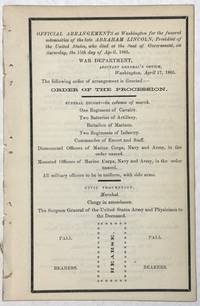
1865réf. 42319Washington D. C. 1865. Caption title as issued. War Department Adjutant General's Office. April 17 1865. Single leaf folded to 3 1 blank pp. Disbound separating at the spine old stitching holes. Printed mourning border with diagram of hearse and pallbearers. Signed in type at the bottom of page 3 by Assistant Adjutant General W.A. Nichols. Except as noted Very Good. This scarce document prints the official arrangements for Abraham Lincoln's Washington D.C. funeral. The program lists participating military units; names the Senate House Army and Navy participants in the procession; family relatives "The Delegations of the States of Illinois and Kentucky"; governmental officials from the President on down. A printed diagram displays the hearse and pallbearers. The procession's route is described beginning "precisely" at 2 o'clock P.M. on Wednesday April 19th after "conclusion of the religious services at the Executive Mansion." The procession began with the firing of guns from St. John's Church City Hall and the Capitol and the ringing of church bells throughout Washington Georgetown and Alexandria. Monaghan 654. OCLC 10408587 13 as of July 2026. unknown books