27.904 risultati
1979rif. 9005983Franklin Center: Franklin Library 1979. Hardcover. Fine Condition. The 100 Greatest Masterpieces of American Literature. Bound in the publisher's original green composition leather with the covers and spine stamped in gilt and with an oxblood leather spine label stamped in gilt. Three raised bands on the spine. All edges gilt. Silk moire end papers. Franklin Library hardcover books
1864rif. 23084New York: Sold at 13 Park Row and at all Democratic Newspaper Offices 1864. 8pp caption title disbound a bit of blank margin wear Good. At head of title: 'Document No. 12.' This Democratic Party campaign pamphlet portrays President Lincoln as an incompetent military strategist who perpetually "interfered with General McClellan both when he was general-in-chief and afterward when he commanded the brave Army of the Potomac." Worse Lincoln has "The Taint of Disunion." He not McClellan the Democratic presidential candidate supported the Jeffersonian right of revolution in a speech during his single term in Congress. He and other "ultra abolitionists" are the "original secessionists and disunion men." George McClellan wants the rebel States to return to the Union but Lincoln's policies render that impossible. Lincoln "regards the States as dead and gone. He magnifies and strengthens the position of the Richmond dynasty" by seeking to negotiate "only with Jefferson Davis." Monaghan 326. Not in LCP. Sold at 13 Park Row, and at all Democratic Newspaper Offices unknown books
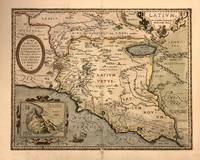
1603rif. 322945Antwerp: Abraham Ortelius 1603. Map. Engraving with beautiful hand coloring. Image measures 14" x 18". Beautiful 1603 map by Abraham Ortelius depicting Ancient Latium including Rome from his "Parergon". It covers Latium from the Tyrrhenian Sea to Umbria with parts of Tuscany and Campania. Cities are identified as individual buildings with particular focus on Rome its walls and notable buildings like the Coliseum. Notes mountains rivers marshlands and forests beautifully illustrated in profile. The map also includes historical and mythological elements such as a reference to Pliny in the Fucine Lake adding depth to the map's depiction of the region. Three cartouches adorn the map. The first is an ornate title cartouche in the upper right quadrant. Another is a dedication to Marcus Velser Augustanus. The third contains an inset of Mount Circeo the supposed dwelling place of the mythical goddess Circe who enchanted Odysseus and turned his companions into swine. This is the second state of the map identified by the addition of a network of roads around Rome and the designation of the swamp extended in the lower right along with the letters "VOLCI". The map is in good condition with some toning and minor abrasion loss near centerfold and verso repair near bottom margin. Van den Broecke #209. Abraham Ortelius 1527-1598 was a prominent Flemish cartographer geographer and cosmographer renowned for creating the first modern atlas "Theatrum Orbis Terrarum" which first appeared in 1570 and expanded over time to include 134 maps by 1592. Born in Antwerp he began his career as a map colorist and became a significant figure in cartography after being influenced by Gerard Mercator. His work was pivotal in the development of modern cartography integrating maps from various sources and reflecting his advanced geographical theories including early thoughts on continental drift. Appointed Royal Cartographer to King Philip II of Spain in 1575 Ortelius had access to extensive Spanish geographical knowledge. Despite the religious and political turmoil of his time he maintained a position of relative neutrality focusing on his scholarly and cartographic pursuits. His influential works also included "Synonymia Geographica" "Nomenclator Ptolemaicus" and "Parergon. Abraham Ortelius unknown books
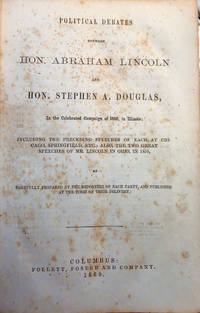
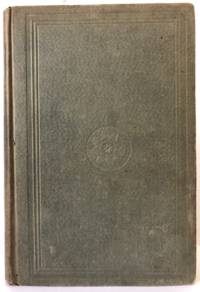
1860rif. 022510Columbus OH: Follett Foster and Company 1860. First Edition. Hardcover. Front endpaper lacking top third; pencil writing on front endpaper and blank as well as rear pastedown; light to moderate foxing heaviest to title page; gilt on spine a little dull but readable. Very Good. Early issue. Publisher's brown blindstamped cloth; iv - ads iv 268 pages. These public debates over slavery are perhaps the most consequential campaign debates in American history. The first speech in the volume is Lincoln's famous "House Divided" speech of 17 June 1858 in Springfield IL. HOWES L-338; NEW HOWES L 339 "b": "Historically the most important series of American political debates." Follett, Foster and Company hardcover books
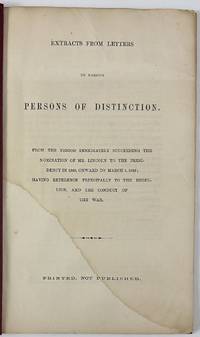
1863rif. 13393N.p.: Printed Not Published 1863. 48pp. Modern crimson wrappers. Large dampstain throughout first half of text text toned thereafter. Marginal pencil markings throughout including one notice of transposed lines on page 9. Overall good plus condition. A rare collection of letters by an anonymous author mostly sent to President Abraham Lincoln but also to Secretary of State William Seward Treasury Secretary Salmon Chase and other officials between October 25 1860 and February 19 1863. The author is a Unionist and a self-described "citizen" not a soldier though he has plenty to recommend to President Lincoln and others about how to prosecute the present war. He also refers to himself as "a cool observer outside the stifling atmosphere of Washington" though again he wastes no time in recommending actions and strategies for political and military improvements. The author was most certainly a political actor of some kind as he writes intimately and on friendly terms with Lincoln and others "You know my personal regard for you" to John J. Crittenden in early 1861. He writes long letters to his correspondents about a decidedly wide variety of issues including the future of slavery political intrigue the dissatisfaction of the public early in the war and more but mostly about troop levels troop movements officer appointments and other aspects and critiques of war strategy. A notable angle of the work is that the author's side of the correspondence and likely some of the return correspondence he mentions within the letters are possibly lost to history other than their presence here. The imprint reads simply "Printed Not Published" and does not include a place or date of publication. We have assumed the date of 1863 given the introductory note is dated March 8 1863. OCLC reports just six copies at Columbia the Huntington Library Harvard Brown the University of Chicago and the Abraham Lincoln Presidential Library. Printed, Not Published unknown books
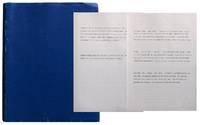
1897rif. 2411Tennessee; Kentucky 1897. Very good -. 91 11" x 8½" photocopied leaves typescript rectos only about 30000 words bound in three-hole vinyl folder. Folder very good minus with light edge wear and scuffing; remnant of penciled price to cover sheet else internally fresh with a few handwritten amendments. This is a rare and thrilling firsthand account of a soldier's experience in the Civil War transcribed by his sister's husband 30 years later from the "original copy removed from drowned body of Thomas Banta." Per the present cover page Abraham Thomas Banta was born in 1839 and "quit Bloomington University in Indiana to go to War." He died there in July 1863 "four months short of his twenty-fourth birthday." Banta's diary begins at Camp Zion Tennessee in January 1863 and soon sets the tone of his spirit: "God forbid that this war should continue any longer for it is the most degrading and demoralizing thing upon the people that ever disgraced God Almighty's green earth." Entries cover the weather general morale "portion of our boys on a high" tasks like horseshoeing guard duty and orders: "On drill as usual . . . We were ordered out here to hold the Yanks in check as they made Duke's regiment skedaddle and killed Col. Hutchison. The saddles are on our horses. The men are stretched around asleep; neither men nor horses have had anything to eat since morning . . . We may have to mount our horses at any moment." Detailed text describes the scenery camp life "one of the most irksome and burdensome yet one of the most lazy lives that mankind was ever subjected to" pickets payrolls and Banta's views on military strategy. We see his troop through Frankfort and Lexington Versailles Harrodsburg Knoxville and the capture of Elizabethtown "and several hundred prisoners." He laments the "demoralization and devastation" of "bright and intelligent youths" as well as the "cruel" effects of war on women and "the negro" - "Horrible is war in every respect!" The account goes until late June noting the perils of river crossing and terrible rain "very hard on soldiers in camp without tents." Banta perished soon thereafter. A thorough fascinating Civil War diary and incredible survival. No record was found of this account in OCLC or online. unknown books
1980rif. 008561San Francisco 1980. Hardcover. Fine. A History of Sinai Memorial Chapel in San Francisco. Chevra Kadisha - Its Meaning and Concern in Jewish Life. Octavo. 8 ¾ x 5 ½ inches. xvi 263pp. Black & white photographic illustrations. Blue cloth lettered in gilt. Front corners lightly bumped mild foxing to edge of text-block overall a fine copy. San Francisco n.d.- c.1980. Presumed first edition. In the mid-1800's in Northern California there often was no local society funeral home or even rabbi to bury Jews in accordance with Jewish traditions. Therefore Sinai Memorial Chapel opened in 1901 in San Francisco to fill this need. This book not only covers the history of the Chapel but continues on to discuss the various rules and laws in Judaism pertaining to the deceased as well as observances during wartime in regards to military burials. hardcover books
1836rif. 020572Halifax NS: Gossip and Coade Times Office 1836. First Edition. Hardcover. Light scattered foxing owner name on front endpaper some looseness of front cover with internal tape reinforcement. Overall Very Good. Small quarto 5-3/4" x 8-3/4" in original brown cloth rebacked with heavy brown binder's tape with most of the original spine label pasted on; xxxix 272 1 pages. Illustrated with a folding lithographic frontispiece "Parrsboro' From the Water 1836" a full-page lithograph "Cape Split 1836" and a hand-colored folding map "A New Map of Nova Scotia Cape Breton Prince Edward Island and part of New Brunswick" by C.H. Belcher with "Explanation of the Maps" bound in. Gossip and Coade, Times Office hardcover books
1860rif. 158491860. Lincoln Abraham. The Lincoln and Douglas Debates 1860 printed record of the seven public debates between Abraham Lincoln and Stephen A. Douglas during the 1858 Illinois Senate campaign a pivotal series of political confrontations over slavery and the future of the United States. The debates addressed the expansion of slavery into western territories and the constitutional implications of the Supreme Court's Dred Scott decision. Lincoln used the campaign to articulate a moral and political critique of slavery's expansion including the position he expressed in his earlier convention speech that "a house divided against itself cannot stand." Although Lincoln lost the Senate race to Douglas the debates established him as a leading national figure within the Republican Party and played a major role in shaping the political arguments that led to his presidential election in 1860. Lincoln Abraham. The Lincoln And Douglas Debates. A Political Debates between Hon. Abraham Lincoln and Hon. Stephen A. Douglas. In the Celebrated Campaign of 1858 in Illinois. Columbus: Follett Foster and Company 1860. First edition third issue identified by the numeral "2" on page 13 and the presence of the publisher's advertisement. Octavo volume containing 268 pages. Bound in publisher's original olive green textured cloth with blind stamped borders and spine lettered in gilt. The Lincoln Douglas debates represented one of the most influential series of political exchanges in nineteenth century American history addressing the central constitutional and moral questions surrounding slavery in the years immediately preceding the Civil War. Douglas defended the doctrine of popular sovereignty arguing that territories should decide the legality of slavery for themselves while Lincoln challenged the compatibility of that doctrine with the Dred Scott decision and emphasized the moral consequences of the institution. Although Douglas retained his Senate seat Lincoln's articulate presentation of the issues drew national attention and positioned him as a major political figure within the emerging Republican Party. Slight chipping to the head of the spine fading to boards and gilt minor damp staining with light foxing and toning consistent with age. Overall good condition. unknown books
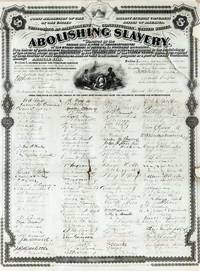
1868rif. 019219Chicago: Western Bank Note & Engraving Co. 1868. First Edition. Document. Recently backed with thin paper with several professional repairs of chips and tears. Very Good . Large folio 16-1/4" x 21-3/4" finely engraved and printed on good quality paper with elaborate decorative borders with a "US" monogram to upper corners a bold calligraphic heading with "ABOLISHING SLAVERY" in prominent decorated letters; at top center is a small vignette of the pyramid and all-seeing eye above an oval vignette of a slave family with child mourning over a cameo portrait of Lincoln. This is followed by the engraved signatures of President Lincoln Vice President Hamlin Schuyler Colfax and J. W. Forney Speaker and Secretary of the Senate and 164 Senators and Congressmen. An exceedingly rare and beautiful printing of the Thirteenth Amendment abolishing slavery: "Neither slavery nor involuntary servitude . Shall exist within the United States." This elaborately engraved Reconstruction-era broadside is based on the special "souvenir" copies on parchment signed by Lincoln and the others of which only a handful are known to have been made. The Thirteenth Amendment represents the first substantive change to how America interpreted those liberties guaranteed by the Bill of Rights since its ratification in 1791. The Emancipation Proclamation only freed the slaves in the openly rebellious states. The Amendment effectively put an end to slavery once and for all upon its passage on 1 February 1865. Western Bank Note & Engraving Co. unknown books
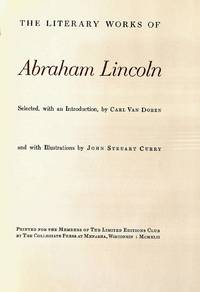
1942rif. 016635Menasha WI: Limited Editions Club 1942. hardcover. Mild soiling to the covers and light scratches to the leather spine label. Still Near Fine in a Very Good intact slipcase with some wear. John Steuart Curry. Quarto 7-1/2" x 10-3/4" bound in full butternut muslin with a gold-stamped reddish brown leather spine label 320 pages. Introduction and notes by Carl Van Doren; designed by Will Ransom. Illustrated with reproductions of watercolors by John Steuart Curry. Of a total edition of 1500 copies SIGNED by the artist on the colophon page this is one of only 15 Presentation Copies with the publisher's blindstamp attesting to such on the colophon page where instead of a number the initials "G.M." are handwritten. Acquired directly from the publisher's files and most likely the publisher George Macy's very own copy. An especially interesting copy in that it or at least its title page appears to have been used as a mock-up for the Heritage Press edition with a strip of camera-ready art with that publisher's name loosely present having once been glued over the Limited Editions Club imprint on the title page with a small stain at the place of contact. Limited Editions Club hardcover books
1979rif. 206760New York: Viking 1979. First. hardcover. fine/very good. Soyer Raphael. Translated by Rebecca S. Beagle and Rebecca Soyer Introduction by Peter S. Beagle. Illustrated by Raphael Soyer. 17 black & white illustrations. viii 70pp. 8vo cloth d.w.; lightly worn along top edge and corners. New York: Viking Press 1979. First edition. A fine copy in a very good dust jacket. Signed by the illustrator on the half-title. Viking unknown books
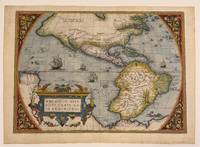
1570rif. 3381021570. unbound. Map. Engraving with hand coloring. Image measures 14 3/4" x 19 3/4" Archival frame measures 22 1/2" x 28" This stunning first state first Latin edition map by Abraham Ortelius depicts an early understanding of North and South America. At the time it was issued the coastal areas of the New World had been fairly well explored and Europeans were just beginning settlement and colonization. It is notable for depicting Spanish and Portuguese colonies in high detail for these powers were notoriously protective of their geographical surveys. As the first depiction of the Americas in an atlas this map is of fundamental importance. Abraham Ortelius 1527--1598 a Flemish cartographer and geographer is widely regarded as one of the important and influential cartographers in history. He is known for his "Theatrum Orbis Terrarum" which was the first modern atlas. van den Broecke 91 unknown books
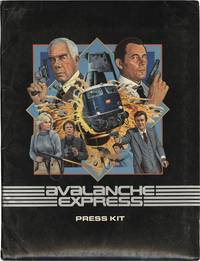
1979rif. 151152Los Angeles: Twentieth Century-Fox 1979. Vintage press kit for the 1979 film. Full-color illustrated pocketed folder containing eight black and white photographs housed in a brown paper envelope and ten gatherings of promotional reading material. A defecting Russian general collaborates with an American secret agent to expose KGB spies throughout Europe by luring them onto a train headed west. Director Mark Robson and actor Robert Shaw died of unrelated heart attacks within months of the film's release making the film a final effort for both. Set and shot on location in Germany England Ireland Italy and the US. Folder photographs and promotional material Near Fine. Twentieth Century-Fox unknown books
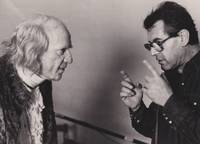
1984rif. 170406N.p.: N.p. 1984. Vintage borderless reference photograph from the 1984 film showing director Milo Forman talking with actor F. Murray Abraham on the set. Based on Peter Shaffer's 1979 play. A dramatization of the life of Wolfgang Amadeus Mozart as well as that of his jealous troubled rival Antonio Salieri. Nominated for eleven Academy Awards winning eight including Best Picture and Best Director. Set in Vienna shot on location in Prague Kromeriz and Vienna. 7 x 5 inches. Fine. National Film Registry. Ebert II. N.p. unknown books
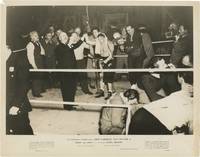
1947rif. 172445Beverly Hills CA: United Artists / Enterprise Sudios 1947. Two vintage studio still photographs from the 1947 film noir. One photograph with an Anglo Amalgamated Film Distributed Ltd. stamp on the recto bottom left corner. An amateur prize fighter's desire for fortune and fame leads him to join a corrupt boxing syndicate led by an unethical promoter. Shot on location in New York City. 8 x 10 inches. Very Good plus. Grant US. Olive Films 452. Selby US. Silver and Ward Classic Noir. Spicer US. United Artists / Enterprise Sudios unknown books
1979rif. 168017Los Angeles: Twentieth Century-Fox 1979. Vintage printed caricature for the 1979 film showing Lee Marvin Linda Evans and Robert Shaw drawn by noted caricaturist Al Hirschfeld and issued by Twentieth Century-Fox to publicize the film. A defecting Russian general collaborates with an American secret agent to expose KGB spies throughout Europe by luring them onto a train headed west. Director Mark Robson and actor Robert Shaw died of unrelated heart attacks within months of the film's release making the film a final effort for both. Set and shot on location in Germany England Ireland Italy and the US. 10 x 8 inches. Near Fine. Twentieth Century-Fox unknown books
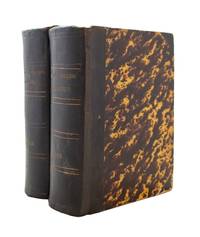
1863rif. 69520Washington D.C.: War Department 1863. CIVIL WAR. War Department General Orders 1863. Washington D.C.: War Department 1863. Full Description: LINCOLN Abraham. CIVIL WAR. Emancipation Proclamation War Department General Orders 1863. Washington D.C.: War Department 1863. The first War Department printing General Orders #1 Jan 2 1863 and fifth overall printing of the final Emancipation Proclamation. The 4 page pamphlet bound together with a nearly complete run of War Department general orders for the year 1863. Two octavo volumes 6 7/8 x 4 5/8 inches; 174 x 119 mm. Volume I comprising General Orders of the War Department Adjutant General's Office Numbers 1-221 2 January 1863 to 16 July 1863 and Volume II comprising Numbers 222-400 16 July 1863 to 28 December 1863. Nearly complete only lacking numbers 55 63 116-119 148 in volume I and 274 352 and 381 in volume II. With 5 copies of number 149 and and 3 copies of number 240. Contemporary half calf over marbled boards. Spine lettered in gilt. All edges speckled brown. Hinges repaired. Some rubbing to board edges. Previous owner's contemporary ink signature Bvt. Col. E.J. Wells on front paste down of each volume. Numerous annotations in the same old ink throughout generally noting when the order was received and dated 1863. Some glue marks to the General Order #1 not affecting text. A small tear to last leaf of text in volume I with no loss. Overall a very good copy. In addition to the very important first War department printing of the Emancipation Proclamation these volumes contain several other very important and interesting General Orders from the War Department as well as President Abraham Lincoln in relation to the military during this year in the Civil War. Notably: No. 100 April 24 "Instructions for the Government of Armies of the United States in the Field." "commonly known as the 'Lieber Code' after its main author Francis Franz Lieber. The Lieber Code set out rules of conduct during hostilities for Union soldiers throughout the U.S. Civil War. Even today it remains the basis of most regulations of the laws of war for the United States. The Lieber Code consists of 157 provisions that deal with a wide range of legal issues that must be considered in armed conflict. It contains general principles but also very detailed rules. Among the issues addressed are whether armed force is justified by military necessity the principle of humanity the distinction between combatants and civilians POW status retaliation and permissible methods and means of warfare." LOC" No. 143 May 22 the establishment of the United States Colored Troops. This authorized the establishment of a bureau regulating the recruitment training and organization of the U.S. Army's first regiments composed entirely of African-American soldiers. Numerous court cases are documented including #17- The sentenced hanging death of a "colored man" for "attempted rape". #346- The trial of George Woolfolk for "Being secretly within lines of the US forces as the same time belonging to the so-called Confederate Army." He was sentenced to be shot to death. And #396- The trial brought by Colonel John Gault against Dr. Aaron James for "Being the captain of a band of guerillas or marauders and shooting at US soldiers." He was sentenced to death but the President disapproved the sentence and directed him to be released. A number of orders of Military discharges both honorable and dishonorable as well as military promotions. #337 announces "Major General U.S. Grant U.S. Army is placed in command of the Military Division of the Mississippi Headquarters in the field." #349 announces "Major General William T. Sherman is appointed to the command of the Department and Army of the Tennessee Headquarters in the field." #194 is the appointment of Major General George Meade as commander of the Army of the Potomac who would defeat General Robert E. Lee at Gettysburg only days later. And #398 honors Ulysses S. Grant for his Mississippi River campaign and presents him a gold medal. Numerous obituaries including #71 which announces the death of Major General E.V. Sumner who fell ill and died on his way to take command of the Department of the Missouri and directs the ways that Department should give him military honors. Important presidential proclamations including #58- Calling to all soldiers who were "absent without leave" urging them to return to their regiments and would not face punishment beside loss of wages for time missed. #252- Orders regarding the treatment of prisoners of war stating that 'if the enemy shall sell or enslave anyone because of his color the offence shall be punished by retaliation upon the enemy's prisoners in our possession'. "President Abraham Lincoln issued an 'eye-for-eye' order warning the Confederacy that Union soldiers would shoot a rebel prisoner for every Black prisoner shot. It also would condemn a rebel prisoner to a life of hard labor for every Black prisoner sold into slavery. AA Registry. #315- Lincoln's suspension of the "writ of habeas corpus." "The doctrine of habeas corpus is the right of any person under arrest to appear in person before the court to ensure that they have not been falsely accused. Lincoln's suspension of the "writ of habeas corpus" was one of the most controversial acts of his administrations. Lincoln defended himself against charges that his administration had subverted the Constitution however arguing that acts that might be illegal in peacetime might be necessary "in cases of rebellion" when the nation's survival was at stake." The Gilder Lehrman Institute of American History. #340- Proclamation by the President calling for three hundred thousand volunteers. "Whereas the term of service of a part of the volunteer forces of the United States will expire during the coming year; and Whereas in addition to the men raised by the present draft it is deemed expedient to call out 300000 volunteers to serve for three years or the war not however. exceeding three years." And numerous other General Orders pertaining to soldiers and the war effort including #35- A list of items that could be sold to soliders by sutlers. #40- The establishment of a Volunteer force for Kentucky. #163- "A resolution to encourage the enlistments in the Regular Army and Volunteer forces." #323- which authorized each enlisted cook "two under-cooks of African descent who shall receive for their full compensation ten dollars per month and one ration per day." #351- This discusses the governance of "The Employment of women nurses in the U.S. General Hospitals." and #364 which discusses the cos of clothing and camp for the U.S. Army and includes a folding chart. Eberstadt 12. Grolier 100 American 71. Streeter 1751. HBS 69520. $7500. War Department unknown books
1977rif. 167653Los Angeles: Samuel L. Bronkowitz 1977. Two vintage lobby cards from the French release of the 1977 film advertising it under both its US title "Kentucky Fried Movie" and its French title "Hamburger Film Sandwich". Written by and starring the Zucker brothers the duo who would eventually pen similarly irreverent comedy hits like "Airplane!" 1980 "Top Secret!" 1984 and "The Naked Gun" series. John Landis' second film as director and the film which would lead him to direct "National Lampoon's Animal House" 1978 at the suggestion of several cast members. Shot on location throughout California. Black-and-white printed on red stock. 8.25 x 11 inches. Fine. Samuel L. Bronkowitz unknown books
1863rif. 69186Boston: Boston Daily Courier 1863. Full Description: LINCOLN Abraham. Emancipation Proclamation."President's Proclamation. Emancipation of Slaves in Rebellious States." Boston. Published in: Boston Daily Courier Volume LXXVIII no. 2. Friday Morning January 2 1863. The publication of Lincoln's Emancipation Proclamation in the Boston Daily Courier and one of if not the first official public announcements of the Final Emancipation Proclamation once it was signed and in effect as of January 1 1863. The Proclamation is featured at the top of the center column of page 3. We could find no other copies of this or any other January 2nd edition at auction and it is not mentioned in Eberstadt. Eberstadt's entry for the second edition of the "Final Proclamation" Eberstadt 9 states "Second edition. Apparently the only separate newspaper edition of the final proclamation and the earliest non-official edition. Printed on Friday evening January 2 1863 this Extra in point of chronological sequence was preceded only by the first official edition." Our present copy although not a separate newspaper edition was rushed to press and published in the Friday Morning edition of the Courier placing it's publication prior to Eberstadt 9. According to Eberstadt "A number of newspapers did not issue on January 2nd because of the previous day's holiday but most of those that did carried the final proclamation. Many of the others printed it on January 3rd." pg. 17. Broadsheet folio one large leaf folded along side to make four pages two leaves printed on recto and verso. Seven-column format. 26 x 19 inches; 655 x 490 mm. Light creases down the middle in both directions. A few minor closed tears. A large old ink signature along top margin of front page causing some bleed-through and foxing but not affecting text. Still a very good copy of this important declaration. Abraham Lincoln issued the preliminary Emancipation Proclamation on September 22 1862 stating that if the rebelling states did not cease fighting and rejoin the Union by January 1 1863 the slaves in those states would be set free. Once January 1st 1863 arrived President Lincoln signs and issues the final Emancipation Proclamation freeing the slaves in the Confederate states. The Boston Courier issued this early printing of Lincoln's Proclamation the very next morning January 2 1863. " HBS 69186. $8500. Boston Daily Courier unknown books
1987rif. 153170N.p.: N.p. 1987. First Draft script for an unproduced film. The white heir to a substantial fortune wakes up one day to discover that his skin has rapidly darkened leading his family to mistake him for an African American and subsequently disown him. Red titled wrappers with credits for screenwriter Abraham Eban. Title page present dated August 1987 noted as First Draft with credits for screenwriter Abraham Eban. 123 leaves with last page of text numbered 123. Xerographic duplication rectos only. Pages Near Fine wrapper Near Fine black tape binding. N.p. unknown books
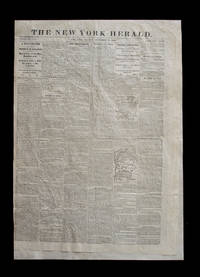
1862rif. 68870New York: The New York Herald 1862. Full Description: LINCOLN Abraham. Emancipation Proclamation."A Proclamation by the President of the United States. Operations of the Confiscation Act. All Slaves in States in Rebellion January 1 1863 to Be Free." New York. Published in: The New York Herald Tuesday September 23 1862. Whole No. 9506. The publication of Lincoln's Emancipation Proclamation in James Gordon Bennett's pro-Democratic New York Herald and one of if not the first official public announcements of the preliminary Emancipation Proclamation. Broadsheet folio one large leaf folded along top to make four pages two leaves printed on recto and verso. Six-column format. 22 x 15 1/2 inches; 560 x 395 mm. Light creases down the middle in both directions. Some nearly invisible repaird along top margin and edges. Some of the repairs just touching a few letters in the headline. Still a very good copy of this important declaration. We could only find 3 copies of this at auction and it is not mentioned in Eberstadt. Eberstadt mentions that his Third edition of the Emancipation has a publication date somewhere between September 24th and 26th therefore putting the current copy before this. Eberstadt's first and second edition are the official state department editions printed the day of the declaration September 22nd just the day before this New York Herald was printed. Abraham Lincoln issued the preliminary Emancipation Proclamation on September 22 1862 stating that if the rebelling states did not cease fighting and rejoin the Union by January 1 1863 the slaves in those states would be set free. The New York Herald issued this front-page top left corner early printing of Lincoln's Proclamation the very next day appearing under the headline: "All Slaves in States of Rebellion January 1 1863 to Be Free." "Lincoln read the first draft of what came to be known as the Preliminary Emancipation Proclamation to his cabinet on 22 July 1862. Given the criticism directed at Lincoln for moving too slowly on the issue of emancipation it is worth noting that this first reading took place just sixteen months after he had pledged not to 'interfere with the institution of slavery in the States where it exists.' He continued to revise the document throughout the summer and following the Union victory at Antietam he issued the preliminary proclamation-which managed to balance daring with prudence-on 22 September. This first proclamation essentially gave the Rebel States one hundred days to return to the Union after which period any slaves within their borders would be "then thenceforward and forever free." Any rebellious states that returned to the Union in the interim would be able to adopt immediate or gradual-and compensated-abolition of slavery within their borders." Sotheby's. The front page of this newspaper also contains two maps and reports of the campaigns in Kentucky. HBS 68870. $3500. The New York Herald unknown books
1947rif. 157481N.p.: N.p. 1947. Vintage reference photograph from the 1947 film noir. An amateur prizefighter's desire for fortune and fame leads him to join a corrupt boxing syndicate led by an unethical promoter. Widely considered one of the finest boxing films ever made with a strong screenplay by noted screenwriter Abraham Polonsky who would later face blacklisting in Hollywood as a result of the HUAC trials. 10 x 8 inches. Near Fine. Grant US. Olive Films 452. Selby US. Silver and Ward Classic Noir. Spicer US. N.p. unknown books
1947rif. 156219N.p.: N.p. 1947. Vintage reference photograph from the 1947 film showing actress Marlene Dietrich playing the zither. Stamp of photographer Whitey Schafer on the verso. Based on the 1946 novel by Jolán Földes about a British soldier who escapes from the Gestapo during World War II by posing as a gypsy. Shot on location in Bend and Corbett Oregon. 8 x 10 inches. Near Fine. N.p. unknown books
1877rif. 726891877. A Distinguished California Jurist's Manuscript Register of Legal Proceedings During the Constitutional Reform Era 1877-1880 Manuscript. California. Freeman Abraham Clark 1843-1911. Register of Actions and Proceedings. Sacramento County California 1877-1880. Folio 13" x 7-3/4"; 33 x 19.7 cm. 244 pp. Manuscript in a single highly legible cursive hand. Contemporary three-quarter sheep over marbled boards gilt fillets to spine marbled edges. Contemporary manuscript title "Register of Actions and Proceedings" to front pastedown. Light rubbing and minor scuffs to boards dampstain to rear board heavier rubbing to extremities with minor wear to spine ends and corners chip to foot of spine. Joints starting slightly at head hinges tender but holding. Slight offsetting to corners of first two leaves. Light toning to interior occasional light foxing and minor spots and stains. Several related contemporary documents tipped or laid in. Good to very good. $3500. An extensive manuscript register documenting the private legal practice of Abraham Clark Freeman one of California's most distinguished nineteenth-century lawyers legal authors and constitutional reformers during the years surrounding the state's Constitutional Convention of 1878-1879. Freeman arrived in California from Illinois in 1861 and was admitted to the bar in 1864. He achieved national prominence with his Treatise on the Law of Judgments 1873 described in an early history of Sacramento County as the first legal treatise of national scope written or published in California. Its exceptional reception helped establish California's reputation as a center of American legal scholarship. Freeman subsequently became an influential editor of American case-law reports assuming the editorship of American Decisions in 1879. The present register covers a particularly significant period in Freeman's career and California's constitutional development. Freeman served as a delegate to the Constitutional Convention of 1878-1879 which drafted the state's second constitution amid intense controversies over railroad monopolies corporate power taxation labor relations and political representation. Ratified in 1879 the new constitution substantially reorganized the state's legal and political institutions. Freeman also served on a commission charged. unknown books