Lincoln, AbrahamABAA
27 901 résultats
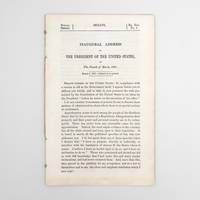
1861réf. 377680Washington D.C.: Government Printing Office 1861. Special Session Senate Ex. Doc. No. 1. 10pp. 8vo. Disbound. Housed in a cloth box. Special Session Senate Ex. Doc. No. 1. 10pp. 8vo. Lincoln began drafting his first inaugural in Springfield soon after his election hoping the speech would impart a spirit of reconciliation toward the seceded states. His speech balances his pledge to protect Federal property in the south while insisting that he would not use military force unless attacked first. In all he eloquently argues against secession presenting the United States as undissolvable. Lincoln ends his speech with the memorable lines: "We are not enemies but friends. We must not be enemies. Though passion may have strained it must not break our bonds of affection. The mystic chords of memory stretching from every battle-field and patriot grave to every living heart and hearth-stone all over this broad land will yet swell the chorus of the Union when again touched as surely they will be by the better angels of our nature." "Lincoln became President on March 4 1861. Before being sworn in he gave his First Inaugural Address devoting it entirely to the secession crisis. It was the linguistic equivalent of an optical illusion: one could view it two ways. As historians have noted he seemed to placate the South; he would not 'interfere with the institution of slavery in the States where it exists.' This language was the old Lincoln . The new Lincoln was a resolute executive who had no choice but to enforce the Constitution a contract that does not allow states to withdraw from it unilaterally. In his enforcement there would be no bloodshed 'unless it be forced upon the national authority" Mazy Boroujerdi editor Abraham Lincoln: His Life in Print p. 108. Lincoln had begun writing his inaugural the month prior before leaving Springfield and once in Washington asked William Seward to review the draft. It was Seward who suggested softening the tone so as not to appear too inflammatory suggesting "a nostalgic call for unity emphasizing the country's shared history. Lincoln embraced the idea but massaged it into near poetry. Seward's prosaic text ended up as Lincoln's oft quoted appeals to the 'mystic chords of memory' and 'the better angels of our nature.' The words did nothing to reverse disunion" Ibid. p. 97. This is the official government printing of Lincoln's first inaugural address issued as a document of a special session of the Senate printed by their order four days after its delivery being only the second printing overall of the memorable speech. Monaghan 102; Abraham Lincoln: His Life in Print p. 108 [Government Printing Office] unknown books
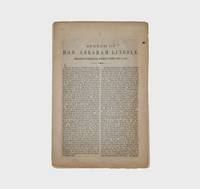
1858réf. 376861Springfield IL 1858. 8pp. printed in double columns. 8vo. Unbound. Minor toning. Housed in a cloth box. 8pp. printed in double columns. 8vo. The only separate printing of this address given by Lincoln at Springfield Illinois. Lincoln's speech which preceded his debates with Douglas puts forth the great themes that marked his political philosophy during the last ten years of his life. More importantly it firmly placed Lincoln as against the expansion of slavery and Douglas on the opposite side of the issue. By targeting Douglas a strategy that resurrected Lincoln's political career he made his fellow Illinoisan out to be the embodiment of the wicked forces safeguarding slavery's expansion . This speech is Lincoln's opening salvo against Douglas for the 1858 senate campaign: 'Free men of Illinois - free men of everywhere - judge ye between him and me'" Abraham Lincoln: His Life in Print p. 67 Urging that slavery be placed on course for "ultimate extinction" he repeats his "House Divided" warning first given at the State Republican Convention a month earlier. He insists that the Kansas-Nebraska bill was "the beginning of a conspiracy" to nationalize slavery. Attacking Douglas and defending himself against the charge that he would "invite a war of sections" he stands on "the principles of our Declaration of Independence." Though African Americans are not the equal of whites "in all respects" the Declaration "does mean to declare that all men are equal in some respects; they are equal in the right to 'life liberty and the pursuit of happiness.'" Most significantly "In the right to put into his mouth the bread that his own hands have earned he is the equal of every other man white or black." A scarce Lincoln speech. Monaghan 12; Byrd 2960 unknown books
1866réf. 375831Washington D.C.: John H. Littlefield; Wm. Terry Printer 1866. Photograph by John Goldin of Littlefield's painting on printed mount. Image 5 x 9 1/2 in.; mounted to 11 x 14 in. Faint toning to mount; fine. Photograph by John Goldin of Littlefield's painting on printed mount. Image 5 x 9 1/2 in.; mounted to 11 x 14 in. A published photograph of Littlefield's hyper-realistic Lincoln death-bed painting each figure meticulously rendered from photographs. Littlefield studied law under Lincoln in 1858 stumped for him in his Presidential bid and was rewarded with a position in the Treasury Department. After Lincoln's death Littlefield invented this tableau of twenty-five people ranged around the death-bed including Vice-President Johnson Surgeon Charles Leale and Mrs. Lincoln. "The artist used photographs as models for the twenty-five people gathered in the death room but his profile of the dying Lincoln shows a first-hand acquaintance" Ostendorf LINCOLN'S PHOTOGRAPHS p. 279. John H. Littlefield; Wm. Terry, Printer unknown books
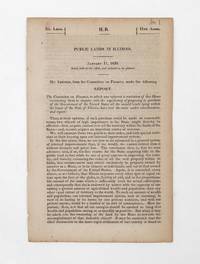
1839réf. 373003Vandalia Illinois 1839. First edition. 3 1pp. 8vo. Disbound. Housed in a morocco backed slipcase. First edition. 3 1pp. 8vo. Abraham Lincoln had yet to join the bar when he began his first stint in politics in the Illinois legislature in 1834 serving four consecutive terms in the Assembly through 1841. "This rare printing has the prestige of being the first occurrence of Lincoln's name as the sole author of a work. As a Whig lawmaker he was devoted to his party's program of public works through government financing. After the Panic of 18376 the spending he had advocated for had resulted in massive state debts. To relieve the budgetary burden Lincoln proposed that Illinois acquire land within its borders which the federal government still possessed and then sell the land at a fourfold profit to settlers and speculators resulting in both increased revenues and self-determined land ownership" Boroujerdi. Very rarethoma. Monaghan 1; Boroujerdi et. al. Abraham Lincoln: His Life in Print p. 29 unknown books
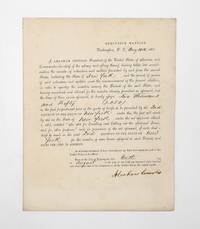
1863réf. 373004Washington D.C. 1863. 1p. plus integral blank. 4to 9-3/4x7-3/4 inches. Minor smudging to signature. Housed in a blue full morocco box. 1p. plus integral blank. 4to 9-3/4x7-3/4 inches. The first military draft in U.S. history was passed by Congress in early 1863 and signed into law by President Abraham Lincoln in March of that year. The Enrollment Act or Civil War Military Draft Act required the enrollment of every male citizen between twenty and forty-five years of age as well as those immigrants who had filed for citizenship unless exempted by the Act. It set enlistment quotas for each state and required states to draft men if they did not meet their enlistment quotas through volunteers. It also included the policies of substitution furnishing a suitable substitute to take the draftee's place and commutation paying $300 to avoid the draft which led to substantial resentment among working-class citizens not wealthy enough to pay their way out of service. Only July 13 during the draft lottery in New York City a riot broke out leading to three days of violence and destruction. Although initially focused on the draft the protests subsequently devolved into vicious race riots. The rioters were largely white and in the wake of the Emancipation Proclamation claimed to fear that freed enslaved men would migrate to the city and take their jobs. Since Blacks were exempted from the draft the Draft Act only heightened fears of Black migration to the city. The violence against the Black community in New York as well as against abolitionists was substantial: the death toll reached upwards of 120 and numerous homes and churches were burned. Since most of the New York State Militia was fighting with Union troops at Gettysburg the New York Police Department was the only force on hand to deal with the rioters initially and they were badly outnumbered and underequipped. By day four of the riots five New York Militia units had reached the city along with the 26th Michigan Volunteers and the 27th Indiana Volunteers and were able to start restoring order. Eventually there were several thousand troops in the city and they brutally put down the remaining rioters. Almost immediately calls came to suspend the draft in New York most notably by Horatio Seymour the Governor of New York who wrote to Lincoln several times in the weeks which followed arguing against the constitutionality of the draft and the inequity in its application. Lincoln replied on August 7 refusing to acquiesce to Seymour's demands writing: "I shall direct the draft to proceed in all the Districts drawing however at first from each of the four Districts towit: the second fourth sixth and eighth . I do not object to abide a decision of the United States Supreme Court or of the judges thereof on the constitutionality of the draft law. In fact I should be willing to facilitate the obtaining of it; but I can not consent to lose the time while it is being obtained. We are contending with an enemy who as I understand drives every able bodied man he can reach into his ranks very much as a butcher drives bullocks into a slaughter-pen. No time is wasted no argument is used. This produces an army which will soon turn upon our now victorious soldiers already in the field if they shall not be sustained by recruits as they should be. It produces an army with a rapidity not to be matched on our side if we first waste time to re-experiment with the volunteer system already deemed by congress and palpably in fact so far exhausted as to be inadequate; and then more time to obtain a court decision as to whether a law is constitutional which requires a part of those not now in the service to go to the aid of those who are already in it; and still more time to determine with absolute certainty that we get those who are to go in the precisely legal proportion to those who are not to go. My purpose is to be in my action just and constitutional; and yet practical in performing the important duty with which I am charged of maintaining the unity and the free principles of our common country" Collected Works of Abraham Lincoln Vol. 6. Three days later on August 10 Lincoln signed the present order to resume the draft in the Second Congressional district of New York the western portion of Long Island primarily Nassau County and part of Queens County. This is the first draft order following his refusal to Governor Seymour to suspend the draft in the New York City area. In full manuscript accomplishments in brackets: "I Abraham Lincoln President of the United States of America and Commander-in-chief of the Army and Navy thereof having taken into consideration the number of volunteers and militia furnished by and from the several States including the State New York and the period of service of said volunteers and militia since the commencement of the present rebellion in order to equalize the numbers among the Districts of the said States and having considered and allowed for the number already furnished as aforesaid and the time of their service aforesaid do hereby assign Two Thousand and Fifty 2050 as the first proportional part of the quota of troops to be furnished by the 2ndDistrict of the State of New York under this the first call made by me on the State of New York under the act approved March 3 1863 entitled 'An Act for Enrolling and Calling our the National Forces and for other purposes' and in pursuance of the act aforesaid I order that a draft be made in the said 2nd District of the State of New York for the number of men herein assigned to said District." On the same day as this order Lincoln would meet with Frederick Douglass at the White House to discuss his traveling through the south to recruit former slaves to fight for the Union. An extraordinary Lincoln document at a turning point moment in the Civil War. unknown books
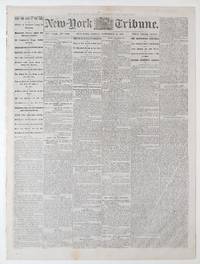
1863réf. 372898New York 1863. 8pp. printed in six columns on a single folded sheet. Large folio. Disbound. Natural paper flaw to first leaf not affecting text of the Gettysburg Address. Cloth portfolio. 8pp. printed in six columns on a single folded sheet. Large folio. The complete issue of the New-York Tribune printing the Gettysburg Address on the morning of Nov. 20 1863 the first possible date of the speech's printing. The previous day Lincoln delivered his great address at the dedication of a cemetery on the Gettysburg battlefield four months after the bloody and pivotal battle that turned the tide of the Civil War in favor of the Union. Lincoln's speech was preceded by an address from Edward Everett the most famous orator of his day. Everett's speech took between ninety minutes and two hours to deliver and today is largely forgotten. Lincoln's speech delivered in only a few minutes stands as a supreme distillation of American values and of the sacrifices necessary for the survival of liberty and freedom. Much controversy surrounds the circumstances and content of the address as it was actually delivered at Gettysburg. The words spoken in the speech differ in the versions appearing in newspapers and the text which appeared in Washington several days later published as The Gettysburg Solemnities and known in only four copies which is now taken as the closest version to Lincoln's final intent because of its correspondence to the known manuscript versions. Interestingly and according to Carbonell the text of the first appearance of the speech in book form published a few days later as An Oration Delivered on the Battlefield of Gettysburg is taken largely from this New York Tribune printing. As it appears here the address corresponds closely to the transcription printed in the same day's edition of the New York Times with slight variations in punctuation and capitalization "Four score and seven years ago our fathers brought forth on this continent a new Nation." in the Tribune versus "Fourscore and seven years ago our Fathers brought forth on this Continent a new nation." in the Times e.g. The address is printed on the first page at the bottom of the fifth column running to the top of the sixth. Significantly it notes the five places during Lincoln's speech where applause broke out thereby providing an important historical record of the reception of the speech as it was delivered by Lincoln. It is noted that the conclusion of the speech was met with "long continued applause" and that "three cheers were here given for the President and the Governors of the States." Lincoln's speech is preceded by the opening prayer of the Rev. Thomas H. Stockton and followed by Everett's speech which occupies the rest of the sixth column and the vast majority of space on page two. War news occupies the other column space on the front page. Together with examples from other newspapers of Nov. 20 1863 this issue of the New-York Tribune represents the first appearance of any version of the Gettysburg Address in print although at some variance with the version Lincoln eventually disseminated. The exact order in which the morning editions of November 20 were printed is practically impossible to determine at this point and as Carbonell states "will almost certainly never be known." Rightfully so Carbonell includes all November 20 morning newspaper printings of the Gettysburg Address as his first entry with no priority. Suffice to say this is as early a printing of one of the foundational documents of American life as one can ever encounter. "Lincoln's speech composed on the train on the way to Gettysburg and written down according to tradition on scratch-paper and the backs of envelopes comprised ten sentences and took only a few minutes to deliver. From the first words - 'Four score and seven years ago' - to the last - 'that government of the people by the people and for the people shall not perish from the earth' - it is immortal one of the supreme utterances of the principles of democratic freedom" PMM. Carbonell 1. Grolier American 100 72 ref. Streeter Sale 1748 ref. PMM 351 ref. Howes E233 ref. Monaghan 192 ref. Paul M. Angle "Four Lincoln Firsts" in Papers of the Bibliographical Society 36 Spring 1942 pp.13-17 unknown books
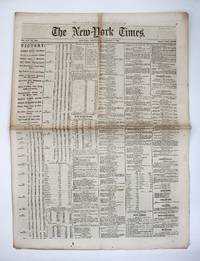
1864réf. 369148New York 1864. 8pp. Oblong folio. Central fold with small fading else fine. 8pp. Oblong folio. Reads on left column in part: VICTORY! Glorious rsult Yesterday. Election of Lincoln and Johnson. Terrible Defeat of McClellan." Haedlines show a little editorializing even then. unknown books
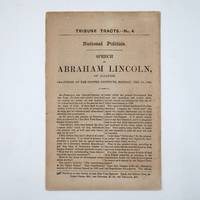
1860réf. 367583New York: Office of the New York Tribune 1860. First edition Monaghan's first issue. 1 2-15 1pp. Lincoln's speech comprises pages 1-11 out of a total of 16 pages. With New York Tribune ads and subscription terms on rear wrapper. 8vo. Stitched self-wrappers minor toning minor chip to terminal leaf. First edition Monaghan's first issue. 1 2-15 1pp. Lincoln's speech comprises pages 1-11 out of a total of 16 pages. With New York Tribune ads and subscription terms on rear wrapper. 8vo. This address made at the Cooper Institute in New York on February 27 1860 catapulted Lincoln into the public eye and made him a viable presidential candidate. Indeed many historians have considered it the key to his success in the 1860 election and it is probably the most important speech Lincoln made after the Gettysburg Address and his inaugural addresses. The Cooper Union address was months in preparation; Lincoln was fully aware of its importance in moving himself from a regional favorite son to a viable national candidate. In the event some 1500 people including many prominent political figures attended on a snowy new York evening. The speech divides into three major parts. In the first Lincoln addressed the spread of slavery arguing that the framers of the constitution had been opposed to it and that the Federal government could regulate the question. In the second he argued that the Republicans were not a sectional Northern party and attacked the threats of southern Democrats to secede if the Republicans should win the election. Finally he addressed his fellow Republicans calling on them to act carefully and do "nothing through passion and ill temper.Let us have faith that right makes might and in that faith let us to the end dare to do our duty as we understand it." The Cooper Union speech was a resounding success. Horace Greeley described it as "one of the happiest and most convincing political arguments ever made in this City. No man ever made such an impression on his first appeal to a New York audience." Greeley quickly issued the speech in the form of this "Tribune Tract." It includes a final page of advertisements for other Tribune publications. The speech was later widely reprinted and made Lincoln nationally famous. This printing differs from other editions by its inclusion of a speech by James Doolittle Senator from Wisconsin and the message of Samuel Medary Democratic governor of the Kansas Territory vetoing the Kansas abolition bill. "The Cooper Union address tested whether Lincoln's appeal could extend from the podium to the page and from the rollicking campaigns of the rural West to the urban East. Cooper Union held the promise of transforming Lincoln from a regional phenomenon to a national figure. Lincoln knew it and rose to the occasion" Harold Holzer Lincoln at the Copper Union: The Speech That Made Abraham Lincoln President. Monaghan 50 Office of the New York Tribune unknown books
1949réf. 327086Chicago: Chicago Illinois Midland Railway Company 1949. Folio. Framed and glazed total dimensions 795 x 718 mm. Folio. Chicago Illinois Midland Railway Company unknown books
1909réf. 256570New York: Privately Printed by the De Vinne Press 1909. First edition one of 300 copies. Frontispiece portrait and 7 other photographs and a colored Jock Scott fly at the end. xii 266 pp. 1 vols. 8vo. Original green cloth t.e.g. Light shelfwear title page foxed else near fine. First edition one of 300 copies. Frontispiece portrait and 7 other photographs and a colored Jock Scott fly at the end. xii 266 pp. 1 vols. 8vo. Scarce privately printed work with considerable sporting content. Pp. 123 to 266 comprise the Logbook of Camp Albany on the Ristigouche River with entries from 1883 to 1898 on angling hunting and social topics. A prefatory note quotes from Dean Sage's classic book and an afterword by Charles H. Raymond offers an appreciation of Abraham Lansing 1835-1899 of Albany New York: "To watch his tall graceful form while casting on the river was to see the exemplar of the accomplished fisherman; the man the rod the line were together but the extension and the completion of artistic and practical perfection". Wetzel p. 174; Bruns L39; Bibliotheca Salmo Salar 107 Privately Printed [by the De Vinne Press] unknown books
1905réf. 327084Chicago: Illinois Central Railroad Company 1905. 200 copies this is one of Fourteen Copies Printer's Edition By Permission #6. illustrated throughout with photogravures of Lincoln documents in the ICRC collection. 4to. Full pebbled limp pebbled black morocco with gilt stamping on upper cover "Compliments of the Illinois Central Railroad Company." Laid into full orange cloth dropbox with gilt stamp "Collection of Foreman M. Lebold. 200 copies this is one of Fourteen Copies Printer's Edition By Permission #6. illustrated throughout with photogravures of Lincoln documents in the ICRC collection. 4to. Provenance: Lou F. English this copy presented by Walter J. Gunthorp to Lou F. English.; Foreman M. Lebold lettering to clamshell box Illinois Central Railroad Company unknown books
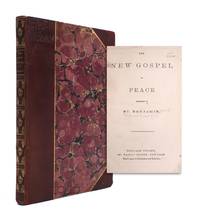
1864réf. 334954New York: Sinclair Toussey 121 Nassau Street parts 1 and 2 . Sinclair Tousey Succeeded by the American News Company part 3 1864. 42; 48; 47 1pp. Original wrappers bound in. 8vo. Later half burgundy dyed calf and marbled paper covered boards. Provenance: Sondley Reference Library with bookplate and other markings. 42; 48; 47 1pp. Original wrappers bound in. 8vo. The first three of an eventual four parts to this Lincoln satire written in Bibilical style and attributed to journalist and social critic Richard Grant White writing under the pseudonym of "St. Benjamin." Howes W368 Sinclair Toussey 121 Nassau Street [parts 1 and 2] ... Sinclair Tousey Succeeded by the American News Company [part 3] unknown books
1941réf. 320873New York: Newhouse Galleries 1941. Presentation manuscript accomplished by Paul Hessemer for Newhouse Galleries illustrated with a photographic portrait of the painting. With typed letters signed from E.J. Rousuck to Allan P. Kirby and a contemporary copy of a letter to John Hay Whitney offering the portrait. With the original label from an 1869 exhibition of the painting at the Pennsylvania Academy of Fine Arts. 4to. Bound in full blue morocco lettered in gilt silk endpapers. Presentation manuscript accomplished by Paul Hessemer for Newhouse Galleries illustrated with a photographic portrait of the painting. With typed letters signed from E.J. Rousuck to Allan P. Kirby and a contemporary copy of a letter to John Hay Whitney offering the portrait. With the original label from an 1869 exhibition of the painting at the Pennsylvania Academy of Fine Arts. 4to. An elaborate brochure for the sale of this important portrait offered to Allan Kirby and John "Jock" Hay Whitney just days before Pearl Harbor. Newhouse Galleries unknown books
1866réf. 238120Washington D.C.: John H. Littlefield; Wm. Terry Printer 1866. Photograph by John Goldin of Littlefield's painting on printed mount. 1 vols. Image 11 1/2 x 18 3/4 in.; mounted to 19 x 24 in. Soiling to image vertical crease large chips to bottom of mount not affecting image or legend; good. Photograph by John Goldin of Littlefield's painting on printed mount. 1 vols. Image 11 1/2 x 18 3/4 in.; mounted to 19 x 24 in. A published photograph of Littlefield's hyper-realistic Lincoln death-bed painting each figure meticulously rendered from photographs. Littlefield studied law under Lincoln in 1858 stumped for him in his Presidential bid and was rewarded with a position in the Treasury Department. After Lincoln's death Littlefield invented this tableau of twenty-five people ranged around the death-bed including Vice-President Johnson Surgeon Chalres Leale and Mrs. Lincoln. "The artist used photographs as models for the twenty-five people gathered in the death room but his profile of the dying Lincoln shows a first-hand acquaintance" Ostendorf LINCOLN'S PHOTOGRAPHS p. 279. Provenance: Harper Family John H. Littlefield; Wm. Terry, Printer unknown books
1958réf. 262865Zurich: The Safaho Foundation 1958. First edition one of 290 numbered copies of which 50 not for sale. xvii 304 pp. 1 vols. 4to. Crimosn cloth. Fine. First edition one of 290 numbered copies of which 50 not for sale. xvii 304 pp. 1 vols. 4to. The Safaho Foundation unknown books
1941réf. 244867New York: Duell Sloan and Pearce 1941. First edition Number 5 of a special edition signed by the author on the half-title. Illustrated throughout. 160 pp. 1 vols. 4to. Quarter brown pebbled morocco and cloth. Fine copy in open-faced slipcase some wear to slipcase. First edition Number 5 of a special edition signed by the author on the half-title. Illustrated throughout. 160 pp. 1 vols. 4to. Duell, Sloan and Pearce unknown books
1590réf. 40297N.p. 1590. Image area 19-1/2" x 12-7/8" in 28" x 23" mat. 1 vols. Imperfectly colored along crease down center small and unobtrusive dampstain in one corner. Still a nice piece. Image area 19-1/2" x 12-7/8" in 28" x 23" mat. 1 vols. Abraham Ortelius 1527-98 was a Flemish geographer of German origin. His major work Theatrum Orbis Terrarum 1570 with later revisions and addendums was the first modern atlas. It was based on contemporary charts and maps and contained a collection of plates engraved by Frans Hagenberg in a uniform size and format. The Theatrum preceded the first atlas of Ortelius' good friend Gerardus Mercator. In fact popular sentimental legend has it that Mercator delayed publication of his own work so that his younger friend's would appear first. Although this simply isn't true Mercator wasn't ready the legendary cartographer did complement Ortelius for the "care and elegance" he had put into the Theatrum. unknown books
1677réf. 36147Sur la Copie a Paris: Chez Frederic Leonard 1677. Second French edition. Engraved title two parts continuous pagination. 24 550 38 pp. 1 vols. Sm. 12mo. Vellum. Title in pen on spine upper joint torn some soiling of binding light browning of text mostly marginal else a very good copy. Second French edition. Engraved title two parts continuous pagination. 24 550 38 pp. 1 vols. Sm. 12mo. Amelot de la Houssaye was secretary to the French embassy at Venice and his account of the Republic for the first time revealed the policy of the Venetian governement. When the book appeared the Venetian state complained to the French court and Amelot was sent to the Bastille for six weeks. Chez Frederic Leonard unknown books
1865réf. 236784Boston: Printed by Order of the City Council 1865. 1 vols. 8vo. Original pebbled bevelled cloth. Fine. 1 vols. 8vo. Includes speeches by Mayor of Boston Lincoln Senator Charles Sumner the eulogy Charles G. Loring A.H. Rice and Richard Henry Dana Jr pp. 56-61. BAL 4465 Printed by Order of the City Council unknown books
réf. 553031 vols. 9 x 6 inches framed to 17 x 14-1/2. Two chips lightly scratched. Glued in wood frame. 1 vols. 9 x 6 inches framed to 17 x 14-1/2. unknown books
1950réf. 18093Worcester Mass: Achilles St. Onge 1950. One of 1500 copies printed from Monotype Plantin type on J. Barcham Green's hand made all rag wove paper by the Chiswick Press. Photographs. 1 vols. 12mo 3 x 2 inches. Bound in full blue morocco by Sangorski & Sutcliffe. One of 1500 copies printed from Monotype Plantin type on J. Barcham Green's hand made all rag wove paper by the Chiswick Press. Photographs. 1 vols. 12mo 3 x 2 inches. Inscribed "To Joseph Miller with kindest regards Achille St. Onge. Achilles St. Onge unknown books
1866réf. 238011Washington D.C.: John H. Littlefield; Wm. Terry Printer 1866. Photograph by John Goldin of Littlefield's painting on printed mount. Image 8 1/2 x 13 3/4 in.; mounted to 13 x 17 in. Faint toning to mount; fine. Photograph by John Goldin of Littlefield's painting on printed mount. Image 8 1/2 x 13 3/4 in.; mounted to 13 x 17 in. A published photograph of Littlefield's hyper-realistic Lincoln death-bed painting each figure meticulously rendered from photographs. Littlefield studied law under Lincoln in 1858 stumped for him in his Presidential bid and was rewarded with a position in the Treasury Department. After Lincoln's death Littlefield invented this tableau of twenty-five people ranged around the death-bed including Vice-President Johnson Surgeon Charles Leale and Mrs. Lincoln. "The artist used photographs as models for the twenty-five people gathered in the death room but his profile of the dying Lincoln shows a first-hand acquaintance" Ostendorf LINCOLN'S PHOTOGRAPHS p. 279. John H. Littlefield; Wm. Terry, Printer unknown books
1681réf. 22467London: Printed by J.M. for Henry Herringman at the Sign of the Blue Anchor in the Lower Walk of the New Exchange 1681. Seventh edition. Frontis portraits. 1 vols. Folio. Bound in contemporary pannelled calf neatly rebacked one joint starting. Seventh edition. Frontis portraits. 1 vols. Folio. Ownership notation on title-page by Thomas Button his book 1712. Printed by J.M. for Henry Herringman, at the Sign of the Blue Anchor in the Lower Walk of the New Exchange unknown books
1865réf. 235590Boston: Oliver Ditson & Co 1865. First edition front wrapper without portrait of Lincoln appearing in later issues. Engraved title and piano score; 5 pp. 1 vols. Folio. Loose as issued; split along spine with some chipping to extremities. First edition front wrapper without portrait of Lincoln appearing in later issues. Engraved title and piano score; 5 pp. 1 vols. Folio. Donizetti died 17 years before Lincoln having gone mad from syphilis. His Funeral March gained a measure of recognition in America after it was performed during Lincoln's funeral ceremonies. It is a heavy solemn piece in a minor with droning octaves in the bass a haunting chromatic figure in the middle register and a lyrical upper voice. see Barret Sale Lot 693; Stern Collection of Lincolniana Oliver Ditson & Co unknown books
1590réf. 37978np 1590. Image area 19 1/2 x 13 1/2 inches in 28 x 23 inch mat. Single crease down center with one 1/2 inch spot worn through otherwise a nice handsome map. Image area 19 1/2 x 13 1/2 inches in 28 x 23 inch mat. Abraham Ortelius 1527-1598 was a Flemish geographer of German origin. His major work Theatrum Orbis Terrarum 1570 with later revisions and addenda was the first modern atlas. It was based on contemporary charts and maps and contained a collection of plates engraved by Franz Hagenberg in a uniform size and format. The Theatrum preceded the first Atlas of Ortelius' good friend Gerardus Mercator. In fact popular and sentimental legend has it that Mercator delayed publication of his own work so that his younger friend's would appear first. although this simply is not true Mercator wasn't ready the legendary cartographer did compliment Ortelius for the "care and elegance" he put into his "Theatrum. unknown books