27 901 résultats
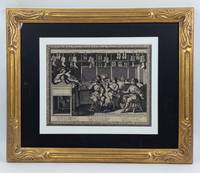
1635réf. 1413892c.1635. Image measures 13 in. x 10.25 in. Matted in frame measuring 23.2 in. x 19.25 in. Shelved at Rockville second floor. From a series of seven engravings titled "Les Metiers" 1413892. Special Collections - Upstairs. unknown books
1976réf. 88892Berkeley & London: Tree/Trigram 1976. First edition. 73 pp. Fine in wrappers and very near fine illustrated dust jacket. Translations and adaptations by Bruria Finkel Jack Hirschman David Meltzer and Gershom Scholem. One of the least common books from the press. Tree Texts 4. Berkeley & London: Tree/Trigram, unknown books
1939réf. acs1030New York: Simon and Schuster 1939. Octavo black boards hardcover 334 pp. Very Good with lettering to spine rubbed and light edgewear. Simon and Schuster, 1939. hardcover books
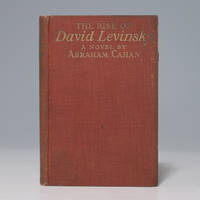
1917réf. 1143571917. First Edition. Signed. BERGER Samuel CAHAN Abraham. The Rise of David Levinsky. New York and London: Harper & Brothers 1917. Octavo original red cloth. $1100.First edition of Cahan's ""literary masterpiece"" a fascinating association copy inscribed by Jewish American Olympic medalist and heavyweight boxing champion Samuel Berger to Vaudeville actor and film producer Bobby North with Berger's inscription dated the year after publication ""To My Friend Bobby North Knowing that his knowledge and appreciation of the subject with which it deals will make this pleasurable reading Samuel Berger July 10 1918.""The Rise of David Levinsky is ""the first classic of Jewish American literatureÉ In it Cahan created one of the greatest characters of Jewish American fiction."" Born in a Lithuanian village Cahan fled pogroms to arrive in New York City in 1882. He became the ""great socialist leader of East Side Jewry a major spokesperson for the American Jewish community and the founder and for decades the editor-in-chief of the Jewish Daily Forward the most important Jewish newspaper in America"" Sternlicht Masterpieces of Jewish American Literature 17-23. ""The unrivalled record of a great historical experience the novel belongs not only in the genre of immigrant fiction but also among the best novels of American business"" John Higham. A ""literary masterpiece"" it tells the life of a ""Jewish boy from Russia who comes to America abandons his religious orthodoxy and plunges into the world of business only to find wealth but lose his soul"" Lipsky Rise of Abraham Cahan. Cahan infused the novel ""with his own fascination with the pitfalls and the possibilities of American life"" Sternlicht 20.As Mencken said of Cahan: ""It is a fine feat to write a first-rate novel but it is also a fine feat to steer a great newspaper from success to success in difficult times. He has done both"" ANB. First edition first issue: with code ""H-R"" on copyright page indicating publication in August 1917. With two rear leaves of publisher's ads. No known dust jacket. Serialized in 1913 in a much-abbreviated form in McClure Magazine. Bruccoli & Clark 83. Rideout Radical Novel 294. Hanna 556. This association copy contains a presentation inscription by the Jewish American athlete Samuel Berger who was ""the first Olympic Heavyweight Boxing Champion winning his gold medal at the 1904 St. Louis OlympiadÉ the first time boxing was included on the Olympic programÉ the 6'2""/200-pound heavyweight turned professional immediately after the Olympics but fought only two years"" Siegman International Jewish Sports Hall of Fame 49. His inscription is to Robert ""Bobby"" North who ""rose from the ranks of Vaudeville and the legitimate stage to be one of the film industry's leading producers in the 1930s responsible for many feature films at First National and Warner Brothers"" Slide Encyclopedia of Vaudeville 375. Prior to North's film career he was early described as a ""Jewish player"" who emerged ""from the East SideÉ and left Yiddish parlance to appear in English dramas"""" Theatre Vol. 28:156. Text very fresh mild rubbing to boards faint toning to spine of gilt-stamped cloth. A near-fine copy with a distinctive association. hardcover books
1994réf. 87586San Francisco: HarperCollins 1994. First US edition. xxxiv 401 pp w/index. Fine in very near fine dust jacket. Foreword by Arthur Hertzberg historical introduction by Moshe Idel. Translated by Avi Weinstein with his introduction. Bronfman Library of Jewish Classics. Nathaniel Tarn’s copy with his bookplate. San Francisco: HarperCollins unknown books
1967réf. 86589NY: Noonday Press/Farrar Straus & Giroux 1967. First edition. xiii 306 pp w/indexes. Former owner’s inked name date and place to first leaf else near fine in very good plus dust jacket with a tear and diagonal crease to front panel. NY: Noonday Press/Farrar, Straus & Giroux unknown books
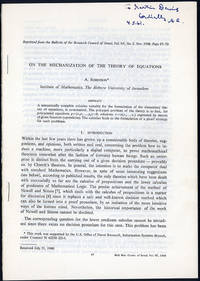
1960réf. 516851960. Robinson Abraham 1918-74. On the mechanization of the theory of equations. Offprint from Bulletin of the Research Council of Israel 9F 1960. 47-70pp. 241 x 170 mm. Without wrappers. Very good. Presentation Copy inscribed by Robinson to Martin Davis 1928-2023 on the first page: "To Martin Davis Cordially A. R. 4.5.61." First Edition Offprint Issue. Robinson is best known for developing nonstandard analysis which reincorporated infinitesimal and infinite numbers into mathematics. In the present paper which addresses "the problem of how to induce a machine more particularly a digital computer to prove mathematical theorems somewhat after the fashion of certain human beings" he constructed "a semantically complete calculus for the formulation of the elementary theory of equations" leading to "the formulation of a proof strategy for such problems" p. 47. . unknown books
1954réf. 76848London: Faber & Faber 1954. Second UK edition first printing. 252 pp. Top edge lightly soiled else near fine in very good plus price-clipped dust jacket. London: Faber & Faber unknown books
réf. 9706gcsThe University Press of Kentucky 1971. First Edition. Octavo cloth hardcover brown spine label gilt letters 354 pp. Fine in a Near-Fine price-clipped dust jacket. From dust jacket: Critics and historians of French literature have for years accepted Francois de Malherbe as the fountainhead of French classical poetry believing that he directly or indirectly influenced the production of most of the French poets of the seventeenth century. Those who opposed him blamed him for imposing restrictions on the century while Boileau’s exultant proclamation of Malherbe as the savior of French poetry has been accepted as the ultimate verdict of the great classicist’s followers. Yet to admire a poet is not necessarily to imitate him and to oppose him is not necessarily to deny his influence. Until the present study the extent of Malherbe’s influence has never been fully documented. Mr. Abraham by examining the prosody of most of the seventeenth-century poets proves that seldom were Malherbe’s precepts actually followed in practice. In choice of poetic forms rhymes rhyme schemes and language few even attempted to attain Malherbe’s “classical ideal.” He shows too that Malherbe neither initiated the reaction to the sixteenth century poetic nor succeeded in establishing a “school.” hardcover books
1969réf. 65439NY: Kennedy Gallieries 1969. First edition. Small 4to. 47 pp. Very good plus in printed wrappers. Introduction by Frank Getlein. Twelve full-color reproductions. NY: Kennedy Gallieries unknown books
1686réf. 43445Nuremberg: Johann Georg Endter 1686. Linden Johannes Antonides van der 1609-64. Lindenius renovatus sive . . . de scriptis medicis libri duo . . . noviter praeter haec addita plurimorum authorum . . . a Georg. Abrah. Mercklino . . . 4to. 22 210 221-1101 55pp. Lacking Part II "Cynosura medica" approx. 170pp. containing Mercklin's subject index to Lindenius renovatus. Engraved frontispiece. Nuremberg: Endter 1686. 200 x 163 mm. Vellum ca. 1686 head of spine and hinges repaired. Occasional light foxing but fine. From the library of anthropologist Johann Friedrich Blumenbach 1752-1840 with booklabel bearing his autograph signature on the front pastedown and annotations and underlinings possibly his on at least 50 leaves. Modern bookplate of Gordon W. Jones M.D. First Edition of Georg Abraham Mercklin's considerably expanded version of van der Linden's bibliography of medicine. First published in 1637 Van der Linden's was the most complete medical bibliography of its time; it was also the most modern of early medical bibliographies both in its contents and format. Mercklin 1664-1702 supplied corrections biographical material on authors and additions that included the innovative listing of articles from the publications of learned societies. This copy is from the library of Johann Friedrich Blumenbach the founder of modern anthropology. He was the author of De generis humani varietate nativa 1775 in which he divided humanity into four races based on head shape skin color and hair type; he later added a fifth race and in the expanded third edition of De generis 1795 he introduced the famous terms "Caucasian Mongolian Ethiopian American and Malayan" to describe the "white yellow black red and brown" varieties of mankind. Brodman Development of Medical Bibliography pp. 29-33; no. 14. Fulton Great Medical Bibliographers pp. 35-36. . Johann Georg Endter unknown books
réf. 41842Margin: 148x101 mm. Edges trimmed remnants of former mounting on reverse of print. unknown books
1969réf. 47551NY: Kennedy Galleries 1969. First edition. 47 pp. Small bump to crown else near fine in printed wrappers. Introduction by Frank Getlein. Twelve color reproductions. NY: Kennedy Galleries unknown books
1824réf. 295691824. SOLOMON Abraham. Laws of the New Synagogue Leadenhall Street London. A.M. 5584. London: E. Justins 1824. Octavo original brown paper-covered boards with printed paper label recently rebacked and cornered in black cloth recent endpapers. $1500.First edition of this collection of laws and codes for the New Synagogue of Leadenhall Street London founded in 1762.Sets out rules for membership and the election of honorary officers and the duties of these officers. With half-title. Small stain to fore-edge; interior generally clean. A very good copy. hardcover books
1927réf. 36305Amsterdam: H. J. Paris 1927. Goudsmit Samuel Abraham 1902-78. Atoommodel en structuur der spectra. 8vo. 8 68pp. 2-leaf "Stellingen" laid in. Text diagrams. Amsterdam: H. J. Paris 1927. 244 x 157 mm. Original printed wrappers a bit worn & creased. Very good copy. Ownership inscription on first leaf. First Edition of Goudsmit's doctoral thesis on atomic spectra an area in which he excelled: during his studies under Ehrenfest at the University of Leiden "Goudsmit concentrated so much on spectroscopy that Ehrenfest once-in the presence of the visiting Albert Einstein-told him: 'The trouble with you is I don't know what to ask you; all you know is spectral lines'" Mehra & Rechenberg I p. 696; see also pp. 695-707. Goudsmit obtained his doctorate in 1927 two years after he and Uhlenbeck published their landmark paper on electron spin which became a cornerstone of the new quantum mechanics. Electron spin is discussed in section 16 of Goudsmit's thesis. DSB. 36305. H. J. Paris unknown books
1910réf. 31962Berlin: Adolf Eckstein 1910. 46.5x30cm. Includes biographical cover page. Fine condition. Adolf Eckstein unknown books
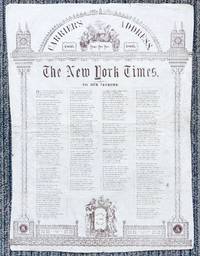
1865réf. 6598New York 1865. Good. Broadside 23 x 17 inches. Printed in brown ink. Old folds. Unevenly trimmed at edges reinforced with later paper in several places on verso. Light soiling foxing and wear. New York Times New Years broadside for 1866 with a lengthy poem commemorating the end of the Civil War and the assassination of President Abraham Lincoln. The text is printed in an elaborate and ornate border with decorative vignettes and the top and bottom center. The poem's couplets greet all readers of the Time from patriotic soldiers to women on the homefront to Wall Street moguls building their mansions. It then turns to address the war: "Twelve little months ago upon this morn / The bosom of the land by warfare torn / Shed tears of blood; while sounding sea to sea / From North to South cried one loud agony. / Twelve months ago and Marching Sherman's host / Struck as he said they should the Atlantic Coast; / While grim in front the rebel capital / King Death stood waiting for his carnival." After a bit the author addresses Lincoln's assassination: "Another tale will old men oft relate / Of how our Lincoln fell 'neath traitor hate; / How he we loved so much with so much pride / Struck by th' assassin's fatal bullet died. / Oh bitter tears fell on that April morn / As o'er our city the sad news was borne." Other battles and heroes are similarly mentioned as well as the mercy of nurses and the newly freed slaves: "O'er snowy cotton fields the people see / The noble spectacle of labor free. / . / And many a school-house open wide its door / To welcome thousands untaught before.". A wonderful exemplar of the genre particularly notable for its content on Lincoln and the end of the Civil War. unknown books
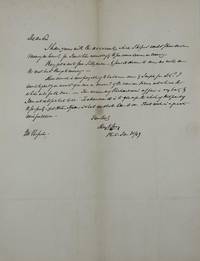
réf. 692494to. One-page verso of integral leaf employed for address Philadelphia postmark approximately 100 words in part: "I have yours with the accounts which I hoped would show more money on hand for I would like exceedingly to see some come or coming." Old fold lines. Very good though Carey's small idiosyncratic hand is difficult in places. unknown books
1899réf. 63536Cleburne TX: A. H. Yeager Publisher T. L. Sanders Printer 1899. First edition. 12mo. 129 pp. Autobiographical account of a Confederate soldier from Washington County Tennessee; Civil War experiences include his capture at Kennesaw Mountain in June 1864 his incarceration as a prisoner of war at Camp Douglas Illinois his journey home and after reflecting on his childhood in east Tennessee how he came to join an infantry company as the war began. Yeager 1842-1940 served with the 29th Tennessee Infantry until his capture; though not included here his post-Civil War years were spent first as a lawyer in Tennessee then as a newspaperman and farmer in Johnson County Texas. Not in Nevins Dornbusch Eicher Nicholson or Broadfoot. OCLC locates 23 copies but only one in Tennessee Knox County Public. Text pages a little toned but a very good copy. Original printed wrappers a little wear to the spine. 10020. A. H. Yeager, Publisher, T. L. Sanders, Printer unknown books
1800réf. 47937Philadelphia PA: Mathew Carey No. 118 High-street 1800. 8vo. 80 pp. Bound with his: Oration Delivered in Wallingford on the 11th of March 1801 Before the Republicans of the State of Connecticut at Their General Thanksgiving for the Election of Thomas Jefferson to the Presidency and of Aaron Burr to the Vice Presidency of the United States of America. New Haven CT: Printed by William W. Morse 1801. 8vo. 111 1 pp. Contemporary leather-backed drab paper boards some staining rubbed. Very good. Third edition of the first title first edition of the second the first work also printed in New Haven 1800; Carey also printed another issue without his address in the imprint in 1800; the second title prints Jefferson's first inaugural address. Sabin 5590 and 5595. Evans 36978 and American Imprints 199. Sowerby 3235 for the New Haven printing and 3264. Mathew Carey, No. 118, High-street unknown books
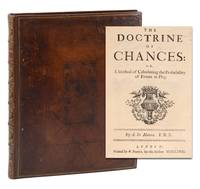
1718réf. 140950005London: Printed by W. Pearson for the Author 1718. First Edition. Near Fine. First edition of the first comprehensive textbook on probability theory. Folio in quarto format π2 A2 a-b2 c1 B-Z2 Aa-Yy2. 4 xiv 175 pp. printed on laid paper and decorated with engraved head- and tail-pieces. Skillfully rebound in period-style calf original paneled calf laid on elaborate gilt tooling and morocco title label to spine all edges speckled red. Original endpapers preserved. Near Fine with light spotting to textblock edges; binding tight. Light soiling to endpapers and widely scattered foxing and occasional smudging to contents. Bookplate to front pastedown effaced gift inscription in old hand to title page ownership signature of O. G. Gregory at upper right infill to upper right corner from removal of third ownership inscription. Dedication leaf creased and edgeworn errata list neatly crossed out in old ink. ESTC T33065. Abraham Moivre added the aristocratic de to his name when he moved from France to England as a young man one of thousands of Huguenot refugees seeking religious freedom. He taught math and within a few years met Isaac Newton who promoted his career and to whom this book is dedicated. De Moivre published several books and papers but it is The Doctrine of Chances which appealed to denizens of ivory towers and gambling dens alike for which the mathematician is most remembered. This copy was owned by the writer mathematician and astronomer Olinthus Gilbert Gregory a protege of Charles Hutton whose own major work was A Treatise of Mechanics 1806. Printed by W. Pearson, for the Author unknown books
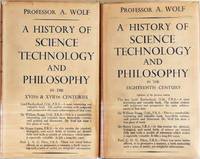
1935réf. S12059New York:: Macmillan 1935 1939. 1935. 2 volumes. Royal 8vo. xxvii 692; 814 pp. 316 345 illus. indexes. Navy blue gilt-stamped cloth dust-jackets. Ownership mark of William B. Bjornstad Drake University Des Moines Iowa. Fine. First American edition. Unusually fine set with jackets of the original edition. Macmillan, 1935, 1939. hardcover books
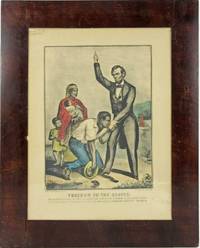
1865réf. 38499New York: Currier & Ives 1865. Color print 11-3/4" x 15-1/2" by sight. A black man newly freed from slavery kneels at Lincoln's feet his shackles broken. He kisses Lincoln's hand. His wife and babies stand behind him. Lincoln's right arm is raised and pointing heavenward. Light uniform toning but brightly colored. Two blank margin tears at lower right corner one blank margin tear at upper left corner. Framed in wood a few small dings to overall size 16" x 20." Very Good. "This commemorative print was issued soon after the assassination of President Lincoln to comfort his supporters. The semi-allegorized representation portrayed the former president as the emancipator of enslaved African Americans guided by divine principles" Description online at The Met. Entering Richmond in 1865 Lincoln was met by many former slaves who kneeled before him. Lincoln told them to stand and thank God not Lincoln for their freedom. A decade later the Colored People's Educational Monument Association headed by the African-American abolitionist Henry Highland Garnet. created a memorial to Lincoln. The result was a sculpture erected in 1876 in Lincoln Park near Capitol Hill depicting a supplicant slave and a towering Lincoln. Known as the Emancipation Memorial or the Freedmen's Memorial it generated some contemporary criticism for its depiction of the inferior position of the black man. Gale 2311. Not in LCP Reilly or Weitenkampf. OCLC 1292616124 1- OH Hist. Connection 870219805 1- IN Hist. Soc. as of May 2024. AAS also owns a copy. Currier & Ives unknown books
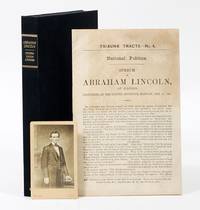
1860réf. 3104New York: New York Tribune 1860. FIRST EDITION. Original wrappers. Very Good. FIRST EDITION of Lincoln's historic Cooper Union Address delivered on February 27 1860 at the Cooper Institute in New York. The speech is largely credited to having launched Lincoln's Presidential bid. With silver print carte-de-visite of the Brady "Cooper Union" photograph. In the fall of 1859 James A. Briggs who served on the lecture committee of the Plymouth Church in Brooklyn invited presidential candidate hopeful Abraham Lincoln to speak to a New York audience on any subject of his choosing. Lincoln accepted the invitation choosing to speak of the current political climate in America. William O. Stoddard an Illinois journalist who worked for President Lincoln during his administration noted that "No previous effort of his life cost him so much hard work as did that Cooper Institute speech" and that the resulting speech "was a masterly review of the history of the slavery question from the foundation of the government with a clear bold statesmanlike presentation of the then present attitude of parties and of sections. It exhibited a careful research a thorough knowledge and understanding of political movements and developments that staggered even the most laborious and painstaking students. It showed a grasp a breadth a mental training and a depth of penetration which compelled the admiration of critical scholars" Stoddard Abraham Lincoln: The True Story of a Great Life. "Horace Greeley had rushed out the speech in pamphlet form as 'Tribune Tract' Number 4 under the headline: National Politics. Speech of Abraham Lincoln of Illinois Delivered at the Cooper Institute Monday Feb. 27 1860. The pamphlet was ready March 6 while Lincoln was still traveling through Connecticut. When he returned to New York he found it already available to the public. "Greeley marketed the eleven-page Tribune edition aggressively. As a bonus the publication included Wisconsin Republican senator James Doolittle's February 24 speech attaching 'the new doctrine of judicial infallibility' as did Lincoln's address at Cooper Union just three days later and also like Cooper Union railing agains 'the headstrong zeal pursued by the other party to force slavery into Territories'. "It was as if Republicans were now speaking with one voice: identifying with the founders attacking the Dred Scott decision rebuking John Brown and drawing their own 'dividing line' on slavery extension. Lincoln did not say it alone; but he said it best. 'Mr. Lincoln's is probably the most systematic and complete defense yet made of the Republican position with regard to Slavery' the Tribune declared in its initial advertisement for the reprints. 'We believe no speech has yet been made better calculated to win the intelligent minds over to our standard. Will the friends of the Cause everywhere aid us to circulate it' "The answer was yes. The Tribune Tract edition proved enormously popular going through at least five additional editions. Lincoln's New York oration was enjoying a new and sustained life in pamphlet form and was being purchased individually and in bulk alike by admirers and groups across the North. "The Cooper Union address tested whether Lincoln's appeal could extend from the podium to the page and from the rollicking campaigns of the rural West to the urban East. Cooper Union held the promise of transforming Lincoln from a regional phenomenon to a national figure. Lincoln knew it and rose to the occasion. "As if to illustrate his metamorphosis the Cooper Union appearance also inspired the most important single visual record on Lincoln's or perhaps any American presidential campaign: an image-transfiguring Mathew Brady photograph. Its later proliferation and reproduction in prints medallions broadsides and banners perhaps did as much to create a 'new' Abraham Lincoln as did the Cooper Union address itself. "Supposedly Lincoln volunteered when he encountered the famous photographer again a few months later: 'Brady and the Cooper Institute made me President'. Make him president they undoubtedly did" Harold Holzer Lincoln at the Copper Union: The Speech That Made Abraham Lincoln President. Note: Although it is difficult to date the carte-de-visite appears to be a late-nineteenth century production. Provenance for the speech: From the collection of George Hambrecht first president of the Wisconsin Lincoln Fellowship and renown Lincoln scholar/collector with his signature in pencil on rear wrapper. New York: New York Tribune Tribune Tracts No. 4 1860. Octavo original wrappers; custom box. Light uniform toning. Lincoln's speech comprises pages 1-11 out of a total of 16 pages. With New York Tribune ads and subscription terms on rear wrapper. RARE. New York Tribune unknown books
1951réf. 622831New York: The Blakiston Company 1951. Hardcover. Near Fine. First edition. Octavo. 415pp. Illustrated. Signature and stamp of a noted American psychologist boards a little sunned else near fine without dust jacket. The Blakiston Company hardcover books