27.536 Ergebnisse
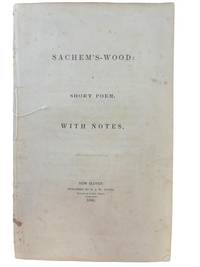
1838Best.-Nr. 93824New Haven: B. & W. Noyes 1838. 1st ed. Paperback. Good. 30p. Softcover. Disbound removed from a bound volume with stitch marks etc. along left side. 22 cm. Original wrapper not preserved. Modest foxing almost entirely confined to the outer leaves. Later stitching. Contents otherwise sound and clean. B. & W. Noyes paperback books
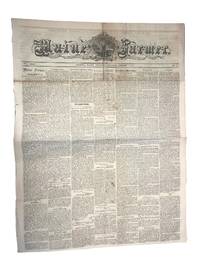
1863Best.-Nr. 182911863. Maine Farmer. January 8 1863 prints the full text of Abraham Lincoln's Emancipation Proclamation within one week of its issuance providing contemporaneous evidence of how federal emancipation policy was circulated to the Northern public during the Civil War. Published just days after January 1 1863 the issue situates emancipation alongside ongoing war reporting integrating the declaration of freedom for enslaved people in Confederate states into the broader military and political narrative of the Union war effort. Introduced under the subheading "The following is the text of the President emancipating the slaves in the rebellious states" the proclamation asserts federal authority through wartime powers declaring that "all persons held as slaves within said designated States and parts of States are and henceforward shall be free" and further authorizes the enlistment of Black men into the armed forces. The proximity of this text to battlefield reports and personal correspondence underscores the immediacy with which emancipation entered public discourse as both military strategy and social transformation. Maine Farmer. Vol. not stated. Maine January 8 1863. 4 pages. Newspaper format. The Emancipation Proclamation appears in full on the second page accompanied by additional Civil War coverage including reports of troop movements battle outcomes and casualties. On the same page a letter from a Union soldier of the 16th Maine Regiment written at the Battle of Fredericksburg reads in part: "Dear Father I write you while lying on the battlefield wounded perhaps fatally. Tell mother I think of her while lying here and wish I had her to be with me in my last parting moments." An editorial note explains that the letter was written in pencil on the battlefield the paper "tinged with blood" and that the soldier died the following day linking the proclamation directly to the lived experience of wartime sacrifice. Issued at a turning point in the Civil War the publication captures the intersection of emancipation policy military necessity and public communication in the Union states. The inclusion of both the proclamation and firsthand testimony from the battlefield demonstrates how questions of slavery citizenship and national survival were experienced simultaneously at the level of policy and individual life. Newspapers such as this served as primary vehicles through which federal decisions reached civilian audiences shaping understanding of the war's aims and consequences. Small edge tears and light foxing present not affecting text. Overall very good. unknown books
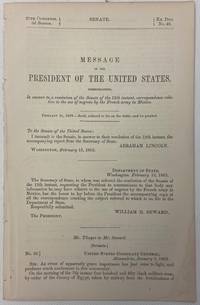
1863Best.-Nr. 175681863. Lincoln Abraham. African Troops Scarce U.S. Senate executive document transmitting a message from Abraham Lincoln and accompanying State Department correspondence concerning the French deployment of Black troops to Mexico during the American Civil War. Issued by the 37th Congress 3rd Session in February 1863 the report reflects the convergence of emancipation-era policy racialized military labor and international imperial strategy. U.S. Senate Executive Document No. 40 37th Congress 3rd Session; February 1863. Original printed pamphlet in standard folio format.Prepared under the direction of William H. Seward the document compiles diplomatic intelligence indicating that France transported African troops from Egypt-specifically from regions identified as "Dalfour" and Nubia-to reinforce forces stationed at Veracruz during the French Intervention in Mexico. The stated rationale as recorded in the report was that "the black race is not subject to the yellow fever" revealing the period's racialized medical assumptions and their direct application in imperial military logistics. Produced in the immediate aftermath of the Emancipation Proclamation this document is especially significant for situating Black military labor within a global context. While the Union was actively recruiting African American soldiers U.S. officials were simultaneously monitoring European powers deploying African troops across colonial networks. The report thus provides rare contemporary evidence of how race disease theory and military necessity intersected in both American and European wartime policy. This document holds strong research value across multiple fields: African American military history Civil War diplomacy transnational slavery and emancipation colonial medicine and 19th-century imperial warfare. It is particularly notable for documenting the perceived biological resilience of Black soldiers as a strategic asset-an idea central to both colonial and military history. AS per OCLC Scarce in institutional holdings with only a small number of recorded copies including Wyoming North Texas Michigan and Faulkner University. OCLC data should be understood as approximate and subject to revision. Condition: Light dampstaining to the lower right blank corner; otherwise in very good condition and clean legible text. unknown books
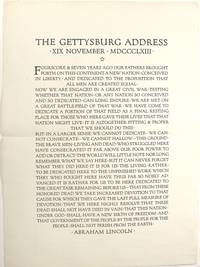
1940Best.-Nr. 58841New York: Frederic W. Goudy for R. R. Bowker Co 1940. Large folio broadside approx. 24½" x 18" previous central fold; all else fine. Set by Bertha Goudy and beautifully printed in the Goudy-designed Forum type. Only the Huntington in OCLC but there are also copies at Vassar and Syracuse and likely others framed up hanging on the wall somewhere and uncatalogued. Frederic W. Goudy, for R. R. Bowker Co unknown books
1865Best.-Nr. 97261865. Kilburn Brothers. Abraham Lincoln Stereoview Photograph of Funeral Leaves circa 1865-1875 preserves an early visual expression of the memorial culture surrounding Abraham Lincoln after his assassination in 1865. Centered on a cross incorporating a small portrait of the sixteenth president and surrounded by skeleton leaves the composition places Lincoln within the visual language of nineteenth-century mourning combining Christian symbolism portraiture and ornamental natural forms. Comparable contemporary stereographs were explicitly issued as "Lincoln Memorial" images using "dissected leaves" demonstrating that this arrangement belonged to a recognizable genre of commemorative Lincoln imagery. Kilburn Brothers. Stereoview photograph Littleton New Hampshire circa 1865-1875. Approximately 3½ x 7 inches. The paired photographic views depict a memorial arrangement dominated by a cross bearing a small image of Lincoln surrounded by delicate skeleton leaves whose exposed vein structures produce an elaborate almost lace-like setting around the portrait. The stereoscopic format was intended to create an illusion of three-dimensional depth when viewed through a stereoscope placing this image within a form of domestic visual entertainment that became particularly popular in the United States after the Civil War. Benjamin and Edward Kilburn established their stereoscopic publishing business in Littleton in 1865 and became major producers of views distributed for home viewing; the company continued under the Kilburn Brothers name into the 1870s. Lincoln's death generated an extensive material culture of mourning in which photographs prints memorial compositions and household objects helped transform the assassinated president into a national commemorative figure. Here that remembrance entered the intimate setting of stereoscopic viewing: a purchaser could encounter Lincoln's portrait and funerary symbolism as a three-dimensional parlor image rather than solely through public monuments or printed biography. The survival of closely related "Lincoln Memorial Dissected Leaves" stereographs by other publishers further documents the circulation of this particular memorial vocabulary during the 1860s. Light evidence of handling if any with no specific defects reported; near fine. A compact example of nineteenth-century Lincoln mourning imagery that joins presidential history with the visual and domestic culture of post Civil War remembrance. unknown books
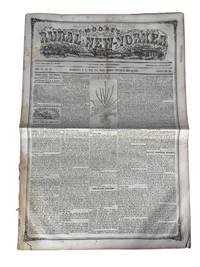
1860Best.-Nr. 58991860. Moore Daniel D. ed. Moore's Rural New Yorker May 26 1860 reports Abraham Lincoln's closely contested nomination for president at the Republican National Convention in Chicago eight days earlier. The issue preserves contemporary ballot totals showing William H. Seward's commanding initial lead and Lincoln's subsequent accumulation of delegate support providing evidence for the study of Republican Party politics antebellum newspaper coverage the presidential election of 1860 and the sectional conflict over slavery that shaped the campaign. Lincoln entered the convention as a less nationally prominent candidate than Seward but secured the nomination on May 18 after three ballots and the transfer of additional votes. Moore's Rural New Yorker. Rochester New York. For the week ending Saturday May 26 1860. Four pages. The issue gives a detailed account of the convention proceedings and reproduces the presidential balloting: "The resolutions were adopted and on motion the Convention proceeded to ballot for a candidate for President of the United States. Various individuals were put in nomination." Its first-ballot tally records "Seward - 173 1/2" and "Lincoln - 102" documenting Lincoln's substantial initial deficit. The report continues that on the final ballot Lincoln received "231 1/2 votes or within 1 1/2 of the nomination" after which a delegate corrected his state's vote by transferring four votes to Lincoln "thus nominating Lincoln by 2 1/2 majority." The newspaper attributes that decisive change to Massachusetts and names "Mr. Andrews"; later historical accounts generally identify four Ohio delegates as supplying the votes that placed Lincoln over the required threshold making the discrepancy useful evidence of how convention news was transmitted and sometimes imperfectly reported by the contemporary press. Published as the Republican Party prepared to contest a four-way presidential election amid intensifying national conflict over slavery's expansion the issue captures Lincoln's transformation from regional politician to presidential nominee almost immediately after the convention. Seward had entered as the leading contender but concerns about his electability and Lincoln's appeal to delegates from pivotal northern states altered the result over successive ballots. Lincoln subsequently won the presidency in November with 180 electoral votes an outcome followed by the secession of slaveholding states and the onset of the Civil War. Very light foxing with customary folds and no stated loss of text; very good overall. A detailed contemporary record of the convention arithmetic and shifting delegate support that produced one of the most consequential presidential nominations in United States history. unknown books
1865Best.-Nr. 127171865. Tilton Theodore editor of The Independent May 4 1865 issued this Lincoln memorial coverage nineteen days after the president's death and on the day of his burial in Springfield Illinois. Tilton edited the New York newspaper from 1863 to 1870 during a period in which its longstanding antislavery editorial position placed emancipation and the consequences of the Civil War prominently before its readers. The front page preserves contemporary Northern responses to Abraham Lincoln's assassination through both memorial verse and attention to his final public statements appearing as the country confronted presidential succession emancipation and the political consequences of Union victory. The Independent. New York. May 4 1865. One page 18 × 25 inches twice folded. The front page includes the poem "President Lincoln Dead" and the prominent central headline "The Last Word and Deed of Abraham Lincoln." Published less than three weeks after Lincoln was shot at Ford's Theatre on April 14 and died on April 15 the sheet places commemoration alongside an account of his final words and actions. Its May 4 publication date coincides with Lincoln's burial in Springfield giving the issue a particularly precise place within the national mourning that followed the assassination. Lincoln's death came only days after the surrender of Robert E. Lee's Army of Northern Virginia and before the Civil War had fully concluded while the Thirteenth Amendment abolishing slavery awaited ratification by the states. The Independent had advocated against slavery since its antebellum years making its treatment of Lincoln's death part of a newspaper history closely connected to abolitionist politics. Some spotting and tearing around the edges and at the creases not affecting the text with a small amount of paper loss from the upper right corner of the banner. Good condition overall with the principal headlines and memorial content intact. unknown books
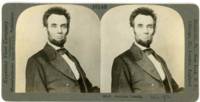
1865Best.-Nr. 136231865. Lincoln Abraham. Late Civil War portrait of Abraham Lincoln derived from a February 1865 photograph taken during the final months of the American Civil War. The image records Lincoln near the conclusion of the conflict that preserved the Union and ended legal slavery in the United States. Created shortly before his assassination in April 1865 the portrait captures a visibly worn president whose appearance reflected the physical and political strain of leading the nation through four years of war. The photograph was long attributed to Mathew Brady but was actually taken by government photographer Lewis Emory Walker and issued commercially through the New York photographic publishers E. & H. T. Anthony. The portrait belongs to a group of late images that document Lincoln's appearance in the closing weeks of the war. Stereoview photograph published by Keystone View Company reproducing the 1865 Walker portrait of Abraham Lincoln. Keystone stereograph number 92. The mount bears the Keystone biographical text about Lincoln on the verso together with the company's copyright notice. A handwritten pencil notation on the reverse references the earlier attribution of the photograph to Mathew Brady. The portrait shows Lincoln with closely cut hair a style that contemporary accounts suggested was recommended by his barber in preparation for the creation of a life mask by sculptor Clark Mills. Photographic portraits of Lincoln produced during the final months of the Civil War became some of the most widely circulated visual representations of the president after his assassination in April 1865. Images such as this stereographic reproduction contributed to the creation of Lincoln's public memory in the late nineteenth century when photographic publishers issued stereographs and other prints that allowed Americans to view notable figures through emerging visual media. Stereographs played an important role in popular visual culture during this period offering audiences three dimensional photographic views through stereoscopic viewers and distributing portraits of political leaders to a wide national audience. Light wear consistent with age and handling. Overall condition good to very good. unknown books
Best.-Nr. 11717Ford's Theatre stereopticon view undated depicts the Washington D.C. building where John Wilkes Booth shot President Abraham Lincoln on April 14 1865 during a performance of Our American Cousin. The image belongs to the later visual commemoration of Lincoln's assassination presenting the surviving theater as a historic site for audiences encountering Civil War history through commercially produced stereoscopic imagery. Lincoln was carried from the theater to the Petersen House across the street where he died the following morning. Full color stereopticon view 6 x 3 inches captioned "Old Theater Where Lincoln Was Assassinated Washington D.C." The image is a later historical view of Ford's Theatre adapted from a photograph contemporary with the production of the stereoview rather than an image made at the time of the assassination. Printed descriptive remarks appear on the reverse. Produced for stereoscopic viewing the paired images were intended to create an illusion of depth when viewed through the appropriate optical device. Stereoscopic images circulated historic buildings landscapes and monuments to domestic and educational audiences during the nineteenth and early twentieth centuries making geographically distant sites available as visual objects of study and commemoration. This example records Ford's Theatre not as the scene of the 1865 assassination itself but as a later memorialized landmark identified explicitly through its caption. Minor edge wear; otherwise very good condition. unknown books
1862Best.-Nr. 129821862. Lincoln Abraham. Front-page printing of the September 22 1862 Preliminary Emancipation Proclamation in the Republican Herald and Post of Providence Rhode Island dated September 27 1862 carrying Lincoln's emancipation policy to newspaper readers only five days after its issuance. The proclamation announced that enslaved people in states remaining in rebellion on January 1 1863 would thereafter be free making its rapid newspaper circulation central to public understanding of a major change in Union war policy. Its appearance in this Providence issue documents the immediate dissemination of Lincoln's order during the Civil War. Republican Herald and Post. Providence Rhode Island. Saturday morning September 27 1862. Four pages printed recto and verso. The front page prints Lincoln's September 22 proclamation including the passage: "I Abraham Lincoln President of the United States of America and Commander-in-Chief of the Army and Navy thereof do hereby proclaim and declare that hereafter as heretofore the war will be prosecuted for the object of practically restoring the constitutional relations between the United States and the people thereof. Abraham Lincoln." The full proclamation joined the Union war effort to a stated deadline for emancipation in rebellious states while also addressing compensated emancipation colonization enforcement by military and naval personnel and the status of people escaping slavery under federal law. Lincoln issued the Preliminary Emancipation Proclamation after the Battle of Antietam and months of debate within his administration over the timing and legal basis of emancipation. By printing the proclamation on September 27 the Republican Herald and Post records how quickly readers encountered the new policy through the daily and weekly press before the final Emancipation Proclamation took effect on January 1 1863. Minor chipping to the edges; otherwise excellent condition. A closely dated Civil War newspaper preserving contemporary public circulation of Lincoln's preliminary order for emancipation. unknown books
1861Best.-Nr. 131421861. Lincoln Abraham. March 22 1861 issue of The Union carries extensive reporting on Lincoln's first inauguration and the secession crisis less than three weeks after he took office. The newspaper devotes approximately two columns of its "News from America" coverage to Lincoln quoting extensively from his March 4 inaugural address in which he rejected the legality of secession declared the Union unbroken and stated his intention to execute federal law in every state. The same issue reports the secession of Texas placing Lincoln's assumption of the presidency beside the continuing dissolution of federal authority in the slaveholding South immediately before the outbreak of the Civil War. The Union. March 22 1861. Sixteen pages measuring approximately 9.75 x 15 inches. The issue includes multiple articles concerning Lincoln's inauguration with two columns of American news substantially devoted to the new president and extensive quotations from his inaugural address. It also reports Texas's withdrawal from the Union. Texas had adopted its ordinance of secession on February 1 ratified it by popular vote on February 23 and entered the Confederacy in March following six other slaveholding states that had already seceded. The newspaper thus places contemporary discussion of Lincoln's constitutional position alongside reporting on the continuing expansion of the Confederacy. Published only weeks before Confederate forces opened fire on Fort Sumter on April 12 the issue records the unresolved political crisis between Lincoln's insistence that the Union remained legally intact and the seceding states' establishment of a separate government. Its extensive reproduction of Lincoln's words preserves how readers encountered his inaugural position through the contemporary press before the crisis became open warfare. Complete newsstand issue never bound into a volume according to the supplied provenance. Minor edge wear and small edge tears; very good overall. An intact March 1861 newspaper preserving contemporary reporting on Lincoln's inauguration and Texas secession during the final weeks before the Civil War. unknown books
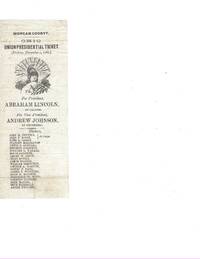
1864Best.-Nr. 156621864. Lincoln Abraham Union Presidential Ticket November 8 1864 documents Civil War electoral mobilization through a printed county ballot listing national state and local Union candidates during the only United States presidential election held while the nation was actively at war with itself. The ticket records the Union Party electoral system through its Lincoln and Johnson presidential slate state electors and Morgan County candidates revealing how wartime party organization operated in practice by connecting national reelection politics to local printed voting materials. Lincoln defeated George B. McClellan in the 1864 election by 212 electoral votes to 21 and the National Union coalition joined Republicans with War Democrats in support of continuing the war and restoring the Union. Union Presidential Ticket. Morgan County Ohio: Union Party November 8 1864. Broadside-style printed election ticket approximately 3 by 7 inches. The ticket lists Abraham Lincoln for President and Andrew Johnson for Vice President together with state electors and local candidates showing the practical mechanics of nineteenth-century party voting before standardized government-printed ballots. A patriotic vignette depicts Columbia holding a sword labeled "Union" linking the act of voting to national preservation military sacrifice and loyalty to the federal cause. The election followed the Union capture of Atlanta in September 1864 a military success that strengthened Lincoln's political position after months of uncertainty about his reelection prospects. The ticket's timing gives it particular force: Lincoln's reelection made him the first president since Andrew Jackson to win a second term and he was assassinated on April 14 1865 dying the following morning less than two months after beginning that term. As a county-level ballot from Ohio the piece provides primary-source evidence for the study of Civil War political culture Union campaign symbolism local election administration and the wartime coalition that paired Lincoln with Tennessee War Democrat Andrew Johnson. Two light vertical folds not noted; no tears or losses described; overall excellent. A compact but unusually direct artifact of the 1864 Union electoral system linking Lincoln's national reelection campaign to the printed voting practices of a specific Ohio county. unknown books
Best.-Nr. 11721Abraham Lincoln birthplace stereoview undated depicts the log cabin identified with the birth of the sixteenth president near Hodgenville Kentucky. The image belongs to the visual commemoration of Lincoln through sites associated with his early life presenting the birthplace as a historic landmark for audiences encountering presidential history through stereoscopic photography. Black and white albumen stereoview on gray mount showing the log cabin associated with Lincoln's birthplace. The paired images were intended for viewing through a stereoscope creating an illusion of depth and allowing the cabin and its setting to be examined as a three-dimensional scene. No photographer publisher or production date is supplied in the present description. Lincoln was born in Kentucky on February 12 1809 and his birthplace became an increasingly prominent site of national remembrance after his presidency and assassination. This stereoview records the cabin as it was presented to later visitors and viewers linking domestic-scale architecture with the expanding culture of Lincoln commemoration. Albumen prints and mount in excellent condition. unknown books
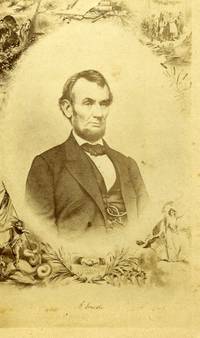
Best.-Nr. 11015Lazier. Abraham Lincoln carte de visite undated combines a portrait of the sixteenth president with patriotic imagery and a scene identified as showing freed slaves placing Lincoln's likeness within the visual culture of Union nationalism and emancipation. Such imagery connected the president directly to the political and social consequences of the Civil War including the destruction of slavery and the emergence of freedom as a central theme in popular commemorative material. Carte de visite by Lazier of Syracuse New York with photographer's back imprint. Approximately 2.5 x 4 inches. The mount presents Lincoln together with patriotic scenes and an additional vignette depicting freed slaves. The combination of presidential portraiture and emancipation imagery gives the card a more explicitly political character than a conventional studio portrait linking Lincoln's public image to Union victory and the end of slavery. Lincoln's image circulated extensively in cartes de visite during and after the Civil War becoming part of a broader culture of political remembrance following his assassination in 1865. The inclusion of African American subjects identified as freed slaves places this example within the visual record of how emancipation was represented to contemporary audiences through inexpensive photographic and printed formats. In excellent condition. unknown books
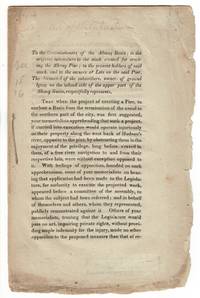
1828Best.-Nr. 55054Albany NY 1828. First edition 8vo pp. 16; self-wrappers unopened and uncut very light rubberstamp in the bottom margin of the first leaf a few pencil marks and edgewear all else very good. A complaint that the erection of the Albany Pier was effectively a deprivation of property against the subscribers who's access to the canal became limited. American Imprints 35521; NYPL only in OCLC. unknown books
1860Best.-Nr. 85724Chicago: Charles Leib 1860. Very Good. Four-page newspaper. A couple of small holes various brown spots and other bits of minor wear A campaign newspaper for Abraham Lincoln in the Presidential Campaign of 1860. We note a half-column story on the front page of this issue that accuses Senator Douglas of being a Roman Catholic -- a charge based partly on the fact that Mrs. Douglas was a Catholic as were their children -- probably an effective charge in largely Protestant mid-19th century America. Our brief research suggests that Douglas was neither a Catholic nor a formal member of any other organized religious group. The purpose of another half-column story on the front page was to make it clear that Lincoln had publicly condemned the actions of John Brown and did not object to Brown's execution. Charles Leib the editor was a political operative with an unclear background who had previously edited a Democratic campaign newspaper on behalf of the Buchanan campaign in 1856. Leib served briefly as an Assistant Quartermaster in the Union Army before heading to New Mexico probably in 1863 and died there in 1865 at the age of 38. Charles Leib unknown books
1712Best.-Nr. 43188Franequerae Franeker: Ex Officina Wibii Bleck 1712. Later edition Vol. 1 First edition Vol. 2. Hardcover. g- to vg. Octavo 8 x 6 1/2" Vol. 1; 8 1/4 x 6 3/4" Vol. 2. 32 1134 36pp Index Vol. 1; 18 531 23 Index and Emendanda Vol. 2. Contemporary full vellum with handwritten title to spine. Main title in first volume in red and black lettering. Title vignette for each title page. Decorative head- tailpieces and initials. "Observationum Sacrarum" is an impressive collection of material on "philological exegetical and theological topics which grew over the decades into an impressive six-volume set the seven and last volume was published posthumously. The collection consists largely of material prepared in connection with Vitringa's public disputations" For more information see: Charles K. Telfer's "Wrestling with Isaiah: The Exegetical Methodology of Campegius Vitringa" Vandenhoeck & Ruprecht 2016 Page 29. This work is complete with engraver Abraham de Blois' Kabbalistic plate facing page 142 in first volume. The first volume contains the first four books of "Observationum Sacrarum." Books 2 3 and 4 have their own separate title page each dated 1711. The main title indicates that the first book is the 4th edition books 2 and 3 are the third edition and book 4 is the second edition. The second volume contains the first edition of the last two books of "Observationum Sacrarum" 5 and 6. Moderate and sporadic age-toning and soiling to bindings. Ex-library stickers to spines and bookplate on inside of each front cover. Contemporary previous owner's name Joannes Carolus de Lithe Onoldi dated 1733 on main title Vol. 1 and title page of second volume. Clear water-staining to upper part of title page in second volume. Moderate age-toning and sporadic foxing throughout. Text in Latin with some Hebrew and Greek. Bindings in overall good- to good interior in good- to very good condition. About the author: Campegius Vitringa 1659-1722 was a Dutch Protestant theologian and Hebraist. A follower of Johannes CocceiusVitringa was a supporter of prophetic theology. He was educated at the universities of Franeker and Leiden and became professor of Oriental languages at the former in 1681. When locating prophetic outcomes he would associate events to the near rather than the far-off future placing a distinct focus on the period of the Maccabees 2nd Century BC. Like Joseph Mede 1586-1638 Vitringa believed wholeheartedly that the Millennium was yet to come but did not expect any immediate changes. He relegated the end of the time to a remote future and strongly emphasized the concept of New Jerusalem From Wikipedia. Ex Officina Wibii Bleck hardcover books
1971Best.-Nr. 35299New York: Association Press 1971. First edition 16mo pp. 127 2; near fine in original pictorial wrappers. "The war in Vietnam is 'impossible to justify'. An appeal of moral urgency rallying Catholic Jew and Protestant to join in blood steps to end the conflict." upper cover. Association Press unknown books
1923Best.-Nr. 40871Keswick: G.P. Abraham 1923. 8vo pp. 52; portrait frontispiece of William Wordsworth 28 additional monogravure plates; contemporary full black morocco gilt-stamped decorative covers gilt-lettered spine in 6 compartments raised bands; front cover badly rubbed general shelf wear along edges and corners interior near fine. G.P. Abraham unknown books
2001Best.-Nr. 38923Amsterdam: John Benjamins Publishing Company 2001. 8vo pp. xii 2 148; original red printed wrappers some soiling else a good copy. John Benjamins Publishing Company unknown books
1967Best.-Nr. 81376Philadelphia: Jewish Quarterly Review 1967. 1st Edition. Hardcover. Near Fine. xi 592p. Red cloth. 24cm. No Jacket. Jewish Quarterly Review hardcover books
1952Best.-Nr. 79016Meriden 1952. Hardcover. Very Good. photos unpaginated. 28cm. No Jacket. hardcover books
1951Best.-Nr. 39793Los Angeles 1951. 1st ed. Hardcover. Very Good. 125p. Hardcover. 23 cm. No Jacket. INSCRIBED by Arias-Larreta. Spanish text. hardcover books
1943Best.-Nr. 27370New York: Froben Press 1943. Second edition revised and reset first published 1936 8vo pp. 1 119; frontispiece facsimile and 28 full-page portraits in the text; minor wear to extremities and vertical "stripe" of water damage on back cover otherwise a very good copy. A brief "General Survey" of pediatrics followed by chronologically arranged chapters and capped by four special interest chapters: "Pioneers in Infant Feeding" Investigators of Alimentary Disturbances in Infancy" "Pioneers in the Study of the History of Pediatrics" and "American Pioneers of Pediatrics." Also with table of "Outstanding Contributions of American Pioneers." Garrison-Morton 6357. Froben Press unknown books
1927Best.-Nr. 30635London: Nonesuch Press 1927. Limited edition one of 1050 copies 8vo pp. xx 213 2; engraved title-page vignette; original brown buckram red leather spine label gilt; spine darkened spine label chipped otherwise a very good partially unopened copy. Nonesuch Press unknown books