27.519 Ergebnisse
1946Best.-Nr. 33849London: Oxford University Press 1946. Small octavo. Cloth. 116 pp. In dustjacket. Oxford University Press unknown books
1948Best.-Nr. 35185London: Cassell 1948. Hardcover. Very Good. Octavo. Full light gray boards. 330 pp. Endpapers browned; outer edges spotted. Cassell hardcover books
1974Best.-Nr. 32563London: Oxford University Press 1974. Boards. xxv 978 pp. In dustjacket. New Oxford History of Music Volume IV. Oxford University Press unknown books
1947Best.-Nr. 145154Beverly Hills CA: United Artists 1947. Vintage linen backed keybook photograph of cinematographer James Wong Howe actress Lilli Palmer and members of the crew on the set of the 1947 film noir. Manuscript annotations on the verso. Considered by many to be amongst the best boxing films of all time as well as one of the great 1940s noirs. "Body and Soul" tells the story of a man who became a successful boxer to support himself and his mother after his father is killed but who realizes that he has slowly lost his integrity somewhere along the way. Winner of an Academy Award and nominated for two others. Shot on location in New York City. 10 x 8 inches. Near Fine. Grant US. Selby Canon US. Silver Classic Noir. Spicer US. United Artists unknown books
1985Best.-Nr. 135071Washington DC: The Film Company / Public Broadcasting Service PBS 1985. Original Press Kit for the 1985 documentary. With a transcript of the program and a 32-page companion guide featuring facts about Herman Melville's life and work articles on Melville and a selected bibliography. This documentary tracks the personal and intellectual adventures of Herman Melville. Narrated by John Huston the film includes readings and commentary by F. Murray Abraham Robert Penn Warren Alfred Kazan and other notable writers and critics. Arthur Unger with The Christian Science Monitor reviewed the film in 1985: "Directed written produced and photographed mostly by Robert Squier a unique and dedicated artist himself. Mr. Squier has accomplished an inspired film about a writer and his writing which manages to combine the song of poetry and the zing of adventure with the shock of psychological recognition. not merely a labor of love; it is a probing and incisive study of how a man and his work interact with the environment physical and emotional. Utilizing real locations top literary scholars and a delicate sense of time and place with a minimal amount of reenactment Mr. Squier's film records the paradoxes in Melville's life his sense of hopelessness his disgust with brutality his agonizing search for religion his intellectual resolve his determination to survive personal disasters."not afraid of deep questions.'' Companion guide 32 pages transcript 36 pages and promotional letter from the publishers advertising a videocassette of the film rental $75 purchase $350 house in a dark green folder with silver titles and blind-stamped design. Near Fine overall. The Film Company / Public Broadcasting Service [PBS] unknown books
1954Best.-Nr. 132689Burbank CA: Warner-Pathe / Warner Brothers 1954. Eight vintage British front-of-house cards and 2 black-and-white double weight still photographs from the 1954 UK release of the 1954 US film. Distributor rubber-stamps on the versos of 2 stills black-and-white. A Yankee sea captain Lancaster finds himself stranded after a mutiny on an island where the financial potential of cocoanut excites him and the mysterious wealth of the island beguiles him. 8 x 10 inches. Very Good plus with pinholes at the top edge color stills 2 color stills roughly trimmed at the top edge staple holes to 2 black-and-white stills and light creasing to the extremities. Warner-Pathe / Warner Brothers unknown books
2013Best.-Nr. 589492013. ISBN-13: 9781616192495; ISBN-10: 1616192496. Fraunce Abraham. The Lawiers Logike Exemplifying the Praecepts of Logike by the Practice of the Common Lawe. Originally published: London: William How 1588. xxxvii iii-xxvii new introduction xiv 151 leaves total 364 pp. Reprinted by The Lawbook Exchange Ltd. 2013. With a new introduction by Steve Sheppard Professor of Law St. Mary's University School of Law. ISBN-13: 9781616192495. Hardcover. New. $49.95 "From this work Shakespeare is supposed to have acquired some of his legal knowledge" Sweet & Maxwell I: 166. In his introduction Sheppard addresses longstanding academic speculation as to whether Shakespeare learned law from Fraunce. Written in 1588 The Lawiers Logike is the first legal treatise to apply the tools of logic to legal argument. This was a controversial and new concept at the time because its thesis contrasts with common law and its unmethodical and disorganized approach to law. Its influence is still felt. It is a unique work in which Fraunce castigates "lazy lawyers" and mixes illustrations from poetry and prose with often quite technical illustrations from law treatises and case reports. In his introduction Steve Sheppard points out that this "work informs three fields of American law - the study of legal analysis and argument the intersection of law with other disciplines and the moral justification of law itself." Introduction iii. "Abraham Fraunce's The Lawiers Logike 1588 was the first attempt to theorise English law within a structure provided by humanist dialectic and rhetoric." -- Mark D. Walters Cambridge Law Journal 67 2008 360 Abraham Fraunce 1559-1592 attended St. John's College Cambridge enrolled in Gray's Inn in 1583 and was called to the bar in 1588 before Christopher Yelverton and Francis Bacon. In addition to his law practice he was a noted poet having been a classmate and protege of Philip Sidney Edmund Spenser's patron. unknown books
1817Best.-Nr. 619331817. Appeals of murder were abolished after this case. Appeals of murder were abolished after this case. "Diabolically Ravished Murdered And Thrown Into a Pit" Trial. Thornton Abraham c.1793-1860 Defendant. Horrible Rape and Murder!! The Affecting Case of Mary Ashford A Beautiful Young Virgin Who was Diabolically Ravished Murdered And Thrown Into a Pit As She Was Returning From a Dance; Including the Trial of Abraham Thornton For the Wilful Murder of the Said Mary Ashford; With the Whole of the Evidence Charge to the Jury &c. Tried at Warwick Assizes Before Mr. Justice Holroyd On the 8th of August 1817. Taken in Short Hand. To Which is Added Copious Elucidations of this Extraordinary Case; And a Correct Plan of the Spot Where the Rape and Murder were Committed &c. &c. London: Published by John Fairburn 1817. ii 60 columns 34 pp 64 1 pp. Several newspaper clippings concerning this case pasted to final leaf rear wrapper and verso of title page. Woodcut folding map of crime scene. Octavo 8-3/4" x 5-1/2". Stab-stitched pamphlet in printed wrappers untrimmed edges. Some soiling and edgewear spine and fold-lines of table reinforced fore-edge mended some toning to text. Early owner inscriptions to front wrapper "Bright" and "St John Crookes" and verso of map "St John Crookes/ Sunderland/ 1856". $950. "Third Edition." Abraham Thornton a bricklayer was accused of the rape and murder of Mary Ashford when she was found dead the morning after a dance where the two had been seen together. Thornton admitted that the two had been consensually intimate but denied the charges of rape and murder. Eyewitness accounts backed up his story and in the absence of other evidence he was acquitted of both charges. Public outcry around his acquittal led to Mary's brother William invoking an "appeal of murder." This uncommon legal practice allowed a retrial of a defendant acquitted for murder but crucially gave the defendant the right to trial by battle. Thornton invoked that right and was released after William Ashford declined the challenge. The case resulted in the abolition of appeals by murder and thus the end of trial by battle. Despite his protestations of innocence the public was thoroughly convinced of his guilt. Unable to lead a normal life Thornton moved to the United States and settled in Baltimore Maryland. One of the former owners of our copy may have been John Bright 1811-1889 a r. unknown books
1729Best.-Nr. 547681729. Collected Works of Notable Roman-Dutch Jurist Wesel Abraham van 1633-1680. Opera Omnia Antea Diversis Temporibus Seorsim Edita Nunc in Unum Corpus Redacta Nempe I. Commentarius ad Novellas Constitutiones Ultrajectinas Multarum Litium Diremendarum Causa XIV. Aprilis M. DC. LIX. Promulgatas. II. De Connubiali Bonorum Societate & Pactis Dotalibus. III. De Remissione Mercedis Propter Bellum Inundationem Aquarum & Sterilitatem. Editio Nova a Mendis Quibus Priores Scatebant Purgata. Ghent: Apud Cornelium Meyer 1729-30. Three parts each with title page and individual pagination. Main text in parallel columns. Quarto 7-1/2" x 6-1/2". Contemporary mottled calf gilt frames to boards gilt spine with raised bands and lettering piece edges rouged speckled endpapers. Some rubbing to extremities chipping to head of spine corners bumped and somewhat worn residue from bookplate to front pastedown. First title page printed in red and black attractive woodcut head-pieces tail-pieces and decorated initials. Some toning to text. Brief later annotation to front pastedown interior otherwise fresh. $650. Third and final edition with corrections. Educated at the University of Utrecht Wesel was Counsellor to the Court of Vianen where he was a colleague of Paul Voet and fiscal lawyer to the Court of Utrecht. A solid Romanist he was also says Wessels "a great authority not only on the law of Utrecht but also on the law of Holland." Opera Omnia was first published in 1692 and it collects his principal works. The first part is a detailed article-by-article commentary on the Novellae Constitutiones of the Province of Utrecht in Dutch and Latin. The other parts address the Roman and Roman-Dutch law of husband and wife dowry community property and compensation. OCLC locates 1 copy in North America at UC-Berkeley Law School; another copy located at Harvard Law School. Wessels History of Roman-Dutch Law 316. Dekkers Bibliotheca Belgica Juridica 188 4. unknown books
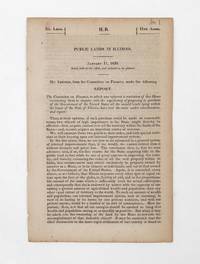
1839Best.-Nr. 373003Vandalia Illinois 1839. First edition. 3 1pp. 8vo. Disbound. Housed in a morocco backed slipcase. First edition. 3 1pp. 8vo. Abraham Lincoln had yet to join the bar when he began his first stint in politics in the Illinois legislature in 1834 serving four consecutive terms in the Assembly through 1841. "This rare printing has the prestige of being the first occurrence of Lincoln's name as the sole author of a work. As a Whig lawmaker he was devoted to his party's program of public works through government financing. After the Panic of 18376 the spending he had advocated for had resulted in massive state debts. To relieve the budgetary burden Lincoln proposed that Illinois acquire land within its borders which the federal government still possessed and then sell the land at a fourfold profit to settlers and speculators resulting in both increased revenues and self-determined land ownership" Boroujerdi. Very rarethoma. Monaghan 1; Boroujerdi et. al. Abraham Lincoln: His Life in Print p. 29 unknown books
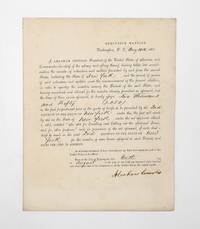
1863Best.-Nr. 373004Washington D.C. 1863. 1p. plus integral blank. 4to 9-3/4x7-3/4 inches. Minor smudging to signature. Housed in a blue full morocco box. 1p. plus integral blank. 4to 9-3/4x7-3/4 inches. The first military draft in U.S. history was passed by Congress in early 1863 and signed into law by President Abraham Lincoln in March of that year. The Enrollment Act or Civil War Military Draft Act required the enrollment of every male citizen between twenty and forty-five years of age as well as those immigrants who had filed for citizenship unless exempted by the Act. It set enlistment quotas for each state and required states to draft men if they did not meet their enlistment quotas through volunteers. It also included the policies of substitution furnishing a suitable substitute to take the draftee's place and commutation paying $300 to avoid the draft which led to substantial resentment among working-class citizens not wealthy enough to pay their way out of service. Only July 13 during the draft lottery in New York City a riot broke out leading to three days of violence and destruction. Although initially focused on the draft the protests subsequently devolved into vicious race riots. The rioters were largely white and in the wake of the Emancipation Proclamation claimed to fear that freed enslaved men would migrate to the city and take their jobs. Since Blacks were exempted from the draft the Draft Act only heightened fears of Black migration to the city. The violence against the Black community in New York as well as against abolitionists was substantial: the death toll reached upwards of 120 and numerous homes and churches were burned. Since most of the New York State Militia was fighting with Union troops at Gettysburg the New York Police Department was the only force on hand to deal with the rioters initially and they were badly outnumbered and underequipped. By day four of the riots five New York Militia units had reached the city along with the 26th Michigan Volunteers and the 27th Indiana Volunteers and were able to start restoring order. Eventually there were several thousand troops in the city and they brutally put down the remaining rioters. Almost immediately calls came to suspend the draft in New York most notably by Horatio Seymour the Governor of New York who wrote to Lincoln several times in the weeks which followed arguing against the constitutionality of the draft and the inequity in its application. Lincoln replied on August 7 refusing to acquiesce to Seymour's demands writing: "I shall direct the draft to proceed in all the Districts drawing however at first from each of the four Districts towit: the second fourth sixth and eighth . I do not object to abide a decision of the United States Supreme Court or of the judges thereof on the constitutionality of the draft law. In fact I should be willing to facilitate the obtaining of it; but I can not consent to lose the time while it is being obtained. We are contending with an enemy who as I understand drives every able bodied man he can reach into his ranks very much as a butcher drives bullocks into a slaughter-pen. No time is wasted no argument is used. This produces an army which will soon turn upon our now victorious soldiers already in the field if they shall not be sustained by recruits as they should be. It produces an army with a rapidity not to be matched on our side if we first waste time to re-experiment with the volunteer system already deemed by congress and palpably in fact so far exhausted as to be inadequate; and then more time to obtain a court decision as to whether a law is constitutional which requires a part of those not now in the service to go to the aid of those who are already in it; and still more time to determine with absolute certainty that we get those who are to go in the precisely legal proportion to those who are not to go. My purpose is to be in my action just and constitutional; and yet practical in performing the important duty with which I am charged of maintaining the unity and the free principles of our common country" Collected Works of Abraham Lincoln Vol. 6. Three days later on August 10 Lincoln signed the present order to resume the draft in the Second Congressional district of New York the western portion of Long Island primarily Nassau County and part of Queens County. This is the first draft order following his refusal to Governor Seymour to suspend the draft in the New York City area. In full manuscript accomplishments in brackets: "I Abraham Lincoln President of the United States of America and Commander-in-chief of the Army and Navy thereof having taken into consideration the number of volunteers and militia furnished by and from the several States including the State New York and the period of service of said volunteers and militia since the commencement of the present rebellion in order to equalize the numbers among the Districts of the said States and having considered and allowed for the number already furnished as aforesaid and the time of their service aforesaid do hereby assign Two Thousand and Fifty 2050 as the first proportional part of the quota of troops to be furnished by the 2ndDistrict of the State of New York under this the first call made by me on the State of New York under the act approved March 3 1863 entitled 'An Act for Enrolling and Calling our the National Forces and for other purposes' and in pursuance of the act aforesaid I order that a draft be made in the said 2nd District of the State of New York for the number of men herein assigned to said District." On the same day as this order Lincoln would meet with Frederick Douglass at the White House to discuss his traveling through the south to recruit former slaves to fight for the Union. An extraordinary Lincoln document at a turning point moment in the Civil War. unknown books
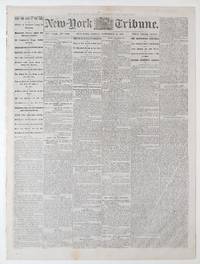
1863Best.-Nr. 372898New York 1863. 8pp. printed in six columns on a single folded sheet. Large folio. Disbound. Natural paper flaw to first leaf not affecting text of the Gettysburg Address. Cloth portfolio. 8pp. printed in six columns on a single folded sheet. Large folio. The complete issue of the New-York Tribune printing the Gettysburg Address on the morning of Nov. 20 1863 the first possible date of the speech's printing. The previous day Lincoln delivered his great address at the dedication of a cemetery on the Gettysburg battlefield four months after the bloody and pivotal battle that turned the tide of the Civil War in favor of the Union. Lincoln's speech was preceded by an address from Edward Everett the most famous orator of his day. Everett's speech took between ninety minutes and two hours to deliver and today is largely forgotten. Lincoln's speech delivered in only a few minutes stands as a supreme distillation of American values and of the sacrifices necessary for the survival of liberty and freedom. Much controversy surrounds the circumstances and content of the address as it was actually delivered at Gettysburg. The words spoken in the speech differ in the versions appearing in newspapers and the text which appeared in Washington several days later published as The Gettysburg Solemnities and known in only four copies which is now taken as the closest version to Lincoln's final intent because of its correspondence to the known manuscript versions. Interestingly and according to Carbonell the text of the first appearance of the speech in book form published a few days later as An Oration Delivered on the Battlefield of Gettysburg is taken largely from this New York Tribune printing. As it appears here the address corresponds closely to the transcription printed in the same day's edition of the New York Times with slight variations in punctuation and capitalization "Four score and seven years ago our fathers brought forth on this continent a new Nation." in the Tribune versus "Fourscore and seven years ago our Fathers brought forth on this Continent a new nation." in the Times e.g. The address is printed on the first page at the bottom of the fifth column running to the top of the sixth. Significantly it notes the five places during Lincoln's speech where applause broke out thereby providing an important historical record of the reception of the speech as it was delivered by Lincoln. It is noted that the conclusion of the speech was met with "long continued applause" and that "three cheers were here given for the President and the Governors of the States." Lincoln's speech is preceded by the opening prayer of the Rev. Thomas H. Stockton and followed by Everett's speech which occupies the rest of the sixth column and the vast majority of space on page two. War news occupies the other column space on the front page. Together with examples from other newspapers of Nov. 20 1863 this issue of the New-York Tribune represents the first appearance of any version of the Gettysburg Address in print although at some variance with the version Lincoln eventually disseminated. The exact order in which the morning editions of November 20 were printed is practically impossible to determine at this point and as Carbonell states "will almost certainly never be known." Rightfully so Carbonell includes all November 20 morning newspaper printings of the Gettysburg Address as his first entry with no priority. Suffice to say this is as early a printing of one of the foundational documents of American life as one can ever encounter. "Lincoln's speech composed on the train on the way to Gettysburg and written down according to tradition on scratch-paper and the backs of envelopes comprised ten sentences and took only a few minutes to deliver. From the first words - 'Four score and seven years ago' - to the last - 'that government of the people by the people and for the people shall not perish from the earth' - it is immortal one of the supreme utterances of the principles of democratic freedom" PMM. Carbonell 1. Grolier American 100 72 ref. Streeter Sale 1748 ref. PMM 351 ref. Howes E233 ref. Monaghan 192 ref. Paul M. Angle "Four Lincoln Firsts" in Papers of the Bibliographical Society 36 Spring 1942 pp.13-17 unknown books
1794Best.-Nr. 66806London: printed for J. Owen No. 168 Piccadilly 1794. First edition 8vo pp. 56 4 ads; unbound; stitched as issued; very good. Not found in OCLC under this title but apparently the same text as State of the Country in the Month of November 1794. By Abraham Jones also in 56 pages. printed for J. Owen, No. 168, Piccadilly unknown books
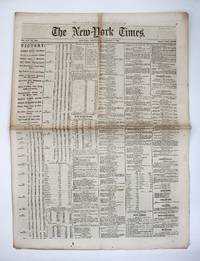
1864Best.-Nr. 369148New York 1864. 8pp. Oblong folio. Central fold with small fading else fine. 8pp. Oblong folio. Reads on left column in part: VICTORY! Glorious rsult Yesterday. Election of Lincoln and Johnson. Terrible Defeat of McClellan." Haedlines show a little editorializing even then. unknown books
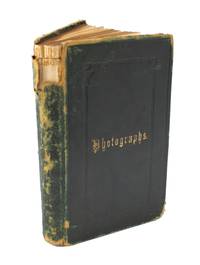
1864Best.-Nr. 175101864. Abraham Lincoln and Civil War Figures Album of pasted oval portraits with signatures underneath each image. 1861. Features most notably Abraham Lincoln with a pasted signature below his image. This mid-nineteenth-century photographic album assembles oval portraits of political and military figures during the Civil War era including a pasted signature beneath an engraved portrait of Abraham Lincoln on the 15th page. Dated inscriptions from 1861 situate the compilation at the outset of national conflict. The inclusion of Lincoln Henry Clay and numerous uniformed figures reflects contemporary practices of collecting and memorializing political leadership through photographic reproduction and autograph acquisition. Photographic album measuring approximately 4.5 x 7 inches. Dark green morocco boards with gilt "Photographs" title. Contains 93 black-and-white and sepia portraits most approximately 2.5 x 2.25 inches mounted on pages. Lincoln portrait with separate pasted signature "A. Lincoln"; Henry Clay portrait with pasted signature; additional signatures written directly on album leaves. Spine chipped at head with separation; rubbing along margins; binding intact; photographs generally clear with minor age toning. Overall condition very good. he album reflects nineteenth-century commemorative culture preserving images and autographs of national figures during a transformative political moment. unknown books
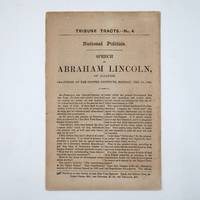
1860Best.-Nr. 367583New York: Office of the New York Tribune 1860. First edition Monaghan's first issue. 1 2-15 1pp. Lincoln's speech comprises pages 1-11 out of a total of 16 pages. With New York Tribune ads and subscription terms on rear wrapper. 8vo. Stitched self-wrappers minor toning minor chip to terminal leaf. First edition Monaghan's first issue. 1 2-15 1pp. Lincoln's speech comprises pages 1-11 out of a total of 16 pages. With New York Tribune ads and subscription terms on rear wrapper. 8vo. This address made at the Cooper Institute in New York on February 27 1860 catapulted Lincoln into the public eye and made him a viable presidential candidate. Indeed many historians have considered it the key to his success in the 1860 election and it is probably the most important speech Lincoln made after the Gettysburg Address and his inaugural addresses. The Cooper Union address was months in preparation; Lincoln was fully aware of its importance in moving himself from a regional favorite son to a viable national candidate. In the event some 1500 people including many prominent political figures attended on a snowy new York evening. The speech divides into three major parts. In the first Lincoln addressed the spread of slavery arguing that the framers of the constitution had been opposed to it and that the Federal government could regulate the question. In the second he argued that the Republicans were not a sectional Northern party and attacked the threats of southern Democrats to secede if the Republicans should win the election. Finally he addressed his fellow Republicans calling on them to act carefully and do "nothing through passion and ill temper.Let us have faith that right makes might and in that faith let us to the end dare to do our duty as we understand it." The Cooper Union speech was a resounding success. Horace Greeley described it as "one of the happiest and most convincing political arguments ever made in this City. No man ever made such an impression on his first appeal to a New York audience." Greeley quickly issued the speech in the form of this "Tribune Tract." It includes a final page of advertisements for other Tribune publications. The speech was later widely reprinted and made Lincoln nationally famous. This printing differs from other editions by its inclusion of a speech by James Doolittle Senator from Wisconsin and the message of Samuel Medary Democratic governor of the Kansas Territory vetoing the Kansas abolition bill. "The Cooper Union address tested whether Lincoln's appeal could extend from the podium to the page and from the rollicking campaigns of the rural West to the urban East. Cooper Union held the promise of transforming Lincoln from a regional phenomenon to a national figure. Lincoln knew it and rose to the occasion" Harold Holzer Lincoln at the Copper Union: The Speech That Made Abraham Lincoln President. Monaghan 50 Office of the New York Tribune unknown books
1949Best.-Nr. 327086Chicago: Chicago Illinois Midland Railway Company 1949. Folio. Framed and glazed total dimensions 795 x 718 mm. Folio. Chicago Illinois Midland Railway Company unknown books
1909Best.-Nr. 256570New York: Privately Printed by the De Vinne Press 1909. First edition one of 300 copies. Frontispiece portrait and 7 other photographs and a colored Jock Scott fly at the end. xii 266 pp. 1 vols. 8vo. Original green cloth t.e.g. Light shelfwear title page foxed else near fine. First edition one of 300 copies. Frontispiece portrait and 7 other photographs and a colored Jock Scott fly at the end. xii 266 pp. 1 vols. 8vo. Scarce privately printed work with considerable sporting content. Pp. 123 to 266 comprise the Logbook of Camp Albany on the Ristigouche River with entries from 1883 to 1898 on angling hunting and social topics. A prefatory note quotes from Dean Sage's classic book and an afterword by Charles H. Raymond offers an appreciation of Abraham Lansing 1835-1899 of Albany New York: "To watch his tall graceful form while casting on the river was to see the exemplar of the accomplished fisherman; the man the rod the line were together but the extension and the completion of artistic and practical perfection". Wetzel p. 174; Bruns L39; Bibliotheca Salmo Salar 107 Privately Printed [by the De Vinne Press] unknown books
1959Best.-Nr. 193742Springfield IL: State of Illinois 1959. First edition. Softcover 24 pages. Features an introduction by Clyde C. Walton. Reproduces ten letters by Abraham Lincoln along with transcriptions of them as well. A very good copy in stapled wrappers with some minor wear. State of Illinois unknown books
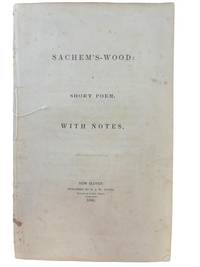
1838Best.-Nr. 93824New Haven: B. & W. Noyes 1838. 1st ed. Paperback. Good. 30p. Softcover. Disbound removed from a bound volume with stitch marks etc. along left side. 22 cm. Original wrapper not preserved. Modest foxing almost entirely confined to the outer leaves. Later stitching. Contents otherwise sound and clean. B. & W. Noyes paperback books
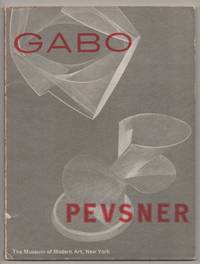
1948Best.-Nr. 195846New York: The Museum of Modern Art 1948. First edition. Softcover. Joint exhibition catalog for these two brothers who were both Russian artists. Features Herbert Read's essay "Constructivism: The Art of Naum Gabo and Antoine Pevsner" along with biographies of the two men by Ruth Olson and Abraham Chanin. Includes numerous black and white illustrations. A very good copy in wrappers with some slight wear along the spine and some other minor wear. Internally a clean copy. The Museum of Modern Art unknown books
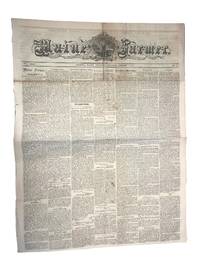
1863Best.-Nr. 182911863. Maine Farmer. January 8 1863 prints the full text of Abraham Lincoln's Emancipation Proclamation within one week of its issuance providing contemporaneous evidence of how federal emancipation policy was circulated to the Northern public during the Civil War. Published just days after January 1 1863 the issue situates emancipation alongside ongoing war reporting integrating the declaration of freedom for enslaved people in Confederate states into the broader military and political narrative of the Union war effort. Introduced under the subheading "The following is the text of the President emancipating the slaves in the rebellious states" the proclamation asserts federal authority through wartime powers declaring that "all persons held as slaves within said designated States and parts of States are and henceforward shall be free" and further authorizes the enlistment of Black men into the armed forces. The proximity of this text to battlefield reports and personal correspondence underscores the immediacy with which emancipation entered public discourse as both military strategy and social transformation. Maine Farmer. Vol. not stated. Maine January 8 1863. 4 pages. Newspaper format. The Emancipation Proclamation appears in full on the second page accompanied by additional Civil War coverage including reports of troop movements battle outcomes and casualties. On the same page a letter from a Union soldier of the 16th Maine Regiment written at the Battle of Fredericksburg reads in part: "Dear Father I write you while lying on the battlefield wounded perhaps fatally. Tell mother I think of her while lying here and wish I had her to be with me in my last parting moments." An editorial note explains that the letter was written in pencil on the battlefield the paper "tinged with blood" and that the soldier died the following day linking the proclamation directly to the lived experience of wartime sacrifice. Issued at a turning point in the Civil War the publication captures the intersection of emancipation policy military necessity and public communication in the Union states. The inclusion of both the proclamation and firsthand testimony from the battlefield demonstrates how questions of slavery citizenship and national survival were experienced simultaneously at the level of policy and individual life. Newspapers such as this served as primary vehicles through which federal decisions reached civilian audiences shaping understanding of the war's aims and consequences. Small edge tears and light foxing present not affecting text. Overall very good. unknown books
1905Best.-Nr. 327084Chicago: Illinois Central Railroad Company 1905. 200 copies this is one of Fourteen Copies Printer's Edition By Permission #6. illustrated throughout with photogravures of Lincoln documents in the ICRC collection. 4to. Full pebbled limp pebbled black morocco with gilt stamping on upper cover "Compliments of the Illinois Central Railroad Company." Laid into full orange cloth dropbox with gilt stamp "Collection of Foreman M. Lebold. 200 copies this is one of Fourteen Copies Printer's Edition By Permission #6. illustrated throughout with photogravures of Lincoln documents in the ICRC collection. 4to. Provenance: Lou F. English this copy presented by Walter J. Gunthorp to Lou F. English.; Foreman M. Lebold lettering to clamshell box Illinois Central Railroad Company unknown books
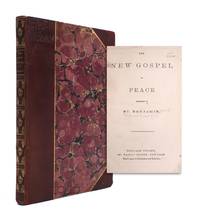
1864Best.-Nr. 334954New York: Sinclair Toussey 121 Nassau Street parts 1 and 2 . Sinclair Tousey Succeeded by the American News Company part 3 1864. 42; 48; 47 1pp. Original wrappers bound in. 8vo. Later half burgundy dyed calf and marbled paper covered boards. Provenance: Sondley Reference Library with bookplate and other markings. 42; 48; 47 1pp. Original wrappers bound in. 8vo. The first three of an eventual four parts to this Lincoln satire written in Bibilical style and attributed to journalist and social critic Richard Grant White writing under the pseudonym of "St. Benjamin." Howes W368 Sinclair Toussey 121 Nassau Street [parts 1 and 2] ... Sinclair Tousey Succeeded by the American News Company [part 3] unknown books
1941Best.-Nr. 320873New York: Newhouse Galleries 1941. Presentation manuscript accomplished by Paul Hessemer for Newhouse Galleries illustrated with a photographic portrait of the painting. With typed letters signed from E.J. Rousuck to Allan P. Kirby and a contemporary copy of a letter to John Hay Whitney offering the portrait. With the original label from an 1869 exhibition of the painting at the Pennsylvania Academy of Fine Arts. 4to. Bound in full blue morocco lettered in gilt silk endpapers. Presentation manuscript accomplished by Paul Hessemer for Newhouse Galleries illustrated with a photographic portrait of the painting. With typed letters signed from E.J. Rousuck to Allan P. Kirby and a contemporary copy of a letter to John Hay Whitney offering the portrait. With the original label from an 1869 exhibition of the painting at the Pennsylvania Academy of Fine Arts. 4to. An elaborate brochure for the sale of this important portrait offered to Allan Kirby and John "Jock" Hay Whitney just days before Pearl Harbor. Newhouse Galleries unknown books