27.519 Ergebnisse
1980Best.-Nr. LFA01a65Une plaquette de 60 pages, format 135 x 215 mm, brochée, publiée en 1980, Editions du Cerf - Vie Montante
1981Best.-Nr. LFA01a66Une plaquette de 58 pages, format 135 x 215 mm, brochée, publiée en 1981, Editions du Cerf - Vie Montante
1981Best.-Nr. LFA01a67Une plaquette de 62 pages, format 135 x 215 mm, brochée, publiée en 1981, Editions du Cerf - Vie Montante
1981Best.-Nr. LFA01a68Une plaquette de 62 pages, format 135 x 215 mm, brochée, publiée en 1981, Editions du Cerf - Vie Montante
1981Best.-Nr. LFA01a69Une plaquette de 62 pages, format 135 x 215 mm, brochée, publiée en 1981, Editions du Cerf - Vie Montante
1982Best.-Nr. LFA01a6aUne plaquette de 62 pages, format 135 x 215 mm, brochée, publiée en 1982, Editions du Cerf - Vie Montante
Best.-Nr. 3094P., Gauthier-Villars, 1905, 2 fort volumes in 8 brochés couvertures imprimées, 16pp., 1138pp.
Best.-Nr. LBW02e5eAmsterdam circa 1720 368 x 429 mm.
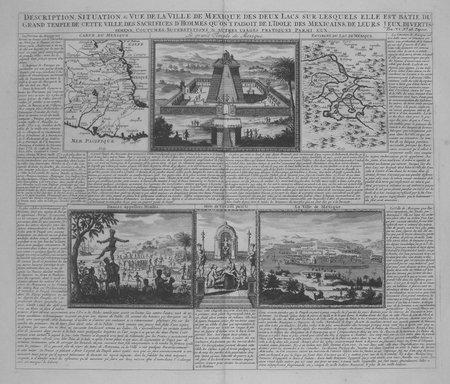
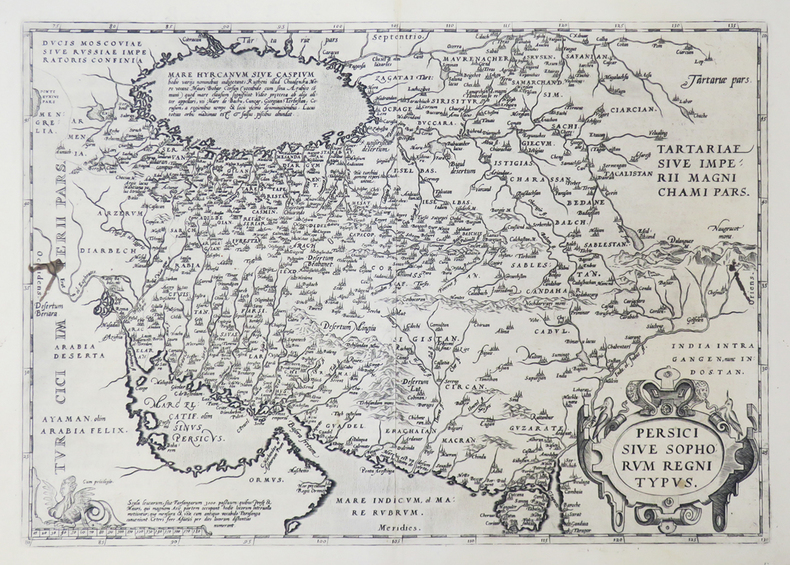
1592Best.-Nr. LBW0251e[Anvers, 1592]. 349 x 496 mm.
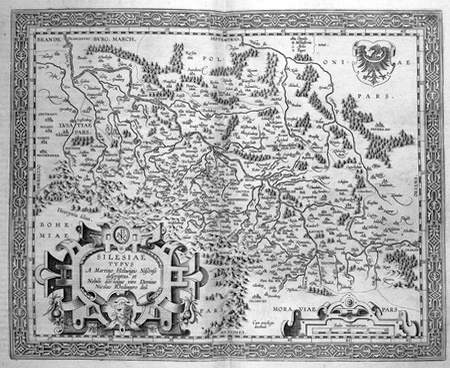
1603Best.-Nr. LBW02528[Anvers, 1603]. 344 x 420 mm.
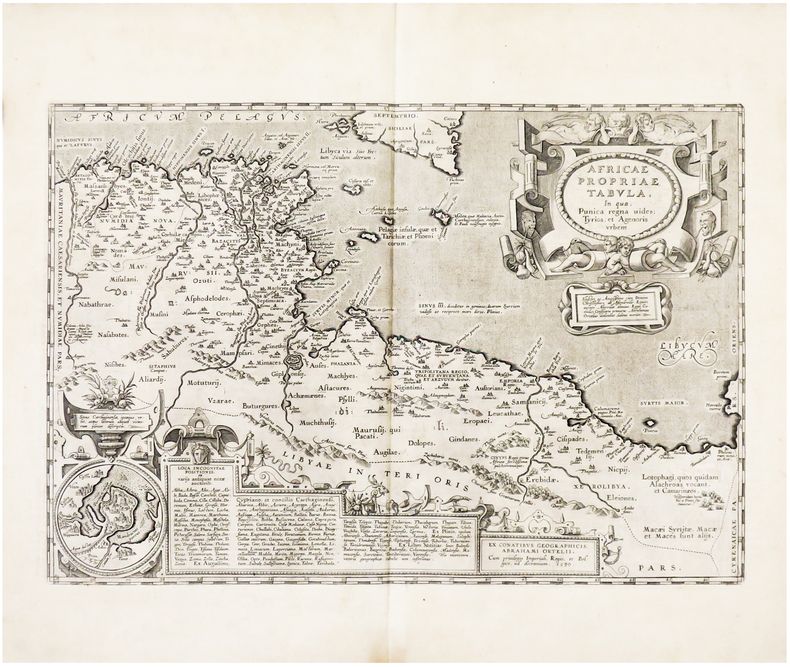
1608Best.-Nr. LBW01b3a[Anvers, 1608]. 335 x 486 mm.
Best.-Nr. 3095P., Gauthier-Villars, 1905, 2 fort volumes in 8 reliés en demi-basane marron, dos ornés de filets dorés (reliures de l'époque), (dos frottés), 16pp., 1138pp.
Best.-Nr. 4530New Haven, Yale University Press, 1979, 3 VOLUMES in 4 reliés en pleine toile éditeur, T.1 : 1 portrait, 37pp., 694pp., T.2 : 1 portrait, 45pp., 582pp., T.3 : 1 portrait, 32pp., 270pp.
1992Best.-Nr. LFA00ee8Un ouvrage de 439 pages, format 240 x 150 mm, illustré, broché couverture couleurs, publié en 1992, Editions France-Empire, bon état
1864Best.-Nr. 376854Np 1864. Broadside 9-3/4x8-3/4 inches. Remnants of prior mounting on verso small separation at horizontal fold repaired with tape. Broadside 9-3/4x8-3/4 inches. Rare broadside or handbill printing of the famous telegram sent by Abraham Lincoln to General George B. McClellan early in the Civil War expressing his frustration at McClellan's unwillingness to engage the enemy during the Peninsular Campaign and urging him in no uncertain terms to attack the Confederates. Lincoln uses a combination of reason force assessment and strategic reasoning in an attempt to draw McClellan into the fight famously concluding "you must act." This small broadside was published either in an effort to galvanize the public into pressuring the always reluctant McClellan to engage Confederate forces under General Joseph E. Johnston or perhaps as a campaign piece for the Election of 1864 to remind voters of McClellan's failures as a leader. Six months following its stinging defeat at the Battle of Bull Run the Union Army was reorganized trained and reformed into the Army of the Potomac by Major General George B. McClellan. After four months of training and reorganization however McClellan had done little more with his troops than run drills and reviews. In December 1861 President Lincoln took matters into his own hands and proposed the Peninsular Campaign March 1862 - July 1862 against Johnston's Confederate forces in which the Army of the Potomac would use a flanking attack in the nearby Occoquan Valley to capture Johnston and his army. McClellan rejected Lincoln's plan in favor of his own which consisted of a flanking movement much further south without leaving enough troops behind to protect Washington. Although Lincoln eventually acceded to McClellan's plan he held back the First Corps of the Army of the Potomac under the command of General McDowell for the protection of Washington. McClellan's plans were thwarted by Johnston who had in the interim moved the Confederate forces further south causing McClellan to march his men all the way to Yorktown deep in the Virginia peninsula. Instead of mounting a direct attack against the 17000 Confederates near Yorktown with his massive contingent of 70000 Union soldiers McClellan always overestimating Confederate forces and always fearful of failure took the safer route and laid siege to Yorktown which allowed Johnston to move his whole army down to Yorktown in opposition. In an April 7th telegram to Lincoln McClellan firm in his belief that he was always outnumbered by the Confederate forces complained that Lincoln held back too many troops for the protection of Washington which hamstrung his efforts for a successful campaign. In the present telegram to McClellan composed on April 9 Lincoln patiently responds: "Your dispatches complaining that you are not properly sustained while they do not offend me pain me very much." Lincoln continues "After you left to begin the Peninsular Campaign I ascertained that less than 20000 unorganized men without a field battery were all you designed should be left for the defense of Washington.This presented or would present.a great temptation for the enemy to turn back from the Rappahannock and sack Washington.My explicit directions that Washington sustained by the judgment of all the commanders of corps should be left secure had been entirely neglected. It was precisely this that drove me to detain McDowell." Lincoln refutes McClellan's belief that he did not have enough troops by using McClellan's own troop estimates obtained from the Secretary of War to argue McClellan into action stating that when "the whole force which has gone forward to you is with you.I think it is the precise time for you to strike a blow." Lincoln patiently tries to convince McClellan of the consequences of his inaction: "the enemy will readily gain on you; that is he will gain faster by fortifications and re-enforecments than you can by re-enforcements alone" and forcefully concludes "And once more let me tell you it is indispensable to you that you strike a blow." Lincoln then shows his brilliance as a judge of character addressing McClellan's fear of failure by holding up the public consequences of his inaction: "The country will not fail to note - is now noting - that the present hesitation to move upon an intrenched sic enemy is but the story of Manassas repeated." Then knowing by experience of McClellan's personal defensiveness Lincoln concludes in the words of Lincoln biographers John G. Nicolay and John M. Hay "with as much consideration and kindness as a father would use towards a querulous and petulant child." He ends his telegram writing "I beg to assure you that I have never written you or spoken to you in greater kindness of feeling than now nor with a fuller purpose to sustain you so far as in my most anxious judgment I consistently can. But you must act." Ultimately the Peninsular Campaign failed and the Army of the Potomac withdrew from the Virginia Peninsula in July 1862. By November of 1862 Lincoln frustrated with McClellan's lack of initiative on the field finally removed him from command and replaced him with General Ambrose Burnside as commander of the Army of the Potomac. Lincoln would later encounter McClellan as his Democratic adversary in the Presidential election of 1864 easily defeating him. OCLC lists just six copies located at New York Historical Society University of Delaware Abraham Lincoln Presidential Library Boston Athenaeum Library Company of Philadelphia and the Huntington Library. A rare and important printing of one of Lincoln's most famous messages of the Civil War. Nicolay John G. and John Hay. Abraham Lincoln: A History New York: The Century Company 1890 Volume 5 p.362 unknown books
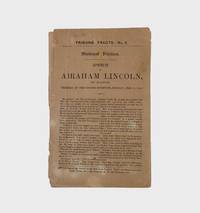
1860Best.-Nr. 376855New York: Office of the New York Tribune 1860. First edition Monaghan's first issue. 1 2-15 1pp. With New York Tribune ads and subscription terms on verso of the terminal leaf. 8vo. Stitched self-wrappers toning. First edition Monaghan's first issue. 1 2-15 1pp. With New York Tribune ads and subscription terms on verso of the terminal leaf. 8vo. This address made at the Cooper Institute in New York on February 27 1860 catapulted Lincoln into the public eye and made him a viable presidential candidate. Indeed many historians have considered it the key to his success in the 1860 election and it is probably the most important speech Lincoln made after the Gettysburg Address and his inaugural addresses. The Cooper Union address was months in preparation; Lincoln was fully aware of its importance in moving himself from a regional favorite son to a viable national candidate. In the event some 1500 people including many prominent political figures attended on a snowy new York evening. The speech divides into three major parts. In the first Lincoln addressed the spread of slavery arguing that the framers of the constitution had been opposed to it and that the Federal government could regulate the question. In the second he argued that the Republicans were not a sectional Northern party and attacked the threats of southern Democrats to secede if the Republicans should win the election. Finally he addressed his fellow Republicans calling on them to act carefully and do "nothing through passion and ill temper.Let us have faith that right makes might and in that faith let us to the end dare to do our duty as we understand it." The Cooper Union speech was a resounding success. Horace Greeley described it as "one of the happiest and most convincing political arguments ever made in this City. No man ever made such an impression on his first appeal to a New York audience." Greeley quickly issued the speech in the form of this "Tribune Tract." It includes a final page of advertisements for other Tribune publications. The speech was later widely reprinted and made Lincoln nationally famous. This printing differs from other editions by its inclusion of a speech by James Doolittle Senator from Wisconsin and the message of Samuel Medary Democratic governor of the Kansas Territory vetoing the Kansas abolition bill. "The Cooper Union address tested whether Lincoln's appeal could extend from the podium to the page and from the rollicking campaigns of the rural West to the urban East. Cooper Union held the promise of transforming Lincoln from a regional phenomenon to a national figure. Lincoln knew it and rose to the occasion" Harold Holzer Lincoln at the Copper Union: The Speech That Made Abraham Lincoln President. Monaghan 50 Office of the New York Tribune unknown books
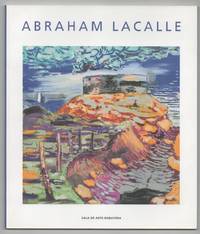
2015Best.-Nr. 217509Cantabria Spain: Sala De Arte Robayera 2015. First edition. Softcover. 26 pages. Exhibition catalog for a show that ran June 27 through July 25 2015. Text in Spanish. Features an essay by Pedro G. Romero. Includes numerous color illustrations list of previous exhibitions and other biographical information. A fine copy in French style wrappers. Uncommon. Sala De Arte Robayera unknown books
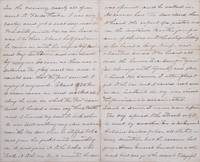
1865Best.-Nr. 376410Montauk Montauk Navy Yard Wash D.C. 1865. 4 pp. 8vo. Slight soiling and minor tears along old folds otherwise in very good condition. 4 pp. 8vo. ".About 10:25 P.M. a man came in and walked slowly along the side." A remarkably clear and dramatic eyewitness account of the assassination of Abraham Lincoln from a naval surgeon who was close to the President's box at Ford's theater on that fateful night of April 14 1865. In this letter to his brother written the night after the assassination while the details were still fresh in his memory Dr. George B. Todd surgeon aboard the U.S. "Montauk" at anchor in the Navy Yard that day recounts the terrible event with a clarity of observation one might expect of his profession-a rarity among confused eyewitness accounts. The text of Todd's letter one of only 7 eyewitness accounts written within 24 hours of the assassination reads: "The few hours that have intervened since that most terrible tragedy of last night have served to give me a little clearer brain and I believe I am now able to give you a clear account up to this hour. Yesterday about 3 P.M. the President and wife drove down to the navy yard and paid our ship a visit going all over her accompanied by us all. Both seemed very happy and so expressed themselves - glad that this war was over or so near its end and then drove back to the White House. In the evening nearly all of us went to the Ford's Theatre. I was very early and got a seat near the President's private box as we heard he was to be there. About half past nine he came in with his wife a Miss Harris and Major Rathburn and was cheered by every one. As soon as there was a silence the play went on and I could see that the "pres." seemed to enjoy it very much. About 10:25 P.M. a man came in and walked slowly along the side on which the 'pres.' box was and I heard a man say "there's Booth" and I turned my head to look at him. He was still walking very slow and was near the box door when he stopped took a card from his pocket wrote something on it and gave it to the usher who took it to the box. In a minute the door was opened and he walked in. No sooner had the door closed then I heard the report of a pistol and on the instant Booth jumped out of the box onto the stage holding in his hand a large knife and shouted so as to be heard all over the house - 'Sic Semper Tyrannis' "so always with tyrants" and fled behind the scenes-I attempted to get to the box but I could not and in an instant the cry was raised 'The President is Assassinated.' "Such a scene I never saw before. The cry spread to the street only to be met by another 'So is Mr. Seward.' Soldiers had gone. Some General handed me a note and bid me go to the nearest telegraph office and arouse the nation. I ran with all my speed and in ten minutes the sad news was all over the country. Today all the city is in mourning nearly every house being in black and I have not seen a smile. No business and many a strong man I have seen in tears. "Some reports say Booth is a prisoner others that he has made his escape but from orders received here I believe he is taken as a mob once raised now would know no end. I will not seal this until morning and I may have some more news. "April 24th. "I have had no time to write until now as I have been a detective. We have now 7 that are implicated. Why don't you write Love to all George" Several important facts regarding the movements of both the President and John Wilkes Booth are recorded here: 1 This appears to be the only eyewitness account of the President's inspection of the "Montauk" earlier that afternoon. 2 Todd's account of Booth's interaction with the "usher" sitting outside the President's box "took a card from his pocket wrote something on it and gave it to the usher" is especially intriguing and reveals not only something of Todd's powers of observations but also his proximity to the assassin immediately before the shooting. Todd alone among eyewitnesses notes that the "usher" first took the card from Booth then went into the box and that a short time later the door opened and Booth went in. In fact Good finds only 7 other eye-witness accounts of the Lincoln assassination as early as April 15-most of these witnesses record little or nothing regarding the events before hearing the shot itself and none of them noticed Booth's interchange with the usher who was in fact Lincoln's valet Charles Forbes. There are three other accounts by eyewitnesses which partially corroborate Todd's observation of the Forbes and Booth interchange-but they were written much later than Todd's. 3 Todd's observation of the time he spotted Booth moving toward the box "about 10:25" corresponds to Good's own conclusion that Booth fired the fatal shot close to 10:30 PM. According to James Swanson MANHUNT p. 419 "the exact time of Booth's shot cannot be fixed . Booth may have shot Lincoln as early as 10:13 or as late as 10:30" Todd's account - again one of the freshest and most reliable weighs heavily in favor of Good. 4 Todd by his own account played a role in alerting the nation by telegraph. 5 Although he doesn't mention it as a surgeon of the ironclad Montauk Todd was also probably present at the autopsy of John Wilkes Booth on Thursday April 27 in the gun room of his ship. Indeed in an article in the February issue of the Baltimore and Ohio Magazine 1926 where the letter was first published and reproduced Todd is reported to have been "one of the surgeons who performed the autopsy." That as well as the fact that the other prisoners were being held on board the ironclad "Montauk" and "Saugus" may explain his cryptic remark near the end ". I have been a detective .". Todd actually mailed the letter on April 30 3 days after the autopsy and may very have participated in the actual investigation of the captives aboard the "Montauk." AN EXTRAORDINARY AND UNIQUE RECORD OF ONE THE NATION'S GREAT TRAGEDIES. Published from a copy in the State Historical Library of Wisconsin in Timothy S. Good WE SAW LINCOLN SHOT U. of Miss. 1995; with the mistaken date of April 30 1865 unknown books
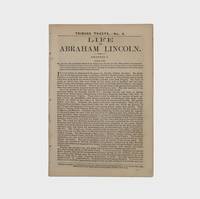
1860Best.-Nr. 377692New York: Horace Greeley & Co 1860. 32pp. 8vo. Disbound. 32pp. 8vo. An early campaign biography of future president Abraham Lincoln written by John Locke Scripps of the New York Tribune. Scripps reports on the life of Abraham Lincoln in eight chapters touching on the major events of his life and career beginning with his early life and his move to Illinois through his transition from merchant to lawyer and legislator and covering his time in Congress with accounts of Lincoln's opposition to the Mexican-American War his support of the Wilmot Proviso and his involvement with the organization of the Republican Party. Wessen states that this edition was printed by Horace Greeley "from plates cast from the same type forms" as the 1860 Chicago edition which is considered the first published biography of Lincoln. An advertisement for the Tribune and the Tribune Almanac fills the bottom two thirds of the last page. "Most authentic of Lincoln campaign biographies" - Howes. Howes S247a "aa"; Managhan 79 note; Wessen Campaign Lifes of Abraham Lincoln 12 ref; Miles 418a; Abraham Lincoln: His Life in Print p. 85 Horace Greeley & Co unknown books
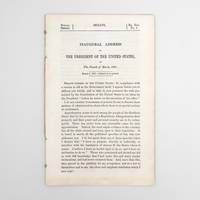
1861Best.-Nr. 377680Washington D.C.: Government Printing Office 1861. Special Session Senate Ex. Doc. No. 1. 10pp. 8vo. Disbound. Housed in a cloth box. Special Session Senate Ex. Doc. No. 1. 10pp. 8vo. Lincoln began drafting his first inaugural in Springfield soon after his election hoping the speech would impart a spirit of reconciliation toward the seceded states. His speech balances his pledge to protect Federal property in the south while insisting that he would not use military force unless attacked first. In all he eloquently argues against secession presenting the United States as undissolvable. Lincoln ends his speech with the memorable lines: "We are not enemies but friends. We must not be enemies. Though passion may have strained it must not break our bonds of affection. The mystic chords of memory stretching from every battle-field and patriot grave to every living heart and hearth-stone all over this broad land will yet swell the chorus of the Union when again touched as surely they will be by the better angels of our nature." "Lincoln became President on March 4 1861. Before being sworn in he gave his First Inaugural Address devoting it entirely to the secession crisis. It was the linguistic equivalent of an optical illusion: one could view it two ways. As historians have noted he seemed to placate the South; he would not 'interfere with the institution of slavery in the States where it exists.' This language was the old Lincoln . The new Lincoln was a resolute executive who had no choice but to enforce the Constitution a contract that does not allow states to withdraw from it unilaterally. In his enforcement there would be no bloodshed 'unless it be forced upon the national authority" Mazy Boroujerdi editor Abraham Lincoln: His Life in Print p. 108. Lincoln had begun writing his inaugural the month prior before leaving Springfield and once in Washington asked William Seward to review the draft. It was Seward who suggested softening the tone so as not to appear too inflammatory suggesting "a nostalgic call for unity emphasizing the country's shared history. Lincoln embraced the idea but massaged it into near poetry. Seward's prosaic text ended up as Lincoln's oft quoted appeals to the 'mystic chords of memory' and 'the better angels of our nature.' The words did nothing to reverse disunion" Ibid. p. 97. This is the official government printing of Lincoln's first inaugural address issued as a document of a special session of the Senate printed by their order four days after its delivery being only the second printing overall of the memorable speech. Monaghan 102; Abraham Lincoln: His Life in Print p. 108 [Government Printing Office] unknown books
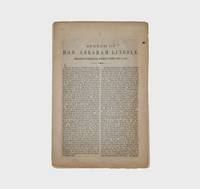
1858Best.-Nr. 376861Springfield IL 1858. 8pp. printed in double columns. 8vo. Unbound. Minor toning. Housed in a cloth box. 8pp. printed in double columns. 8vo. The only separate printing of this address given by Lincoln at Springfield Illinois. Lincoln's speech which preceded his debates with Douglas puts forth the great themes that marked his political philosophy during the last ten years of his life. More importantly it firmly placed Lincoln as against the expansion of slavery and Douglas on the opposite side of the issue. By targeting Douglas a strategy that resurrected Lincoln's political career he made his fellow Illinoisan out to be the embodiment of the wicked forces safeguarding slavery's expansion . This speech is Lincoln's opening salvo against Douglas for the 1858 senate campaign: 'Free men of Illinois - free men of everywhere - judge ye between him and me'" Abraham Lincoln: His Life in Print p. 67 Urging that slavery be placed on course for "ultimate extinction" he repeats his "House Divided" warning first given at the State Republican Convention a month earlier. He insists that the Kansas-Nebraska bill was "the beginning of a conspiracy" to nationalize slavery. Attacking Douglas and defending himself against the charge that he would "invite a war of sections" he stands on "the principles of our Declaration of Independence." Though African Americans are not the equal of whites "in all respects" the Declaration "does mean to declare that all men are equal in some respects; they are equal in the right to 'life liberty and the pursuit of happiness.'" Most significantly "In the right to put into his mouth the bread that his own hands have earned he is the equal of every other man white or black." A scarce Lincoln speech. Monaghan 12; Byrd 2960 unknown books
1844Best.-Nr. 209025New York: Harper & Brothers 1844. Hardcover. 461 pages. 1 A later edition of this classic. Features Alison's text with corrections and improvements by Abraham Mills. An about very good copy in cloth boards with wear to the top of the spine. some foxing throughout and the tiny rubber-stamp: Gift of Nathan Lyons 1930-2016 to the front free endpaper. No dust jacket. A solid copy with an interesting provenance. Harper & Brothers unknown books
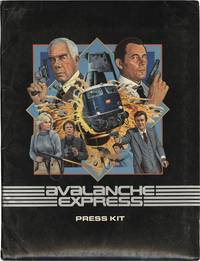
1979Best.-Nr. 151152Los Angeles: Twentieth Century-Fox 1979. Vintage press kit for the 1979 film. Full-color illustrated pocketed folder containing eight black and white photographs housed in a brown paper envelope and ten gatherings of promotional reading material. A defecting Russian general collaborates with an American secret agent to expose KGB spies throughout Europe by luring them onto a train headed west. Director Mark Robson and actor Robert Shaw died of unrelated heart attacks within months of the film's release making the film a final effort for both. Set and shot on location in Germany England Ireland Italy and the US. Folder photographs and promotional material Near Fine. Twentieth Century-Fox unknown books
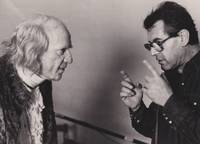
1984Best.-Nr. 170406N.p.: N.p. 1984. Vintage borderless reference photograph from the 1984 film showing director Milo Forman talking with actor F. Murray Abraham on the set. Based on Peter Shaffer's 1979 play. A dramatization of the life of Wolfgang Amadeus Mozart as well as that of his jealous troubled rival Antonio Salieri. Nominated for eleven Academy Awards winning eight including Best Picture and Best Director. Set in Vienna shot on location in Prague Kromeriz and Vienna. 7 x 5 inches. Fine. National Film Registry. Ebert II. N.p. unknown books
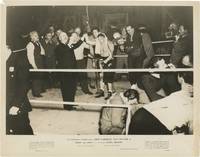
1947Best.-Nr. 172445Beverly Hills CA: United Artists / Enterprise Sudios 1947. Two vintage studio still photographs from the 1947 film noir. One photograph with an Anglo Amalgamated Film Distributed Ltd. stamp on the recto bottom left corner. An amateur prize fighter's desire for fortune and fame leads him to join a corrupt boxing syndicate led by an unethical promoter. Shot on location in New York City. 8 x 10 inches. Very Good plus. Grant US. Olive Films 452. Selby US. Silver and Ward Classic Noir. Spicer US. United Artists / Enterprise Sudios unknown books