Lincoln, AbrahamABAA
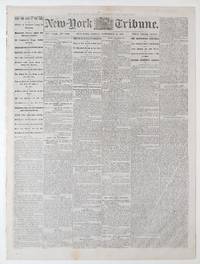
1863Best.-Nr. 372898New York 1863. 8pp. printed in six columns on a single folded sheet. Large folio. Disbound. Natural paper flaw to first leaf not affecting text of the Gettysburg Address. Cloth portfolio. 8pp. printed in six columns on a single folded sheet. Large folio. The complete issue of the New-York Tribune printing the Gettysburg Address on the morning of Nov. 20 1863 the first possible date of the speech's printing. The previous day Lincoln delivered his great address at the dedication of a cemetery on the Gettysburg battlefield four months after the bloody and pivotal battle that turned the tide of the Civil War in favor of the Union. Lincoln's speech was preceded by an address from Edward Everett the most famous orator of his day. Everett's speech took between ninety minutes and two hours to deliver and today is largely forgotten. Lincoln's speech delivered in only a few minutes stands as a supreme distillation of American values and of the sacrifices necessary for the survival of liberty and freedom. Much controversy surrounds the circumstances and content of the address as it was actually delivered at Gettysburg. The words spoken in the speech differ in the versions appearing in newspapers and the text which appeared in Washington several days later published as The Gettysburg Solemnities and known in only four copies which is now taken as the closest version to Lincoln's final intent because of its correspondence to the known manuscript versions. Interestingly and according to Carbonell the text of the first appearance of the speech in book form published a few days later as An Oration Delivered on the Battlefield of Gettysburg is taken largely from this New York Tribune printing. As it appears here the address corresponds closely to the transcription printed in the same day's edition of the New York Times with slight variations in punctuation and capitalization "Four score and seven years ago our fathers brought forth on this continent a new Nation." in the Tribune versus "Fourscore and seven years ago our Fathers brought forth on this Continent a new nation." in the Times e.g. The address is printed on the first page at the bottom of the fifth column running to the top of the sixth. Significantly it notes the five places during Lincoln's speech where applause broke out thereby providing an important historical record of the reception of the speech as it was delivered by Lincoln. It is noted that the conclusion of the speech was met with "long continued applause" and that "three cheers were here given for the President and the Governors of the States." Lincoln's speech is preceded by the opening prayer of the Rev. Thomas H. Stockton and followed by Everett's speech which occupies the rest of the sixth column and the vast majority of space on page two. War news occupies the other column space on the front page. Together with examples from other newspapers of Nov. 20 1863 this issue of the New-York Tribune represents the first appearance of any version of the Gettysburg Address in print although at some variance with the version Lincoln eventually disseminated. The exact order in which the morning editions of November 20 were printed is practically impossible to determine at this point and as Carbonell states "will almost certainly never be known." Rightfully so Carbonell includes all November 20 morning newspaper printings of the Gettysburg Address as his first entry with no priority. Suffice to say this is as early a printing of one of the foundational documents of American life as one can ever encounter. "Lincoln's speech composed on the train on the way to Gettysburg and written down according to tradition on scratch-paper and the backs of envelopes comprised ten sentences and took only a few minutes to deliver. From the first words - 'Four score and seven years ago' - to the last - 'that government of the people by the people and for the people shall not perish from the earth' - it is immortal one of the supreme utterances of the principles of democratic freedom" PMM. Carbonell 1. Grolier American 100 72 ref. Streeter Sale 1748 ref. PMM 351 ref. Howes E233 ref. Monaghan 192 ref. Paul M. Angle "Four Lincoln Firsts" in Papers of the Bibliographical Society 36 Spring 1942 pp.13-17 unknown books
1896Best.-Nr. 817511896. Maslan Ben A. Seattle attorney former owner. Maslan Ben A. Seattle attorney former owner. Watt Francis. The Law's Lumber Room. London: John Lane 1896. 139 pp. Octavo 4-1/2" x 7". Cloth uncut edges. Moderate shelfwear some fading to spines. Owner bookplate Ben A. Maslan to front pastedown. Internally clean. A good copy. $50. From the library of Benjamin Abraham Maslan 1901-1979 the great bibliophile and a leading Seattle attorney. Contents: Benefit of Clergy.; Peine Forte et Dure.; A Passage in Shakespeare Fines and Recoveries; The Custom of the Manor.; Deodands.; The Law of the Forest.; Par Nobile Fratrum John Doe and Richard Roe; Sanctuary.; Trial by Ordeal.; Wager of Battle.; The Press Gang.; Sumptuary Laws. unknown books
1818Best.-Nr. 820231818. The End of Trial by Battle in the United Kingdom Broadside. Trial. Thornton Abraham c.1793-1860 Respondent. Appeal of Murder: The Decision of the Judges in the Case of Ashford ver. Thornton Court of King's Bench April 20th 1818. Nottingham: Shorrock and Son Successors to E. Hodson Printers 1818. 12-1/2" x 7-1/2" broadside mounted to later backing sheet text in two columns separated by rule below headline and woodcut vignette of a landscape. Moderate toning light soiling to edges a few faint creases printer's flaw and clean tear to right column no loss to legibility. Rare. $3000. Ashford v. Thornton dealt with the aftermath of the murder of Mary Ashford in 1817. Abraham Thornton who had seen and been intimate with Ashford the previous night was tried for rape and murder but acquitted of both charges due to a lack of evidence and inconsistencies in the prosecutor's case. Public outcry around his acquittal led to Mary's brother William invoking an "appeal of murder." This uncommon legal practice allowed a retrial of a defendant acquitted for murder but crucially gave the defendant the right to trial by battle. Thornton invoked that right. After extensive proceedings in the Court of King's Bench the court found that he was eligible to do so. Our broadside documents the final hearing in which Ashford declined to battle with Thornton and withdrew his appeal. Thornton was given a pro forma arraignment and released. The case resulted in the abolition of appeals by murder and thus the end of trial by battle. This broadside is rare and appears to be unrecorded. No copies located on OCLC or Library Hub. Not at Harvard or the British Library. unknown books
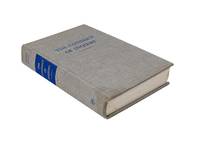
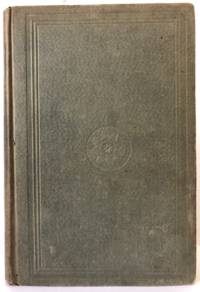
1964Best.-Nr. 813701964. Kaplan Abraham. The Conduct of Inquiry: Methodology for Behavioral Science. San Francisco: Chandler Pub. Co. 1964. xix 428 pp. Publisher's original gray cloth with blue lettering piece. Light soiling previous owner's signature to front free endpaper else very good. $15. In arguably the finest text ever written in the philosophy of social science Abraham Kaplan emphasizes what unites the behavioral sciences more than what distinguishes them from one another. Kaplan avoids the bitter disputes among people doing methodology claiming instead that what is important are those qualities intrinsic to the overall aspirations of the social sciences. He deals with special problems of various disciplines only so far as may be helpful in clarifying the general method of inquiry.Publisher's description. unknown books
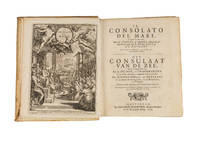
1723Best.-Nr. 805501723. Amsterdam: Salomon Schouten 1723. Amsterdam: Salomon Schouten 1723. Bilingual Edition of an Important Maritime Code Consolato Del Mare. Westerveen Abraham d.1725 Translator. Il Consolato del Mare Nel Quale Si Comprendono Tutti Gli Statuti & Ordini Disposti da Gli Antichi Per Ogni Cosa di Mercantia & di Navigare. Cosi a Beneficio di Marinari Come di Mercanti & Patroni di Nave / Het Consulaat van de Zee Waar in Begreepen Zyn Alle de Keuren en Ordonnantien by de Ouden Gemaakt Aangaande Alderly Gevallen des Koophandels En Zeevaart. Amsterdam: By Salomon Schouten Boekverkooper In de St. Lucye-Steeg 1723. xxxii 533 1; 2 25 73 pp. Copperplate pictorial frontispiece dated 1704. Quarto 8-1/4" x 6-1/2"; 20.95 x 16.51 cm. Contemporary vellum later hand-lettered title to spine. Light soiling and rubbing to boards light scuff to front board spine darkened rear joint partially cracked corners bumped. Moderate toning to interior somewhat heavier in places faint dampstaining to head of text block above headlines faint spotting to sections of text. $1250. Second and final Dutch edition. Italian and Dutch on facing pages. The final section contains in the original Catalan Ordinacions de Tot Vexell qui Armara per Anar en Cors e de Tota Armada Ques Faca per Mar a code dealing with such subjects as piracy. A landmark in the development of maritime law the Consolato del Mare was first published in Barcelona in 1484. A digest of the law and practice commonly followed by the commercial judges in the chief ports around the Mediterranean it became a maritime common law of the Mediterranean and a foundation for subsequent European maritime laws and customs. Its circulation was widest in Italy especially among the Venetians but it was also influential in Western Europe. First published in 1704 Westerveen's translation appeared at a time when Holland was a dominant maritime power with interests in the Atlantic and Pacific worlds. Indeed his introduction and prefatory verse present Holland as the legitimate successor to the previous maritime leaders Spain and Italy. This is why it was time he argued to produce a translation for Dutch readers. The striking frontispiece in our edition by Pieter Sluiter Sluyter 1675-1713 features a large group of men in a classical setting who are acclaiming the Consolato which i. unknown books
1863Best.-Nr. 69186Boston: Boston Daily Courier 1863. Full Description: LINCOLN Abraham. Emancipation Proclamation."President's Proclamation. Emancipation of Slaves in Rebellious States." Boston. Published in: Boston Daily Courier Volume LXXVIII no. 2. Friday Morning January 2 1863. The publication of Lincoln's Emancipation Proclamation in the Boston Daily Courier and one of if not the first official public announcements of the Final Emancipation Proclamation once it was signed and in effect as of January 1 1863. The Proclamation is featured at the top of the center column of page 3. We could find no other copies of this or any other January 2nd edition at auction and it is not mentioned in Eberstadt. Eberstadt's entry for the second edition of the "Final Proclamation" Eberstadt 9 states "Second edition. Apparently the only separate newspaper edition of the final proclamation and the earliest non-official edition. Printed on Friday evening January 2 1863 this Extra in point of chronological sequence was preceded only by the first official edition." Our present copy although not a separate newspaper edition was rushed to press and published in the Friday Morning edition of the Courier placing it's publication prior to Eberstadt 9. According to Eberstadt "A number of newspapers did not issue on January 2nd because of the previous day's holiday but most of those that did carried the final proclamation. Many of the others printed it on January 3rd." pg. 17. Broadsheet folio one large leaf folded along side to make four pages two leaves printed on recto and verso. Seven-column format. 26 x 19 inches; 655 x 490 mm. Light creases down the middle in both directions. A few minor closed tears. A large old ink signature along top margin of front page causing some bleed-through and foxing but not affecting text. Still a very good copy of this important declaration. Abraham Lincoln issued the preliminary Emancipation Proclamation on September 22 1862 stating that if the rebelling states did not cease fighting and rejoin the Union by January 1 1863 the slaves in those states would be set free. Once January 1st 1863 arrived President Lincoln signs and issues the final Emancipation Proclamation freeing the slaves in the Confederate states. The Boston Courier issued this early printing of Lincoln's Proclamation the very next morning January 2 1863. " HBS 69186. $8500. Boston Daily Courier unknown books
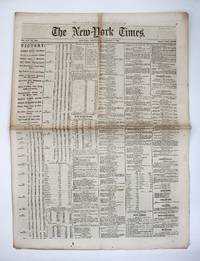
1864Best.-Nr. 369148New York 1864. 8pp. Oblong folio. Central fold with small fading else fine. 8pp. Oblong folio. Reads on left column in part: VICTORY! Glorious rsult Yesterday. Election of Lincoln and Johnson. Terrible Defeat of McClellan." Haedlines show a little editorializing even then. unknown books
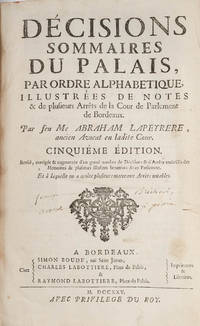
1725Best.-Nr. 787371725. Bordeaux: Chez Simon Boud‚ 1725. Folio. Bordeaux: Chez Simon Boud‚ 1725. Folio. Pre-Revolutionary Law in Action: An Interleaved 1725 Bordeaux Folio Heavily Annotated by Eminent Jurist Francois Brechard Lapeyrere Abraham. Brechard Francois 1770-1843 Annotator. Decisions Sommaires du Palais Par Ordre Alphabetique Illustrees de Notes & De Plusieurs Arrets de la Cour de Parlement de Bordeaux. Par feu Me Abraham Lapeyrere Ancien Avocat en Ladite Cour. Cinquieme Edition. Revue Corrigee & Augmentee d'un Grand Nombre de Decisions & d'Arrets Recueillis des Memoires de Plusieurs Illustres Senateurs de ce Parlement. Et a Laquelle on a Ajoute Plusieurs Nouveaux Arrets Notables. Bordeaux: Chez Simon Boude Rue Saint James Charles Labottiere Place du Palais & Raymond Labottiere Place du Palais Imprimeurs & Libraires 1725. xii 539 7 pp. Interleaved. Folio 14" x 9-1/2"; 35.6 x 24 cm. Contemporary sheep blind rules and cat's-paw decoration to boards gilt spine with raised bands and lettering piece edges rouged. Negligible light rubbing and a few minor scuffs to boards slightly heavier rubbing to extremities corners bumped and somewhat worn. Light toning to interior faint dampspotting and foxing in a few places side-notes affected by trimming in a few places some text leaves have underlining corrections and brief annotations 140 interleaves have annotations main text followed by 16-pp. double-column manuscript index all annotations in a neat contemporary hand signature of annotator Francois Brechard "avocat a Poitiers" to title page. $3500. This interleaved working legal text bridges the complex world of Pre-Revolutionary French customary law coutumes and the legal landscape of the early 19th century. Digested by topic this copy of Lapeyrere's landmark compilation records the decisions of the Parlement of Bordeaux-one of the absolute highest courts of justice under the Ancien Regime. Books like this are vital artifacts of early European legal history for several key reasons: - The Battle for Regional Autonomy Before the Napoleonic Code unified French law in 1804 France was divided into a patchwork of local customary laws. Parlements like the one in Bordeaux did not just try cases; they fiercely protected regional privileges against royal overreach by centralizing local precede. unknown books
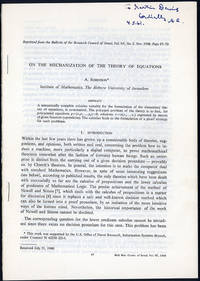
1960Best.-Nr. 516851960. Robinson Abraham 1918-74. On the mechanization of the theory of equations. Offprint from Bulletin of the Research Council of Israel 9F 1960. 47-70pp. 241 x 170 mm. Without wrappers. Very good. Presentation Copy inscribed by Robinson to Martin Davis 1928-2023 on the first page: "To Martin Davis Cordially A. R. 4.5.61." First Edition Offprint Issue. Robinson is best known for developing nonstandard analysis which reincorporated infinitesimal and infinite numbers into mathematics. In the present paper which addresses "the problem of how to induce a machine more particularly a digital computer to prove mathematical theorems somewhat after the fashion of certain human beings" he constructed "a semantically complete calculus for the formulation of the elementary theory of equations" leading to "the formulation of a proof strategy for such problems" p. 47. . unknown books
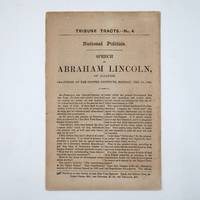
1860Best.-Nr. 367583New York: Office of the New York Tribune 1860. First edition Monaghan's first issue. 1 2-15 1pp. Lincoln's speech comprises pages 1-11 out of a total of 16 pages. With New York Tribune ads and subscription terms on rear wrapper. 8vo. Stitched self-wrappers minor toning minor chip to terminal leaf. First edition Monaghan's first issue. 1 2-15 1pp. Lincoln's speech comprises pages 1-11 out of a total of 16 pages. With New York Tribune ads and subscription terms on rear wrapper. 8vo. This address made at the Cooper Institute in New York on February 27 1860 catapulted Lincoln into the public eye and made him a viable presidential candidate. Indeed many historians have considered it the key to his success in the 1860 election and it is probably the most important speech Lincoln made after the Gettysburg Address and his inaugural addresses. The Cooper Union address was months in preparation; Lincoln was fully aware of its importance in moving himself from a regional favorite son to a viable national candidate. In the event some 1500 people including many prominent political figures attended on a snowy new York evening. The speech divides into three major parts. In the first Lincoln addressed the spread of slavery arguing that the framers of the constitution had been opposed to it and that the Federal government could regulate the question. In the second he argued that the Republicans were not a sectional Northern party and attacked the threats of southern Democrats to secede if the Republicans should win the election. Finally he addressed his fellow Republicans calling on them to act carefully and do "nothing through passion and ill temper.Let us have faith that right makes might and in that faith let us to the end dare to do our duty as we understand it." The Cooper Union speech was a resounding success. Horace Greeley described it as "one of the happiest and most convincing political arguments ever made in this City. No man ever made such an impression on his first appeal to a New York audience." Greeley quickly issued the speech in the form of this "Tribune Tract." It includes a final page of advertisements for other Tribune publications. The speech was later widely reprinted and made Lincoln nationally famous. This printing differs from other editions by its inclusion of a speech by James Doolittle Senator from Wisconsin and the message of Samuel Medary Democratic governor of the Kansas Territory vetoing the Kansas abolition bill. "The Cooper Union address tested whether Lincoln's appeal could extend from the podium to the page and from the rollicking campaigns of the rural West to the urban East. Cooper Union held the promise of transforming Lincoln from a regional phenomenon to a national figure. Lincoln knew it and rose to the occasion" Harold Holzer Lincoln at the Copper Union: The Speech That Made Abraham Lincoln President. Monaghan 50 Office of the New York Tribune unknown books
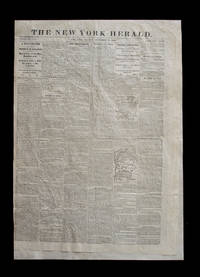
1862Best.-Nr. 68870New York: The New York Herald 1862. Full Description: LINCOLN Abraham. Emancipation Proclamation."A Proclamation by the President of the United States. Operations of the Confiscation Act. All Slaves in States in Rebellion January 1 1863 to Be Free." New York. Published in: The New York Herald Tuesday September 23 1862. Whole No. 9506. The publication of Lincoln's Emancipation Proclamation in James Gordon Bennett's pro-Democratic New York Herald and one of if not the first official public announcements of the preliminary Emancipation Proclamation. Broadsheet folio one large leaf folded along top to make four pages two leaves printed on recto and verso. Six-column format. 22 x 15 1/2 inches; 560 x 395 mm. Light creases down the middle in both directions. Some nearly invisible repaird along top margin and edges. Some of the repairs just touching a few letters in the headline. Still a very good copy of this important declaration. We could only find 3 copies of this at auction and it is not mentioned in Eberstadt. Eberstadt mentions that his Third edition of the Emancipation has a publication date somewhere between September 24th and 26th therefore putting the current copy before this. Eberstadt's first and second edition are the official state department editions printed the day of the declaration September 22nd just the day before this New York Herald was printed. Abraham Lincoln issued the preliminary Emancipation Proclamation on September 22 1862 stating that if the rebelling states did not cease fighting and rejoin the Union by January 1 1863 the slaves in those states would be set free. The New York Herald issued this front-page top left corner early printing of Lincoln's Proclamation the very next day appearing under the headline: "All Slaves in States of Rebellion January 1 1863 to Be Free." "Lincoln read the first draft of what came to be known as the Preliminary Emancipation Proclamation to his cabinet on 22 July 1862. Given the criticism directed at Lincoln for moving too slowly on the issue of emancipation it is worth noting that this first reading took place just sixteen months after he had pledged not to 'interfere with the institution of slavery in the States where it exists.' He continued to revise the document throughout the summer and following the Union victory at Antietam he issued the preliminary proclamation-which managed to balance daring with prudence-on 22 September. This first proclamation essentially gave the Rebel States one hundred days to return to the Union after which period any slaves within their borders would be "then thenceforward and forever free." Any rebellious states that returned to the Union in the interim would be able to adopt immediate or gradual-and compensated-abolition of slavery within their borders." Sotheby's. The front page of this newspaper also contains two maps and reports of the campaigns in Kentucky. HBS 68870. $3500. The New York Herald unknown books
1949Best.-Nr. 327086Chicago: Chicago Illinois Midland Railway Company 1949. Folio. Framed and glazed total dimensions 795 x 718 mm. Folio. Chicago Illinois Midland Railway Company unknown books
1909Best.-Nr. 256570New York: Privately Printed by the De Vinne Press 1909. First edition one of 300 copies. Frontispiece portrait and 7 other photographs and a colored Jock Scott fly at the end. xii 266 pp. 1 vols. 8vo. Original green cloth t.e.g. Light shelfwear title page foxed else near fine. First edition one of 300 copies. Frontispiece portrait and 7 other photographs and a colored Jock Scott fly at the end. xii 266 pp. 1 vols. 8vo. Scarce privately printed work with considerable sporting content. Pp. 123 to 266 comprise the Logbook of Camp Albany on the Ristigouche River with entries from 1883 to 1898 on angling hunting and social topics. A prefatory note quotes from Dean Sage's classic book and an afterword by Charles H. Raymond offers an appreciation of Abraham Lansing 1835-1899 of Albany New York: "To watch his tall graceful form while casting on the river was to see the exemplar of the accomplished fisherman; the man the rod the line were together but the extension and the completion of artistic and practical perfection". Wetzel p. 174; Bruns L39; Bibliotheca Salmo Salar 107 Privately Printed [by the De Vinne Press] unknown books
1959Best.-Nr. 193742Springfield IL: State of Illinois 1959. First edition. Softcover 24 pages. Features an introduction by Clyde C. Walton. Reproduces ten letters by Abraham Lincoln along with transcriptions of them as well. A very good copy in stapled wrappers with some minor wear. State of Illinois unknown books
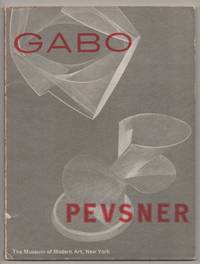
1948Best.-Nr. 195846New York: The Museum of Modern Art 1948. First edition. Softcover. Joint exhibition catalog for these two brothers who were both Russian artists. Features Herbert Read's essay "Constructivism: The Art of Naum Gabo and Antoine Pevsner" along with biographies of the two men by Ruth Olson and Abraham Chanin. Includes numerous black and white illustrations. A very good copy in wrappers with some slight wear along the spine and some other minor wear. Internally a clean copy. The Museum of Modern Art unknown books
1831Best.-Nr. 754121831. Only English-Language Edition of an Important Work by Savigny Savigny Frederick Charles von 1779-1861. Hayward Abraham 1801-1884 Translator. Of the Vocation of Our Age for Legislation and Jurisprudence. London: Littlewood 1831. ix 9-192 pp. Octavo 8-1/4" x 5-1/2"; 21 x 14 cm. Nineteenth-century three-quarter sheep over textured cloth raised bands blind fillets and lettering piece to spine. Light rubbing and soiling to boards moderate rubbing to extremities with some wear to spine ends and corners hinges cracked spot of label residue to front pastedown. Moderate toning to interior early underlining marks and brief annotations in faint pencil in a few places faint gradually diminishing staining to upper-outside corners of several leaves at the beginning and end of text block light soiling to title page. $350. Only edition in English. Written in the wake of the Napoleonic Wars and the Congress of Vienna in 1814 this book was as noted by Walker "an attack on the code system imposed on much of Europe by Napoleon and.the advocacy by Thibaut of a German Code. He attacked the demand for a code on the grounds that it was impracticable adequate juristic preparation being impossible and the German language being juridically underdeveloped and that existing codes were unsuccessful." Walker Oxford Companion to Law 1103. Dauchy et al. The Formation and Transmission of Western Legal Culture: 150 Books that Made the Law in the Age of Printing 102. British Museum Catalogue Compact Edition 22:711. unknown books
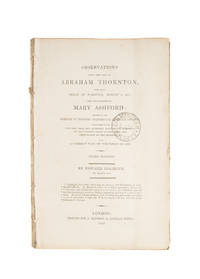
1819Best.-Nr. 758881819. Murder Rape and Trial by Battle Holroyd Edward 1794-1881. Thornton Abraham c.1793-1860. Observations Upon the Case of Abraham Thornton Who was Tried at Warwick August 8 1817 For the Murder of Mary Ashford: Shewing the Danger of Pressing Presumptive Evidence Too Far Together with the Only True and Authentic Account Yet Published of the Evidence Given at the Trial The Examination of the Prisoner &c. And a Correct Plan of the Locus in Quo. London: Printed for J. Mawman T. Miller 1819. 88 pp. Folding map. Portrait frontispiece misbound before preface. Octavo 7-3/4" x 4-3/4". Disbound stab-stitched pamphlet untrimmed edges. Moderate toning light soiling to exterior dampspotting to map small library stamps to title page and frontispiece. $500. Third and final edition one of three printed in 1819. Abraham Thornton a bricklayer "was accused of rape and murder after attending a dance where he became intimate with a gardener's daughter named Mary Ashford. They left the dance together and her body was found the next morning in a deep pool of water near a local footpath. Thornton was tried at the Warwick assizes on 8 August 1817. Since the marks on Mary's body were not necessarily inconsistent with Thornton's claim that she had consented to sexual intercourse and since the times on the morning in question when Thornton was seen walking home to Bromwich suggested he could not have been with her when she met her death the jury found him not guilty. The case aroused much interest and reminded people of a similar murder of a local woman a year earlier. Many were convinced of Thornton's guilt and he was assailed in local and London newspapers. A group collected around the Birmingham solicitor William Bedford invoked the old legal process of 'appeal of murder' by which a person acquitted of murder could be tried again for the same offense. This process was generally regarded as obsolete though there had been several instances in the eighteenth century. More controversy arose when Thornton came before the court of King's Bench in November 1817 and demanded ordeal by battle which was open to the subject of an appeal of murder but had not been claimed since Charles I's reign. After several hearings between November 1817 and April 1818 the court decided that the appellee did have this right. The appe. unknown books
1905Best.-Nr. 327084Chicago: Illinois Central Railroad Company 1905. 200 copies this is one of Fourteen Copies Printer's Edition By Permission #6. illustrated throughout with photogravures of Lincoln documents in the ICRC collection. 4to. Full pebbled limp pebbled black morocco with gilt stamping on upper cover "Compliments of the Illinois Central Railroad Company." Laid into full orange cloth dropbox with gilt stamp "Collection of Foreman M. Lebold. 200 copies this is one of Fourteen Copies Printer's Edition By Permission #6. illustrated throughout with photogravures of Lincoln documents in the ICRC collection. 4to. Provenance: Lou F. English this copy presented by Walter J. Gunthorp to Lou F. English.; Foreman M. Lebold lettering to clamshell box Illinois Central Railroad Company unknown books
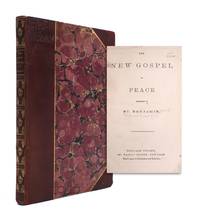
1864Best.-Nr. 334954New York: Sinclair Toussey 121 Nassau Street parts 1 and 2 . Sinclair Tousey Succeeded by the American News Company part 3 1864. 42; 48; 47 1pp. Original wrappers bound in. 8vo. Later half burgundy dyed calf and marbled paper covered boards. Provenance: Sondley Reference Library with bookplate and other markings. 42; 48; 47 1pp. Original wrappers bound in. 8vo. The first three of an eventual four parts to this Lincoln satire written in Bibilical style and attributed to journalist and social critic Richard Grant White writing under the pseudonym of "St. Benjamin." Howes W368 Sinclair Toussey 121 Nassau Street [parts 1 and 2] ... Sinclair Tousey Succeeded by the American News Company [part 3] unknown books
1877Best.-Nr. 726891877. A Distinguished California Jurist's Manuscript Register of Legal Proceedings During the Constitutional Reform Era 1877-1880 Manuscript. California. Freeman Abraham Clark 1843-1911. Register of Actions and Proceedings. Sacramento County California 1877-1880. Folio 13" x 7-3/4"; 33 x 19.7 cm. 244 pp. Manuscript in a single highly legible cursive hand. Contemporary three-quarter sheep over marbled boards gilt fillets to spine marbled edges. Contemporary manuscript title "Register of Actions and Proceedings" to front pastedown. Light rubbing and minor scuffs to boards dampstain to rear board heavier rubbing to extremities with minor wear to spine ends and corners chip to foot of spine. Joints starting slightly at head hinges tender but holding. Slight offsetting to corners of first two leaves. Light toning to interior occasional light foxing and minor spots and stains. Several related contemporary documents tipped or laid in. Good to very good. $3500. An extensive manuscript register documenting the private legal practice of Abraham Clark Freeman one of California's most distinguished nineteenth-century lawyers legal authors and constitutional reformers during the years surrounding the state's Constitutional Convention of 1878-1879. Freeman arrived in California from Illinois in 1861 and was admitted to the bar in 1864. He achieved national prominence with his Treatise on the Law of Judgments 1873 described in an early history of Sacramento County as the first legal treatise of national scope written or published in California. Its exceptional reception helped establish California's reputation as a center of American legal scholarship. Freeman subsequently became an influential editor of American case-law reports assuming the editorship of American Decisions in 1879. The present register covers a particularly significant period in Freeman's career and California's constitutional development. Freeman served as a delegate to the Constitutional Convention of 1878-1879 which drafted the state's second constitution amid intense controversies over railroad monopolies corporate power taxation labor relations and political representation. Ratified in 1879 the new constitution substantially reorganized the state's legal and political institutions. Freeman also served on a commission charged. unknown books
1941Best.-Nr. 320873New York: Newhouse Galleries 1941. Presentation manuscript accomplished by Paul Hessemer for Newhouse Galleries illustrated with a photographic portrait of the painting. With typed letters signed from E.J. Rousuck to Allan P. Kirby and a contemporary copy of a letter to John Hay Whitney offering the portrait. With the original label from an 1869 exhibition of the painting at the Pennsylvania Academy of Fine Arts. 4to. Bound in full blue morocco lettered in gilt silk endpapers. Presentation manuscript accomplished by Paul Hessemer for Newhouse Galleries illustrated with a photographic portrait of the painting. With typed letters signed from E.J. Rousuck to Allan P. Kirby and a contemporary copy of a letter to John Hay Whitney offering the portrait. With the original label from an 1869 exhibition of the painting at the Pennsylvania Academy of Fine Arts. 4to. An elaborate brochure for the sale of this important portrait offered to Allan Kirby and John "Jock" Hay Whitney just days before Pearl Harbor. Newhouse Galleries unknown books
1963Best.-Nr. 175938New York: The Jewish Museum 1963. First edition and first printing. Hardcover. 63 pages. Published in conjunction an exhibition that ran October 6 through Decemer 8 1963. Preface by Alan R. Solomon. Introduction by Richard Meier. Features essays by Dr. Abraham Kampf Rabbi Raphael Posner along with statements by Orthodox Conservative and Reform rabbis on the architecture of the synagogue and statements of the architects as well. Includes numerous black and white images and illustrations of synagogues in New York New Jersey Illinois and Michigan. A near fine copy in paper covered boards with printed labels affixed to the spine and front panel with some minor wear. No dust jacket as issued. An attractive example of the much less common hardcover issue of this catalog which was designed by Elaine Lustig. The Jewish Museum unknown books
1860Best.-Nr. 158491860. Lincoln Abraham. The Lincoln and Douglas Debates 1860 printed record of the seven public debates between Abraham Lincoln and Stephen A. Douglas during the 1858 Illinois Senate campaign a pivotal series of political confrontations over slavery and the future of the United States. The debates addressed the expansion of slavery into western territories and the constitutional implications of the Supreme Court's Dred Scott decision. Lincoln used the campaign to articulate a moral and political critique of slavery's expansion including the position he expressed in his earlier convention speech that "a house divided against itself cannot stand." Although Lincoln lost the Senate race to Douglas the debates established him as a leading national figure within the Republican Party and played a major role in shaping the political arguments that led to his presidential election in 1860. Lincoln Abraham. The Lincoln And Douglas Debates. A Political Debates between Hon. Abraham Lincoln and Hon. Stephen A. Douglas. In the Celebrated Campaign of 1858 in Illinois. Columbus: Follett Foster and Company 1860. First edition third issue identified by the numeral "2" on page 13 and the presence of the publisher's advertisement. Octavo volume containing 268 pages. Bound in publisher's original olive green textured cloth with blind stamped borders and spine lettered in gilt. The Lincoln Douglas debates represented one of the most influential series of political exchanges in nineteenth century American history addressing the central constitutional and moral questions surrounding slavery in the years immediately preceding the Civil War. Douglas defended the doctrine of popular sovereignty arguing that territories should decide the legality of slavery for themselves while Lincoln challenged the compatibility of that doctrine with the Dred Scott decision and emphasized the moral consequences of the institution. Although Douglas retained his Senate seat Lincoln's articulate presentation of the issues drew national attention and positioned him as a major political figure within the emerging Republican Party. Slight chipping to the head of the spine fading to boards and gilt minor damp staining with light foxing and toning consistent with age. Overall good condition. unknown books
1861Best.-Nr. 126721861. Mills Clark. Abraham Lincoln life mask originally taken in February 1865 two months before the president's death. Mills' was the second and last life mask taken of Lincoln preserving his features directly from life rather than through later artistic interpretation. The cast is often compared to Leonard Volk's cast taken in 1860 shortly after Lincoln secured the Republican nomination and is a remarkable record of the toll the presidency and Civil War took on Lincoln physically. John Hay secretary to the president once noted that Volk cast shows "a man of fifty-one and young for his years. . . . full of life of energy of vivid aspiration. . . . .Mills' cast is so sad and peaceful in its infinite repose . . . . a look as of one on whom sorrow and care had done their worst without victory is on all the features." The Mills cast captured Lincoln's entire skull unlike the Volk which shows only the face. After Clark Mills. Abraham Lincoln life mask cast from the original 1865 mold. Plaster mask showing Lincoln's face from the forehead to below the chin with closed eyes lean cheeks pronounced cheekbones deep-set eyes narrow mouth and beard visible along the jawline. The casting emphasizes the elongated structure of Lincoln's face and preserves the asymmetry and modeling that gave later sculptors a direct reference for portrait accuracy. Mills was a New York born sculpter who developed his own method of creating plaster masks for portrait busts in the 1840s. His works include the equestrian statues of Andrew Jackson and George Washington which now reside in Washington D.C.'s Lafayette Square and Washington Circle respectively as well as the Statue of Freedom which sits atop the United States Capitol dome and over 100 portrait busts of Native American prisoners and Black students at the Hampton Agricultural and Industrial School now Hampton University. This original 1865 life mask became an essential source for later Lincoln portraits and sculptures especially after 1865 when artists and monument makers sought models for Lincoln memorials. The pieces has a unique documentary value distinct from painted or engraved likenesses often filtered through personal interpretation. Minor surface wear consistent with age; overall very good condition. Life masks are created in negative molds casts therein are created in relief "after" the original. It is unclear at when this particular cast was taken. unknown books
2019Best.-Nr. 169792New York: Marlborough Gallery 2019. First edition. Softcover. Exhibition catalog for a show that ran February 5 through March 2 2019. Includes with the covers 10 color illustrations and a list of previous exhibitions. A near fine copy in stapled wrappers with some very minor wear. Marlborough Gallery unknown books