27.953 risultati
rif. 12459NP n/d. Hardcover. g. 2 volumes Mixed edition see above. 1 Folio 226p. Rebound in half leather over cloth. Decorated title page. Age wear to binding with browning throughout. Title page repaired but complete with no parts missing. In Hebrew. Very good condition. 2 312p. Rebound in half leather over blue cloth. Decorated title page. Age wear to binding with covers worn and slightly frayed at the corners.Top half inch of back slip is missing with rubbing. 1" tear to title page. Browning throughout. In Hebrew. Overall good condition. Work of Responsa on two sections of the main work of Halacha Jewish Law the "Shulchan Aruch". Written by one of the most profound and original thinkers in the world of Chasidism also known as the "Sochhatchover Rebbe." see below. On the author Source: Public Domain: Rabbi Abraham Bornstein also known as Avraham Bornsztajn Abraham ben Ze'ev Nachum Bornstein Reb Avraham Borensztejn was born in Biala Poland in 1839 and died on March 20 1910 in Sochaczew. He was a Hasidic rabbi known as the "Tzadik of Sochachov" or 'Cadyk z Sochaczewa' in Polish. He the son of a rabbi. When he graduated yeshiva became a rabbi in Parczew Kroniewice Nasielsk and from 1883 in Sochaczew. He founded there Hassidic synagogues and yeshivas. He is buried in the Jewish cemetery in Sochaczew where a "ohel" burial vault was built. Following his passing his position was filled by his son Rabbi Samuel Bornstein 1856-1926 who edited Shem Mi-Shmuel. Bet Eked Vol.1 p10 item #246. NP hardcover books
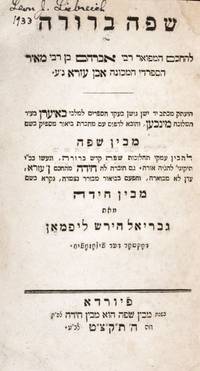
1839rif. 22720Furth: Fulda and Zumfdorffer 1839. Hardcover. g. 8vo. 52 pages. Rebound in quarter cloth black paper covered boards. A Hebrew grammar book discussing the roles of the letters. Ibn Ezra is considered the father of Hebrew grammar even though he did not create anything new he collected the conclusions of early grammarians and he wrote in Hebrew making Hebrew grammer more accessable. This work not the first grammer book written by Ibn Ezra was the result of a student asking him to do so. This was orginally written between 1146-1147. This editon contains the commentary Mevin Safah by Gabriel Hirsch Lippmann introduction in German and the novella Sha'ar Binyamin published here for the first time a work by Abraham Benjamin Hamburg 1770-1850 German talmudic scholar whose disciples include Moses Sofer and Seligmann-Baer Bamberger. Signature of Leon Liebreich late professor of liturgy at Hebrew Union College on top left margin of title page. Hebrew title page with facing German title page. Slight staining and foxing with small waterstains to few pages. Lacking free rear endpaper. Closed tear on page 46 slightly affecting text. Text in Hebrew in 'Rashi Script.' Overall in good condition. Fulda and Zumfdorffer hardcover books
1855rif. 20487Berlin: Kornek 1855. Hardcover. g. 8vo. 2 238 8 pp. Blue cloth with decorative gold lettering in English on spine. The author Abraham ben Nathan a.k.a the Rabn ha-Yarhi was born in the second half of the 12th century. He began this work in 1204. The extreme importance of this work goes well beyond the limited influence it had on the history of Jewish legal codes for it contains numerous literal quotations from the two Talmuds and most of the halakhic and haggadic Midrashim as well as from certain collections of the Haggadot which have been wholly lost; so that the "Manhig" contributes considerably to the textual criticism of all of those works. Text in Hebrew. Pp. 1-18 are detached but present. Minor foxing and marginal pencil and pen marks and underlining throughout. Long inscription in pen on front endpaper with notes taken from the Jewish Encyclopedia entry regarding the author. Book is in overall good condition. Kornek hardcover books
1821rif. 22575Fuerth Germany: Zurndorff 1821. Hardcover. g. Three quarter leather over paper covered boards. Heavy age wear on binding. A wonderful philosophical work on the theme of the futility and vanity of this world and the inestimably greater benefits of intellectual and religious pursuits. This work includes a German translation by Samson Hamburger Chaim Hirsh. Schwabacher and the world famous philosopher Moses Mendelssohn and commentary by David Ottensoser. The German translation is in Hebrew characters as was the custom of the time. Also included is Bi'ur Ha-Milot by Moses ben Menahem Mendel Kunits which is a great reference tool citing the sources and gives an explanation of the words of Behinat Olam. Inscription in Hebrew by previous owner on verso of front endpaper. Signature of previous owner Hananiah David Cohen in blue ink on top of title page. Some pencil notes on margin of several pages not affecting text. Text in Hebrew and German in Hebrew characters. Binding in fair interior in overall good condition. Zurndorff hardcover books
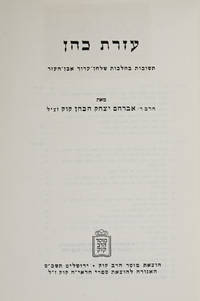
1969rif. 17948Jerusalem: Mossad Ha-Rav Kook 1969. Hardcover. vg. Small 4to. 485pp Hebrew pagination. 1/4 leather over brown cloth in original dust jacket. Ex-libris Rabbi Isaac David Essrig author of "The fountain of wisdom". Work by Rav Cook one of the most influential Rabbis of what now is considered "religious Zionism" see below. The topic of this book is the "Even Ha-'Ezer" - section of the "Shulkhan ha-Arukh" that deals with personal law marriage divorce sexual conduct etc. The "Shulkhan ha-Arukh" a.k.a. Shulchan Aruch meaning "set table" is the most authoritative compilation of Halakha Jewish Law. Staining and minor tears to dj. Age wear to binding. Inside clean and tight. In Hebrew. Very good condition. On the author from a public domain online encyclopedia: Abraham Isaac Kook 1864 - 1935 was the first Ashkenazi chief rabbi of the British Mandate for Palestine the founder of the now Religious Zionist "Yeshiva Merkaz HaRav" and a renowned Torah scholar. He was a master of Halakha in the strictest sense while at the same time possessing an unusual openness to new ideas especially in regards to the settling of Eretz Yisrael. This drew many religious and non-religious people to him but also led to widespread misunderstanding of his ideas. He wrote prolifically on both Halakha and Jewish thought and his books and personality continued to influence many even after his death in Jerusalem in 1935. Mossad Ha-Rav Kook hardcover books
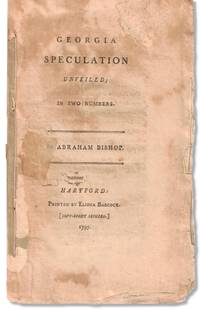
1797rif. 72332Hartford: Elisha Babcock 1797. Paperback. Good. Paperback. 39pp. Cloth residue at spine from previous binding. Old paper repair to title page spot of loss above 'Hartford' and the edge else a good complete example. Written in answer to the "State of Facts" published by the Georgia Companies. Howes B471; Sabin 5593. Elisha Babcock paperback books
1940rif. 1415447New York: Wilfred Funk 1940. Hardcover. Octavo xii 415 pages. In Good plus condition with a Good dust jacket. Spine is grey with black print. Dust jacket in mylar; light edge wear. Price clipped. Boards in blue cloth; light wear to spine caps and corners. Text block has grey tinted top edge. Illustrated: b&w plates photographs facsimiles maps etc. NOTE: Shelved in Netdesk Column K ND-K. 1415447. FP New Rockville Stock. Wilfred Funk hardcover books
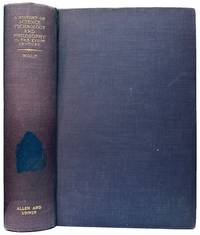
1952rif. M15172London:: George Allen & Unwin 1952. 1952. Second edition. 8vo. 814 2 pp. 345 figures index. Original navy-blue gilt-stamped cloth; top of front hinge mended with kozo lower spine over-painted. Bookplate of the Los Angeles County Medical Association Library embossed stamp on title. Good. Second edition revised by Douglas McKie. Wolf is credited with introducing the history of science to University College London where he lectured as Professor of Logic and Scientific Method from 1920 to 1941. George Allen & Unwin, 1952. hardcover books
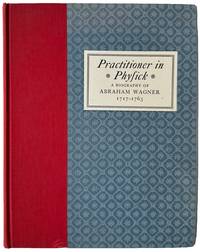
1954rif. M14637Pennsburg PA:: Schwenkfelder Library 1954. 1954. Sq. 8vo. ix 3 175 1 pp. 5 plates 1 folding. Original quarter red gilt-stamped cloth decorative boards printed cover label. Ex-library copy from the Los Angeles County Medical Assoc. Historical Collection; rear pocket removed. Very good. Abraham Wagner was a Pennsylvania physician and poet. The author Berky was director 1951-73 of the Schwenfelder Library Pennsburg Pennsylvania. Schwenkfelder Library, 1954. hardcover books
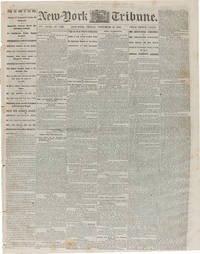
1863rif. 56893New York. November 20 1863. The Gettysburg Address Published in New York the Day After the Event The complete issue of the New-York Tribune printing the Gettysburg Address on the morning of November 20 1863 the first possible date of the speech's printing. The previous day Lincoln delivered his great address at the dedication of a cemetery on the Gettysburg battlefield four months after the bloody and pivotal conflict that turned the tide of the Civil War in favor of the Union. Lincoln's speech was preceded by an address from Edward Everett the most famous orator of his day. Everett's speech took between ninety minutes and two hours to deliver and today is largely forgotten. Lincoln's speech delivered in only a few minutes stands as a supreme distillation of American values and of the sacrifices necessary for the survival of liberty and freedom. Much controversy surrounds the circumstances and content of the address as it was actually delivered at Gettysburg. The words spoken in the speech differ in the versions appearing in newspapers and the text which appeared in Washington several days later published as The Gettysburg Solemnities and known in only four copies which is now taken as the closest version to Lincoln's final intent because of its correspondence to the known manuscript versions. Interestingly and according to Carbonell the text of the first appearance of the speech in book form published a few days later as An Oration Delivered on the Battlefield of Gettysburg Monaghan 193 is taken largely from this New-York Tribune printing. As it appears here the address corresponds closely to the transcription printed in the same day's edition of the New York Times with slight variations in punctuation and capitalization e.g. "Four score and seven years ago our fathers brought forth on this continent a new Nation." in the Tribune versus "Fourscore and seven years ago our Fathers brought forth on this Continent a new nation." in the Times. The address is printed on the first page at the bottom of the fifth column running to the top of the sixth. Significantly it notes the five places during Lincoln's speech where applause broke out thereby providing an important historical record of the reception of the speech as it was delivered by Lincoln. It is noted that the conclusion of the speech was met with "long continued applause" and that "three cheers were here given for the President and the Governors of the States." Lincoln's speech is preceded by the opening prayer of the Rev. Thomas H. Stockton and followed by Everett's speech which occupies the rest of the sixth column and the vast majority of space on page two. War news occupies the other column space on the front page. Together with examples from other newspapers of November 20 1863 this issue of the New-York Tribune represents the first appearance of any version of the Gettysburg Address in print although at some variance with the version Lincoln eventually disseminated. The exact order in which the morning editions of November 20 were printed is practically impossible to determine at this point and as Carbonell states "will almost certainly never be known." Rightfully so Carbonell includes all November 20 morning newspaper printings of the Gettysburg Address as his first entry with no priority. Suffice to say this is as early a printing of one of the foundational documents of American life as one can ever encounter. "Lincoln's speech composed on the train on the way to Gettysburg and written down according to tradition on scratch-paper and the backs of envelopes comprised ten sentences and took only a few minutes to deliver. From the first words—'Four score and seven years ago'—to the last—'that government of the people by the people and for the people shall not perish from the earth'—it is immortal one of the supreme utterances of the principles of democratic freedom" - PRINTING AND THE MIND OF MAN. A handsome copy of this rare and important document. Large folio newspaper. Disbound from a volume. Minor chipping along spine edge. Trimmed closely along top and bottom edges likely when previously bound in a run of the newspaper. One soft horizontal center fold. Withal very good. A perfect candidate for display. CARBONELL 1. GROLIER AMERICAN 100 72 ref. STREETER SALE 1748 ref. PRINTING AND THE MIND OF MAN 351 ref. HOWES E233 ref. MONAGHAN 192 ref. Paul M. Angle "Four Lincoln Firsts" in Papers of the Bibliographical Society of America Vol. 36 no. 1 First Quarter 1942 pp.13-17. For an outstanding analysis of the structure and importance of the Gettysburg Address see Garry Wills Lincoln at Gettysburg New York 1992. unknown books
1861rif. 69112Washington. March 19 1861. A Fine Commission on Vellum Signed in Full by Lincoln Less Than a Month Before Ft. Sumter A very fine military commission printed on vellum and signed by Lincoln in the tense weeks leading to the outbreak of hostilities at Fort Sumter in April. After South Carolina officially adopted the Ordinance of Secession on December 20 hopes for a peaceful cure to the nation's ills were slim. Small skirmishes and strategic maneuvers punctuated by more and more states joining the Confederacy made the imminent need for an empowered military and more military officers abundantly clear by March. This document appoints Thomas G. Baylor as a Second Lieutenant in the Ordnance Department on March 19 and is evidence of that need. Baylor 1837–1890 born in Virginia graduated from West Point in 1857 and was positioned at the Fort Monroe Arsenal from 1858–1861. Baylor took command of that Union stronghold behind Confederate lines on August 15 and remained its leader until October 20 1863. He was then appointed Chief Ordnance Officer of the Army of the Cumberland and was acting Chief Ordnance Officer of the Military Division of the Mississippi until August 1864. During this time he fought at Missionary Ridge and was on Sherman's staff throughout the Carolina and Georgia campaigns. He was Brevetted Major for his services at Atlanta then Lieutenant-Colonel for "gallant services in the capture of Savannah" eventually reaching the rank of Brevet Colonel. After Savannah he returned to command of the Fort Monroe Arsenal which he retained until 1876. From his West Point eulogy: "Colonel Baylor's record of thirty-three years' service in the Army is an exceptional one. A Southerner by birth and lineage he continued loyal to the flag throughout the Civil War in which he bore a conspicuous part although against influences that would have tested the firmness of most men but the lack of sympathy if not hostility from friends and relatives never made him falter in his faith and he went to the grave a gallant soldier and a loyal gentleman." Strong old folds light soiling. Near fine. Twenty-Second Annual Reunion of the Association Graduates of the Untied States Military Academy at West Point New York June 12th 1891 Saginaw MI: Seemann & Peters 1891 pp.18-19. hardcover books
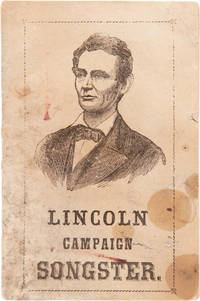
1864rif. 62679Philadelphia: Published by Mason & Co. 1864. Singing for Lincoln in '64 A pocket songster printed to support Lincoln's reelection campaign in 1864 featuring a rather youthful portrait of the president on the front wrapper and twelve spirited pro-Union songs. The titles largely military in theme include such works as "Give us Noble Leaders" "The Veteran Volunteer" "Cast Your Votes for Abraham" "For Lincoln or McClellan you'll be called on to decide/ The one to save the union the other to divide" and "We are Coming Father Abraham 600000 More." The advertisements on the rear wrapper encourage readers to purchase a wide variety of Lincoln campaign badges emblems pins and photographs from the publishers. Despite Lincoln's overwhelming electoral victory in 1864 the race was rather close in Pennsylvania where this was printed – Lincoln took Philadelphia County by a scant few percent and actually failed to secure a majority in neighboring Montgomery and Bucks counties. 16mo. Original pictorial wrappers. Wrappers soiled and stained. Largely clean internally. Advertisements on rear wrapper shaved slightly at outer edge as issued. Good plus. MONAGHAN 323. unknown books
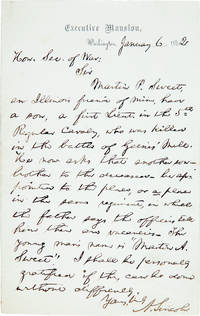
1862rif. 63833Washington. January 6 1862 i.e. 1863. Abraham Lincoln Writes on Behalf of an Illinois Friend Colleague and Patriot A remarkably moving and poignant autograph letter signed from Abraham Lincoln as president writing to Secretary of War Edwin Stanton on behalf of his former Illinois Whig colleague Martin P. Sweet who seeks to have a second son appointed to the Union Army even after his first had fallen in battle. Lincoln and Sweet were political colleagues and friends and the two shared the experience of losing sons at a young age. Not only had Sweet's son Lieutenant John J. Sweet died at the Battle of Gaines Mill on June 27 1862 but Lincoln himself had lost two young sons most recently his son Willie who died of typhoid fever in February 1862. Lincoln's brief letter to Stanton is fewer than one hundred words and contains the terse and eloquent rhythms that would categorize many of his most famous utterances including the Gettysburg Address later in 1863. The text written on Executive Mansion stationery reads in full: "Hon. Sec. of War; Sir Martin P. Sweet an Illinois friend of mine had a son a first Lieut. in the 5th Regular Cavalry who was killed in the battle of Gaines' Mill. He now asks that another son – brother to the deceased – be appointed to the place or a place in the same regiment in which the father says the officers tell him there are vacancies. The young man's name is 'Martin A. Sweet.' I shall be personally gratified if this can be done without difficulty. Yours truly A. Lincoln." The president has dated his letter January 6 1862 although based on the reference to the 5th Cavalry's role at Gaines' Mill in the summer of that year we must attribute this to an early New Year's error and assume that the date would properly be January 6 1863. Gaines' Mill took place on the third of the Seven Days Battles and was a major tactical victory for the Confederacy despite heavy losses on both sides. The "vacancies" alluded to by Lincoln would not be surprising – the 5th United States Cavalry suffered fifty-eight casualties in the fighting including all but one of its officers. It is unclear if Sweet's second son Martin Anthony ever received his appointment despite the heart-wrenching plea of his father and personal request of the President; in whatever case he lived through the war before passing away at a relatively young age in 1889. A "Martin A. Sweet" is recorded in the 6th Michigan Cavalry which was part of the Michigan Brigade and saw heavy action from Gettysburg through Appomattox. Martin Pierce Sweet 1806-64 was a native of New York who moved to Freeport Illinois in 1840 becoming a prominent local figure in law and politics. He and his wife Catherine Van Etten had six children. Sweet's policies mirrored Lincoln's own early views being firmly opposed to slavery through legislation though not a radical abolitionist. Throughout the 1840s and 50s Sweet and Lincoln were alternately comrades and opponents in the Illinois Whig party – in 1849 for example Lincoln backed Cyrus Edwards against Sweet for the appointment as General Land Commissioner and in 1855 he and Lincoln were both considered as alternatives to Lyman Trumbull who nonetheless took the seat in the Senate over both. In 1856 Sweet firmly backed Lincoln for vice president though he was soundly defeated by Dayton. From then on Sweet became an unofficial political adviser to the ascendant Lincoln – perhaps his most enduring legacy in that role was when he met with Joseph Medill and others to strategize on Lincoln's behalf in the Lincoln-Douglas debates one of which took place in Sweet's hometown of Freeport. Among their advice to Lincoln was that he should ask "a few ugly questions" including the famous prompt which resulted in Douglas' so-called Freeport Doctrine. Lincoln's ties to Sweet and the Douglas debates are made clear in a letter of September 16 1858 in which the future president wrote to his Illinois friend to apologize for a potentially disparaging comment fearing "that those villainous reporters Douglas has with him will try to make something out of it.I write this to assure you that nothing can be farther from me than to feel much less intentionally say anything disrespectful to you." A deeply moving autograph letter signed from Abraham Lincoln as president assisting a friend political ally and bereaved father prepared to lose a second son and give a last full measure of devotion for the Union cause. Light tanning vertical crease near right edge just touching signature. Very good. In a cloth chemise and half morocco and cloth box spine gilt. Michael Burlingame Abraham Lincoln: A Life Baltimore: Johns Hopkins Univ. Press 2008 pp.486-557. hardcover books
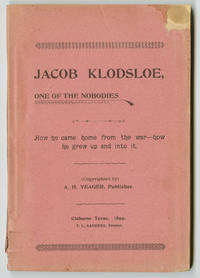
1899rif. 52883Cleburne TX: T.L. Sanders 1899. Autobiographical Account of a Confederate Soldier The autobiographical story of a Confederate soldier from an area described as having "Carolina's tallest peaks" on its southeastern horizon. Most names in the story appear to be fictional. Includes his capture at Kennesaw Mountain in June 1864; as a prisoner of war at Camp Douglas Illinois; his journey home; and how he came to join an infantry company. Yeager 1842-1940 served with the 29th Tennessee Infantry Confederate until his capture. After the war he was a lawyer in Tennessee then a newspaperman and farmer in Johnson County Texas. Rare. Not in any of the standard reference works on the Civil War or Tennessee. Original printed wrappers. Small chip to top corner of front wrapper and toe of spine. Small stain to top corner of first few leaves. Last few leaves and rear wrapper chipped at lower corner not affecting text. Contents tanned as usual. Good plus. unknown books
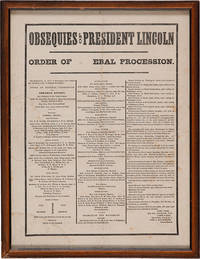
1865rif. 55213N.p. but almost certainly Springfield Il. ca. May 3 1865. The Program for Lincoln's Official Funeral Procession in Springfield on May 4 1865: The Saddest Day in American History Likely a proof copy of the exceedingly rare broadside announcing the funeral procession for President Abraham Lincoln in Springfield in early May 1865. Struck down by assassin John Wilkes Booth on April 15 1865 Lincoln's body lay in state in the White House on April 18 and a ceremonial funeral service took place in Washington D.C. around noon on April 19. Two days later President Lincoln's casket was loaded on a funeral train headed for Springfield Illinois stopping at Baltimore Harrisburg Philadelphia New York City Albany Buffalo Cleveland Columbus Indianapolis Michigan City and Chicago before arriving in Lincoln's adopted hometown early on the morning of May 3. At this time Springfield's population numbered around 15000 but Lincoln's funeral train pulled into a town swollen with over 100000 visiting mourners. Immediately upon arrival Lincoln's coffin was transferred by hearse to Representatives' Hall inside the Illinois Old State Capitol. For the next twenty-four hours from about ten o'clock in the morning on May 3 to the same time the next day about 75000 mourners were allowed to pass by the open coffin of the slain president to pay last respects. According to the present broadside President Lincoln's funeral procession left the Old State Capitol "on Thursday the 4th Inst. at 10 o'clock a.m. precisely." The funeral party of over 10000 people then turned right on 7th Street to pass by the Lincoln family home and then right up Cook Street to proceed past the Governor's Mansion before heading north to Oak Ridge Cemetery. This broadside printing of the order of the procession for Lincoln's Springfield funeral was probably printed the afternoon of May 3 or possibly even the morning of May 4 the day of the funeral. Surrounded by a heavy black band the broadside lists all the persons and units involved in the procession along with their places and the rules for the day. The entire procession was divided into eight divisions with Gen. Joseph Hooker acting as Marshal in Chief. The first three divisions of the military escort represented all the elements of the Army and Navy. After them came the attending clergy and Lincoln's attending physicians. Next was the casket itself the only wheeled vehicle in the procession with the pall bearers to each side followed by Lincoln's horse and then the immediate family. Three more military divisions followed interspersed with government officials ambassadors and state officials followed by delegations from Springfield and other Illinois towns. Next were representatives of various organizations delegations from colleges lawyers doctors and the press Masons Odd Fellows and firemen all interspersed with two more military divisions. The final segment of the funeral procession was designated for "Citizens at large" and "Colored Persons." The broadside gives directions for locations for the forming up of each group. Only marshals were allowed to be on horseback; all others walked. Bands were under the direction of the Committee on Music. Other particular directions follow including regulations for the colors of the various scarves worn by the marshals. The text of the document ends with directions to keep the streets through which the procession passes "clear from sidewalk to sidewalk." This broadside must have been widely distributed to assist the mourners in Springfield but like all such ephemeral pieces few copies have survived. OCLC locates only six at Indiana University the Abraham Lincoln Memorial Library the Boston Athenaeum the Chapin Library at Williams College the John Hay Library at Brown University and the Library Company of Philadelphia. The latter location also attributes the place of printing to Springfield. There is also a copy at the Library of Congress and a copy formerly owned by noted collector James Copley and previously sold by this firm. The present copy is likely an early printer's proof of the broadside as it lacks the first three letters of the word "FUNERAL" in the title. The Library of Congress copy is also likely a proof with its variant title omitting the words "ORDER OF." Both copies also lack the letter "e" in "Order" in the first sentence of text. These errors speak to the haste and stress under which this broadside was surely produced perhaps the day before or the very morning of the day when America's greatest president the Savior of the Union and Illinois' favorite son was laid to rest in a city teeming with seven times its own population in attendance. A remarkable and moving document reflecting a moment of national grief perhaps only approached by the John F. Kennedy funeral and memorializing the day when America's first assassinated president was solemnly committed to the earth. Broadside 12 x 9 inches. Printed in three columns edged with a printed black border. Old folds center vertical fold with some separation. Moderate staining. Still very good. Framed. OCLC 5023077 79462381. unknown books
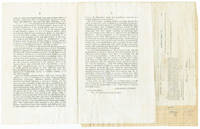
1863rif. 55254N.p. perhaps Virginia. Late 1863 or early 1864. Lincoln's Amnesty Proclamation: A Most Uncommon and Interesting Printing An exceedingly rare separate printing - perhaps by a military field press - of President Abraham Lincoln's December 1863 presidential proclamation offering amnesty to citizens of the Confederacy providing they take an oath that they "will abide by and faithfully support all proclamations of the President made during the existing rebellion having reference to slaves" i.e. the Emancipation Proclamation. When the number of persons in any state taking the oath reached ten percent of the number of voters in 1860 this group of loyal voters could form a state government that could be recognized by the President. The Amnesty Proclamation was issued with President Lincoln's third Annual Message to Congress i.e. State of the Union Address on December 8 1863. It was appended per the language in the title here to the official printing of that address but also printed separately. The present printing almost certainly executed in the weeks after Lincoln's State of the Union was likely hastily composed from the text of the official printing of the proclamation. The work carries no imprint information of any kind and bears the hallmarks of a military field press printing. Toward the close of 1863 with the Confederate Army in full retreat discussions in Congress centered on how to restore the Southern states to the Union. "The crisis which threatened to divide the friends of the Union is past" announced Lincoln. Now it was the duty of Congress to ensure that all citizens in the South regardless of race were guaranteed the equal protection of the law. A number of competing proposals emerged from deliberations but in the end during his message to Congress on December 8 1863 Lincoln declared reconstruction of the South a wholly executive responsibility and "offered 'full pardon.with restoration of all rights of property except as to slaves' to all rebels who would take an oath of future loyalty to the Constitution and pledge to obey acts of Congress and presidential proclamations relating to slavery" Donald p.471. Those excluded from taking the oath were the highest ranking members of the Confederacy - government officials judges military and naval officers above the rank of army colonel or navy lieutenant former congressmen and "all who have engaged in treating colored persons or white persons otherwise than lawfully as prisoners of war." Lincoln further encouraged the Southern states to make provisions "in relation to the freed people of such State which shall recognize and declare their permanent freedom provide for their education and which may yet be consistent as a temporary arrangement with their present condition as a laboring landless and homeless class." "Lincoln indicated that this was only one plan for reconstructing the rebel South and while it was the best he could think of for now he would gladly consider others and possibly adopt them. He might even modify his own classes of pardons if that seemed warrantable.Afterward almost everybody but die-hard Democrats seemed happy with the plan" Oates p.371. The proclamation is accompanied by a partially-printed Oath of Allegiance dated 1864 and datelined Harper's Ferry Virginia. The oath requires the taker to "solemnly swear that I will support protect and defend the Constitution and Government of the United States against all enemies." It is signed in type by Henry A. Urban Lieutenant and A.D.C. Aide-de-Camp. The oath is printed with a blank space for the name of the person taking the oath and the date. There is also a space for people who know the oath-taker and "certify on honor that we know Mr. blank to be a true and loyal man to the Federal Government." The Oath is affixed to a partial manuscript ledger report recording lost military stores for an unidentified unit in 1863 This printing of the Amnesty Proclamation is just as interesting as the government broadside printing or the first pamphlet printing as this edition would have also been used in the field by Union troops encountering Confederate rebels. The composition of the beginning of the seventh paragraph is consistent with the first pamphlet printing of the Amnesty Proclamation Monaghan 191 and not the broadside printing. The text here begins "Therefore I Abraham Lincoln."; in the broadside printing "Therefore" is present at the end of the preceding paragraph. The simple and somewhat loose execution of the composition seen here is consistent with field press printings as is the lack of an imprint of any kind. Perhaps this simple production was intended for Union troops to literally hand to Confederate soldiers to read. The presence of the portion of the ledger and the Oath of Allegiance lends credence to the notion that this edition of the Amnesty Proclamation was produced for use by the military. This printing of the Amnesty Proclamation is not in Monaghan OCLC or in any reference work we could find. In fact we could find no other three-page editions of the Amnesty Proclamation at all. Surely printed in small numbers to begin with it is perhaps a unique surviving example. The OATH affixed to a partial manuscript ledger report recording lost military stores for an unidentified unit in 1863 which is itself glued to the verso of the last blank page of the Amnesty Proclamation. Minor toning light foxing some wrinkling. Overall very good. In a cloth chemise and green half morocco and cloth slipcase spine gilt. MONAGHAN 191 ref. SABIN 41162 note. David Herbert Donald Lincoln New York 1995 p.471. Stephen B. Oates With Malice Toward None: A Life of Abraham Lincoln New York 1977 p.371. hardcover books
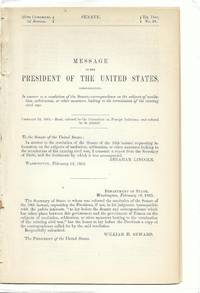
1863rif. 010765Washington DC 1863. Wraps. Very good. Lincoln Abraham. Message of the President of the United States communicating in answer to a resolution of the Senate correspondence on the subjects of mediation arbitration or other measures looking to the termination of the existing civil war. 37th Congress 3d Session. Ex. Doc. No. 38. Washington D. C.: 1863. Complete with 16 pages. Tipped into a white heavy paper wrapper. In nice shape. This pamphlet contains transcripts of diplomatic correspondence forwarded by President Lincoln from and to Secretary of State William H. Seward regarding attempts to negotiate peace via diplomacy through France. . The Lincoln administration and Secretary of State William H. Seward were aware diplomatic maneuvers by the Confederacy with France. The letters and papers included in this pamphlet make it clear to French Minister in Washington Henri Mercier and the U.S. Minister to France William L. Dayton that the U.S. would interpret any foreign recognition of the Confederacy as an act of war. Furthermore crucial Union victories at Gettysburg and Vicksburg in July 1863 thoroughly undermined any European case for Confederate viability prompting Napoleon III to shift his focus entirely to his intervention in Mexico. . unknown books
rif. 6509ABRAHAM LINCOLN 1809-1865. Lincoln was the Sixteenth President.DS. 1pg. August 1 1864. Washington. A vellum military commission signed Abraham Lincoln as President and co-signed E.M. Stanton as Secretary of War. The President appointed James Wylie Crawford a First Lieutenant in the Veterans Reserve Corps. Crawford 1832-1910 was from Maine; according to family lore he was badly wounded at Antietam I bought this directly from a descendant. This injury required his enlistment in the Veterans Reserve Corps. The Veterans Reserve Corps allowed wounded soldiers to remain active often performing small tasks and light duty; established in the middle of 1863 it was first known as the Invalid Corps until the official name was changed. The document recently underwent conservation with the vellum stretched and flattened; the top right corner of the vellum has shrunk and the document was once rolled. The Lincoln autograph is a tad light and gets lighter as the autograph gets towards the conclusion; the Stanton is also a bit faint but vellum does not hold ink that well especially compared to paper. hardcover books
rif. 5341A WEEK AFTER THE LINCOLN ASSASSINATION FIVE BOSTONIANS CONTRIBUTE TO AN ABRAHAM LINCOLN MEMORIALABRAHAM LINCOLN. DS. 1pg. April 21 1865. Boston. A document pledging one dollar apiece to a Massachusetts memorial to President Abraham Lincoln. Lincoln had been assassinated one week prior. Enclosed please find the pledge of myself and family to the cause for our late Presidents memory. Five signatures follow by T. Clement Mary A. Clement Clement O Jordan Elisa M. Huston and one more. The document is in very good condition with some smudges. I am uncertain if the funds went to the controversial Boston statue of Lincoln that was removed in 2020. unknown books
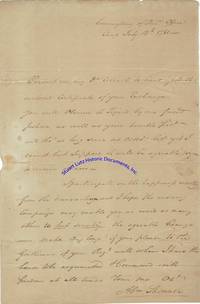
rif. 5036AMERICAN REVOLUTION PRISONERS OF WAR. ALS. 1pg. 8 x 12 . July 12 1781. Commissary of Prisnrs. Office Phillipsburg New York. An autograph letter signed Abm Skinner the American Commissary General of British prisoners of war. He wrote to an unidentified man: Permit me my Dr. Colonel to hand you the inclosed Certificate of your Exchange. You will observe it Signed by our friend Joshua Loring British commissioner for prisoners as well as your humble Servt. and tho as long since as Octobr. Last I cannot but Suppose it will be agreeable to you to receive it now. I participate in the happiness resulting from the transaction and I hope the ensuing Campaign may enable you as well as many others to feel sensibly the agreeable Change - make my Compts. if you please to the Gentlemen of your Regt. with whom I have the honor to be acquainted. The letter is docketed in an unknown hand on a stub remnant most likely by the gratified Colonel. The letter is tanned there are some spots and there is a minor repair to the verso. unknown books
1948rif. M12429New York:: Froben Press 1948. 1948. One of 350 copies. 8vo. xiv 15-22 23-447 pp. Frontispiece. Single-ruled gilt-stamped black leatherette. SIGNED AND INSCRIBED in ink from editor Friedman to former UCLA physiologist Dr. Ralph Sonnenschein with Sonnenschein's address label. Near fine. Robinson was a prolific Ukranian-born American physician who authored numerous works including An Essay on Hasheesh in 1910. He founded the journal Medical Life and helped organize the History of Science Society. Froben Press, 1948. hardcover books
1927rif. M2591Berlin:: Julius Springer 1927. 1927. 243 x 165 mm. 8vo. iv 285 pp. Index. Original printed wrappers. Very good. FIRST GERMAN EDITION of Flexner's comparative study of medical education. Flexner wrote the first systematic and thorough comparisons of the major systems of medical education with his medical education in Europe New York 1912. Here he continues and expands his work. Garrison and Morton 1766.504 English ed. New York 1925. Julius Springer, 1927. unknown books
1738rif. M4047Lugduni Batavorum: Apud Samuelem Luchtmans 1738. 1738. 160 x 101 mm. Small 8vo. xvi 36 4 445 2 pp. Title in red and black printer's device on title headpieces floriated initials corrigenda. Contemporary tan calf raised bands red leather spine label; rubbed spine ends chipped joints and hinges reinforced with kozo. Ex library rubber stamps of the National Library of Medicine. Very good. FIRST EDITION. In this work Kaau Boerhaave describes the process of the excretion of sweat from the sweat-glands of the skin and the motion of fluids within the body. The book also reprints his short lecture on the alchemists for which he received a gold medal from Leyden University. In this copy the lecture on alchemy is bound at the front of the volume. There was a second edition Lovanni 1779. Stieda calls this "a brilliant work." Abraham Kaau Boerhaave the prominent physician studied medicine at Leyden under his uncle Hermann Boerhaave. After graduating and practicing medicine at The Hague for several years Kaau-Boerhaave went to St. Petersburg where he was appointed professor of theoretical and practical medicine and pharmacy. He was a member of the Russian Academy of Sciences. Blake NLM p. 239; Hirsch III pp. 436-437; Waller 13832; Wellcome III p. 375. Apud Samuelem Luchtmans, 1738. hardcover books
1795rif. M3955Jena:: Fiedlerianis 1795. 1795. 232 x 197 mm. Small 4to. iv iv 46 ix pp. Foxed. Self wraps; last few gatherings loose. Ex library rubber stamp on title. Very good. Albers' dissertation on dropsy of the belly. Johann Abraham Albers studied under J. C. von Loder and Chistoph Wilhelm Hufeland 1762-1836. Hirsch I pp. 80. Not in RLIN. Fiedlerianis, 1795. paperback books
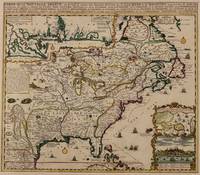
1719rif. 338195Amsterdam: Henri Abraham Chatelain 1719. unbound. Map. Engraving with hand coloring. Handsome archival frame 24 1/4 x 26 3/4" not examined out of frame. A finely engraved map of New France by Henri Abraham Chatelain depicting the inhabited regions of eastern North America and promoting French colonization. The map features excellent detail of the Great Lakes the Mississippi River and French settlements along with a striking trompe-l'oeil inset of the Mississippi Delta and Mobile Bay. A second inset includes both a plan and view of Quebec. Richly embelished with sailing ships Native American villages and explanatory notes the map is an good example of early eighteenth-century French cartography. Henri Abraham Chatelain 1684-1743 was a Dutch cartographer and pastor best known for his influential seven-volume Atlas Historique. A beautiful and decorative example of his work. Henri Abraham Chatelain unknown books