28 140 résultats
réf. 1314673114.Gpaperback. Good. Access codes and supplements are not guaranteed with used items. May be an ex-library book. paperback
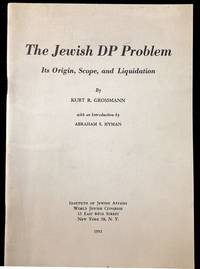
1951réf. 41424New York: Institute of Jewish Affairs World Jewish Congress 1951. 1st edition. Original paper wrappers. 8vo 43 pages. “No single phenomenon of the postwar period except the struggle for the Jewish Homeland and its miraculous survival in the face of Arab intransigence has proven at once so tragic and so inspiring as that of the more than two hundred thousand Jews from various countries who at one time or another sojourned in camps and towns in Germany Austria and Italy while waiting for new homes and a new life in freedom. For years the two letters ‘DP’ figured prominently on the pages of Jewish publications were a daily topic of conversation the concern of Jewish philanthropy and the preoccupation of all major Jewish organizations the world over. It is for these reasons that the Institute of Jewish Affairs decided to relate the story of the Jewish DPs in the present study…. The purpose of this brochure is to summarize the unique experience in Jewish history which the DPs represented and to give a brief account of what their problem was like and how and by what means it was solved. The full story of the Jewish DPs of course has yet to be written.” from foreword. SUBJECTS: Jewish refugees. Jews -- Europe. World War 1939-1945. OCLC: 21664940. Very Good Condition. B HOLO2-159-59-ALGGR-’p. New York: Institute of Jewish Affairs, World Jewish Congress unknown
1976réf. 43026Yerushalayim: Yad va-shem rashut ha-zikaron la-Sho'ah vela-gevurah 1976. First edition. Original boards with dust jacket 4to 285 xv pages. Includes illustrations and maps. 28 cm. In Hebrew. Introduction also in English. Title in English as “Pinkhas HaKehilot: Encyclopedia of Jewish Communities: Poland: The Communities of Lodz and its Region.” Encyclopedia of Jewish life in Poland focusing on the regions of Lodz. Includes 42 cm fold out map. Includes bibliographical references. “Encyclopedia of Jewish Communities from Their Foundation till after the Holocaust is the name of each volume of a series presenting collected historical information and demographic data on Eastern European countries' Jewish communities most of which were depopulated and whose populations were exterminated in the Holocaust. Pinkasei haKehillot is one of the most important projects undertaken by Yad Vashem in Jerusalem concisely documenting this aspect of the history of the Holocaust… Each volume of Pinkas Hakehillot is produced geographically with locale names in Yiddish as well as the local language's version. The content is composed of collected documents lists personal memoirs in their original unedited form historical accounts and essays devoted to the life of Jewish communities from antiquity until the present including maps and period photographs. The Pinkas attempts to illustrate ‘the life that once was and is no more.’” Wikipedia. SUBJECTS: Jews -- Poland -- History. Holocaust Jewish 1939-1945 -- Poland. Ethnic relations. Jews. OCLC: 22956042. Slightly worn dust jacket. Very Good Condition in Very Good- Jacket. YIZ-23-52-CCLEX. Yerushalayim: Yad va-shem, rashut ha-zikaron la-Sho'ah vela-gevurah unknown
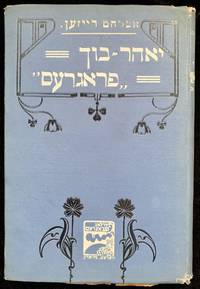
1904réf. 43110Varsha Warsaw: Ferlag "Progress 1904. First edition. Original illustrated printed boards 8vo 162 32 pages plus 7 unnumbered leaves of plates with illustrations. 22 cm. In Yiddish. Title translates as “Yearbook ‘Progress’: A Journal for Literature Science and Criticism.” “Abraham Reisen was a Yiddish poet short-story writer playwright and editor…While he was still a teenager his talent was recognized by Shalom Aleichem and I.L. Peretz who arranged for the publication of his earliest poems. After some years in Minsk Warsaw Krakow and Berlin he settled permanently in New York in 1914. Influenced by Heinrich Heine whom he translated into Yiddish he was one of the first Yiddish poets to make use of folksong material. His poetry though mostly written in conventional quatrains is suffused by a refined sensibility that adumbrates the writing of Di Yunge.” Jewish Virtual Library ”In 1900 Yakov Lidski founded "Progress" publishing house. Its name clearly communicated its goal. This publishing company considered to be the first to deal with modern Yiddish literature published a series of original and translated popular science books along with translated European literature and original Yiddish literature. The first editor of the publishing house was poet Avrom Reyzen.” Wikipedia. SUBJECTS: Yiddish literature. Jews -- Poland -- Periodicals. OCLC: 21651882 Wear to spine some page separation toning and markings. About Good Condition. YID-46-28-GGLEX-’cc. Varsha [Warsaw]: Ferlag "Progress unknown
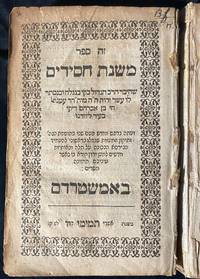
1740réf. 42573Amsterdam: No Publisher Listed 1740. Hardback. 2nd edition. Period Vellum binding 12mo 132 leaves; 17 cm. In Hebrew. Mayer Sulzberger's copy with his bookplate. Like the Mishnah Mishnat Hasidim is arranged in "Sedarim" which are divided into "massechtot" and subdivided into "perakim." With an introduction entitled: Olam Katan. Includes index. Title-page has ornamental border. Raphael Immanuel ben Abraham Hai Ricchi 1688-1743 was an "Italian rabbi cabalist and poet.After having studied Talmud under Nathan Pinkerle rabbi of Alessandria della Paglia Ricchi became tutor in the houses of several wealthy Jews. He was thus successively employed at Göritz Fiorenzuola Finale in Modena and Venice; in the last-named place he opened a school. He then went to Triest where he was ordained rabbi in 1717 by Hillel Ashkenazi rabbi of Canea after which he was invited to the rabbinate of Görz. Owing to his great love for cabalistic studies and to his ascetic tendencies Ricchi resolved to settle in Palestine. He arrived at Safed in 1718 and during his stay there of two years he occupied himself with the study of the works of Isaac Luria and Hayyim Vital. He was also reordained rabbi by Hayim Abulafia. In 1720 an epidemic broke out in Palestine and Ricchi was compelled to return to Europe. On the voyage he and all his fellow passengers were captured by pirates and brought to Tripolitza whence through the efforts of Abraham Halfon Ricchi and his family were allowed to return to Italy. He then occupied the rabbinate of Florence till 1723 in which year he removed to Leghorn where for twelve years he engaged in business as a merchant. He spent twenty months in travel visiting Smyrna Salonica Constantinople Amsterdam and London and in 1735 set out for Palestine spending two years at Aleppo and three at Jerusalem. In 1741 he returned to Leghorn and in 1743 while traveling in Italy for the purpose of selling his works he was killed by robbers who buried his body by the shore of the Reno. Six days later some Modena Jews discovered the remains and brought them to Cento for burial. Ricchi's most important work is the above-cited 'Mishnat Hasidim' a cabalistic work begun in 1726 at Leghorn. Like the Mishnah it is arranged in orders 'sedarim' which are divided into treatises 'massektot' and subdivided into chapters 'peraim' the names of the six Mishnah orders being taken in a cabalistic sense. But the chief divisions of the work are three termed 'mafteot' besides the introduction entitled ''Olam Kaon' = 'microcosmos' in which Ricchi endeavors to popularize the Cabala. The first main division is the 'Maftea ha-'Olamot' in which the worlds are treated. It contains: 1 the order of Zera'im treating of the cabalistic cosmology and of metaphysics and divided into seven massektot and eighteen chapters; 2 the order Kodashim treating of the realm of emanation 'olam ha-azilut' which is styled 'the holy of holies' and containing twenty massektot and seventy-eight chapters; 3 the order ohorot treating of the three other realms namely those of creative ideas 'beri'ah' creative formations 'yezirah' and creative matter 'asiyah' and divided into nine massektot and twenty-seven chapters; and 4 the order Nezikin treating of the demons and 'kelifot' and divided into six massektot and seventeen chapters. The second main division entitled 'Maftea ha-Neshamot' contains the order Nashim treating of souls in twelve massektot and forty-eight chapters. The third main division entitled 'Mafteah ha-Kawwanot' contains the order Mo'ed divided into fifty-eight massektot and 371 chapters and treating of the Kawwanah. It will be seen that the number of massektot in this work is 112 corresponding to the numerical value of the sacred name ; and the number of chapters 547 equal to the numerical value of Ricchi's name plus twelve the number of its letters. The sources for this work besides the Zohar are mostly Isaac Luria's and Hayyim Vital's writings of which the 'Sefer ha-Gilgulim' 'Kanfe Yonah' and 'Shulhan 'Aruk' may be particularly mentioned. Ricchi drew also from other cabalists" M. Seligsohn in JE 1905. NYU houses their copy in the Mitchell M. Kaplan Collection of Rare Judaica and Hebraica. Aviva Ben-Ur's Ladino catalog list #14. Judge Mayer Sulzberger "was closely associated with Isaac Leeser and assisted that scholar in editing The Occident contributing to it a partial translation of Maimonides' "Moreh Nebukim." After Leeser's death Sulzberger edited vol. xxvi. of The Occident. He was one of the founders of the Young Men's Hebrew Association which he served as president; and he has taken great interest in the Jewish Hospital of Philadelphia of which he has been vice-president since 1880. He was from the beginning in 1888 chairman of the publication committee of the Jewish Publication Society of America; was one of the original trustees of the Baron de Hirsch fund; and interested himself in the establishment of agricultural colonies at Woodbine N. J. and in Connecticut.Sulzberger had one of the best private libraries in America; it contained a very large number of Hebraica and Judaica" WIkipedia. SUBJECTS: Cabala -- Early works to 1800. Siddurim -- Texts. Judaism -- Ari rite -- Liturgy -- Kabbale -- Ouvrages avant 1800. Siddour -- Textes. Cabala. OCLC: 904949349. OCLC lists only 2 copies of this 1740 2nd edition worldwide NYU & Cambridge and only 3 copies of the first edition of 1727. Boards slightly bowed with front hinge starting. Remains of 19th Century paper label on spine. Lacks front blank pastedown. Jewish institutional bookplate in addition to that of Sulzberger. Paper toning but strong. About Very Good- Condition. Attractive copy of early edition of an important cabalistic text. RAB-67-7. Amsterdam: [No Publisher Listed] unknown
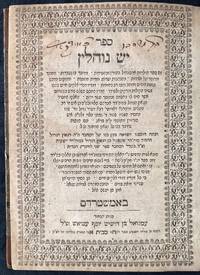
1701réf. 43446Amsterdam: 'Imanu'el ben Yosef 'Atias 1701. 1st edition. Period Half Leather over Marbled Boards 8vo 2 46 leaves i.e. 4 92 pages 20 cm. In Hebrew. By the father of the Holy Shela'h haKadosh. Ethical teachings and customs by the father of the holy Shelah with the will of his son Rabbi Shabtai Sheftel printed here for the first time Sefer Yesh Nochalin a collection of ethical teachings conduct and laws by the Gaon and Kabbalist Rabbi Avraham HaLevi Horowitz father of the Ba'al Shelah HaKadosh with glosses and additions by his son Rabbi Yaakov Horowitz. At the end of the book the will of Rabbi Shabtai Sheftel Horowitz son of the holy Shelah and grandson of the author was printed for the first time. Rabbi Shabtai Sheftel HaLevi Segal Horowitz 1592-1660 son of Rabbi Yeshayahu HaLevi Horowitz is known for his book "Snei Luchot HaBrit." He was a rabbi and Rosh Yeshiva one of the greatest Ashkenazi Jewish scholars of his generation. He was a preacher in the Prague community and the rabbi of Fürth Frankfurt Poznan and Vienna. He edited his father's book "Snei Luchot HaBrit" and is known by the name of his own book "Vavei HaAmudim." SUBJECTS: Jewish ethics -- Early works to 1800. Morale juive -- Ouvrages avant 1800. Testaments moraux OCLC: 9055147.Light rubbing to boards toning as expected a very attractive copy in original binding Very Good Condition. B Rab-67-15-KKXLB. Amsterdam: 'Imanu'el ben Yosef 'Atias unknown
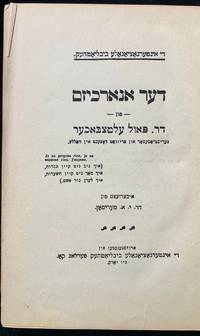
1909réf. 43139New York: Internatsyonale bibliothek Verlag ko 1909. First edition. Original boards 8vo 347 pages 21 cm. In Yiddish. Title translates as “Anarchism.” Translation of Paul Eltzbacher’s “Anarchism” into Yiddish. In it he covers seven anarchist figures: Godwin Proudhon Stirner Bakunin Kropotkin Tucker and Tolstoy. Includes bibliographical references. “Jacob Abraham Maryson was a Jewish–American anarchist doctor essayist and Yiddish translator. Maryson was among the few Pioneers of Liberty who could write in English. He was among the Pioneers who launched the Varhayt in 1889 the first American anarchist periodical in Yiddish….Maryson contributed to a variety of other Yiddish publications and became known as ‘the Kropotkin of the Jewish anarchist movement’. During Fraye Arbeter Shtime's hiatus in the late 1890s Maryson assisted in the cultural and literary journal Di Fraye Gezelshaft. Beginning in 1911 he edited the anarchist periodical Dos Fraye Vort. Maryson organized the Kropotkin Literary Society to print Yiddish translations of European thinkers. Maryson handled some of the group's most challenging translations including Marx's Das Kapital Stirner's The Ego and His Own and Thoreau's Civil Disobedience. He also translated John Stuart Mill's On Liberty. Maryson later wrote The Principles of Anarchism in 1935.” Wikipedia. SUBJECTS: Anarchism. OCLC: 19304220 Very Good Condition. YID-48-3-. New York: Internatsyonale bibliothek Verlag ko unknown
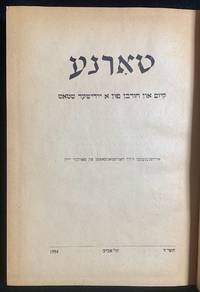
1954réf. 43017Tel Aviv: Aroysgegeben durkh Landsmanshaftn fun Torner Yidn 1954. First edition. 8vo. Original printed boards. xx 928 pages includes illustrations facsimiles map and portraits. 25 cm. In Yiddish. Title translates as “Tarnow: Existence and Destruction of a Jewish City.” Memorial book for the community of Tarnow in Poland. Includes essays on the religious and political life of Jews in Tarnow and essays on the various diasporic communities where they established landsmanshaftn. Includes bibliographical references and index. “Before World War II about 25000 Jews lived in Tarnow a city in southern Poland 45 miles east of Krakow Cracow. Jews—whose recorded presence in the town went back to the mid-fifteenth century—comprised about half of the town's total population. A large portion of Jewish business in Tarnow was devoted to garment and hat manufacturing. The Jewish community was ideologically diverse and included both religious Hasidim and secular Zionists.” USHMM. SUBJECTS: Jews -- Poland -- Tarnow Wojewo´dztwo Malopolskie -- History. Holocaust Jewish 1939-1945 -- Poland -- Tarnow Wojewo´dztwo Malopolskie Ethnic relations. Jews. OCLC: 19197168. Some tears and discoloration. Good Condition. YIZ-23-58-CCLEX. Tel Aviv: Aroysgegeben durkh Landsmanshaftn fun Torner Yidn unknown
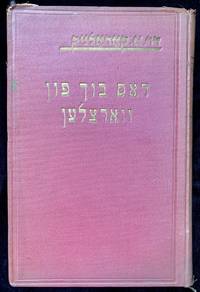
1928réf. 43187Varshe Warsaw: Ahisefer 1928. First edition. Original printed boards. 8vo 262 pages 22 cm. In Yiddish. Title translates as “The Book of Roots.” Auto-biography of Jewish-American Yiddish writer Abraham Coralnik. Coralnik 1883-1937 “was born in Uman Kiev district to a father who was a scholar and a follower of the Jewish Enlightenment…. His literary activities commenced in 1903 in German as a contributor to Die Welt The world in Vienna the central organ of the Zionist world organization. He later edited German periodicals in Czernowitz Vienna and Zagreb. He placed work in German philosophical journals and major German newspapers. He wrote several dramas in German and Das Russenbuch The Russian book Strassburg 1922 471 pp. an anthology of Russian literature. He also wrote for several Russian newspapers and from 1911 was a correspondent writing from Berlin Copenhagen and Rome for the St. Petersburg newspaper Rech’ Speech. Several of his essays appeared in Haatid The future in Berlin over the years 1908-1913. In 1914 he lived for a short time in Copenhagen and in 1915 he emigrated to New York and became a contributor to Tog Day. His first article in Tog appeared on October 11 1915.” Leksikon Fun Der Nayer Yidisher Literatur. SUBJECTS: Jews -- Biography. OCLC: 19313330. Paper browning some pages loose. Otherwise Good Condition. YID-48-17-LEXCCGG. Varshe [Warsaw]: Ahisefer unknown
1711réf. 5962[sans lieu], [sans nom], 1711. In-12 de [4]-270p. demi-basane brune, dos à nerfs, pièce de titre verte, coiffe sup. accrochée (reliure 1900), tampon-ex-libris moderne.
1778réf. 74611778 2 Neuchâtel: Chez Samuel Fauche, 1778. 2 vol. in-4.: 19.5 x 25 cm. I/ 3 ff. de fx-t., front. et titre, iv pp. de dédicace et préface, 454 pp., 1 f. d'avis au relieur + 38 pl. grav. et cartes; II/ 3 ff. de fx-t., front. et titre, 391-[1] pp. avec avis au relieur au vo de la p. 391 + 41 pl. grav. et cartes. Première et unique édition in-4°, la plus recherchée, avec les 81 gravures et cartes d'après Merian: 2 frontispices, 67 vues de la Suisse et 12 cartes donc 6 dépliantes. Cette nouvelle édition, la quatrième, entièrement refondue, est plus exacte que les précédentes. (Lonchamp: no. 2560 /Quérard, VIII: 276). Reliures de l'époque en veau granité. Dos à nerfs avec pièces de titre et de tomaison en veau vert et caissons ornés aux petits fers. Trois filets dorés en encadrement des plats. Deux filets aux coupes. Tranches marbrée. Ex-libris: andré Gutzwiller. Traces d'usage aux reliures. Quelques rousseurs. Petite déchirure à la partie sup. de la p. 305 du 1er volume. La figure représentant le plan de Lausanne de Mérian, quelque peu effacée à un endroit: en compensation une figure plus ancienne, également d'après Mérian, a été contrecollée à son recto (Vol I: p. 351).
1999réf. 110195AB1999. Skibbereen Co. Cork Red Barn Publishing 1999. 21 cm. 5 102pages with illustrations by Anthony Ruby. Softcover. Excellent condition with only minor signs of external wear. Rare ! Out-of-Print ! Includes for example the following essays: Abraham Abell's Ancestry / Abraham Abell: Bibliophile and Collector / Abraham Abell as Seanchai / The Arts and Abraham Abell / The Cuvierian Society / Abraham Abell the Ogham Collector / An Excursion to Bantry and Castletown / Abraham Abell's Library etc. paperback
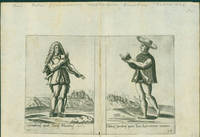
réf. 63-7940Padua Italy: Joos de Bosscher 1593. Engravings. 17 x 11.4 cm. Image size. Very Good. Some scribbling in pencil in margins outside image. [Padua, Italy: Joos de Bosscher, 1593]. unknown
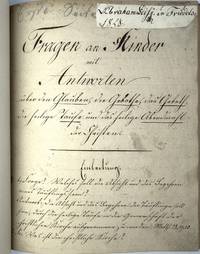
1828réf. 512100Self-Published 1828. Hardcover. VERY GOOD. 89 32pp. Two autograph manuscripts in fine longhand by Abraham Leisy. The first is a transcription of the Gerrit Roosen's Mennonite Catechism; the second text is a 32-page collection of pious tales. The books were bound together with a signature inlaid from a letter by Abraham Leisy and pasted to the title page of the first volume. Bound in black finished cloth with 'Biblische Fragen' stamped to the front cover. The FFEP bears a note by Leisy's sister Babette reading 'Babette Leisy. / Cleveland. / Dieses Buch brachte meinen topfchen Diana im Jahr 1895. von Deutschland Friedelsheim das hat alles Bruders Abraham Leisy geschrieben.' 'The Abraham and Katarina Leisy family emi grated to America in 1855 from Friedelsheim Germany. They settled on a farm outside of Donnellson Iowa. The Leisys were members of the West Zion Mennonite Church of Donnellson.' Mennonite Life April 1976. Abraham's sons notably founded the Leisy Brothers' 'Union Brewery' in 1862 in Keokuk Iowa. When the state of Iowa banned manufacture of alcoholic beverages in 1884 the brewery was moved to Peoria Illinois and renamed 'Leisy Brewing Company' a major regional beer producer and known as the last Mennonite-operated brewery in the U.S. Self-Published hardcover
1864réf. 24901.02"with the same determination to divide the country unless they can secure universal abolition we are exposed to the same dangers every day and God only knows in what unlucky hour our ruin may be consummated. Compare his policy with McClellan's expression of readiness to receive any State when its people offer to submit to the Union." This Democratic Party campaign pamphlet quotes an April 1864 letter to argue that Lincoln gave Lieutenant General Ulysses S. Grant free rein to conduct the war after having interfered with and micromanaged McClellan's Peninsula Campaign in 1862. The publication also declared that Republicans were stained with "The Taint of Disunion" and quoted from Republican speeches and editorials to insist that the Democrats were the party of "UNION AND PEACE." ABRAHAM LINCOLN.Printed Document. Democrat Campaign "Document No. 12" with headings "Lincoln's Treatment of Gen. Grant" "Mr. Lincoln's Treatment of Gen. McClellan" and "The Taint of Disunion." New York 1864. 8 pp. 5¾ x 8â… in. Excerpts: Lincoln to Grant April 30 1864 "I wish to express in this way my entire satisfaction with what you have done up to this time so far as I understand it. The particulars of your plans I neither know nor seek to know. You are vigilant and self-reliant; and pleased with this I wish not to obtrude any restrains or constraints upon you while I am very anxious that any real disaster or capture of our men in great numbers be avoided." p1/c1 "Such in brief are some of the most notable instances in which Mr. Lincoln interfered with General McClellan when he occupied a position similar to that held by General Grant. They reflect so severely upon the President that no attempt to gloss them over by his apparent subsequent repentance can disabuse the patriotic portion of the nation of the matured conviction that he is to be held responsible for the lack of decisive victories in Eastern Virginia. The blame must and will rest upon him to whom it belongs." p5/c2 "Having shown by copious extracts from the speeches of Abraham Lincoln W. H. Seward Wendell Phillips Wm. Lloyd Garrison and from the editorial writings of the Chicago Tribune and the N. Y. Tribune… that they were all original secessionists and disunion men we propose now to give the evidence that Mr. Lincoln himself has within the last three months been concerned in a movement to make peace with Jeff. Davis on terms involving the direct proposal to divide the Union and let the South go." p7/c2-p8/c1 "with the same determination to divide the country unless they can secure universal abolition we are exposed to the same dangers every day and God only knows in what unlucky hour our ruin may be consummated. Mark how Mr. Lincoln constantly keeps up the idea of negotiating only with Jefferson Davis. Why does he never address himself to the people or the States of the South. Compare his policy with McClellan's expression of readiness to receive any State when its people offer to submit to the Union." p8/c2 Historical Background The 1864 presidential election pitted President Lincoln against his Democratic challenger General George B. McClellan. Although McClellan had been the commander of the Army of the Potomac and general-in-chief of the Union Army the Peace platform adopted by the Democratic National Convention in Chicago declared the war a failure. The party was bitterly divided between War Democrats who favored continuing the war to restore the Union while leaving slavery alone; moderate Peace Democrats who favored an armistice and a negotiated peace that would likely protect slavery in a reconstructed union and radical Peace Democrats who favored an immediate end to the war without securing Union victory. McClellan was a War Democrat but the platform was written by radical Peace Democrat Clement Vallandigham and Peace Democrat George H. Pendleton was nominated for vice president. In 1864 Republicans created the National Union Party to attract War Democrats Unconditional Unionists and Unionist Party members who would not vote for the Republican Party though most state Republican parties did not change their name. President Abraham Lincoln won the nomination of the "National Union Party" at its Baltimore convention and won re-election with new running mate War Democrat Andrew Johnson. Although Lincoln was convinced by August 1864 that he would not be reelected General William T. Sherman's capture of Atlanta in early September and General Philip Sheridan's successes in the Shenandoah Valley of Virginia from August to October ensured his victory. Without the participation of the seceded states Lincoln and Johnson won 55 percent of the popular vote and an overwhelming 212-to-21 victory in the Electoral College. McClellan and Pendleton carried only Kentucky Delaware and McClellan's home state of New Jersey.
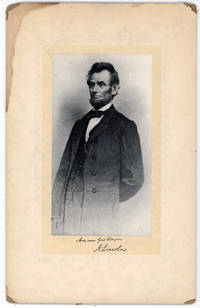
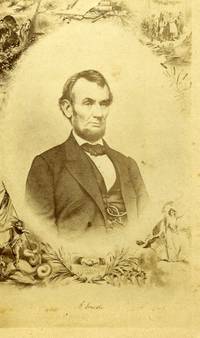
1909réf. 000014161Boston: M.T. Sheahan 1909 1909. Cabinet Card. Good. 27.5 cm x 17.5 cm. Photograph measures 17 cm x 9.25 cm. A cabinet card in black and white mounted and inset on a cream-colored paper board. A portrait of Lincoln with the caption "And now God bless you A. Lincoln." A striking image of the sixteenth President of the United States. A dampstain on the left edge of the cabinet card light chipping to the paper and a private namestamp on the verso. M.T. Sheahan [1909] unknown
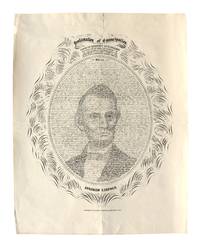
1900réf. 27986Denver CO: Issued by Halsey M. Rhoads 1900. Very Good. Denver CO: Issued by Halsey M. Rhoads ca. 1900. Later printing. Broadside with calligraphic portrait of Abraham Lincoln in which the script of the Emancipation Proclamation forms the image within a decorative frame surrounded by the names of the members of Congress who voted for the amendment of the U.S. Constitution. 48 x 37 3/4 cm. A few tears to edges with tape mend to verso top edge; folds; minor edge wear; paper residue to verso from previous mount; overall Very Good. The original design was by W.H. Pratt in 1865 with just portrait and border and the names to the outside added to later printings. Halsey Rhoads was publisher of the Rocky Mountain Herald and a well known and prominent Denver citizen--even his bout with appendicitis in 1901 treated with leeches and ice garnered several writeups in contemporary newspaper accounts. This broadside scarce in any printing. See Eberstadt 42. Issued by Halsey M. Rhoads unknown
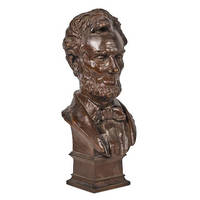
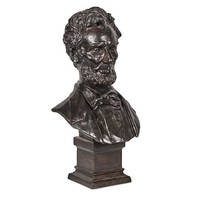
réf. 133797Patinated bronze portrait bust of Abraham Lincoln marked "GEO. E. BISSELL Sc GORHAM CO. FOUNDERS copyrighted" and stamped "G 47." This is one of a series of popular desktop busts of Lincoln produced by the Gorham foundry in the early part of the 20th century. In fine condition. The piece measures 18 inches in height. An exceptional piece of American history. unknown
réf. 131044Patinated bronze cast of Abraham Lincoln by George Bissell one of only three commissioned by Ralph Newman for THE USS AL. Boldly signed by the artist in the back Geo. E. Bissell Sc. George Bissell was an important American sculptor working in the late 19th and early 20th centuries. He produced two full length statues of Lincoln: one in Edinburgh and one in Clermont Iowa. According to the letter from Lincoln College Curator Paul Beaver the present item is one of three copies made from the school's original Bissell bronze bust of Lincoln by the Van Dyke Galleries of Chicago in the summer of 1989. One copy was presented to the USS Abraham Lincoln commissioned in 1989 one copy was sold to Mel Smith and the third to Barry and Louise Taper. In fine condition. The piece measures 25.5 inches in height. An exceptional piece. unknown
réf. 11015Lazier. Abraham Lincoln carte de visite undated combines a portrait of the sixteenth president with patriotic imagery and a scene identified as showing freed slaves placing Lincoln's likeness within the visual culture of Union nationalism and emancipation. Such imagery connected the president directly to the political and social consequences of the Civil War including the destruction of slavery and the emergence of freedom as a central theme in popular commemorative material. Carte de visite by Lazier of Syracuse New York with photographer's back imprint. Approximately 2.5 x 4 inches. The mount presents Lincoln together with patriotic scenes and an additional vignette depicting freed slaves. The combination of presidential portraiture and emancipation imagery gives the card a more explicitly political character than a conventional studio portrait linking Lincoln's public image to Union victory and the end of slavery. Lincoln's image circulated extensively in cartes de visite during and after the Civil War becoming part of a broader culture of political remembrance following his assassination in 1865. The inclusion of African American subjects identified as freed slaves places this example within the visual record of how emancipation was represented to contemporary audiences through inexpensive photographic and printed formats. In excellent condition. unknown
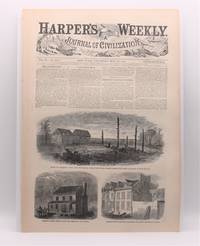
1865réf. W2380New York: Harper's Weekly 1865. 16 pages. Large folio 16 inches by 11 1/4 inches. Original complete issue of Harper's Weekly. Harper's Weekly was the most important American pictorial newspaper in the 19th century. Because the original wood engravings in virtually every issue are highly collectible complete issues are becoming more difficult to obtain. The issue offered here focuses on the events following the assassination of Lincoln. On the front page are articles on the assassination and the funeral along with three original wood engravings: one showing the ruins of the Garrett barn where John Wilkes Booth was shot; another showing the house where Booth died; and a third engraving of the house of Booth's co-conspirator David Herold. On the interior are multiple engravings of various Lincoln funeral sites. Among the unrelated engravings is the double-page centerfold by Thomas Nast entitled "Palm Sunday"--one side portraying the arrival of Jesus in Jerusalem and the other side Lee surrendering to Grant. This issue of Harper's Weekly is disbound from an annual volume and has the usual sewing holes along the binding edge but it is still in very good condition: clean and bright with minimal toning of the paper. Note: we have available more than 500 complete issues of Harper's Weekly as well as thousands of individual wood engravings. Please inquire if you are looking for specific items. First Edition. Paperback. Very Good. Elephant Folio - over 15" - 23" tall. Magazine. Harper's Weekly Paperback
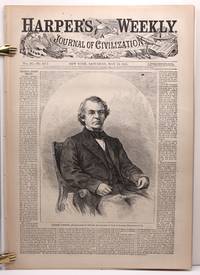
1865réf. W2422New York: Harper's Weekly 1865. 16 pages. Harper's Weekly was the most important American pictorial newspaper in the 19th century. Because the original wood engravings in virtually every issue are highly collectible complete issues are becoming more difficult to obtain. The issue here focuses on Lincoln's New York City funeral procession and the capture and killing of John Wilkes Booth. The front page features a wood engraving of the newly sworn-in President Andrew Johnson. It is based on a photograph by Alexander Gardner. The centerfold is a double-page wood engraving captioned "President Lincoln's Funeral--Procession in New York City." It is based on a photograph by Matthew Brady. Other wood engravings include "Sergeant Boston Corbett" a portrait based on a Brady photograph of the man who shot Booth; "Planning the Capture of Booth and Harold" based on a Gardner photograph; "Booth's Capture--The Assassin Brought to Bay" a recreated view of Booth in the burning barn in which he was killed; "President Lincoln's Funeral--Removal of the Body from the City Hall to the Funeral Car New York"; and "Post-Mortem Examination of Booth's Body on Board the Monitor 'Montauk'." There is text accompanying most images. Especially striking is the lengthy description of the interaction between Booth and his pursuers before he was killed. This newspaper is disbound from an annual volume and has the usual sewing holes along the binding edge but it is still in very good condition: clean and bright with minimal toning of the paper; a long but neat closed tear along the centerfold line of the double-page engraving; a one-inch closed tear limited to the blank margin of the front page; and a 1.5 inch by 3.5 inch triangular chip out of a corner of the last leaf primarily impacting one word in the title of an advertisement. Note: we have available more than 500 complete issues of Harper's Weekly as well as thousands of individual wood engravings. Please inquire if you are looking for specific items. . First Edition. Paperback. Very Good. Elephant Folio - over 15" - 23" tall. Magazine. Harper's Weekly paperback
1865réf. 25618Frank Leslie published this print as a premium for his new family magazine Frank Leslie's Chimney Corner and copyrighted it on April 8 1865 just a week before Lincoln's death. The image created by engraver Henry B. Major and lithographer Joseph Knapp portrays Lincoln flanked by the First Lady and Vice President Andrew Johnson greeting Julia Dent Grant wife of Lieutenant General Ulysses S. Grant who stands nearby. According to a notice printed at the bottom right corner "Every Person who pays Ten Cents each for numbers 1 and 2 of Frank Leslie's Chimney Corner The New Family Paper is entitled to a copy of this PLATE without extra charge" or individuals could purchase the print for $3. ABRAHAM LINCOLN.Lithograph. "Grand Reception of the Notabilities of the Nation at the White House 1865" New York: Frank Leslie April 1865. 1 p. 19 x 23¾ in. In the first issue of The Chimney Corner Leslie described the "Grand Reception" image as "the most costly gift plate ever presented by any publisher in the United States having been produced at an expense of $10000." "Every family should possess this truly national picture and carefully preserve it" Leslie continued "as it will transmit to future generations the men who have restored our great national unity. It is especially valuable as it contains an excellent likeness of our late lamented President introducing General Grant and his wife to Mrs. Lincoln." The picture contains "nearly 100 portraits of our most celebrated Generals Statesmen and Civilians also of many of our most distinguished American ladies. The likenesses are admirable having been taken from photographs by Brady." The key giving the names of each individual portrait was published in issue number 4 of the Chimney Corner on June 24. Included in the image are Generals Ulysses S. Grant John G. Foster William T. Sherman Hugh J. Kilpatrick Nathaniel P. Banks Philip H. Sheridan Winfield S. Hancock John A. Logan Joseph Hooker Benjamin F. Butler Oliver O. Howard John A. Dix and Henry W. Slocum. Admirals David Farragut and David Dixon Porter represent the Navy. Members of the cabinet include Secretary of War Edwin M. Stanton Secretary of State William H. Seward and Secretary of the Navy Gideon Welles. Members of Congress include Senator Henry B. Anthony of Rhode Island Senator William P. Fessenden of Maine Senator Charles Sumner of Massachusetts and Speaker of the House Schuyler Colfax of Indiana. Chief Justice Salmon P. Chase represents the U.S. Supreme Court. New York newspaper editors Horace Greeley Henry J. Raymond and James Gordon Bennett are also present. Prominent women include First Lady Mary Lincoln Ann S. Stephens dime novelist and magazine editor Miriam Folline Squier wife of Leslie's former editor-in-chief and Leslie's future wife Julia Dent Grant wife of Ulysses S. Grant Kate Chase Sprague daughter of Chief Justice and wife of Rhode Island Senator and Adele Cutts Douglas widow of Stephen A. Douglas. Others identified in the key include Ephraim G. Squier Leslie's former editor-in-chief archaeologist and U.S. commissioner to Peru Governor Andrew G. Curtin of Pennsylvania and Ambassador to Russia Cassius M. Clay of Kentucky. Despite Leslie's copyright Anton Hohenstein created a very similar image entitled "Lincoln's Last Reception" which also featured Lincoln's meeting General Ulysses S. Grant's wife Julia. Published by John Smith in Philadelphia in 1865 and hand-colored "Lincoln's Last Reception" also included more than thirty military and political leaders and a few prominent women among the onlookers in the ballroom. Frank Leslie's Chimney Corner 1865-1884 was a weekly family newspaper published "every Tuesday" in New York by Frank Leslie. Each illustrated issue of sixteen pages contained serial fiction short stories poetry biographies history travel sketches natural history anecdotes and other subjects. According to the prospectus the newspaper would be "a welcome messenger of instruction and amusement to the young and old in the family and by the fireside—that altar around which cluster our holiest and most cherished recollections." Leslie had copyrighted the title in 1861 but "the great Rebellion now happily closing intervened to put a stop to the enterprise." Frank Leslie 1821-1880 was born in England as Henry Carter but he adopted the pseudonym of Frank Leslie to keep his artistic activities a secret from his relatives who disapproved. He came to the United States in 1848 and settled in New York in 1853 to engrave woodcuts for P. T. Barnum's Illustrated News. When that publication failed Leslie began work on his own series of illustrated publications including Frank Leslie's Illustrated Newspaper The Budget of Fun Frank Leslie's Chimney Corner and others. At his death he was deeply in debt but his second wife Miriam Folline Squier 1836-1914 continued his publications and again made them profitable even legally changing her name to Frank Leslie in 1881. Condition Spot-mounted to modern board mat toning moderate foxing minor edge wear. Would benefit from conservation. Frank Leslie
1865réf. 153154New York: Trent Filmer & Co. n.d. 1865. First edition of this uncommon memorial tribute issued in the wake of Abraham Lincoln's assassination gathering his most celebrated words each page printed within a heavy black mourning border. Octavo original printed wrappers on coated stock twelve leaves printed on the rectos only reprinting his farewell speech to his Springfield friends on setting out for Washington the Gettysburg Address the Emancipation Proclamation the Second Inaugural Address and a poem he was said to cherish among other texts. In very good condition with light rubbing soiling and toning. From the collection of the Lincoln collector and author Harry J. Lytle with a small translucent slip bearing typed text signed and dated 1927 by Lytle tipped to the title page. Abraham Lincoln was shot by John Wilkes Booth at Ford's Theatre on April 14 1865 and died the following morning the first American president to be assassinated. His death coming only days after Lee's surrender at Appomattox plunged the North into an outpouring of grief and publishers hurried to issue memorial books broadsides and pamphlets honoring the fallen president. Printed within black mourning borders tributes such as this one preserved the speeches and proclamations that had already come to define his presidency from the Emancipation Proclamation which declared the enslaved people of the rebelling states forever free to the Gettysburg Address and the Second Inaugural with its closing plea for "malice toward none" and "charity for all." Such ephemeral memorial printings were little valued at the time and survive today in small numbers. Trent, Filmer & Co. unknown
1864réf. 25614The second in a series of four racist political cartoons published in 1864 by Bromley & Company which was closely affiliated with the Copperhead New York World newspaper. These prints sought to undermine Abraham Lincoln's chances for reelection by branding him as a "miscegenationist" and playing on white fears of "race-mixing." The cartoon scene pictures several interracial couples enjoying a day at the park eating ice cream discussing wedding plans and a woman's upcoming lecture. Two African American families have white employees a carriage driver and footmen and a babysitter. The only other example traced at auction brought $7800 in 2010. ABRAHAM LINCOLN. RACISM.Print. "Miscegenation or the Millennium of Abolitionism." Political Cartoon. New York: Bromley & Co. 1864. 1 p. 20¾ x 13â… in. American politics had long played on fears of sexual relationships between races. A powerful new word for "race-mixing" was coined in an anonymous December 1863 pamphlet entitled Miscegenation: The Theory of the Blending of the Races Applied to the American White Man and Negro published in New York. Purporting to advocate the virtues of the "blending of the white and black races on this continent" it was a literary forgery prepared by The World managing editor David Goodman Croly and reporter George Wakeman. The authors were unsuccessful in their attempt to trick President Lincoln into endorsing the work. At the far left of the image Abraham Lincoln declares "I shall be proud to number among my intimate friends any member of the Squash family especially the little Squashes." The African American woman to whom he is speaking replies "I'se 'quainted wid Missus Linkum I is washed far her 'fore de hebenly Miscegenation times was cum. Dont do nuffin now but gallevant 'round wid de white gem'men! he-ah! he-ah! he-ah!" Senator Charles Sumner says "Mr. President! Allow me the honor of introducing my very dear friend Miss Dinah Arabella Aramintha Squash." A white carriage driver complains in the background "Gla-a-ang there 240t! White driver white footmen niggers inside my heys! I wanted a situation when I took this one" while a black man in the carriage tells his companion "Phillis de_ah dars Sumner. We must not cut him if he is walking." A black woman at a table tells a white man with her "Ah! Horace its-its-its-bully 'specially de cream" and he replies "Ah! my dear Miss Snowball we have at last reached our political and social Paradise. Isn't it extatic" To the right are two couples embracing each a white woman and an African American man. The first white women tells her partner "Oh! You dear creature. I am so agitated! Go and ask Pa" to which he replies "Lubly Julia Anna name de day when Brodder Beecher shall make us one!" The second white woman says "Adolphus now you'll be sure to come to my lecture to morrow night won't you" to which he answers "I'll be there Honey on de front seat sure!" In the background are various immigrant minorities viewing the scene. One exclaims "Most hextwadinary! Aw neva witnessed the like in all me life if I did dem me!" and another adds "Mine Got vat a guntry vat a beebles!" An Irish girl complains "And is it to drag nagur babies that I left old Ireland Bad luck to me." Manton Marble the editor of The World collaborated with printmaker Bromley & Company to issue a series of four anti-Lincoln "Political Caricatures." The present example was the No. 2 in that series. No. 1 was "The Grave of the Union or Major Jack Downing's Dream"; No. 3 "The Abolition Catastrophe Or the November Smash-up"; and No. 4 "The Miscegenation Ball." Republicans responded by trying to turn the "miscegenation" charge against the Democrats. A Republican print "The Political "Siamese" Twins: The Offspring of Chicago Miscegenation" pictures McClellan and Pendleton joined together despite their very different ideas on ending the war. Although Abraham Lincoln won New York states' electoral votes in 1860 Stephen Douglas had carried New York City and its environs. Financial elites fearing that civil war would ruin business and recent immigrants fearing competition with free black labor supported Douglas. Lincoln's unpopularity in New York City during the Civil War was a factor in the deadly 1863 Draft Riots. In 1864 Lincoln again won the states' electoral votes while New York City favored his Democratic opponent McClellan. In fact Lincoln's majority dropped from 50136 votes in 1860 to only 7373 votes in 1864 with approximately 50000 more total votes cast than in 1860. Bromley and Company continued to sell the caricatures after the election as this January 1865 advertisement from an Ohio newspaper makes clear. Another advertisement assured purchasers that the set of four prints available for $1 were "sent on wooden rollers to insure safe carriage." The World 1860-1931 a daily independent newspaper was published in New York City. Alexander Cummings founded it as a religious Republican outlet in 1860. August Belmont and others purchased it in 1862 changing the editorial focus. With editor Manton Marble 1834-1917 The World soon became the country's leading Democratic newspaper. In 1864 Union authorities shut down The Worldand another paper for three days after they published forged documents purportedly written by Lincoln that were really part of a hoax to manipulate the price of gold. The paper actively supported George B. McClellan against Lincoln in 1864. Condition Fine for exhibit despite flaws. Cropped with loss of "Political Caricature No. 2" from top edge and part of printed pricing information from bottom edge publisher's name rubbed out from the copyright statement lacking ½" from lower left corners a few short tape repairs by the edges a 2" closed tear through the second dialogue bubble along the top edge and a 3" closed tear parallel to the right edge. Mount remnants on verso.