[Aristotle] Edel, AbrahamBiblio.com

28 131 résultats
1982réf. 70550AB1982. Chapel Hill The University of North Carolina 1982. 235 cm x 16 cm. XII 479 pages. Original Hardcover. Very good condition with only minor signs of external wear. Former library copy with library-stamp. Marker signs on edges. Includes for example the following essays: Aristotle's Works and the Problem of Interpretation / The Character of Aristotle's Thought and His Philosophic Method / Explanation and the Teleological Model / Methodological Aspects of Psychology etc etc. Aristotle 384 322 BC was a Greek philosopher and scientist born in the Macedonian city of Stagira Chalkidice on the northern periphery of Classical Greece. His father Nicomachus died when Aristotle was a child whereafter Proxenus of Atarneus became his guardian. At eighteen he joined Plato's Academy in Athens and remained there until the age of thirty-seven c. 347 BC. His writings cover many subjects including physics biology zoology metaphysics logic ethics aesthetics poetry theater music rhetoric linguistics politics and government and constitute the first comprehensive system of Western philosophy. Shortly after Plato died Aristotle left Athens and at the request of Philip of Macedon tutored Alexander the Great starting from 343 BC. According to the Encyclopædia Britannica "Aristotle was the first genuine scientist in history . and every scientist is in his debt." Teaching Alexander the Great gave Aristotle many opportunities and an abundance of supplies. He established a library in the Lyceum which aided in the production of many of his hundreds of books. The fact that Aristotle was a pupil of Plato contributed to his former views of Platonism but following Plato's death Aristotle immersed himself in empirical studies and shifted from Platonism to empiricism. He believed all peoples' concepts and all of their knowledge was ultimately based on perception. Aristotle's views on natural sciences represent the groundwork underlying many of his works. Aristotle's views on physical science profoundly shaped medieval scholarship. Their influence extended into the Renaissance and were not replaced systematically until the Enlightenment and theories such as classical mechanics. Some of Aristotle's zoological observations such as on the hectocotyl reproductive arm of the octopus were not confirmed or refuted until the 19th century. His works contain the earliest known formal study of logic which was incorporated in the late 19th century into modern formal logic. In metaphysics Aristotelianism profoundly influenced Judeo-Islamic philosophical and theological thought during the Middle Ages and continues to influence Christian theology especially the scholastic tradition of the Catholic Church. Aristotle was well known among medieval Muslim intellectuals and revered as "The First Teacher". His ethics though always influential gained renewed interest with the modern advent of virtue ethics. All aspects of Aristotle's philosophy continue to be the object of active academic study today. Though Aristotle wrote many elegant treatises and dialogues Cicero described his literary style as "a river of gold" it is thought that only around a third of his original output has survived. Wikipedia. hardcover
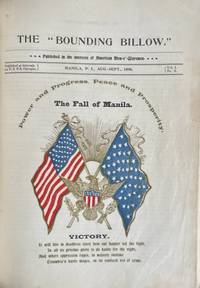
1899réf. 59607San Francisco & USFS Olympia: The Bounding Billow Printed by Whittaker & Ray Co. Inc. 1899. Eleven parts in one vol. 4to. 2 138 6 pp. With text photos illustrations 2 colour illustrations map photo plates at rear. Original blue publisher’s cloth embossed gilt lettering & shield on front cover edgewear rubbing wear to corners some spotting & wear a few occasional minor closed tears still a G copy from library of Chief Petty Officer William E. Bates 1871-1941 who served in the U.S. Navy for 30 years beginning with the Asiatic Squadron under Admiral Dewey and later during World War I w/ ownership marking on 2nd flyleaf a couple spelling corrections in manuscript. First edition thus of this “cruise book” for the U.S.S. Olympia which served as Admiral Dewey’s flagship during the Spanish-American War and had served as the flagship from 1895 three years prior as flagship of the Asiatic Squadron. This volume opens with an illustrated account of the USS Olympia’s cruises and experiences visiting China Japan Siberia and The Philippines. Included here as well is a reissue including photos colour illustrations and map Vol. 1 Nos. 1-7 of the shipboard periodical published by the seamen of the USS Olympia with place imprints of Nagasaki Hong Kong and Manila. Incorporated are firsthand accounts of shipboard life battle accounts contemporary photos and map prepared by L.C. Passano using sail needles. Of particular interest is the appendix listing the crews of the U.S. Asiatic Squadron including the USS Olympia USS Raleigh USS Boston USS Baltimore USS Concord USS Petrel USS McCulloch. The Bounding Billow, Printed by Whittaker & Ray Co., Inc.], hardcover
1968réf. 47890Baltimore: Willliams & Wilkins 1968. First Edition. Octavo. Maroon cloth; 520pp. Ex-Institute for Psychoanalysis Chicago with bookplate and card pocket. Very Good. 43rd volume in the series. Contributions include "Addiction to Barbiturate andNonbarbiturate Sedative Drugs" Carl F. Essig; "Patterns of Intravenous Self-Injection by Morphine-addicted Rats" James R. Weeks and R. James Collins; "Opioid Addiction Problems in Canada" S.J. Holmes; "Small Group Drinking Behavior: an Experimental Study of Chronic Alcoholics" Jack H. Mendelson Nancy K. Mello and Philip Solomon; etc. Willliams & Wilkins unknown books
réf. 23575P., Charles-Lavauzelle, 1949, in 8° broché, VIII-260 pages ; non coupé ; couverture illustrée en couleurs.
1929réf. 121451929 P., Rieder (Collection "Maîtres des Littératures"), 1929, in 8° broché, 87 pages ; 59 planches hors-texte ; rares annotations marginales ; signature sur le titre.
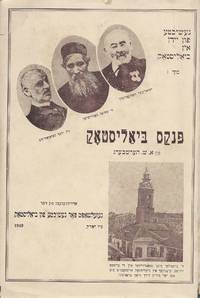
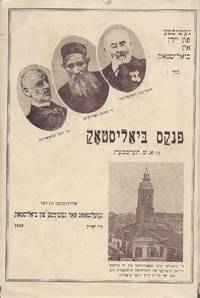
1949réf. 41480New York Bialystok Jewish Historical Association 1949. HARDBACK. 1st edition. Original Cloth 8vo 380 pages. In Yiddish. The chronicle of Bialystok: basic material for the history of the Jews in Bialystok until the period after the First World War. Very Good ConditionYIZ-10-1A. New York, Bialystok Jewish Historical Association unknown
1949réf. 41479New York Bialystok Jewish Historical Association 1949. HARDBACK. 1st edition. Original Cloth 8vo 480 380 pages. In Yiddish. The chronicle of Bialystok: basic material for the history of the Jews in Bialystok until the period after the First World War. OCLC: 10792576. Very Good ConditionYIZ-10-1. New York, Bialystok Jewish Historical Association unknown
réf. 201014765Paris, Revue europe mensuelle, 1969 ; in-8, 282 pp., broché, couverture illustr. BON ÉTAT - revue mensuelle juillet aout 1969 n°483/484.
réf. 65857P., L. Allison (Collection "Les Artistes Célèbres"), sans date, grand in 8° relié d'une modeste demi-toile grise, dos lisse avec étiquette de basane bleue, 116 pages ; nombreuses illustrations ; quelques rousseurs ; cachets ; reliure fanée avec frottis.
réf. 7502Paris, Les éditions Roger Dacosta, (octobre) 1967. In-4, reliure toilée de l'éditeur, jaquette.
1667réf. 131Paris Par A. Bosse 1667 In-8 - 12x18,5cm. Reliure d'époque en plein veau moucheté, dentelle dorée sur sur les coupes. 5ff, 72pp, 10ff.
1608réf. 64956Ingolstadt, Gedruckt in der Ederischen Truckerey, durch Andream Angermeyer [Andreas Angermaier], 1608. 4°. Mit Holzschn.-Titelvignette. 1 Bl., 30 S., Geheftet (ausgebunden; ohne Einband).
réf. 3059Marseille. Cahiers du Sud. 1953. In-8° broché. 150 pages. E.O. sur papier ordinaire.
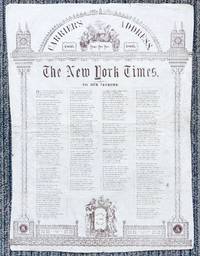
1865réf. 6598New York 1865. Good. Broadside 23 x 17 inches. Printed in brown ink. Old folds. Unevenly trimmed at edges reinforced with later paper in several places on verso. Light soiling foxing and wear. New York Times New Years broadside for 1866 with a lengthy poem commemorating the end of the Civil War and the assassination of President Abraham Lincoln. The text is printed in an elaborate and ornate border with decorative vignettes and the top and bottom center. The poem's couplets greet all readers of the Time from patriotic soldiers to women on the homefront to Wall Street moguls building their mansions. It then turns to address the war: "Twelve little months ago upon this morn / The bosom of the land by warfare torn / Shed tears of blood; while sounding sea to sea / From North to South cried one loud agony. / Twelve months ago and Marching Sherman's host / Struck as he said they should the Atlantic Coast; / While grim in front the rebel capital / King Death stood waiting for his carnival." After a bit the author addresses Lincoln's assassination: "Another tale will old men oft relate / Of how our Lincoln fell 'neath traitor hate; / How he we loved so much with so much pride / Struck by th' assassin's fatal bullet died. / Oh bitter tears fell on that April morn / As o'er our city the sad news was borne." Other battles and heroes are similarly mentioned as well as the mercy of nurses and the newly freed slaves: "O'er snowy cotton fields the people see / The noble spectacle of labor free. / . / And many a school-house open wide its door / To welcome thousands untaught before.". A wonderful exemplar of the genre particularly notable for its content on Lincoln and the end of the Civil War. unknown
1865réf. 6598New York 1865. Good. Broadside 23 x 17 inches. Printed in brown ink. Old folds. Unevenly trimmed at edges reinforced with later paper in several places on verso. Light soiling foxing and wear. New York Times New Years broadside for 1866 with a lengthy poem commemorating the end of the Civil War and the assassination of President Abraham Lincoln. The text is printed in an elaborate and ornate border with decorative vignettes and the top and bottom center. The poem's couplets greet all readers of the Time from patriotic soldiers to women on the homefront to Wall Street moguls building their mansions. It then turns to address the war: "Twelve little months ago upon this morn / The bosom of the land by warfare torn / Shed tears of blood; while sounding sea to sea / From North to South cried one loud agony. / Twelve months ago and Marching Sherman's host / Struck as he said they should the Atlantic Coast; / While grim in front the rebel capital / King Death stood waiting for his carnival." After a bit the author addresses Lincoln's assassination: "Another tale will old men oft relate / Of how our Lincoln fell 'neath traitor hate; / How he we loved so much with so much pride / Struck by th' assassin's fatal bullet died. / Oh bitter tears fell on that April morn / As o'er our city the sad news was borne." Other battles and heroes are similarly mentioned as well as the mercy of nurses and the newly freed slaves: "O'er snowy cotton fields the people see / The noble spectacle of labor free. / . / And many a school-house open wide its door / To welcome thousands untaught before.". A wonderful exemplar of the genre particularly notable for its content on Lincoln and the end of the Civil War. unknown books
1946réf. 33849London: Oxford University Press 1946. Small octavo. Cloth. 116 pp. In dustjacket. Oxford University Press unknown books
réf. b5898First Edition . Soft cover. Near Fine. Near fine in original wrappers with wear at the extremities. Civil War scenes and portraits including the final portrait of Abraham Lincoln in a two-page spread paperback
1863réf. 58199Camp near Brooks Station Saturday April 11 1863. Fine original condition. 15-1/2 x 9-3/4 inches. ".Yesterday I witnessed one of the grandest sights that I ever beheld. Our whole corps was reviewed by the President Generals Hooker McLain Howard Steinway Secretary Seward and an innumerable host of Brigadier Generals and it was a sight that has paid me for coming to war." The spectacle is described in great detail. Private Penfield was soon to be captured at Chancellorsville spending 12 days as a prisoner of war before being exchanged. He survived the war to carry on his father's carriage making business in Monroe Connecticut and later founded a small private academy. unknown
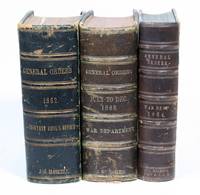
1862réf. 2923Washington D.C.: War Department 1862. Calf marbled boards. Very Good. FIRST OBTAINABLE PRINTING OF THE PRELIMINARY EMANCIPATION PROCLAMATION setting a date for the freedom of more than three million enslaved in the United States and reframing the Civil War as a fight against slavery. Issued by the War Department to regimental commanders in the field during the Civil War in the week after the completion of President Lincoln’s official manuscript version. Contained is a set of three volumes of General Orders covering the full year 1862 July-Dec 1863 and the full year 1864. History of the Emancipation Proclamation: “The proclamation has been called by responsible persons one of the three great documents of world history ranking with Magna Carta and the Declaration of Independence” – Eberstadt “From the first days of the Civil War slaves had acted to secure their own liberty. The Emancipation Proclamation confirmed their insistence that the war for the Union must become a war for freedom. It added moral force to the Union cause and strengthened the Union both militarily and politically. As a milestone along the road to slavery’s final destruction the Emancipation Proclamation has assumed a place among the great documents of human freedom” – National Archives Following the Seven Days Battle and General McClellan’s retreat from the Peninsula at the end of June 1862 President Lincoln realized that there would be no early end to the war and found himself “as inconsolable as it was possible for a human to be and yet live.” Anxious for news from the army and needing to escape the constant interruptions at the White House he frequently visited the telegraph office in the War Department building to await dispatches. It was during one such visit early in July that he asked the chief of the telegraph staff Major Thomas Thompson Eckert for some paper to “write something special” and began the first draft of the Emancipation Proclamation completing it in a few weeks. Lincoln had long hoped to resolve the slavery issue through a congressional act of emancipation compensating slave owners for their loss of “property” but that approach was roundly rejected by representatives from the border states leaving the President who had decided upon the necessity of emancipation with a presidential proclamation as the only option. The extraordinary document he conceived would announce the liberation on January 1 1863 of all slaves in those states still in rebellion against the Union and promised compensation to slave owners in those states that returned to the fold before that time if they adopted “immediate or gradual abolishment of slavery.” This proclamation would be followed by a final proclamation issued on the 1st of January identifying those states still in rebellion and confirming the liberation of all slaves therein. On Tuesday July 22 Lincoln presented his draft to the Cabinet telling them that he had resolved firmly upon the course of action it specified and asking them not for advice but suggestions. The only observation he had not anticipated came from Secretary of State Seward who proposed that it might be best to wait for a military victory before issuing the Proclamation as it could otherwise seem like “the last measure of an exhausted government.” Immediately recognizing the wisdom of the suggestion Lincoln held back. On September 17 after an anxious wait of nearly two months he received the victory he needed at the bloody Battle of Antietam. Completing his final draft Lincoln presented it to his cabinet for refinement on September 22. Following the meeting Seward took the amended draft with him to the State Department where a formal manuscript copy was made then signed by Lincoln and Seward. The formal official “Emancipation Proclamation” was of course issued on January 1 1863 the day it became the law of the land. Printing History: This printing in the War Department’s official “General Orders” is the fourth printing overall but realistically the first obtainable printing. It is preceded by: -The first printing Eberstadt #1 a small three-page circular intended for distribution within the government and to the local press likely printed on September 22. At the time that Charles Eberstadt published his study of the Proclamation 1950 he was able to locate only one copy which he himself owned and as nearly as we have been able to determine no other copies have come to light since then. -The second printing Eberstadt #2 may be a phantom printing. Charles Eberstadt was not able to locate a copy but he inferred its existence from the standard State Department practice of printing a folio edition consisting solely of the text of the proclamation followed by another printing consisting of the text of a letter of transmittal from the Secretary of State as well as the text of the proclamation. While there may be a copy of Eberstadt #2 in the National Archives as he speculated it is not recorded in their online catalogue nor have we been able to find a copy in any other online catalogue including OCLC the Library of Congress and the Abraham Lincoln Library. -Eberstadt’s third printing is of legendary rarity. It consists of Secretary of State Seward’s one-page letter of transmittal addressed “To the Diplomatic and Consular Officers of the United States in foreign countries” and the text of the proclamation. Eberstadt located a total of only five copies in institutions at the Library of Congress the National Archives Yale the Clements Library and Brown. OCLC does not record any additional copies nor is it recorded in Monaghan. There has been one copy at auction $400000 in 2021 and that was described as the only copy in private hands. -The present copy General Orders No. 139 is Eberstadt’s fourth printing of the Preliminary Emancipation Proclamation dated in print on September 24. Eberstadt surmises that this field order printing could have been accomplished as late as September 29 or 30. Although it may have been printed in as many as 15000 copies it is very rare in commerce likely due to the ephemeral nature of the printing and distribution. Additional General Orders and Provenance: The three volumes once belonged to John G. Haskell A.Q.M. Chief Quartermaster and contain the General Orders for the year 1862 July-December only for the year 1863 and for the full year 1864. John Gideon Haskell 1832-1907 was a resident of Kansas and joined the Union Army when the war broke out. He enlisted with the 14th Kansas Volunteer Cavalry Regiment and later served as Assistant Quartermaster General of Kansas as quartermaster of the Third Kansas and the Tenth Kansas Volunteers as Captain and Assistant Quartermaster on the staff of General James G. Blunt and as Chief Quartermaster of the Army of the Frontier. After the war Haskell was named official state architect and worked on the state house the capitol the State University and more. In addition to the preliminary Emancipation Proclamation the three volumes also contain the Acts of Congress on many other subjects including pay discharge recruitment handling of troops etc. Washington D.C.: War Department Adjutant General’s Office 1862-64. Three volumes. Small octavo contemporary three-quarter brown morocco two volumes with cloth boards one with marbled boards. Some rubbing and wear to bindings pencil notations on endpapers with collation and highlighting certain orders and some internal pages. Dampstaining to general title of 1862 volume; internal text and Emancipation Proclamation generally fine. RARE AND IMPORTANT. References: Charles Eberstadt. “Lincoln’s Emancipation Proclamation.” New York: 1950. War Department unknown
1862réf. 2923Washington D.C.: War Department 1862. Calf marbled boards. Very Good. FIRST OBTAINABLE PRINTING OF THE PRELIMINARY EMANCIPATION PROCLAMATION setting a date for the freedom of more than three million enslaved in the United States and reframing the Civil War as a fight against slavery. Issued by the War Department to regimental commanders in the field during the Civil War in the week after the completion of President Lincoln’s official manuscript version. Contained is a set of three volumes of General Orders covering the full year 1862 July-Dec 1863 and the full year 1864. History of the Emancipation Proclamation: “The proclamation has been called by responsible persons one of the three great documents of world history ranking with Magna Carta and the Declaration of Independence” – Eberstadt “From the first days of the Civil War slaves had acted to secure their own liberty. The Emancipation Proclamation confirmed their insistence that the war for the Union must become a war for freedom. It added moral force to the Union cause and strengthened the Union both militarily and politically. As a milestone along the road to slavery’s final destruction the Emancipation Proclamation has assumed a place among the great documents of human freedom” – National Archives Following the Seven Days Battle and General McClellan’s retreat from the Peninsula at the end of June 1862 President Lincoln realized that there would be no early end to the war and found himself “as inconsolable as it was possible for a human to be and yet live.” Anxious for news from the army and needing to escape the constant interruptions at the White House he frequently visited the telegraph office in the War Department building to await dispatches. It was during one such visit early in July that he asked the chief of the telegraph staff Major Thomas Thompson Eckert for some paper to “write something special” and began the first draft of the Emancipation Proclamation completing it in a few weeks. Lincoln had long hoped to resolve the slavery issue through a congressional act of emancipation compensating slave owners for their loss of “property” but that approach was roundly rejected by representatives from the border states leaving the President who had decided upon the necessity of emancipation with a presidential proclamation as the only option. The extraordinary document he conceived would announce the liberation on January 1 1863 of all slaves in those states still in rebellion against the Union and promised compensation to slave owners in those states that returned to the fold before that time if they adopted “immediate or gradual abolishment of slavery.” This proclamation would be followed by a final proclamation issued on the 1st of January identifying those states still in rebellion and confirming the liberation of all slaves therein. On Tuesday July 22 Lincoln presented his draft to the Cabinet telling them that he had resolved firmly upon the course of action it specified and asking them not for advice but suggestions. The only observation he had not anticipated came from Secretary of State Seward who proposed that it might be best to wait for a military victory before issuing the Proclamation as it could otherwise seem like “the last measure of an exhausted government.” Immediately recognizing the wisdom of the suggestion Lincoln held back. On September 17 after an anxious wait of nearly two months he received the victory he needed at the bloody Battle of Antietam. Completing his final draft Lincoln presented it to his cabinet for refinement on September 22. Following the meeting Seward took the amended draft with him to the State Department where a formal manuscript copy was made then signed by Lincoln and Seward. The formal official “Emancipation Proclamation” was of course issued on January 1 1863 the day it became the law of the land. Printing History: This printing in the War Department’s official “General Orders” is the fourth printing overall but realistically the first obtainable printing. It is preceded by: -The first printing Eberstadt #1 a small three-page circular intended for distribution within the government and to the local press likely printed on September 22. At the time that Charles Eberstadt published his study of the Proclamation 1950 he was able to locate only one copy which he himself owned and as nearly as we have been able to determine no other copies have come to light since then. -The second printing Eberstadt #2 may be a phantom printing. Charles Eberstadt was not able to locate a copy but he inferred its existence from the standard State Department practice of printing a folio edition consisting solely of the text of the proclamation followed by another printing consisting of the text of a letter of transmittal from the Secretary of State as well as the text of the proclamation. While there may be a copy of Eberstadt #2 in the National Archives as he speculated it is not recorded in their online catalogue nor have we been able to find a copy in any other online catalogue including OCLC the Library of Congress and the Abraham Lincoln Library. -Eberstadt’s third printing is of legendary rarity. It consists of Secretary of State Seward’s one-page letter of transmittal addressed “To the Diplomatic and Consular Officers of the United States in foreign countries” and the text of the proclamation. Eberstadt located a total of only five copies in institutions at the Library of Congress the National Archives Yale the Clements Library and Brown. OCLC does not record any additional copies nor is it recorded in Monaghan. There has been one copy at auction $400000 in 2021 and that was described as the only copy in private hands. -The present copy General Orders No. 139 is Eberstadt’s fourth printing of the Preliminary Emancipation Proclamation dated in print on September 24. Eberstadt surmises that this field order printing could have been accomplished as late as September 29 or 30. Although it may have been printed in as many as 15000 copies it is very rare in commerce likely due to the ephemeral nature of the printing and distribution. Additional General Orders and Provenance: The three volumes once belonged to John G. Haskell A.Q.M. Chief Quartermaster and contain the General Orders for the year 1862 July-December only for the year 1863 and for the full year 1864. John Gideon Haskell 1832-1907 was a resident of Kansas and joined the Union Army when the war broke out. He enlisted with the 14th Kansas Volunteer Cavalry Regiment and later served as Assistant Quartermaster General of Kansas as quartermaster of the Third Kansas and the Tenth Kansas Volunteers as Captain and Assistant Quartermaster on the staff of General James G. Blunt and as Chief Quartermaster of the Army of the Frontier. After the war Haskell was named official state architect and worked on the state house the capitol the State University and more. In addition to the preliminary Emancipation Proclamation the three volumes also contain the Acts of Congress on many other subjects including pay discharge recruitment handling of troops etc. Washington D.C.: War Department Adjutant General’s Office 1862-64. Three volumes. Small octavo contemporary three-quarter brown morocco two volumes with cloth boards one with marbled boards. Some rubbing and wear to bindings pencil notations on endpapers with collation and highlighting certain orders and some internal pages. Dampstaining to general title of 1862 volume; internal text and Emancipation Proclamation generally fine. RARE AND IMPORTANT. References: Charles Eberstadt. “Lincoln’s Emancipation Proclamation.” New York: 1950. War Department unknown books
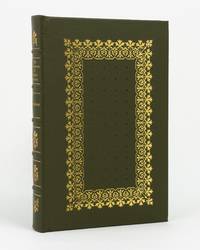
1994réf. 147068New York: Classics of Psychiatry & Behavioral Sciences Library 1994. Hardcover. Fine. New York Classics of Psychiatry & Behavioral Sciences Library 1994 facsimile edition/ 1925. Octavo ii 336 1 colophon pages with numerous diagrams. Gilt-decorated full leather all edges gilt; a fine copy. The pictorial bookplate of Robert Finlay-Jones is mounted on the verso of the front free endpaper. Classics of Psychiatry & Behavioral Sciences Library hardcover
1957réf. 15099Paris, Les Editeurs français réunis, 1957 1 volume In-8° (13,5 x 21,3 cm) Broché sous couverture au 1er plat orné d'une grande photo. 175p. Bon état.
1958réf. 120644Europe 1958 In-8 broché 21,5 cm sur 13,5. 158 pages. Bon état d’occasion.
1962réf. 120645Europe 1962 In-8 broché 21,5 cm sur 13,5. 314 pages. Illustrations en noir et blanc hors-texte. Bon état d’occasion.
réf. 6690Paris, Centre Georges Pompidou, 1985. In-4, broché, iconographie.