Abraham LincolnBiblio.com

28 034 résultats
réf. 1333073186.Gpaperback. Good. Access codes and supplements are not guaranteed with used items. May be an ex-library book. paperback
réf. 0260963313.Ghardcover. Good. Access codes and supplements are not guaranteed with used items. May be an ex-library book. hardcover
réf. 0483468738.Ghardcover. Good. Access codes and supplements are not guaranteed with used items. May be an ex-library book. hardcover
réf. 1527986128.Ghardcover. Good. Access codes and supplements are not guaranteed with used items. May be an ex-library book. hardcover
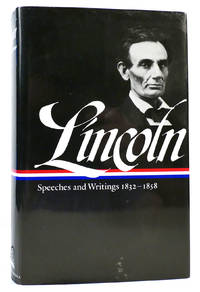
1989réf. 161904New York: Library of America 1989. Tenth Printing. Hardcover. Fine in a Near Fine dust jacket. Owner personalization on entire backside of FEP.; LOA #45; 8.1 X 5.2 X 1.3 inches; 900 pages. Library of America hardcover
réf. B9783337112066Paperback / softback. New. paperback
réf. B9783337110109Paperback / softback. New. paperback
réf. B9783337080358Paperback / softback. New. paperback
réf. 1334976465.Gpaperback. Good. Access codes and supplements are not guaranteed with used items. May be an ex-library book. paperback
réf. x-0804709467Stanford Univ Pr 1964. Paperback. New. 318 pages. 7.50x4.50x0.75 inches. Stanford Univ Pr paperback
réf. B9781258427382Hardback. New. hardcover
réf. 1331083486.Gpaperback. Good. Access codes and supplements are not guaranteed with used items. May be an ex-library book. paperback
1994réf. Q-0760702314Barnes & Noble 1994-01-01. Hardcover. New. In shrink wrap. Looks like an interesting title! Barnes & Noble hardcover
réf. Q-0804709467Stanford University Press 1964-06-01. Paperback. New. In shrink wrap. Looks like an interesting title! Stanford University Press paperback
réf. 1334989141.Gpaperback. Good. Access codes and supplements are not guaranteed with used items. May be an ex-library book. paperback
2009réf. Q-158182677XCumberland House 2009-02-01. Hardcover. New. New. In shrink wrap. Looks like an interesting title! Cumberland House hardcover
1991réf. Q-0486268721Dover Publications 1991-11-20. Paperback. New. New. In shrink wrap. Looks like an interesting title! Dover Publications paperback
1998réf. Q-088088066XPeter Pauper Press 1998-01-01. Hardcover. New. In shrink wrap. Looks like an interesting title! Peter Pauper Press hardcover
1865réf. 97261865. Kilburn Brothers. Abraham Lincoln Stereoview Photograph of Funeral Leaves circa 1865-1875 preserves an early visual expression of the memorial culture surrounding Abraham Lincoln after his assassination in 1865. Centered on a cross incorporating a small portrait of the sixteenth president and surrounded by skeleton leaves the composition places Lincoln within the visual language of nineteenth-century mourning combining Christian symbolism portraiture and ornamental natural forms. Comparable contemporary stereographs were explicitly issued as "Lincoln Memorial" images using "dissected leaves" demonstrating that this arrangement belonged to a recognizable genre of commemorative Lincoln imagery. Kilburn Brothers. Stereoview photograph Littleton New Hampshire circa 1865-1875. Approximately 3½ x 7 inches. The paired photographic views depict a memorial arrangement dominated by a cross bearing a small image of Lincoln surrounded by delicate skeleton leaves whose exposed vein structures produce an elaborate almost lace-like setting around the portrait. The stereoscopic format was intended to create an illusion of three-dimensional depth when viewed through a stereoscope placing this image within a form of domestic visual entertainment that became particularly popular in the United States after the Civil War. Benjamin and Edward Kilburn established their stereoscopic publishing business in Littleton in 1865 and became major producers of views distributed for home viewing; the company continued under the Kilburn Brothers name into the 1870s. Lincoln's death generated an extensive material culture of mourning in which photographs prints memorial compositions and household objects helped transform the assassinated president into a national commemorative figure. Here that remembrance entered the intimate setting of stereoscopic viewing: a purchaser could encounter Lincoln's portrait and funerary symbolism as a three-dimensional parlor image rather than solely through public monuments or printed biography. The survival of closely related "Lincoln Memorial Dissected Leaves" stereographs by other publishers further documents the circulation of this particular memorial vocabulary during the 1860s. Light evidence of handling if any with no specific defects reported; near fine. A compact example of nineteenth-century Lincoln mourning imagery that joins presidential history with the visual and domestic culture of post Civil War remembrance. unknown
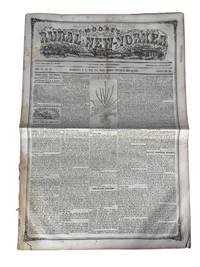
1860réf. 58991860. Moore Daniel D. ed. Moore's Rural New Yorker May 26 1860 reports Abraham Lincoln's closely contested nomination for president at the Republican National Convention in Chicago eight days earlier. The issue preserves contemporary ballot totals showing William H. Seward's commanding initial lead and Lincoln's subsequent accumulation of delegate support providing evidence for the study of Republican Party politics antebellum newspaper coverage the presidential election of 1860 and the sectional conflict over slavery that shaped the campaign. Lincoln entered the convention as a less nationally prominent candidate than Seward but secured the nomination on May 18 after three ballots and the transfer of additional votes. Moore's Rural New Yorker. Rochester New York. For the week ending Saturday May 26 1860. Four pages. The issue gives a detailed account of the convention proceedings and reproduces the presidential balloting: "The resolutions were adopted and on motion the Convention proceeded to ballot for a candidate for President of the United States. Various individuals were put in nomination." Its first-ballot tally records "Seward - 173 1/2" and "Lincoln - 102" documenting Lincoln's substantial initial deficit. The report continues that on the final ballot Lincoln received "231 1/2 votes or within 1 1/2 of the nomination" after which a delegate corrected his state's vote by transferring four votes to Lincoln "thus nominating Lincoln by 2 1/2 majority." The newspaper attributes that decisive change to Massachusetts and names "Mr. Andrews"; later historical accounts generally identify four Ohio delegates as supplying the votes that placed Lincoln over the required threshold making the discrepancy useful evidence of how convention news was transmitted and sometimes imperfectly reported by the contemporary press. Published as the Republican Party prepared to contest a four-way presidential election amid intensifying national conflict over slavery's expansion the issue captures Lincoln's transformation from regional politician to presidential nominee almost immediately after the convention. Seward had entered as the leading contender but concerns about his electability and Lincoln's appeal to delegates from pivotal northern states altered the result over successive ballots. Lincoln subsequently won the presidency in November with 180 electoral votes an outcome followed by the secession of slaveholding states and the onset of the Civil War. Very light foxing with customary folds and no stated loss of text; very good overall. A detailed contemporary record of the convention arithmetic and shifting delegate support that produced one of the most consequential presidential nominations in United States history. unknown
1865réf. 127171865. Tilton Theodore editor of The Independent May 4 1865 issued this Lincoln memorial coverage nineteen days after the president's death and on the day of his burial in Springfield Illinois. Tilton edited the New York newspaper from 1863 to 1870 during a period in which its longstanding antislavery editorial position placed emancipation and the consequences of the Civil War prominently before its readers. The front page preserves contemporary Northern responses to Abraham Lincoln's assassination through both memorial verse and attention to his final public statements appearing as the country confronted presidential succession emancipation and the political consequences of Union victory. The Independent. New York. May 4 1865. One page 18 × 25 inches twice folded. The front page includes the poem "President Lincoln Dead" and the prominent central headline "The Last Word and Deed of Abraham Lincoln." Published less than three weeks after Lincoln was shot at Ford's Theatre on April 14 and died on April 15 the sheet places commemoration alongside an account of his final words and actions. Its May 4 publication date coincides with Lincoln's burial in Springfield giving the issue a particularly precise place within the national mourning that followed the assassination. Lincoln's death came only days after the surrender of Robert E. Lee's Army of Northern Virginia and before the Civil War had fully concluded while the Thirteenth Amendment abolishing slavery awaited ratification by the states. The Independent had advocated against slavery since its antebellum years making its treatment of Lincoln's death part of a newspaper history closely connected to abolitionist politics. Some spotting and tearing around the edges and at the creases not affecting the text with a small amount of paper loss from the upper right corner of the banner. Good condition overall with the principal headlines and memorial content intact. unknown
réf. 11717Ford's Theatre stereopticon view undated depicts the Washington D.C. building where John Wilkes Booth shot President Abraham Lincoln on April 14 1865 during a performance of Our American Cousin. The image belongs to the later visual commemoration of Lincoln's assassination presenting the surviving theater as a historic site for audiences encountering Civil War history through commercially produced stereoscopic imagery. Lincoln was carried from the theater to the Petersen House across the street where he died the following morning. Full color stereopticon view 6 x 3 inches captioned "Old Theater Where Lincoln Was Assassinated Washington D.C." The image is a later historical view of Ford's Theatre adapted from a photograph contemporary with the production of the stereoview rather than an image made at the time of the assassination. Printed descriptive remarks appear on the reverse. Produced for stereoscopic viewing the paired images were intended to create an illusion of depth when viewed through the appropriate optical device. Stereoscopic images circulated historic buildings landscapes and monuments to domestic and educational audiences during the nineteenth and early twentieth centuries making geographically distant sites available as visual objects of study and commemoration. This example records Ford's Theatre not as the scene of the 1865 assassination itself but as a later memorialized landmark identified explicitly through its caption. Minor edge wear; otherwise very good condition. unknown
réf. 11721Abraham Lincoln birthplace stereoview undated depicts the log cabin identified with the birth of the sixteenth president near Hodgenville Kentucky. The image belongs to the visual commemoration of Lincoln through sites associated with his early life presenting the birthplace as a historic landmark for audiences encountering presidential history through stereoscopic photography. Black and white albumen stereoview on gray mount showing the log cabin associated with Lincoln's birthplace. The paired images were intended for viewing through a stereoscope creating an illusion of depth and allowing the cabin and its setting to be examined as a three-dimensional scene. No photographer publisher or production date is supplied in the present description. Lincoln was born in Kentucky on February 12 1809 and his birthplace became an increasingly prominent site of national remembrance after his presidency and assassination. This stereoview records the cabin as it was presented to later visitors and viewers linking domestic-scale architecture with the expanding culture of Lincoln commemoration. Albumen prints and mount in excellent condition. unknown
2008réf. DADAX1598530372Brand: Library of America 2008-12-26. Bicentennial Jacket ed. hardcover. New. 5.10x1.50x8.20. Buy with confidence. Excellent Customer Service & Return policy. Brand: Library of America hardcover
réf. 6943056Stanford University Press . Papeback. New. pp. 376 Stanford University Press unknown