27 919 résultats
1866réf. 15522Leipzig, Spamer, 1866. IX, 260 S. mit zahlr. Abb. im Text und auf Tafeln. 1 mehrfach gefalt. Karte. 8°. HLwd. der Zeit (Gebrssprn., Rücken gebleicht).
1903réf. 015643New York: McClure Phillips and Co. 1903. A rather scarce piece of Lincoln material. Photographic reproduction of a small notebook kept by Mr. Lincoln during the Campaign of 1858 with jottings in his own hand. It came into the possession of Captain James N. Brown who added newspaper clippings to the notebook. In 1900 the book was sold by Brown's family to William Lambert who at the time possessed the most complete Lincoln collection in exixtence. Forty-two pages of photo reproductions followed by fifteen pages of explanatory notes by J. McCan Davis. We see reprints of this edition for sale and a recent sale of an original such as ours by Bonham's in May 2023. . Second Impression. Full Thin Leather. Covers Worn/No Jacket. 5' x 3 1/4". McClure, Phillips, and Co. Hardcover books
1872réf. 12463Springfield IL: Privately Printed 1872. FIRST EDITION. Frontispiece portrait of Lincoln and 11 text illustrations. Complete with the fold-out map. Blue cloth with blind-ruled boards very lightly rubbed. Generally a fresh and bright copy inscribed in the year of publication to Newton Bateman a well known Illinois educator. First edition. This work describes the life and then the public mourning of the assassinated President. The author details the funeral funeral train and the monument built for Lincoln in Springfield. [Privately Printed] unknown books
1865réf. 97261865. Kilburn Brothers. Abraham Lincoln Stereoview Photograph of Funeral Leaves circa 1865-1875 preserves an early visual expression of the memorial culture surrounding Abraham Lincoln after his assassination in 1865. Centered on a cross incorporating a small portrait of the sixteenth president and surrounded by skeleton leaves the composition places Lincoln within the visual language of nineteenth-century mourning combining Christian symbolism portraiture and ornamental natural forms. Comparable contemporary stereographs were explicitly issued as "Lincoln Memorial" images using "dissected leaves" demonstrating that this arrangement belonged to a recognizable genre of commemorative Lincoln imagery. Kilburn Brothers. Stereoview photograph Littleton New Hampshire circa 1865-1875. Approximately 3½ x 7 inches. The paired photographic views depict a memorial arrangement dominated by a cross bearing a small image of Lincoln surrounded by delicate skeleton leaves whose exposed vein structures produce an elaborate almost lace-like setting around the portrait. The stereoscopic format was intended to create an illusion of three-dimensional depth when viewed through a stereoscope placing this image within a form of domestic visual entertainment that became particularly popular in the United States after the Civil War. Benjamin and Edward Kilburn established their stereoscopic publishing business in Littleton in 1865 and became major producers of views distributed for home viewing; the company continued under the Kilburn Brothers name into the 1870s. Lincoln's death generated an extensive material culture of mourning in which photographs prints memorial compositions and household objects helped transform the assassinated president into a national commemorative figure. Here that remembrance entered the intimate setting of stereoscopic viewing: a purchaser could encounter Lincoln's portrait and funerary symbolism as a three-dimensional parlor image rather than solely through public monuments or printed biography. The survival of closely related "Lincoln Memorial Dissected Leaves" stereographs by other publishers further documents the circulation of this particular memorial vocabulary during the 1860s. Light evidence of handling if any with no specific defects reported; near fine. A compact example of nineteenth-century Lincoln mourning imagery that joins presidential history with the visual and domestic culture of post Civil War remembrance. unknown books
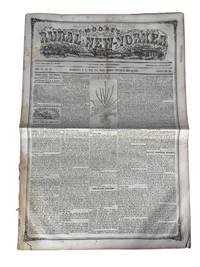
1860réf. 58991860. Moore Daniel D. ed. Moore's Rural New Yorker May 26 1860 reports Abraham Lincoln's closely contested nomination for president at the Republican National Convention in Chicago eight days earlier. The issue preserves contemporary ballot totals showing William H. Seward's commanding initial lead and Lincoln's subsequent accumulation of delegate support providing evidence for the study of Republican Party politics antebellum newspaper coverage the presidential election of 1860 and the sectional conflict over slavery that shaped the campaign. Lincoln entered the convention as a less nationally prominent candidate than Seward but secured the nomination on May 18 after three ballots and the transfer of additional votes. Moore's Rural New Yorker. Rochester New York. For the week ending Saturday May 26 1860. Four pages. The issue gives a detailed account of the convention proceedings and reproduces the presidential balloting: "The resolutions were adopted and on motion the Convention proceeded to ballot for a candidate for President of the United States. Various individuals were put in nomination." Its first-ballot tally records "Seward - 173 1/2" and "Lincoln - 102" documenting Lincoln's substantial initial deficit. The report continues that on the final ballot Lincoln received "231 1/2 votes or within 1 1/2 of the nomination" after which a delegate corrected his state's vote by transferring four votes to Lincoln "thus nominating Lincoln by 2 1/2 majority." The newspaper attributes that decisive change to Massachusetts and names "Mr. Andrews"; later historical accounts generally identify four Ohio delegates as supplying the votes that placed Lincoln over the required threshold making the discrepancy useful evidence of how convention news was transmitted and sometimes imperfectly reported by the contemporary press. Published as the Republican Party prepared to contest a four-way presidential election amid intensifying national conflict over slavery's expansion the issue captures Lincoln's transformation from regional politician to presidential nominee almost immediately after the convention. Seward had entered as the leading contender but concerns about his electability and Lincoln's appeal to delegates from pivotal northern states altered the result over successive ballots. Lincoln subsequently won the presidency in November with 180 electoral votes an outcome followed by the secession of slaveholding states and the onset of the Civil War. Very light foxing with customary folds and no stated loss of text; very good overall. A detailed contemporary record of the convention arithmetic and shifting delegate support that produced one of the most consequential presidential nominations in United States history. unknown books
réf. 11721Abraham Lincoln birthplace stereoview undated depicts the log cabin identified with the birth of the sixteenth president near Hodgenville Kentucky. The image belongs to the visual commemoration of Lincoln through sites associated with his early life presenting the birthplace as a historic landmark for audiences encountering presidential history through stereoscopic photography. Black and white albumen stereoview on gray mount showing the log cabin associated with Lincoln's birthplace. The paired images were intended for viewing through a stereoscope creating an illusion of depth and allowing the cabin and its setting to be examined as a three-dimensional scene. No photographer publisher or production date is supplied in the present description. Lincoln was born in Kentucky on February 12 1809 and his birthplace became an increasingly prominent site of national remembrance after his presidency and assassination. This stereoview records the cabin as it was presented to later visitors and viewers linking domestic-scale architecture with the expanding culture of Lincoln commemoration. Albumen prints and mount in excellent condition. unknown books
1861réf. 126721861. Mills Clark. Abraham Lincoln life mask originally taken in February 1865 two months before the president's death. Mills' was the second and last life mask taken of Lincoln preserving his features directly from life rather than through later artistic interpretation. The cast is often compared to Leonard Volk's cast taken in 1860 shortly after Lincoln secured the Republican nomination and is a remarkable record of the toll the presidency and Civil War took on Lincoln physically. John Hay secretary to the president once noted that Volk cast shows "a man of fifty-one and young for his years. . . . full of life of energy of vivid aspiration. . . . .Mills' cast is so sad and peaceful in its infinite repose . . . . a look as of one on whom sorrow and care had done their worst without victory is on all the features." The Mills cast captured Lincoln's entire skull unlike the Volk which shows only the face. After Clark Mills. Abraham Lincoln life mask cast from the original 1865 mold. Plaster mask showing Lincoln's face from the forehead to below the chin with closed eyes lean cheeks pronounced cheekbones deep-set eyes narrow mouth and beard visible along the jawline. The casting emphasizes the elongated structure of Lincoln's face and preserves the asymmetry and modeling that gave later sculptors a direct reference for portrait accuracy. Mills was a New York born sculpter who developed his own method of creating plaster masks for portrait busts in the 1840s. His works include the equestrian statues of Andrew Jackson and George Washington which now reside in Washington D.C.'s Lafayette Square and Washington Circle respectively as well as the Statue of Freedom which sits atop the United States Capitol dome and over 100 portrait busts of Native American prisoners and Black students at the Hampton Agricultural and Industrial School now Hampton University. This original 1865 life mask became an essential source for later Lincoln portraits and sculptures especially after 1865 when artists and monument makers sought models for Lincoln memorials. The pieces has a unique documentary value distinct from painted or engraved likenesses often filtered through personal interpretation. Minor surface wear consistent with age; overall very good condition. Life masks are created in negative molds casts therein are created in relief "after" the original. It is unclear at when this particular cast was taken. unknown books
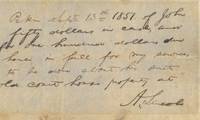
1851réf. 3655813/09/1851. This is our first such document <img class=""alignnone wp-image-36570 size-post-window"" src=""https://cdn.raabcollection.com/wp-content/uploads/20260526171629/Lincoln-Sept-13-1851-1-1600x604.jpg"" alt="""" width=""1600"" height=""604"" /> John H. Harris was a hatter in New York and then in South Carolina. In 1833 he came to Illinois to scout the land and in 1835 he returned with a group of prospective settlers from New York who established themselves in what became the town of Tremont. Harris laid out the village built a schoolhouse and built a church. He was clearly a major local booster and land developer. When there was a possibility for Tremont to become the county seat of Tazewell County in 1836 John Harris donated 20 acres of land and the citizens raised $2000 to bring the county seat to the town. Harris married Catharine Montross in 1815 with whom he had four children before her death. In 1843 he married Sarah Holder with whom he had one child. In 1860 Harris was a farmer living in Tremont with his second wife and their son and he owned $5000 in real estate and $400 in personal property. Abraham Lincoln represented Harris in three cases in the Tazewell County Circuit Court two of which he won and one of which Lincoln lost and appealed to the Illinois Supreme Court. This is the famous case of Harris v. Shaw. In 1850 Harris brought suit in the Tazewell County Circuit Court to obtain compensation by reason of the removal of the county seat of Tazewell County from Tremont to Pekin. This was because of his gift of the piece of ground in the public square of Tremont to the county on the condition that the county seat be located there. The judgment of the Court was against Harris and he carried the case to the Supreme Court of the State of Illinois. He employed Lincoln as his attorney. The Supreme Court case was heard on Jan. 24th and 25th 1851 in the city of Springfield. It was taken under advisement by the Court. Almost a year later February 4 1852 the Supreme Court finally affirmed the judgment of the lower court on the premise that in no part of the contract between Harris and the County was it stated that the county seat should remain forever as located. So Lincoln lost this case. As for Lincoln’s fee for the case and appeal he received $50 in cash upfront and a promissory note for another $100 due a year later — a total fee of $150 for the case. It is interesting to note that Lincoln had argued a similar case shortly before Harris v Shaw. This one was Adams et al. v the County of Logan and he had represented the County - and won. This is a very rare receipt for Lincoln’s legal services. It is our first. Autograph document signed Pekin Ill. September 13 1851. “Received Pekin Sept. 13th 1851 of John H. Harris fifty dollars in cash and his note for one hundred dollars due one year hence in full for my services done and to be done about his suit for the old court house property at Tremont. A. Lincoln.” In another earlier case in which Harris used Lincoln’s legal services Harris sued a Mr. Dean in an action of debt. The ruled against Harris and Harris retained Lincoln and appealed to the Tazewell County Circuit Court. A jury found for Harris and awarded him $19.95. <img class=""alignnone wp-image-25018 size-post-window"" src=""https://cdn.raabcollection.com/wp-content/uploads/20231204144051/Folder-site-11-1600x1327.jpg"" alt=""historical memorabilia dealer"" width=""1600"" height=""1327"" /> unknown books
1946réf. 12569n.p.: n.p. 1946. Lithographic print of a pencil and charcoal drawing of Abraham Lincoln signed in pencil by Woolf. Protected in a matted portfolio and tissue guard. Light soiling. Near fine. Samuel Johnson Woolf 1880-1948 was a famous portrait artist whose subjects included Mark Twain Winston Churchill and other famous performers writers and politicians. His work is represented in collections of the Metropolitan Museum of Art and New York Public Library among many other museums and has been exhibited all over the world. He also published numerous interviews for the New York Times Magazine each accompanied by a portrait of his subject. [n.p.] unknown books
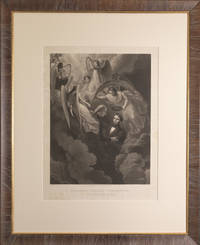
1866réf. 1296971866. LINCOLN Abraham. SARTAIN John engraver. Mezzotint: Abraham Lincoln the Martyr Victorious. Philadelphia: W.H. Hermans 1866. Oversized folio. Plate measures 22 by 17 inches sheet measures 28 by 22 inches matted and framed entire piece measures 28 by 34 inches. $7200.Publisher's proof copy with printed statement thus of a large striking tribute to Lincoln as martyr.Abraham Lincoln ascends to heaven welcomed by George Washington and a crowd of angelsÑone of the angels holding a palm branch and a laurel wreath over his headÑin this remarkable mezzotint done by John Sartain after a painting by W.H. Hermans. Sartain 1808-1897 a respected painter and printmaker was an early proponent of mezzotint engraving in the United States and the head of a family of artists including Samuel Henry William Emily and Harriet Sartain. Mounted on wove paper. Backing leaf and plate edges with pinholes in corners; minor spotting to edges very faint crease to center. Small paper label in lower left corner. An impressive print beautifully framed. unknown books
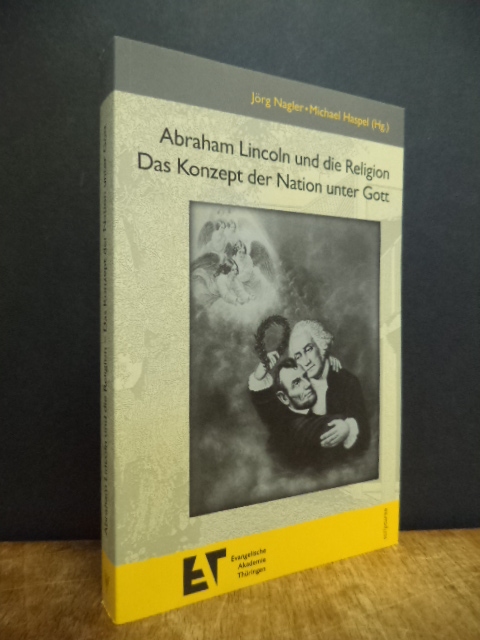
2012réf. 38761ABWeimar, Wartburg-Verlag (= Scripturae, Band 2), 2012. 8°, 240 S., illustr. original Kartonage (Paperback), tadelloses, sauberes Exemplar ohne Mängel
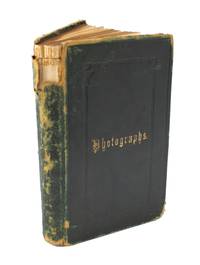
1864réf. 175101864. Abraham Lincoln and Civil War Figures Album of pasted oval portraits with signatures underneath each image. 1861. Features most notably Abraham Lincoln with a pasted signature below his image. This mid-nineteenth-century photographic album assembles oval portraits of political and military figures during the Civil War era including a pasted signature beneath an engraved portrait of Abraham Lincoln on the 15th page. Dated inscriptions from 1861 situate the compilation at the outset of national conflict. The inclusion of Lincoln Henry Clay and numerous uniformed figures reflects contemporary practices of collecting and memorializing political leadership through photographic reproduction and autograph acquisition. Photographic album measuring approximately 4.5 x 7 inches. Dark green morocco boards with gilt "Photographs" title. Contains 93 black-and-white and sepia portraits most approximately 2.5 x 2.25 inches mounted on pages. Lincoln portrait with separate pasted signature "A. Lincoln"; Henry Clay portrait with pasted signature; additional signatures written directly on album leaves. Spine chipped at head with separation; rubbing along margins; binding intact; photographs generally clear with minor age toning. Overall condition very good. he album reflects nineteenth-century commemorative culture preserving images and autographs of national figures during a transformative political moment. unknown books
1959Roy. 8vo., First Edition; original printed wrappers, wire-stitched as issued, covers lightly dust-soiled else a very good, clean copy. PROFESSOR JACK MORPURGO'S COPY WITH HIS SIGNATURE ON TITLE. Sold from an institution with the usual markings.
1891117 p. Publisher's device on title page. XLib bookplate. Slightly damp stained. 12mo. Original full olive cloth binding, stained. Remnants of library call numbers on spine. Hardbound. SHELF W24
1958réf. 113402Paul Zsolnay Verlag, 1958.
1940Nine pamphlets, relating to Abraham Lincoln. 8vo. EMANUEL HERTZ (1870-1940), U.S. lawyer and historian, was born in Bukta, Austria, brother of Rabbi Joseph Herman Hertz. He, arrived in the United States when he was 14, and was admitted to the bar in 1894. Hertz became well known as an authority on Abraham Lincoln. He assembled the largest private collection of material relating to Lincoln, and was said to have gathered 4,000 items previously unknown. He wrote many pamphlets and books on various aspects of the life of Lincoln. He was a substantial benefactor of the Library of Congress and the National and Hebrew University Library, Jerusalem. **PRICE JUST REDUCED! JUN5 BOX 1
1950réf. 18093Worcester Mass: Achilles St. Onge 1950. One of 1500 copies printed from Monotype Plantin type on J. Barcham Green's hand made all rag wove paper by the Chiswick Press. Photographs. 1 vols. 12mo 3 x 2 inches. Bound in full blue morocco by Sangorski & Sutcliffe. One of 1500 copies printed from Monotype Plantin type on J. Barcham Green's hand made all rag wove paper by the Chiswick Press. Photographs. 1 vols. 12mo 3 x 2 inches. Inscribed "To Joseph Miller with kindest regards Achille St. Onge. Achilles St. Onge unknown books
1880réf. 771641880 Paris, Hachette, 1875, in 12 broché, 256 pages ; portrait en frontispicecouverture fanée.
1891pp. 398, (2) [Publisher's catalogue] + Portrait Frontis. XLib. Large 12mo. Original full red buckram binding, lettered in gold. Remnants of library call numbers on spine. Hardbound. First edition of this volume in the American Reformers Series. SHELF W24
2016br. Abraham Lincoln (1809-1865), con Washington e F.D. Roosevelt il più famoso presidente degli Stati Uniti, incarna il mito della frontiera e dell'uomo che si fa da sé: dalle foreste del West al Campidoglio, da contadino a presidente. Eletto nel 1860, dovette affrontare la crisi della nazione americana precipitata nella sanguinosissima guerra civile seguita alla secessione degli stati schiavisti. Nel farlo rafforzò il potere federale, modernizzò l'economia e liberò i 4.000.000 di schiavi presenti nel Sud; ma pagò i suoi successi con la vita, assassinato pochi giorni dopo la conclusione della guerra. Il libro delinea il ritratto coinvolgente di un uomo complicato, depresso cronico e quasi insondabile, intrecciandolo alla storia violenta, vitale e contraddittoria di un paese in formazione.
réf. 306153Boston Houghton Mifflin Company 1928. First edition later state with no date on the title page. Thick 8vo. Frontispiece portraits; 16 illustrations. Original gilt stamped blue cloth. Very good. 2 volumes. No dust jackets. Volume I - 607 pages. Volume II - 741 pages. 1st Edition. Hardcover. Very Good/No Jacket. Boston, Houghton Mifflin Company, 1928. hardcover books
1947réf. 574863Kingsport Tennessee: The Kingsport Press 1947. Hardcover. Fine. First edition. Edited and introduced by Paul M. Angle. Tall octavo. 62 3 pp. Illustrated with a frontispiece portrait of Lincoln. Fine in oatmeal cloth stamped in green and gilt lacking the glassine jacket and box. One of 1250 copies published for presentation by the press with a slip laid in. The Kingsport Press hardcover books
1946réf. ULINABR00drpDa Capo 1946. Very Good. Lincoln Abraham. Abraham Lincoln: His Speeches and Writings. Basler Roy P. Cleveland: Da Capo 1946. 843pp. Indexed. Bibliography. 8vo. Paperback. Book condition: Very good with rubbed edges. Highlighting on first few pages. Da Capo paperback books
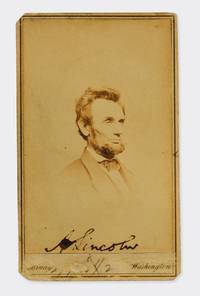
1864réf. 3082New York: Mathew Brady 1864. First edition. Very Good. SIGNED CDV PHOTOGRAPH FROM 1864 MATHEW BRADY SITTING WITH DIRECT FAMILY PROVENANCE. Vignetted photographic portrait from Mathew Brady's sitting of January 8 1864 signed by Lincoln along the lower edge of the photograph. The photograph descended directly through Lincoln's family from the president and Mary Todd Lincoln through five generations to the family of Robert Todd Lincoln Beckwith the last surviving direct descendant of Abraham Lincoln. The photograph remained within Lincoln's direct family until it appeared at Cowan's Auctions in 2010 offered as lot 272 along with other items descended in the Lincoln-Beckwith lineage. It had passed from Abraham and Mary Todd Lincoln to their son Robert Todd Lincoln and from him to his daughter Jessie Lincoln Beckwith. Jessie's son Robert Todd Lincoln Beckwith 1904-1985 was the last surviving direct descendant of Abraham Lincoln; the photograph passed to his wife Margaret Fristoe Beckwith and by descent to her daughter from whose estate it was consigned to the sale. Albumen print carte-de-visite on Brady's photographic mount; 1864. Small abrasion at bottom margin toning to verso; ink blot original on "A. Mathew Brady unknown books
1933réf. 226729Chicago Chicago Book & Art Auctions 1933. 1933. First edition. 8vo. Foreword by Franklin J. Meine. Bibliographical references. Original stiff tan wrappers stamped in black. 66 pages. Very good. Catalogue of 531 Lincoln related items for "unrestricted public auction" June 14-15 1933. 1st Edition. Soft cover. Very Good. Chicago, Chicago Book & Art Auctions [1933]. paperback books