27 904 résultats
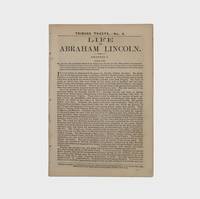
1860réf. 377692New York: Horace Greeley & Co 1860. 32pp. 8vo. Disbound. 32pp. 8vo. An early campaign biography of future president Abraham Lincoln written by John Locke Scripps of the New York Tribune. Scripps reports on the life of Abraham Lincoln in eight chapters touching on the major events of his life and career beginning with his early life and his move to Illinois through his transition from merchant to lawyer and legislator and covering his time in Congress with accounts of Lincoln's opposition to the Mexican-American War his support of the Wilmot Proviso and his involvement with the organization of the Republican Party. Wessen states that this edition was printed by Horace Greeley "from plates cast from the same type forms" as the 1860 Chicago edition which is considered the first published biography of Lincoln. An advertisement for the Tribune and the Tribune Almanac fills the bottom two thirds of the last page. "Most authentic of Lincoln campaign biographies" - Howes. Howes S247a "aa"; Managhan 79 note; Wessen Campaign Lifes of Abraham Lincoln 12 ref; Miles 418a; Abraham Lincoln: His Life in Print p. 85 Horace Greeley & Co unknown books
1860réf. 377692New York: Horace Greeley & Co 1860. 32pp. 8vo. Disbound. 32pp. 8vo. An early campaign biography of future president Abraham Lincoln written by John Locke Scripps of the New York Tribune. Scripps reports on the life of Abraham Lincoln in eight chapters touching on the major events of his life and career beginning with his early life and his move to Illinois through his transition from merchant to lawyer and legislator and covering his time in Congress with accounts of Lincoln's opposition to the Mexican-American War his support of the Wilmot Proviso and his involvement with the organization of the Republican Party. Wessen states that this edition was printed by Horace Greeley "from plates cast from the same type forms" as the 1860 Chicago edition which is considered the first published biography of Lincoln. An advertisement for the Tribune and the Tribune Almanac fills the bottom two thirds of the last page. "Most authentic of Lincoln campaign biographies" - Howes. Howes S247a "aa"; Managhan 79 note; Wessen Campaign Lifes of Abraham Lincoln 12 ref; Miles 418a; Abraham Lincoln: His Life in Print p. 85 Horace Greeley & Co unknown
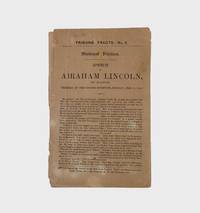
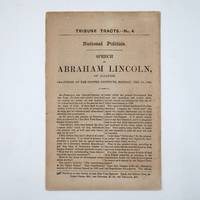
1860réf. 376855New York: Office of the New York Tribune 1860. First edition Monaghan's first issue. 1 2-15 1pp. With New York Tribune ads and subscription terms on verso of the terminal leaf. 8vo. Stitched self-wrappers toning. First edition Monaghan's first issue. 1 2-15 1pp. With New York Tribune ads and subscription terms on verso of the terminal leaf. 8vo. This address made at the Cooper Institute in New York on February 27 1860 catapulted Lincoln into the public eye and made him a viable presidential candidate. Indeed many historians have considered it the key to his success in the 1860 election and it is probably the most important speech Lincoln made after the Gettysburg Address and his inaugural addresses. The Cooper Union address was months in preparation; Lincoln was fully aware of its importance in moving himself from a regional favorite son to a viable national candidate. In the event some 1500 people including many prominent political figures attended on a snowy new York evening. The speech divides into three major parts. In the first Lincoln addressed the spread of slavery arguing that the framers of the constitution had been opposed to it and that the Federal government could regulate the question. In the second he argued that the Republicans were not a sectional Northern party and attacked the threats of southern Democrats to secede if the Republicans should win the election. Finally he addressed his fellow Republicans calling on them to act carefully and do "nothing through passion and ill temper.Let us have faith that right makes might and in that faith let us to the end dare to do our duty as we understand it." The Cooper Union speech was a resounding success. Horace Greeley described it as "one of the happiest and most convincing political arguments ever made in this City. No man ever made such an impression on his first appeal to a New York audience." Greeley quickly issued the speech in the form of this "Tribune Tract." It includes a final page of advertisements for other Tribune publications. The speech was later widely reprinted and made Lincoln nationally famous. This printing differs from other editions by its inclusion of a speech by James Doolittle Senator from Wisconsin and the message of Samuel Medary Democratic governor of the Kansas Territory vetoing the Kansas abolition bill. "The Cooper Union address tested whether Lincoln's appeal could extend from the podium to the page and from the rollicking campaigns of the rural West to the urban East. Cooper Union held the promise of transforming Lincoln from a regional phenomenon to a national figure. Lincoln knew it and rose to the occasion" Harold Holzer Lincoln at the Copper Union: The Speech That Made Abraham Lincoln President. Monaghan 50 Office of the New York Tribune unknown
1860réf. 367583New York: Office of the New York Tribune 1860. First edition Monaghan's first issue. 1 2-15 1pp. Lincoln's speech comprises pages 1-11 out of a total of 16 pages. With New York Tribune ads and subscription terms on rear wrapper. 8vo. Stitched self-wrappers minor toning minor chip to terminal leaf. First edition Monaghan's first issue. 1 2-15 1pp. Lincoln's speech comprises pages 1-11 out of a total of 16 pages. With New York Tribune ads and subscription terms on rear wrapper. 8vo. This address made at the Cooper Institute in New York on February 27 1860 catapulted Lincoln into the public eye and made him a viable presidential candidate. Indeed many historians have considered it the key to his success in the 1860 election and it is probably the most important speech Lincoln made after the Gettysburg Address and his inaugural addresses. The Cooper Union address was months in preparation; Lincoln was fully aware of its importance in moving himself from a regional favorite son to a viable national candidate. In the event some 1500 people including many prominent political figures attended on a snowy new York evening. The speech divides into three major parts. In the first Lincoln addressed the spread of slavery arguing that the framers of the constitution had been opposed to it and that the Federal government could regulate the question. In the second he argued that the Republicans were not a sectional Northern party and attacked the threats of southern Democrats to secede if the Republicans should win the election. Finally he addressed his fellow Republicans calling on them to act carefully and do "nothing through passion and ill temper.Let us have faith that right makes might and in that faith let us to the end dare to do our duty as we understand it." The Cooper Union speech was a resounding success. Horace Greeley described it as "one of the happiest and most convincing political arguments ever made in this City. No man ever made such an impression on his first appeal to a New York audience." Greeley quickly issued the speech in the form of this "Tribune Tract." It includes a final page of advertisements for other Tribune publications. The speech was later widely reprinted and made Lincoln nationally famous. This printing differs from other editions by its inclusion of a speech by James Doolittle Senator from Wisconsin and the message of Samuel Medary Democratic governor of the Kansas Territory vetoing the Kansas abolition bill. "The Cooper Union address tested whether Lincoln's appeal could extend from the podium to the page and from the rollicking campaigns of the rural West to the urban East. Cooper Union held the promise of transforming Lincoln from a regional phenomenon to a national figure. Lincoln knew it and rose to the occasion" Harold Holzer Lincoln at the Copper Union: The Speech That Made Abraham Lincoln President. Monaghan 50 Office of the New York Tribune unknown
1992réf. Q-0939680971Bear & Co 1992-07-01. Paperback. New. In shrink wrap. Looks like an interesting title! Bear & Co paperback
1993réf. 161896Saint-Michel de Boulogne: Editions Saint Michel 1993. Broché. Etat satisfaisant. in-8. Mention page de garde Editions Saint Michel unknown
1995réf. R320164909Kosmos Z&Z Uitgevers Utrecht/Antwerpen. 1995. In-8. Broché. Etat d'usage, Couv. convenable, Dos satisfaisant, Intérieur acceptable. 208 pages - ouvrage en néerlandais - quelques illustrations, figures en noir et blan dans le texte - quelques traces de stylo à l'intérieur de l'ouvrage et sur les tranches sans conséquence sur la lecture.. . . . Classification Dewey : 430-Langues germaniques. Allemand
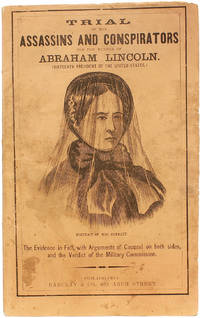
1865réf. 005102Philadelphia: Barclay & Co. 1864 1865 1865. FIRST EDITION. 1 vol. 9-1/4" x 5-3/4" original pictorial wrappers illustrated pagination irregular but complete original stitching completely unsophisticated without repairs internally clean and bright mild general handling but surely one of the nicest copies you're going to encounter VERY GOOD. McDade 623 According to RBH only 2 copies have ever appeared at auction. The last one in 2008. Variant issue mentioned by Howes with the illustration of the execution moved to p 96; also with misprint of copyright date as "1864". Featuring engraved portrait of Mary Surratt on cover. The assassination of Lincoln by John Wilkes Booth on the night of April 14 1865 need no retelling. Time however which has its own way with our judgments has raised some doubts about some of these. The unfairness of the military tribunal is now manifest and the guilt of Mrs. Surratt is certainly doubtful. This was amply demonstrated by the fact that only two years after the crime the government could not obtain the conviction of her son John Surratt in the civil courts in Washington. Philadelphia: Barclay & Co., 1864 [1865] unknown
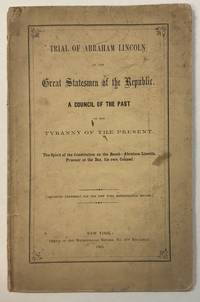
1863réf. 40887New York: Office of the Metropolitan Record 1863. Original printed wrappers. Stitched. 29 1 blank 1- advertisement for 'The Washington Despotism Dissected' 1 blank pp. Light wear and fox. About Very Good. The Metropolitan Record whose Prospectus is printed on the rear wrapper calls itself "an unswerving opponent of fanaticism in every form and an advocate of constitutional liberty and the rights of the citizens against despotic usurpation." This pamphlet is "A mock trial wherein Lincoln was charged with treasonable intent purposes and designs and of having committed among other unconstitutional acts the following: 'Declared War against Sovereign States under pretence of repossessing himself of certain forts and other property; arresting citizens without process of law; suppressed liberty of speech; stopped publication of certain newspapers; placed the military power above the civil power; overthrown State Sovereignty; forced unconstitutional acts through Congress.' At the conclusion of the trial the Court addressed the 'Criminal' as follows: 'You have been tried and found wanting. You have been given the opportunity of saving a nation but you have stabbed it to the heart. You have converted your country into a despotism'." Eberstadt. "Quotations from Lincoln and others selected to discredit his administration" Monaghan. A second edition was printed in 1867. Sabin Monaghan and LCP do not collate the advertisement at page 31. FIRST EDITION. 111 Eberstadt 332. Monaghan 252. Sabin 41234. LCP 10399. Office of the Metropolitan Record unknown books
1863réf. 40887New York: Office of the Metropolitan Record 1863. Original printed wrappers. Stitched. 29 1 blank 1- advertisement for 'The Washington Despotism Dissected' 1 blank pp. Light wear and fox. About Very Good. The Metropolitan Record whose Prospectus is printed on the rear wrapper calls itself "an unswerving opponent of fanaticism in every form and an advocate of constitutional liberty and the rights of the citizens against despotic usurpation." This pamphlet is "A mock trial wherein Lincoln was charged with treasonable intent purposes and designs and of having committed among other unconstitutional acts the following: 'Declared War against Sovereign States under pretence of repossessing himself of certain forts and other property; arresting citizens without process of law; suppressed liberty of speech; stopped publication of certain newspapers; placed the military power above the civil power; overthrown State Sovereignty; forced unconstitutional acts through Congress.' At the conclusion of the trial the Court addressed the 'Criminal' as follows: 'You have been tried and found wanting. You have been given the opportunity of saving a nation but you have stabbed it to the heart. You have converted your country into a despotism'." Eberstadt. "Quotations from Lincoln and others selected to discredit his administration" Monaghan. A second edition was printed in 1867. Sabin Monaghan and LCP do not collate the advertisement at page 31. FIRST EDITION. 111 Eberstadt 332. Monaghan 252. Sabin 41234. LCP 10399. Office of the Metropolitan Record unknown
1926réf. 145229Edinburgh: William Hodge & Company Limited 1926. P p. xii184last blank20publisher's catalogue frontispiece plus 7 plates large folding map at end the title page printed in red & black appendices; demy 8vo; red cloth spine lettered and ruled in black fore-corners of boards faintly bruised the spine a trifle faded; tiny chip at centre of lower hinge the top fore-corner of plate opposite p. 32 creased; William Hodge & Company Limited Edinburgh 1926. Later printing Notable British Trials series. Trial August 1817 in the county of Warwick for the murder of Mary Ashford May 27 1817. William Hodge & Company, Limited unknown
réf. 0331995174.Ghardcover. Good. Access codes and supplements are not guaranteed with used items. May be an ex-library book. hardcover
réf. 0331995077.Gpaperback. Good. Access codes and supplements are not guaranteed with used items. May be an ex-library book. paperback
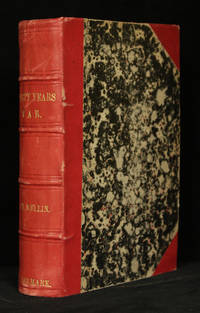
réf. 78689Norrköping Östlund & Berling 1847-49. 8:o. XV 1 658 s. 35 planscher och skisser utvikbar gränskolorerad karta. Trägravyrer i texten. Lätta lagerfläckar. Nött rött senare hfrbd med engelsk ryggtitel: Thirty Years War. Längst ner på ryggen C. J. Ahlmark i guld. Setterwall 1913. Den utkom i 11 häften mellan 1847 och 1849 och är huvudsakligen ett arbete av Abraham Cronholm. Mellin skrev själv endast de första arken och överlämnade därefter allt material till Cronholm som skrev klar den. unknown
réf. 74669Norrköping Östlund & Berling 1847-49. 8:o. XV 1 658 s. 35 planscher och skisser utvikbar gränskolorerad karta. Trägravyrer i texten. Lätta lagerfläckar. Samtida något nött ljusbrunt hfrbd liten skada på övre främre fals. Setterwall 1913. Den utkom i 11 häften mellan 1847 och 1849 och är huvudsakligen ett arbete av Abraham Cronholm. Mellin skrev själv endast de första arken och överlämnade därefter allt material till Cronholm som skrev klart verket. unknown
réf. 51157Norrköping Östlund & Berling 1847-49. 8:o. XV 1 658 s. 35 planscher och skisser varav 8 utvikbara 1 utvikbar gränskolorerad karta. Trägravyrer i texten. Återkommande liten fuktrand i övre marginal. Nött samtida hfrbd med svagt gldornerad rygg gröna snitt små hål i falsarna. Med J. Gawells biblioteksetikett. Setterwall 1913. Den utkom i 11 häften mellan 1847 och 1849 och är huvudsakligen ett arbete av Abraham Cronholm. Mellin skrev själv endast de första arken och överlämnade därefter allt material till Cronholm som skrev klar den. unknown
réf. A9789535132097Hardback. New. hardcover
2016réf. x-3319301829Springer 2016. Hardcover. New. 234 pages. 9.50x6.50x1.00 inches. Springer hardcover
réf. 1497327113.Gpaperback. Good. Access codes and supplements are not guaranteed with used items. May be an ex-library book. paperback
réf. B9781497327115Paperback / softback. New. paperback
1981réf. 16862Herstellung: Hub. Hoch, Düsseldorf, 1981. ca. 90 nn. Seiten. 4to. Kartoniert.
1970réf. 585947Santa Barbara California: Christopher Books 1970. Softcover. Near Fine. Issue 1. Introduction from Introduction to the Rabbinic Bible by Jacob ben Chajim c. 1525. Octavo. 159pp. Illustrated. Light wear and a bit of light soil near fine. Christopher Books) unknown
1970réf. 585947Santa Barbara California: Christopher Books 1970. Softcover. Near Fine. Issue 1. Introduction from Introduction to the Rabbinic Bible by Jacob ben Chajim c. 1525. Octavo. 159pp. Illustrated. Light wear and a bit of light soil near fine. Christopher Books) unknown books
réf. 3642261205.Gpaperback. Good. Access codes and supplements are not guaranteed with used items. May be an ex-library book. paperback
réf. 614405618Springer . Papeback. New. pp. 222 Springer unknown