45 532 résultats
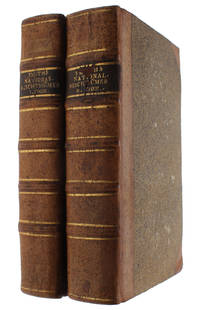
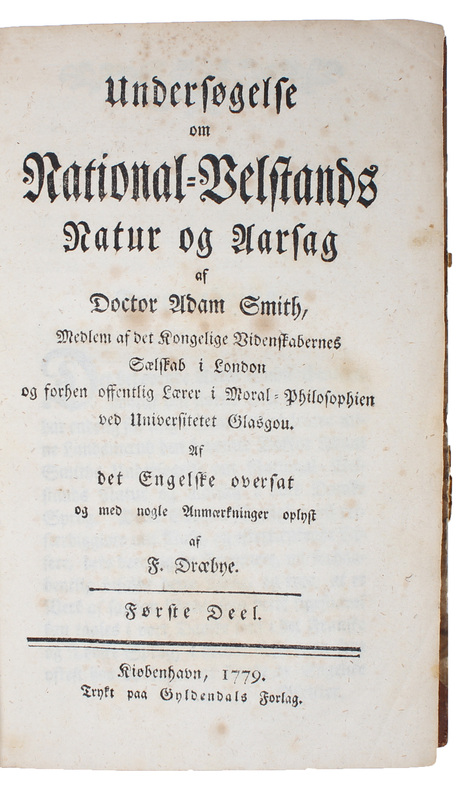
1779réf. 47455Kiøbenhavn [Copenhagen], 1779-80. 8vo. Two very nice contemporary brown half calf bindings with raised bands, gilt ornamentations and gilt leather title- and tome-labels. Volume two with a bit of wear to upper capital. Corners slightly bumped. Pencil annotations to verso of title-page in volume one" title-page in volume two mounted to cover up a small hole caused by the removal of an old owner's name. Internally very clean and bright. All in all a very nice, clean, fresh, and tight copy. Engraved (by Weise, 1784) armorial book plate to inside of front boards (Gregorius Christianus Comes ab Haxthausen). (12), 575" (8), 775, (3, - errata) pp.
1779réf. 47455Kiøbenhavn Copenhagen 1779-80. 8vo. Two very nice contemporary brown half calf bindings with raised bands gilt ornamentations and gilt leather title- and tome-labels. Volume two with a bit of wear to upper capital. Corners slightly bumped. Pencil annotations to verso of title-page in volume one; title-page in volume two mounted to cover up a small hole caused by the removal of an old owner's name. Internally very clean and bright. All in all a very nice clean fresh and tight copy. Engraved by Weise 1784 armorial book plate to inside of front boards Gregorius Christianus Comes ab Haxthausen. 12 575; 8 775 3 - errata pp. The extremely scarce first Danish edition of Adam Smith's seminal main work "the first and greatest classic of modern economic thought" PMM 221 the main foundational work of the era of liberal free trade. This publication constitutes the first Danish work worth mentioning in the history of economic thought - in spite of the great interest in political economy that dominated Danish political thought in the last quarter of the 18th century. The value of Smith's work was not immediately recognized in Denmark at the time of its appearance and a quarter of a century had to go by for its importance to be acknowledged and for Danish political economy to adapt the revolutionizing theories of Adam Smith. Few copies of the translation were published and sold and the book is now a great scarcity. As opposed to for instance the German translation of the work Smith concerned himself a great deal with this Danish translation. As is evident from preserved correspondence about it he reacted passionately to it and was deeply concerned with the reaction to his work in Scandinavia see "Correspondence of Adam Smith" Oxford University Press 1977.- As an example Smith writes in a letter to Andreas Holt on Oct. 26th 1780: "It gives me the greatest pleasure to hear that Mr. Dreby has done me the distinguished honour of translating my Book into the Danish language. I beg you will present to him my most sincere thanks and most respectful Compliments. I am much concerned that I cannot have the pleasure of reading it in his translation as I am so unfortunate as not to understand the Danish language." The translation was made by Frants Dræby 1740-1814 the son a whiskey distiller in Copenhagen who mastered as a theologian and was then hired by the great Norwegian merchant James Collett as tutor to his son. There can be no doubt that Dræbye's relation to the Collett house had a great impact upon his interest in economics. In the middle of the 1770'ies Dræbye accompanied Collett's son on travels throughout Europe which took them to England in the year 1776 the same year that the "Wealth of Nations" was published for the first time. Through the Colletts Dræbye was introduced to the mercantile environment in England and here became thoroughly acquainted with English economics and politics at the time. It is presumably here that he gets acquainted with Adam Smith's freshly published revolutionary work. When Dræbye returned to Denmark at the end of 1776 he was appointed chief of the Norwegian secretariat of the Board of Economics and Trade. He began the translation of the "Wealth of Nations" that he brought back with him from England immediately after his return."WN i.e. Wealth of Nations was translated into Danish by Frants Dræbye and published in 1779 three years after the first English edition. The translation was initiated by Andreas Holt and Peter Anker who were acquainted with Smith. Dræbye was a Dane who lived mainly in Norway reflecting the fact that Norway was much more British-oriented than Denmark proper Denmark and Norway were united until 1814 when Sweden took Norway away from the Danes; in 1905 Norway became an independent state. Norwegian merchants lived from exporting timber to Britain and tended on the whole to be adherents of a liberal economic policy whereas the absolutist government in Copenhagen was more German-oriented and had economic views similar to those in contemporary Prussia." Cheng-chung Lai edt.: "Adam Smith Across Nations" p. 37. The last quarter of the eighteenth century in Denmark was dominated by a lively discussion of monetary policy and the institutional framework best suited to realize that policy. There was a vital interest in questions of economic concern and contemporary Danish sources refer to the period as "this economic age" and state things such as "never was the world more economically minded" both from "Denmark and Norway's Economic Magazine". During this period Smith's revolutionary ideas did not play a major role however and only at the beginning of the 19th century did Danish politicians and economists come to realize the meaning of Smith's views. "Without exaggeration it can essentially be said that a quarter of a century was to pass from the time of the publication of the book in Denmark before Danish political economy fully made Adam Smith's theories and points of view its own. It took so long a time because the economic conditions as a whole in the years from 1780-1800 did not make desirable or necessary the changing of their concepts. That glorious commercial period had to pass before it was understood that we had altogether too little help in our own natural resources and that a different course was therefore necessary. Only when one had come so far could the new thinking find a nourishing soil so that it could develop strength with which to push aside the old ideas."Hans Degen: "On the Danish Translation of Adam Smith and Contemporary Opinion Concerning It." Translated by Henrietta M. Larson. In: Adam Smith Across Nations p. 51. This first Danish translation is one of the very earliest translations of "Wealth of Nations"; it is only preceded by the German 1776-78 and the extremely scarce French 1778-79. As a comparison the Italian translation does not appear until 1790-91 the Spanish 1792 the Swedish 1800-1804 the Russian 1802 etc.Adam Smith Across Nations: A4 - nr. 1. "All five books were translated; appears to be a complete translation. The long letter from Governor Pownall to Adam Smith 25 Sept. 1776 is added as the Appendix vol. 2 pp. 683 ff."PMM 221 - first edition hardcover
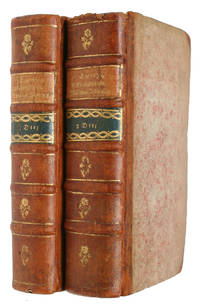
1778réf. 60523Leipzig Weidmann 1776-78. 8vo. Bound in two nice uniform contemporary half calf bindings with five raised bands black title-label and gilt lettering to spine. Small paper-label to upper compartment Catalogue-number from an estate-library. Light wear to extremities otherwise a very nice set. VIII 632 pp; XII 740 pp. First German edition also being the very first overall translation of Adam Smith's ground-breaking main work the "Inquiry into the Nature and Causes of the Wealth of Nations". This seminal first translation of the work was undertaken by J.F. Schiller who finished the first part of the translation in time for it to appear as soon as 1776 the same year as the original English edition. The second part appeared in 1778 the same year as the exceedingly scarce first French translation. This first German translation has been of the utmost importance to the spreading of Smith's ideas throughout Europe and after the true first this must count as the most important edition of the work."The influence of the Wealth of Nations . in Germany . was so great that 'the whole of political economy might be divided into two parts - before and since Adam Smith; the first part being a prelude and the second a sequel." Backhouse Roger E. The Methodology of Economics: Nineteenth-Century British Contributions Routledge 1997."The first review of the translation which appeared in the Göttingische gelehrte Anzeigen for March 10 1777 by J. G. H. Feder professor of Philosophy at the University of Göttingen was very favorable. In the words of the reviewer: "It is a classic; very estimable both for its thorough not too limited often far-sighted political philosophy and for the numerous frequently discursive historical notes" but the exposition suffers from too much repetition." Lai Cheng-chung. Adam Smith Across Nations: Translations and Receptions of The Wealth of Nations Clarendon Press UK 2000.Until 1797 . the work of Adam Smith received scant attention in Germany. While Frederick II was living Cameralism held undisputed sway in Prussia and the economic change which began with the outbreak of the French Revolution had still not gained sufficient momentum to awake the economic theorists from their dogmatic slumber." Lai Cheng-chung. Adam Smith Across Nations: Translations and Receptions of The Wealth of Nations Clarendon Press UK 2000.Various German economist read the german translations and was inspired by it."Christian Garve . must be considered as among the important contributors to the spread of Smith's views. Himself a popularizer of philosophical doctrines he was early attracted by the Scotch writers and became one of their foremost exponents in Germany." In 1791 Garve began a second translation of the Smith's work and in the introduction to the the translation he wrote: "It Smith's work attracted me as only few books have in the course of my studies through the number of new views which it gave me not only concerning the actual abject of his investigations but concerning all related material from the philosophy of civil and social life". Georg Sartorius August Ferdinand Lueder and perhaps the most important economist of the period Christian Jacob Kraus were all important figures in the spread of Smith's thought. "The most significant of Kraus' works and that also which shows his conception of economic science most clearly is the five-volume work entitled State Economy. The first four volumes of this work are little more than a free paraphrase of the Wealth of Nations". Kraus was: "to a large extent responsible for the economic changes which took place in Prussia after 1807 in so far as they can be ascribed to Smithan influence." Lai Cheng-chung. Adam Smith Across Nations: Translations and Receptions of The Wealth of Nations Clarendon Press UK 2000.Kraus wrote of the present volume: "The world has seen no more important book than that of Adam Smith. Certainly since the times of the New Testament no writing has had more beneficial results than this will have. Smith's doctrines form the only true great beautiful just and beneficial system." Fleischacker Samuel A Third Concept of Liberty Princeton University Press 1999._____________Hailed as the "first and greatest classic of modern thought" PMM 221 Adam Smith's tremendously influential main work has had a profound impact on thought and politics and is considered the main foundation of the era of liberal free trade that dominated the nineteenth century. Adam Smith 1723-1790 is considered the founder of Political Economy in Britain mainly due to his groundbreaking work the "Wealth of Nations" from 1776. The work took him 12 years to write and was probably in contemplation 12 years before that. It was originally published in two volumes in 4to and was published later the same year in Dublin in three volumes in 8vo. The book sold well and the first edition the number of which is unknown sold out within six months which came as a surprise to the publisher and probably also to Smith himself partly because the work "requires much thought and reflection qualities that do not abound among modern readers to peruse to any purpose." Letter from David Hume In: Rae Life of Adam Smith 1895 p. 286 partly because it was hardly reviewed or noticed by magazines or annuals. In spite of this it did evoke immense interest in the learned and the political world and Buckle's words that the work is "in its ultimate results probably the most important book that has ever been written" and that it has "done more towards the happiness of man than has been effected by the united abilities of all the statesmen and legislators of whom history has preserved an authentic account" History of Civilisation 1869 I:214 well describes the opinion of a great part of important thinkers then as well as now. Kress S. 2567Goldsmith 11394Menger 521Not in Einaudi hardcover
1778réf. 60523Leipzig, Weidmann, 1776-78. 8vo. Bound in two nice uniform contemporary half calf bindings with five raised bands, black title-label and gilt lettering to spine. Small paper-label to upper compartment (Catalogue-number from an estate-library). Light wear to extremities, otherwise a very nice set. VIII, 632 pp" XII, 740 pp.
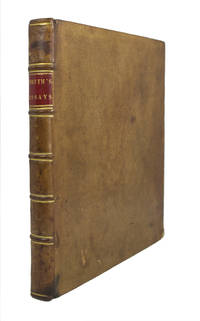
1795réf. 68261London: Printed for T. Cadell Jun. and W. Davies etc. 1795. London: Printed for T. Cadell Jun. and W. Davies. 1795. First edition. Quarto 10 3/4 x 8 1/2 inches; 273 x 215 mm. xcv 1 blank 244 pp. Contemporary speckled calf. Board edges ruled in gilt. Spine ruled in gilt. Red morocco spine label lettered in gilt. Edges speckled brown. Green silk page-marker. Board edges a bit rubbed and corners bumped. Previous owner's old ink signature on title-page not affecting text. Occasional minor foxing or staining. Otherwise a fine copy. A posthumously published collection of essays mainly of a scientific and philosophical nature. Smith had instructed lis literary editors Joseph Black and James Hutton to destroy almost all of his manuscript material amounting to some sixteen volumes. These essays were exempted because the editors perceived them to "be part of a plan he had once formed for giving a connected history of the liberal sciences and elegant arts" even though Smith had to abandon the plan because it was too extensive. The essays illustrate the diversity of Adam Smith's interests and comprise: "The Principles which lead and direct Philosophical Enquiries; illustrated by the History of Astronomy;" "The Principles which lead and direct Philosophical Enquiries; History of the Ancient Physics;" "The Principles which lead and direct Philosophical Enquiries; History of the Ancient Logics and Metaphysics; "Of the Nature of that Imitation which takes place in what are called the Imitative Arts;" "Of the Affinity between Music Dancing and Poetry;" "Of the Affinity between certain English and Italian Verses;" "Of the External Senses." ESTC T33499 . Goldsmiths' 16218. Kress B. 3038. Rothschild 1902. HBS 68261. $9500. Printed for T. Cadell Jun. and W. Davies, etc. unknown
1795réf. 68261London: Printed for T. Cadell Jun. and W. Davies etc. 1795. London: Printed for T. Cadell Jun. and W. Davies. 1795. First edition. Quarto 10 3/4 x 8 1/2 inches; 273 x 215 mm. xcv 1 blank 244 pp. Contemporary speckled calf. Board edges ruled in gilt. Spine ruled in gilt. Red morocco spine label lettered in gilt. Edges speckled brown. Green silk page-marker. Board edges a bit rubbed and corners bumped. Previous owner's old ink signature on title-page not affecting text. Occasional minor foxing or staining. Otherwise a fine copy. A posthumously published collection of essays mainly of a scientific and philosophical nature. Smith had instructed lis literary editors Joseph Black and James Hutton to destroy almost all of his manuscript material amounting to some sixteen volumes. These essays were exempted because the editors perceived them to "be part of a plan he had once formed for giving a connected history of the liberal sciences and elegant arts" even though Smith had to abandon the plan because it was too extensive. The essays illustrate the diversity of Adam Smith's interests and comprise: "The Principles which lead and direct Philosophical Enquiries; illustrated by the History of Astronomy;" "The Principles which lead and direct Philosophical Enquiries; History of the Ancient Physics;" "The Principles which lead and direct Philosophical Enquiries; History of the Ancient Logics and Metaphysics; "Of the Nature of that Imitation which takes place in what are called the Imitative Arts;" "Of the Affinity between Music Dancing and Poetry;" "Of the Affinity between certain English and Italian Verses;" "Of the External Senses." ESTC T33499 . Goldsmiths' 16218. Kress B. 3038. Rothschild 1902. HBS 68261. $9500. Printed for T. Cadell Jun. and W. Davies, etc. unknown books
1935réf. 1-2529291935. Couverture souple. Bon . Grasset collection 1935. 1 volume brochés format In-12 bon Envoi avec numéro de Suivi - shipping with tracking number. Grasset unknown
1767réf. 187228Edinburgh: for A. Millar & T. Cadell London; and A. Kincaid & J. Bell Edinburgh 1767. Synthetizing the Enlightenment First edition of this key text of the Scottish Enlightenment a pioneering precursor of modern sociology. The Essay explores how nations had developed towards the state of commerce refinement and liberty associated with 18th-century Britain. It consequently examines the development of human society from barbarism to civilized refinement and the consequences of that development - both beneficial and detrimental. Widely seen as synthesizing the thought of his times Ferguson followed Montesquieu in emphasizing the great variety of factors informing the historical rise and fall of polities in Europe and beyond. He had much to say on the issues of contemporary society including the thorny question of balancing wealth and virtue. His answer was to challenge the tendency of wealthy commercial men to withdraw from politics and thus from virtuous activities by inculcating a greater civic consciousness among such individuals. Among his contemporaries Ferguson's Essay made a particularly significant impact on the efforts to develop a discipline of social sciences at the University of Göttigen: "They were impressed by his comparative attitude to societies ancient and modern and by his attack on Rousseau's concept of the state of nature. Ferguson's approach inspired a comparative ethnography that went beyond the traditional dichotomy between 'primitive' and 'civilized' and tried to map the varieties of social mores without grading them on a strict ladder of historical progress" ODNB. Quarto 263 x 201 mm pp. viii 430. Contemporary sprinkled calf spine ruled in gilt and with red morocco label edges sprinkled red. Light bumping and wear minor infrequent foxing to otherwise crisp contents: a very good copy indeed. ESTC T76205; Goldsmiths' 10264; Higgs 3973; Kress 6432. unknown
1868réf. 56148St Petersburg, I. I. Glazunov, 1868. 8vo. In contemporary half calf with with embossed boards. Three raised bands and gilt lettering to spine. Spine with wear. Small label pasted on to top left corner of pasted down front free end-paper. Removed stamp to half-title and title-page with stamp and a a few number written to top of title-page. A few light occassional underlining in pencil, otherwise internally fine and clean. (1)-515, (1), IV pp.
1779réf. 50523Kiøbenhavn [Copenhagen], 1779-80. 8vo. Two nice contemporary half calf bindings with four raised bands and gilt leather title label to spines. Volume one lacking one cm of upper part of spine. Volume two with a small tear to lower part of spine. Both volumes with light brown spotting throughout, however, mainly affecting first and last five leaves of both volumes. A fine set. (12), 575"" (8), 775, (3, - errata) pp.
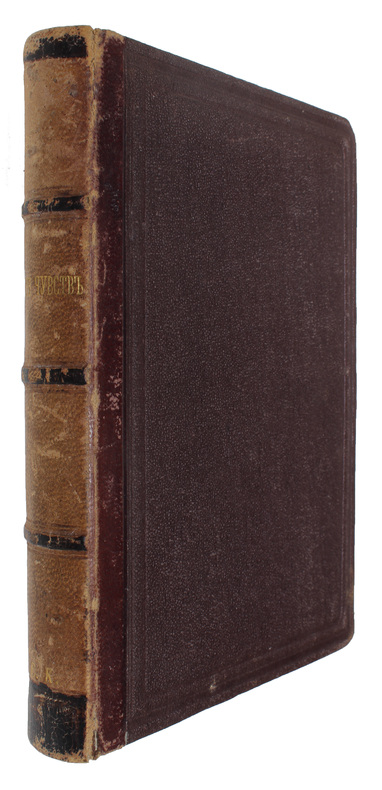
1868réf. 56148St Petersburg I. I. Glazunov 1868. 8vo. In contemporary half calf with with embossed boards. Three raised bands and gilt lettering to spine. Spine with wear. Small label pasted on to top left corner of pasted down front free end-paper. Removed stamp to half-title and title-page with stamp and a a few number written to top of title-page. A few light occassional underlining in pencil otherwise internally fine and clean. 1-515 1 IV pp. Rare first Russian translation of Adam Smith's 'The Theory of Moral Sentiments'.The translator Pavel Bibikov 1831-1875 also translated the 'Wealth of Nations' in 1866 both being part of his series the Library of Classical European Writers. Bibikov regarded the two works as complementing each other as he remarks in his preface to this translation "the works reinforce each other. That is why having published in Russian Adam Smith's great work of political economy I decided to translate and publish his other work which is no less remarkable and yet known even less to Russian society than the first" p. 5. "Bibikov's translation probably done via French remained the only Russian version available until 1997". National Library of Scotland.Adam Smith developed a comprehensive and unusual version of moral sentimentalism in his Theory of Moral Sentiments 1759 TMS. He did not expressly lay out a political philosophy in similar detail but a distinctive set of views on politics can be extrapolated from elements of both TMS and his Wealth of Nations. Although these economic doctrines had not been unheard of in Russia prior to the rise of Anglophile feelings at the beginning of the nineteenth century "it was not until interest and admiration for things British was firmly rooted that classical economics could secure its ground in Russia" Tanaka The Controversies Concerning Russian Capitalism - An Analysis of the Views of Plekhanov and Lenin this processes coincided with the present publication which became important in the spreading of Adam Smith's economic principles in Russia. OCLC only locates three copies. hardcover
1779réf. 50523Kiøbenhavn Copenhagen 1779-80. 8vo. Two nice contemporary half calf bindings with four raised bands and gilt leather title label to spines. Volume one lacking one cm of upper part of spine. Volume two with a small tear to lower part of spine. Both volumes with light brown spotting throughout however mainly affecting first and last five leaves of both volumes. A fine set. 12 575; 8 775 3 - errata pp. The extremely scarce first Danish edition of Adam Smith's seminal main work "the first and greatest classic of modern economic thought" PMM 221 the main foundational work of the era of liberal free trade. This publication constitutes the first Danish work worth mentioning in the history of economic thought - in spite of the great interest in political economy that dominated Danish political thought in the last quarter of the 18th century. The value of Smith's work was not immediately recognized in Denmark at the time of its appearance and a quarter of a century had to go by for its importance to be acknowledged and for Danish political economy to adapt the revolutionizing theories of Adam Smith. Few copies of the translation were published and sold and the book is now a great scarcity. As opposed to for instance the German translation of the work Smith concerned himself a great deal with this Danish translation. As is evident from preserved correspondence about it he reacted passionately to it and was deeply concerned with the reaction to his work in Scandinavia see "Correspondence of Adam Smith" Oxford University Press 1977.- As an example Smith writes in a letter to Andreas Holt on Oct. 26th 1780: "It gives me the greatest pleasure to hear that Mr. Dreby has done me the distinguished honour of translating my Book into the Danish language. I beg you will present to him my most sincere thanks and most respectful Compliments. I am much concerned that I cannot have the pleasure of reading it in his translation as I am so unfortunate as not to understand the Danish language." The translation was made by Frants Dræby 1740-1814 the son a whiskey distiller in Copenhagen who mastered as a theologian and was then hired by the great Norwegian merchant James Collett as tutor to his son. There can be no doubt that Dræbye's relation to the Collett house had a great impact upon his interest in economics. In the middle of the 1770'ies Dræbye accompanied Collett's son on travels throughout Europe which took them to England in the year 1776 the same year that the "Wealth of Nations" was published for the first time. Through the Colletts Dræbye was introduced to the mercantile environment in England and here became thoroughly acquainted with English economics and politics at the time. It is presumably here that he gets acquainted with Adam Smith's freshly published revolutionary work. When Dræbye returned to Denmark at the end of 1776 he was appointed chief of the Norwegian secretariat of the Board of Economics and Trade. He began the translation of the "Wealth of Nations" that he brought back with him from England immediately after his return."WN i.e. Wealth of Nations was translated into Danish by Frants Dræbye and published in 1779 three years after the first English edition. The translation was initiated by Andreas Holt and Peter Anker who were acquainted with Smith. Dræbye was a Dane who lived mainly in Norway reflecting the fact that Norway was much more British-oriented than Denmark proper Denmark and Norway were united until 1814 when Sweden took Norway away from the Danes; in 1905 Norway became an independent state. Norwegian merchants lived from exporting timber to Britain and tended on the whole to be adherents of a liberal economic policy whereas the absolutist government in Copenhagen was more German-oriented and had economic views similar to those in contemporary Prussia." Cheng-chung Lai edt.: "Adam Smith Across Nations" p. 37. The last quarter of the eighteenth century in Denmark was dominated by a lively discussion of monetary policy and the institutional framework best suited to realize that policy. There was a vital interest in questions of economic concern and contemporary Danish sources refer to the period as "this economic age" and state things such as "never was the world more economically minded" both from "Denmark and Norway's Economic Magazine". During this period Smith's revolutionary ideas did not play a major role however and only at the beginning of the 19th century did Danish politicians and economists come to realize the meaning of Smith's views. "Without exaggeration it can essentially be said that a quarter of a century was to pass from the time of the publication of the book in Denmark before Danish political economy fully made Adam Smith's theories and points of view its own. It took so long a time because the economic conditions as a whole in the years from 1780-1800 did not make desirable or necessary the changing of their concepts. That glorious commercial period had to pass before it was understood that we had altogether too little help in our own natural resources and that a different course was therefore necessary. Only when one had come so far could the new thinking find a nourishing soil so that it could develop strength with which to push aside the old ideas."Hans Degen: "On the Danish Translation of Adam Smith and Contemporary Opinion Concerning It." Translated by Henrietta M. Larson. In: Adam Smith Across Nations p. 51. This first Danish translation is one of the very earliest translations of "Wealth of Nations"; it is only preceded by the German 1776-78 and the extremely scarce French 1778-79. As a comparison the Italian translation does not appear until 1790-91 the Spanish 1792 the Swedish 1800-1804 the Russian 1802 etc.Adam Smith Across Nations: A4 - nr. 1. "All five books were translated; appears to be a complete translation. The long letter from Governor Pownall to Adam Smith 25 Sept. 1776 is added as the Appendix vol. 2 pp. 683 ff." hardcover
réf. 114143Paris chez Bulla et chez Aumont c.1830 . First edition; landscape folio 35 x 48 cm; 12 hand-coloured lithographed plates heightened in gum arabic after Adam French and Spanish captions signed letter tipped onto reverse of front free end-paper a couple of spots to pp. 3 and 4 otherwise clean and bright internally; later half blue morocco marbled boards with gilt morocco title label to upper board spine banded in six compartments boards a little rubbed otherwise a fine copy. A striking set of plates graphically depicting the stages of a traditional bullfight. Particular attention is paid to the anatomical correctness of the bull alive or dead. A manuscript letter signed by Jean Victor Adam is tipped in. Jean Victor Adam 1801-1866 was a celebrated artist who started to receive commissions for works from the age of eighteen. This work of his is considered one of the great depictions of the bullfight. Palau 2598. Paris, chez Bulla et chez Aumont, (c.1830) hardcover
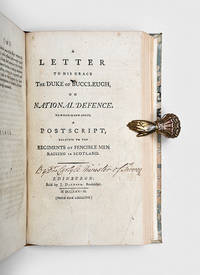
1778réf. 152780Edinburgh: J. Dickson 1778. First edition second issue "a re-issue of the London edition of the same year with a cancel title page and the addition of a postscript dated: Lincoln's Inn July 20th 1778" ESTC this copy also retaining the London title page. "This discussion of the bill for extending the militia law of Scotland introduced in 1776 contains a number of passing references to the war in America" Adams. The postscript comments on Burgoyne's defeat. Carlyle is identified as author in a contemporary hand on the Edinburgh title. After studies at Edinburgh Glasgow and Leiden where his classmates included William Robertson Adam Ferguson and John Home Carlyle was licensed to preach in 1746 and was introduced to the parish of Inveresk some five miles south-east of Edinburgh by the duke of Buccleuch the following year receiving his ordination in 1748. A moderate in his support for ecclesiastical patronage and politically conservative issues as well as in his endorsement of Enlightenment cultural principles including liberal education polite learning and religious toleration Carlyle was a familiar figure in the cultural life of what has come to be known as the Scottish Enlightenment. Strong and outspoken in his support for the Scots militia cause having written in 1760 The Question relating to a Scots Militia Considered the present pamphlet attacks Smith's apparent opposition to militias in the Wealth of Nations citing passages from Smith's book and also referring to the opinions of the Encyclopedistes. The other pamphlets included in this volume are: DOUGLAS John William Pulteney and Junius attributed authors. A Letter addressed to two Great Men on the prospect of peace; and on the terms necessary to be insisted upon in the negotiation. London: Millar and A. Kincaid & J. Bell Edinburgh 1760. Howes 6095. DALRYMPLE Sir John. The Rights of Great Britain asserted against the Claims of America: being an answer to the declaration of the General Congress. The third edition with additions. London: T. Cadell 1776. Howes 2564. LIND John. An Answer to the Declaration of the American Congress. The fourth edition. London: T. Cadell J. Walter and T. Sewell 1776. Howes 6167. TOWNSHEND Charles. Remarks on the Letter addressed to two Great Men. I a Letter to the author of that piece. London: printed in the year 1760. Howes 10372. Manuscript attribution to Henry Lord Holland on title. Octavo 209 x 122 mm. Bound fourth with four other pamphlets related to American affairs in contemporary quarter sheep and marbled boards vellum tips spine ruled gilt in compartments red morocco label lettered "Pamphlets" and numbered 2 direct sprinkled edges. Ownership inscription "Binning" to front pastedown dated 1779 with a manuscript list of the volume's contents to front free endpaper. Short tear to head of front joint; a very good copy. Adams The American Controversy 78-56b variant; ESTC T179898 locating copies at the National Library of Scotland and Harvard Business School only. The London imprint ESTC T107064 is slightly more common with copies located at British Library Columbia Harvard JCB and the New York Historical Society only; Vanderblue p. 50. hardcover
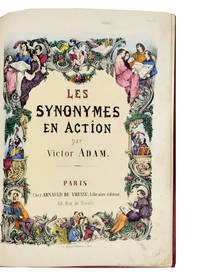
1850réf. 1702701850. ADAM Victor. Les Synonymes en Action. Contents include: hand-coloured lithographed title and twenty-four hand-colored lithographed plates heightened with gum arabic W X & Y on one plate. Folio 337 x 250 mm. bound in publisher's blind stamped red cloth over boards front cover decorated and lettered in gilt expertly rebacked to style. Paris: Chez Arnauld de Vresse 1850. A rare and attractive Abécédaire by the keen Parisian societal observer and illustrator Victor Adam. Each letter of the alphabet is represented by a series of colourful and imaginative vignettes on subjects including costume animals trades and many others. OCLC lists only a copy at NYPL. Minor rubbing to extremities. Short marginal tears to plate numbers 11 12 19 & 21 minimal marginal foxing and soiling otherwise an excellent copy of this scarce series of plates. PROVENANCE: Small bookplate of J.J. Coudera on front pastedown. hardcover
1850réf. 1702701850. ADAM Victor. Les Synonymes en Action. Contents include: hand-coloured lithographed title and twenty-four hand-colored lithographed plates heightened with gum arabic W X & Y on one plate. Folio 337 x 250 mm. bound in publisher's blind stamped red cloth over boards front cover decorated and lettered in gilt expertly rebacked to style. Paris: Chez Arnauld de Vresse 1850. A rare and attractive Abécédaire by the keen Parisian societal observer and illustrator Victor Adam. Each letter of the alphabet is represented by a series of colourful and imaginative vignettes on subjects including costume animals trades and many others. OCLC lists only a copy at NYPL. Minor rubbing to extremities. Short marginal tears to plate numbers 11 12 19 & 21 minimal marginal foxing and soiling otherwise an excellent copy of this scarce series of plates. PROVENANCE: Small bookplate of J.J. Coudera on front pastedown. hardcover books
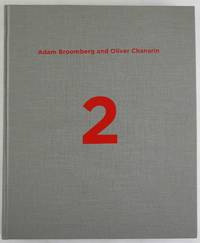
réf. 5307Mack 2011. First Edition First Printing. Hardcover. As new. SIGNED COPY. MACK 2011. Hardcover. First Edition First Printing. Limited to only 100 individually numbered copies of which this is #53/100 SIGNED by both photographers on the front end page. 4to.11.5 x 9.5 inches. Unpaginated with circa 180 pages with color and black and white photographic images throughout. 85 black-and-white photographs printed in offset each with a new photographic reproduction partially pasted over it by hand. Broomberg & Chanarin concerned with the proliferation of imagery relating to the 'War on Terror' that began with 9/11 have taken copies of the 1998 first English edition of Brecht's War Primer as the starting point for this revised version. Keeping the original captions intact they have partially overlaid the original photographs selected by Brecht with contemporary imagery from both sides of the recent conflict drawn from online sources. The URL for each image is provided with a caption in a new set of notes screenprinted over the originals. Cited in The Photobook: A History III p285. War Primer 2 is in the permanent collection of the Museum of Modern Art and was awarded the Deutsche Börse Photography Prize 2013. BOOK CONDITION: Near Fine; a solid clean copy with black cloth reinforcement along title page gutter as issued showing some shallow bends to front cover that are only noticable on the cover verso. Overall a very solid clean copy of the rare limited 1st edition. SIGNED. Originally released in 2011 as a limited edition hardback this book is in the permanent collection of the Museum of Modern Art and gained Adam Broomberg and Oliver Chanarin the 2013 Deutsche Börse Photography Prize. War Primer 2 appropriates the first English-language version of Bertolt Brecht's remarkable 1955 Kriegsfibel in which Brecht combined press photographs from the World Wars with four-line poems. Compiled intermittently over three decades Brecht's book was a visual and lyrical attack on war and its propagandists under modern capitalism. Shifting the critique to contemporary narratives perpetuated by the so-called 'War on Terror' Broomberg and Chanarin strategically overlay the pages of Brecht's War Primer with images culled from the internet and generated by the actors propagators and reporters of the contemporary conflict. Mack hardcover
1945réf. 45143Wels Austria: NP 1945. First edition. Pamphlet. fair to vg-. Large quartos. 16 16 16 20 26 4 2pp. Mimographed staple-bound typescript pamphlets. First issue reproduced in facsimile. This scarce weekly journal was produced by liberated Hungarian holocaust survivors at the Alpenjäger camp in Wels Austria in the summer of 1945. Printed in Hungarian and edited by György Láng 1908-1976 and István Ãdám 1914- the issues contain camp news literature including short stories and poems medical advice entertainment reviews and crossword puzzles among other content. Of particular interest are unusual stories found in the section of police news reports on smuggling theft burglary and forgery and even murders at the camp or others in the surrounding areas. This periodical was published for only 5 issues plus a "Special" and a "Farewell issue" for a total of 7 issues issued June 14 - July 12 1945. Here issue #1 is missing. The editors and the readership were Hungarian former inmates of various local concentration camps who had been moved to the Alpenjager camp after liberation. The camp was a former infantry barracks which had been turned into a DP camp by the Americans. Little is known about Istvan Adam but György Láng was a successful writer and journalist and composer who wrote a number of biographies of famous classical composers before and after the war including Bach Bartok and Beethoven. He himself composed a piece titled "Concerto Ebraico" during the Holocaust which was performed in Budapest after the war. Text in Hungarian. Some bindings and some leaves loose. Some smudges water stains light soiling to a number of pages. In most of these instances the text is mostly decipherable. Markings in pencil throughout from the original owner. Some light closed tears and/or light chipping to extremities. Issues in overall fair to very good- condition overall. Extrmely Scarce. NP unknown
1945réf. 45143Wels Austria: NP 1945. First edition. Pamphlet. fair to vg-. Large quartos. 16 16 16 20 26 4 2pp. Mimographed staple-bound typescript pamphlets. First issue reproduced in facsimile. This scarce weekly journal was produced by liberated Hungarian holocaust survivors at the Alpenjäger camp in Wels Austria in the summer of 1945. Printed in Hungarian and edited by György Láng 1908-1976 and István Ãdám 1914- the issues contain camp news literature including short stories and poems medical advice entertainment reviews and crossword puzzles among other content. Of particular interest are unusual stories found in the section of police news reports on smuggling theft burglary and forgery and even murders at the camp or others in the surrounding areas. This periodical was published for only 5 issues plus a "Special" and a "Farewell issue" for a total of 7 issues issued June 14 - July 12 1945. Here issue #1 is missing. The editors and the readership were Hungarian former inmates of various local concentration camps who had been moved to the Alpenjager camp after liberation. The camp was a former infantry barracks which had been turned into a DP camp by the Americans. Little is known about Istvan Adam but György Láng was a successful writer and journalist and composer who wrote a number of biographies of famous classical composers before and after the war including Bach Bartok and Beethoven. He himself composed a piece titled "Concerto Ebraico" during the Holocaust which was performed in Budapest after the war. Text in Hungarian. Some bindings and some leaves loose. Some smudges water stains light soiling to a number of pages. In most of these instances the text is mostly decipherable. Markings in pencil throughout from the original owner. Some light closed tears and/or light chipping to extremities. Issues in overall fair to very good- condition overall. Extrmely Scarce. NP unknown books
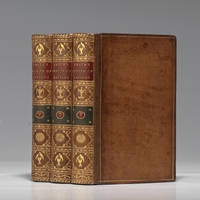
1791réf. 1306621791. SMITH Adam. An Inquiry into the Nature and Causes of the Wealth of Nations. London: Printed for A. Strahan; and T. Cadell 1791. Three volumes. Octavo early full speckled calf sympathetically rebacked in calf-gilt red morocco spine label. $8500.Sixth edition of Smith's landmark work the first published after his deathÑ""the first and greatest classic of modern economic thought"" PMM 221 in contemporary calf boards beautifully respined.""The tone of irreverent skepticism with which it describes the motives of men and governments has influenced the style of economic discourse to the present dayÉ The historical importance of the Wealth of Nations is surpassed by no other economic bookÉ Smith for the first time put together the body of economic knowledge that can still be recognized as an early form of what today may be called mainstream economicsÉ There is little in Jean-Baptiste Say Robert Malthus David Ricardo and John Stuart Mill that is not more or less directly an elaboration of Adam Smith"" Niehans 62-72. On publication of the first American edition not long before this 1791 English edition Thomas Jefferson wrote ""In political economy I think Smith's Wealth Of Nations the best book extant."" ""Where the political aspects of human rights had taken two centuries to explore Smith's achievement was to bring the study of economic aspects to the same point in a single workÉ The certainty of its criticism and its grasp of human nature have made it the first and greatest classic of modern economic thought"" PMM 221. Smith's Wealth of Nations was an immediate success when first published in 1776 and four additional editions came out during Smith's lifetime. The 1776 first edition is exceptionally rare. Bound without half titles. ESTC T95383. Goldsmiths 14612. Kress B2209. Armorial bookplates.Occasional light foxing a beautiful copy in restored contemporary boards. hardcover
1791réf. 1306621791. SMITH Adam. An Inquiry into the Nature and Causes of the Wealth of Nations. London: Printed for A. Strahan; and T. Cadell 1791. Three volumes. Octavo early full speckled calf sympathetically rebacked in calf-gilt red morocco spine label. $8500.Sixth edition of Smith's landmark work the first published after his deathÑ""the first and greatest classic of modern economic thought"" PMM 221 in contemporary calf boards beautifully respined.""The tone of irreverent skepticism with which it describes the motives of men and governments has influenced the style of economic discourse to the present dayÉ The historical importance of the Wealth of Nations is surpassed by no other economic bookÉ Smith for the first time put together the body of economic knowledge that can still be recognized as an early form of what today may be called mainstream economicsÉ There is little in Jean-Baptiste Say Robert Malthus David Ricardo and John Stuart Mill that is not more or less directly an elaboration of Adam Smith"" Niehans 62-72. On publication of the first American edition not long before this 1791 English edition Thomas Jefferson wrote ""In political economy I think Smith's Wealth Of Nations the best book extant."" ""Where the political aspects of human rights had taken two centuries to explore Smith's achievement was to bring the study of economic aspects to the same point in a single workÉ The certainty of its criticism and its grasp of human nature have made it the first and greatest classic of modern economic thought"" PMM 221. Smith's Wealth of Nations was an immediate success when first published in 1776 and four additional editions came out during Smith's lifetime. The 1776 first edition is exceptionally rare. Bound without half titles. ESTC T95383. Goldsmiths 14612. Kress B2209. Armorial bookplates.Occasional light foxing a beautiful copy in restored contemporary boards. hardcover books
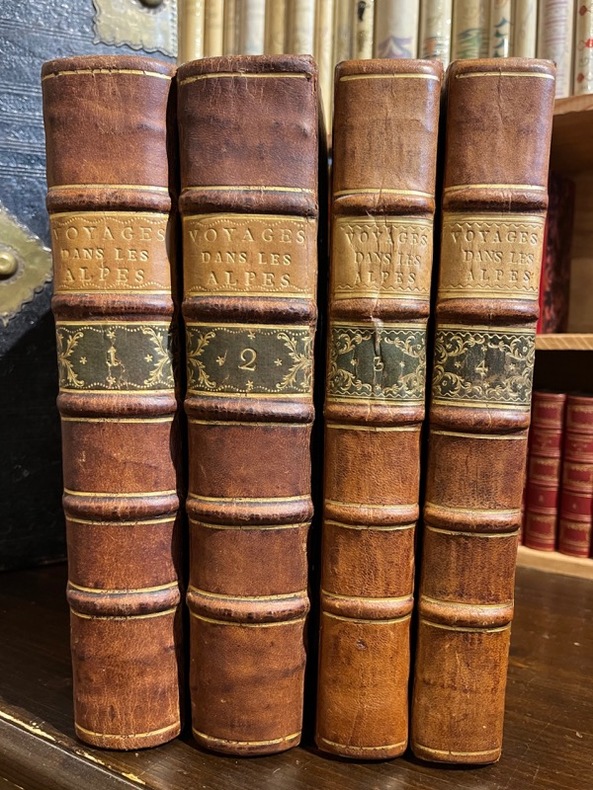
1796réf. 19158Neuchâtel, Samuel Fauche, 1779, [et] Genève, Barde, Manget et Compagnie, 1786 [et] Neuchâtel, Louis Fauche-Borel, 1796. 4 volumes in-4 de [4]-XXXVI-540-[2]; [4]-XVI-641-[3]; [4]-XX-532-[2]; [4]-594-[4] pages. Demi-veau brun à coins, dos à nerfs ornés de filets dorés, pièces de titre et tomaison beiges et vertes, tranches mouchetées.
1777réf. elala682London: Printed for B.White J.Robson P.Elmsly and G.Robinson 1777. 1777. 2 Volumes. 4to. pp. xviii 2 602; 2 p.l. 607. without the errata leaf at the end of Vol. I. folding engraved map frontis. An attractive set in contemporary sprinkled calf neatly rebacked corners renewed spines tooled in gilt Vol. I title-leaf professionally remargined at lower edge & upper outer corner with small repair marginal repair to GG2-3 affecting part of headline occasional spotting. First Edition of this important account of Cooks second voyage which preceded the publication of the official record by some six weeks. The author and his father Johann Reinhold served as naturalists on the expedition. While the elder Forster was originally to have written the account he was forbidden to do so because of a dispute with the Admiralty concerning his emoluments. It is based on his journal and also draws from Cooks own although no acknowledgement is given. Humboldt said that he was indebted to this work more so than to any other for his early love of nature and tropical beauty. On his second and historically most important voyage Cook determined that the Terra Australis Incognita which supposedly lay between New Zealand and South America did not exist and accomplished the first crossing of the Antarctic Circle. Cook revisited New Zealand and discovered or re-explored and charted many of the islands in the Pacific including Easter Island the Marquesas Tahita and the Society Islands the Tonga Islands the New Hebrides and New Caledonia. A vast amount of scientific and ethnographical information was gathered and as a result of new techniques developed by Cook not one crew member on the voyage died from scurvy a remarkable achievement for the time and for which Cook was awarded the Copley gold medal. Beddie 1247. Cox I p. 60. Hill p. 108. Hocken pp. 16-17. Holmes 23. Kroepelien 450. OReilly-Reitman 382. Sabin 25140. Spence 464. 1st Edition. Hardcover. Very Good. London: Printed for B.White, J.Robson, P.Elmsly, and G.Robinson, 1777. hardcover
1776réf. 48982Leipzig, Weidmann, 1776-78. 8vo. Bound in two nice uniform contemporary half calf bindings with five raised bands and gilt lettering to spine. Ex-libris pasted on to pasted down front free end-papers and a small embossed stamp to front free end paper on volume 1 (""Buchhändler u. Antiquar Carl Helf""). Stamp to p. 1 of both volumes. Spines with light soiling and capital on volume 1 lacking a small part of the leather. A few light brown spots throught. A fine set. VIII, 632 pp"" XII, 740 pp.
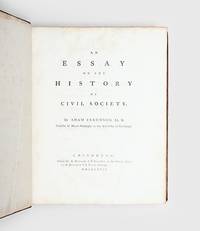
1767réf. 61031Edinburgh 1767. Large 4to. Recased preserving the contemporary marbled leather boards with a gilt line-frame over a more recent light brown full calf binding with five raised bands and gilt ornamentations to spine. The contemporary gilt title-label also preserved in second compartment of the spine. A later leather-onlay to the lower compartment presumably covering an earlier library-marking. All edges of boards gilt. Inner hinges re-enforced. A good solid and sturdy copy. Library stamp Freie Universität Berlin to verso of title-page along with a deaccession-stamp as well as to blank lower margin of p. 48. Apart from the stamps internally extremely well preserved clean and fresh with only light occasional brownspotting. A very wide-margined copy on good paper. Leaves measuring 27x21 cm. VII 1 430 pp. The uncommon first edition of this pioneering classic of the Enlightenment a magnum opus in the history of political thought. The Essay became extremely influential and established Ferguson’s reputation in Britain and the rest of Europe. The work was also taught at the University of Moscow causing Voltaire to praise Ferguson for “civilizing the Russians”. Marx was also directly influenced by the work as were numerous of the great political and sociological theoreticians. “Adam Ferguson's Essay on the History of Civil Society first published in 1767 is a classic of the Scottish - and European - Enlightenment. Drawing on such diverse sources as classical authors and contemporary travel literature Ferguson offers a complex model of historical advance which challenges both Hume's and Smith's embrace of modernity and the primitivism of Rousseau. Ferguson combines a subtle analysis of the emergence of modern commercial society with a critique of its abandonment of civic and communal virtues. Central to Ferguson's theory of citizenship are the themes of conflict play political participation and military valour. The Essay is a bold and novel attempt to reclaim the tradition of active virtuous citizenship and apply it to the modern state.” Cambridge University Press. ”A pioneering work of the Scottish Enlightenment in the field of “philosophical history” or what we would today call sociology. It deals with the social political economic intellectual and legal changes which accompanied societies as they made the transition to modern commercial and manufacturing society.” OLL – Online Library of Liberty hardcover