Mickiewicz, AdamBiblio.com

44 528 résultats
réf. 0270757317.Ghardcover. Good. Access codes and supplements are not guaranteed with used items. May be an ex-library book. hardcover
réf. 0270757309.Gpaperback. Good. Access codes and supplements are not guaranteed with used items. May be an ex-library book. paperback
réf. 1017794707.Ghardcover. Good. Access codes and supplements are not guaranteed with used items. May be an ex-library book. hardcover
réf. 1147821836.Gpaperback. Good. Access codes and supplements are not guaranteed with used items. May be an ex-library book. paperback
réf. 0282190791.Gpaperback. Good. Access codes and supplements are not guaranteed with used items. May be an ex-library book. paperback
1844réf. 044168Leipzig Germany: Brockhaus & Avenarius 1844. Hardcover. Good /No Jackets. 12mo - over 6¾" - 7¾" tall. 2vol.set: 447&357pp.; HBs half-bound blk.&blk.w/blk./white label; heavy wear w/edges&corners worn; some tan w/cleantight pgs. Title trans.: "Lectures on Slavic Literature and States. Held in College de France in the years of 1840-1842 &1842-1843. Parts Two & Three" in German. Brockhaus & Avenarius hardcover
1992réf. BN110223Erich Wewel 1992. 1992. Vorlesungen über die Kirchengeschichte 1-2 Vorlesungen über die Kirchengeschichte 1-2 Erich Wewel unknown
réf. 1166187152.Gpaperback. Good. Access codes and supplements are not guaranteed with used items. May be an ex-library book. paperback
réf. 1104928248.Gpaperback. Good. Access codes and supplements are not guaranteed with used items. May be an ex-library book. paperback
1812réf. 9925AB1812. Wien Kupffer und Wimmer. 1812. XIV recte XII 2 Bl. 184 S. 1 Bl. Pp. d. Zt. mit umlauf. Rotschnitt stärker berieben. Geringfügig braunfleckig. Sehr sauber und sehr gut erhalten. Erste Ausgabe. - Lesky 589 und 591. - Posthum erschienenes Werk von Johann Adam Schmidt 1759-1809. Dem Vorwort von Wilhelm Joseph Schmitt zufolge hat der Verfasser nirgends eine Theorie der Syphilis aufgestellt und die große Frage was die Syphilis sei nicht förmlich beantwortet wohl aber Bausteine zu einer künftigen Theorie vorgelegt. Der dritte Abschnitt des Buches S. 63 bis zum Schluß befaßt sich mit verschiedenen Quecksilberkuren. - J. A. Schmidt war einer der ersten Augenärzte seiner Zeit und u. a. Prof. der Medizin an der Josephs-Akademie in Wien. unknown
1812réf. 700791812. Wien Bey Kupffer und Wimmer 1812 8° XIV 2 184 pp. 1 Blatt Verlagsanzeigen 1 Blatt Verbesserungen Pappband d.Zt.; St.a.Tit.; feines Expl. Erstdruck! Johann Adam Schmidt 1759-1809 einer der eigentlichen Begründer einer wissenschaftlichen Ophthalmologie war u.a. Professor der Medizin an der Josephs-Akademie in Wien. Er behandelte u.a. auch Beethovens Augenleiden. Mit Himly in Göttingen gab er 1802 die erste augenärztliche Zeitschrift "Ophthalmologische Bibliothek" heraus. Die Entdeckung der Iritis syphilitica durch Schmidt und seine Verdientste um die Kenntnisse der Augensyphilis sind sein wesentlicher Beitrag zur Entwicklung der Lehre der syphilitischen Krankheitsformen. -cf. Proksch Gesch. vener. Krankh. II 586 unknown
2005réf. BN550980Köln : DuMont-Literatur-und-Kunst-Verl. 2005. 2005. Von neuen Sternen : Adam Elsheimers Flucht nach Ägypten anlässlich der Ausstellung Von Neuen Sternen. Adam Elsheimers Flucht nach Ägypten Alte Pinakothek München 17. Dezember 2005 bis 26. Februar 2006. Mit Beitr. von Wolfgang Augustyn . / Pinakothek-DuMont Von neuen Sternen : Adam Elsheimers Flucht nach Ägypten anlässlich der Ausstellung Von Neuen Sternen. Adam Elsheimers Flucht nach Ägypten Alte Pinakothek München 17. Dezember 2005 bis 26. Februar 2006. Mit Beitr. von Wolfgang Augustyn . / Pinakothek-DuMont Elsheimer Adam Illustrator Reinhold Herausgeber Baumstark und Marcus Dekiert Köln : [DuMont-Literatur-und-Kunst-Verl.] unknown
2001réf. Q-1840021527Oberon Books 2001-04-01. Paperback. New. In shrink wrap. Looks like an interesting title! Oberon Books paperback
1991réf. Q-0948230398Oberon Books 1991-01-01. Paperback. New. In shrink wrap. Looks like an interesting title! Oberon Books paperback
1925réf. 3134629München & Berlin: Oldenbourg 1925. 94 Seiten. Frakturdruck. Mit Porträtfrontispiz. 8° (17,5-22,5 cm). Orig.-Pappband. [Hardcover / fest gebunden].
réf. __3486751166De Gruyter Oldenbourg 1924. Hardcover. New. reprint edition. 94 pages. German language. 9.06x6.10x0.55 inches. De Gruyter Oldenbourg hardcover
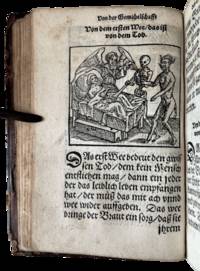
1572réf. 4221Dillingen: Sebald Mayer 1572. 8vo 153 x 120 mm. Collation: A-Z8 a4 -a4 blank. 7 173 7 leaves. Title printed in red and black within 4-part metalcut border repeated on title verso shoulder notes; 121 woodcuts of which 17 flanked by type-ornament borders; the cut on f. 113v roughly colored. One-inch tear to title first few leaves loosening and slightly softened some minor soiling a few short marginal tears. Contemporary blind-tooled calf over wooden boards covers with border of a Fides-Justitia-Prudentia-Spes roll approx. 166 x 14 mm. not in Haebler or the Einbanddatenbank pair of metal fore-edge clasps and catches plain endpapers rubbed knife slashes to front cover by an anti-Catholic. Provenance: partially legible early signature on back flyleaf Ex libris Andreas Zwy---; inscription in a different early hand on front flyleaf: ich läbte lebte und weiss nit wie / ich stirb und weiss nich wän / ich fahr und weiss nit wohin" this popular German saying incorrectly attributed to Martin von Biberach was called by Luther the "rhyme of the godless". First Edition of Walasser's modernized adaptation of a late medieval allegorical romance of the soul's marriage to Christ in an illustrated pocket edition from the first press of Dillingen. It is a previously unrecognized imitation of an Augsburg incunable. The compiler Adam Walasser was not a cleric but a writer for hire who worked as "content producer" editor and proofreader for Sebald Mayer from the time the press was founded in 1550 until 1573 when along with Mayer's son Johann Walasser helped the Tegernsee Benedictines set up their own monastic press. His charge for Mayer was to produce copy by editing translating reworking or completing existing printed or manuscript works in order to further the Counter-Reformation program of the press's patron and eventually owner the Cardinal-Prince-Bishop of Augsburg Otto von Waldburg. The hard-working Walasser who also had experience as a printer also produced a few works of his own and left dozens of works of Catholic religious devotion Counter-Reformation polemics and a couple of books on German heraldry and language. The Büchlein der geistlichen Gemahelschaft a didactic allegory in rhyming couplets by one "Konrad of Vienna" identified as the Viennese Franciscan Konrad Spitzer d. 1380 circulated in manuscript in the late 14th and 15th centuries. A prose version written ca. 1418-1430 known in a few illustrated manuscripts was printed in Augsburg by Johann Bämler in 1477-1478 GW 5666-5668 and later by Johann Schönsperger GW 5669. Bämler used the title Buch der Kunst dadurch der weltliche Mensch mag geistlich werden "the Book of art by which the worldly person can become spiritual" hence the word Kunstbüchlin usually reserved for practical manuals in Walasser's title. Walasser used one of the Bämler editions as his copy-text. In his dedicatory letter to the powerful Abbess of the Imperial Abbey of Buchau Maria Jakoba from the noble family of von Schwarzenberg und Hohenlandsberg he describes his labors after receiving an "old book" from an "honorable person in Konstanze" who suggested that he republish it; it "delighted him as if it were a noble precious treasure" for he found it filled with the Gold and Silver of Christ's teachings fol. A6r-v. Walasser followed the Bämler text modernizing the language omitting a few words and phrases and adding others and added chapter numbers and a final table. The tale of seven virgins one of whom is chosen to marry the King is an allegory of the eternal struggle between good and evil God and Satan. The bride is led through temptation and is accompanied on mystical visits by the allegorical figures of Hope Faith and Wisdom. The latter teaches her "the theocentric worldview" Verfasserlexikon through seven secret words. The final magnificent wedding prepared by ten more virtuous maidens represents the unification through baptism of the soul with God. The symbolic meanings of the plot developments are helpfully spelled out in printed shoulder notes. The story is used as a framework for teaching the basics of Christian doctrine of Creation the Passion and the Sacraments. Using this old tale for Counter-Reformation messaging was a way to beat the Protestants at their own vernacular game by instructing while diverting the literate lay reader unversed in Latin often a woman. The many woodcut illustrations are smaller copies some in reverse of the cuts used in Bämler's editions. Whereas Bämler used some of his blocks more than once there are no repeats in Mayer's edition and while the cuts showing the virgins in action are all copied from the incunable editions there are some divergences in the sections on the Passion and other "generic" passages. A few of the woodcuts which are more heavily shaded than the others and/or are narrower than the text-block may have come from Mayer's stock and been used in other works. The cut on 51v stylistically different from the others is signed BP; this monogrammist's woodcuts appeared in other books by Walasser cf. Nagler Monogrammisten I:1992. No doubt in part because of the rarity of the Dillingen editions the source of this work does not seem to have been previously recognized. Although four more editions appeared during the next 30 years all are rare with none represented in American libraries. USTC 703501; VD16 ZV 2620; Otto Bucher Bibliographie der deutschen Drucke des XVI. Jahrhunderts. I: Dillingen Bibliotheca Bibliographica I 648; cf. Bäumker Wilhelm "Walasser Adam" Allgemeine Deutsche Biographie 40 pp 640-643. Sebald Mayer unknown books
1572réf. 4221Dillingen: Sebald Mayer 1572. 8vo 153 x 120 mm. Collation: A-Z8 a4 -a4 blank. 7 173 7 leaves. Title printed in red and black within 4-part metalcut border repeated on title verso shoulder notes; 121 woodcuts of which 17 flanked by type-ornament borders; the cut on f. 113v roughly colored. One-inch tear to title first few leaves loosening and slightly softened some minor soiling a few short marginal tears. Contemporary blind-tooled calf over wooden boards covers with border of a Fides-Justitia-Prudentia-Spes roll approx. 166 x 14 mm. not in Haebler or the Einbanddatenbank pair of metal fore-edge clasps and catches plain endpapers rubbed knife slashes to front cover by an anti-Catholic. Provenance: partially legible early signature on back flyleaf Ex libris Andreas Zwy---; inscription in a different early hand on front flyleaf: ich läbte lebte und weiss nit wie / ich stirb und weiss nich wän / ich fahr und weiss nit wohin" this popular German saying incorrectly attributed to Martin von Biberach was called by Luther the "rhyme of the godless". First Edition of Walasser's modernized adaptation of a late medieval allegorical romance of the soul's marriage to Christ in an illustrated pocket edition from the first press of Dillingen. It is a previously unrecognized imitation of an Augsburg incunable. The compiler Adam Walasser was not a cleric but a writer for hire who worked as "content producer" editor and proofreader for Sebald Mayer from the time the press was founded in 1550 until 1573 when along with Mayer's son Johann Walasser helped the Tegernsee Benedictines set up their own monastic press. His charge for Mayer was to produce copy by editing translating reworking or completing existing printed or manuscript works in order to further the Counter-Reformation program of the press's patron and eventually owner the Cardinal-Prince-Bishop of Augsburg Otto von Waldburg. The hard-working Walasser who also had experience as a printer also produced a few works of his own and left dozens of works of Catholic religious devotion Counter-Reformation polemics and a couple of books on German heraldry and language. The Büchlein der geistlichen Gemahelschaft a didactic allegory in rhyming couplets by one "Konrad of Vienna" identified as the Viennese Franciscan Konrad Spitzer d. 1380 circulated in manuscript in the late 14th and 15th centuries. A prose version written ca. 1418-1430 known in a few illustrated manuscripts was printed in Augsburg by Johann Bämler in 1477-1478 GW 5666-5668 and later by Johann Schönsperger GW 5669. Bämler used the title Buch der Kunst dadurch der weltliche Mensch mag geistlich werden "the Book of art by which the worldly person can become spiritual" hence the word Kunstbüchlin usually reserved for practical manuals in Walasser's title. Walasser used one of the Bämler editions as his copy-text. In his dedicatory letter to the powerful Abbess of the Imperial Abbey of Buchau Maria Jakoba from the noble family of von Schwarzenberg und Hohenlandsberg he describes his labors after receiving an "old book" from an "honorable person in Konstanze" who suggested that he republish it; it "delighted him as if it were a noble precious treasure" for he found it filled with the Gold and Silver of Christ's teachings fol. A6r-v. Walasser followed the Bämler text modernizing the language omitting a few words and phrases and adding others and added chapter numbers and a final table. The tale of seven virgins one of whom is chosen to marry the King is an allegory of the eternal struggle between good and evil God and Satan. The bride is led through temptation and is accompanied on mystical visits by the allegorical figures of Hope Faith and Wisdom. The latter teaches her "the theocentric worldview" Verfasserlexikon through seven secret words. The final magnificent wedding prepared by ten more virtuous maidens represents the unification through baptism of the soul with God. The symbolic meanings of the plot developments are helpfully spelled out in printed shoulder notes. The story is used as a framework for teaching the basics of Christian doctrine of Creation the Passion and the Sacraments. Using this old tale for Counter-Reformation messaging was a way to beat the Protestants at their own vernacular game by instructing while diverting the literate lay reader unversed in Latin often a woman. The many woodcut illustrations are smaller copies some in reverse of the cuts used in Bämler's editions. Whereas Bämler used some of his blocks more than once there are no repeats in Mayer's edition and while the cuts showing the virgins in action are all copied from the incunable editions there are some divergences in the sections on the Passion and other "generic" passages. A few of the woodcuts which are more heavily shaded than the others and/or are narrower than the text-block may have come from Mayer's stock and been used in other works. The cut on 51v stylistically different from the others is signed BP; this monogrammist's woodcuts appeared in other books by Walasser cf. Nagler Monogrammisten I:1992. No doubt in part because of the rarity of the Dillingen editions the source of this work does not seem to have been previously recognized. Although four more editions appeared during the next 30 years all are rare with none represented in American libraries. USTC 703501; VD16 ZV 2620; Otto Bucher Bibliographie der deutschen Drucke des XVI. Jahrhunderts. I: Dillingen Bibliotheca Bibliographica I 648; cf. Bäumker Wilhelm "Walasser Adam" Allgemeine Deutsche Biographie 40 pp 640-643. Sebald Mayer unknown
réf. 1023962934.Ghardcover. Good. Access codes and supplements are not guaranteed with used items. May be an ex-library book. hardcover
réf. 1149073411.Gpaperback. Good. Access codes and supplements are not guaranteed with used items. May be an ex-library book. paperback
réf. 1174497769.Gpaperback. Good. Access codes and supplements are not guaranteed with used items. May be an ex-library book. paperback
1933réf. 68420BB1933 . Berlin: Alldeutscher Verband 1933. 8°. 158 S. broschiert Einband mit leichten Gebrauchsspuren; sonst altersgemäss gut erhalten unknown
réf. 3347065182.Ghardcover. Good. Access codes and supplements are not guaranteed with used items. May be an ex-library book. hardcover
réf. 3347065174.Gpaperback. Good. Access codes and supplements are not guaranteed with used items. May be an ex-library book. paperback
1987réf. BN152044Stuttgart ; Berlin ; Köln ; Mainz : Kohlhammer 1987. 1987. Vom reinen Denken zur Sprachvernunft : über d. Grundmotive d. Offenbarungsphilosophie Franz Rosenzweigs. Adam Zak Münchener philosophische Studien ; N.F. Bd. 1 Vom reinen Denken zur Sprachvernunft : über d. Grundmotive d. Offenbarungsphilosophie Franz Rosenzweigs. Adam Zak Münchener philosophische Studien ; N.F. Bd. 1 Franz Rosenzweig - Zak Adam Stuttgart ; Berlin ; Köln ; Mainz : Kohlhammer unknown