114 résultats
réf. 124923England c.1260-1275. . 579ll on very thin parchment; early foliation in roman numerals with errors top outer corner recto supplemented by modern foliation in pencil; horizontal catchword centre lower margin in quire 2 traces in quires 12 16 18 19 quires signed at the beginning very bottom inside corner in an Arabic numeral many trimmed presumably by the 19th-century binder ruled in lead sometimes with the top two middle two and bottom two horizontal lines full across full-length vertical bounding lines inside outside and between the columns and with an extra set of double rules at the top and bottom of the page justification 94-90 x 68-64 mm. Written by many scribes below the top line in very small formal gothic bookhands in two columns ff. 546-575v the Interpretation of Hebrew Names in three columns of 49-45 lines majuscules within the text stroked with red red and blue running titles and chapter numbers occasional red rubrics often blank spaces for the rubrics remain one-line alternately red and blue initials chapters begin with two-line with extensions up to fifteen lines alternately red and blue initials with pen decoration in the other colour approximately sixty-eight 6- to 25-line parted red and blue initials with red and/or blue pen work parted initials on f. i and iv verso opening prologue and Genesis extend the full-length of the page. With ten illuminated initials 7-lines high pink or mauve with white highlights infilled with pink and blue rinceaux some terminating with animal heads on highly polished gold grounds or on contrasting grounds of dark blue or pink heavily edged in black overall in very good condition f. 1 darkened and repaired in the inner margin f. 32 modern repair with slight loss of text f. 490 erasure with some damage to a few lines of text ff. 539-545 damage from damp top outer corner f. 544 top outer corner repaired with loss of text generous margins but trimmed some loss at the edges of the added text on ff. 544-545 the ink on some pages has faded or been abraded. Bound in early 19th-century red roan spine elaborately tooled in gilt and lettered 'Biblia/Sacra/M.S.S' expertly rebacked with old spine laid down boards with a single gilt rule speckled edges with yellow glazed endpapers lower board and edges lightly scuffed; a very handsome binding with 20th-century slipcase with paper label to spine lettered in ink and matching chemise. Dimensions 153 x 105 mm. Small portable Bibles containing the complete Old and New Testaments were one of the greatest achievements of 13th-century book production transforming the use and ownership of the Bible. This English example was copied by numerous scribes and decorated in a number of styles. The ten handsome illuminated initials decorate the Minor Prophets an unusual choice. Textual evidence links it to both the Dominicans and Franciscans. Notable here are the numerous additions that show how this was used including the contemporary table of introits and Mass lections and numerous marginal notes from the thirteenth to the fifteenth centuries. The first portable Bibles may have been copied in Paris at the end of the 1220s or early 1230s. Many of them were products of the commercial booksellers of Paris. English examples of this type of Bible however appear at almost the same time and 13th-century England was an important centre for the production of Bibles although in smaller numbers than France. However the text of English 13th-century Bibles is often quite distinct from contemporary Bibles from Paris. Centralised production in Paris resulted in numerous Bibles that share the same text the text modern scholars call the Paris Bible. In England a much more diffuse production meant that there is a much greater variety in the text of the Bibles; there is no 'typical' English text. The Psalms have been omitted here. This is fairly common in 13th-century Bibles and possibly more common in England than elsewhere. This Bible does show some influence of the Paris Bible. In particular the biblical books are arranged according to the 'new' Paris order the same order used today with the Gospels followed by the Pauline Epistles rather than by Acts and the books are divided according to the modern chapters although as noted above with many variations including some that Paul Saenger has identified as English Saenger 2013 and it includes the Interpretation of Hebrew Names. The many different scribes who copied this book and the variety of different styles found in the pen decoration are certainly of great interest. There are many intriguing bits of evidence that tell us how this Bible was put together. The rubricator for example made fairly frequent errors confusing prologues and biblical books and in one case inserting the wrong running title calling the book usually known as 2 Ezra in 13th-century Bibles and 3 Ezra by modern scholars Stegmüller 941 'Osee' i.e. the minor prophet Hosea. A corrector changed it to 'iosias' not the usual name for this book although it does begin 'Et fecit iosias ' The foliation in Roman numerals is also noteworthy most books in the Middle Ages do not include page or folio numbers with numerous mistakes in the series including large gaps despite the text being complete. Ten biblical books begin with finely executed illuminated initials by a well-trained but provincial or idiosyncratic artist freely interpreting more mainstream initials from commercial centres such as Oxford or Paris; most of the initials are pink or a distinctive mauve shade with white highlights infilled with tightly curled vine scrolls that terminate in simple leaves or animal-heads on contrasting grounds or on highly polished gold all heavily edged in black. The 'I' on f. 397v extends 30-lines and is infilled with a distinctive geometric lattice-pattern. The evidence of the script and decorations supports an origin in the second half of the thirteenth century probably c.1260-1275. It was used very early in its history in England and many small details fit best with an origin in England including the lack of a Psalter the Interpretation of Hebrew Names copied in three columns variations in the beginnings of some of the chapters Saenger 2013 p. 60 n. 104 and the quire structure especially the quires of sixteen and twenty leaves Ruzzier 2013 p. 116. None of these details by themselves would be an argument for an English origin but together they are highly suggestive. Moreover the main style of the penwork decoration although unusually exuberant and perhaps idiosyncratic and the style of the illuminated initials also suggest England. Evidence of the script however is more difficult to interpret. There are numerous hands in the volume and the rounded bookhands used by some of the scribes suggest they may have been from Southern France. It is worth remembering that Aquitaine was English throughout the thirteenth century. A full description with further information on the text and the provenance with a full bibliography is available on request. Branner Manuscript Painting in Paris during the Reign of St. Louis 1977; Burke Heraldic Register 1850 p. 83; De Hamel The Book. A History of the Bible 2001 chapter 5 'Portable Bibles of the Thirteenth Century'; Light The Bible and the Individual: The Thirteenth-Century Paris Bible. England, c.1260-1275]. hardcover
1878réf. 74449Paris, P. Lethielleux, Libraire-Editeur, 1878, in-8, demi-chagrin vert, plats percaline, titre à l'or, 170 pages. Bon état.
réf. LFA-126744604Un ouvrage de 663 pages, format 235 x 290 mm, illustré, relié cartonnage dos cuir à cinq nerfs, s.d. (fin du XIXe siècle), Librairie de Firmin Didot Frères, Fils et Cie, bon état
1894réf. 33189Wien; Leipzig: Verlag der Goldenen Klassiker-Bibel Max Herzig 1894. First edition thus. Hardcover. g. Folio. 76 1080 columns 38 540pp 708 columns 354pp 127pp plates. Splendid blind and gilt-stamped crushed full morocco with gold lettering and decoration on front covers and spines. Beveled edges. Raised bands. All edges gilt. Decorative endpapers. Double ribbon marker in each volume. Title pages in red and black lettering. Text in two columns within double red and black ruled box. This remarkable edition of The Old and New Testaments is magnificently illustrated with 127 captioned chromolithographs after classical and modern paintings by the most renowned German Italian Spanish Dutch and French artists such as Ridinger C. W. E. Dietrich Luca Giordano Andrea Appiani Giorgio Barbarelli Ferdinand Boll Philippe de Champagne Nicolas Poussin Alessandro Turchi Jean Germain Drouet Carlo Dolci Rafael Santi Paolo Veronese Francesco Barbieri Leonardo da Vinci Michelangelo etc. Each plate is protected with a tissue-guard. Paper size 14 1/2 x 11 inches; image size varies ca 11 x 8 1/4 inches. Spine of first volume slightly discolored. Spine and front cover of second volume partly discolored. Bottom edge of the first six leafs first volume and of the first four leafs second volume partly damaged by silverfish not affecting pages throughout. Text in German gothic script. Bindings in overall good interior in good to very good condition. Verlag der Goldenen Klassiker-Bibel Max Herzig hardcover
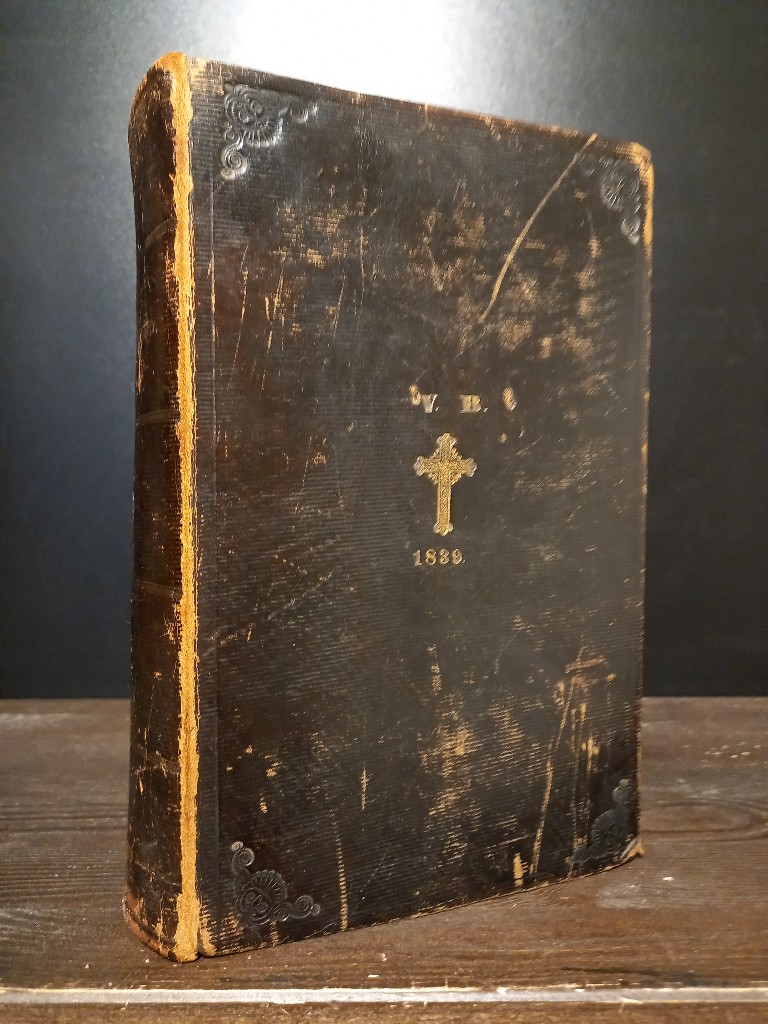
1838réf. 2142814Landshut: Johann Palm'sche Verlagsbuchhandlung / Wien: Mösle und Braumüller 1838. 536, 771 Seiten. Frakturdruck. Mit einem Frontispiz, gestochen und gedruckt von Carl Meyer in Nürnberg. Gr. 8° (22,5-25 cm) Lederband der Zeit mit Gold- und Blindprägung auf Deckel und Rücken (Titel, Kreuz, Initialen "V.B." und Jahreszahl "1839) auf dem Deckel sowie gelbgefärbten Schnitten. [Hardcover / fest gebunden].
1639réf. 1147291639 Sumpt. Haered. B. Gualteri et Sociorum - M.DC.XXXIX. (1639) - In-16 (10,2 x 5,3 x 3 cm), plein maroquin, plats ornés de filets dorés, dos à 4 nerfs ornés de caissons et fleurons dorés - 528 pp.
1843In-folio, pp. (2), xix, 256. Con una tavola in cui è riprodotta una pagina del manoscritto originale. Aponio fu uno scrittore cristiano del V-VI sec., probabilmente di origine orientale, che scrisse a Roma una Explanatio in canticum canticorum, in cui utilizzando il testo latino della vulgata fornisce una interpretazione allegorica. Editio princeps. Legatura in piena pelle con ricche impressioni in oro e a secco ai piatti, fregi e titolo in oro al dorso, tagli in oro.
1891réf. 160797Regensburg, New York & Cincinnati: Druck und Verlag von Friedrich Pustet 1891. XLVIII, 1340; 1341 Seiten. Frakturdruck. Lateinisch-deutscher Paralleltext in zweispaltigem Druck. Gr. 8° (22,5-25 cm). Orig.-Halblederbände mit goldgeprägten Rückentiteln und Lesebändchen. [Hardcover / fest gebunden].
1578réf. 113001578 3 tomes en 2 volumes (two books), reliure plein veau havane marbré in-octavo (binding full calfskin in-octavo)(14 x 20,3 cm), (reliure d'époque), dos 5 nerfs (spine with 5 raised bands) - entre-nerfs à la "fanfare" dorure très estompé (between the raised bands gilt very shaded off) - titre frappé or (gilt title), coiffes abîmées (head and tail of the spine lightly faded), plats avec craquelures et des épidermures (crackles and scratches on the covers), coins écornés (corners dog-eared), tranches jaspées (marbled edges) - petite tache d'encre sur la gouttière de queue du second volume (small ink mark on the bottom edge of the second book), texte 2 colonnes à manchette (text - 2 coloumns with marginal note) - texte en noir encadré de filets bruns rouge avec quelques soulignages à l'encre brune in texte (some underlining ), manque la page de titre du premier volume, remplacée par une photocopie (miss the title page of the first volume), illustrations : orné de 160 bois in-texte en noir par Tobias Stimmer (160 woodcuts in text and a map full page engraving by Tobias Stimmer) + une grande Carte hors-texte en noir de la Méditerranée et des pays circonvoisins (page 98 du tome 3) par Tobias Stimmer , cicatrices de mouillures sur la gouttière du second volume (scars of waterstains on the fore-edge of the second book), [(30)+ 612] + 251+ [ (6+ 224 + (72 pages d'index)] pages, 1578 Basileae per Thomam Guarinum,
réf. 97909Parisiis, Excudebat Antonius Vitré, 1652, 8 volumes in-16 de 155x90 mm environ, T. I. (12) ff. (faux-titre, titre gravé, titre, epistola, praefatio), 768 p. - T. II. 714 p. (1) f. - T. III. 622 p. - T. IV. 648 p.-(2) ff. (index) - T. V. 780 p. - T. VI. 583 p. - T. VII. 480-110 p. (2) ff. (approbation, privilège) -T. VIII. 144-447 p. (27) ff. (index),plein maroquin bordeaux, titres et tomaisons dorés sur dos lisses, tranches coupes et chasses dorées, gardes marbrées avec ex-libris sur les premiers contreplats (en partie arrachés sur les tomes III et V). Quelques rousseurs, des notes au crayon à papier dans les tomes VII et VIII, dos décolorés ou brunis (tome I et V), 2 coiffes ébréchées, des mors en partie fendus avec trous et galerie de ver (tome VI et VIII), frottements sur le dos et les coins, petit manque de papier dans la marge p. 235-236, sinon bon état. Texte en latin.
1574réf. 310455Geneva: Pierre de Saint-André 1574. Illustrated with woodcuts of the Tabernacle Noah's Ark maps including 1 folding etc. 8 435 1; 131 i.e. 113 27 f. Lacking title page with general title supplied from a near contemporary edition separate New Testament title with imprint of Francis Estienne. Small 8vo. 17th century morocco flat spine elaborate gilt scrollwork Dutch gilt endpapers. Some headlines shaved old pale dampstain to gutters at front small split to rear hinge at bottom. Illustrated with woodcuts of the Tabernacle Noah's Ark maps including 1 folding etc. 8 435 1; 131 i.e. 113 27 f. Lacking title page with general title supplied from a near contemporary edition separate New Testament title with imprint of Francis Estienne. Small 8vo. The general title in this copy is supplied from another edition entirely the octavo Biblia Sacra published in Lyon by Jean de Tournes in 1554. The New Testament title bears the imprint Francis Estienne 1567 as found in copies of the Biblia Sacra published in Geneva by Pierre de Saint-André in 1574 and 1583 with the preliminary leaves in this copy matching those of 1574. The title appears to have been supplied at an early date probably when the book was trimmed and rebound in the 17th century. Darlow and Moule 6160 Pierre de Saint-André unknown books
1670réf. 41594Coloniæ Agrippinæ Cologne Germany: Sumptibus Balthasaris ab Egmond & Sociorum. Very Good. Hardcover. 24mo; 81 119 pages; Contemporary full polished tan calf with five raised bands on the spine there is a red morocco label lettered in gilt "BIBLIA SACR" in the second panel. The central panel directly under the label has gilt tooling directly stamped reading: "T. 5." sic for "6". The other panels have elaborate gilt floral tooling the covers are framed with a single rule fin gilt marbled endpapers edges decoratively stained red. With a superb engraved armorial bookplate mounted to the front free endpaper -- a nine-point coronet surmounting a pear-shaped shield which contains a loop of rope surrounded by three stars and a crescent moon at the top. This excellent plate has no name no date and no identification of engraver. The binding is entirely consistent with the period of this 1670 book. The fine bookplate is in the Rococo style often denoted Louis XIV with no straight lines an elegantly curved pear-form to the heraldic shield and even the coronet atop the shield is at a slightly jaunty angle. This plate while unidentified is worth further study. In all a wonderful copy beautifullly preserved of the final volume of a miniature edition of the Sixto-Clementine Vulgate Latin version of the Bible 'Biblia Sacra Vulgatæ Editionis Sixti Quinti Pontificis Maximi iussu recognita atque edita' . This edition resembles but is slightly larger than the miniature edition published at Cologne in 1638-1639. Our volume is the final volume in the 1670 miniature set; these three Biblical texts form an appropriate end to the set as Clement VIII removed 3 and 4 Esdras and the Prayer of Manasses from the Old Testament and placed them as Apocrypha into an appendix following the New Testament -- "ne prorsus interirent" "lest they utterly perish". The first text the "Prayer of Manasses" is brief -- 15 verses of the penitential prayer of king Manasseh of Judah; occupying page 3 and half of page 4 only. "3 Esdras" -- called 1 Esdras in the King James Bible was extensively quoted by early Christian authors and it ws given a place in Origen's Hexapla. While it was not included in early canons of the Western Church it remains part of the Eastern Orthodox canon. "4 Esdras" is considered one of the gems of Jewish apocalyptic literature. It is canonical only in the Orthodox Slavonic Bible and a portion is part of the canon of the Ethiopian Orthodox Church. Like 3 Esdras it is widely cited by early church Fathers particularly Ambrose of Milan. Its verses provided sources for several liturgical prayers and may have suggested the text of the Introitus of the traditional Catholic Requiem Mass -- "Eternal rest grant unto them O Lord and let perpetual light shine upon them." These three texts preserved by Clement VIII are followed by an unpaginated index to the Biblical texts "cum indice Bibliorum triplici" -- specifically "Index Testimoniorvm a Christo et Apostolis in novo Testamento"; "Hebraicorvm Chaldæorvm Græcorvmqve Nominum interpretatio"; and "Index Biblicvs.". See Darlow & Moule no. 6239. Indeed the Bible Society copy deposited in Cambridge University is the only complete set I can find recorded of the full six volumes of this 1670 set. The Cambridge/Bible Society set is carefully described by an excellent catalogue entry available online with a Newton search which makes clear that our volume VI is the only one of the set not to have an additional engraved title-page before the text running title: "Pentateuchum Moysi". The other distinction is that this final volume is the only one to omit the Parisian portion of the imprint found in the other volumes "Parisiis : Væneunt apud Fr. Leonard". See OCLC Number: 265388382; Univ. Cambridge & Catholic Univ. of America but note that Catholic Univ. has only volume one. There are copies of volume VI like ours unaccompanied by others of the set of six at: Cleveland Public Library; Radboud Universiteit Nijmegen; Biblioteca Diocesana Tridentina "A. Rosmini" Trento Italy; and the Bibliothèque Mazarine Paris. A rare and fascinating appendix to the fine miniature set of the Sixtus-Clementine Vulgate -- which has elegantly encouraged owners for three and a half centuries to fulfill Clement VIII's wish that these books not "utterly perish." . 1670. Sumptibus Balthasaris ab Egmond & Sociorum hardcover
1785réf. 40318Parisiis: Excudabat Fr. Amb. Didot natut maj. 1785. 8vo in 4s 19 cm 7.5". 8 vols. I: xvi 501 1 pp. II: 2 ff. 450 pp. III: 2 ff. 393 1 pp. IV: 2 ff. 428 pp. V: 2 ff. 400 pp. VI: 2 ff. 444 pp. VII: 2 ff. 407 1 pp. VIII: 2 ff. 373 1 pp. Produced here in fine French bibliophilic style is the most extensive collection of => Old Latin versions which exist only in fragments compiled from manuscripts and the writings of the Fathers by Pierre Sabbathier and continued after his death under the care of Vincent de La Rue Darlow & Moule. This edition following the first Rheims 173949 was issued In the Didot series Collection des auteurs classiques françois et latins. Binding: Full red crushed morocco gilt spine and boards; gilt rule on board edges; gilt rolls on turn-ins; marbled endpapers. All edges gilt. => Bindings signed Petit Succs. de Simier. Provenance: Bookplates of Casimir L. Stralem Clarence E. Clark and Brian Douglas Stilwell. WorldCat locates only six U.S. libraries reporting ownership of => all eight volumes as present here NYPL Cornell Seton Hall Holy Cross College New York Historical Society UC-Berkeley Law and two libraries reporting ownership of incomplete sets Harvard Divinity vols. 1 2 only University of Dayton vol. 3 only. . Darlow & Moule III 6263; Jammes Les Didot 25. Bound as above some joints outside showing cracking but all intact. All volumes housed in light marbled-paper open-back cases some with tape repairs. => Very good. Excudabat Fr. Amb. Didot natut maj. hardcover books
1562réf. 37346Lugduni Lyons: apud Theobaldum Paganum 1562. 16mo 11.5 cm; 4.5". 284 pp. 16th-century printers seem to have been fond of printing these particular books of the Bible as a unit in small format for personal use. The palm-sized "poetical books" or "wisdom literature" do not survive in the appreciable numbers that the octavo and larger format whole Bibles or Testaments do. => In fact of this edition in North American libraries we trace only this now deaccessioned copy and one other in a Canadian institution. Pagan's variant of the famous Estienne printer's device appears on the title-page. Text is printed in roman type with occasional use of italic and Hebrew and a few nice historiated initials here and there. Early limp vellum dust-soiled and gently cocked. Exseminary library with rubber-stamp on bottom edge of closed volume others on front and rear pastedowns bookplate at front shadows of librarian's pencilling erased from title and verso. Light age-toning small chipping to first and last few leaves light inking on verso of front fly-leaf. apud Theobaldum Paganum hardcover books
1462réf. 001313Mainz: Johann Fust & Peter Schoeffer 14 August 1462 1462. Fust and Schoeffer 48-line Bible Leaf. Royal folio 413 x 286 mm. Leaf 194 from gathering 20 of book one text from 2 Esdras chapter 15 and 16. Double column 48-lines printed in Gothic type. Titles and chapters in alternating red and blue letters red and blue two-line initials rubricated capital initials. Lines 35 to 41 in both columns of recto only are reset. 2 -inch closed tear to outer margin just slightly affecting text expertly repaired two old paper-clip ghosting marks to upper margin. Leaf housed in a cloth portfolio; slipcase with gilt lettered red morocco spine label. A fine leaf from the fourth edition of the Vulgate Bible or the 48- line Bible preceded only by the 42-line Gutenberg Bible the 36-line Pfister Bible Bamberg and the 49-line Mentelin Bible Strassburg. The first also to include the date of publication the place of printing and bear the name of the printer. Mainz: Johann Fust & Peter Schoeffer, 14 August 1462, hardcover
1975réf. 28545Stuttgart, Württembergische Bibelgeschellschaft, (1975). 4to. XXXI, 1980 S. Dünndruck, zweispaltig gedruckt. Grüne OLwd. m. Deckel- u. Rückentitel.
1726réf. AUB-2073Lugdini Petri Valfray Leonardi de la Roche 1726. Bon exemplaire relié, reliure plein veau , dos orné avec dorures et étiquette d'époque, fort et pet. In-4 (26x21) non paginé (plus de 1200 pages). Couverture usagée.
1662réf. 21448Paris, Pierre le Petit, 1662 ; in-12, velin ivoire de l’époque, titre manuscrit au dos; [8], 417 pp.
1754In-4° (30,4 x 20,6 cm), pp. (12), 1028, legatura coeva in piena pergamena con titoli manoscritti al dorso (normali segni del tempo alla legatura). Tagli decorati a spruzzo. Al frontespizio, caratteri stampati in rosso e nero; sempre al frontespizio, vignetta incisa su rame (11,7 x 8,9 cm alla battuta) e nota d'appartenenza coeva scriita in elegante e minuta grafia. Bella testatina incisa a pagina 5 non numerata. Testo disposto su tre colonne. Leggero alone d'umido nell'angolo inferiore esterno delle pagine, una piccola macchia (diametro 1,2 cm) nel margine esterno della carta che ospita le pagine 753-754, molto lontano dal testo, per il resto in ottimo stato di conservazione. Nota di spedizione il volume, debitamente imballato per l'invio, supera i 2 chilogrammi di peso. Titolo completo: Sacrorum Bibliorum vulgatae editionis concordantiae Hugonis Cardinalis Ordinis Praedicatorum, ad recognitionem jussu Sixti V Pont. Max. bibliis adhibitam recensitae, atque emendatae. Primum a Francisco Luca Theologo, et Decano Audomaropolitano, postea variis locis expurgatae, ac locupletata cura, et studio U. D. Huberti Phalesii, Ordinis Sancti Benedicti. Editio novissima prae ceteris correctior in qua summo labore, ac diligentia singuli numeri ad trutinam revocati, attentoque examine cum Sacris Bibliis nunc denuo collati fuere, Venetiis (a Venezia), apud Nicolaum Pezzana (presso Niccolò Pezzana), MDCCLIV.
1894réf. 3107876Leipzig: J. C. Hinrichs'sche Buchhandlung 1894. IX, 139 Seiten. Mit 2 Tafeln in Lichtdruck. 8° (21,5 x 14 cm). Bibliotheks-Halbleinenband. [Hardcover / fest gebunden].
1872réf. 510240Barri-Ducis / Ludovicus Guerin 1872. Hardcover. VERY GOOD. xxiv 1484pp. Rebound in black cloth with gilt spine lettering. From the non-circulating collection of Golden Gate Baptist Seminary with their bookplate noting donation from the library of Edward R. Dalgish as the only paraphernalia. Text entirely clean and fresh - a nice copy. Barri-Ducis / Ludovicus Guerin hardcover
1984réf. 3029987Freiburg, Herder 1984. 118 Seiten, Gr. 8° (25 x 16 cm), Orig.-Pappeinband.
1988réf. 3029988Freiburg, Herder 1988. 100 Seiten, Gr. 8° (25 x 16 cm), Orig.-Pappeinband.
2013réf. 481462013. ISBN-13: 9781584777816; ISBN-10: 1584777818. The Vulgate Edition in Law French Great Britain. Vulgate Edition. The Year Books; Or Reports in the Following Reigns with Notes to Brooke and Fitzherbert's Abridgments. Originally published: London: by George Sawbridge etc. 1678 1679-80. 11 volumes. Folio 9" x 14". 5802 pp. With New Introductory Notes and Tables in Each Volume Naming all Justices and Serjeants and Listing Calendar Years of Law Terms by David J. Seipp Professor of Law Boston University with Carol F. Lee of the District of Columbia Bar. Reprinted 2007 2013 by The Lawbook Exchange Ltd. Set: ISBN-13: 9781584777816; ISBN-10: 1584777818. Hardcover folio 9" x 14". New. $2495. Reprint of the Vulgate edition with new detailed introductions that address the history content and significance of the Year Books and tables that list all justices and sergeants as well as calendar years of law terms. The new material includes references to Seipp's Index and Paraphrase of Printed Year Book Reports 1268-1535 which is based on the Vulgate edition reprinted here. A powerful research tool Seipp's Index and Paraphrase of Printed Year Book Reports 1268-1535 is a free online database of all printed Year Book reports that indexes and summarizes almost all of the cases in this edition. It also guides the reader to later and prior proceedings of individual cases and to all case references in abridgments and other sources. It is difficult to overestimate the importance of The Year Books. As Marvin put it in his Legal Bibliography these were the "venerable books" from which Littleton Hobart Hale and Coke drew "so much valuable ore melting it into ingots and refining and sending it abroad as the correct coin of the common law" 756. As a series of notes on debates and points of pleadings they are primary sources for our knowledge of medieval common law. The origin of The Year Books is unknown. Maitland believed that the earliest volumes were notes taken by law students in court copied for the use of pleaders in later cases. Holdsworth maintained that The Year Books like other law reports were records of cases made by lawyers for their own private use with no thought toward subsequent publication. Though it is not known when the first volumes were compiled it is clear that the earliest cases date from 1268; t. unknown
2013réf. 519932013. ISBN-13: 9781584777823. ISBN-10: 1584777826. Great Britain. Vulgate Edition. The Year Books. Originally published: London: by George Sawbridge etc. 1678 1679-80. With New Introductory Notes and Tables in Each Volume Naming all Justices and Serjeants and Listing Calendar Years of Law Terms by David J. Seipp Professor of Law Boston University with Carol F. Lee of the District of Columbia Bar. xii vii-xii new introduction 2 685 70 pp. Reprinted 2007 2013 by The Lawbook Exchange Ltd. VOLUME I: ISBN-13: 9781584777823. ISBN-10: 1584777826. Hardcover folio 9" x 14". VOLUME I ONLY. New. $250. Reprint of Vol. I of the Vulgate edition with a new detailed introduction that addresses the history content and significance of The Year Books and tables that list all justices and sergeants as well as calendar years of law terms. The new material includes references to Seipp's Index and Paraphrase of Printed Year Book Reports 1268-1535 which is based on the Vulgate edition reprinted here. A powerful research tool Seipp's Index and Paraphrase of Printed Year Book Reports 1268-1535 is a free online database of all printed Year Book reports that indexes and summarizes almost all of the cases in this edition. It also guides the reader to later and prior proceedings of individual cases and to all case references in abridgments and other sources. It is difficult to overestimate the importance of The Year Books. As Marvin put it in his Legal Bibliography 1847 these were the "venerable books" from which Littleton Hobart Hale and Coke drew "so much valuable ore melting it into ingots and refining and sending it abroad as the correct coin of the common law" 756. As a series of notes on debates and points of pleadings they are primary sources for our knowledge of medieval common law. The origin of The Year Books is unknown. Maitland believed that the earliest volumes were notes taken by law students in court copied for the use of pleaders in later cases. Holdsworth maintained that The Year Books like other law reports were records of cases made by lawyers for their own private use with no thought toward subsequent publication. Though it is not known when the first volumes were compiled it is clear that the earliest cases date from 1268; the printed series continues to. unknown