Sturhahn, Carl LuitpoldAntiquariat.de

216 results
1952ref. 311667Göttingen : Vandenhoeck & Ruprecht, 1952. 206,122, XI Seiten. Originalhalbleinen. 29cm
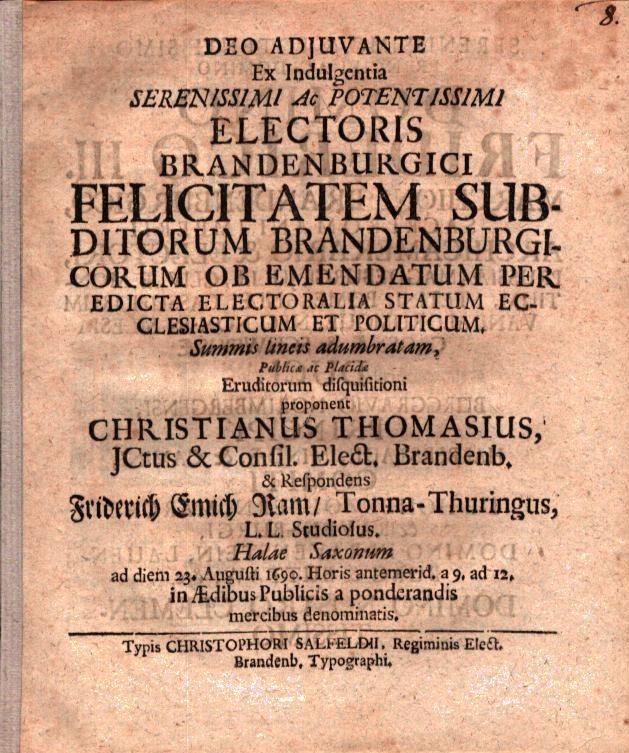
1690ref. 94355[Halle (Saale)], Christoph Salfeldus, 1690. [3] Bl., 48 S. Rückenbrosch.
1968ref. 2090502113717997Not Available 1968. Soft Cover. Fine. The book is in fine condition. Not Available paperback
1862ref. 025059Paris - Genève Joël Cherbuliez 1862 Deux volumes grand in-8°, (4) 482 pp. et IV 374 pp. Reliure en demi-basane fauve, dos à faux nerfs ornés de pièces de titre et de tomaison, roulettes dorées, fers estampés (reliures anciennes). (dos un peu frottés, petit manque à une coiffe, rousseurs éparses).
Mendrisio, Casa Editrice Cultura Moderna, 1912 (vol.1 e 2) – 1913 (vol. 3 e 4) – 1914 (vol. 5, 6 e 7). Prima versione italiana sulla IV edizione tedesca. In 8° PP 404n (vol. I); PP 381n (vol. 2); PP 399n (vol. 3); PP 420n (vol. 4); PP 425n (vol.5); PP 394n (vol.6); PP 321n (vol. 7). Legatura mezza tela con titoli in oro al dorso. Ottime condizioni.
1952ref. 311666Göttingen : Vandenhoeck & Ruprecht, 1952. 206,122, XI Seiten. Originalhalbleinen. 29cm
1892Romae Forzani et Socii 1892, fort In-8 demi vélin à coins, dos lisse à filets dorés, pièce de titre, 1040 pages. Bon exemplaire.
1892ref. 99912708Romae Forzani et Socii Romae Forzani et Socii 1892, fort In-8 demi vélin à coins, dos lisse à filets dorés, pièce de titre, 1040 pages. Bon exemplaire.
ref. DADAX0198808984New unknown
ref. 129670aafParis, Librairie Fischbacher, 1886, in-8vo, XXXVI + 390 + 550 p., reliure en d.-cuir originale.
2017New Turkish Paperback. 4to. (33 x 25 cm). Edition in Turkish. 382 p., color ills. Kur'an-i Kerim sanati. Türk ve Islâm Eserleri Müzesi hazineleri. 15 Ekim 2016 - 20 Subat 2017. [Exhibition catalogue]. With contributions by François Derroche, Edhem Eldem, Jane McAuliffe, Sana Mirza, Zeren Tanindi. In the early twentieth century, the Ottoman Empire was in political turmoil. Officials moved valuable artworks--including thousands of sumptuous Qur'an (Koran) manuscripts and loose pages dating from the 7th to 17th century--to Istanbul to ensure their safety. Penned by celebrated calligraphers and embellished by skilled illuminators and bookbinders, these manuscripts are now housed in the Museum of Turkish and Islamic Arts (Türk ve slam Eserleri Müzesi or TIEM) in Istanbul, established in 1914. This story unfolds in "The Art of the Qur'an: Treasures from the Museum of Turkish and Islamic Arts," the companion publication to the Arthur M. Sackler Gallery's groundbreaking exhibition, the first major presentation of Qur'ans in the United States. The book's authors describe the formation of this one-of-a-kind collection and the history of TIEM, whose centuries-old records on patrons, calligraphers, illuminators, and provenance allow us to create "biographies" detailing the production of the Qur'ans in the exhibition. Essays address the Qur'an as a written text--from content and organization to the elaborate calligraphy and illuminated designs that transformed the volumes into beautiful artworks. "The Art of the Qur'an "also includes in-depth descriptions of some seventy works from TIEM and the Smithsonian's Sackler and Freer Galleries. It features full-page, color images of the earliest known Qur'an folios and manuscripts from the Umayyad and Abbasid Near East (7th-10th century), Seljuk Iran and Anatolia (12th century), the Mongol Il-Khanid and Timurid empires and Mamluk Cairo (14th and 15th centuries), Safavid and Ottoman empires (16th and 17th centuries) as well as a number of mosque furnishings, such as Qur'an boxes and stands. Most of these works have rarely, if ever, been published.
1900ref. 820Paris, A.-L. Guyot, s.d. (circa tout déb. XXe siècle), deux tomes in-16 reliés en un volume ; demi-chagrin vert foncé, plats de percaline vert anglais, dos à nerfs décoré de fleurettes dorées ; 191 pp. ; 189 pp.
ref. DADAX0195369238New unknown
1966Fine French Original decorative imitation full leather bdg. Demy 8vo. (22 x 14cm). In French. [Lxv], 632, [7] p. Le Coran. Traduction intégrale et notes de Muhammad Hamidullah. Préface de Louis Massignon. Avec la collaboration de Michel Leturmy. Hamidllah, (1908-2002), D. Phil., D. Litt., HI, was a Muhaddith, Faqih, scholar of Islamic law and an academic author with over 250 books. A prolific writer, his extensive works on Islamic science, history and culture have been published in several languages and many thousands of articles in learned journals. His scholarship is regarded by many as unparalleled in the last century. A double doctorate (D.Phil. and D.Litt.) and a polymath, he was fluent in 22 languages including Urdu (his mother tongue), Persian, Arabic, French, English, German, Italian, Greek, Turkish, Russian etc. He learned Thai at the age of 84. Hamidullah is known for contributions to the research of Hadith history, translations of the Qur'an into multiple languages and in particular into French (first by a Muslim scholar) and for the monumental biography of the Islamic prophet Muhammad in French. He is also famous for discovering a missing work on the Prophet Muhammad regarded as one of his great contributions to the Hadith literature. The earliest Hadith manuscript still extant today, Sahifa Hammam bin Munabbah, was discovered in a Damascus library. Hammam bin Munabbah being a disciple of Sayyidina Abu Huraira, one of the Sahaba. Massignon, (1883-1962), was a Catholic scholar of Islam and a pioneer of Catholic-Muslim mutual understanding (Krokus 2012, p. 525). He was an influential figure in the twentieth century with regard to the Catholic church's relationship with Islam. He focused increasingly on the work of Mahatma Gandhi, whom he considered a saint. He also played a role in Islam being accepted as an Abrahamic Faith among Catholics. Some scholars maintain that his research, esteem for Islam and Muslims, and cultivation of key students in Islamic studies largely prepared the way for the positive vision of Islam articulated in the Lumen gentium and the Nostra aetate at the Second Vatican Council (Krokus 2012, p. 525). Although a Catholic himself, he tried to understand Islam from within and thus had a great influence on the way Islam was seen in the West; among other things, he paved the way for a greater openness inside the Catholic Church towards Islam as it was documented in the pastoral Vatican II declaration Nostra aetate. "This non-trade edition is reserved exclusively for members of the French Book Club. It includes ten thousand copies numbered from 1 to 10,000.". This is no. 9499. 9499/10000.
ref. DADAX0313279594New unknown
ref. DADAX0971448124New unknown
ref. SONG0895550091Used: Good unknown
ref. BN444226urban villa from speculation to cooperation. urban villa from speculation to cooperation. Dogma Pier Vittorio Aureli and Martino Tattara; with Annalisa Massari Natalie Hase Karla Radovi Paul Knauer Elitsa Ilieva Leo Zumbusch Ben Standke unknown
ref. DADAX0198808976New unknown
2019Nell’ottica di Harnack il dogma è considerato dalla prospettiva dell’incontro della predicazione cristiana con la cultura ellenistica, e la sua storia come storia della concettualizzazione e della sostanziazione metafisica della figura di Gesù. Scritto di portata rivoluzionaria, la Storia di Harnack è la messa in discussione della legittimità di un cristianesimo fondato sui dogmi. Frutto di un sapere vastissimo, quest’opera – per dirla con Yves Congar – è il risultato felice del concorso di una serie di doni eccezionali: chiarezza di vedute, sensibilità per gli sviluppi e le differenze, unite a uno stile brillante e alle qualità del conferenziere. Autori: Adolf von Harnack.
1894Very Good English Original 1/4 leather bounds. 4to. (28 x 21 cm). In Arabic text. 2 volumes: ([viii], 491 p.; [x], 574 p.). El-fetava-i hindiyye. 2 volumes.
ref. DADAX0268000824New unknown
2004Book is in excellent condition. Binding is solid and square, covers have sharp corners, exterior shows no blemishes, text/interior is clean and free of marking of any kind except for pages 8 and 9 with marginalia and underlining. 586 pages, chapters include Of terrorism and the arts, Posh art and post-historic art, The anti-aesthetics of an art of chaos, Furniture as frame, Vital structures: the constructive nexus in South America, The ruptura group and concrete art, Gego and the analytic context, Julio Le Parc, promoter of technological art, On the subject of Waldemar Cordeiro's popcretos, Critical painting of Jose Balmes, Leon Ferrari: Dogma and resistance, Play and grief, etc. Full color prints and photos throughout, often full page.
2017New English Paperback. 4to. (33 x 25 cm). Edition in English. 382 p., color ills. The art of the Qur'an. Treasures from the Museum of Turkish and Islamic Arts. 15 October 2016 - 20 February 2017. [Exhibition catalogue]. With contributions by François Derroche, Edhem Eldem, Jane McAuliffe, Sana Mirza, Zeren Tanindi. In the early twentieth century, the Ottoman Empire was in political turmoil. Officials moved valuable artworks--including thousands of sumptuous Qur'an (Koran) manuscripts and loose pages dating from the 7th to 17th century--to Istanbul to ensure their safety. Penned by celebrated calligraphers and embellished by skilled illuminators and bookbinders, these manuscripts are now housed in the Museum of Turkish and Islamic Arts (Türk ve slam Eserleri Müzesi or TIEM) in Istanbul, established in 1914. This story unfolds in "The Art of the Qur'an: Treasures from the Museum of Turkish and Islamic Arts," the companion publication to the Arthur M. Sackler Gallery's groundbreaking exhibition, the first major presentation of Qur'ans in the United States. The book's authors describe the formation of this one-of-a-kind collection and the history of TIEM, whose centuries-old records on patrons, calligraphers, illuminators, and provenance allow us to create "biographies" detailing the production of the Qur'ans in the exhibition. Essays address the Qur'an as a written text--from content and organization to the elaborate calligraphy and illuminated designs that transformed the volumes into beautiful artworks. "The Art of the Qur'an "also includes in-depth descriptions of some seventy works from TIEM and the Smithsonian's Sackler and Freer Galleries. It features full-page, color images of the earliest known Qur'an folios and manuscripts from the Umayyad and Abbasid Near East (7th-10th century), Seljuk Iran and Anatolia (12th century), the Mongol Il-Khanid and Timurid empires and Mamluk Cairo (14th and 15th centuries), Safavid and Ottoman empires (16th and 17th centuries) as well as a number of mosque furnishings, such as Qur'an boxes and stands. Most of these works have rarely, if ever, been published.
1902Very Good English Leather spine, hardcover not original. 2 volumes in 1 set. [ii], 367 p.; [ii], 327 p. 4 to. (30 x 20 cm). In imprint page of 1st volume, there's wear. In Ottoman script. h. 1318 - 1320 = m. 1902 - 1904., Ozege: 14796. Rare. Kitab-i Mevkûfatî. 2 volumes set [in 1]. Translator: Mehmed Mevkûfatî.