914 results
1970ref. 59398Santa Barbara California: Art Galleries University of California. As New. Paperback. FREE UPGRADE to Courier/Priority Shipping Upon Request – – IN STOCK AND IMMEDIATELY AVAILABLE FOR SHIPMENT - AS NEW THE TEXT BLOCK IS PRISTINE CLEAN UNMARKED AND IN EXCELLENT CONDITION - - 70 pp. With 39 ills. 3 col. . 23 x 22 cm. -- with a bonus offer-- . 1970. Art Galleries, University of California paperback
1704ref. 90345Paris: Par la Compagnie des Libraires 1704. Fine. Par la Compagnie des Libraires Paris 1704 9.5 x 15.6 cm Relié Rare first edition of d'Alègres French translation cf. Brunet V 25. Barbier II 596.Contemporary full marbled calf spine in five raised bands richly gilt in compartments with floral tools red shagreen lettering-piece marbled endpapers gilt fillets to board edges now almost rubbed away red-speckled edges contemporary binding.Restorations to spine and joints marginal dampstain at the foot of about ten leaves annotations and a pen drawing on a flyleaf.This is the second translation of this masterpiece by the Persian poet and philosopher Saadi one of the great Sufi masters of the thirteenth century.The first by André Du Ryer dates from 1634.It corresponds only to part of the Golestân but introduced Persian poetry to the West.Approved by Fontenelle d'Alègres translation likewise partial concerns the first of the seven treatises that relating to the manners of kings.Contemporary manuscript ownership inscription at the end of the volume dated Paris 23 June 1798 Clément Lemoine wigmaker. Par la Compagnie des Libraires hardcover
1924ref. 000569Bagdad: al- Furat press 1924 Book. Very Good. Hardcover. 1st Edition. 12mo - over 6¾ - 7¾" tall. Arabic text 224 p. with several full page photographic plates. Detailed history of the jews in iraq by a jew Iraqi scholar. Contemporary hard cover binding. Occasional minor marginal worm holes without text affects. Rare. al- Furat press hardcover
2006ref. 69490Birmingham AL: Birmingham Museum of Art. New. 2006. Folded Broadsheet. FREE UPGRADE to Courier/Priority Shipping Upon Request - IN STOCK AND IMMEDIATELY AVAILABLE FOR SHIPMENT - FLAWLESS PRISTINE - Poster-like folded broadsheet announcing dual exhibitions featured at the Birmingham Museum of Art from February 5 to April 23 2006: 1 Painting Ethiopia: The Life and Work of Ques Adamu Tesfaw organized by the UCLA Fowler Museum of Cultural History; and 2 Ethiopian Art: From the Walters Museum Birmingham Museum of Art unknown
1951ref. ABC_50690Damascus Syria: Ibn Zeydoun Printing Shop 1951. Original green faded to brown printed paper wrappers with the English title on one wrapper and the Arabic title on the other staple bound. 4to. A scarce bilingual pamphlet trying to connect music theory to global pacifistic politics and international harmony by the Syrian musicologist Allawerdi published in the year he was nominated for the Nobel Peace Prize in 1951 for his efforts to advance world peace through a unified universal language of music which he had formulated a few years before in his groundbreaking work The Philosophy of Oriental Music Damascus Ibn Zeydoun 1949. The pamphlet contains the text of a speech Allawerdi originally delivered in Arabic over the radio. He held that there were two basic forms of music: the oriental natural one based on the natural harmonic series - associated with serenity and peace - and the western mechanical one based on the tempered scale of 18th-century instruments which he considered as artificial and complex ultimately leading to restlessness chaos and war. He wanted to unify the language of music as a first step towards achieving world peace.Allawerdi went even further connecting his ideas on world peace with his belief in economic equality and justice having once advocated his theories already from the platform of the Unesco conference in Beirut in 1948 where he caught the attention of the eminent English evolutionary biologist Julian Huxley the brother of Aldous and serving at the time as the first Director-General of Unesco.Also including in this pamphlet between the English and Arabic texts pp. 1-4 is a short positive review of his main work The Philosophy of Oriental Music.With manuscript annotations on the front wrapper "duplicate". The green wrappers are somewhat faded to brown. Otherwise in good condition.l WorldCat 690043678 1547321918 17306860 78737345. Ibn Zeydoun Printing Shop, unknown
ref. 62377Cairo: al-Maktab al-misri al-hadith 1978. FIRST EDITION. Large 8vo. 24.5 x 16.5 cm. pp.334. Text mostly in Arabic with some English. Publisher's original lemon cloth upper cover gilt-lettered in Arabic. With the unclipped dust-jacket showing a map showing the Gulf States. Book with 25 plates and 2 folding maps. Accompanied by 7 loose folding maps and genealogical tables ranging from 70 x 54 cm to 36 x 49 cm. Some light wear to maps and charts the book itself with just some trivial light spotting to edges generally an excellent copy in a well preserved jacket. First edition first printing of this study of the Arabian Peninsula in the late 18th and early 19th centuries examining the early history of the United Arab Emirates and Oman much enhanced by photographs of the forts of the Gulf and reproductions of paintings depicting battles and complete with large loose genealogical charts showing the descent of ruling families of the United Arab Emirates and Oman including the Nahyan Qasimi and Busa'id families. The period between 1793 and 1818 marks a turning point in the history of the Gulf as the First Saudi State expanded and came into conflict with Oman and the British signed treatises with the leaders of the region. The author begins by surveying the history of the Busa'id family in Oman the confederation of Bani Yas and the Qawasim. Next he examines the eastwards expansion of the First Saudi State and the spread of its influence including the alliance between it and Ra's al-Khaima. The British decision to become militarily involved in the Gulf is presented here as the result of a desire to limit the influence of the Saudis and Wahhabism. After studying the conflict between the Saudis and the Omanis the author discusses the fall of the First Saudi State at the hands of the Ottomans and the lasting impact that the alliances formed during this period had on the emirates of the UAE. The author's research is augmented with the text of the treatises signed between the East India Company Oman and the Emirates between 1789 and 1820. The author Muhammad Morsi Abdullah was a leading historian of the emergence of the United Arab Emirates; he was awarded his doctorate at Cambridge for a thesis on the modern history of the UAE after which he returned to his work in Abu Dhabi as Director of the Documentation and Studies Center in the Office of the President of the United Arab Emirates. In 1969 Abdullah published the book "Abu Dhabi Between Yesterday and Today" as well as a map of the emirate of Abu Dhabi. In 1972 he participated in the crucial project of making the first map of the United Arab Emirates itself. Fittingly the present work was issued with seven large maps and charts alongside the book which is itself illustrated with two folding maps and numerous photographic plates providing a visual history of the UAE. Cairo: al-Maktab al-misri al-hadith, 1978. hardcover
1960ref. 000460Book. Very Good. Softcover. First Editions. 8vo over 7¾–9¾ inches. A complete scholarly edition of one of the most important primary sources for Mamluk history written by a major medieval scholar who lived and worked in Cairo and Damascus. The text is edited directly from the author's autograph manuscript dated 734 AH making this one of the most authoritative modern editions of a medieval Islamic historical source. Published under the auspices of the Deutsches Archäologisches Institut Cairo and issued over several decades between 1960 and 1994 in Cairo and Beirut. As issued the first four volumes remain uncut and unopened. All volumes are preserved in their original publisher's wrappers. Each volume contains the Arabic text accompanied by a scholarly German introduction critical apparatus and facsimile plates of the autograph manuscript an exceptional feature for Islamic historiography. Publication Details by Volume: Vol. 9 – Edited by Hans Robert Roemer. Cairo: al-Khanji 1960. 502 pp. Arabic; 24 pp. German. One facsimile plate of the autograph manuscript. Vol. 6 – Edited by ṢalÄḥ al-Dīn al-Munajjid. Cairo: Government Press of Lajnat al-Taʾlīf wa-l-Tarjama 1961. 675 pp. Arabic; 13 pp. German. One facsimile plate within the Arabic text. Vol. 8 – Edited by Ulrich Haarmann. Cairo: ʿĪsÄ al-BÄbī al-Ḥalabī 1971. 497 pp. Arabic; 38 pp. German. One facsimile plate within the Arabic section. Vol. 7 – Edited by Saʿīd ʿAbd al-FattÄḥ ʿĀshūr. Cairo: al-BÄbī al-Ḥalabī 1972. 454 pp. Arabic; 12 pp. German. Vol. 3 – Edited by Muḥammad al-Saʿīd JamÄl al-Dīn. Cairo: al-BÄbī al-Ḥalabī 1981. 476 pp. Arabic; 6 pp. German. Vol. 1 – Edited by Bernd Radtke. Cairo: al-BÄbī al-Ḥalabī 1982. 497 pp. Arabic; 30 pp. German. Vol. 5 – Edited by Dorothea Krawulsky. Beirut 1992. 504 pp. Arabic; 28 pp. German. Vol. 2 – Edited by Edward Badeen. Beirut 1994. 689 pp. Arabic; 32 pp. German. Vol. 4 – Edited by Gunhild Graf and Erika Glassen. Beirut 1994. 674 pp. Arabic; 41 pp. German. A cornerstone reference for the study of Mamluk political social and intellectual history produced to the highest standards of 20th-century Orientalist scholarship and rarely encountered complete especially with early volumes unopened and in original wrappers. Deutsches Archaologisches Institut Kairo paperback
1974ref. 194605London and Abu Dhabi: George Philip & Son and Centre for Documentation and Research Ministry of Cabinet Affairs 1974. Early cartography of the UAE The smaller-format English version of the most detailed map of the UAE at the time of publication originally prepared and published in 1973 only two years after the establishment of the federation. In addition to pearling grounds the map also details oil fields oil production in 1968-1972 and the oil companies operating in the area. It delineates tarmac roads roads under construction and important traditional trails as well as ports and airports. The three islands contested by Iran - Greater and Lesser Tunb and Abu Musa - are shown as being part of the UAE. The official stamp states that the changes to the borders with Oman and Saudi Arabia subsequent to the Treaty of Jeddah 1974 "are not present on this map which was prepared in 1973". An Arabic version was also published in the same year. The Egyptian-born Ezzeddin Ibrahim was cultural adviser to Sheikh Zayed. The former director of the Centre for Documentation and Research Abu Dhabi Muhammad Mursi Abd' Allah was the author of some of the earliest historical studies of the UAE. Colour folding map 583 x 735 mm; 194 x 123 mm when folded. With 2 insets. Pale blue cover printed in black with arms of the UAE. Official ink stamp in English on front wrapper. Contents clean: a fine copy. unknown
1974ref. 194607London and Abu Dhabi: George Philip & Son and Markaz al-watha'iq wa-l-dirasat bi-wazirat shu'un al-ra'asah 1974. Early cartography of the UAE The smaller-format Arabic version of the most detailed map of the UAE at the time of publication originally prepared and published in 1973 only two years after the establishment of the federation. In addition to pearling grounds the map also details oil fields oil production in 1968-1972 and the oil companies operating in the area. It delineates tarmac roads roads under constructions and important traditional trails as well as ports and airports. The three island contested by Iran - Greater and Lesser Tunb and Abu Musa - are shown as being part of the UAE. The official stamp states that the changes to the borders with Oman and Saudi Arabia subsequent to the Treaty of Jeddah 1974 "are not present on this map which was prepared in 1973". An English version was also published in the same year. The Egyptian-born Ezzeddin Ibrahim was cultural adviser to Sheikh Zayed. The former director of the Centre for Documentation and Research Abu Dhabi Muhammad Mursi Abd' Allah was the author of some of the earliest historical studies of the UAE. Colour folding map 583 x 735 mm; 194 x 123 mm when folded. With 2 insets. Pale blue cover printed in black with arms of the UAE. Official ink stamp in Arabic on front wrapper. Wrappers minimally soiled minor clean tear on upper blank margin couple of tiny holes at fold junctures contents clean: a very good copy. unknown
ref. 42636Piazza.1918.In-4 relié en portefeuille.177 p. Illustrations d'Etienne Dinet et Mohamed Racim.Exemplaire n°584.177 p.avec la carte du Hedjaz et la Route de la Syrie, la table des illustrations et celle des chapitres.Reliure de J.Bosco,relieur à Alger. Ouvrage unique,ayant appartenu à Henry Frugès,qui en a inspiré la reliure et les soies de doublures et de gardes.Plein maroquin mosaiqué de toutes les couleurs.Larges bandeaux et motifs orientalistes.Rabat en portefeuille à l'identique avec doublure de soie.Tète dorée.Très bel ouvrage.
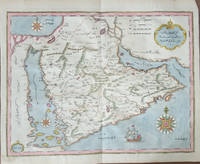
1732ref. 000239Arabian Peninsula. Şekil-i Cezîre-i Arab Map of the Arabian Peninsula. Istanbul: İbrahim Müteferrika in Kâtib Çelebi's Kitâb-i Cihannuma 1732. Measures; 36.5x30.5 cm. Copper-engraved map with contemporary hand color and gold out rules printed on laid paper. The map depicts the Arabian Peninsula with the Red Sea Arabian Gulf and Indian Ocean including numerous Ottoman Turkish place names mountain ranges shown pictorially compass roses an engraved ship vignette and an ornate title cartouche. Original central fold as issued in the atlas. An early and important Ottoman printed map from the first Turkish-language Muslim printing press. Engraved by Ahmed el kirimi أحمد القريمي who does not appear in İbrahim Müteferrika's estate inventory tereke register which provides detailed information about the personnel of his printing house. He was most likely not part of the permanent staff of the press ; rather he sseems to have produced printing plates on a commission basis whenever needed. İbrahim Muteferrika
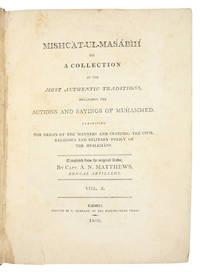
1809ref. ABC_45217Calcutta: T. Hubbard at the Hindoostanee Press 1809. Contemporary sheepskin flat spines with red morocco labels. Small folio 23.5 x 31 cm. 2 volumes. The Mishcàt-ul-Masábìh niche for lamps by al-Khatib al-Tabrizi also known as Wali al-Din d. 741 AH or 1340/41 CE a revised and expanded version of the Masábìh al-Sunnah by al-Baghawi adding approximately 1500 hadith short non-Quranic texts by or approved by Muhammad. This important Sunni text was first translated into English by Capt. Matthews of the Bengal Artillery. Although some of the original hadith are not included and others incorrectly translated this attempt to publish a translation from the Arabic was a noted accomplishment for its time. The list of subscribers accounts for 122 copies with an additional 100 copies noted as being published on order of the Governor General in Council for the Honourable Company. A statement in a 1848 issue of the Journal of Sacred Literature suggests that most copies of the work were destroyed at sea yet it was still advertised for sale in 1817 in the Literary panorama at the price of £4.4s.Some browning throughout more pronounced in endpapers a short tear in the foot of vol. 1 not affecting the text but still in good condition. A rare Calcutta imprint bound in India.l WorldCat 15466515. T. Hubbard at the Hindoostanee Press, unknown
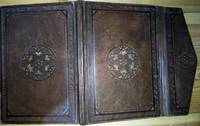
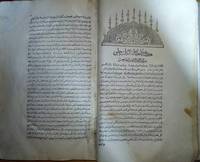
1450ref. 000103Arabic manuscript in Naskh script 80 pages copied by Muḥammad b. Abī Bakr b. ʿAlī b. Muḥammad b. ʿAlī al-Ḥarīrī in 848 AH 1450 AD. The manuscript contains a samÄÊ¿ سماع note written by the scribe himself and further annotated by ShihÄb al-Dīn b. Aḥmad al-QÄdirī al-Mawṣilī al-IqnÄʿī in 849 AH. It is preserved in a Mamluk-style binding possibly contemporary with the manuscript. The work is by Abū al-Faá¸l Ibn ʿAá¹Äʾ AllÄh al-Iskandarī d. 709 AH / 1309 AD one of the great Sufi imams also renowned as a muḥaddith preacher and MÄlikī jurist. He was a student of Abū al-ʿAbbÄs al-Mursī d. 686 AH / 1288 AD and the second successor of ImÄm Abū al-Ḥasan al-ShÄdhilī. Ibn ʿAá¹Äʾ AllÄh was the first to systematically transmit the teachings of the ShÄdhiliyya order in written form. Born in the mid-7th century AH 13th century AD he grew up in Alexandria during the Mamluk period. Although detailed information about his early life is limited he studied with leading scholars in all branches of the traditional Islamic sciences and became a distinguished authority in MÄlikī jurisprudence. His lifetime coincided with the flourishing of several major Sufi orders including the ShÄdhiliyya Mawlawiyya Chishtiyya and Aḥmadiyya. His father had been a disciple of ImÄm al-ShÄdhilī though it is unlikely that Ibn ʿAá¹Äʾ AllÄh himself met the founder of the order. Initially inclined toward jurisprudence rather than Sufism he later became a devoted disciple of Shaykh Abū al-ʿAbbÄs al-Mursī. As evidenced by his most important and enduring work al-Ḥikam Ibn ʿAá¹Äʾ AllÄh emerged as a Sufi master in his own right and was already recognized as a shaykh by the time of al-Mursī's death. He became the third major figure of the ShÄdhiliyya order which originated in Morocco and spread throughout North Africa and beyond. While enjoying a prominent scholarly career in Cairo under the Mamluks he died at approximately sixty years of age in 709 AH 1309 AD and was buried in the QarÄfa cemetery. hardcover
1732ref. 000109The first page of the preface and the final page of the index are in facsimile; otherwise complete. The volume includes 40 original maps and diagrams preserved in mint condition with wide and complete margins. It comprises 698 pages of Ottoman Turkish text printed by İbrahim Müteferrika in 1145 AH 1732 AD. Bound in later hard covers. FIRST AND ONLY EDITION OF THE JIHANNUMA. Planned as a great cosmosgraphy the work was never completed although Katib Celebi wrote two versions. The text contained here is the second version rewritten after the author had acquired a Mercator-Hondius Atlas minor Koemans mistakenly considered the Jihannuma a translation into Turkish of that Atlas. It covers the world from Japan to the Ottoman borders and is well-illustrated with engraved maps including: the World in twin hemispheres the World in oval projection Europe Africa Asia America the North and South Poles Arabia Japan and various other parts of Asia and Asia Minor. Several of the maps and diagrams had appeared in earlier books printed by Mteferrika. The author born Mustafa ibn Abd Allah at Constantinople in 1609 was a prolific scholar historian geographer and bibliophile. Another of his works Tuhfet l-Kibar fi esfar il bihar was published only 4 years earlier at the same press and was the first geographical work to be printed in Turkey. Mteferrika added to the Jihannuma a section concerning the ideas of Copernicus and Tycho Brahe. Koemans II 549 cites 37 plates; Toderini p.114ff. cites 39; and copies are known with 41. Christies note. Ibrahim Muteferrika hardcover