[Trentsensky, Joseph]Antiquariat.de
332 résultats
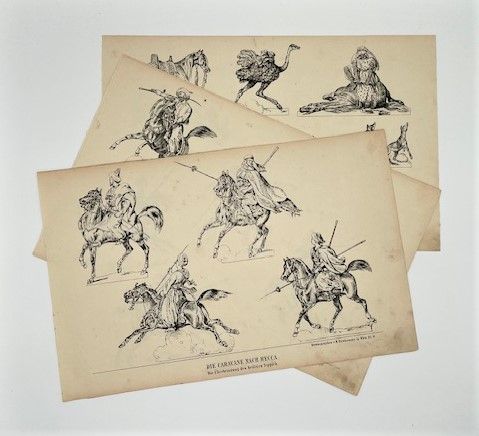
1860réf. 65528Wien, Verlag v. M[atthäus] Trentsensky (Druck v. E. Sieger), o. J. (um 1860). Qu.-Fol. 7 lithogr. Tafeln (ca. 23 x 37 cm) mit jeweils mehreren Darstellungen.
1928In-8, 2 volumi, tela editoriale con scritte in arabo al piatto, taglio super. dorato, pp. XV,302,(2); VII,287; con 2 tavole fotografiche in b.n. ai due frontespizi, protette da velina con didascalia e 8 piante e mappe f.t., alc. a doppia pagina, relative a: “Mekka - The road between Mekka and ‘Arafa - The Haram of Mekka - Roads connecting Mekka with Et-Taif - Et-Taif - El Medina - The Haram of El Medina - Arabia, showing author’s route”. "Prima edizione" di quest’opera di Rutter, definita dal "Bulletin of the School of Oriental and African Studies" come la migliore introduzione sull'Arabia mai scritta. Esemplare ben conservato.
réf. 14938An early original black & white photograph of the Hajj Pilgrimage Atop Mount Arafat outside of Mecca Circa 1930. Measures: 3.5" x 5.5" with Arabic writing to bottom right hand corner. This photo captures thousands of Muslim pilgrims on their second day of pilgrimage the culminating experience of the Hajj gathered together to pray atop the very sacred site of Mt. Arafat Mount of Mercy outside of Mecca in the 1930's. Overall in very good condition. unknown books
1894In-8 gr. (mm. 260x208), tela editoriale con titolo oro al piatto (in lingua orientale) e al dorso, pp. (4),6,(4), 42 cc.num., 1 c.nn., stampate solo al recto. Seconda edizione (la prima è del 1880, stampata privatamente da Quaritch). Dalla prefazione, scritta da Isabel Burton (moglie dell’A.): “On the return journey from Meccah, when Richard Burton could secure any privacy, he composed the following exquisite gem of Oriental poetry, and called it “The Kasidah”. by Haji Abdu al-Yazdi, which was one of his Eastern noms-de-plume.. “The Kasidah” was written in 1853. It is a poem of extraordinary power, on the Nature and Destiny of Man, anti-Christian and Pantheistic. So much wealth of Oriental learning has rarely been compressed into so small a compass..”. “Sir Richard Francis Burton (1821-1890), viaggiatore e scrittore inglese. Per alcuni anni in India, compì (1853) un viaggio alla Mecca travestito da pellegrino; e quindi in Somalia riuscendo a raggiungere Harrar, non ancora visitata da Europei (1854). Parti’ quindi con Speke alla ricerca delle sorgenti del Nilo e scoprì il lago Tanganica (1858). Fu poi in California e nuovamente in Africa, dove salì per primo il M. Camerun. Lasciò importanti relazioni delle sue esplorazioni”, così Diz. Treccani,II, p. 561-62. Bella edizione in tiratura limitata di sole 100 copie numerate. La ns., 46, è in ottimo stato, con barbe.
1918Exquisite vintage 1918 catalog for Vantine's, a "veritable Mecca of objects of art and utility, centrally located on Fifth Avenue... The recognized headquarters in this country for the best that the Orient produces." - from back cover. 24 pages. Printed upon glossy stock. Presents women's hats, blouses, nightgowns, kimonos, robes, hosiery, slippers, purses, handbags, jewelry, toiletries, silks, men's ties and shirts, and knitting tools. Blank order form laid-in. Color illustration and photos on covers. Extensively illustrated, including several black and white photos. Unmarked with moderate wear. Binding intact. A well-preserved copy. Book
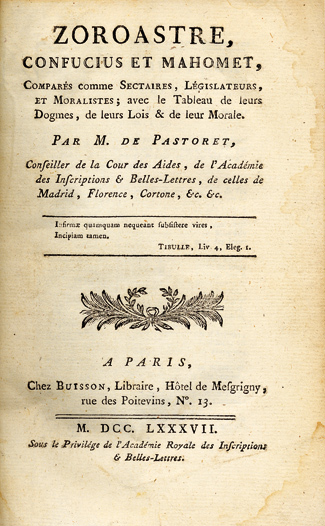
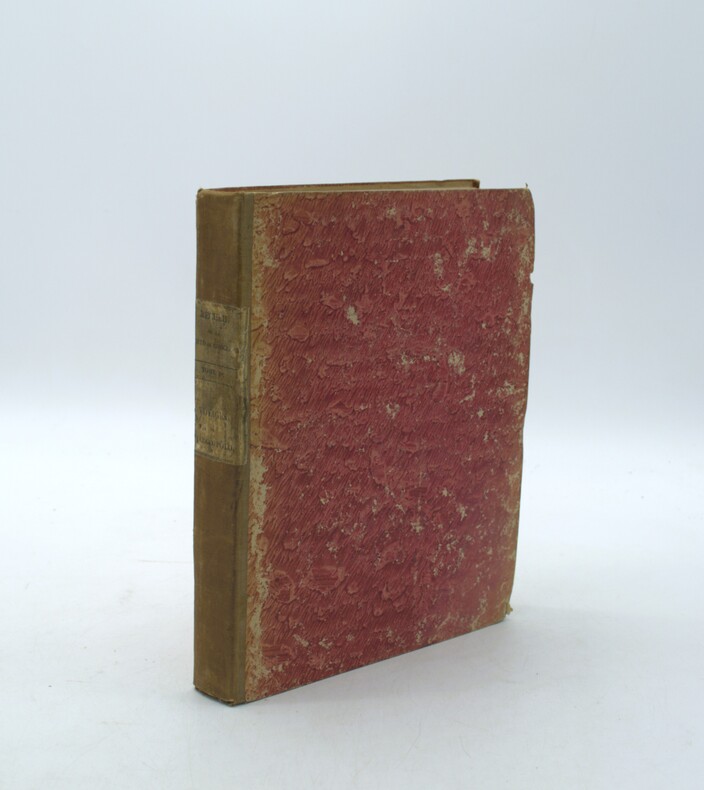
1787réf. 15507Paris, Buisson, 1787 ; in-8 ; demi-veau havane, dos à faux-nerfs décoratifs dorés, fleurons dorés, pièce de titre vert foncé décorée et dorée, plats de papier peint rose (reliure de l'époque) ; (8), 477, (1) pp.
1790réf. 145711790. Engraved plate titled View Of The Temple of Mecca and accompanying Plan Of The Temple of Mecca circa eighteenth century represents an early modern European visual interpretation of the Kaaba and the Masjid al-Haram in Mecca Islam's most sacred site. Produced for inclusion in eighteenth-century printed works including editions of André du Ryer's French translation of the Qur'an L'Alcoran de Mahomet the engraving reflects European efforts to depict and systematize knowledge of Islamic sacred geography during a period of expanding global contact. The print supports research in Islamic studies the history of book illustration Orientalist visual culture and early modern European representations of non-Christian religious architecture. Engraved plate. Circa 1700s. Approximately 8 x 12 inches. Unmounted and unframed. The foldout plate comprises two distinct but related images: an aerial plan of the sacred precinct at Mecca and a perspectival view of the Kaaba within the Masjid al-Haram. The central structure of the Kaaba is depicted surrounded by arcaded and domed architectural elements characteristic of the sanctuary as understood in the eighteenth century. In the foreground courtyard numerous Muslim worshippers-approximately one hundred figures-are shown engaged in prayer emphasizing both ritual practice and spatial organization. The engraving was issued in connection with eighteenth-century European editions of Islamic texts including Du Ryer's influential translation and reflects the period's hybrid combination of documentary ambition and interpretive stylization. As a visual artifact circulating within early modern printed Qur'anic translations the plate documents how European readers encountered Islam through mediated imagery shaped by travel accounts diplomatic reports and secondhand description. Such engravings played a formative role in constructing Western visual conceptions of Mecca at a time when access to the holy city was restricted to Muslims. The presence of both plan and elevation view demonstrates Enlightenment-era interest in architectural order cartographic precision and comparative religion. Light age-related toning and traces of original fold at center; minor fold wear consistent with issuance as a book plate; image clear with well-preserved engraved detail. Overall very good condition. A significant eighteenth-century engraved representation of the Kaaba and Masjid al-Haram reflecting early European visual engagement with Islamic sacred space. unknown
2009New English Original decorative bdg. with flap. In special box. Folio. (32 x 27 cm). In English. [10], 351, [1] p., color ills. The Sacred Trusts: Pavilion of the Sacred Relics. Topkapi Palace Museum, Istanbul. his gorgeous, full-color photographic guide reveals the marvelous collection of the sacred relics at the Topkapi Palace Museum in Istanbul, which houses more than 600 invaluable belongings from prophets such as Abraham, Moses, and Muhammad as well as a number of Muslim saints. Excavated from the most restricted rooms of the palace, the entire selection?including the pieces that are not on exhibit for daily visits?is compiled here for the first time in this fundamental handbook, making it perfect for students interested in Ottoman history, sacred relics of the Ottoman rule, or the broader Islamic heritage. This edition comes without the special box that accompanied previous edition. First Edition
2014New English Original decorative bdg. with flap. In special box. Folio. (32 x 27 cm). In English. [16], 351, [1] p., color ills. The Sacred Trusts: Pavilion of the Sacred Relics. Topkapi Palace Museum, Istanbul. his gorgeous, full-color photographic guide reveals the marvelous collection of the sacred relics at the Topkapi Palace Museum in Istanbul, which houses more than 600 invaluable belongings from prophets such as Abraham, Moses, and Muhammad as well as a number of Muslim saints. Excavated from the most restricted rooms of the palace, the entire selection?including the pieces that are not on exhibit for daily visits?is compiled here for the first time in this fundamental handbook, making it perfect for students interested in Ottoman history, sacred relics of the Ottoman rule, or the broader Islamic heritage. This edition comes without the special box that accompanied previous edition. First Edition
1920Very Good Turkish, Ottoman (1500-1928) Original illustrated wrappers. Chipping on top edge and front cover. Occasional foxing on pages. Overall a good copy. Roy. 8vo. (23 x 15 cm). In Ottoman script (Old Turkish with Arabic letters). 103 p., b/w plates (19 unnumbered b/w plates and 1 map). First edition of this extremely rare first-hand and historically significant eyewitness account of the Syrian and the Suez Canal Operations during the Great War by an Ottoman soldier and statesman. Erden describes in this book his return to Istanbul after his military attaché duty in Paris and his departure to Damascus to join the 4th Army in Syria under the command of Cemal Pasha (1872-1922). He then discusses the Arab Revolt in Hejaz and its possible effects on the Ottoman Empire (The Arab Uprising was initiated by Sharif Hussein bin Ali in June 1916 during the Great War with the aim of creating an independent and united Arab state comprising of Aden in Yemen and Aleppo in Syria against the Imperial Ottoman). After disclosing his views and the actions of the army in the region, he goes on to describe Jerusalem, the Suez Canal, and the wars that took place there. Erden gave new information on the reasons and results of the Canal operation, the condition of the Turkish army along Palestine and Syria fronts, the relations among the Turkish staff, and the nature of the Arab revolt through his views and observations in Egypt, Palestine, and Syria fronts accumulated as he was Cemal Pasha's chief of staff. Erden was a Turkish soldier and war historian. After graduating from the Military Academy in 1903, he worked in the units and headquarters in Yemen, as the staff of the 3rd Corps in the Balkan War and as the Paris Military Attaché. During the Great War, he served as the Chief of Staff of the 4th Army within the entourage of Admiralty Minister Cemal Pasha in Syria. Özege 16174. Kursun p. 51.
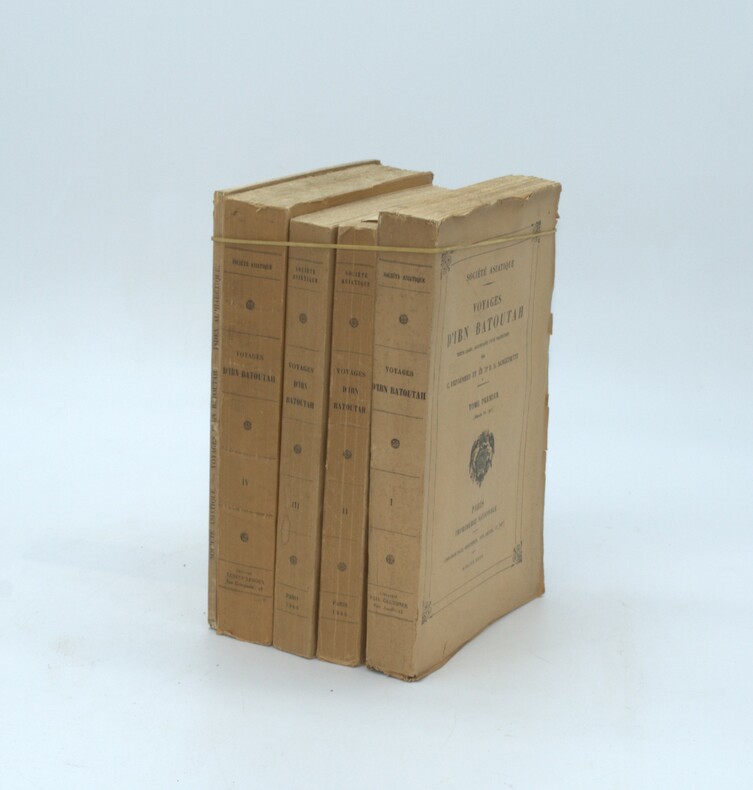
réf. PHO-1451A l'Imprimerie Nationale, Paris, Ernest Leroux et Paul Geuthner Éditeur, 1922-1949. . Édition bilingue: Texte arabe avec traduction française en regard. 5 volumes In-8° de: Tome I (4e tirage,1927) 2ff-XLVI & 443pp. Tome II (5e tirage,1949), XIV & 465 pp. Tome III (5e tirage, 1949), XXVI & 476 pp. Tome IV (4e tirage, 1922), 479 pp. Le Tome V, constitue l'index ,(3e tirage , 1927) 91 pp.. Broché avec couverture éditeur ,non coupé .
1824réf. PHO-2191Paris, Everat, 1824, in-4 (260x210mm), 2ff-LIV-568pp-1ff , avec en fin d’ouvrage la liste des membres de la Société de Géographie, relié demi toile, dos lisse avec étiquette de titre, éditeur et tomaison, frottements aux plats et étiquette usée, vieille mouillure claire en coin, piqures.
1826réf. PHO-1339Paris, Imprimerie Royale, 1826-1827. 2 volumes grand In-8°(sur 3 , manque tome 1), de VII, 577pp. ; VIII, 596 pp. , demi-chagrin , dos ornés avec auteur ,titre et tomaison , initiale en pied , plat frottés , coins usés , pages de garde brunies , tache au titre (tome 2).
réf. 14816Unpublished original sepia toned photograph of pilgrims journeying to Mecca circa 1921. Measures 3.5x5". The original photograph depicts the rugged and mountainous landscape outside of Mecca where thousands of white tents form an encampment of pilgrims making their religious journey. The photo comes from the album of a British naval officer who traveled the region between 1920-1923 and witnessed these events. Photo has some age related curling and some chipping to the bottom that does not affect the image. In overall good condition. unknown books
réf. 14571Antique engraving of the Kaaba and Masjid Haram in Mecca titled: "View Of The Temple of Mecca" accompanied by "Plan Of The Temple of Mecca" circa 18th century. Size: 8" x 12." The engraving illustrates at its center the Kaaba and the surrounding domed structures as it was in 1700's. There are 2 images on this foldout plate the first is an aerial plan of Mecca and the second is a view of the Kaaba with 100 Muslims praying in the outside court. Unmounted and unframed with traces of original fold. This image is different from the above plate and was included in 18th century books including the Al Coran de Mahomet of Du Ryer. With some aged related toning and folds present. An important print in very good condition. unknown books
1921réf. 148161921. Unpublished sepia-toned photograph of pilgrims journeying to Mecca circa 1921 documents the material and spatial realities of the Hajj in the early twentieth century during a period of geopolitical transition in the Arabian Peninsula following the First World War. The image captures a vast encampment of white tents set against a rugged and mountainous landscape outside Mecca visually conveying the scale of pilgrimage infrastructure prior to modern urban expansion. Created during the years immediately preceding the establishment of the Kingdom of Saudi Arabia in 1932 the photograph supports research in Islamic religious practice the history of pilgrimage logistics and British imperial observation of the Hejaz during the inter war period. Photograph. Circa 1921. Approximately 3.5 x 5 inches. Sepia-toned silver gelatin print. The composition presents thousands of white tents clustered across uneven terrain forming a temporary city of pilgrims undertaking the religious journey to Mecca. The mountainous backdrop situates the encampment geographically within the arid environment surrounding the holy city. The photograph originates from the album of a British naval officer who traveled in the region between 1920 and 1923 providing contemporaneous visual documentation from a foreign observer during a time of shifting political authority in the Hejaz following the collapse of Ottoman control. The image appears unpublished and retains the intimate scale characteristic of personal travel albums. As a visual record predating large-scale modernization of pilgrimage facilities the photograph preserves evidence of early twentieth-century Hajj organization material culture and environmental conditions. The presence of an extensive tent city underscores both the enduring continuity of Islamic ritual practice and the logistical complexity of pilgrimage prior to the oil-era transformation of the region. Light age-related curling; minor chipping at lower edge not affecting the image area; surface otherwise clean with strong tonal range. Overall good condition. A historically significant early twentieth-century photograph documenting the lived landscape of pilgrimage to Mecca during a pivotal moment in Arabian political history. unknown
1922réf. PHO-1362A l'Imprimerie Nationale, Paris, Ernest Leroux et Paul Geuthner Éditeur, 1922-1949. . Édition bilingue: Texte arabe avec traduction française en regard. 5 volumes In-8° de: Tome I (4e tirage,1927) 2ff-XLVI & 443pp. Tome II (4e tirage,1914), XIV & 465 pp. Tome III (4e tirage, 1914), XXVI & 476 pp. Tome IV (4e tirage, 1922), 479 pp. Le Tome V, constitue l'index ,(3e tirage , 1927) 91 pp.. Broché avec couverture éditeur ,tome 1,4 et annexe non coupé , étiquettes au dos et cachets (tome 2 et 3) , manque au dos tome 3.
1922réf. PHO-1091A l'Imprimerie Nationale, Paris, Ernest Leroux et Paul Geuthner Éditeur, 1922-1949. . Édition bilingue: Texte arabe avec traduction française en regard. 5 volumes In-8° de: Tome I (4e tirage,1927) 2ff-XLVI & 443pp. Tome II (5e tirage,1949), XIV & 465 pp. Tome III (5e tirage, 1949), XXVI & 476 pp. Tome IV (4e tirage, 1922), 479 pp. Le Tome V, constitue l'index ,(3e tirage , 1927) 91 pp.. Broché avec couverture éditeur .
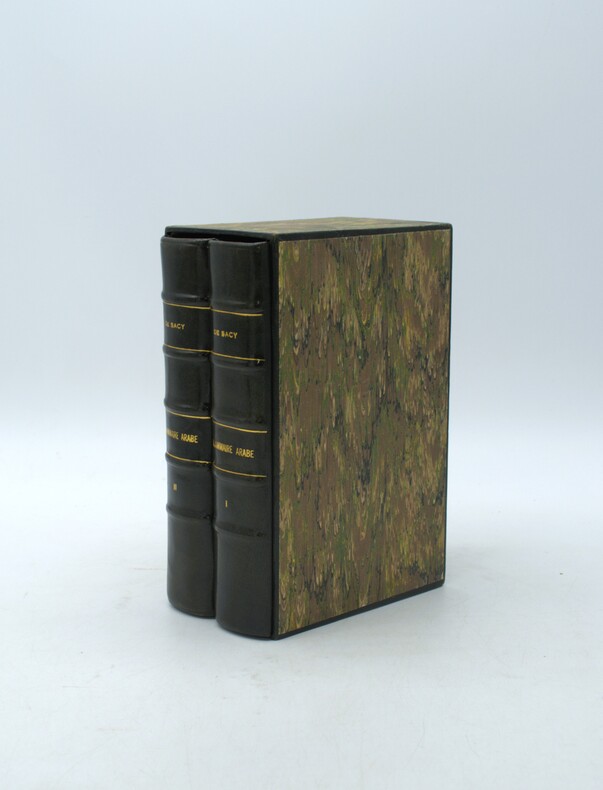
1810réf. PHO-2229Paris, Imprimerie impériale, 1810, 2 volumes in-8 (22,5x15,5cm), xxvi-434pp.-1f (catalogue), x-473pp.-1f (catalogue suite). Demi chagrin et coins moderne dans un coffret, dos à nerfs avec auteur, titre et tomaison, brunissures sur les premières et dernières pages, travail de vers sur les 3 premiers feuillets de chaque tome renforcé, petit travail de ver en pied. Complet de ses 10 tableaux dont 9 dépliants, manque les 8 gravures de lettres arabes
réf. 39703Paris,Desaint & Saillant.Amsterdam.1754. In-12 dans une reliure de l'époque.Avertissement et 215 pages. Reliure en veau moucheté avec dos orné de caissons fleuris et pièce de titre.Bon exemplaire.Coiffe supérieure accidentée avec mors légèrement fendus.Mors inférieur avec trou de vers.Tranches rouges.
1829réf. PHO-1340Paris, 1829 , imprimerie Royale , in-8 , X-519 pp.-164 pp. ,catalogue in fine, relié demi cuir époque , dos lisse avec auteur et titre , initiales en pied , coins et coupes usés , frottements aux plats , quelques rousseurs , pages de garde bruni.
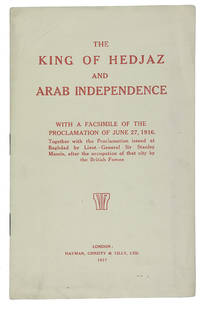
1917réf. F14GSQ01U79OLondon: Hayman Christy and Lilly Ltd. 1917. Original stapled wrappers with red lettering on front wrapper. 8vo. With a photographic portrait of Hussein bin Ali for frontispiece and a folding facsimile proclamation 38 x 28 cm. British pamphlet advertising the independence of Hedjaz from Ottoman rule. The pamphlet includes a facsimile of the proclamation in Arabic pronouncing the Arab peoples free from Turkish domination an introduction about allied involvement the Monroe Doctrine and its role in the region and more basic history behind the eventual writing of the proclamation.Some minor traces of use. In very good condition. Hayman, Christy and Lilly Ltd., unknown
1906Very Good Turkish, Ottoman (1500-1928) Original wrappers. Foolscap 8vo. (17 x 12 cm). In Ottoman script (Old Turkish with Arabic letters). 152 p. Roumi: 1324 = Gregorian: 1906. Taken from a volume including multiple books. Spine is restored. A very good copy. First and only edition of this early and extensively rare book including a first-hand account of the topography and descriptions of Hejaz, Mecca, and other parts of Arabian Peninsula such as Taif and Yemen by Sadiq Sherif, who was the first person to take photographs of Mecca, Medina, and the Hajj in 1880 and 1881 as well. Sadiq Sherif was the grandson of Serif Abdulmuttalib, the Emîr of Mecca. This book written by Sherif was dedicated to 'the Progress and Union Society' [i.e. Ittihad ve Terakki Cemiyeti]. The book describes the way of administration and territorial division of Hejaz after giving some information of its geography, borders, tribes and natives, mountains, rivers, crops and products, and animals of this Ottoman 'vilâyat' [i.e. province]. Sherif gives detailed information on how and when the Ottoman Empire ruled Hejaz, the location of Mecca city, its borders, physical and social geography, crops in Mecca and around, its flora, fauna, demographic structure, 'nahiyes', Kâba's construction, and its history, sacred places around, Masjid-i Haram and other masjids, cemeteries, mountains, gifts by Ottoman caliphs to Kaba, 'Taif' area, people who were 'Emîr' of Mecca from the period of Mohammad, Wahhabism and its birth, etc. At the last, Sherif gives place to his personal letter (layihâ) including 49 articles. The letter was about the reforms that Hejaz needs and it was sent to the Ottoman 'sadâret' [i.e. prime ministry]. (Source: History of geographical literature during the Ottoman Empire, Edited by Ihsanoglu). Muhammad Sadiq Sherif Bey was the first person to take photographs of Mecca, Medina, and the Hajj in 1880 and 1881. Sadiq Bey trained as a military engineer after completing his studies in Cairo and at the École Polytechnique in Paris. It is not known when, or from whom, Sadiq Bey learned to take photographs but it was most probably through one of the resident photographers in Egypt. In 1861, prompted by the need to carry out more extensive military land surveys of the area between Wajh and Medina, Sadiq Bey made his first journey to Arabia. He took a camera along with his surveying equipment and took his very first photographs of Medina. In a series of articles published in the Egyptian Military Gazette in 1877, he refers to his early photography at Medina describing the use of a 'photographia'. Sadly, however, none of the photographs from this first journey has survived. In 1880 he was appointed as the treasurer of the Mahmal, the ornate cloth to cover the Ka'ba brought each year on a special litter to Mecca. He accompanied the Mahmal to Medina and Mecca from September 1880 until January 1881. Again equipped with his camera, he succeeded in producing the series of photographs that are now considered some of the earliest known photographs of the region, those of the Ka'ba, taken under great secrecy. Sadiq Bey published various accounts of his travels in Arabia in military journals, through the Emiry Grand Press in Cairo, but the 1880/81 series of photographs appear to have been issued separately for wider distribution through the Société Khédiviale de Géographie. The society's secretary, Dr. Frederic Bonola, advertised sets of photographs for sale. In January and April 1880 Sadiq Bey gave a talk and report to the society on his earlier 1861 expedition, and on 20 May 1881 he presented a report on his recent journey to Mecca; detailed accounts were published in the society's bulletins, numbers 9/10 and 12. (Source: Christie's). Özege 11888.; Karatay, TM II: 695.; MKAHTBK, II: 991.; OCLC 248374684 / 4082352.
1849Very Good Turkish, Ottoman (1500-1928) In contemporary fine black 1/3 leather bdg. Decorated gilt to spine. Roy. 8vo. (23 x 16 cm). In Ottoman script (Old Turkish with Arabic letters). 112 p. Extremely rare first edition of this Nabi's first-hand account of Mecca, Medina and the Hejaz during his pilgrimage in the late 17th century. This is the most celebrated literary pilgrimage narrative written in Ottoman Turkish. Nabi (1642-1712) was one of the prominent Ottoman poets and is considered a foremost exponent of the didactic trend (hikem-i tarz) in Ottoman Turkish literature. Nabi, whose given name was Yusuf, was born in Urfa (then known as Ruha) in 1052/1642. In 1082/1671 he took part in the Ottoman military campaign in Poland, in the retinue of Müsahib Pasha, (1640-1686). Having spent thirteen years in Istanbul, Nabi desired to go on a pilgrimage to Mecca. He was personally ready to undertake a journey to the Hijaz and to set down an eloquent account of his journey, the experience of his lifetime. Accordingly, having achieved a position of good standing with his patrons, Müsahib Mustafa Pasha and Mehmed IV, Nabi revived his longstanding desire to perform the hajj. In 1089/1678, at around 37 years of age, he set out in a small private caravan from Istanbul, passing through Konya, Urfa, Damascus, Jerusalem and Cairo, where he joined the main Egyptian pilgrimage caravan. The work, which is one of the most successful examples of Ottoman insa (artistic prose), includes historical, sociological, geographical and autobiographical information. In his preliminary remarks, Nabi indicates that he had received governmental help for his journey. He relates that he first obtained leave for the hajj from his patron Musahib Mustafa Pasha, and then submitted a qasida to Mehmed IV, describing the sacred places. The sultan provided Nabi a letter of recommendation addressed to Abdurrahman Pasha (d. 1691), governor of Egypt, ordering him to enable Nabi to make a comfortable journey. Nabi traveled in a small private caravan, since the caravan extended its route to Nabi's homeland, Urfa, and spent about fifty days there. It appears that he generally followed the usual route of the pilgrimage caravan from Istanbul to Damascus, passing through Scutari, Kartal, Gebze, Hersek, Iznik, Eskisehir, Seyitgazi, Aksehir, Ilgin, Ladik, Konia, Eregli, Adana, Misis bridge, Payas, Antioche, Aleppo (with a long detour to Urfa (Edessa) and back to Aleppo via Aintab), Hama, Hims and the Kuteyfe strait. He was fascinated with the splendid architecture of the buildings, the bazaars and the mosques built side by side by Kurdish and Circassian rulers and the Nile when he arrived in Cairo. Nabi gives a general description of the city of Cairo, the Nile, the two reservoirs of the city, parklands, the Ahram hills and the immediate neighborhood of the city. In Mecca, Nabi visited the sacred sites enthusiastically and performed the hajj on 77 January 1679. He gives a moving account of his experience as a pious emotional pilgrim. It appears that Nabi stayed in Mecca for more than twenty days. Immediately after 1 Muharrem 1090/12 February 1679, he set out for Medina, presumably in the Damascus caravan. While in Medina, Nabi served at the tomb of the Prophet by lighting the candles since his name was on the honorary list of attendants who were determined by the central government to serve the sanctuaries in Mecca and Medina. Nabi regards these services as a testimony to the legitimacy of Ottoman rule. He summarizes his journey of return from Medina to Damascus and to Istanbul in a few general words. Özege 21267.; Not in OCLC.
1745Very Good Turkish, Ottoman (1500-1928) Contemporary 1/3 leather bdg. with cloth spine. Leather boards. Restored. Demy 8vo. (22 x 15 cm). In Arabic. [138] p. Slightly chipped extremities of papers. Occasionally stained on pages, wear on binding. Text is fine. Including 'kataba'. The routine, predictable, yet exhaustive nature of the journey Ottoman pilgrims endured may have discouraged them from recording their journeys. The route was relatively well-defined, and the caravan orderly and well-protected. Moreover, Ottoman pilgrims, unlike Christian travelers, were traveling across the lands of the same state, thus seeing people of the same Muslim culture, without needing to speak different languages, use different currencies, or negotiate borders between states. The uniqueness and peculiarity of a journey would motivate the traveler to record it and the result would be of interest to an audience. As for the Ottomans, if the texts which were composed to help future pilgrims with practical information are excluded, the majority of known narratives, are written by those authors such as Ahmed Fakih, Fevri, Evliya Çelebi, Nabi, and Shaikh Sinan er-Rûmî who undertook at least some parts of their journeys independently of the official caravan. Texts which seem to have been intended simply to provide practical information either on the stations or on the rites of the hajj or on both are defined as guidebooks. These texts appear not to be based on a particular pilgrimage journey, regardless of the fact that their authors might have performed the hajj. This manuscript starts with 'Bayân al-Menâzil Beyt Al-Sam wa al-Qabah' [i.e. Descriptions and stations from Damascus to Mecca] including a very detailed routes' list with their times hour by hour. 40 routes and hours probably by mounts and/or walking between Damascus and Mecca, Qaba. Other chapters of the text include rites and routes like "Farziyyat of Hajj, Ihram, Mukhrima, entry to Mecca-i Muqarrama, tawaf, Sa'y between Safa and Marwa, Arafat in Mecca, Muzdalifa from Arafat, Ef'al in Mina, Umra, Taawaf al-Vedâ, Qabr-i Sharif in Medina al-Munawwara, etc. Sheikh Sinan Al-Roumi's manasik al-hajj is one of the most important and famous ones in the hajj literature of the Islamic world. It was a mostly used reference book among Muslim pilgrims, especially in the Ottoman world. Calligrapher and copied by Ahmed b. Muhammed b. Suleyman. Text in black ink and important headings in red ink on paper with 'ahar'. A fine paper suitable for calligraphy. A very good example from the first half of the 18th century.