BELTRAME A. -MareMagnum

316 risultati
1922Copertina illustrata a colori in fascicolo originale completo de "La Domenica del Corriere" del 30/07/1922
petit in-4° 223 pages, abondamment illustre h.t. n/b/couleurs, carte, notes, index, relie cartonnage ed., jaquette illustree. Bel exemplaire. [P-29]
1924Copertina illustrata a colori in fascicolo originale completo de "La Domenica del Corriere" del 12/10/1924
1950In-4, brossura, in buono stato di conservazione. In questo numero: "Ratto in Sicilia. A Partinico (Palermo) un giovanotto spalleggiato dai suoi tre fratelli e da quattro amici, tutti armati, ha fatto irruzione di notte nella casa di una ragazza che si era rifiutata di sposarlo. Bastonata la madre per costringerla a tacere, i violenti hanno tratto a forza la giovane sulla via a caricata su un carro che subito è dileguato nel buio. La ragazza è stata trovata il mattino dopo dai carabinieri, in aperta campagna." "Pellegrinaggio a nuoto nel deserto. Fenomeno raro, le piogge hanno trasformato in lago la spianata della Grande Moschea della Mecca, nel cuore dell'Arabia, dove sorge la Caaba, pietra sacra dei maomettani. Per raggiungere il venerato monumento i pellegrini hanno dovuto immergersi nell'acqua e perfino procedere nuotando.".
1924In-4, brossura, in buono stato di conservazione. In questo numero: “La solenne cerimonia svoltasi nel mare di Pola. I reduci di guerra gettano alle onde una corona d’alloro in onore dei mairnai d’Italia caduti per la Patria.” "La Mecca, la città santa dei musulmani, è minacciata dai wahabiti, i puritani della religione maomettana. Il re dell'Heggiaz, Hussein, e gli alti funzionari, si sono già trapiantati a Gedda sul Mar Rosso, con gli archivi, il denaro pubblico e il tesoro privato del sovrano. Tutte le botteghe si sono chiuse, e gran parte della popolazione si mette in salvo.".
1955rif. LFA-1267211762 volumes de 355 et 336 pages, format 160 x 245 mm, brochés, publiés en 1955-1956, Chez l'auteur, bon état, rare
1981rif. LFA-1267211113 volumes de 200, 167 et 150 pages, format 140 x 225 mm, brochés, publié en 1981, 1983 et 1984, Nouvelles Editions Latines, bon état, rare complet
1931rif. RO30041414LES PRESSES UNIVERSITAIRES DE FRANCE. 1931. In-8. Broché. Bon état, Couv. convenable, Mors fendus, Intérieur frais. 257 pages.. . . . Classification Dewey : 305.4-La femme
1931rif. 2121923Paris.: Les Presses Univer. 1931. Paperback. Cubierta deslucida. Good. 25 cm. 253 p. Encuadernación en tapa blanda de editorial. Idioma francés . Cubierta deslucida. Sociología. Política Les Presses Univer. paperback
1972Mm 165x235 Collana "Gli Uomini e le loro Istituzioni. Antologie storiche moniografiche". Brossura editoriale, 119 pagine, copertina illustrata a colori. Buono stato. Spedizione entro 24 ore dalla conferma dell'ordine.
2018rif. 6342018 - broché - Editions Belin - Collection Mondes anciens, dirigée par Joël CORNETTE - 2018 - Fort in-8 (24 x 17 cm) broché, couverture à rabats - 678 pages - Très riche iconographie, avec photographies, documents et illustrations en couleurs - ISBN : 9782701198361 - Ouvrage collectif dirigée par François-Xavier FAUVELLE
2018New Turkish Paperback. 4tp. (29 x 25 cm). In Turkish. 60 p., fully color ills. Kâbe düsleri. Erol Kiliç Resim Sergisi. [Exhibition catalogue]. 11 Aralik 2018 - 14 Ocak 2019. Curated by Mehmet Lütfi Sen. Printed to 3000 copies.
2017New New Turkish Original bdg. Dust wrapper. 4to. (33 x 25 cm). In Turkish. 461 p., color ills. Kutsal mekanlarda kutsanmis örtüler. Topkapi Sarayi'ndan örneklerle Kâbe örtüleri.
2014rif. 1-1440237867Krause Pubns Inc 2014. Paperback. New. 128 pages. 9.75x8.00x0.50 inches. Krause Pubns Inc paperback
rif. 017435New York: Mecca Cigarettes Book. NF. NAP. Cigarette baseball card mounted in protective plastic case. Mecca Cigarettes unknown
1926rif. 144221926. Gröber Karl. Bird's Eye View of Mecca 1926. Original copperplate photogravure depicting Mecca Islam's holiest city and the destination of the annual Hajj pilgrimage. The elevated view records the historic urban setting of Mecca home to the Masjid al-Haram the Sacred or Grand Mosque and the Kaaba toward which Muslims worldwide direct their daily prayers. Published in 1926 the image dates from the early rule of Abdulaziz Ibn Saud over the Hejaz following his conquest of Mecca in 1924 and assumption of the title King of the Hejaz in 1926. The illustration preserves a photographic view of the holy city during a period of political transition decades before the extensive urban redevelopment and mosque expansions of the later twentieth century. Gröber Karl photographer. Bird's Eye View of Mecca. 1926. Original copperplate photogravure after a photograph by Gröber published as an illustration in the first edition of a 1926 book containing his text and photogravures. Sheet measures approximately 8.25" x 10.25" with a printed area of approximately 8.5" x 6.25". The elevated perspective presents a panoramic view of Mecca recording the city's buildings and urban topography. The copperplate photogravure process reproduces the tonal gradations and architectural detail of the original photograph. Mecca had been under Ottoman sovereignty until the Arab Revolt of 1916 after which it formed part of the Hashemite Kingdom of the Hejaz before coming under Saudi control in 1924. Gröber's 1926 publication belongs to this transitional period in the city's modern history. The original photogravure provides a contemporary visual record of Mecca before the major architectural alterations and expansions undertaken in subsequent decades. unknown books
1928rif. 144851928. Varthema Ludovico di. The Itinerary of Ludovico di Varthema of Bologna from 1502 to 1508 1928. Limited first Argonaut Press edition of one of the earliest European firsthand accounts of Mecca and Medina originally published in Italian in 1510. Varthema an Italian traveler from Bologna entered the Islamic holy cities in 1503 after joining a pilgrim caravan from Damascus under the assumed Muslim name Yunus serving among its Mamluk military escort. His account is among the earliest recorded descriptions of the Hajj and Mecca by a European visitor who was not originally Muslim detailing pilgrimage ceremonies religious customs urban life and encounters with merchants and local authorities. His subsequent travels extended through Yemen the Persian Gulf Persia India and parts of Southeast Asia recording commercial networks religious practices military organization and maritime trade during the opening decades of Portuguese expansion into the Indian Ocean. The 1928 edition reproduces John Winter Jones's 1863 English translation prepared for the Hakluyt Society together with Sir Richard Carnac Temple's historical examination of Varthema's travels in southern Asia. Varthema Ludovico di. The Itinerary of Ludovico di Varthema of Bologna from 1502 to 1508. As Translated from the Original Italian Edition of 1510 by John Winter Jones F.S.A. in 1863 for the Hakluyt Society with A Discourse on Varthema and His Travels in Southern Asia by Sir Richard Carnac Temple. London: The Argonaut Press 1928. First Argonaut Press edition limited to 975 numbered copies printed on Japon vellum. One volume quarto 4to pp. lxxxvi 122 last blank 2 colophon blank. Illustrated with one plate five full-page maps within the pagination a facsimile of the original 1510 title page and a title-page vignette printed in blue and black; includes an index. Edited by N. M. Penzer. Original quarter vellum over blue-grey buckram boards spine lettered and ruled in gilt with rectangular gilt devices on both covers. Retains the original ribbon marker and an ownership bookplate centered on the front pastedown. Varthema's narrative follows his passage through Egypt and Syria to Medina and Mecca then southward through Yemen and Aden onward to Hormuz and Persia and across the Indian Ocean to India and Southeast Asia. His descriptions address the religious observances of the Muslim pilgrims Bedouin encounters regional customs and laws commercial products trading practices and methods of warfare. Varthema's travels took place during a period of increasing Portuguese intervention in Indian Ocean commerce shortly after Vasco da Gama's voyage around the Cape of Good Hope established a new maritime route between Europe and India. His account records the established Muslim trading networks connecting the Arabian Peninsula Persian Gulf Indian ports and Southeast Asian markets before Portuguese naval power substantially altered regional commerce. First printed in Rome in 1510 the narrative circulated in successive European editions and translations becoming an early source for European geographical knowledge of Arabia and the Indian Ocean. Sir Richard Carnac Temple's accompanying discourse examines the historical and geographical evidence for Varthema's itinerary distinguishing his observations from earlier travel accounts and evaluating his descriptions of southern Asia. The original vellum and buckram binding retains its gilt decoration ribbon marker and ownership bookplate. Overall in very good condition. unknown books
1928rif. 144851928. Varthema Ludovico di. The Itinerary of Ludovico di Varthema of Bologna from 1502 to 1508 1928. Limited first Argonaut Press edition of one of the earliest European firsthand accounts of Mecca and Medina originally published in Italian in 1510. Varthema an Italian traveler from Bologna entered the Islamic holy cities in 1503 after joining a pilgrim caravan from Damascus under the assumed Muslim name Yunus serving among its Mamluk military escort. His account is among the earliest recorded descriptions of the Hajj and Mecca by a European visitor who was not originally Muslim detailing pilgrimage ceremonies religious customs urban life and encounters with merchants and local authorities. His subsequent travels extended through Yemen the Persian Gulf Persia India and parts of Southeast Asia recording commercial networks religious practices military organization and maritime trade during the opening decades of Portuguese expansion into the Indian Ocean. The 1928 edition reproduces John Winter Jones's 1863 English translation prepared for the Hakluyt Society together with Sir Richard Carnac Temple's historical examination of Varthema's travels in southern Asia. Varthema Ludovico di. The Itinerary of Ludovico di Varthema of Bologna from 1502 to 1508. As Translated from the Original Italian Edition of 1510 by John Winter Jones F.S.A. in 1863 for the Hakluyt Society with A Discourse on Varthema and His Travels in Southern Asia by Sir Richard Carnac Temple. London: The Argonaut Press 1928. First Argonaut Press edition limited to 975 numbered copies printed on Japon vellum. One volume quarto 4to pp. lxxxvi 122 last blank 2 colophon blank. Illustrated with one plate five full-page maps within the pagination a facsimile of the original 1510 title page and a title-page vignette printed in blue and black; includes an index. Edited by N. M. Penzer. Original quarter vellum over blue-grey buckram boards spine lettered and ruled in gilt with rectangular gilt devices on both covers. Retains the original ribbon marker and an ownership bookplate centered on the front pastedown. Varthema's narrative follows his passage through Egypt and Syria to Medina and Mecca then southward through Yemen and Aden onward to Hormuz and Persia and across the Indian Ocean to India and Southeast Asia. His descriptions address the religious observances of the Muslim pilgrims Bedouin encounters regional customs and laws commercial products trading practices and methods of warfare. Varthema's travels took place during a period of increasing Portuguese intervention in Indian Ocean commerce shortly after Vasco da Gama's voyage around the Cape of Good Hope established a new maritime route between Europe and India. His account records the established Muslim trading networks connecting the Arabian Peninsula Persian Gulf Indian ports and Southeast Asian markets before Portuguese naval power substantially altered regional commerce. First printed in Rome in 1510 the narrative circulated in successive European editions and translations becoming an early source for European geographical knowledge of Arabia and the Indian Ocean. Sir Richard Carnac Temple's accompanying discourse examines the historical and geographical evidence for Varthema's itinerary distinguishing his observations from earlier travel accounts and evaluating his descriptions of southern Asia. The original vellum and buckram binding retains its gilt decoration ribbon marker and ownership bookplate. Overall in very good condition. unknown
1926rif. 144221926. Gröber Karl. Bird's Eye View of Mecca 1926. Original copperplate photogravure depicting Mecca Islam's holiest city and the destination of the annual Hajj pilgrimage. The elevated view records the historic urban setting of Mecca home to the Masjid al-Haram the Sacred or Grand Mosque and the Kaaba toward which Muslims worldwide direct their daily prayers. Published in 1926 the image dates from the early rule of Abdulaziz Ibn Saud over the Hejaz following his conquest of Mecca in 1924 and assumption of the title King of the Hejaz in 1926. The illustration preserves a photographic view of the holy city during a period of political transition decades before the extensive urban redevelopment and mosque expansions of the later twentieth century. Gröber Karl photographer. Bird's Eye View of Mecca. 1926. Original copperplate photogravure after a photograph by Gröber published as an illustration in the first edition of a 1926 book containing his text and photogravures. Sheet measures approximately 8.25" x 10.25" with a printed area of approximately 8.5" x 6.25". The elevated perspective presents a panoramic view of Mecca recording the city's buildings and urban topography. The copperplate photogravure process reproduces the tonal gradations and architectural detail of the original photograph. Mecca had been under Ottoman sovereignty until the Arab Revolt of 1916 after which it formed part of the Hashemite Kingdom of the Hejaz before coming under Saudi control in 1924. Gröber's 1926 publication belongs to this transitional period in the city's modern history. The original photogravure provides a contemporary visual record of Mecca before the major architectural alterations and expansions undertaken in subsequent decades. unknown
1926rif. 144231926. Gröber Karl. Two Views of the Mosque at Mecca 1926. Pair of original copperplate photogravures depicting the Masjid al-Haram the Sacred or Grand Mosque in Mecca Islam's holiest city and the destination of the annual Hajj pilgrimage. The mosque surrounds the Kaaba toward which Muslims worldwide turn in daily prayer. Published in 1926 the illustrations date from the early period of Saudi rule over Mecca following the city's conquest by Abdulaziz Ibn Saud in 1924. The two views record the mosque from ground-level and elevated perspectives preserving photographic documentation of the sacred precinct before the extensive architectural expansions of the later twentieth century. Gröber Karl photographer. Two Views of the Mosque at Mecca. 1926. Two original copperplate photogravures after photographs by Gröber published in the first edition of a 1926 book containing his text and photographic illustrations. Each sheet measures approximately 8.25" x 10.25" with a printed area of approximately 6.25" x 8.25". The first photogravure presents a ground-level view of the mosque recording its architecture from within the surrounding urban setting. The second provides a bird's-eye view of the mosque showing the sacred complex from an elevated perspective. Both illustrations reproduce the tonal gradations and architectural details of the original photographs through the copperplate photogravure process. The illustrations were published during a decisive period in the modern history of Mecca. Following the collapse of Ottoman authority in the Hejaz during the First World War the city came under Hashemite rule before its capture by Ibn Saud in 1924. In 1926 Ibn Saud assumed the title King of the Hejaz incorporating Mecca into the expanding Saudi state. The paired views record the mosque's architectural setting during this transition preceding the major expansion and redevelopment campaigns undertaken from the mid-twentieth century onward. Both original photogravures are in excellent condition presenting complementary perspectives of the Grand Mosque as reproduced in 1926. unknown books
1926rif. 144231926. Gröber Karl. Two Views of the Mosque at Mecca 1926. Pair of original copperplate photogravures depicting the Masjid al-Haram the Sacred or Grand Mosque in Mecca Islam's holiest city and the destination of the annual Hajj pilgrimage. The mosque surrounds the Kaaba toward which Muslims worldwide turn in daily prayer. Published in 1926 the illustrations date from the early period of Saudi rule over Mecca following the city's conquest by Abdulaziz Ibn Saud in 1924. The two views record the mosque from ground-level and elevated perspectives preserving photographic documentation of the sacred precinct before the extensive architectural expansions of the later twentieth century. Gröber Karl photographer. Two Views of the Mosque at Mecca. 1926. Two original copperplate photogravures after photographs by Gröber published in the first edition of a 1926 book containing his text and photographic illustrations. Each sheet measures approximately 8.25" x 10.25" with a printed area of approximately 6.25" x 8.25". The first photogravure presents a ground-level view of the mosque recording its architecture from within the surrounding urban setting. The second provides a bird's-eye view of the mosque showing the sacred complex from an elevated perspective. Both illustrations reproduce the tonal gradations and architectural details of the original photographs through the copperplate photogravure process. The illustrations were published during a decisive period in the modern history of Mecca. Following the collapse of Ottoman authority in the Hejaz during the First World War the city came under Hashemite rule before its capture by Ibn Saud in 1924. In 1926 Ibn Saud assumed the title King of the Hejaz incorporating Mecca into the expanding Saudi state. The paired views record the mosque's architectural setting during this transition preceding the major expansion and redevelopment campaigns undertaken from the mid-twentieth century onward. Both original photogravures are in excellent condition presenting complementary perspectives of the Grand Mosque as reproduced in 1926. unknown
1958pp. viii, 97. Sm. 4to. Original printed wraps. Very good copy. Scarce, ISLAM BOX 1
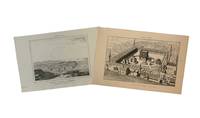
1847rif. 146231847. Mecca is the birthplace of prophet Muhammad and home to the Kaaba the holiest site while Medina is the second holiest city where the Prophet's Mosque is located.Two original steel engravings titled "Medina et Sepulcre du Prophete" and "Temple de la Mecque" issued in Picturesque Universe Paris: Firmin Didot 1847. Engraved plates measuring approximately 5" x 8.2". These mid-nineteenth-century French views present idealized yet intricately rendered representations of Islam's two holiest cities Medina and Mecca produced for a European readership at a moment of expanding Orientalist travel literature and imperial curiosity about the Islamic world. The Medina engraving offers a panoramic prospect from an elevated vantage point depicting the walled city and the Prophet's Mosque at its center approached by four travelers traversing a mountainous road some mounted on camels. The composition emphasizes distance and pilgrimage situating the sacred city within both devotional and geographic imagination. The companion engraving of Mecca presents a detailed architectural rendering of the Masjid al-Haram complex with the Kaaba prominently centered and surrounded by arcades and ancillary structures the broader urban fabric faintly delineated in the background. Produced at a time when non-Muslim access to these cities was extremely restricted such engravings mediated sacred Islamic space through European print culture shaping nineteenth-century visual conceptions of the Hijaz. As products of a major Parisian press renowned for technical excellence these steel engravings reflect both advances in reproductive printmaking and the period's fascination with global religious and cultural monuments.First engraving with loss to the lower right corner not affecting the primary architectural focal points; light age toning and minor edge wear consistent with issue; second engraving clean and well-preserved with strong plate impression. Overall very good. An evocative pair of mid-nineteenth-century European views of Medina and Mecca documenting the circulation of Islamic sacred geography within illustrated travel literature at the height of Orientalism publishing. unknown books
1847rif. 146231847. Mecca is the birthplace of prophet Muhammad and home to the Kaaba the holiest site while Medina is the second holiest city where the Prophet's Mosque is located.Two original steel engravings titled "Medina et Sepulcre du Prophete" and "Temple de la Mecque" issued in Picturesque Universe Paris: Firmin Didot 1847. Engraved plates measuring approximately 5" x 8.2". These mid-nineteenth-century French views present idealized yet intricately rendered representations of Islam's two holiest cities Medina and Mecca produced for a European readership at a moment of expanding Orientalist travel literature and imperial curiosity about the Islamic world. The Medina engraving offers a panoramic prospect from an elevated vantage point depicting the walled city and the Prophet's Mosque at its center approached by four travelers traversing a mountainous road some mounted on camels. The composition emphasizes distance and pilgrimage situating the sacred city within both devotional and geographic imagination. The companion engraving of Mecca presents a detailed architectural rendering of the Masjid al-Haram complex with the Kaaba prominently centered and surrounded by arcades and ancillary structures the broader urban fabric faintly delineated in the background. Produced at a time when non-Muslim access to these cities was extremely restricted such engravings mediated sacred Islamic space through European print culture shaping nineteenth-century visual conceptions of the Hijaz. As products of a major Parisian press renowned for technical excellence these steel engravings reflect both advances in reproductive printmaking and the period's fascination with global religious and cultural monuments.First engraving with loss to the lower right corner not affecting the primary architectural focal points; light age toning and minor edge wear consistent with issue; second engraving clean and well-preserved with strong plate impression. Overall very good. An evocative pair of mid-nineteenth-century European views of Medina and Mecca documenting the circulation of Islamic sacred geography within illustrated travel literature at the height of Orientalism publishing. unknown
2012rif. 2998364Madrid.: Dykinson S.L. 2012. Paperback. Good. 24 cm. Encuadernación en tapa blanda de editorial ilustrada. Sánchez Meca Diego 1950-. En la cubierta: UNED. Incluye referencias bibliográficas. Epistemología. Historia . Teoría del conocimiento. Epistemología. 165091 165 Dykinson, S.L. paperback