Augsbourg Géa:Livre Rare Book

10,215 results
ref. 25431Dessin original à l’encre, signé, avec annotations manuscrites (« couverture recto », « page 2 », indications de mise en page, mesures), encadré - format du dessin: 21 x 28 cm., du cadre: 28 x 34 cm..
ref. 83812aafZürich, Wolfsberg, 1935, 102x64 Orig. Farblithogr. 1 Blatt
ref. 131349aafFarb. Plakat bei W.U.B., Innsbruck, um 1935, 89,5 x 63 cm. Tls. etw. knittrig, tls. etw. randrissig.
ref. 433.1aaf1919, 57x76 cm, Farb-Lithographie. Künstler: Colombi. Gerahmt.
ref. 663.1aafs.d. Feuille 39x49.7 cm. Original Farblithographie Handsigniert und mit n° 156. (Member of the CoBra group) 1 Blatt
1924ref. 954DG(Aarau). A. Trüb & Cie. (1924). Farbige Lithographie. Blattformat 125.8 x 89.5 cm.
ref. 124436aafDruck: Basler Druck-und Verlagsanstalt, Basel Imprimé en Suisse. Printed in Switzerland. o.J. um 1956, 100x64 cm, schönes farbiges Orig.-Plakat auf Leinen aufgezogen, Lwd ca. 110x75 cm.
ref. 93660aafLuzern, C.J. Bucher A.G. o.J., 100x65 cm
ref. 1744.1aafAffiche de Galerie Maeght. 1981, 71x76 cm.
1996ref. 9741Haarlem, sans nom, [1996]. Portfolio au format 48 x 43 cm., fond en métal, charnière en rondin de bois, premier plat de carton ajouré. 12 pages de textes (en néerlandais) et 4 sérigraphies, chacune numérotée et signée par Swarte.
Manifesto litografico intelato, cm. 104x74, ben conservato. La funicolare porta dal comune di Paradiso, nei pressi di Lugano, fino alla cima del Monte San Salvatore, punto panoramico sulla regione del lago, sulla pianura lombarda e sulle catene delle Alpi svizzere e della Savoia. Fu installata per sfruttare i pellegrinaggi dei credenti che sin dal Medioevo raggiungevano a piedi la sommità del monte per rendere omaggio alla breve sosta che Cristo vi avrebbe fatto durante l'Ascensione.. .
Manifesto litografico intelato, cm. 104x74, ben conservato. La funicolare porta dal comune di Paradiso, nei pressi di Lugano, fino alla cima del Monte San Salvatore, punto panoramico sulla regione del lago, sulla pianura lombarda e sulle catene delle Alpi svizzere e della Savoia. Fu installata per sfruttare i pellegrinaggi dei credenti che sin dal Medioevo raggiungevano a piedi la sommità del monte per rendere omaggio alla breve sosta che Cristo vi avrebbe fatto durante l'Ascensione.. .
ref. 2555Delpire Publicité Paris, printed in France. Impression en offset. 1967. Dim : 1000 x 700 mm.
ref. 2555Delpire Publicité Paris, printed in France. Impression en offset. 1967. Dim : 1000 x 700 mm.
ref. 9669P., Imprimerie Nationale, 1904. Affiche de 92 x 71 cm.
1920ref. 37005Dijon R. de Thorey [vers 1920?] 53 x 28 cm environ en feuille, papier fin, petite déchirure marginale, traces de mouillure claire
1915ref. 562DGZürich, Kunsthaus, 1915. + Wichtig: Für unsere Kunden in der EU erfolgt der Versand alle 14 Tage verzollt ab Deutschland / Postbank-Konto in Deutschland vorhanden +
ref. 2932Sans mention d'éditeur. ca.1995. Dim: 710 x 560 mm. Signatures originales.
ref. 2932Sans mention d'éditeur. ca.1995. Dim: 710 x 560 mm. Signatures originales.
ref. 2940Impression en sérigraphie, 7 passages. 2014. Dim: 610 x 455 mm. Tirée à 100 exemplaires. Signature originale.
ref. 2940Impression en sérigraphie, 7 passages. 2014. Dim: 610 x 455 mm. Tirée à 100 exemplaires. Signature originale.
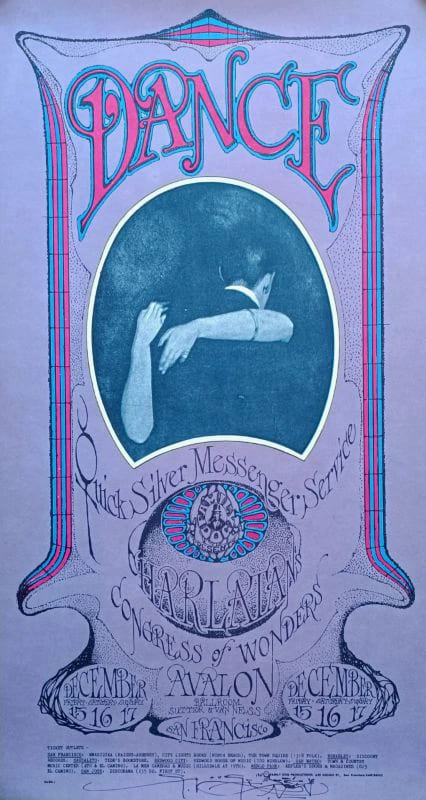
ref. 4375Affiche originale. Premier tirage. Réf. FD-96. Avallon Ballroom, San Francisco. 1967. Impression en offset. Dim: 523 x 286 mm. Parfait état. Très rare signée.
ref. 4375Affiche originale. Premier tirage. Réf. FD-96. Avallon Ballroom, San Francisco. 1967. Impression en offset. Dim: 523 x 286 mm. Parfait état. Très rare signée.
1921- Lucien Vogel éditeur, Paris 1921, 18x24cm, en feuilles. - Set of eight original prints in color, drawn on laid paper, signed lower right and left boards. The boards are introduced by a text signed Jean Cocteau and represent costumes for Shakespeare (two Bergeres Paulina or Time). Original prints made ??for the illustration of The Gazette fashionable, one of the finest and most influential twentieth century fashion magazines, celebrating the talent of creators and artists French burgeoning art deco. Famous fashion magazine founded in 1912 by Lucien Vogel, The Gazette fashionable appeared until 1925 with an interruption during the War of 1915 to 1920, due to mobilization of its editor. She is 69 Deliveries from just 2000 copies and is illustrated including 573 color plates and 148 sketches depicting models of fashion designers. Upon publication, these luxury publications "are for bibliophiles and worldly aesthetes" (Françoise Tétart-Vittu "good Gazette of tone" in the fashion dictionary, 2016). Printed on fine laid paper, they use a typeface created specifically for the magazine by Georges Peignot, the Cochin character, taken in 1946 by Christian Dior. The prints are made with the technique of metal stencil, enhanced color and some outlined in gold or palladium. The adventure began in 1912 when Lucien Vogel, man of the world and fashion - it has already participated in Femina magazine - decided to found with his wife Cosette de Brunhoff (John's sister, the father of Babar) Gazette good tone in which the subtitle is then "Art, fashions and frivolities." Georges Charensol quotes the editor: "In 1910, he observed, there was no truly artistic fashion magazine and representative of the spirit of his time. So I thought of making a glossy magazine with truly modern artists [...] I was certain of success because for any fashion country can compete with France. "(" A great art editor. Lucien Vogel "in literary News, No. 133, May 1925). The success of the magazine is immediate, not only in France but also the US and South America. Originally, Vogel therefore brings together a group of seven artists: André-Édouard Marty and Pierre Brissaud, followed by Georges Lepape and Dammicourt; and finally his friends from the School of Fine Arts as are George Barbier, Bernard Boutet de Monvel or Charles Martin. Other talents come quickly reach the equipped Guy Arnoux, Léon Bakst, Benito, Boutet de Monvel, Umberto Brunelleschi, Chas Laborde, Jean-Gabriel Domergue, Raoul Dufy, Edward Halouze Alexander Iacovleff, Jean Emile Laboureur Charles Loupot, Charles Martin, Maggie Salcedo. These artists, mostly unknown when Lucien Vogel appealed to them, will eventually become iconic figures and artistic sought. These are the same illustrators who make the drawings advertisements Gazette. The boards highlight the dresses and sublime seven artists of the time: Lanvin, Doeuillet, Paquin, Poiret, Worth, Vionnet and Doucet. The designers provide for each number of exclusive models. Nevertheless, some of Illustrations contained no real model, but only the idea that the illustrator is done in the fashion of the day. Gazette fashionable is a milestone in the history of fashion. Combining the aesthetic requirement and plastic unit, it brings together for the first time the great talents of the world of arts, literature and fashion and imposed by this alchemy, a new image of women, slender, independent and bold, also driven by the new generation of designers Coco Chanel, Jean Patou, Rochas Marcel ... Recovery in 1920 by Condé Montrose Nast, Gazette fashionable modeled for the new composition and the aesthetic choices of the "little dying newspaper" that Nast had bought a few years ago: the Vogue magazine. [FRENCH VERSION FOLLOWS] Réunion de carnets extraits de la Gazette du Bon Ton ainsi constituée : Intérieurs modernes par MAM (Croquis, La Gazette du Bon ton, 1921 n°1). Ensemble de quatre lithographies originales en couleur, tirées sur papier vergé. Installation mode
1900- 1900, 7,8x19cm, autre. - Manuscrit érotique constitué de deux ais de bois biseautés avec deux peintures et 10 feuilles avec une peinture sur le recto et un texte en thibétain manuscrit sur le recto. Le texte est le même sur les 10 feuilles, il s'agit d'un mantra. Sur deux des feuillets il est presque totalement effacé. Au recto des deux ais de bois se trouve également deux mantras manuscrits différents. Les peintures sont réalisées directement sur le bois et les feuilles. La dimension des peintures varient quelque peu, de 5,5 cm, 6 cm à 12, 14 cm en largeur. Cette forme, 2 morceaux de bois avec des feuilles au milieu, est traditionelle. L'ensemble était souvent attaché par une ficelle, ou par des trous dans le bois dans lesquelles on passait une ficelle. Très bon état de l'ensemble, avec de petits taches sur les peintures sur bois. Les peintures déroulent 12 positions sexuelles dans un environnement abstrait et géométrique, constitué de courbes. Dans plusieurs peintures les couleurs du fond, du sol changent. La femme porte systématiquement une couronne. Il est aisé de distinguer le caractère religieux ou sacré de la sexualité dans ces images. Les couleurs utilisées sont vives, avec une omniprésence du orange, de traits dorés et blancs, du jaune... [ENGLISH DESCRIPTION ON DEMAND]