2 053 résultats
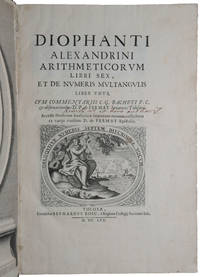
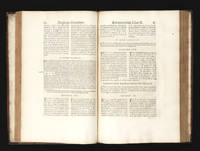
1670réf. 105031670. Cum Commentariis C.G. Bacheti…& observationibus D.P. de Fermat…Accessit Doctrinae Analyticae inventum novum collectum ex variis eiusdem D. de Fermat Epistolis. Large engraved vignette on title several finely engraved headpieces & initials & a few woodcut diagrams in the text. 6 p.l. 64 341 48 pp. one leaf of errata. Folio cont. speckled calf carefully rebacked with the orig. spine laid-down light browning as usual two corners discretely repaired spine richly gilt. Toulouse: B. Bosc 1670. First edition and a very fine and fresh copy. This edition is the first to contain Fermat’s observations on the Arithmetica of Diophantus the first systematic treatise on algebra; it also contains on H3r the first statement of the celebrated “Last Theorem” which Fermat originally wrote by hand in the margins of his copy of Bachet’s edition of Diophantus 1620. This theorem is the most famous problem in mathematics and remained unsolved for over 325 years until its recent solution by Andrew Wiles. But it should be remembered that Wiles was able to resort to sophisticated 20th-century techniques not available to Fermat. The exact form of Fermat’s proof if indeed he had a genuine one thus remains one of the great unsolved puzzles of mathematics. The 1670 edition was published posthumously by Fermat’s son Clement Samuel. It is based on his father’s annotated copy of the Bachet edition of 1621 and contains a major part of Fermat’s work on number theory a branch of mathematics that he virtually created. A nice copy with the extremely rare errata leaf. ⧠Smith Rara Arithmetica p. 348. unknown books
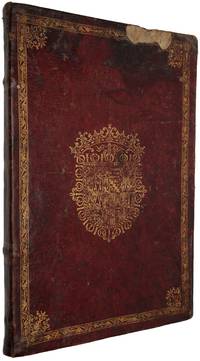
1575réf. 6346Basel: Eusebius Episcopius & Heirs of Nikolaus Episcopius 1575. First edition. First edition of Diophantus - the first printing of the Arithmetica in any language in any form - owned annotated and signed by Giovanni Camillo Gloriosi 1572-1643 Galileo's successor in the chair of mathematics at the University of Padua. Gloriosi's mathematical annotations dating from 1611 and 1612 revise and correct the calculations of Diophantus and of his Latin translator Xylander. The long note at page 59 against Proposition II.19 is the working source for Gloriosi's 1613 Ad theorema geometricum Venice Baglioni whose publication with Galileo's recommendation secured the Padua chair in October of that year. After Gloriosi's death the library passed for five hundred gold coins to Ramiro de Guzmán Viceroy of Naples who bound the books in red morocco with his armorial. Bouza's 2024 catalogue of thirty-five Gloriosi books surviving in Madrid libraries records signatures only; this copy differs from them in the density of its 1611-1612 marginalia and in the direct textual link between the note at page 59 and pages 28-29 of the printed Ad theorema geometricum. . Hardcover. Diophantus Annotated by Galileo's Successor at Padua. First edition of Diophantus - the first printing of the Arithmetica in any language in any form - owned annotated and signed by Giovanni Camillo Gloriosi 1572-1643 Galileo's successor in the chair of mathematics at the University of Padua and subsequently acquired from Gloriosi's estate for five hundred gold coins by Ramiro de Guzmán Duke of Medina de las Torres and Viceroy of Naples who bound the book in red morocco with the combined armorial of himself and his wife Anna Carafa de Stigliano on the covers. The Arithmetica is the first systematic treatise on algebra and the founding text of Diophantine analysis; the 1575 Xylander was until Bachet's Greek text of 1621 the only printed Diophantus in existence. Antonio Favaro in his 1904 study of Gloriosi in the series on Galileo's acquaintances and correspondents asked what had become of the mathematician's books and papers. He reported that every effort he had made to trace them had been entirely in vain. The present copy is bound in the viceroy's unmistakable red morocco and carries Gloriosi's signature on the last leaf with extensive mathematical annotations in his hand. Among the now-identified survivors of that library it is distinguished by the density of the annotations and by their demonstrable bearing on Gloriosi's own published mathematical work. Gloriosi was a Neapolitan Jesuit-trained and came to mathematics through the algebraic tradition rather than through natural philosophy. In 1604 a friar asked Galileo to write on his behalf for a lectureship in mathematics; the appointment did not materialise but the correspondence opened a cordial if occasionally pointed relationship between the two men. By 1606 Gloriosi was in Venice moving in the circle around Paolo Sarpi and Giovanfrancesco Sagredo where he also met Antonio Santini and Marino Ghetaldi who introduced him to the algebra of François Viète - the immediate and decisive influence on his reading of Diophantus. In October 1613 with Galileo's recommendation and on the strength of his first publication Ad theorema geometricum Venice: Tommaso Baglioni 1613 Gloriosi was nominated to the chair Galileo had just vacated at Padua. He held the post until 1622 returning thereafter to Naples where he lived as a private gentleman maintained correspondence with the mathematical communities at Padua Venice Bologna and the Roman College and continued to exchange letters with Galileo until at least 1635. He died in January 1643 leaving four surviving letters to Galileo as the record of a thirty-year intellectual acquaintance. Gloriosi's annotations transform the copy from a bibliographical rarity into a document of working mathematical scholarship. Dating from 1611 and 1612 - the two years immediately preceding the Ad theorema geometricum and the Padua appointment - they fall into two kinds. Many are brief marginal identifiers a single Latin word most often Theorema placed beside the statement of a particular proposition to fix its status in the flow of Diophantus's argument. The majority however are substantive mathematical calculations in Gloriosi's fine italic hand revising extending and in a number of cases correcting the work of Diophantus and of the book's Latin translator and commentator Wilhelm Holtzmann of Augsburg Xylander. They are concentrated in Book II and in the later books in which the more intricate indeterminate problems occur and they are dense enough in places to fill margins on both sides of the printed page. Where Xylander's own calculation has gone astray Gloriosi writes out the corrected arithmetic to several orders of fractional precision; where a proposition requires a generalisation Diophantus had not offered he supplies it. The most consequential of these annotations occupies the lower margin of page 59 against Proposition 19 of Book II - the problem that asks a given number to be divided into three parts such that each part on donating a specified fraction of itself plus a fixed number of units to the next yields three equal results. For the number 80 with the fractions one-fifth one-sixth and one-seventh and the added units 6 7 and 8 respectively Xylander's solution failed: the parts summed to 80 but the distribution did not in fact satisfy the equations. Gloriosi noted the failure precisely - aequatio facta est ad 16 2/3 cum fieri debebant ad 26 2/3 the equation had been set at 16 2/3 when it should have been set at 26 2/3 - and then in the same annotation recorded the three correct fractional parts 1N 9530/363 10200/363 and 9310/363 obtained from the corrected equation. He rejected the possibility that Diophantus himself had erred insisting that the Alexandrian would not have proposed a problem without knowing its solution and argued instead that the Greek text had been mutilated in transmission. The task he set himself was to recover a solution using as Diophantus's method required a single hypothesis. This is exactly the reconstruction carried out on pages 28-29 of the Ad theorema geometricum of 1613 - the annotation and the printed text correspond point by point in the equation in the numerator 9530 over the common denominator 363 and in the subsequent reasoning - and the book prints no other source for the reconstruction. The margin of the present copy is the working source. The marginal notes of 1611-1612 fed into the printed argument of 1613 the printed argument of 1613 supplied the published credential on which Galileo's recommendation built and the appointment to the Padua chair followed in October of the same year. The book at hand is therefore not merely an annotated copy of a famous mathematical work but the physical support for the single published achievement that elevated Gloriosi into the most visible Italian chair of mathematics. That it emerged from a library thought lost - and emerged intact bound by a seventeenth-century viceroy with the annotations complete and legible - is among the more unusual recoveries of the last generation of rare-science-book scholarship. Favaro's search had run up against a problem he could not solve from the evidence then available. Gloriosi had died a private gentleman in Naples; his nephew in Tomasini's words in the 1644 Elogia was a stranger to the study of letters who disposed of the entire library at a single stroke for five hundred gold coins to the viceroy. The viceroy then transferred the books to Spain and after his own death in 1668 the collection dispersed into the Madrid book trade where the Gloriosi association was no longer visible to anyone not already looking for it. Fernando Bouza working from Tomasini's text and from the catalogue records of Spanish libraries reconstructed the trajectory in a 2024 article in Galilæana and catalogued thirty-five printed books once belonging to Gloriosi almost all of them in Madrid - at the Biblioteca Nacional de España the Biblioteca Histórica of the Universidad Complutense the Biblioteca Francisco de Zabálburu and the Real Academia de Bellas Artes de San Fernando - together with a further two outside Madrid a 1521 Alfonsine Tables rebound in the eighteenth century and a 1545 Cardano Ars Magna sold at the 1861 Guglielmo Libri auction at Sotheby's. In each of the thirty-five Madrid books Gloriosi is identified by his characteristic signature alone set on the title verso or after the colophon; Bouza does not describe any of them as carrying substantive mathematical annotation. This copy differs from that group in two respects: the density of Gloriosi's 1611-1612 marginalia and the specific point-for-point correspondence between the note on page 59 and pages 28-29 of the printed Ad theorema geometricum which ties this particular volume to a particular publication in a way no other survivor has yet been shown to do. Ramiro Núñez de Guzmán 1600-1668 second Duke of Medina de las Torres by marriage to Anna Carafa and son-in-law of the Count-Duke of Olivares served as Viceroy of Naples from 1637 to 1644 and was one of the most powerful Spanish grandees of his generation. His library-building followed the pattern common to seventeenth-century Italian viceregal courts in which the acquisition of a scholar's entire legacy was an act of cultural prestige as well as of intellectual collecting. The red morocco binding with his armorial stamps - exclusive bindings known to collectors as medines combining the viceroy's quartered arms on one cover with those of Anna Carafa REVOLUTA FOECUNDANT the Carafa stars and crescent on the other - was presumably executed in Naples or in Madrid after the purchase. Of the small number of these bindings that survive the one on the present volume is identical in tool format and armorial layout to that on the Bodleian sammelband Rigaud.e.148 which contains Gloriosi's own copies of Galileo's Sidereus nuncius 1610 and Il Saggiatore 1623 Giulio Cesare La Galla's 1612 De phoenomenis in orbe lunae Francesco Sizzi's 1611 Dianoia astronomica and Mario Guiducci's 1620 Lettera al padre Tarquinio Galluzzi. Taken together the sammelband and the present copy demonstrate that the viceroy bound the mathematical and the Galilean-astronomical portions of Gloriosi's library in a single uniform style and that Gloriosi himself had studied Galileo's principal works at first hand. Provenance: Giovanni Camillo Gloriosi 1572-1643 with his signature on the last leaf and his mathematical annotations of 1611-1612 in the margins; Ramiro Núñez de Guzmán 1600-1668 Duke of Medina de las Torres and Viceroy of Naples who acquired Gloriosi's library from Gloriosi's estate for five hundred gold coins and bound the book in red morocco with his arms and those of Anna Carafa on the covers; 'Ãlvarez' with his signature on the title page under a contemporary paper slip who appears to have acquired the book directly from the viceroy's dispersal; the Earls of Macclesfield Shirburn Castle lot 636 in the 2005 sale. After Medina de las Torres's death in 1668 the library began to disperse. The principal buyer was William Godolphin c. 1634-1696 the English diplomat and Catholic convert then resident at the court in Madrid whose prominent ownership inscriptions identify a substantial block of former Guzmán books. The present Diophantus was not among them. A second buyer identified only as 'Ãlvarez' signed his name on the title page; the inscription survives covered by a contemporary paper slip that has been preserved in place. The same 'Ãlvarez' signature appears on three other former Guzmán books currently traceable in the Spanish antiquarian market and in one of them - a 1600 Brescia edition of Alessandro Manerba's Moralis sylva - Godolphin's own title-page inscription overlaps Ãlvarez's showing that the two were contemporaries and that Ãlvarez transferred part of his collection on to Godolphin. The absence of Godolphin's characteristic title-page or colophon signature from the present copy indicates that Ãlvarez acquired the book directly from the viceroy's dispersal and retained it and that it never entered Godolphin's library. Ãlvarez is therefore the third known owner standing between Guzmán and the Earls of Macclesfield from whose library at Shirburn Castle the book came to the market as lot 636 in the 2005 sale. The edition Gloriosi annotated was in 1611-1612 the only printed Diophantus in existence. Wilhelm Holtzmann of Augsburg 1532-1576 who Hellenised his name as Xylander was a classical philologist and professor of Greek at Heidelberg and his Latin Arithmetica of 1575 was the first complete European rendering of the text. The Greek editio princeps would not appear for another forty-six years when Bachet de Méziriac printed it in Paris in 1621. Xylander worked from a single Byzantine manuscript derived like every surviving Greek witness from a single lost archetype and the manuscript was in André Weil's phrase marred throughout by the numerical errors of professional scribes who had not been mathematicians. He laboured for several years under these conditions supplied the text with a running Latin commentary - the Xylandri sections set beneath each Diophantine proposition - and dedicated the book to his pupil Prince Ludwig of Württemberg. Thomas Heath writing in 1910 observed that Xylander's achievement had been inadequately appreciated by later commentators largely because the book itself was so rare: Nesselmann preparing his 1842 Algebra der Griechen was unable to find a copy at all. The translation's immediate and enormous influence on the shaping of European algebra as Heath put it ran through Bombelli Stevin Viète and - through Bachet's 1621 reprinting with improvements - Pierre de Fermat. Xylander himself did not live to see that influence take hold: he died the year after publication. Almost nothing is known of the life of Diophantus. He quotes Hypsicles and so must have worked after roughly 150 BC; he is quoted in turn by Theon of Alexandria and so must have worked before AD 364. The conventional placement around AD 250 rests on a single passage in an eleventh-century Byzantine letter and on the absence of Diophantus's name from the commentaries of Pappus. His place of birth is unknown his teachers unknown and the fourteen-line Greek epigram in the Palatine Anthology that purports to record his age at death is generally regarded as a mathematical exercise rather than a biographical document. The Arithmetica itself composed at Alexandria in approximately AD 250 is the first systematic treatise on algebra and the founding text of the tradition now called Diophantine analysis: the search for rational or integer solutions to polynomial equations in several unknowns. Diophantus introduced the earliest sustained symbolism in Greek mathematics - a character for the unknown for its powers up to the sixth and for the operations of addition and subtraction - and treated roughly two hundred and sixty problems whose solutions though always given in specific numerical terms tend to suggest general methods. The work was originally in thirteen books. Six survived in Greek transmitted by Byzantine scholars from Michael Psellus through Maximus Planudes whose scholia on the first two books Xylander prints alongside the text to the codex Cardinal Bessarion rescued before the fall of Constantinople and that Regiomontanus discovered at Venice; four further books surfaced in 1968 in a ninth-century Arabic translation by QustÄ ibn LūqÄ dispersing the suspicion that the ancient numbering had corresponded straightforwardly to the surviving Greek sequence. Three books remain lost. The Arab reception had in fact been considerable: al-Nadīm's index of the sciences 987-988 lists commentaries by QustÄ ibn LūqÄ and by Abū'l-WafÄ' and a substantial fraction of the problems in al-Karajī's algebra are drawn directly from Diophantus's first three books. Xylander's volume prints at the end a fragment of the only other surviving work by Diophantus - a treatise on polygonal numbers which is differentiated from the Arithmetica by its use of geometric proofs and which breaks off in the middle of its investigation of the number of ways in which a given number can be expressed as a polygonal. The full transmission history of both texts from Bessarion and Regiomontanus through Bombelli's partial assimilation in his 1572 Algebra 271 problems of which 147 were taken directly from Diophantus to Viète's Zetetica of 1593 and on to Bachet's definitive 1621 edition runs entirely through this 1575 volume. It was in the margins of a copy of Bachet's 1621 reprint that Pierre de Fermat in the mid-1630s wrote the forty-eight observations that founded modern number theory - among them on page 85 against Problem II.8 on the decomposition of a square into two squares the proposition now known as Fermat's Last Theorem whose proof by Andrew Wiles in 1995 closed a gap that had stood for three hundred and fifty-eight years. The 1670 reprint of Bachet's edition with Fermat's observations printed in the margins carried the Last Theorem into circulation. Auction records since Honeyman list only three other copies of the 1575 Xylander; each is in a nineteenth- or twentieth-century binding and none has significant provenance. OCLC records eight copies in North American libraries. Copies in contemporary armorial bindings with identifiable early mathematical ownership are essentially unrecorded in commerce of the last century and the present volume - the Gloriosi copy in the Medina de las Torres binding standing as the material support for the 1613 Ad theorema geometricum and for the Padua appointment that followed it - is without known parallel. References: Norman 641 - Honeyman 890 - Adams D-652 - Macclesfield 636 this copy - DSB IV 110-19 - Smith Rara Arithmetica p. 348 - Bouza 'The mathematician and the viceroy' Galilæana XXI 1 2024 pp. 201-220 - Favaro Amici e corrispondenti di Galileo Galilei. IX. Giovanni Camillo Gloriosi 1904 - Tomasini Elogia virorum literis et sapientia illustrium 1644 - Heath Diophantus of Alexandria: A Study in the History of Greek Algebra 2nd ed. 1910 - Heath A History of Greek Mathematics 1921 vol. II pp. 448-517 - Weil Number Theory: An Approach Through History from Hammurapi to Legendre 1984 - Katz & Parshall Taming the Unknown 2014 ch. 4 - Schappacher 'Diophantus of Alexandria: a text and its history' IRMA Strasbourg Folio 307 × 200 mm pp. xii 152. Printer's device on title legend Episcop woodcut initials printed marginal notes. Occasional foxing light damp stains to blank corners of some leaves. Mid-seventeenth-century red morocco with gilt arms of the Duke of Medina de las Torres and his wife on the covers elaborate gilt borders and corner fleurons spine gilt; damage to upper edge of front board affecting gilt border. . / Hardcover. Eusebius Episcopius & Heirs of Nikolaus Episcopius unknown
1670réf. 6238Toulouse: Bernard Bosc 1670. First edition. First edition large-paper issue with the rare engraved portrait of Fermat by François Poilly and with the editor's presentation inscription on the title page: de Molieres ex dono authoris placing this copy with Louis de Molières Pierre de Fermat's brother-in-law and trésorier de France at Montauban in the year of publication. Prepared by Clément-Samuel de Fermat from his father's marginalia on Bachet's Diophantus the volume prints Fermat's forty-eight number-theoretic observations among them at page 61 the editio princeps of Fermat's Last Theorem - the marginal claim that no power above the second decomposes into two like powers and that a marvellous proof exists which the margin cannot contain. The theorem held for three hundred and fifty-eight years generating algebraic number theory the arithmetic of elliptic curves and modular forms in the course of the search for its proof until Wiles closed it in 1995. A contemporary hand has attempted corrections to Fermat's observation on cube differences at page 135. . Box: 378 x 264 x45 mm. The First Printing of Fermat's Last Theorem. First edition large-paper issue of the volume in which Fermat's Last Theorem first entered print with the engraved portrait of Fermat by François Poilly on the leaf facing the title - rarely found in copies of this edition - and with the editor's presentation inscription on the title page. The portrait a fine oval bust set above Fermat's family arms on a chevron three eagles and in base a crescent for the Fermats of Bas-Quercy is the work of one of the leading Parisian printmakers of the second half of the seventeenth century. Most copies of the 1670 Diophantus lack it. Its presence here together with the generous margins of the large-paper sheets and the inscription immediately below marks the volume as one of the small number of copies Clément-Samuel reserved for the inner circle of the Fermat family and their Toulouse connections. Beneath the printed line naming Pierre de Fermat as Senatoris Tolosani a period hand has added the Latin words de Molieres ex dono authoris - "to de Molières from the gift of the author." The recipient is Louis de Molières 1610-1687 born at Cahors into the noblesse de robe of Bas-Quercy and established as trésorier de France at the Montauban bureau des finances a post he would hold for forty-two years. His first marriage in 1646 had been to Louise de Fermat c. 1613-c. 1650 Pierre de Fermat's younger sister. Louise had been dead twenty years by the time this copy left the press; Louis had long since remarried a demoiselle de Marqueyret; but the connection between the two robe families of the lower Garonne ran too deep for that to matter. The author named in the inscription is not Pierre - who had died in January 1665 - but Pierre's eldest son Clément-Samuel de Fermat c. 1632-1697 the lawyer and conseiller au parlement who had inherited his father's offices. He had spent the five years since his father's death transcribing the elder Fermat's mathematical marginalia into publishable form and he oversaw the volume through the Toulouse press. By sending a large-paper copy to his late aunt's widower - the senior surviving link to his father's family in the generation above his own - Clément-Samuel placed the copy with him. The volume is the second edition of Bachet de Méziriac's 1621 Greek-and-Latin Arithmetica of Diophantus of Alexandria expanded by Clément-Samuel with his father's forty-eight mathematical observations and completed by the Doctrinae analyticae inventum novum of the Jesuit Jacques de Billy - a summary account of Fermat's analytical method drawn from the correspondence Billy had maintained with Fermat in the last years. The Arithmetica itself is the foundational work of Greek algebra and of Diophantine analysis setting out 189 problems in indeterminate analysis that had occupied mathematicians from Regiomontanus and Bombelli through Viète and Bachet. Fermat had annotated his personal copy of the 1621 Bachet edition - the copy he acquired in 1636 or 1637 probably through the circle of Carcavi and Mersenne - with marginal notes responding to individual Diophantine problems and in many cases generalising them into new theorems. That original annotated copy is lost. Its contents survive because Clément-Samuel working from his father's papers and almost certainly with the copy itself in hand transcribed the forty-eight observations and printed each at the appropriate point in the Diophantine text. The result is a conflation of the Bachet edition with Fermat's marginalia: Greek and Latin in parallel columns for the Diophantus with Bachet's commentary and Fermat's observation intervening at the relevant problems. On page 61 of this volume as a commentary on Diophantus Book II Problem VIII the problem of dividing a given square into two smaller squares sits Fermat's observation in nine lines of italic Latin. Against the proposition that every square decomposes into two squares - the problem whose rational solutions are the Pythagorean triples - Fermat remarks that no cube decomposes into two cubes no fourth power into two fourth powers and in general no power higher than the second can be decomposed into two powers of the same kind. He has discovered he adds a truly marvellous proof of this proposition; the narrowness of the margin cannot contain it. This is Fermat's Last Theorem. It is printed here for the first time. The original 1621 Bachet that Fermat annotated no longer exists so the 1670 printing is the sole testimony to how Fermat actually wrote the proposition and the sole source for the evocative remark about the margin. The theorem held. For three hundred and fifty-eight years Fermat's claim resisted verification. Leonhard Euler produced the proof for exponent three in 1770 invoking the method of infinite descent that Fermat had set out in other contexts. Sophie Germain in the first decade of the nineteenth century opened a substantial class of exponents - the class of primes now called Sophie Germain primes. Dirichlet and Legendre settled exponent five in 1825. Gabriel Lamé reached exponent seven in 1839 and briefly claimed the full theorem a claim Liouville corrected within weeks by pointing to a failure of unique factorisation in the relevant cyclotomic integers. Ernst Kummer in 1847 working precisely on that failure introduced the ideal numbers that would become the foundation of algebraic number theory and proved Fermat's proposition for all regular primes. By the late nineteenth century Fermat's Last Theorem stood as a celebrated challenge and Paul Wolfskehl's 1908 bequest of a hundred-thousand-mark prize for a valid demonstration kept thousands of amateur attempts flowing to the University of Göttingen through the First World War and the Weimar collapse. The decisive modern move came in 1986 when Gerhard Frey suggested that any counterexample to the Fermat equation would produce a semistable elliptic curve whose properties must contradict the Taniyama-Shimura-Weil conjecture on modular forms. Kenneth Ribet proved the Frey implication the same year. Andrew Wiles working almost alone at Princeton announced a proof of the relevant portion of the modularity conjecture at Cambridge in June 1993; referee Nick Katz identified a subtle error; Wiles and Richard Taylor together closed the gap over fourteen further months; and the finished paper appeared in the Annals of Mathematics in May 1995. Fermat was right. The three and a half centuries between statement and proof generated a disproportionate share of modern number theory. Kummer's ideal numbers founded algebraic number theory. The theory of cyclotomic fields the arithmetic of elliptic curves and the whole modern apparatus of modular forms and Galois representations - together forming the present-day Langlands programme - all derive directly or by consanguinity from the long search for Fermat's proof. Wiles's demonstration runs past a hundred pages and invokes techniques Fermat could not have envisaged; the opinion of most specialists is that whatever proof Fermat believed he had was probably in error most likely a descent argument of the kind that works for exponents three and four but cannot be extended. Fermat himself in a 1659 letter to Carcavi set out his method of infinite descent in some detail and applied it to prove that the area of a rational right triangle can never be a square number - a proposition that by a short chain of reasoning implies his Last Theorem for exponent four. Whether that technique could be stretched to the general case is the question to which the answer three hundred and thirty-six years later was Wiles's hundred pages. Fermat's engagement with Diophantus ranged far beyond the single marginal note at page 61. Forty-seven further observations thread through the volume responding to Diophantine problems on rational squares Pythagorean right triangles the representation of integers as sums of squares and the arithmetic of cubes. Several of these observations announce theorems of comparable depth. The two-square theorem - that every prime congruent to one modulo four is the sum of two squares in essentially one way - sits among them as do the germ of the four-square theorem later proved by Lagrange the statement that every number is the sum of three triangular numbers and the generalised Fermat equation x2 − Ay2 = 1 the Pell equation which Fermat correctly recognised as always solvable in integers for non-square A. The observation at page 135 - headed OBSERVATIO D.P.F. and placed after Diophantus Book IV Question III - displays Fermat's characteristic fusion of correction and extension. Bachet had offered a partial treatment of the problem of finding two cubes whose difference equals a given number; Fermat shows that Bachet missed an entire further family of solutions which follow from his own method by continued iteration in infinitely many cases. Given the two cubes 8 and 1 whose difference is 7 Fermat produces a second pair of rational cubes with the same difference. His printed solution gives the sides 1265/183 and 1256/183 yielding the cubes 2024284625/6128487 and 1981385216/6128487. The verification is clean: the difference of these two new cubes reduces exactly to 7. Across the printed denominators on this page however a contemporary hand has drawn firm lines and written substitutions above the print: 61 in place of 183 for the sides and 226981 in place of 6128487 for the cubes. The substitution is not arbitrary - 183 is three times 61 and 6128487 is twenty-seven times 226981 which is itself 61 cubed. The annotator has evidently noticed that Fermat's fractions appear to contain a common factor of the cube of three and has tried to simplify them by cancelling it. But the correction does not preserve the answer. The revised sides 1265/61 and 1256/61 are each three times larger than their printed counterparts; the revised cubes are each twenty-seven times larger; and the difference of the revised cubes becomes 189 rather than 7. The substitution would solve a scaled version of Fermat's problem - one in which the given cubes were 216 and 27 rather than 8 and 1 - but it does not solve the problem as Fermat poses it on this page. The correction is the work of a contemporary reader who followed Fermat's argument closely enough to recognise the internal structure of the solution and who carried enough confidence to intervene in a freshly printed Toulouse folio but who stopped short of the final verification that would have caught the scaling error. Fermat's observation on Book IV Question III was considered obscure even among the professional mathematicians of the period; the appearance of contemporary manuscript attention to its numerical detail in a copy that left the editor's hands in 1670 places this volume inside the very narrow circle of readers who took Fermat's more technical observations seriously from the moment of publication. Two further inserted slips of paper at pages 61 and 197 carry contemporary but more elementary annotations placing this copy plainly in the hands of a seventeenth-century reader working through the mathematics of the volume rather than merely its production. The slip at page 197 - facing the large printed table of eighty-one integer solutions to a Diophantine problem in four variables from Book V - carries calculations in a reader's hand involving the quantities eight hundred and ten thousand a cubic variable and a squared variable in a working attempt at the problem treated above. A later eighteenth-century English hand has added a note on the flyleaf framed as a dismissive verdict on Fermat's mathematical claims. Provenance: Louis de Molières 1610-1687 trésorier de France at the Montauban bureau des finances with Clément-Samuel de Fermat's presentation inscription de Molieres ex dono authoris on the title page; a later eighteenth-century English hand with a note on the flyleaf framed as a dismissive verdict on Fermat's mathematical claims. Molières's first marriage in 1646 was to Louise de Fermat daughter of Dominique de Fermat - the consul and leather merchant of Beaumont-de-Lomagne - and therefore sister of Pierre and paternal aunt of Clément-Samuel. His son by the second marriage Armand de Molières later served as second président of the Cour des aides at Montauban - the Armand whose name has occasionally been conflated with his father's in later bibliographic sources producing the hybrid 'Louis-Armand' that appears in some modern descriptions. The inscription is addressed to Louis senior Pierre's brother-in-law and Clément-Samuel's uncle by marriage whose household at Montauban sat fifty kilometres north of Pierre's at Toulouse. Pierre de Fermat's reputation does not rest on the Last Theorem alone. A conseiller at the parlement of Toulouse and a magistrate of the Chambre de l'Édit at Castres he was an amateur mathematician in the technical sense only - an amateur who corresponded with Mersenne Pascal Descartes Huygens Wallis Carcavi and Roberval on terms of complete intellectual equality and who made fundamental discoveries in four distinct branches of mathematics. In number theory beyond the Last Theorem he discovered the theorem now called Fermat's Little that for any prime p and integer a not divisible by p the quantity a raised to the power p minus one is congruent to one modulo p stated and used the two-square theorem developed the method of infinite descent as a rigorous technique for negative existence proofs and extended the theory of amicable numbers well beyond the pair 220 and 284 known since antiquity. In analytic geometry his Ad locos planos et solidos isagoge - which he sent in manuscript to Carcavi and Mersenne in 1636 - predated Descartes's Géométrie in composition though not in print. In the calculus of variations his method of adequality supplied a systematic technique for locating maxima minima and tangents that Newton and Leibniz both later acknowledged as precursor. In the summer of 1654 in the correspondence with Pascal that Carcavi preserved he worked out with Pascal the foundations of the mathematical theory of probability solving the problem of the division of stakes in interrupted games of chance. In optics he enunciated the principle of least time - Fermat's principle - which furnished the first variational formulation in physics and served as direct ancestor to the principle of least action and the whole edifice of Lagrangian and Hamiltonian mechanics. Any one of these contributions would secure a reputation; that a sitting magistrate of the Toulouse parlement made all four is the condition Clément-Samuel set himself to commemorate in this volume. Of those four strands the 1670 Diophantus captures chiefly the number-theoretic Fermat and within that only the portion he wrote as marginalia on Bachet. His analytic geometry and his general method of maxima et minima appeared in 1679 as Varia Opera Mathematica again at Toulouse edited again by Clément-Samuel. His complete correspondence and further manuscripts were assembled definitively only in the late nineteenth century by Paul Tannery and Charles Henry whose four-volume Œuvres de Fermat 1891-1912 with a supplementary fifth volume by Cornelis de Waard in 1922 remains the standard scholarly edition. But the 1670 edition is the book in which Fermat's Last Theorem first entered print the book through which Fermat's name reached the working mathematicians of the late seventeenth and eighteenth centuries and the book Euler and Gauss both studied and built on. Its place in the foundational history of number theory is not in dispute. This copy preserves in addition the presence in 1670 of readers who took Fermat's more technical observations seriously enough to attempt corrections in the margins even when as at page 135 those corrections did not finally succeed. References: Norman 771 - Honeyman 885 - Smith Rara Arithmetica pp. 348-349 - Brunet II 702 - Roberts & Trent Bibliotheca Mechanica p. 108 - Hoffmann 1242 - Weil Number Theory: An Approach through History from Hammurapi to Legendre Birkhäuser 1984 chapters II-IV - Mahoney The Mathematical Career of Pierre de Fermat Princeton University Press second edition 1994 - Goldstein Un théorème de Fermat et ses lecteurs Presses Universitaires de Vincennes 1995 - Singh Fermat's Enigma Fourth Estate 1997 - Wiles 'Modular elliptic curves and Fermat's Last Theorem' Annals of Mathematics 141 1995 pp. 443-551 - Taylor and Wiles 'Ring theoretic properties of certain Hecke algebras' Annals of Mathematics 141 1995 pp. 553-572. Folio 365 × 246 mm pp. xii 341; 48. Engraved portrait of Pierre de Fermat by François Poilly on the leaf facing the title Fermat in scholarly dress within an oval frame his arms below on the plinth. Engraved allegorical vignette on the title page Orpheus with the lyre encircled by the Virgilian motto obloquitur numeris septem discrimina vocum. Numerous woodcut diagrams in the text. Greek and Latin in parallel columns throughout the Diophantus. Separate pagination for the Inventum novum. Light browning. Contemporary calf gilt fillet on covers spine richly gilt in compartments with gilt-tooled lettering DIOPHANTI / FERMAT edges speckled red binding slightly rubbed. A fine copy. . Bernard Bosc unknown