5791 risultati
2002rif. R200044752CANDLEWICK PRESS. 2002. In-4. Relié. Bon état, Couv. convenable, Dos satisfaisant, Intérieur frais. 47 Pages augmentées de nombreuses illustrations en couleurs hors texte. jaquette abimé en tranche de tête. OUVRAGE INTEGRALEMENT EN ANGLAIS.. Avec Jaquette. . . Classification Dewey : 841-Poésie
2014rif. R100085699Rivages. 2014. In-8. Broché. Bon état, Couv. convenable, Dos plié, Intérieur frais. 300 pages - une étiquette collée sur le 1er plat.. . . . Classification Dewey : 840.092-XXI ème siècle
rif. RO60085835M. Pechlivanidis & Cie. Non daté. In-8. Broché. Bon état, Couv. convenable, Dos satisfaisant, Intérieur frais. Env. 100 pages. Illustré de nombreuses photos en noir et blanc dans le texte, et de cartes en couleur au dos des plats.. . . . Classification Dewey : 430-Langues germaniques. Allemand
2015rif. R300295569Rebis. 2015. In-8. Relié. Etat d'usage, Couv. légèrement passée, Dos satisfaisant, Intérieur frais. 411 pages. Livre en polonais. Trace d'étiquette (colle) sur le 1er plat.. . . . Classification Dewey : 490-Autres langues
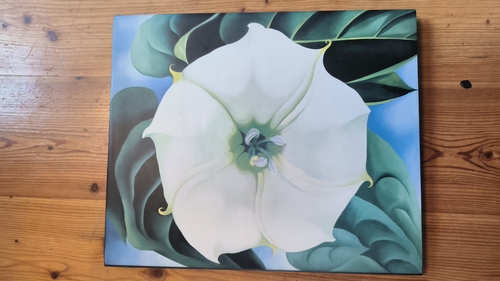
1968rif. NF2386HUMAN FACTOR IN A SCIENCE FIRST THE DOUBLE HELIX REVIEW in Life Magazine for March 1 1968 Time Inc. first edition fine in wraps with a tiny nick to the upper margin of the front cover. Besides this review by Morrison of this most important scientific achievement there is an eleven page photo essay both in color and black & white of Georgia O'Keefe entitled HORIZONS OF A PIONEER. Time, Inc. 1968 paperback books
2001rif. NF3642GEORGIA O'KEEFFE SELECTIONS FROM ONE HUNDRED FLOWERS IN THE WEST THE NEW YOUR YEARS Callaway 2001 first edition fine in like full color dust-wrapper with over 50 full color full page plates. Callaway unknown books
1982rif. 15125Paris Association Française D'action Artistique 1982 Grand In-8 Ecu 224 pp, Paris, Galeries Nationales du Grand Palais, 17 avril - 16 juillet 1982, nombreuses illustrations en noir in et hors-texte, quelques planches couleurs, illustration couleurs sur 1ère de couverture, brochage doré. Légrer accroc sans manque en tête du dos, 1er cahier légèrement débroché.
1900rif. 18272P., L. Boulanger, (vers 1900) in-4 broché, format à l'italienne (24 X 32 cm) couverture vert amande décoré sur le premier plat d'un titre stylisé.
rif. 13982179Paris: Galerie Flak, 1991 in-4 à l'italienne, 38 pages, nombreuses reproductions et fac-similés. Broché, couverture à rabats, très bon état. Tirage limité.
2004rif. MDURBAL1Genève Editions Papillon 2004 In-8 broché (21x15 cm), couverture illustrée, illustrations et extraits de partitions, bibliographie, 160 pp.
1974161pp.with 112 illustrations out-of-text, 29cm., cart., bilingual: Russian-English
1974rif. X61714Leningrad, Aurora Kunstverlag 1974 161pp.with 112 illustrations out-of-text, 29cm., cart., bilingual: Russian-English
1923rif. 108011Partitions sur les États-Unis Witmark 1923
191017pp., avec 4 ills. en n/bl, 3e édition, brochure originale, bon état, T97765
1910rif. T97765Bruxelles, Charles Bulens 1910 17pp., avec 4 ills. en n/bl, 3e édition, brochure originale, bon état, T97765
2012rif. 114981Worcester Massachusetts: American Antiquarian Society 2012. paperback. 8.5 x 11 inches. paperback. 100 pages. First edition. A near fine copy. With a French Accent: American Lithography to 1860 from the American Antiquarian Society features five essays from Georgia B. Barnhill Lauren B. Hewes Catherine Wilcox-Titus Marie-Stéphanie Delamaire and Helena E. Wright that explore several topics of interest to scholars of American print publishing. Together the essays examine the impact of French lithographic practice on the American lithographic industry and American visual culture; the circulation of French imagery in the United States with a case study on portraits of Napoleon and Lafayette; Goupil's French lithographs after American genre and history paintings; and the use of French lithographs in didactic displays at the Smithsonian Institution in the late nineteenth century. The book explores the variations in quality among early American lithographs. The first essay by Georgia Barnhill closely looks at this phenomenon and examines the work of several academically-trained French lithographic artists who worked in New Orleans New York Philadelphia and Boston from the mid-1830s to 1860. The essay by Lauren Hewes looks at the circulation of French imagery in the United States. Some lithographs in the American Antiquarian Society collection were published in France for an American market and there is a selection of sentimental prints and portraits that were printed in the United States but were French in derivation. The book provides reasoning for why prints of Napoleon and Lafayette were moved into the American culture. Using the paintings and prints of these two political leaders as a case study Catherine Wilcox-Titus reveals the importance of lithography to the dissemination of fine art to a large mass audience. Next the essay by Marie-Stéphanie Delamaire considers how the American paintings reproduced by Goupil Vibert and Company led to the transatlantic cultural understanding and exchange. Because Goupil published so many lithographs for American and European audiences he is an important part of the link between French and American lithography. The last essay by Helena Wright provides thoughts on the afterlife of French lithographs in American culture and the collecting and use of French lithographs in the United States National Museum. Illustrated with black-and-white and color prints this publication will be an excellent resource for the study of American prints and the French influence on the development of early lithography in the United States. American Antiquarian Society unknown books
rif. 115541Editions à la Carte 2009, 220x150mm, 92pages, broché. Bel exemplaire.
rif. 27445Genève, Musée d’Art et d’Histoire 1979, 240x175mm, broché. Bel exemplaire.
rif. 49741aafGenève, Musée d'Art et d'Histoire, 1979, gr. in-8vo, 48 ff. avec 1 carte + 80 planches en couleur, reliure en toile + Jaquette en couleurs.
1948rif. 69605New York: The Exposition Press. Very Good-. 1948. Hardcover. Inscribed by the author on the front free endpaper. 64 pages dark green boards with gilt stamping. The spine and edges are rubbed. Contents slightly toned but complete. Near Very Good. . The Exposition Press hardcover books
1966rif. 69604Charleston Illinois: Prairie Press. Very Good. 1966. Hardcover. Signed by the author on the dedication page. 62 pages blue pictorial boards gilt stamping. The covers are a bit soiled and rubbed pencil notes in table of contents former owner gift inscription on the front free endpaper. Good. . Prairie Press hardcover books
1990rif. 71354Santa Fe: Gerald Peters Gallery. Very Good. 1990. Paperback. 093503739x . Pictorial wrappers exhibition catalogue Very Good condition. ; 0.2 x 10.6 x 9.8 Inches . Gerald Peters Gallery paperback books
1987rif. 701262München :: Droemer - [New York] : Callaway. 1987. überwiegend Ill. 100, [16] S. 42x35cm;. Zustand: Sehr Gut, ungelesen; Gewebe (Brauner Leinen)
2007New English Paperback. Pbo. 4to. (29 x 24 cm). In English and Turkish. 123 p., color ills. "Since its establishment, Pera Museum has hosted works by several outstanding artists representing different genres. In 2007, the museum opened its doors to one of the most intriguing creative artists in the world, the Georgian peasant painter Pirosmani. This exhibition of Pirosmani's naïve paintings took us on a journey through joyous feasts of colour, scent, and forms, through the blossoming meadows, villages, and animals of a neighbouring country. Recognized only by his immediate circle while he was still alive, Pirosmani gained acknowledgment in the 1920s and 30s, particularly in the Western art circles, in which primitive and naïve artists were starting to be appreciated. Since then, his paintings continue to fascinate art connoisseurs in the world with their unprecedented sincerity and charm. Niko Pirosmani (1862-1918) was born to a peasant family in one of the regions of Georgia - Kakheti, in the village of Mirzaani. During his life, most of which he spent in Tbilisi, he never received any professional education. In 1882, he opened a studio with another painter, Gigo Zaziashvili, accepting commissions for signboards. However, the partners soon went bankrupt. For mere subsistence, he occasionally worked in Tbilisi 'dukhans' (tavern), or at the rail station, dying in poverty in Tbilisi, in 1918. Art was the goal of his whole being, his life's vocation. Towards the end of the 1890s, he devoted himself exclusively to painting. Pirosmani's life was hard and tragic. The artist was homeless and lonely. Whenever he could afford it, he would rent a small room in the basement or under a staircase. Often, he would spend the night where he worked. Pirosmani passed away in loneliness and obscurity in 1918. Even the location of his grave remains unknown. As it usually is the case, after his death, the artist's works were collected and bought, references about his life were sought, and publications started to flood the newspapers. Pirosmani's name and his works were famed and appreciated worldwide. Pirosmani's paintings speak for the great mastery of the artist. Most of them are performed on black oilcloth, which was his technological expertise. It is known that Pirosmani created quickly; it only took him several hours or days to paint. He worked rapidly and spontaneously. A certain clue to unveiling Pirosmani's artistic conception is the inscriptions and names on the paintings, the meaningful connotation of which defines the artistic order of the painting. In each specific case, the common compositional structure, time, space interpretation, rhythm, manner of conveying the form and colour expression directly respond to the defining role of the artistic image. Pirosmani, as an artist, was first discovered in 1912 by Ilya Zdanevich (Ilyazd), a poet and an active representative of Georgian, Russian and European avant-garde, along with his brother artist Kiril Zdanevich, and the artist Michael Le Dantiu. At the avant-garde exhibition 'Mishen' (Target) held in Moscow, in 1913, Ilya Zdanevich presented Pirosmani's works to the public for the first time and began promoting the artist through different publications thereafter. He also arranged an exhibition for Pirosmani in his art studio in 1916. Interest towards Pirosmani grew considerably. The same year, he was invited to the meeting of 'Georgian Artists' Society.' The artist's photograph and a reproduction of his painting were published in the newspaper 'Tsnobis Purtseli' ('Messenger'). Pirosmani was starting to be recognized by Georgian artists and the public. Today, Pirosmani is known across the world and his art has long reached beyond the borders of his native country.".