740 résultats
1866réf. 030652London: Chapman And Hall 1866. 1st Edition . Hardcover. Fine. Vi 298 Pp. Modern Blue Cloth Gilt Stamped Black Leather Spine Label. The Modern Binding Is Fine Contents Just Very Good With Wear At Corners And Slight Even Foxing To Title Page. Scarce. Morley Reports That The Observations Were Provided By A Friend Who Brought Them From A Doctor Long Resident In Russia. The Quality And Immediacy Of The Observations Are Remarkable. Chapman And Hall hardcover
1750réf. 16523A large engraved cont. handcoloured map of the Northern part of Russia from Novaja Semlja in the north to the Caspian Meer in the South from Finland to Jakusskkáy measuring 485 x 62 cm. Folded in center. A few tears in margins. This large map is from Vaugondy: Atlas universel Paris 1757. unknown
réf. dola2480cNew York: cRussian Socialist Federation c1919. First Edition. oblong folio. title on thick red paper & 48 photographic plates on glossy paper covering the period 1917 to 1919 & including portraits of revolutionary leaders & officials & scenes of demonstrations military engagements political meetings &c. title & plate captions in Russian & English. original cloth-backed bds. binding worn but sound spine ends frayed small area of surface damage on lower rear cover resulting in loss of most of the copyright information - last word ‘Federation’ still visible internally very good. dola2480 [cNew York: cRussian Socialist Federation, c1919] hardcover
1775réf. 36879Moscow: Meisto Pechati first piece 1775. 2; 6 2 blank. 1 vols. Folio. The two pieces loosely stitched together. Some stains not affecting legibility stitchmarks light soiling else very good. 2; 6 2 blank. 1 vols. Folio. Decrees relating to the military issued by Catherine II. These were issued the year following the end of the Russo-Turkish wars and the treaty of Kuchuk Kainarji signed the 21st July 1774 and after the Cossack rebellion lead by Ymelyan Pugachev who claimed to be Peter III and who was finally captured and executed at Moscow the 11th of January 1775. As a result of the wars and the rebellion in 1775 Catherine seriously reformed the provincial and urban administrations giving greater control to the central government. The first decree lists eight numbered points perhaps officers for promotion or commendation it has the Royal titles as a caption title and commences citing the decree of 3 August 1744. The second piece bears no caption title or heading but lists 47 separately numbered points each a short paragraph imprint on final leaf of text. Meisto Pechati [first piece] unknown
réf. 57309Second half of the 18th C. 12-1/2 x 17 inches. Bordered in green paper. Light rubbing and creasing some browning around the edges else Very Good. 12-1/2 x 17 inches. unknown
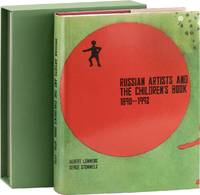
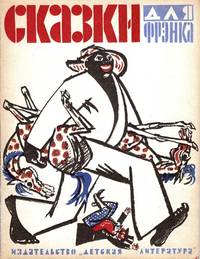
1990réf. 81719Nijmegen: LS 1990. First Limited Edition. Deluxe issue one of eleven copies in slipcase signed by both authors and issued with an original Soviet children's book in this case a copy of Kornei Chukovsky's Telefon Moscow: 1936 with illustrations by Vladimir Konashevich. Quarto 28cm; cloth hardcover dustjacket 511pp; illus. Supplemental DVD laid in as-issued. A fine copy in a crisp unworn dustwrapper and unworn slipcase. The included copy of Telefon is housed in a folding chemise designed to slip into the same slipcase as the main volume; staple-bound pictorial wrappers; 16pp light toning and wear to wrappers else Near Fine. A most desirable copy of what has become a standard English-language reference for Russian illustrated children's books. The deluxe issue is necessarily rare and seldom offered for sale. LS unknown
1965réf. 011354Moscow Russia: Progress Publishers 1965. 3 Volume Set Translated from the third German edition by Samuel Moore and Edward Aveling and edited by Frederick Engels. First English edition published in Moscow. Vol. 1- 1st ed 1st pt- 1965- Very Good book square tight no marks 807 pages in Near Fine jacket. Vol. 2 - 1st ed 4th pt- 1967- Fine book square tight no marks 551 pages in very good white jacket with smalltears/chips. Vol. 3- 1st ed 3rd pt- 1966- Fine book square tight no marks 948 pages in Very Good clean near fine white jacket. All books have previous owner name on ffep. Cloth. Very Good/Very Good. 8vo - over 7¾" - 9¾" tall. Progress Publishers Hardcover
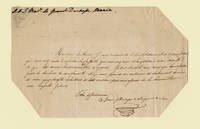
1830réf. 101272Weimar Germany circa 1830's to 1840's. 1830's to 1840's. Very good. - Over 75 words penned in French on 5-1/4 inch high by 8-1/4 inch wide J. Whatman watermarked wove paper. The Grand Duchess of Russia & Saxony Maria Pavlovna thanks the German diplomat Heinrich von Struve for conveying a "cassette" likely a jewelry box or other decorative box from England. "Monsieur de Struve. Je vous remercie de la Complaisance et de la promptesse que vous avez mise a expedier la Cassette que vous avez recue d'Angleterre a mon Adresse et qui est arrivee heureusement a Weymar. Je suis sensible aux voeux que vous faites pour le bonheur de ma famille." roughly translated: Monsieur de Struve. I thank you for the courtesy and promptness that you showed in forwarding the little box you received from England addressed to me and which has happily arrived in Weimar. I am appreciative of the wishes you make for the happiness of my family. Signed with affection "Marie la Duchesse de Russie et de Saxes". Folded for mailing vertically & horizontally three of the blank corners have been clipped. There is a minor repair with a narrow strip of matching paper along the right edge though there remains a tiny tear to the right edge of the horizontal fold. There are remnants of paper possibly from a seal along the verso of the top left corner. Very good. Not to be confused with the later Grand Duchess of the same name Grand Duchess Maria Pavlovna of Russia & Saxony 1786-1859 was the daughter of Emperor Paul I of Russia. She married Charles Frederick Grand Duke of Saxe-Weiman-Eisenach in 1804. Through her love for culture she turned her Weimar court into a mini-St. Petersburg transforming the small duchy into a major center for the arts music and science. Maria Pavlovna supported artists and writers such as Goethe and her palace was always full of life. A talented pianist she studied under Giuseppe Sarti. Pavlovna often corresponded with Vasily Zhukovsky. Friedrich Schiller praising her talent dedicated one of his last poems to her. In her later years she appointed Franz Liszt as "Kapellmeister extraordinaire" to her court and the premiere of Wagner's Lohengrin took place in Weimar. She was the ancestor of several major European royal families her daughter marrying Kaiser Wilhelm I and their son marrying Queen Victoria's eldest daughter. Through these close ties the courts of Weimar & England often exchanged gifts such as the "cassette" mentioned in this letter. The German diplomat nobleman and mineralogist Heinrich von Struve 1772-1851 served as the Russian Minister Resident to Hamburg's Hanseatic cities handling diplomatic affairs for the Tsar. He often handled logistics communication and transport between Great Britain the northern German ports and the central states such as Weimar. Struve was one of the young Beethoven's closest friends. The English papermaker James Whatman was celebrated for inventing "wove paper" which because of its strength was highly favored by world leaders and artists such as Napoleon Queen Victoria and George Washington. [Weimar, Germany], circa [1830's to 1840's].
réf. MD18Elephant Folio broadside ca. 45x33 cm with the additional leaf for border officers’ entries attached to the bottom ca. 205x33 cm. 1 p. Official woodcut passport form filled in brown ink. With over a dozen officials’ entries and stamps on verso. Fold marks paper age toned worn on extremities but overall a very good document. Interesting example of a 19th century European travel passport. It was given to a “portrait maker and photographer” Friedrich Karl August Kühnemann a native and resident of Berlin for his work in Russia and was valid for one year. There is an interesting description of Kühnemann’s appearance: “26 years old of medium height hair and eyebrows fair eyes brown nose and mouth ordinary chin and face oblong”. The notes left by consular or border officials range from 29 January/10 February to 25 October/3 November 1857. According to them Kühnemann travelled via Austria and Breslau crossed the Russian border at Brody and proceeded to Husiatin Kamenets-Podolsky and Odessa. unknown
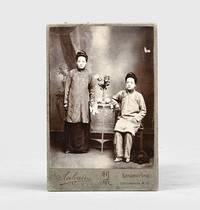
1890réf. 154515Vladivostok: Livay Studio No. 11 Svetlanskaya Street c. 1890. A scarce late 19th-century record of styles of clothing and foot-binding followed by well-to-do Chinese women in the Russian border city of Vladivostok. The Livay photographic studio catered specifically to Chinese residents and visitors and we have not been able to trace any other surviving examples of its work. Following China's transfer of the Haishenwei region to the Tsar in 1860 Vladivostok became a thriving centre of economic activity and cultural interchange between Russians and Chinese with both of these communities served by the Livay studio based on the city's main boulevard. This photograph is a pleasing corrective to the many surviving photographs of late-imperial Chinese women often produced in cities such as Shanghai which adopt an orientalizing gaze. While photography was introduced into Russia soon after its invention it remained a preserve of the very wealthy until the 1860s when technological changes fuelled an explosion in the number of photographic studios in major cities. "In the hands of commercial studio photographers the medium retained its original social function namely "to solemnize and to immortalize" the portrayed subject. The studio photograph was an index and a means of communicating one's status; it indicated the sitter's place in the social hierarchy both as a commodity object and as information. But more importantly photography dominated the market for portraiture and democratized visual self-representation. It captured people from across the social spectrum and brought about a visual levelling whereby the social benefits and drawbacks of this type of publicity was showered equally on kings nobles lawyers merchants and cobblers. Photography as a mechanized medium of self-representation pulled members of different social class onto the same visual level in the public sphere" Stolarski pp. 4-5. Cabinet card 164 x 108 mm mounted gelatine photograph 140 x 103 mm with glossy finish card lettered in red in Russian and Chinese. Small scuff to upper right corner of photograph image substantially unaffected couple of faint stains to card verso skinned where sometime mounted. A very good example. Christopher Stolarski "The Rise of Photojournalism in Russia and the Soviet Union 1900-1931" PhD Diss. 2013. hardcover
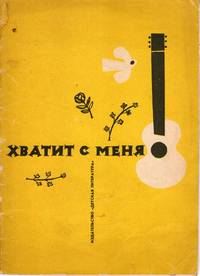
1966réf. 13401Moscow: Detskaia Literatura Children's Literature Publishing House 1966. Original illustrated wrappers stapled. Illustrated by Mark Kliachko. Front wrapper detached moderate soiling rubbing and toning. Contents a bit creased but mostly clean. Good condition. A rare Soviet anthology of African American folk poetry comprising work songs songs from the era of slavery blues texts humorous verse counting rhymes and children's folklore selected from material previously edited by Langston Hughes and Arna Bontemps in the major 1958 anthology The Book of Negro Folklore. The editors drew extensively on traditional African American stories blues rhythms and folk songs. For a Soviet child of the mid-1960s the book offered a remarkably direct encounter with the voices of Black America. There is little of the explanatory narrative framework through which the United States was so often presented to Soviet readers: here for the most part the songs speak for themselves. They evoke slave labour cotton plantations and Mississippi docks poverty exhausting work and racial inequality; yet alongside these appear humour play mockery children's rhymes and the distinctive rhythms of African American oral tradition. The work songs are particularly striking. In "Song on the River" the speaker compares the position of workers in different cities and comments with bitter irony on racial disparities in wages; in "Bales of Cotton" the monotonous movement of heavy cotton bales becomes the rhythmic principle of the poem itself. For a Soviet publisher such material naturally carried an obvious social and ideological significance. Yet the book is not reducible to a political illustration of American racism: it genuinely communicated to Russian readers something of the forms rhythms and humour of African American folk culture. The translation is by Nina Voronel a prominent Soviet translator from English. A graduate of the physics faculty of Kharkov University she entered the Literary Institute after meeting Korney Chukovsky and went on to specialise in literary translation. She became particularly known for her Russian translation of Oscar Wilde's The Ballad of Reading Gaol. Voronel later became a playwright and an active participant in the Soviet Jewish emigration movement; she left the USSR in 1974. Mark Kliachko's minimalist illustrations are constructed almost entirely from black line and solid areas of ink. Laborers carrying heavy cotton bales solitary figures animals and grotesque characters do not merely illustrate individual lines but echo the rhythm of the songs themselves. Even the cover -- a guitar a bird and a flower against a yellow ground -- gives the volume something of the character of a small graphic album rather than an ordinary Soviet collection of verse. OCLC locates only two copies outside Russia in Armenia and the United States the latter at the Bancroft Library. Detskaia Literatura [Children's Literature Publishing House] unknown
1971réf. 13402Leningrad: Children's Literature Publishing House 1971. 32pp. Quarto. Profusely illustrated by Boris Vlasov. Original pictorial wrappers printed in black brown red and blue stapled. Minor scuffing to spine minor edge wear and toning. A rare and unusual Soviet children's book devoted to African American culture. The traditional tales are set within a contemporary frame narrative as a Black family travels across the United States to Washington. A white motorist refuses to give them a lift and insults them because of their race; gradually the protagonists find themselves surrounded by marches a large encampment and groups of people making their way towards the capital. The old tales of slavery cunning strength and liberation are thus brought into direct connection with the contemporary African American struggle for civil rights. The frame story appears to allude to the 1968 Poor People's Campaign and in particular to the celebrated Resurrection City encampment in Washington. Following the assassination of Martin Luther King Jr. thousands of participants travelled to the capital from across the United States in caravans and buses and spent several weeks living in a temporary settlement erected on the National Mall demanding economic and social equality. The combination found in the book -- the journey to Washington the large camp and new groups of people continually arriving from different parts of the country -- is particularly suggestive of these events. The tales themselves however have genuine roots in African American oral tradition. One episode is recognizably related to the celebrated story of Big Sixteen a slave of supernatural strength who is capable of overcoming even the Devil. The tale was recorded by Zora Neale Hurston during her folkloric fieldwork in the American South and included in her book Mules and Men. For a Soviet publisher such material naturally carried an obvious ideological charge: racial discrimination provided a ready means of exposing the contradictions of American society. Through this ideological framework Soviet children were nevertheless introduced to African American folk culture the history of slavery and the contemporary Civil Rights Movement. The book is given particular distinction by the illustrations of Boris Vlasov 1936-1981 an important representative of the Leningrad school of graphic art of the 1960s and 1970s. Vlasov's expressive manner is especially effective here. Red blue black and white form an almost poster-like visual language. OCLC locates only one copy outside Russia held in Armenia. As such no copies in American libraries. Children's Literature Publishing House unknown
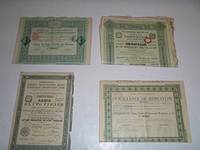
réf. 16-4567Moscow and St. Petersburg: 1869 -1918. Includes Société du Chemin de Fer de Tauris; Société Franco-Russe de Produits chimiques & d'explosives; Société . de machines de Briansk; Houilleres de Berestow; Imperial Russian Government; Forges .de la Kama; Gouvernement Imperial de Russie .4% Or de 1889; Various sizes often with coupons. Russian 3% Gold Loan of 1896; Emprunt de l'Etat Russe 5% de 1906; Banque Russo-Asiatique; Emprunt de l'Etat Russe 4-1/2% de 1909; Compagnie du Chemin de Fer du Nord-Donetz; Nicolas Railroad ; Ville de SDt-Petersburg 1908; Ville de Moscou 1908; Banque Fonciere des Paysans 1912; Grand Russian Railroad 1890; Chemin de fer de Moscou-Kief-Voronege 1914.; Manufactures de Lin de de Cotoi de Kostroma; Muliples of most. Moscow and St. Petersburg: 1869 -1918 unknown
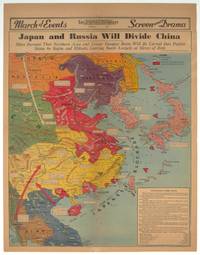
1940réf. 209821Los Angeles.: Los Angeles Examiner. 1940. Printed colour pictorial map on a single newspaper leaf 42.3 x 39.9 cms; 54.3 x 42.5 cms sheet archivally laid down on linen slight discolouration to lower centrefold and sheet slightly age-toned but in very good condition. A striking geopolitical map by Los Angeles Examiner artist Howard Burke covering China Japan Southern Russia and the northern part of French Indochina and Siam showing how the "Aggressors Divide China." Areas under Japanese occupation are shown in red and their naval blockade shown by an arc of naval vessels with vivid arrows indicating lines of supply. Text labels including sources of agricultural and raw materials provide a dynamic overview of the geopolitical situation and show the influence of American scientific illustrator and cartographer Richard Edes Harrison who argued for examining geographic issues from multiple perspectives and Los Angeles Times artist Charles Owens. . Los Angeles Examiner. unknown
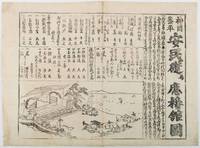
1854réf. 177799Japan. Circa1854. Black and white woodblock kawaraban printed on two joined sheets vertical central crease 41 x 63cm a little worming mainly on margins and repaired with paper on the reverse a little light browning but still presents very well. This kawaraban reports on how foreign visitors from the United States and Russia were treated in order to keep the peace and safety of God's country Japan. It reports that foreigners had arrived in Uraga this being the time of the second visit of Perry to Japan in 1854. The kawaraban goes on to list official gifts from the Shogunate to the President and his delegation members from the United States as well as to the Russian delegation. The gifts include lacquer boxes silk textiles as well as rice and chickens for the crew. The attractive black and white image at the foot of the report depicts a meeting in Yokohama at which a high ranking Tokugawa official received foreign visitors. The visitors are shown prostrating themselves in the open outdoor space in front of the building where the official sits. . unknown
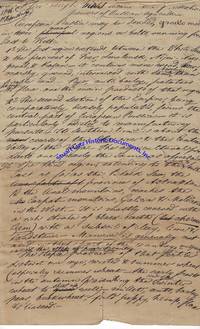
réf. 4678JOSEPH SLOCUM 1800-1853. Slocum was a merchant from Syracuse New York who attempted to sell farm equipment to Russia in the nineteenth century. He was unable to turn a profit from his endeavors and his family fell into financial hardship. His daughter Margaret Olivia Scolum Sage became an influential philanthropist and teacher. She endowed a building and a now-defunct agricultural school at Syracuse University both named after him.Archive. 9 pieces. 1830s-40s. An archive related to Joseph Slocum and his business with Russian agriculture. There are nine letters and documents predominately letters written to Slocum from various Americans and Russians. Highlights are listed below and the best piece is the first one the lengthy manuscript detailing Russian agriculture and natural resources:Handwritten document. 4pgs. September 12 1846. St. Petersburg Russia. The four page handwritten manuscript is entitled Some Rough Hints About the Productive Power of Russian Agriculture. It states in part: European Russia it may be divided grosso muto in three great regions or belts running from East to West. 1st - The first region extends between the White Sea and the provinces of Tver Smolensk Nijni-Novogorod & Kazan - it contains more wood low marshy ground intermixed the sand Baron then arable land. Rye oats barley potatoes hemp and flax are the main products of that region. 2nd - the second section of the Empire being comparatively densely populated forms a central part of the European Russia it is particularly addicted to manufacturing pursuits. It's Southern limits is about the course of the Oka River & the Central Valley of the Volga. The agricultural products are nearly the same as aforesaid. 3rd - the third region extending to the south and southeast as far as the Black Sea the provinces of Ashnaklan and the Ural Mountains reaches the Carpathian mountains Galicia & Moldavia in the West. It is mostly covered with a rich strata of black earth with a subsoil of clay lime & sandstone. Minoru is generally not used in this part of the country vulgarly called the step or prairie count the staple products of the fertile district are rye winter and summer wheat especially summer wheat - the summer frosts in the autumn preventing the seeds of the winter week to start up well millet oats barley peas buckwheat field poppy hemp flax & linseed. Cotton & Vine are raised merely in the most remote districts of the South such as Georgia Astrakhan the territory of the Cossacks of the Don Crimea & Bessarabia. Three other very important staples of Steph region are livestock & saltworks & fisheries. The stock consists mainly of horned cattle and horses grazing in large herds on the pastorate of the steps of the Black Sea As well as on both sides a lower Volga. Sheep both Merinos Saxon & form and main object of the agricultural industry of the step and owners. The Russian or common sheep is generally the property of the peasantry. The wool and tallow are usually sent overland in the winter to the manufacturing districts of the central belt of Russia Moscow. Or exported via Odessa Taganrog Riga & Petersburg to England and France. The saltworks are especially remarkable on the left sure the Volga on the verge of the province of Astrakhan as well as near the Ural River not far from the city of Orenburg. The Lake Elton alone of a circumference of nearly 180 miles is a solid mass of salt inexhaustible in its mineral riches. The stone saltworks of Gletznaia.As well as the saltworks a Crimea produce an immense quantity of that precious mineral. Besides that all the basin of the Caspian is full of an infinity of small salt lakes. The main fisheries are at the mouth of the Volga on the Caspian they produce an enormous quantity of fish of all kind. Besides that of the fisheries of the Ural River on the Don. The main fluvial artery of Russia is the Volga it is a Mississippi of our country. Its length is upwards 3000 miles. Unfortunately it is frozen up during nearly 6 months of the year. There are but very few steamboats in it. This year a large steam tow boat has been put into action on the Volga attended with great success. The manuscript continues extolling Russias natural resources. It is uncertain who wrote it and the condition is good with folds and fold separations. A partial typewritten transcript is included.LS. 1pg. August 1843. Russia. A letter signed L. Perovsky by Russian nobleman Lev Perovski 1792-1856 as Russian Minister of the Interior. Perovski thanked Slocum: The Directo fo the AgronomicalSchool having informed me that you presented to the museum of this Institution several agronomical instrument I feel myself much gratified to acknowledge. Agronomy is crop and soil science. The letter is in very good condition with folds and short fold separations.ALS. 4pg. 5 x 8 . November 7 1846. St. Peterburg Russia. An autograph letter signed by an American working for the United States Legation at St. Petersburg. He wrote in part to Slocum: The only reproach I ever heard from the Minister as I told you at that time and which certainly stands on a misunderstanding concerns the establishment of a cast iron fabrication. The Minister is in full belief you had spoken to him about ain the Union that as soon as a new colony any where is establishedThis seemed to His Excellency excellent means to introduce in Russia and toin this way thepossibility to the peasants to have their implements cheap & well one. The letter is in fine condition.ANS. 1pg. 1834. New York. A brief note acknowledging money received from Slocum signed Ja J Roosevelt by Jacobus James Roosevelt III 1760-1847 the New York state businessman and politician who was great-grandfather of FDR. In fine condition.ALS. 1pg. June 6 1834. New York. An autograph letter signed Jab J Roosevelt by Jacobus Roosevelt. Roosevelt wrote to Slocum requesting the return of an item. In very good condition.ALS. 3pgs. October 22 1846. St. Petersburg Russia. A lengthy letter to Slocum signed Chas Cramer to Slocum. Charles Cramer 1799-1879 was an important trader to Russian and his letter concerns finance: he gave you an order for the purchase of Implements for Agricultural purposes & that he assigned you a credit againstof the Government. He fully confirmed the contents of the letter you communicated to me & promised to reply to your letterMr. Clay stated when I asked him on your behalf that he could do nothing in the case to further your interest. Major Whistler whom I called on several time but missed has not yet returned my calls. I rather think he will not be able to serve you better than I can with the Government of this EmpireWe merchants often meet with heavy losses Do consider your Adventure to Russia misfortune & think no more about it for you will not gain anything. The penciled letter is in very good condition with a tear in the address leaf.Letter. 1pg. 5 x 8 . 1846. St. Petersburg. A contemporary copy of an 1846 letter by Rhesa Griffin a Syracuse area merchant: Received St. Petersburg 31 July 1846 of the Russian Imperial Departmentfive hundred thirty six silver rubles and sixteen seven coppers in full satisfaction of all and every claim or Demand on the above Department or if any other Department of the Russian Government and in full satisfaction of all and every agreement or understanding made by me with Joseph Slocum as an agent of the Russian Government. The document is wrinkled and in very good condition. unknown
1996réf. 012534New York New York U.S.A.: Doubleday 1996. 769pp/illus. Gorbachev's autobiography Gorbachev has autographed the title page. Signature guaranteed original. Was purchased at Gorbachev's booksigning in Washington DC in 1996. Clean no marks. 1st Printing. Hard Cover. Near Fine/Very Good. 8vo - over 7¾" - 9¾" tall. Doubleday hardcover
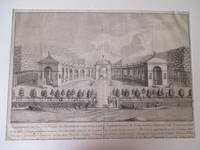
1750réf. 14523AB1750. Sta. Petersburg Academie Imp. des Scien et des Arts ca. 1750 48 : 69 cm Original engraving with text in Russien and Frenche below the image. Rare engraving of the Amphitheatre near St. Petersburg. unknown
1999réf. 0008049Boulder CO: Westview Press 1999. First English language edition. Hardcover. As New/issued without. 8vos; xxxiv 562; ix 389 pages maroon cloth in original shrinkwrap. Not x-library. Scarce. O.P. This English translation contains an autobiography by Mironov which was not in the Russian edition. It details his anti-Marxism philosophy while a student in Leningrad. "The author has assimilated a large body of foreign scholarship primarily "new social history" produced by Anglo-American authors along with a sprinkling of more broadly European economic and demographic history from the 1970s and 1980s which is effectively incorporated into his own very deep empirical knowledge. . The reader does not find in this extensively researched account the standard Soviet answers to specific historical questions. Mironov has abandoned most Soviet cliches though he still assumes that laws of Russian history can be identified based on social science theory and quantitative analysis Elise Kimerling Wirtschafter." "This is a massterful work that provides other scholars with a wealth of useful information while confrontimg them with an argument that compels a response - William G. Wagner." Maps. Westview Press hardcover
1769réf. 647731769. Early French-Language Edition of Catherine's Nakaz Catherine II 1762-1796 Empress of Russia. Landres J. Rodolphe Frey de Translator. Instructions Adressees par Sa Majeste L'Imperatrice de Toutes les Russies: A la Commission Etablie Pour Travailler a L'Execution du Projet d'un Nouveau Code de Lois. Traduit de l'Allemand. "A Petersbourg" i.e. Yverdon Switzerland: s.n. 1769. 286 pp. 12mo. 6" x 4". Early quarter vellum over marbled boards untrimmed edges a few unopenened signatures. Light soiling corners lightly bumped and worn. Moderate toning to interior somewhat heavier in places some leaves have light foxing a few have light dampstaining to margins internally clean. Ex-library with a small inkstamp to title page. A handsome copy. $1000. Reissue of the first edition in French published by the St. Petersburg Academy of Sciences for private distribution in 1769. This important text also known as the Nakaz or Instruction is a statement of legal principles written by Catherine II from 1764 and 1766. Permeated with the ideas of the French Enlightenment and copied mostly from the work of Voltaire Montesquieu and Beccaria it was compiled as a guide for the All-Russia Legislative Commission convened by the Empress in 1767 to create a new code to replace the 1649 Muscovite Code. Revised in consultation with Beccaria Frederick the Great and Voltaire the Instruction proclaimed the equality of all men before the law and disapproved of death penalty and torture. Unfortunately her proposed code was never completed. Catherine's manuscript was written in French and she later produced a Russian translation. Editions in German and Russian were published in Moscow in 1767. The book was initially banned in France because it was too liberal which is why the first French-language edition was produced in Switzerland with a false imprint. French and Latin editions were eventually published in 1770. OCLC locates 6 copies of this imprint in North American law libraries Columbia George Washington University Harvard Library of Congress UC-Berkeley Yale. Butler The Nakaz of Catherine the Great 531 Entry 40. unknown
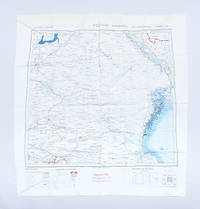
1952réf. 183941London: Ordnance Survey 1952. Later editions marked "restricted" revised from those produced by the War Office in 1919 and 1916 with isogonals correct to 1953. These maps were issued in the early years of the Cold War only a decade after the region was ravaged in the Battle of Stalingrad. Stepnoy now Elista was renamed only five years after this map's publication. In the early years of the Cold War the CIA attempted to gather information on the Soviet Union through aerial spying missions flown with the co-operation of the British government. "The RAF formed a top-secret reconnaissance outfit in the spring of 1951. Churchill approved the RAF overflight program knowing that if one of the planes came down on Russian territory Labour MPs in an embarrassed and angered House of Commons undoubtedly would force a vote of confidence to bring down his government. But he balanced that possibility against the desperate need for radar pictures of Soviet military targets that would held SAC and RAF bombers in the event of war" Burrows pp. 131-33. In 1952 John Crampton flew a high-speed high-altitude test run over the Berlin corridor which Bomber Command followed with three simultaneous sorties reaching as far as Moscow itself. After a ten-hour mission that triggered the Soviet air defences "All three planes made it back to Sculthorpe with their radar imagery and without a scratch" Burrows p. 134 angering the Kremlin and prompting a review of the nation's air warning systems. The map of Stalingrad is the fourth edition and the map of Stepnoy is the fifth. Single sheet of cloth 605 x 554 mm colour maps with key on each side pale border on Stalingrad side lettered in red blue and black. Map bright sometime folded and creased edges a little frayed: a very good copy. William Burrows By Any Means Necessary: America's secret air war in the Cold War 2001. hardcover
1966réf. ZB1278337London Math Soc 1966. Russian Mathematical Surveys. v. 21; 22; 25; 27; 32; 33; 34; 35 including postage to Germany. - If you are reading this this item is actually physically in our stock and ready for shipment once ordered. We are not bookjackers. Buyer is responsible for any additional duties taxes or fees required by recipient's country. Photos available upon request. London Math Soc unknown
1929réf. 505546Paris: Editions J. Oliven 1929. Book. Good / État Satisfaisant. Soft cover. Signed and inscribed by the Author. Inscribed to previous owner and signed in English by the Grand Duke Alexander of Russia. Text in French. A good copy. . Editions J. Oliven Paperback
1769réf. 719841769. Lausanne: Francois Grasset & Comp. 1769. Lausanne: Francois Grasset & Comp. 1769. Early French Translation of an Important Document of the Enlightenment Catherine II 1762-1796 Empress of Russia. Balthasar Joseph Anton Felix von 1737-1810 Translator. Instruction Donnee par Catherine II. Imperatrice et Legislatrice de Toutes les Russies a la Commission Etablie par cette Souveraine pour Travailler ala Redaction d'un Nouveau Code de Loix Telle Qu'elle e ete Imprimee en Russe & en Allemand Dans l'Imprimerie Imperiale de Moscow. Nouvelle Edition Augmentee. Lausanne: Chez Francois Grasset & Comp. 1769. xiv 160 i.e. 204 pp. Lacking dedication leaf and copperplate portrait frontispiece. Quarto 7" x 4-3/4". Recent period-style three-quarter calf over marbled boards raised bands and red and black lettering pieces to spine marbled endpapers untrimmed edges. Light rubbing to extremities light fading to spine. Moderate toning light foxing in a few places. $1250. Third French-language edition. An important document of the Enlightenment the Nakaz or Instruction composed by Catherine the Great served to guide the assembly summoned in 1766 to draft a new code of laws for the Russian Empire. Drawn primarily from Montesquieu as well as Rousseau Beccaria and other Enlightenment thinkers the Nakaz condemned torture and capital punishment and endorsed such principles as the equality of all before the law. Published in the principal European tongues between 1767 and 1769 it proved to be a statement to the world as much as a practical legal text. Three editions in French were published in 1769 first in Moscow then in Yverdon with a false St. Petersburg imprint and Lausanne. In 1769 Duc de Choiseul added the "libertine" Nakaz to the list of books prohibited in France. Balthasar the translator of our edition was a Swiss historian and member of the Enlightenment's international "Republic of Letters." His introduction pp. iii-iv is a notable document of the early reception of the Nakaz in Western Europe. Graesse Tresor de Livres Rares et Precieux II:80. unknown
1771réf. 647971771. Amsterdam 1771. 2nd Dutch ed. Amsterdam 1771. 2nd Dutch ed. Scarce Early French-Language Edition of Catherine the Great's Landmark Legal Treatise Issued by Marc-Michel Rey The Premier Publisher of the Enlightenment Catherine II 1762-1796 Empress of Russia. Instruction de Sa Majeste Imperiale Catherine II. Pour la Commission Chargee de Dresser le Projet d'un Nouveau Code de Loix. Amsterdam: Chez Marc Michel Rey 1771. vii 229 pp. Frontispiece engraved copperplate medallion portrait of Catherine II by C.A. Boily. Octavo 7-3/4" x 4-3/4"; 19.68 x 12.06 cm. Contemporary mottled calf blind rules to boards gilt spine with lettering piece edges rouged marbled endpapers. A few minor scuffs to boards moderate rubbing to extremities spine ends worn front joint starting at ends corners bumped and somewhat worn. Light toning to text dampstaining and light foxing to a few leaves internally clean. An attractive copy. $1250. Second Dutch edition. Known universally as the Nakaz or Instruction this monument of legal philosophy was composed by Catherine II between 1764 and 1766 as a guiding manual for the All-Russia Legislative Commission convened in 1767. Intended to replace the outdated Sobornoye Ulozheniye 1649 Muscovite Code the treatise stands as one of the most prominent practical applications of Enlightenment jurisprudence in early modern Europe. Heavily influenced by Montesquieu's De l'Esprit des Lois and Beccaria's Dei Delitti e Delle Pene the text translates radical legal theories into imperial policy. It explicitly advocated for equal protection under the law for all citizens abolition of torture and strict limitation of the death penalty prevention of crime over retributive punishment and judicial proportion between crimes and penalties. Catherine drafted the original text in French and subsequently produced a Russian translation. Following the initial 1767 Moscow printings in Russian and German regional editions proliferated across Europe. The text was famously banned in France by Louis XV due to its radical political liberalism-a censorship event that only increased continental demand. The first Dutch edition was published in Dutch translation in 1769. This 1771 imprint by Marc-Michel Rey represents the first Dutch edition printed in the original French. Publishing from Amsterdam Rey was the principal printer for ra. unknown