Meyendorff (M. le Baron Georges de; Colonel à l'Etat-Major de S.M. l'Empereur de toutes les Russies).Livre Rare Book

17 691 résultats
1826réf. 14060paris Librairie Orientale de Dondey-Dupré Père et Fils. 1826 1 Un volume de format in 8° de XII pp.( faux titre, titre, avertisement, préface de l'auteur); 508 pp.; 4 planches hors texte en couleurs dont le frontispice; et trois en noir; une grande carte dépliantes en fin (rousseurs). Le voyage en lui-même couvre 306 pp.; viennent ensuite de nombreux suppléments d'érudits russes concernant les monnaies les langues, l'histoire naturelle de la Boukharie (sic)... Dos lisse richement orné; demi basane violine; titre doré. Brunet III; col.1690.
1826Un volume de format in 8° de XII pp.( faux titre, titre, avertisement, préface de l'auteur); 508 pp.; 4 planches hors texte en couleurs dont le frontispice; et trois en noir; une grande carte dépliantes en fin (rousseurs). Le voyage en lui-même couvre 306 pp.; viennent ensuite de nombreux suppléments d'érudits russes concernant les monnaies les langues, l'histoire naturelle de la Boukharie (sic)... Dos lisse richement orné; demi basane violine; titre doré. Brunet III; col.1690. Importante rousseurs sur le titre et le frontispice puis rousseurs éparses plus rares. Bien complet . Parfaitement relié. Ouvrage peu fréquent; voir les photos.
1805réf. 25101Amsterdam 1805 3 tomes en 1 vol. in-4 demi-basane fauve racinée, dos lisse orné de filets et fleurons dorés, pièce de titre brique, coins en vélin, tranches mouchetées de bleu [Rel. de l'époque], un mors un peu fragile
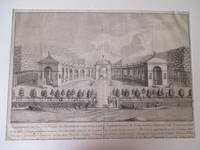
1750réf. 14523AB1750. Sta. Petersburg Academie Imp. des Scien et des Arts ca. 1750 48 : 69 cm Original engraving with text in Russien and Frenche below the image. Rare engraving of the Amphitheatre near St. Petersburg. unknown
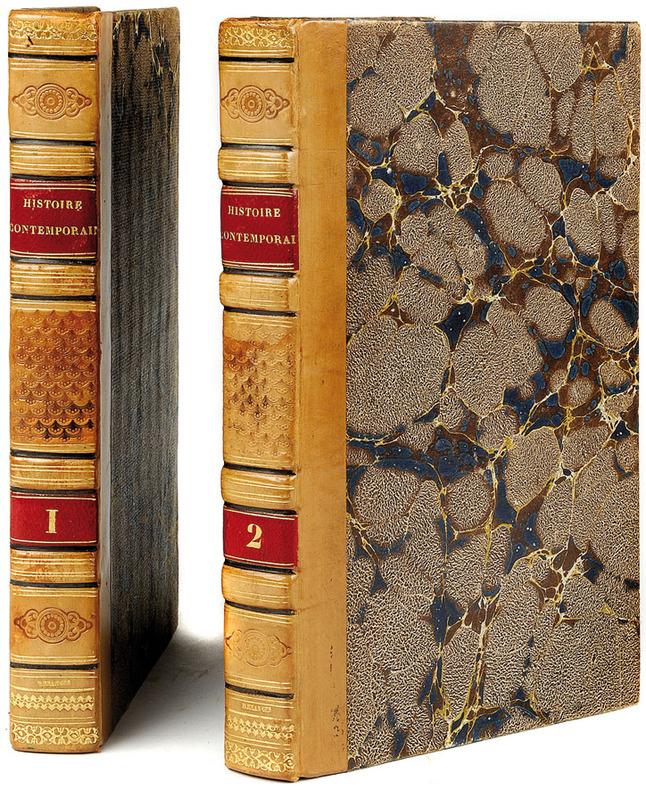
1825réf. 20949Paris Alexis Eymery 1825 3 vol. in-8 basane racinée, dos lisses ornés de motifs dorés, tranches jaunes, [Rel. de l'époque], piqûres
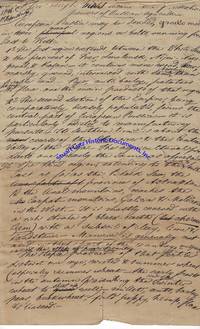
réf. 4678JOSEPH SLOCUM 1800-1853. Slocum was a merchant from Syracuse New York who attempted to sell farm equipment to Russia in the nineteenth century. He was unable to turn a profit from his endeavors and his family fell into financial hardship. His daughter Margaret Olivia Scolum Sage became an influential philanthropist and teacher. She endowed a building and a now-defunct agricultural school at Syracuse University both named after him.Archive. 9 pieces. 1830s-40s. An archive related to Joseph Slocum and his business with Russian agriculture. There are nine letters and documents predominately letters written to Slocum from various Americans and Russians. Highlights are listed below and the best piece is the first one the lengthy manuscript detailing Russian agriculture and natural resources:Handwritten document. 4pgs. September 12 1846. St. Petersburg Russia. The four page handwritten manuscript is entitled Some Rough Hints About the Productive Power of Russian Agriculture. It states in part: European Russia it may be divided grosso muto in three great regions or belts running from East to West. 1st - The first region extends between the White Sea and the provinces of Tver Smolensk Nijni-Novogorod & Kazan - it contains more wood low marshy ground intermixed the sand Baron then arable land. Rye oats barley potatoes hemp and flax are the main products of that region. 2nd - the second section of the Empire being comparatively densely populated forms a central part of the European Russia it is particularly addicted to manufacturing pursuits. It's Southern limits is about the course of the Oka River & the Central Valley of the Volga. The agricultural products are nearly the same as aforesaid. 3rd - the third region extending to the south and southeast as far as the Black Sea the provinces of Ashnaklan and the Ural Mountains reaches the Carpathian mountains Galicia & Moldavia in the West. It is mostly covered with a rich strata of black earth with a subsoil of clay lime & sandstone. Minoru is generally not used in this part of the country vulgarly called the step or prairie count the staple products of the fertile district are rye winter and summer wheat especially summer wheat - the summer frosts in the autumn preventing the seeds of the winter week to start up well millet oats barley peas buckwheat field poppy hemp flax & linseed. Cotton & Vine are raised merely in the most remote districts of the South such as Georgia Astrakhan the territory of the Cossacks of the Don Crimea & Bessarabia. Three other very important staples of Steph region are livestock & saltworks & fisheries. The stock consists mainly of horned cattle and horses grazing in large herds on the pastorate of the steps of the Black Sea As well as on both sides a lower Volga. Sheep both Merinos Saxon & form and main object of the agricultural industry of the step and owners. The Russian or common sheep is generally the property of the peasantry. The wool and tallow are usually sent overland in the winter to the manufacturing districts of the central belt of Russia Moscow. Or exported via Odessa Taganrog Riga & Petersburg to England and France. The saltworks are especially remarkable on the left sure the Volga on the verge of the province of Astrakhan as well as near the Ural River not far from the city of Orenburg. The Lake Elton alone of a circumference of nearly 180 miles is a solid mass of salt inexhaustible in its mineral riches. The stone saltworks of Gletznaia.As well as the saltworks a Crimea produce an immense quantity of that precious mineral. Besides that all the basin of the Caspian is full of an infinity of small salt lakes. The main fisheries are at the mouth of the Volga on the Caspian they produce an enormous quantity of fish of all kind. Besides that of the fisheries of the Ural River on the Don. The main fluvial artery of Russia is the Volga it is a Mississippi of our country. Its length is upwards 3000 miles. Unfortunately it is frozen up during nearly 6 months of the year. There are but very few steamboats in it. This year a large steam tow boat has been put into action on the Volga attended with great success. The manuscript continues extolling Russias natural resources. It is uncertain who wrote it and the condition is good with folds and fold separations. A partial typewritten transcript is included.LS. 1pg. August 1843. Russia. A letter signed L. Perovsky by Russian nobleman Lev Perovski 1792-1856 as Russian Minister of the Interior. Perovski thanked Slocum: The Directo fo the AgronomicalSchool having informed me that you presented to the museum of this Institution several agronomical instrument I feel myself much gratified to acknowledge. Agronomy is crop and soil science. The letter is in very good condition with folds and short fold separations.ALS. 4pg. 5 x 8 . November 7 1846. St. Peterburg Russia. An autograph letter signed by an American working for the United States Legation at St. Petersburg. He wrote in part to Slocum: The only reproach I ever heard from the Minister as I told you at that time and which certainly stands on a misunderstanding concerns the establishment of a cast iron fabrication. The Minister is in full belief you had spoken to him about ain the Union that as soon as a new colony any where is establishedThis seemed to His Excellency excellent means to introduce in Russia and toin this way thepossibility to the peasants to have their implements cheap & well one. The letter is in fine condition.ANS. 1pg. 1834. New York. A brief note acknowledging money received from Slocum signed Ja J Roosevelt by Jacobus James Roosevelt III 1760-1847 the New York state businessman and politician who was great-grandfather of FDR. In fine condition.ALS. 1pg. June 6 1834. New York. An autograph letter signed Jab J Roosevelt by Jacobus Roosevelt. Roosevelt wrote to Slocum requesting the return of an item. In very good condition.ALS. 3pgs. October 22 1846. St. Petersburg Russia. A lengthy letter to Slocum signed Chas Cramer to Slocum. Charles Cramer 1799-1879 was an important trader to Russian and his letter concerns finance: he gave you an order for the purchase of Implements for Agricultural purposes & that he assigned you a credit againstof the Government. He fully confirmed the contents of the letter you communicated to me & promised to reply to your letterMr. Clay stated when I asked him on your behalf that he could do nothing in the case to further your interest. Major Whistler whom I called on several time but missed has not yet returned my calls. I rather think he will not be able to serve you better than I can with the Government of this EmpireWe merchants often meet with heavy losses Do consider your Adventure to Russia misfortune & think no more about it for you will not gain anything. The penciled letter is in very good condition with a tear in the address leaf.Letter. 1pg. 5 x 8 . 1846. St. Petersburg. A contemporary copy of an 1846 letter by Rhesa Griffin a Syracuse area merchant: Received St. Petersburg 31 July 1846 of the Russian Imperial Departmentfive hundred thirty six silver rubles and sixteen seven coppers in full satisfaction of all and every claim or Demand on the above Department or if any other Department of the Russian Government and in full satisfaction of all and every agreement or understanding made by me with Joseph Slocum as an agent of the Russian Government. The document is wrinkled and in very good condition. unknown
réf. 4678JOSEPH SLOCUM 1800-1853. Slocum was a merchant from Syracuse New York who attempted to sell farm equipment to Russia in the nineteenth century. He was unable to turn a profit from his endeavors and his family fell into financial hardship. His daughter Margaret Olivia Scolum Sage became an influential philanthropist and teacher. She endowed a building and a now-defunct agricultural school at Syracuse University both named after him.Archive. 9 pieces. 1830s-40s. An archive related to Joseph Slocum and his business with Russian agriculture. There are nine letters and documents predominately letters written to Slocum from various Americans and Russians. Highlights are listed below and the best piece is the first one the lengthy manuscript detailing Russian agriculture and natural resources:Handwritten document. 4pgs. September 12 1846. St. Petersburg Russia. The four page handwritten manuscript is entitled Some Rough Hints About the Productive Power of Russian Agriculture. It states in part: European Russia it may be divided grosso muto in three great regions or belts running from East to West. 1st - The first region extends between the White Sea and the provinces of Tver Smolensk Nijni-Novogorod & Kazan - it contains more wood low marshy ground intermixed the sand Baron then arable land. Rye oats barley potatoes hemp and flax are the main products of that region. 2nd - the second section of the Empire being comparatively densely populated forms a central part of the European Russia it is particularly addicted to manufacturing pursuits. It's Southern limits is about the course of the Oka River & the Central Valley of the Volga. The agricultural products are nearly the same as aforesaid. 3rd - the third region extending to the south and southeast as far as the Black Sea the provinces of Ashnaklan and the Ural Mountains reaches the Carpathian mountains Galicia & Moldavia in the West. It is mostly covered with a rich strata of black earth with a subsoil of clay lime & sandstone. Minoru is generally not used in this part of the country vulgarly called the step or prairie count the staple products of the fertile district are rye winter and summer wheat especially summer wheat - the summer frosts in the autumn preventing the seeds of the winter week to start up well millet oats barley peas buckwheat field poppy hemp flax & linseed. Cotton & Vine are raised merely in the most remote districts of the South such as Georgia Astrakhan the territory of the Cossacks of the Don Crimea & Bessarabia. Three other very important staples of Steph region are livestock & saltworks & fisheries. The stock consists mainly of horned cattle and horses grazing in large herds on the pastorate of the steps of the Black Sea As well as on both sides a lower Volga. Sheep both Merinos Saxon & form and main object of the agricultural industry of the step and owners. The Russian or common sheep is generally the property of the peasantry. The wool and tallow are usually sent overland in the winter to the manufacturing districts of the central belt of Russia Moscow. Or exported via Odessa Taganrog Riga & Petersburg to England and France. The saltworks are especially remarkable on the left sure the Volga on the verge of the province of Astrakhan as well as near the Ural River not far from the city of Orenburg. The Lake Elton alone of a circumference of nearly 180 miles is a solid mass of salt inexhaustible in its mineral riches. The stone saltworks of Gletznaia.As well as the saltworks a Crimea produce an immense quantity of that precious mineral. Besides that all the basin of the Caspian is full of an infinity of small salt lakes. The main fisheries are at the mouth of the Volga on the Caspian they produce an enormous quantity of fish of all kind. Besides that of the fisheries of the Ural River on the Don. The main fluvial artery of Russia is the Volga it is a Mississippi of our country. Its length is upwards 3000 miles. Unfortunately it is frozen up during nearly 6 months of the year. There are but very few steamboats in it. This year a large steam tow boat has been put into action on the Volga attended with great success. The manuscript continues extolling Russias natural resources. It is uncertain who wrote it and the condition is good with folds and fold separations. A partial typewritten transcript is included.LS. 1pg. August 1843. Russia. A letter signed L. Perovsky by Russian nobleman Lev Perovski 1792-1856 as Russian Minister of the Interior. Perovski thanked Slocum: The Directo fo the AgronomicalSchool having informed me that you presented to the museum of this Institution several agronomical instrument I feel myself much gratified to acknowledge. Agronomy is crop and soil science. The letter is in very good condition with folds and short fold separations.ALS. 4pg. 5 x 8 . November 7 1846. St. Peterburg Russia. An autograph letter signed by an American working for the United States Legation at St. Petersburg. He wrote in part to Slocum: The only reproach I ever heard from the Minister as I told you at that time and which certainly stands on a misunderstanding concerns the establishment of a cast iron fabrication. The Minister is in full belief you had spoken to him about ain the Union that as soon as a new colony any where is establishedThis seemed to His Excellency excellent means to introduce in Russia and toin this way thepossibility to the peasants to have their implements cheap & well one. The letter is in fine condition.ANS. 1pg. 1834. New York. A brief note acknowledging money received from Slocum signed Ja J Roosevelt by Jacobus James Roosevelt III 1760-1847 the New York state businessman and politician who was great-grandfather of FDR. In fine condition.ALS. 1pg. June 6 1834. New York. An autograph letter signed Jab J Roosevelt by Jacobus Roosevelt. Roosevelt wrote to Slocum requesting the return of an item. In very good condition.ALS. 3pgs. October 22 1846. St. Petersburg Russia. A lengthy letter to Slocum signed Chas Cramer to Slocum. Charles Cramer 1799-1879 was an important trader to Russian and his letter concerns finance: he gave you an order for the purchase of Implements for Agricultural purposes & that he assigned you a credit againstof the Government. He fully confirmed the contents of the letter you communicated to me & promised to reply to your letterMr. Clay stated when I asked him on your behalf that he could do nothing in the case to further your interest. Major Whistler whom I called on several time but missed has not yet returned my calls. I rather think he will not be able to serve you better than I can with the Government of this EmpireWe merchants often meet with heavy losses Do consider your Adventure to Russia misfortune & think no more about it for you will not gain anything. The penciled letter is in very good condition with a tear in the address leaf.Letter. 1pg. 5 x 8 . 1846. St. Petersburg. A contemporary copy of an 1846 letter by Rhesa Griffin a Syracuse area merchant: Received St. Petersburg 31 July 1846 of the Russian Imperial Departmentfive hundred thirty six silver rubles and sixteen seven coppers in full satisfaction of all and every claim or Demand on the above Department or if any other Department of the Russian Government and in full satisfaction of all and every agreement or understanding made by me with Joseph Slocum as an agent of the Russian Government. The document is wrinkled and in very good condition. unknown books
1996réf. 012534New York New York U.S.A.: Doubleday 1996. 769pp/illus. Gorbachev's autobiography Gorbachev has autographed the title page. Signature guaranteed original. Was purchased at Gorbachev's booksigning in Washington DC in 1996. Clean no marks. 1st Printing. Hard Cover. Near Fine/Very Good. 8vo - over 7¾" - 9¾" tall. Doubleday hardcover
réf. 110543aafA Genève, Chez Barde, Manget & Comp. et à Paris, chez Buisson, M D CC LXXXV / MDCCLXXXVI, 1785, 1786, pt. in-8vo, (19 x 12.5 cm). Illustré d’au total : 28 planches ou cartes hors texte. reliure en d.-cuir du début du XIXe, pièce de titre en maroquin rouge au dos avec titre ‘Recueil de voyages au nord de l’Europe’ les tomaisons dorées, bel exemplaire.
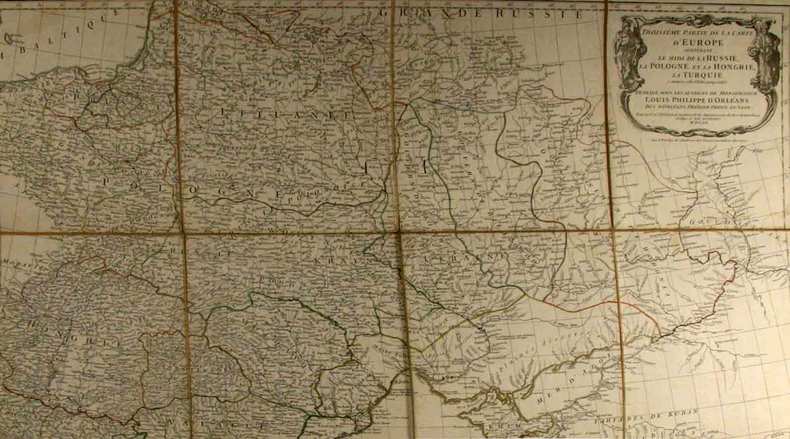
réf. 116334aafPubliée sous les auspices de Monseigneur Louis Philippe dOrléans premier Prince du Sang. MDCCLX, 1760, 84x100 cm, Carte en 16 éléments montés sur toile d’époque, carte pliée 26x21.5 cm. (frontières en couleurs / Map coloured in outline).
1801réf. 94432Paris, Maradan 1801 6 volumes in-8, plein veau raciné époque, dos lisses teintés en vert et richement ornés, roulette dorée encadrant les plats et sur les coupes, XX-400- 451- 464- 432- 419- 384 pp. Bel exemplaire
réf. 242266À Paris, Chez Plancher, Delaunay, 1817 in-8, XII-232 pp., demi-maroquin rouge à la Bradel (reliure postérieure). Petite mouillure angulaire à la fin de l'ouvrage.
ARTARIA. Neuste karte des Russischen Reiches. Mit der Eintheilung in die neu errichteten Statth alterschaften und Kreise. Zu haben in Wien bey Artaria und Compagnie. Nouvelle Carte de la Russie en trois feuilles. Wien, 1807 ca. Cm. 80x175 on three sheets. Large engraved map dissected and mounted on linen, hand-coloured in outline. Titles in german and french. Half calf slipcase.
1825réf. 17472Paris, Vernarel et Tenon (imp. de Lebel), 1825 ; 2 tomes in-8, demi veau blond glacé, dos à quatre nerfs plats encadrant les pièces rouges de titre et de tomaison, dos décoré de roulettes dorées et fleurons à froid, tranches marbrées (Beranger) ; XVI, 433, (2) pp. ; XXVII, 363 pp.
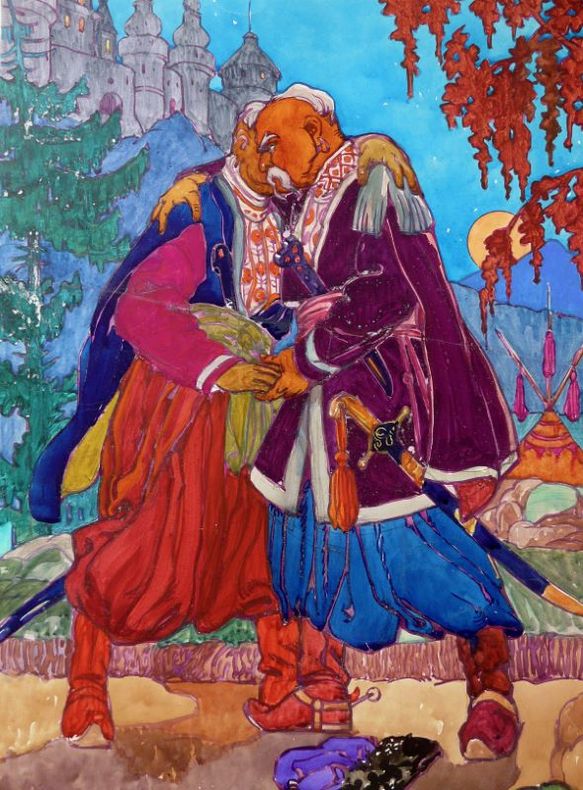
1920réf. 194881920 Aquarelle et encre de Chine, s.d. (1920), sur carton, 48 x 35.5 cm, titrée sous le dessin.
réf. 200460Paris, Champion, 1907 gr. in-8 carré, XX-256 pp., nbses ill. in-t., demi-basane rouge, dos à nerfs orné de filets à froid (reliure de l'époque). Dos un peu frotté.
1705réf. 15301Van Poolsum Utrecht 1705 1 vol. In-12 de 8 ff.n.ch. 394 pp., pleine basane de l'époque, dos à nerfs orné, pièce de titre (coiffe supérieure arasée), tranches jaspées.
réf. 217714À Paris, Chez Pillet ainé, 1838 3 vol. in-8 et un atlas in-8, 5 tabl. dépl., frontispice à chaque tome, 9 cartes repliées et un plan de Moscou en 1812 à l'atlas, demi-chagrin brun, dos à nerfs orné, broché pour l'atlas, (reliure fin XIXe). Rousseurs, un cahier bruni au tome 1, étiquettes de bibliothèque au dos, cachet (annulé).
1845réf. LBW-7689[Paris], Dépôt-Général de la Marine, 1844 [1845]. 600 x 423 mm.
réf. 204741Paris, Dupont, 1833 2 tomes en un vol. in-8, [2]-420 pp. et 436 pp., gravures en frontispice, demi-chagrin rouge, dos à nerfs, couv. cons. (reliure postérieure). Coins usagés, rousseurs.
réf. 223911Paris, Dupont, 1833 2 vol. in-8, [4]-420 pp., 1 f. d'errata et 436-3 pp. (catalogue), 1 f. d'errata, gravures en frontispice, demi-chagrin bordeaux à grain long, dos lisse orné de filets dorés (reliure moderne). Fortes rousseurs, des feuillets brunis.
1854réf. LBW-2699Paris, Bouquillard, 1854. 553 x 713 mm.
19351st edition. Original Color Wrappers, many photographic or illustrated, bound into publishers cloth, 4to, generally 24-36 pages per issue. In Yiddish, with English section at rear. Loaded with photos and illustrations, some on the Yiddish or English covers, and many of them by William Gropper. Nazi-era Communist monthly in support of Soviet Birobidjan, the Soviet Autonomos Jewish Republic. Much on rising Antisemitism in Germany, as wel asl, of course, the history of antisemitism in pre-Soviet Russia, reports Icor and settlement of Jews into Birobidzhan, why Icor opposes Zionism, photos, literary works, including poetry, fiction, humor, satire and other materials covering virtually all aspects of life in the Jewish Autonomous region. Monthly Periodical of the Association for Jewish Colonization in the Soviet Union. "IKOR: Buletin Fun Der Gezelshaft " was issued on an excellent quality paper in Yiddish and English from 1928 to 1935 under the title Icor, and from 1935 to 1950 as Naylebn. The magazine features articles, photos, literary works, including poetry, fiction, humor, satire and other materials covering virtually all aspects of life in the Jewish Autonomous region of Birobidzhan. "IKOR: Buletin Fun Der Gezelshaft " ran 65 issues (eight volumes) between March 1925 and April 1935. It was Monthly (except usually for Aug.) from Jan. 1930-Apr. 1935; and was irregular from 1925-1929. It was succeeded by Naylebn (New York) in 1935 (see volume below). Subjects: Idishe Kolonizatsie Organizatsie (IKOR). Jews - United States - Periodicals. Jews - Colonization - Soviet Union - Periodicals. Jews - Russia (Federation) - Birobidzhan. Jewish periodicals - United States. Jewish periodicals. OCLC Number: 174120726. OCLC lists 8 holdings. Slight mustiness. Boards, paper, and color paper covers remain bright and strong. Very Good Condition, a beautiful set (Yid-22-25C-elx)
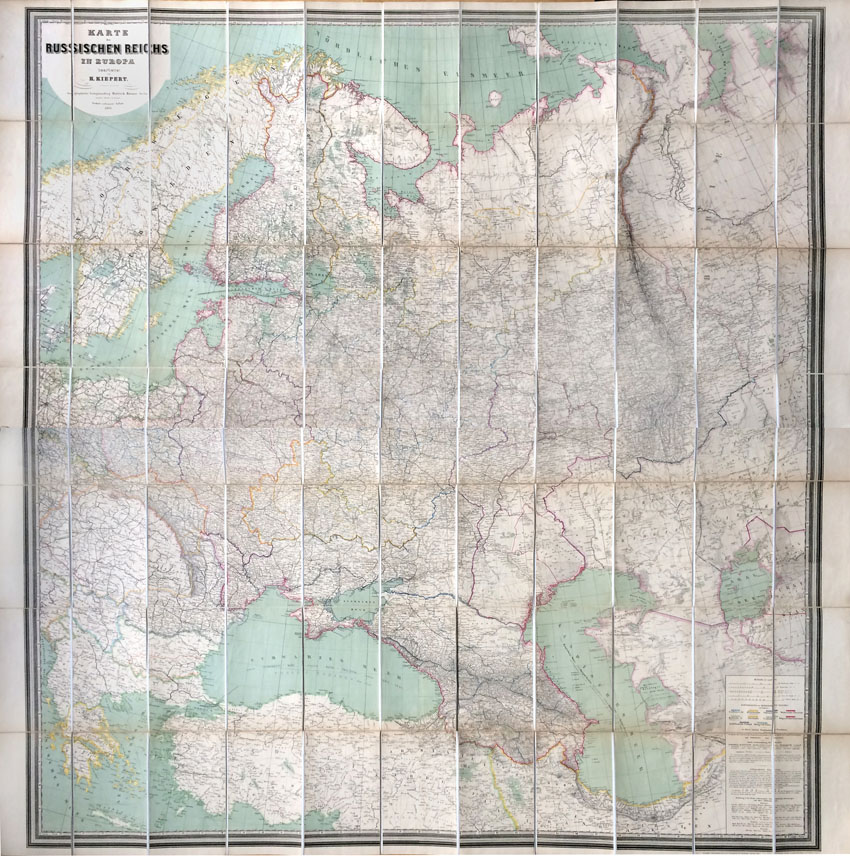
1893réf. 49033ABBerlin, Dietrich Reimer, 1893. Farblithografie, zwei Teile je 122,5 x 67,5 cm (Blattgr. 137,5 x 71 cm) in zus. 88 Segmenten auf Leinen aufgezogen. Zusammen in Leinenschuber d. Zt. mit Titelschild der Londoner Landkartenhandlung Edward Stanford, r1 6. verb. Auflage. (dieser mit geringen Gebrauchsspuren).
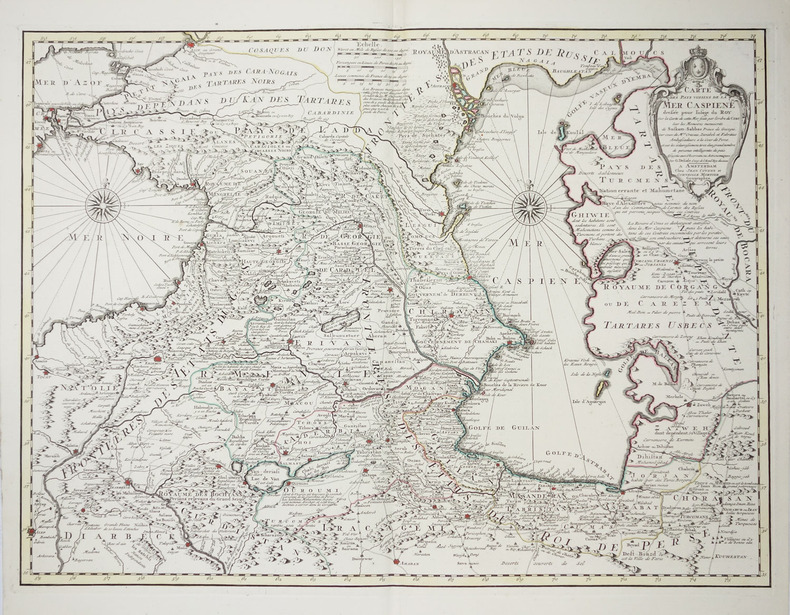
1730réf. LBW-2256Amsterdam, Jean Covens et Corneille Mortier, [circa 1730]. 458 x 616 mm.