17 624 résultats
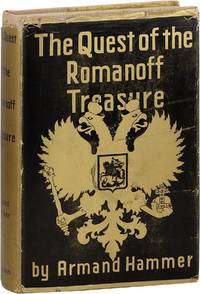
1936réf. 83612New York: The Paisley Press Inc. Succeeding William Farquhar Payson 1936. Stated Third Edition. Octavo. 21.5cm. Publisher's heavy grain pale grey cloth titled and decorated in gilt to spine and front board. Dustjacket. xi; 241pp. Some wear and discoloration to extremities very light it's a very solidly produced book so wear and tear is represented by darkening of the cloth at the edges and some softening of the spine ends rather than anything more drastic; internally clean ownership to front pastedown author's signature to front flyleaf; in a handsome example of the gold and black dustjacket with some chipping and shallow loss to the spine ends scuffing and rubbing to the gilt paper coating and some marginal creasing and soiling. A very good solid copy. Illustrated throughout with full page plates. For a man named by his father after the logo of the American Socialist Labor Party after slipping out of Odessa in the 1870's Armand Hammer's journey to become one of the world's most influential businessmen and "Lenin's Favorite Capitalist" must have been a dramatic one. His father Julius had spent much of the early 20th century consolidating his role at Allied Drug and Chemical which was essentially at times a smuggling front shipping embargoed goods to Russia during the US trade sanctions. After Julius was sentenced to 3 years in Sing Sing allegedly for a botched abortion that resulted in the death of a Russian woman from subsequent pneumonia although modern research suggests that Armand a medical student might have been the one who performed the abortion and Julius took responsibility as the qualified senior medical professional present Armand took over Allied Drug and Chemical and raised it to new heights of corporate success. During Prohibition Allied's largest seller was a essentially alcoholic ginger ale sold as a medicinal tonic to great profit. Acting under the instructions of his imprisoned father Armand began taking numerous business trips to the Soviet Union. A young J. Edgar Hoover at that point basically an analyst at the Justice Department very strongly believed that the equally youthful Hammer was a COMINTERN courier and essentially placed him under surveillance for the rest of his life. Hammer's trips to Russia were ostensibly to recoup bad debts but this quickly developed into a number of lucrative business deals not least of which was selling cheap wheat to starving famine hit areas of Russia. Hammer developed a close co-operative no pun intended relationship with Lenin which resulted in a number of very high status business contracts and deals ranging from medical import contracts to 25 year's worth of asbestos mining in the Urals; one of Hammer's greatest coups was arranging payment for various services in furs caviar jewellery and antiquities seized by the Party from its long tail of enemies making him essentially a conduit for looted and otherwise dubious art jewels and antiques. At the height of Lenin's New Economic Policy Armand Hammer was the sole trade liason between the enormity of Soviet Russia and 38 major US corporations seeking to build trade deals through him. His grasp of the downrange necessities of dealing with the Soviets; graft bribery corruption and palm greasing was legendary and by the 1970's when his methods were starting to be inspected more closely there was no doubt that Hammer's understanding of legitimate business was secondary to his instinctive abilities in the fields of corporate and beaurocratic bribery and manipulation. This book is one personal perspective on the empire of treasure that Hammer accumulated; there are others and the entangled ephemeral traces of looted artworks forged and unfinished Fabergé eggs specially manufactured jeweller's tools designed to copy Fabergé's style exactly and a wealth of other foggy rumors and suspicions ranging from Armand the KGB stooge to Armand the James Bond Villain bent on Soviet domination through capitalism will continue to follow in his wake whether he be considered a legitimate businessman or a highly successful 20th century robber baron of legendary proportions. The Paisley Press Inc. Succeeding William Farquhar Payson unknown
1999réf. x-0313305110Greenwood Pub Group 1999. Hardcover. New. 773 pages. 9.75x6.25x1.50 inches. Greenwood Pub Group hardcover
réf. MB99Six leaves all Elephant Folio ca. 63x77 cm or 20 ¼ x 24 ¾ in. With a notary stamp a small wax seal and six revenue stamps. Leaves stitched through on the bottom and folded. Brown ink on vellum filled in on one side. Fold marks outer leaf soiled and slightly rubbed otherwise a very good document. Interesting original real estate document written and certified in Saint Petersburg. Concluded between British merchants in Saint Petersburg William Gillison Bell of Melling Hall and Thomas Graven the contract was witnessed by local merchants James Liddell and John Ledderdale. William Gillison Bell was later listed as a member of the United Company of Merchants of England see: A List of the Names of the Members of the United Company of Merchants of England Trading to the East Indies… London 1825 p. 10. John Ledderdale 1782-1845 was the father William Lidderdale 1832-1902 Director 1870 Deputy Governor 1887 and the Governor of the Bank of England 1889-1892. The contract was certified signed and sealed by Saint Petersburg public notary Stephen Sasonoff on June 2 1816 and further certified by the British Consul General in Russia Sir Daniel Bayley 1766-1834 on June 7 1816. “For two centuries after the foundation of St Petersburg in 1703 the British merchant community exercised a remarkable influence over the city's economic relations with the wider world. This community operated as a 'City of London' in miniature and where the merchants led others - diplomats travellers soldiers sailors engineers craftsmen and others - followed. As the new capital grew in splendour Britons acquired or rented some of the city's finest residences. At the end of Catherine II's reign the city's first grand embankment along the Neva between the Senate later Decembrist Square and the New Admiralty Canal came to be known as the English Embankment” Thompstone S. On the Banks of the Neva: British Merchants in St Petersburg before the Russian Revolution// History Today Vol. 53 No. 12. Sir Daniel Bayley “became a merchant at St Petersburg being a partner in the great Russian house of Thorntons and Bayley firm dissolved 30th April 1810. He was appointed 9th October 1812 His Britannic Majesty’s Consul-General at St. Petersburg and was also agent to the Russia company. He was knighted 20th June 1815 and his services as chargé d’affaires during the absence of the English ambassador were also rewarded by the knighthood of the Hanoverian Guelphic Order” Axon E. The Family of Bayley of Manchester and Hope. Manchester 1894 p. 19-20. hardcover
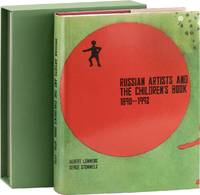
1990réf. 81719Nijmegen: LS 1990. First Limited Edition. Deluxe issue one of eleven copies in slipcase signed by both authors and issued with an original Soviet children's book in this case a copy of Kornei Chukovsky's Telefon Moscow: 1936 with illustrations by Vladimir Konashevich. Quarto 28cm; cloth hardcover dustjacket 511pp; illus. Supplemental DVD laid in as-issued. A fine copy in a crisp unworn dustwrapper and unworn slipcase. The included copy of Telefon is housed in a folding chemise designed to slip into the same slipcase as the main volume; staple-bound pictorial wrappers; 16pp light toning and wear to wrappers else Near Fine. A most desirable copy of what has become a standard English-language reference for Russian illustrated children's books. The deluxe issue is necessarily rare and seldom offered for sale. LS unknown
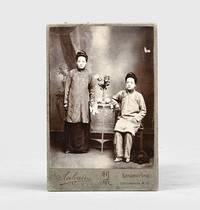
1890réf. 154515Vladivostok: Livay Studio No. 11 Svetlanskaya Street c. 1890. A scarce late 19th-century record of styles of clothing and foot-binding followed by well-to-do Chinese women in the Russian border city of Vladivostok. The Livay photographic studio catered specifically to Chinese residents and visitors and we have not been able to trace any other surviving examples of its work. Following China's transfer of the Haishenwei region to the Tsar in 1860 Vladivostok became a thriving centre of economic activity and cultural interchange between Russians and Chinese with both of these communities served by the Livay studio based on the city's main boulevard. This photograph is a pleasing corrective to the many surviving photographs of late-imperial Chinese women often produced in cities such as Shanghai which adopt an orientalizing gaze. While photography was introduced into Russia soon after its invention it remained a preserve of the very wealthy until the 1860s when technological changes fuelled an explosion in the number of photographic studios in major cities. "In the hands of commercial studio photographers the medium retained its original social function namely "to solemnize and to immortalize" the portrayed subject. The studio photograph was an index and a means of communicating one's status; it indicated the sitter's place in the social hierarchy both as a commodity object and as information. But more importantly photography dominated the market for portraiture and democratized visual self-representation. It captured people from across the social spectrum and brought about a visual levelling whereby the social benefits and drawbacks of this type of publicity was showered equally on kings nobles lawyers merchants and cobblers. Photography as a mechanized medium of self-representation pulled members of different social class onto the same visual level in the public sphere" Stolarski pp. 4-5. Cabinet card 164 x 108 mm mounted gelatine photograph 140 x 103 mm with glossy finish card lettered in red in Russian and Chinese. Small scuff to upper right corner of photograph image substantially unaffected couple of faint stains to card verso skinned where sometime mounted. A very good example. Christopher Stolarski "The Rise of Photojournalism in Russia and the Soviet Union 1900-1931" PhD Diss. 2013. hardcover
1769réf. 719841769. Lausanne: Francois Grasset & Comp. 1769. Lausanne: Francois Grasset & Comp. 1769. Early French Translation of an Important Document of the Enlightenment Catherine II 1762-1796 Empress of Russia. Balthasar Joseph Anton Felix von 1737-1810 Translator. Instruction Donnee par Catherine II. Imperatrice et Legislatrice de Toutes les Russies a la Commission Etablie par cette Souveraine pour Travailler ala Redaction d'un Nouveau Code de Loix Telle Qu'elle e ete Imprimee en Russe & en Allemand Dans l'Imprimerie Imperiale de Moscow. Nouvelle Edition Augmentee. Lausanne: Chez Francois Grasset & Comp. 1769. xiv 160 i.e. 204 pp. Lacking dedication leaf and copperplate portrait frontispiece. Quarto 7" x 4-3/4". Recent period-style three-quarter calf over marbled boards raised bands and red and black lettering pieces to spine marbled endpapers untrimmed edges. Light rubbing to extremities light fading to spine. Moderate toning light foxing in a few places. $1250. Third French-language edition. An important document of the Enlightenment the Nakaz or Instruction composed by Catherine the Great served to guide the assembly summoned in 1766 to draft a new code of laws for the Russian Empire. Drawn primarily from Montesquieu as well as Rousseau Beccaria and other Enlightenment thinkers the Nakaz condemned torture and capital punishment and endorsed such principles as the equality of all before the law. Published in the principal European tongues between 1767 and 1769 it proved to be a statement to the world as much as a practical legal text. Three editions in French were published in 1769 first in Moscow then in Yverdon with a false St. Petersburg imprint and Lausanne. In 1769 Duc de Choiseul added the "libertine" Nakaz to the list of books prohibited in France. Balthasar the translator of our edition was a Swiss historian and member of the Enlightenment's international "Republic of Letters." His introduction pp. iii-iv is a notable document of the early reception of the Nakaz in Western Europe. Graesse Tresor de Livres Rares et Precieux II:80. unknown
1931réf. 95764Paris : Librairie Stock 1931. reliure toile. MARIE DE RUSSIE.Education d'une princesse. Mémoires traduits de l’anglais par F. W. Laparra. Préface d’André Maurois. Paris Librairie Stock1931 200x140mm frontispiceXXIII - 406 pages illustré reliure toile. Pièce de titre et d’auteur dorés au dos. Edition originale sur papier vélin d’Alfa satiné numérotée n.° 938 / 1160. Bel exemplaire. No hidden customs fees for orders shipped to the U.S.A with a value of up to 800 USD PDDP shipping we pay the VAT in advance Librairie Stock unknown
réf. RGW19683Aquatint with original hand-colouring from 'A Picture of St Petersburgh represented in a collection of Twenty interesting Views of the City the Sledges and the People . . .' unknown
réf. RGW19426AAquatint with original hand-colouring from 'A Picture of St Petersburgh represented in a collection of Twenty interesting Views of the City the Sledges and the People . . .' unknown
réf. RGW19427AAquatint with original hand-colouring from 'A Picture of St Petersburgh represented in a collection of Twenty interesting Views of the City the Sledges and the People . . .' unknown
réf. RGW20400Aquatint with original hand-colouring from 'A Picture of St Petersburgh represented in a collection of Twenty interesting Views of the City the Sledges and the People . . .' some fading to colouring unknown
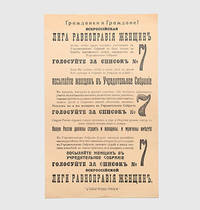
1917réf. 134554Petrograd: Tsentr. Tipograf 1917. A new Russia should be built by women and men together A remarkable survival of a flyer printed by the All-Russian League of Equal Rights for Women for their political campaign for the election to the Constituent Assembly in November 1917. The League participated in elections as its own party under the number 7. In English the flyer text reads: ''Female Citizens and male citizens! The League of Equality for Women wishing that the right of women to participate in the Constituent Assembly was not only on paper expose its candidates to the Constituent Assembly. Vote for the list number 7. If you want our children not to grow up without a home and the old people to not die on the street - send women to the Constituent Assembly. In America Australia and other countries where women take part in the drafting of laws the number of schools is multiplied prisons are empty debauchery and drunkenness noticeably diminish the protection of children and the elderly is fully secured by law. Let's send women to the Constituent Assembly too. The old Russia was built only by men and the grief and misfortunes of the motherland were always shared with them by mothers wives and daughters. A new Russia should be built by women and men together! The most important Russian laws will be written in the Constituent Assembly. From the laws that will be created in the Constituent Assembly the fate and life of many generations depends not only on men but also on women and so send women to the Constituent Assembly.''. The campaign for women's political rights in Russia termed the ''women's liberation movement'' became possible only with the beginning of the revolution in 1905 when the question of the democratization of the political system arose. The oldest women's association in Russia the All-Russian Women's Mutual Charity Society established in 1895 was actively involved and new organizations were created: the Union for the Equality of Women 1905 Women's Progressive Party 1905 and the All-Russian League of Equal Rights for Women 1907. The most influential organization was the first the Union which had 48 offices in various cities across Russia and actively conducted agitation among women workers and peasants. After its disintegration the League of Equal Rights for Women became its successor. Members of the League deliberately abandoned the broad political programme and focused their attention only on suffragist demands practising agitation tours through the provinces Orel Saratov Rostov-on-Don Kremenets Tomsk Kiev Simferopol and Narva. As a result branches of the League emerged in many cities including Moscow 1910 Kharkov 1912 Tomsk 1914 and Yekaterinburg 1914. This included the establishment of the following departments: a reading room for street children with a view to preventing child prostitution; a publishing committee that printed cheap pamphlets and books on women's issues; and an editorial commission that published the proceedings of the congress. Every day reports were given on the issues of women's equality in the League's premises. After the February Revolution delegates from the League repeatedly met with the leaders of the Soviet of Workers' and Soldiers' Deputies on the issue of women's suffrage. Despite initial promises of support they refused to immediately act on granting political rights to women. In response the League organized the famous mass march on 20 March 1917 which brought together about 40000 women. To that date it was the most numerous and memorable stand by the Russian women's movement and resulted in the adoption by the Provisional Government of a decree on universal suffrage which was passed on 20 July 1917. Single-sided flyer 365 x 220 mm. In near-fine condition. unknown
1798réf. 132180St Petersburg: A l'Academie Imperiale des Sciences 1798. First and only edition. Single location on WorldCat at BL KVK adds a copy in the Austrian National Library lacking 2 plates; and copies in the Zentralbibliothek der Bundeswehr Düsseldorf and Universitäts- und Landesbibliothek Sachsen-Anhalt Halle. Decidedly uncommon infantry manual for the Imperial Russian Army from the brief reign of Tsar Paul I r.1796-1801. Paul had travelled extensively in Europe and had developed a taste for French and Italian architecture and Prussian military practice taking immense pleasure in rigidly drilling his private brigade of troops in the Versailles-inspired grounds of his estate at Gatchina. When he ascended the throne he attempted to remodel the army along Prussian lines introducing entirely impractical uniforms a regime of elaborate ceremonials and parades and as shown here the implementation of rigourous regulations and drill. The present manual was directly translated into French from its Prussian equivalent the words of command also being given in phonetically rendered Russian. Paul was assassinated by a group of disaffected army officers after just 4 years on the throne. Octavo 196 x 110 mm. 13 folding plates at the rear; somewhat erratically numbered no plate 1 2 plans numbered 4 but apparently complete. Recent mottled sheep-backed marbled boards by G. Gauché Paris red morocco label gilt rules to the spine. Spine lightly sunned light soiling to the title page pale toning to the text-block throughout overall very good. hardcover
1815réf. 120459London: Printed for Edward Orme 1815. Magnificent hand-coloured views of St Petersburg First edition "one of the most beautiful plate books of St Petersburg" Bobins Collection offering a wonderfully evocative picture of the city in the wake of the Napoleonic Wars issued during the lifetime of one of its most famous inhabitants Alexander Pushkin. Published at 6 guineas coloured this is a superb record of the city of Peter the Great and is divided into two sections: the first 12 plates represent the months of the year through characteristic views of the city; the other 8 illustrate different modes of transport various types of sledges and carriages but include excellent character studies showing diverse types of costume by class and by season. The 26-page introduction entitled "The present state of St Petersburgh" includes a brief historical survey and a few statistics along with descriptions of the main sites and monuments. "Though unsigned the letterpress was chiefly compiled from Robert Ker Porter's Travelling Sketches in Russia and Sweden during the years 1805-1808 as many sections repeat his text verbatim" Giroud p.72. Mornay the artist responsible for the original sketches upon which Clark and Dubourg's aquatints were based eludes identification and does not appear in Thieme-Becker. Martin Hardie in characteristically waspish fashion describes the plates as "lurid in colouring very much in the style of toy theatre scenery" English Coloured Books 1906 p. 138; this is entirely unfair the colouring in the present copy is certainly not "lurid" and the "toy theatre" quality of the views only lends them a most appealing charm: many of them are composed in such a way that they resemble vues d'optiques - symmetrical and theatrical middle-distance perspectives - which combine well with the small scaling figures staffage adding splashes of bright colour against backgrounds of snowy streets grey skies and yellowish-brown buildings of this "city of stone" forming a satisfyingly picturesque effect. Two of the buildings shown - the Exchange 1809 and the Kazan Cathedral 1811 - had only recently been completed. Edward Orme - "Publisher to His Majesty and HRH the Prince Regent" - was "after Rudolph Ackermann the most important publisher of illustrated books during the short golden age of the coloured aquatint" ODNB. He would have had a prudent eye on the visit of the Allied sovereigns to London in June 1814 which celebrated the Treaty of Fontainebleau 11 April 1814 and the peace following the defeat and abdication of Napoleon. Among them was Tsar Alexander I who stayed with his sister the Grand Duchess of Oldenburg at the Pulteney Hotel on Piccadilly. "In 1809 Edward Orme had begun buying land and property in Bayswater London. He exploited the gravel deposits built houses and in 1818 added a chapel of ease. Orme Square developed between 1823 and 1826 was named after him and Moscow Road and St Petersburgh Place nearby may have commemorated the state visit of Tsar Alexander I in June 1814. In the following year he published a volume of twenty coloured aquatint views of St Petersburg and the reference in his will to jewellery presented to him by the emperor of Russia may be connected with these events" ibid. This is a marvellous survey of one of the world's great cities captured at the time when it served as the backdrop for Tolstoy's War and Peace. Folio 469 x 310 mm. Additional engraved title page incorporating a large double-headed Russian eagle 20 hand-coloured aquatint plates by Clark & Dubourg after Mornay; watermarks: plates J. Whatman 1825 text W. Balston 1813. Late 19th-century dark brown morocco-grain half skiver professionally refurbished marbled sides gilt edges drab grey endpapers. From the library of noted bibliophiles Maxine and Joel Spitz with their "Trail Tree" bookplate Joel Spitz was a member of Chicago's prestigious Caxton Club. Light offsetting from frontispiece to engraved title. An excellent copy the plates fresh and bright and with the four leaves of explanation of the plates in French and English. Abbey Travel 226; Bobins Collection 203; Tooley 355; Vincent Giroud St. Petersburg: A Portrait of a Great City Yale University Press 2003. unknown
1893réf. 653421893. St. Petersburg: Izd. L.F. Pantelieeva 1893. St. Petersburg: Izd. L.F. Pantelieeva 1893. The Last Edition of the Nakaz Published in the Nineteenth Century Catherine II 1762-1796 Empress of Russia. Bezgin Il'ia Grigor'evich Editor. Nakaz Eja Imperatorskago Velicestva Ekateriny Vtoryja Samoderzicy Vserossijskija Dannyj Kommissii o Socinenii Proekta Novago Ulozenija. St. Petersburg: Izd. L.F. Pantelieeva 1893. 53 201 pp. Text of Nakaz in Russian with parallel French translation. Original printed stiff wrappers bound into recent quarter calf over cloth gilt fillets and lettering piece to spine endpapers renewed. Gilding mostly rubbed away from lettering piece light soiling and edgewear to wrappers moderate toning to text faint dampspotting to a few leaves. Small early owner label to front free endpaper internally clean. $1750. The last edition published in the nineteenth century. The Nakaz or Instruction is a statement of legal principles written by Catherine II between 1764 and 1766. It was among her most ambitious and significant undertakings. Infused with the ideas of the French Enlightenment and copied mostly from the work of Voltaire Montesquieu and Beccaria it was compiled as a guide for the All- Russia Legislative Commission convened by the Empress in 1767 to create a new code to replace the 1649 Muscovite Code. Revised in consultation with Frederick the Great and Voltaire the Instruction proclaimed the equality of all men before the law and denounced torture and the death penalty. Unfortunately her proposed code was never completed. The first two editions one with parallel texts in Russian and German were published in 1767. OCLC locates 1 copy in a North American law library Columbia. Another copy located at Harvard Law School. Butler The Nakaz of Catherine the Great 526 Entry 18. unknown
1907réf. 653411907. The First Edition of the Nakaz Published in the Twentieth Century Catherine II 1762-1796 Empress of Russia. Chechulin Nikolai Dmitrevich 1863-1927 Editor. Nakaz Imperatritsy Ekateriny II Dannyi Kommissii o Sochinenii Proekta Novago Ulozheniia. St. Petersburg: Izd. Iurid. Knizhnago Sklada "Pravo" 1907. ii cliv 174 pp. Three folding plates of facsimile manuscript leaves. Text of Nakaz in Russian with parallel French translation. Contemporary pebbled cloth light rubbing to extremities with minor wear to spine ends and corners which are bumped. Light toning to text a few leaves have carefully repaired tears. Early inscription and owner inkstamp to title page interior otherwise clean. $1250. The first edition published in the twentieth century. Title two in the series Pamiatniki Russkago Zakonodatel'stva 1649-1832. The Nakaz or Instruction is a statement of legal principles written by Catherine II between 1764 and 1766. It was among her most ambitious and significant undertakings. Infused with the ideas of the French Enlightenment and copied mostly from the work of Voltaire Montesquieu and Beccaria it was compiled as a guide for the All- Russia Legislative Commission convened by the Empress in 1767 to create a new code to replace the 1649 Muscovite Code. Revised in consultation with Frederick the Great and Voltaire the Instruction proclaimed the equality of all men before the law and denounced torture and the death penalty. Unfortunately her proposed code was never completed. The first two editions one with parallel texts in Russian and German were published in 1767. Our 1907 edition may have been inspired by a spirit of reform fired by the Russian Revolution of 1905. OCLC locates 1 copy in a North American law library Columbia. Another copy located at Harvard Law School. Butler The Nakaz of Catherine the Great 526 Entry 19. unknown
1769réf. 647731769. Early French-Language Edition of Catherine's Nakaz Catherine II 1762-1796 Empress of Russia. Landres J. Rodolphe Frey de Translator. Instructions Adressees par Sa Majeste L'Imperatrice de Toutes les Russies: A la Commission Etablie Pour Travailler a L'Execution du Projet d'un Nouveau Code de Lois. Traduit de l'Allemand. "A Petersbourg" i.e. Yverdon Switzerland: s.n. 1769. 286 pp. 12mo. 6" x 4". Early quarter vellum over marbled boards untrimmed edges a few unopenened signatures. Light soiling corners lightly bumped and worn. Moderate toning to interior somewhat heavier in places some leaves have light foxing a few have light dampstaining to margins internally clean. Ex-library with a small inkstamp to title page. A handsome copy. $1000. Reissue of the first edition in French published by the St. Petersburg Academy of Sciences for private distribution in 1769. This important text also known as the Nakaz or Instruction is a statement of legal principles written by Catherine II from 1764 and 1766. Permeated with the ideas of the French Enlightenment and copied mostly from the work of Voltaire Montesquieu and Beccaria it was compiled as a guide for the All-Russia Legislative Commission convened by the Empress in 1767 to create a new code to replace the 1649 Muscovite Code. Revised in consultation with Beccaria Frederick the Great and Voltaire the Instruction proclaimed the equality of all men before the law and disapproved of death penalty and torture. Unfortunately her proposed code was never completed. Catherine's manuscript was written in French and she later produced a Russian translation. Editions in German and Russian were published in Moscow in 1767. The book was initially banned in France because it was too liberal which is why the first French-language edition was produced in Switzerland with a false imprint. French and Latin editions were eventually published in 1770. OCLC locates 6 copies of this imprint in North American law libraries Columbia George Washington University Harvard Library of Congress UC-Berkeley Yale. Butler The Nakaz of Catherine the Great 531 Entry 40. unknown
1771réf. 647971771. Amsterdam 1771. 2nd Dutch ed. Amsterdam 1771. 2nd Dutch ed. Scarce Early French-Language Edition of Catherine the Great's Landmark Legal Treatise Issued by Marc-Michel Rey The Premier Publisher of the Enlightenment Catherine II 1762-1796 Empress of Russia. Instruction de Sa Majeste Imperiale Catherine II. Pour la Commission Chargee de Dresser le Projet d'un Nouveau Code de Loix. Amsterdam: Chez Marc Michel Rey 1771. vii 229 pp. Frontispiece engraved copperplate medallion portrait of Catherine II by C.A. Boily. Octavo 7-3/4" x 4-3/4"; 19.68 x 12.06 cm. Contemporary mottled calf blind rules to boards gilt spine with lettering piece edges rouged marbled endpapers. A few minor scuffs to boards moderate rubbing to extremities spine ends worn front joint starting at ends corners bumped and somewhat worn. Light toning to text dampstaining and light foxing to a few leaves internally clean. An attractive copy. $1250. Second Dutch edition. Known universally as the Nakaz or Instruction this monument of legal philosophy was composed by Catherine II between 1764 and 1766 as a guiding manual for the All-Russia Legislative Commission convened in 1767. Intended to replace the outdated Sobornoye Ulozheniye 1649 Muscovite Code the treatise stands as one of the most prominent practical applications of Enlightenment jurisprudence in early modern Europe. Heavily influenced by Montesquieu's De l'Esprit des Lois and Beccaria's Dei Delitti e Delle Pene the text translates radical legal theories into imperial policy. It explicitly advocated for equal protection under the law for all citizens abolition of torture and strict limitation of the death penalty prevention of crime over retributive punishment and judicial proportion between crimes and penalties. Catherine drafted the original text in French and subsequently produced a Russian translation. Following the initial 1767 Moscow printings in Russian and German regional editions proliferated across Europe. The text was famously banned in France by Louis XV due to its radical political liberalism-a censorship event that only increased continental demand. The first Dutch edition was published in Dutch translation in 1769. This 1771 imprint by Marc-Michel Rey represents the first Dutch edition printed in the original French. Publishing from Amsterdam Rey was the principal printer for ra. unknown
1771réf. 648601771. Amsterdam: Chez Marc Michel Rey 1771. Amsterdam: Chez Marc Michel Rey 1771. Attractive Early Amsterdam Edition of Catherine's Nakaz Catherine II 1762-1796 Empress of Russia. Instruction de Sa Majeste Imperiale Catherine II. Pour la Commission Chargee de Dresser le Projet d'un Nouveau Code de Loix. Amsterdam: Chez Marc Michel Rey 1771. vii 229 pp. Copperplate portrait frontispiece. Octavo 7-3/4" x 4-3/4". Later patterned-paper covered boards calf lettering piece to spine patterned endpapers. Minor wear to spine ends and corners front joint starting at ends. Negligible light toning to text dampstaining to bottom and fore-edges of text block very faint in most places in preliminaries somewhat darker. A nice copy. $1250. Second Dutch edition. This important text also known as the Nakaz or Instruction is a statement of legal principles written by Catherine II from 1764 and 1766. Permeated with the ideas of the French Enlightenment and copied mostly from the work of Voltaire Montesquieu and Beccaria it was compiled as a guide for the All-Russia Legislative Commission convened by the Empress in 1767 to create a new code to replace the 1649 Muscovite Code. Revised in consultation with Beccaria Frederick the Great and Voltaire the Nakaz proclaimed the equality of all men before the law and disapproved of the death penalty and torture. Unfortunately her proposed code was never completed. Catherine's manuscript was written in French and she later produced a Russian translation. Editions in German and Russian were published in Moscow in 1767. Several editions followed in nations ranging from Italy to Latvia. The first Dutch edition in Dutch translation was published in Amsterdam in 1769. The 1771 Amsterdam edition was the first Dutch edition in French. It is a scarce imprint. OCLC locates 2 copies in North American law libraries Library of Congress UC-Berkeley. Butler The Nakaz of Catherine the Great 528 entry 28. unknown
1866réf. 030652London: Chapman And Hall 1866. 1st Edition . Hardcover. Fine. Vi 298 Pp. Modern Blue Cloth Gilt Stamped Black Leather Spine Label. The Modern Binding Is Fine Contents Just Very Good With Wear At Corners And Slight Even Foxing To Title Page. Scarce. Morley Reports That The Observations Were Provided By A Friend Who Brought Them From A Doctor Long Resident In Russia. The Quality And Immediacy Of The Observations Are Remarkable. Chapman And Hall hardcover
1964réf. 031153Moscow: Books 1964. 1st Edition . Hardcover. Very Good/No Jacket. Photographs Throughout. 404 Pp. Cream Cloth.10 1/2" Tall. Text In Russian. One Of 5000 Copies But Scarce In The West Only Four Institutional Holdings Recorded In Worldcat. Books hardcover
1960réf. 029657Moscow / Moscou / Moskau / Moscu: Ussr Foreign Languages Publishing House Circa 1960/1963 1960. 1st Edition 1st Printing. Hardcover. Very Good/Very Good. Color And B/W Photographs Throughout. Large Format Photography Book In Five Languages Russian English French German And Spanish. A Few Text Pages 147 Numbered Plates. Silver Cloth Printed In Black. Photographic Paper Dj With Additional Clear Plastic Dj. Book With Very Slight Wear But Still Fraying Along Bottom Edge Of Spine With Printed Lettering. Dj's With Light Wear And Short Tears At Corners Small Chips To Plastic Dj At Top And Bottom Of Spine. Ussr Foreign Languages Publishing House Circa 1960/1963 hardcover
1920réf. 029670Vienna Lvov Etc.: 1917-1921 1920. 1st Edition . No Binding. Very Good. Four Postcards Of Ukrainian Patriotic Subjects Anti-Russian Color Illustrations Of Patriotic Subjects Four Different Publishers Undated But Circa 1917-1921 Unused But Somewhat Worn And Aged. One Dramatic Postcard Shows A Peasant Woman Tied To A Cross Two Children At Her Feet Burning City And Village In Background Four Black Evil Fantastic Birds Coming At Her At Top One Bird With Russian Hat With Red Star Another Wearing The Russian Imperial Crown; Ukrainian Text On Reverse 8 Lines And Three Lines Explanatory Text In Ukrainian And German. The Moscow Orks From The Northeast Lithuania Poland And Hungary From The West The Don Cossacks And Turkey From The South And The Mongols From The Southeast Have Fought Over The Vast Plains Now Independent Again As "Ukraine" For 1200 Years But The Battlefields Are Much Older Extending Into The Dim Recesses Of Ancient History And The French And Germans Have Made Their Own Attempts From Further West. The Inhabitants Of The Mediterranean Countries East Asia Africa And Central And South America Have Been Largely Innocent But Received Huge Numbers Of Refugees Fleeing Repeated Incursions Into Ukraine. Vladimir Putin Claims That Reads History Carefully But Has Missed The Vast Majority Of Historical Material On Ukraine Apparently A Visual Or Comprehension Impediment. 1917-1921 unknown
1999réf. 029800U.S.A.: Edition Stemmle 1999. 1st Edition . Hardcover. Fine/New. 224 P. Hardcover. As New Still In Original Shrinkwrap Unopened. Fine In Fine Dust Jacket. Edition Stemmle hardcover
1943réf. 026844Washington circa 1943: Embassy of the Union of Soviet Socialist Republics 1943. First Edition . Thick Brown Card Wrappers. Good. Tall. Photographs Throughout. Unpaginated. Propaganda Piece Celebrating Victories Over Germans With Promise Of Revenge To Come. Wear At Edges Small Losses At Head And Foot Of Spine. Binding Intact But Title Page Detached Damaged Where Torn Out From Binding Clips. It Is Clear That The Only Time Soviet Russia Does Not Seek The Destruction Of Western Governments Is When They Need Something Desperately As In Wwii. Accommodating Any Russian Government Action Is A Fool's Errand. Russia Hoped That Highlighting The Battle Of Stalingrad Would Ignite Our Jealousy As The West Has Always Sought The Same Oil From The Caucasus That Hitler Needed For Survival The Same Oil That International Oil Companies Now Seek But Now Of Course There Are Vastly Greater Petrochemical Resources Elsewhere In Russia That They Are Clawing Their Way Towards. . Embassy of the Union of Soviet Socialist Republics unknown