727 Ergebnisse
Best.-Nr. 216007Paris, Imprimerie de Beaulé et Compagnie, s.d. (1854) placard in-folio (55 x 44 cm), texte sur 4 colonnes, avec un grand bois gravé central représentant le sultan Abdülmecid Ier, en feuille, ébarbé, roussi.
Best.-Nr. 215996Paris, Typographie Beaulé et Compagnie, s.d. (1854) placard in-folio (56 x 45 cm), texte sur 5 colonnes, avec un bois gravé central représentant le Sultan, en feuille.
18542 grandi voll. semestrali in-folio (cm. 37,6x27,6), occhielli + front. semestrali ill., pp. 416 + pp. 456 con 1.600 grandi XILOGRAFIE n.t. Solidissime legature coeve in forte e bella stoffa lucida blu zigrinata (aloni, macchie e fioriture) e impressa con cornici di filetti a secco, tit. oro ai ds. Indici alfabetico e delle illustrazioni a ogni vol. Il primo anno della GUERRA di CRIMEA (inziata nel marzo), movimenti di truppe, UNIFORMI varie, armamenti, navi nel Baltico e nel Mar Nero, eventi ecc. Inoltre: Birmania, esercito Persiano, artiglieria Russa, folclore in Perù; bombardamento a Shangai, i Cosacchi, caccia alla pantera, acque minerali, foreste e costumi della CORSICA, condanna d. attentatori a Pellegrino Rossi, emigrazione in America, insurrezione in Grecia, Marengo, caricature di NADAR, MONTE BIANCO, le pulci in Turchia, TURCHIA, RUSSIA meridionale, insurrezione in SPAGNA, SEBASTOPOLI, ferrovia del pacifico, PANAMA (carta del progetto di Garella), Nuova Caledonia, Sudan ecc. L'annata completa
Best.-Nr. 345957 pages 1/2 in8 - En tête: "Ministre d'Etat et de la Maison de l'Empereur" - bon état -
Best.-Nr. 19155Paris, Veuve Berger-Levrault et fils, 1859. In-folio oblong, 151 plans, cartonnage éditeur à dos de toile bleue (taches, quelques rousseurs, quelques petites déchirures, en cours de débrochage).
Best.-Nr. 3457Paris, Amyot, nd (1855). Deux tomes, grands in-8° reliés dans le même volume, 431+432 pages. Demi-reliures chagrin sombre, dos orné, 4 nerfs filets dorés. Nombreuses gravures.
1898Best.-Nr. 86223Plon, 1898-1913 6 vol. in-8°, xv-560, 576, ii-547, ii-437, 491 et xxix-635 pp, un portrait en héliogravure en frontispice, 15 cartes hors texte, dont 9 dépliantes (une en couleurs), brochés, bon état
1842In-8 p. (mm. 216x135), 2 volumi, mz. pelle coeva, fregi e tit. oro al dorso. L’opera, con testo su due colonne, molto ben illustrata da complessive 164 tavv. inc. in rame (poste alla fine dei volumi), è così suddivisa: - Vol. 1°: "Russia" di Chopin, pp. (4),395, con 100 tavv. + 4 cartine geografiche (litorale del Mar Nero - del Mar Caspio - del Mare Baltico - Siberia ed America russa). - Vol. 2°: (continuazione e fine della “Russia”), pp. 397-666 (incluso l’Indice delle materie) - "Crimea" di Cesare Famin, pp. 32, con 8 tavv. + 1 cartina geografica - "Regione Caucasia" (Giorgia e Circassia) di Cesare Famin, pp. 48, con 12 tavv. + 1 cartina geografica - "Armenia" di E. Boré, pp. 148, con 36 tavv. + 2 cartine dell’Armenia (antica e moderna). Volumi della Collana “L’Universo o Storia e descrizione di tutti i popoli, loro religioni, costumi, usanze, ecc.”. Solo un risg. e un occhietto con fiorit., altrimenti fresco esemplare ben conservato.
Best.-Nr. 498255Chez Maradan Londres - paris 1789 In-8 ( 200 X 125 mm ) de ( 4 )-443-( 5 ) pages, demi-basane fauve, dos lisse orné de filets dorés, pièce de titre de maroquin noisette. ( Reliure de l'époque ). 1 carte et 5 planches dépliantes hors-texte ( sur 6, la planche 4 est manquante ): Vue de la source de la rivière Karason dans la Crimée - Bateau turc - Cimetière turc - Vue du Nord Ouest de Siphanto - Vue du Couvent de Panacrado prise de la Baye de Gabrio. - La carte dépliante des "Routes de la Crimée anciennement Chersonèse Taurique" a été gravée par P. F. TARDIEU. EDITION ORIGINALE publiée l'année de l'originale anglaise. Margravine d'ANSPACH, Elisabeth CRAVEN ( 1750-1828 ) épousa le Margrave d'ANSPACH BAIREUTH à qui elle adresse les lettres de cette relation. «Relation très recherchée» Chadenat II, 3180 Blackmer 527 ( pour l'édition originale anglaise ). Coins usés, bon exemplaire.
1962Best.-Nr. X114025[Bruxelles], 1962 338pp. Illustrated with some original bl/w drawings and some illustrations in colour tipped in (in and out of text), text in Hungarian, this work in typoscript has never been published (and so it does not appear in OCLC) and so it is most probably the author's copy, green half-cloth binding, gilt title on spine, marbled boards and endpapers, 22cm., good condition, unique copy, X114025
1802Best.-Nr. PHO-1118Paris, Maradan, 1802. In-8 broché, couv. d'attente (dos et dernier plat manquants).Dernière page salie et volante , une petite déchirure marginale sans manque, coins cornés sinon bon exemplaire en attente de reliure.
1959Very Good Tatar Original decorative cloth bdg. Cr. 8vo. (20 x 14 cm). In Tatar. 3 volumes set: (193, [2] p.; 959, [1] p.; 1013, [3] p.). Large and comprehensive collection of Tatar proverbs. 38670 registers in set. No copy in OCLC. Extremely rare. First and Only Edition.
Best.-Nr. 214491Ll. dd., 1844-1872 27 pièces in-4, en feuilles, cousues.
1854Best.-Nr. PHO-2122Paris, Ernest Bourdin & Cie, 1854. Grand in-8 (27,5x18,5cm), XIV-510pp.-2ff., demi chagrin époque, dos lisse avec auteur et titre, légères rousseurs, manque de papier sur le dernier plat Illustré de 27 gravures dont plusieurs en couleurs et 2 cartes repliées et en couleurs dans une pochette in-fine.
183662pp + errata First (only) edition, in French, with Errata leaf at the end. Original printed wrappers, light signs of wear and dust, tiny loss (1cm) at upper spine, date and owner inscription on front cover, internally in G-to-VG conditions. Rare, little known first work by Tito Vanzetti, at that time doctor at the Wien General Hospital, describing his visit to Crimea and including a list of the surgical procedures performed. Prima (unica) edizione, in francese, con foglio di Errata in fine. Brossura editoriale originale, lievi segni di usura e piccola mancanza 1cm alla parte superiore del dorso, firma e data proprietario in copertina, internamente piu' che buone. Rara pubblicazione, primo lavoro del Dr. Vanzetti, medico all'Ospedale Generale di Vienna, sulla sua visita in Crimea, con la lista delle operazioni chirurgiche da lui eseguite durante la visita.
1893Best.-Nr. H120561S. Petersburg, Pantleev brothers 1893 CCCV + 129pp., 26cm., original softcover (spine bit repaired, well protected by an extra transparant cover), pages are still uncut, text is clean and bright, [Translation of title: "Russian-Byzantine Studies, part 2: The lives of saint George Amastris (Amastrida) and Stephen of Sourozh (Souros, Sudak)". Study in Russian with text editions in Greek and translation into Russian. A rare original Russian publication and critical study by the famous Russian byzantinist Vasily Vasilievsky on the lives of the byzantine saints George of Amastris and Stephen of Sourozh], H120561
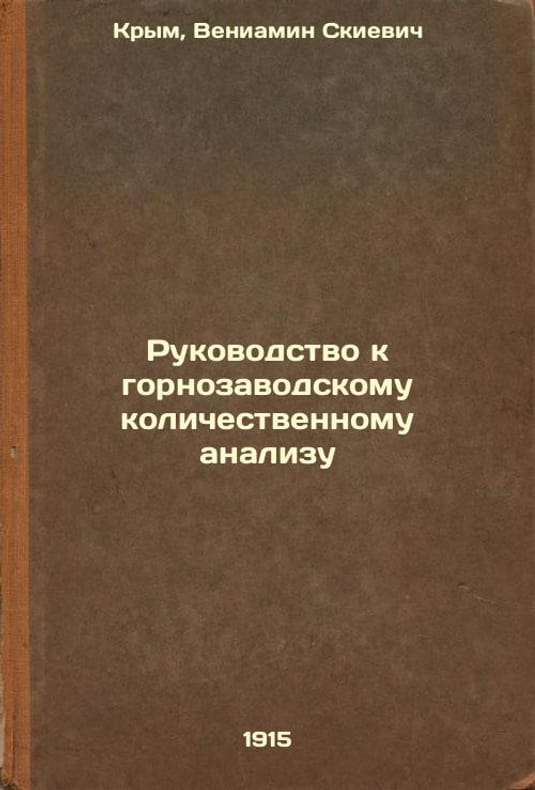
Best.-Nr. 4206031Short description: In Russian. Crimea Veniamin SKyivich. Mining Quantitative Analysis Manual. Kharkiv: Type. Peaceful Labor 1915. The image is provided for reference only. It may reflect condition of one of the available copies or only help in identifying the edition. Please feel free to contact us for a detailed description of the copies available. SKU4206031 unknown
Best.-Nr. 4206031Short description: In Russian. Crimea, Veniamin SKyivich. Mining Quantitative Analysis Manual. Kharkiv: Type. Peaceful Labor, 1915. You are welcome to reach out to us for a detailed description of the copies currently available. Delivery of this book may take longer than usual including extended processing and pre-shipping time, no expedited shipping is available. Please advise us if you have a set date or a deadline to receive your order.SKU4206031
Bella carta tratta dall'opera di Blaeu pubblicata attorno al 1640-dimensioni foglio61.5x47.5 cm- dimensione lastra cm 49.2x37.7- esemplare di fresca tiratura ed in buono stato di conservazione.
1948Very Good English Original autograph letter signed by Vladimir Fedorovich Minorsky, sent to Turkish professor and historian Osman Turan, (1914-1978), was born in year when World War I started. He had some bad conditions in his childhood. Being in Ankara in years when DTCF established was a great chance for him. He was trained by Fuat Köprülü. His studies in the first period were about pre-Islamic Turkish history. But his studies after he became associate-professor were about Seljukians. There isn't a better studying in this field yet than his studies. (Source: Osman Turan's Life (1914/17 - 1978) and Historiography, Tufantoz). Letter has 12 lines in front, and 4 lines on verso, in English completely. It has a plan of a library, probably in the UK which shows Trinity and Sydney Colleges, etc. Letter says: "Dear Dr. Turan, Very good. We shall be waiting for your on Friday. If you are not engaged come andd have lunch with us at 12.45. If you cannot come at 2.30 and I shall show you the Library. Looking forward to meeting you. Yours sinccerely, V. Minorsky'. "When you come to No 9 push the door in front of you...". Repaired margins. Minorsky was a Russian Orientalist best known for his contributions to the study of Persian and Kurdish history, geography, literature, and culture. Minorsky was born in Korcheva, in the Konakovsky District of the Russian oblast of Tver, northwest of Moscow on the upper Volga River, a town now submerged beneath the Ivankovo Reservoir. There he was a gold medallist of the Fourth Grammar School. In 1896 he entered Moscow University to study law, graduating in 1900, then entered the Lazarev Institute of Oriental Languages where he spent 3 years preparing for a diplomatic career. He made his first trip to Iran in 1902, where he collected material on the Ahl-e Haqq. In 1903 he entered the Russian Ministry of Foreign Affairs, serving 1904-1908 in Persia (now Iran), first in the Tabriz Consulate-General and then the Tehran Legation, and 1908-1912 in Saint Petersburg and Tashkent. In 1911, jointly the Four-Power (British, Russian, Turkish, and Persian) Commission, he carried out a mission in North-Western Persia to delimit the Turko-Persian border, and also published a monograph on the Ahl-i ?aqq religion for which he was awarded the Gold Medal of the Ethnography Section of the Imperial Society of Natural Sciences in Moscow. One of the most important Kurdish manuscripts he obtained during this period was The Forqan ol-Akhbar, by Hajj Nematollah, which he later wrote about in "Etudes sur les Ahl-I Haqq, I.", Revue de L'Histoire des Religions, tome XCVII, No. 1, Janvier 1928, pp. 90-105. His surveys in Iran also provided invaluable material for his 1915 work, Materialï dlya izucheniya vostoka (Materials for the Study of the East), published by the Imperial Russian Ministry of Foreign Affairs, St. Petersburg. From 1915-17 he served as Chargé d'affaires in the Russian Legation at Tehran. As the Bolshevik Revolution of 1917 made problematic his return to Russia, in 1919 he moved to Paris where he worked at the Russian Embassy. There his expertise in Middle Eastern and Caucasian affairs was useful during the Versaille and Trianon peace settlements. In 1923 he began to lecture on Persian literature at the École nationale des langues orientales vivantes, where he subsequently taught Turkish and Islamic history. In 1930 he was named Oriental Secretary to the 1931 International Exhibition of Persian Art at Burlington House, London, and in 1932 was made a lecturer in Persian at London's School of Oriental Studies. In 1933 he became Reader in Persian Literature and History, University of London; Professor of Persian in 1937; and in 1944 retired. During World War II, SOAS had evacuated to Christ's College, University of Cambridge, and there the Minorskys retired apart from a year (1948-49) at Fuad University, Cairo. In 1934 Minorsky was one of the distinguished participants in the Ferdowsi Millenary Celebration in Tehran. Minorsky received n
Best.-Nr. 216012Paris, Lemercier, s.d. (1854) 3 cartes in-4 (32 x 44 cm), en feuilles.
Best.-Nr. 217089Paris, Maradan, Imprimerie de Crapelet, an X - 1802 in-8, VIII-398 pp., un f. n. ch. (table des matières et errata), demi-basane brune, dos lisse (reliure postérieure). Modeste reliure d'amateur, sans pièce de titre. Coiffe abîmée. Petites mouillures marginales sans gravité. Non rogné.
Best.-Nr. 3459710 pages 1/2 in8 - En tête: "Ministre d'Etat et de la Maison de l'Empereur" - bon état - (cette lettre date de 10 jours avant la Bataille de l'Alma le 20 septembre et de 19 jours avant la mort du Maréchal) -
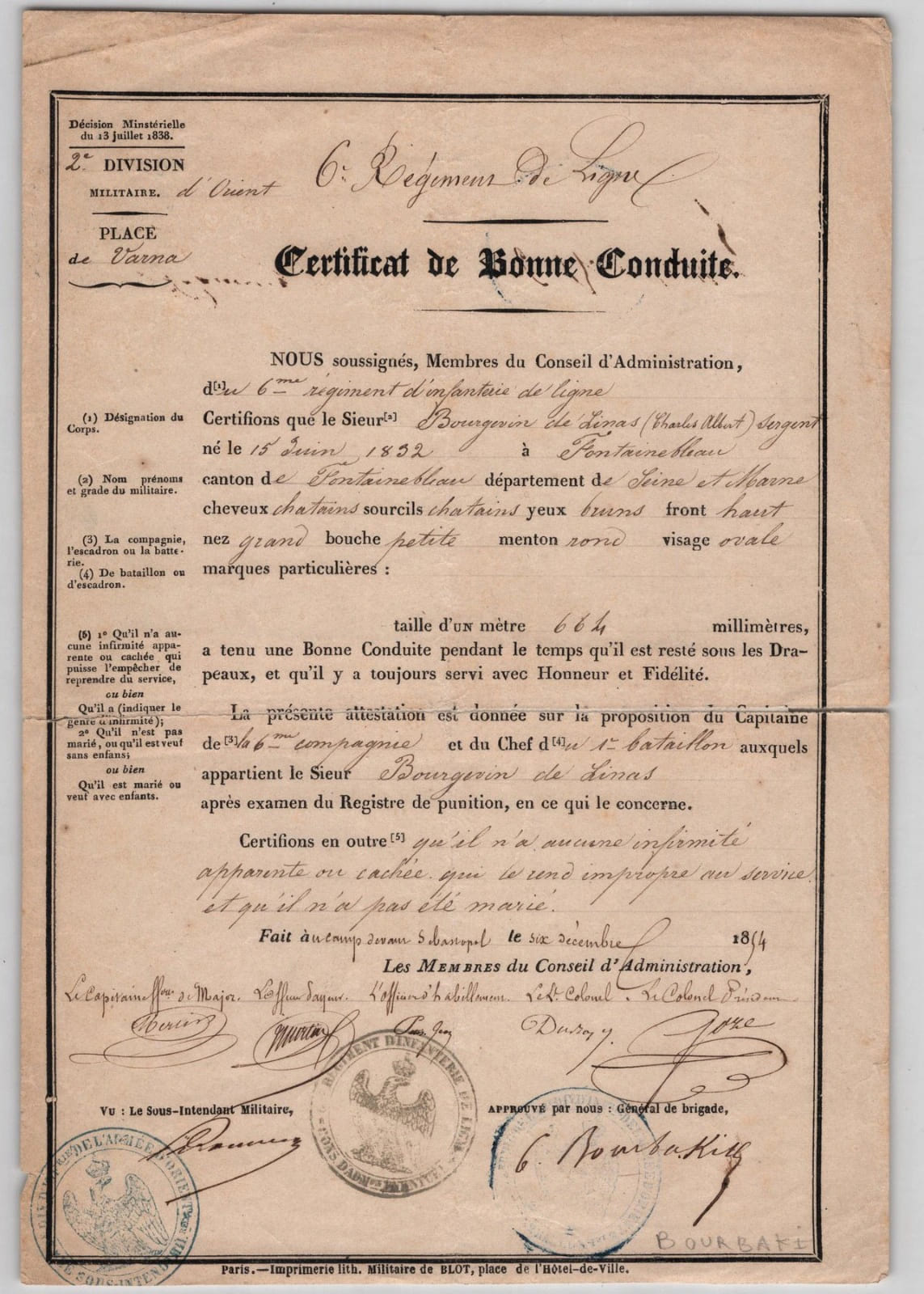
1854Best.-Nr. boz_006930Général Charles Bourbaki - Certificat de bonne conduite signé - Siège de Sébastopol, guerre de Crimée - 1854 Certificat de bonne conduite du sergent Bourgevin de Linas (Charles Albert), 6e régiment d'infanterie de ligne, contresigné par le général de brigade Bourbaki. La pièce est établie et datée du 6 décembre 1854. Imprimé à l'encre noire (Imprimerie lith. Militaire de Blot, Paris) sur feuillet de papier vélin, complété à l'encre brune manuscrite, avec en-tête imprimé « 2e Division militaire, Place de Varna » et mention manuscrite « d'Orient » / « 6e Régiment de Ligne ». Le document porte un cachet noir à l'aigle du régiment et deux cachets bleus de l'Intendance militaire de l'Armée d'Orient. Les membres du Conseil d'administration du régiment (dont les officiers Mercier, Martin et le lieutenant-colonel Duroy) certifient la bonne conduite du sergent Bourgevin de Linas pendant son service sous les drapeaux, avec son signalement complet. L'attestation, établie « au camp devant Sébastopol », est approuvée par la signature autographe, nette et bien conservée, du général de brigade Bourbaki, futur commandant de l'Armée de l'Est de 1870-1871, alors en pleine ascension pendant le siège de Sébastopol. Dimensions : 18,8 x 27,6 cm Nombre de pages : 1 page Etat : Bon état. Papier insolé par le temps. Plis d'origine, avec fente le long du pli central. Encre bien lisible dans l'ensemble, signature de Bourbaki particulièrement nette. Voir photos pour plus de détails.
1850Best.-Nr. G120591Paris, Musée Cosmopolite s.d. [1850's] Collection of 31 hand-coloured engraved plates (from a total of 37 plates published for the Russian costume section), depicting male and female figures in traditinal Russian dress, shown full lenght. Bound in a nice and solid modern hardcover (red half-cloth with gilt title on spine, marbled boards, 28x23cm.). Plates are clean and bright except for very few light foxing, Issued as part of the "Musée Cosmopolite" series published in Paris by Aubert & Cie. // The Russian plates are notable for their detailed rendering of textiles, embroidery and head-dress, illustrating a range of social and regional distinctions within the Russian Empire in the mid-19th century, as perceived by contemporary Western obervers, [CONTENT: Plate no.3: Bergère de Kouli Kovo (Gouvt. de Toula), 6: Tcherkess, 7: Charretier russe, 8: Paysanne de Serpoukoff, 9: Juif d'Epiphan (Gouvt. de Toula), 10: Juive d'Epiphan (Gouvt. de Toula), 11: Moine, 12: Religieuse, 13: Jeune fille russe, 14: Esthonien, 15: Esthonienne, 17: Laitière finlandaise, 19: Cocher de seigneur en petite tenue, 20: Paysan finnois (environs de St-Peterbourg), 21: Paysanne finoise (environ de St-Petersbourg), 22: Jeune paysan, 23: Femme tatar à Kapskhox (Crimée), 24: Paysan tatar (Crimée), 25: Femme de Yalta (Crimée), 26: Femme turque (à Bagtchi-Seraii Crimée), 27: Mollah, prêtre turc à Bagtchi-Seraii (Crimée), 28: Chef de village (Caucase), 29: Paysan russe (frontière de la Bessarabie), 30: Armée russe (Crimée), 31: Trigane ou Bohémien (frontières de la Crimée), 32: Femme Kalmouke (bords du Volga), 33: Kalmouk marchand (Russie méridionale), 34: Kalmouk d'Astrakan (Russie meridionale), 35: Prtre Kalmouk (Russie méridionale), 36: Prêtre desservant, Kalmouk (Russie méridionale), 37: Maitre d'école de St. Petersbourg], Very good condition, G120591