LEGER Louis (traduction par)Livre Rare Book

4 199 résultats
réf. QWA-21711Ernest Leroux, 1882, in-12 br. (11 x 16,5), XIV-266 p., 1ère édition, coll. "Contes et chansons populaires", bandeaux, lettrines et culs-de-lampe, couverture rempliée, rousseurs sur quelques pages, sous papier cristal, bon état.
1972réf. 99753-C4009Paris, Saint-Paul, 1972, 1 vol. br. 191 pages. Etat correct. Un peu défraîchi.
1987réf. ART6026MRelié, 191 pages, paru le 1er septembre 1987 chez Abbeville Press Inc.,U.S., livre en très bon état général.
réf. 50487Paris L'Art et Les Artiste 27 mars 1916 In-4, bradel demi-vlin, plats de papier marbr, dos portant le titre de l'ouvrage calligraphi entre deux motifs aquarells en couleurs; doublures et gardes de papier marbr, tte dore, non rogn, couverture illustre (Henri Creuzevault).Ce numro spcial de la revue l'Art et les artistes runit sept textes indits. L'illustration comporte un bois original indit de Jacques Beltrand reprsentant Adam Mickiewicz et 154 reproductions de sculptures, peintures, pastels, eaux-fortes, dessins et croquis de Vit Stwosz, Bacciarelli, Grassi, Norblin, Marteau, Jean Matejko, Arthur Grottger, Jules Kossak, Kurowski, Gierymski, Chelmonski, Wyspianski, Mehoffer, Malczewski, Weyssenhof, Andriolli, Olga de Boznanska, Axentowicz, Jean Styka, Kamienski, Sichulski, H. Rigaud, David d'Angers, Eugne Delacroix, Ary Scheffer, Gavarni, etc, avec des reproductions d'objets rustiques et de photographies de villes, villages, glises, monuments et costumes de Pologne. La couverture est orne d'un dessin des armes de Pologne reproduit en couleurs. Un des 55 exemplaires numrots sur papier imprial du Japon, seul tirage sur grand papier.
réf. 647R. Laffont, 1987. In-8. Broché. 241 pages. Ex-libris manuscrit sur garde. Bon état.
réf. 2347Editions Spes, 1927. Grand in-8. Broché. 185 pages. Planches photographiques en hors texte. Carte. Ex-libris manuscrit. Intérieur très frais. Couverture légèrement défraîchie. Etat correct. Envoi en tarif " lettre "
réf. 3335Saint-Cloud, Romain Pages Editions, 1992. In-4. Cartonnage sous jaquette illustrée.120 pages. Belle iconographie in et hors texte en couleurs. Gardes illustrées. Très bon état.
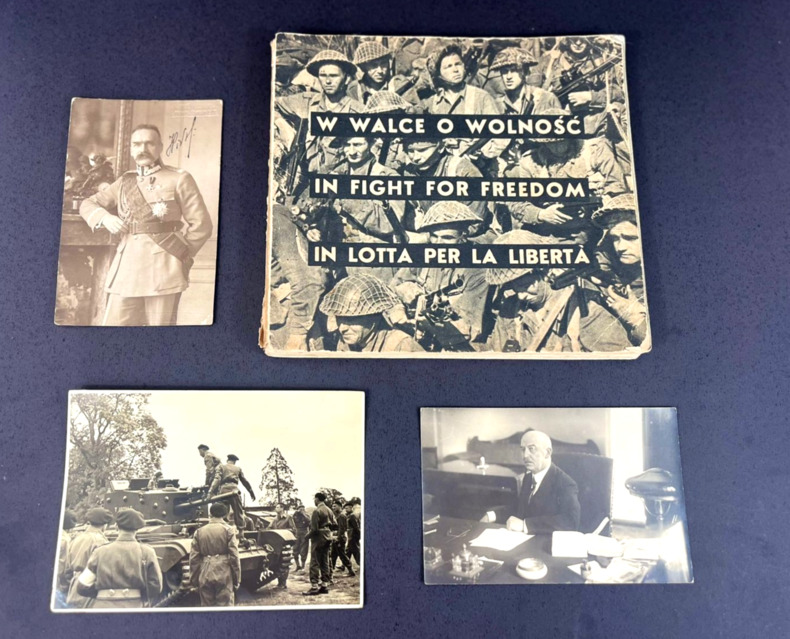
1945réf. 517This is a set which belonged to Janusz Gluchowski, a high-ranking Polish military officer at the time of the WW2. The set contains three original B&W pictures. First one: undated postcard showing Marshal Jozef Pilsudski, signed by himself in black ink, 8.5 x 13.5 cm, with two embossed mentions above and below. Second picture: undated postcard showing Poland President Gabriel Narutowicz, with a written mention on the back. Third picture: 11 x 15.5 cm photograph. General Tadeusz Bór-Komorowski inspecting a British Cromwell tank, accompanied by Polish officers of the 3rd Armored Regiment (3 puk pancerny). The image was captured during an official ceremony in the city of Kelso, Scotland, in the immediate post-war period, on June 15, 1945. The scene shows the General in an observation position, climbing onto the tank while surrounded by Polish soldiers. The tank corresponds to a British model widely used by Polish forces in exile during the Western European campaign. On the reverse, the following handwritten inscriptions appear: VI 1945, Kelso. N. Wódz gen. Bór-Komorowski dokonuje inspekcji 3 p. panc. N. Wódz w towarzystwie bryg. puku na czogu." / June 15, 1945, Kelso The book is an illustrated three-languages (Polish, English and Italian) set commemorating the struggles of the Polish II Corps. Edited by Wyda Rererat [Referat] Kultury i Prasy Kresowej Dywizji Piechoty in Rome, 1945. Oblong book of 21 x 19 cm, unpaginated (144 pp.). Cover detached. Endpapers and first page show Janusz Gluchowski's stamp. In publisher's photographically illustrated wrappers. Each page contains a photographic image or a photomontage accompanied with a short text in three languages. Front cover shows some wear and tear, the binding is a bit loose - we would advise having this book bound. The Polish II Corps was a major tactical and operational unit recruited from Polish deportees in the Soviet Gulags in 1943. First they fought in the Middle East, and in 1944 February they were transferred to Italy and as independent part of the British Army to fight in the Italian campaign, in the battles of Monte Cassino and Ancona and also the Battle of Bologna during the final offensive in Italy in 1945. The book goes through the story of Poland and the later established Polish II Corps, starting with the German and Soviet occupation in 1939. It shows the deportation of Poles to forced labour to the Gulag and, after the Polish-Russian Military Agreement in 1941, the establishment of the Polish Army on Soviet soil, also their military training and their fights in various battles. Janusz Julian Gluchowski was a Major General in the Polish Army during the Second Polish Republic. He was born on August 6, 1888, in Bukowa. He fought in the Polish Legions in World War I, the Polish-Ukrainian War, the Polish-Soviet War, and the invasion of Poland by Nazi Germany, Slovakia, and the Soviet Union in 1939, which culminated in the start of World War II. In his adolescence, he attended high school in Czstochowa. In 1905, he became a member of the Combat Organization of the Polish Socialist Party and was wounded in the hand during an attack near Czstochowa. To avoid arrest by the Russian authorities, he left for Belgium, where he studied at the University of Liège. He returned to divided Poland around 1910 and settled in Austrian Galicia. In 1912 he graduated from the Officers' School of the Riflemen's Association in Stroza, near Krakow. In the early hours of August 1914, he commanded a platoon in Oleandria and was Wadysaw Belina-Pramowski's representative during the legendary attack of the so-called Seven Lancers of Belina (Uaska siódemka). On August 6th, together with the First Cadre Company, he left Krakow and marched to Miechów. In October 1914 he was promoted to Lieutenant (Poruchik) and, in November 1916, to Rittmeister (Cavalry Master). Until 1917 he served in the First Uhlan Regiment of the Polish Legions. After the Oath Crisis (Kryzys przysigowy) he was interned first in Fort Beniaminów and later in Werl. Released in October 1918, he went to Lublin, where, in early November, he formed the Third Ulan Regiment (later renamed the Seventh Ulan Regiment of Lublin). Along with his unit, he fought in the Polish-Soviet War. On May 29, 1920, he was promoted to Polkovnik. He was transferred in July 1920 to Eastern Galicia, taking command of the First Cavalry Brigade, fighting against the Soviets in Galicia and Volhynia. After the war, he remained in this position until 1925, when he was transferred to the Fourth Cavalry Brigade. Promoted to Brigadier General on March 16, 1927. Appointed commander of the Center for Higher Military Studies on June 4, 1930, and three years later, after the death of General Stanislaw Tessaro, he was appointed commander of Military District X in Przemyl. In October 1935, he became Deputy Minister of Military Affairs. In the early days of the 1939 invasion of Poland, Gluchowski ordered General Walerian Czuma to prepare the defense of Warsaw. In mid-September 1939, he fled to Romania. After his escape, he managed to travel to the Middle East and, in January 1941, received orders to go to London. In October 1941, he was appointed Commander of the Training Brigade stationed in Scotland. On September 23, 1943, he was appointed commander of all Polish Army units stationed in Great Britain, except the First Independent Parachute Brigade, which remained under the authority of the Commander-in-Chief. He was promoted to Major General on June 1, 1945. He decided not to return to Soviet-occupied Poland and remained in Great Britain. He frequently criticized the Soviet regime and the Soviet occupation authorities in postwar Poland. Furthermore, he was one of the founders and president of the Jozef Pilsudski Institute in London. He was, therefore, an active member of the Polish community in Great Britain. He was president and honorary member of several Polish veterans' organizations. He died on June 11, 1964, in London, England.
1966réf. 009730Editions Scientifiques De Pologne Jaquette en très bon état reliure Rigide Décorative Warszawa 1966 440 pages en format 13 - 20 cm - photographies hors texte - carte physique de la pologne - reliure rigide en percaline avec dessin en dorure
1956réf. 003664Varsovie Polonia 1956 In-8 Broché Très bon
1981réf. 003697Varsovie Interpress 1981 In-8 Cartonnage Jaquette en bon état Très bon
1964réf. 005410Cracovie Cercle Des Amateurs De L'ex-Libris En Pologne 1964 grand In-8 Broché Bon
réf. AMA-593Paris, A. Colin, 1896. in 12, demi-toile, rousseurs. [2 ff.], 344 pp., [1 f.].
réf. 6399Texte de Paul Cazin sur les Bourguignons dont il se sentait très proche; il a du reste longtemps habité Autun. 2 photos (signées Blanc et Demilly, photographes à Lyon de 1924 à 1962), l'une dédicacée à Abel Moreau (25 janvier 1931). 2 photos d'amateur le montrant en compagnie d'Abel Moreau. 1 feuillet dactylographié et 4 photos. Très bon 1 feuillet dactylographié et 4 photos
1750réf. 7546Très célèbres estampes d’après Rigaud, dans son cadre en bois doré d'époque. Belleudy n° 1. Extrêmement rare. C'est l'estampe qui a causé l'exil de Baléchou à Avignon … Paris 1750
1864réf. 9027Fils naturel de l'Empereur après sa rencontre avec la belle polonaise. Il fit une brillante carrière diplomatique. L.A.S. datée du 9 avril (1864). Très bon Paris 1864 ?
réf. 15571Reine de France. Beau portrait. Beau tirage XVIIIè sur vergé. en feuille Très bon 15 x 11 cm
2024réf. LFA-126749281Un ouvrage de 348 pages, format 205 x 315 mm, illustré, relié cartonnage couleurs, publié en 2024, Pekowice, bon état
1968réf. ABE-173728446710932 PAGES-SUPPLEMENT DE 8 PAGES-LE CONFLIT DU MOYEN-ORIENT ET LE REMANIEMENT EN R.A.U.-LES FORCES ISRAELIENNES FRANCHISSENT LE JOURDAIN ET LANCENT UNE VASTE OPERATION DE REPRESAILLES CONTRE LA JORDANIE-POINT DE VUE: LE PERIL VIETNAMIEN, PAR GASTON DEFFERRE-LES EVENEMENTS DE POLOGNE ET DE TCHECOSLOVAQUIE-CONFLIT AUTOUR D'UN CALVAIRE ENTRE M.EDOUARD LECLERC ET UN MAIRE BRETON-THEATRE, PAR B. POIROT DELPECH: "LES TREIZE SOLEILS DE LA RUE SAINT-BLAISE" D'ARMAND GATTI-LEGERS MANQUES EN PLIURE CENTRALE DE UNE
1945réf. ABE-173335688620016 PAGES-26,5 CM X 36 CM-EN COUVERTURE: FRANCAISE DE L'EMPIRE-LA PAIX DIFFICILE, PAR RAYMOND ARON-LES AMERICAINS OCCUPERONT-ILS SEULS LE JAPON?, PAR WALTER LIPPMANN, 1P, 3 PHOTOS-TCHANG KAI CHEK DOIT LA CHINE A SA FEMME, 1P, 3 PHOTOS-"LA CHINE 1945" DEMOCRATIE UNION NATIONALE, UNE INTERVIEW DE S. EXC. M. TSIEN TAI, AMBASSADEUR DE CHINE A PARIS-LA POLOGNE QUELQUE PART EN FRANCE, CELTIC HOTEL, SAINT CAST, 2 PAGES, 8 PHOTOS-VEDETTES "NOUVELLES", FERNANDEL, MISTINGUETT-AH! SI LES TABLEAUX POUVAIENT PARLER, SALON D'AUTOMNE, 7 PHOTOS-PETANQUE A MONTMARTRE, 1P, 3 PHOTOS (ANDRE STEINER)-MUSSET REVU PAR BATY-EN DERNIERE PAGE: CES FEMMES SONT DES FRANCAISES, 4 PHOTOS, MARTINIQUE, TAHITI, INDOCHINE
1977réf. LFA-126748680Une revue de 24 pages, format 150 x 240 mm, illustrée, brochée, publiée en 1977, Société des Amateurs de Jardins Alpins, bon état
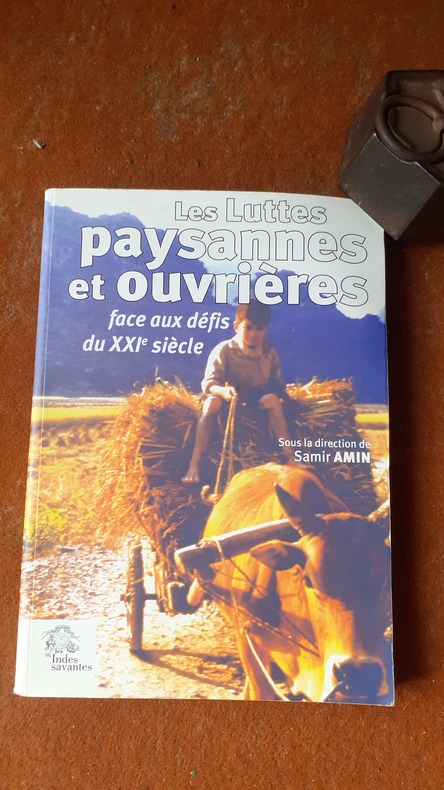
réf. QWA-20725Les Indes savantes, 2005, in-8 br. (17 x 24), 366 p., "Forum du Tiers Monde / Forum mondial des Alternatives", bon état.
réf. 10370P.Sauvaitre 1893. In-8 (23/14cm). VIII-308 pages. Broché, couverture gaufrée verte étiquette au dos, (couverture fragile).
réf. 6791d'après des documents nouveaux et une correspondance inédite de Stanislas Leczinski. Paris. Plon-Nourrit. 1900. In-8 (23x14 cm). XI-418 pages. Broché.
réf. 20993L' Assiette au Beurre n° 75. Paris. Schwarz. 1902. In-4 (32x24 cms). 24 pages. Broché, couverture illustrée.