Beylin KarolinaLivre Rare Book

3 988 résultats
1965réf. rx1143Instytut Wydawniczy Nasza Ksiegarnia Warszawa Cartonné 1965 In-4 (24,3 x 23 cm), cartonné toilé, non paginé, texte en polonais, photographies en noir et blanc ; mouillures et quelques taches sur les plats, deux pages déchirées vers la fin de l'ouvrage, plusieurs ex-libris tamponnés à l'intérieur, en l'état. Livraison a domicile (La Poste) ou en Mondial Relay sur simple demande.
2026réf. x-1009741128Cambridge University Press 2026. Hardcover. New. 242 pages. 6.00x0.56x9.00 inches. Cambridge University Press hardcover
réf. 51790749like new. unknown
Wear to extremities and spine; Towering over Krakow. Unpaginated photo section ; B&W Photographs; 8vo; 109+ pages
Illustrated souvenir book about Warsaw.18p.text+ 59p.of photographs Book
1914réf. A111-111Wien, Kaiserlich-K?nigliches Milit?r-Geographisches Institut, 1914. Hochformat, ca. 34 x 55 cm, Ausgabe: mehrf?rbig; Zustand: gut +
1890réf. A141-1195Wien, Kaiserlich-K?nigliches Milit?r-Geographisches Institut, 1890. Hochformat, ca. 34 x 55 cm, gefaltet zu 4 Segmenten, Ausgabe: mehrf?rbig; Zustand: gut +
Broché. 128 pages.
1992réf. 25342Warszawa : Festina, 1992. [76] pp. : predom. ill. 4°. Orig. cardboard covers (cloth structure) with DJ.
Fine English Paperback. 4to. (33 x 24 cm). In English. 462 p., color and b/w ills. This book is published on the occasion of the exhibition entitled "War and Peace: Ottoman - Polish relations in the 15th - 19th centuries" held at the Museums of Turkish and Islamic Arts in Istanbul between June 29 and September 20, 1999. Contents: M. Istemihan Talay: Preface / Kaya Turgut: Exhibitions of international scale and the role of sponsors / Nazan Olcer: Exhibition of two countries at war and peace / Dariusz Kolodziejczyk: A historical outline of Polish - Ottoman political and diplomatic relations / Dariusz Kolodziejczyk: Ottoman documents in the Polish collections / Andrzej Dziubinski: Polish - Turkish trade ih the 16th to 18th centuries / Tadeusz Majda: Ottoman art in thePolish collections / Magedalena Piwocka: Turkish tents in Poland / Beata Biedronska-Slota: The history of Turkish textile collections in Poland / Zdzislaw Zygulsky Jr: The kalkan - the shield of the orient / Kazimierz Dopierala: Poles in the Ottoman Empire / Kazimierz Dopierala: Adampol - Polonezkoy / Hieronim Kaczmarek: Sefer Pasha - Wladyslaw Koscielski / Zdzislaw Zygulsky Jr: Remarks on the weapons collection of Wladyslaw Koscielski - Alias Sefer Pasa / Catalogue: 15. century / 16. century / 17. century / 18. century / 19. century / Glossary / Bibliography.
1970réf. 869Warszawa, Sport i turystyka, 1970 in-8, 22 pp., 45 double photographies, table des illustrations dépliantes, cartonnage éditeur
1 vol. in-12 reliure de l'époque demi-basane verte, dos à 5 nerfs, couv. conservée, Editions Balzac, Paris, 1943, 334 pp. Bon état (dos passé, bon exemplaire par ailleurs) Français
1943réf. 597161 vol. in-12 reliure de l'époque demi-basane verte, dos à 5 nerfs, couv. conservée, Editions Balzac, Paris, 1943, 334 pp.
réf. 11701Album cartonne gris, dos toile, sous jaquette illustree, format in-4* a l'italienne, nombreuses photos, 1951.Bon etat, jaquette un peu fendue en 4*.
réf. 118160aafWadowice, Drukarnia i Wydawnictwo Grafikon, 2013, in-4to, 176 p., ill. d’env. 140 planches photographiques, cartonnage original ill.
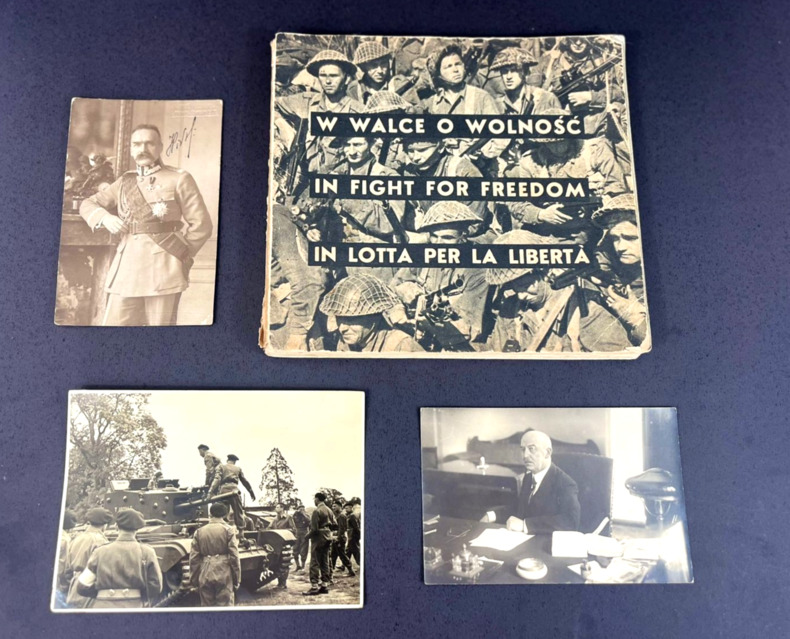
1945réf. 517This is a set which belonged to Janusz Gluchowski, a high-ranking Polish military officer at the time of the WW2. The set contains three original B&W pictures. First one: undated postcard showing Marshal Jozef Pilsudski, signed by himself in black ink, 8.5 x 13.5 cm, with two embossed mentions above and below. Second picture: undated postcard showing Poland President Gabriel Narutowicz, with a written mention on the back. Third picture: 11 x 15.5 cm photograph. General Tadeusz Bór-Komorowski inspecting a British Cromwell tank, accompanied by Polish officers of the 3rd Armored Regiment (3 puk pancerny). The image was captured during an official ceremony in the city of Kelso, Scotland, in the immediate post-war period, on June 15, 1945. The scene shows the General in an observation position, climbing onto the tank while surrounded by Polish soldiers. The tank corresponds to a British model widely used by Polish forces in exile during the Western European campaign. On the reverse, the following handwritten inscriptions appear: VI 1945, Kelso. N. Wódz gen. Bór-Komorowski dokonuje inspekcji 3 p. panc. N. Wódz w towarzystwie bryg. puku na czogu." / June 15, 1945, Kelso The book is an illustrated three-languages (Polish, English and Italian) set commemorating the struggles of the Polish II Corps. Edited by Wyda Rererat [Referat] Kultury i Prasy Kresowej Dywizji Piechoty in Rome, 1945. Oblong book of 21 x 19 cm, unpaginated (144 pp.). Cover detached. Endpapers and first page show Janusz Gluchowski's stamp. In publisher's photographically illustrated wrappers. Each page contains a photographic image or a photomontage accompanied with a short text in three languages. Front cover shows some wear and tear, the binding is a bit loose - we would advise having this book bound. The Polish II Corps was a major tactical and operational unit recruited from Polish deportees in the Soviet Gulags in 1943. First they fought in the Middle East, and in 1944 February they were transferred to Italy and as independent part of the British Army to fight in the Italian campaign, in the battles of Monte Cassino and Ancona and also the Battle of Bologna during the final offensive in Italy in 1945. The book goes through the story of Poland and the later established Polish II Corps, starting with the German and Soviet occupation in 1939. It shows the deportation of Poles to forced labour to the Gulag and, after the Polish-Russian Military Agreement in 1941, the establishment of the Polish Army on Soviet soil, also their military training and their fights in various battles. Janusz Julian Gluchowski was a Major General in the Polish Army during the Second Polish Republic. He was born on August 6, 1888, in Bukowa. He fought in the Polish Legions in World War I, the Polish-Ukrainian War, the Polish-Soviet War, and the invasion of Poland by Nazi Germany, Slovakia, and the Soviet Union in 1939, which culminated in the start of World War II. In his adolescence, he attended high school in Czstochowa. In 1905, he became a member of the Combat Organization of the Polish Socialist Party and was wounded in the hand during an attack near Czstochowa. To avoid arrest by the Russian authorities, he left for Belgium, where he studied at the University of Liège. He returned to divided Poland around 1910 and settled in Austrian Galicia. In 1912 he graduated from the Officers' School of the Riflemen's Association in Stroza, near Krakow. In the early hours of August 1914, he commanded a platoon in Oleandria and was Wadysaw Belina-Pramowski's representative during the legendary attack of the so-called Seven Lancers of Belina (Uaska siódemka). On August 6th, together with the First Cadre Company, he left Krakow and marched to Miechów. In October 1914 he was promoted to Lieutenant (Poruchik) and, in November 1916, to Rittmeister (Cavalry Master). Until 1917 he served in the First Uhlan Regiment of the Polish Legions. After the Oath Crisis (Kryzys przysigowy) he was interned first in Fort Beniaminów and later in Werl. Released in October 1918, he went to Lublin, where, in early November, he formed the Third Ulan Regiment (later renamed the Seventh Ulan Regiment of Lublin). Along with his unit, he fought in the Polish-Soviet War. On May 29, 1920, he was promoted to Polkovnik. He was transferred in July 1920 to Eastern Galicia, taking command of the First Cavalry Brigade, fighting against the Soviets in Galicia and Volhynia. After the war, he remained in this position until 1925, when he was transferred to the Fourth Cavalry Brigade. Promoted to Brigadier General on March 16, 1927. Appointed commander of the Center for Higher Military Studies on June 4, 1930, and three years later, after the death of General Stanislaw Tessaro, he was appointed commander of Military District X in Przemyl. In October 1935, he became Deputy Minister of Military Affairs. In the early days of the 1939 invasion of Poland, Gluchowski ordered General Walerian Czuma to prepare the defense of Warsaw. In mid-September 1939, he fled to Romania. After his escape, he managed to travel to the Middle East and, in January 1941, received orders to go to London. In October 1941, he was appointed Commander of the Training Brigade stationed in Scotland. On September 23, 1943, he was appointed commander of all Polish Army units stationed in Great Britain, except the First Independent Parachute Brigade, which remained under the authority of the Commander-in-Chief. He was promoted to Major General on June 1, 1945. He decided not to return to Soviet-occupied Poland and remained in Great Britain. He frequently criticized the Soviet regime and the Soviet occupation authorities in postwar Poland. Furthermore, he was one of the founders and president of the Jozef Pilsudski Institute in London. He was, therefore, an active member of the Polish community in Great Britain. He was president and honorary member of several Polish veterans' organizations. He died on June 11, 1964, in London, England.
23x24. 203p. Fotogr. Enc. tela ed. La sobrecubierta algo deslucida.
29x21. 125p. Fotogr. Enc. tela ed. La sobrecubierta algo deteriorada.
1962réf. CCC-44033. éditeur, 1962 - Cartonné, 21 cm x 30 cm, 244 pages - Bien complet de la jaquette en état tres moyen -livre en tres bon etat. Texte en tchèque de Pavol Michalides - Nombreuses reproduction noir & blanc et couleurs in et hors-texte d'affiches politiques . photos possible
1761réf. 27684Paris chez Mondhard 1761 une vue d'optique en couleurs, GRAVÉE A L'EAU-FORTE ET AQUARELLÉE SUR PAPIER DE FORMAT: 33,5 x 50 cm., 1761 sans lieu ni Editeur,
1810réf. 27790Paris Basset 1810 une vue d'optique en couleurs,GRAVÉE A L'EAU-FORTE ET AQUARELLÉE, format de la gravure : 38,5 x 25 cm, sans date (1810) à Paris chez Basset Editeur
réf. ORD-14680Sans lieu. Sans date. XVIII°. Vers 1780. Dimensions de la feuille 493 x 328mm de la gravure cuvette comprise: 417 x 292mm. Belle vue aux coloris vifs de l'époque typiques des vues d'optique, présentée sous cache brun bordé de blanc. Très bon état.
in-8° (200x124 mm); leg. in piena pelle di colore bruno chiaro maculata in bruno scuro; tagli dei piatti finemente decorati in oro, dorso liscio con preziosi decori dorati a formare sei compartimenti, compreso quello ove si trova il titolo dorato su pelle rosso bordeaux, numerazione dei tomi dorata su ovale in pelle verde entro uno dei compartimenti; guardie marmorizzate, tagli di color giallo chiaro; 4 Tomi legati in 2 vol.; pp. VIII-380-(4), 404; 393-(1), 303-(1); ogni tomo ha il suo frontespizio, preceduto dall'occhietto; ill. calc., cornici e fregi xil., 19 carte di tav. incise su rame di cui qualcuna più volte ripiegata: 5 carte (Polonia, Russia, Mar Caspio, Svezia e Danimarca), 7 piante (Mosca, San Pietroburgo, Canale di Vishnei-Voloshok, Stoccolma, Canale di Trolhoetta, Copenhaghen e Canale di Kiel), 4 ritratti (Stanislas-Auguste de Pologne, Catherine II, Pugatchev e Gustave III de Suède) e altre 3 tav. (uccelli, scritture cirilliche e costumi). Interessante opera geografica riportante i resoconti di viaggi effettuati dal Coxe in Polonia, Russia, Svezia, Danimarca e Norvegia, tradotta in francese dal Mallet. Un particolare risalto è dato alla Russia (dalla fine del I tomo all'inizio del III); la parte aggiuntiva relativa alla Norvegia (p. 159 - IV tomo) è stata curata direttamente dal Mallet. William Coxe (1747-1828), è stato uno storico inglese e sacerdote che ha servito come compagno di viaggio e tutore di nobiltà dal 1771 al 1786. Scrisse numerose opere storiche e cronache di viaggio. Ordinato diacono nel 1771, ha lavorato come rettore e poi arcidiacono di Bemerton vicino a Salisbury dal 1786 fino alla sua morte. Paul Henri Mallet (1730-1807), scrittore e traduttore svizzero, è stato professore di lingua e letteratura francese in Danimarca. Rif.: IT\ICCU\IEIE\005989-005990-005991-005992-005993 (5 copie). OCLC, 9997601. Cond.: Leggerissime macchie d'umidità su alcune pp.; opera completa ed in perfette condizioni generali. -- Veau raciné de l'époque, dos lisses à compartiments fil. et fleuronnés dorés (lég. passés, minimes frottements), étiq. de cuir rouge ou vert, coiffes et coupes guillochées dorées, tr. jaunes, (qqs défauts marginaux, qqs lég. souill. et bruniss., mouill. angulaire aux 1ers ff. du t. III). Bel ex. Edition in-8 (après une in-4) de cette traduction par Paul-Henri Mallet de "Travels into Poland, Sweden and Denmark" (Londres 1784) du voyageur et historien anglais William Coxe (1747-1828). Ex. complet des 19 planches gravées sur cuivre dont qqs-unes dépliantes: 5 cartes (Pologne, Russie (1 déchir. rest.), mer Caspienne, Suède & Danemark), 7 plans (Moscou, Saint-Pétersbourg, canal de Vishnei-Voloshok, Stockholm, canal de Trolhoetta, Copenhague & canal de Kiel), 4 portraits (Stanislas-Auguste de Pologne, Catherine II, Pugatchev & Gustave III de Suède) et 3 autres pl. (oiseaux, écriture cyrillique et costumes). L'ouvrage concerne surtout la Russie (fin du t. I, t. II et début du t. III); la partie relative à la Norvège (p. 159 sq. du t. IV) est due au suisse Paul-Henri Mallet (1730-1807), un temps professeur de langue et littér. française au Danemark. -- FIRST FRENCH EDITION OF THIS INTERESTING GEOGRAPHICAL WORK SHOWING THE ACCOUNTS OF TRAVELS MADE BY COXE IN POLAND, RUSSIA, SWEDEN, DENMARK AND NORWAY. Very light water stains at some pp .; complete copy, in perfect conditions.
Format de poche. Bon ?tat.