4 091 résultats
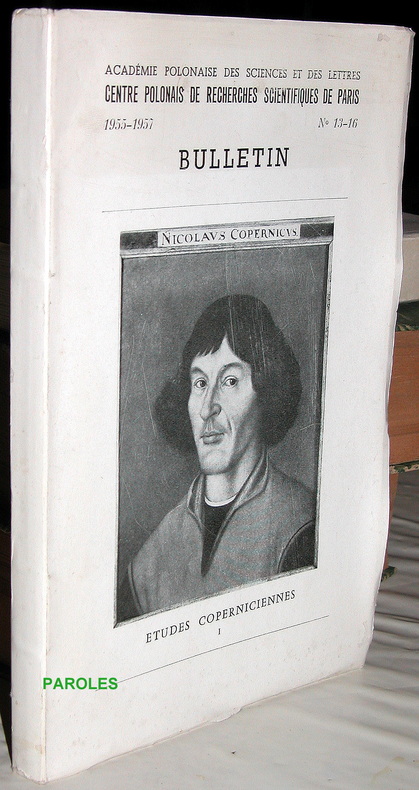
1958Au sommaire: "Copernic et la Pologne" par Stanislaw WEDKIEWICZ ("Sa fortune en Pologne", "Son culte parmi les émigrés polonais en France", "Les monuments de Copernic et ses effigies en Pologne", "Copernic dans les belles-lettres polonaises", biographie de Ludwik Antoni Birkenmajer); "Célébration de l'année Copernic 1953" ("Le Centenaire de 1943", "L'année 1953 en Pologne et à l'étranger", "La commémoration de Galilée"); choix de textes de savants polonais sur Copernic ("L'Université de Cracovie - Centre d'études astronomiques au tournant des XVè et XVIè siècles" par Aleksander BIRKENMAJER, "Le néo-platonisme de Copernic" par Henryk BARYCZ, "La pensée économique de Copernic" par Edward LIPINSKI, "Copernic juriste" par Wojciech HEJNOSZ, "La réforme astronomique de Copernic" par Jozef WITKOWSKI, "Buridan - Oresme - Copernic" par Roman ST. INGARDEN junior, "Rheticus, éditeur de Copernic" par Ryszard GANSINIEC, "Préface à une nouvelle édition du 1er Livre du "De Revolutionibus"" par Aleksander BIRKENMAJER, "La théorie de la relativité et le système de Copernic" (extraits des études d'Albert EINSTEIN, W.A. FOCK et Leopold INFELD); "Etudes coperniciennes" par Stanislaw WEDKIEWICZ ("La connaissance du XVIè siècle polonais en France", "Copernic et la découverte du Nouveau Monde", Problèmes biographiques, ""L'Uomo Universale" (Le philologue, l'économiste, le médecin, le géographe, le peintre, le technicien)", ""Ille sarmaticus astronomus...""; notes et documents (Le nom de Copernic - Le titre du chef-d'oeuvre - Lettre du chapitre de Warmie à Sigismond Ier, roi de Pologne - Le père Adam Kochanski S.J. - Le comte Louis de Tressan - Giacomo Leopardi - Erreurs et légendes - Sur la sphéricité de la Terre et les antipodes - L'expérience de la barque); addenda. Français
1958réf. 15961Paris, Centre polonais de recherches scientifiques, 1958 1 volume 15,3 x 24cm Broché sous couverture au 1er plat orné d'un portrait. VII + 314p., 1feuillet. Bon état (couverture légèrement salie).
19471st edition. 4to, Original Paper Wrappers, 8 pages each issue, 13 numbers in 12 separate issues, as published. In Yiddish. Title translates as Bulletin of the Bund. Complete run of this early post-Holocaust iteration the Bunds monthly newsletter (also serving Kindred Jewish Socilaist Organizations), reflecting the concerns of its membership of secular Polish Holocaust survivors as well as pre-war immigrants to the US. Full of interesting articles including: Reports and declarations from the World Bund Conference in Brussels, including declarations on Antisemitism the workers movement, etc; The 1947 Socialist conference in Zurich; Bund activity in postwar-Poland, Belgium, Italy, France, Brazil, and Argentina; Jewish Socialists in Rumania; Bund Resolutions on the Camps; German Socialists and the Jewish Question; Professor Hirsh and Palestine; Discussion in the Bun on the Status of Palestine; On the Bundist Youth Movement in Poland; Special Camps; The Bulletin of the Bund [ie this periodical] in the [DP] Camps; Five Years in the Warsaw Ghetto, by Bernard Goldshtein; Bundist Academy in the Gan Eden Camp in New York; A Memorial for the Bund at the Congress of the French Socialists; etc. The General Jewish Labour Bund in Lithuania, Poland and Russia (Yiddish: algemeyner yidisher arbeter-bund in lite, poyln un rusland), generally called The Bund or the Jewish Labour Bund, was a secular Jewish socialist party.... founded in Vilnius on October 7, 1897 ..In 1917 the Polish part of the Bund, which dated to the times when Poland was a Russian territory, seceded from the Russian Bund and created a new Polish General Labor Bund which continued to operate in Poland in the years between the two world wars .The Bund sought to unite all Jewish workers in the Russian Empire into a united socialist party, and also to ally itself with the wider Russian social democratic movement to achieve a democratic and socialist Russia. The Russian Empire then included Lithuania, Latvia, Belarus, Ukraine and most of present-day Poland, areas where the majority of the world's Jews then lived. They hoped to see the Jews achieve a legal minority status in Russia. Of all Jewish political parties of the time, the Bund was the most progressive regarding gender equality, with women making up more than one-third of all members. The Bund actively campaigned against anti-Semitism. It defended Jewish civil and cultural rights and rejected assimilation. However, the close promotion of Jewish sectional interests and support for the concept of Jewish national unity (klal yisrael) was prevented by the socialist universalism of the Bund. The Bund avoided any automatic solidarity with Jews of the middle and upper classes and generally rejected political cooperation with Jewish groups that held religious, Zionist or conservative views. Even the anthem of the Bund, known as "the oath" (di shvue in Yiddish), written in 1902 by Sh. An-ski, contained no explicit reference to Jews or Jewish suffering. At the heart of the vision of the future of the Bund was the idea that there is no contradiction between the national aspect on the one hand and the socialist aspect on the other. As a strictly secular organization, the Bund renounced the Holy Land and the sacred language (Hebrew) and chose to speak Yiddish .In its early years the Bund had remarkable success, gaining an estimated 30,000 members in 1903 and an estimated 40,000 supporters in 1906, making it the largest socialist group in the Russian Empire . the Bund was a founding collective member at the RSDLP's first congress in Minsk in March 1898. For the next 5 years, the Bund was recognized as the sole representative of the Jewish workers in the RSDLP, although many Russian socialists of Jewish descent, especially outside of the Pale of Settlement, joined the RSDLP directly .The Bund generally sided with the party's Menshevik faction led by Julius Martov and against the Bolshevik faction led by Vladimir Lenin during the factional struggles in the run-up to the Russian Revolution of 1917 .In the Polish areas of the [Russian] empire, the Bund was a leading force in the 1905 revolution. At that time the organization probably reached the height of its influence. It called for an improvement in living standards, a more democratic political system and the introduction of equal rights for Jews. At least in the early stages of the first Russian Revolution, the armed groups of the "Bund" were likely the strongest revolutionary force in Western Russia. During the following years, the Bund went into a period of decay .The Bund eventually came to strongly oppose Zionism, arguing that emigration to Palestine was a form of escapism. The Bund did not advocate separatism. Instead, it focused on culture, rather than a state or a place, as the glue of Jewish nationalism. . The Bund also promoted the use of Yiddish as a Jewish national language and to some extent opposed the Zionist project of reviving Hebrew. The Bund won converts mainly among Jewish artisans and workers, but also among the growing Jewish intelligentsia. It led a trade union movement of its own. It joined with the Poalei Zion (Labour Zionists) and other groups to form self-defense organisations to protect Jewish communities against pogroms and government troops. During the Russian Revolution of 1905 the Bund headed the revolutionary movement in the Jewish towns, particularly in Belarus and Ukraine ..In 1921, the Communist Bund [in the USSR] dissolved itself and its members sought admission to the Communist Party....Many former Bundists, like Mikhail Liber and David Petrovsky, perished during Stalin's purges in the 1930s. The Polish Bundists continued their activities until 1948. During the latter half of the 20th century the Bundist legacy was represented through the International Jewish Labor Bund, a federation of local Bundist groups around the world .Among the exiled Bundists who went on with Socialist politics in America was Baruch Charney Vladeck (18861938), elected to the New York Board of Aldermen as a Socialist in 1917 [and] 1937 [and] manager of The Jewish Daily Forward Moishe Lewis (18881950)....the father of David Lewis (19091981), a leader of the New Democratic Party in Canada .David Dubinsky (18921982), though never formally a member of the party, had joined the bakers' union, which was controlled by the Bund, and was elected assistant secretary within the union by 1906 ..He later became a member of the Socialist Party of America, helped found the American Labor Party in 1936 and was from 1932 till 1966 the leader of the International Ladies' Garment Workers' Union ..under the name Max Goldfarb, David Petrovsky (18861937) was a member of the Central Committee of the Jewish Socialist Federation of America, a member of the Socialist Party of America, and the labor editor of The Forward (Wikipedia). SUBJECT(S): Jews -- United States -- Periodicals. Jewish socialists -- New York (State). Jewish labor unions. OCLC: 234327189. OCLC: 234327189. OCLC-Worldcat lists 6 holdings worldwide (NYPL, NLI, YIVO, Harvard, Yale, USHMM), though some listings may be for partial runs. Light wear, Very Good Condition. Rare and important complete set. (Yid-33-51)
réf. 96641aafBern, Dalp, 1876, in-8vo, VIII + 619 S., ill. + 12 Tafeln + Beil. mit 9 Tafeln, Original-Leinenband, reichlich goldgepr. Rücken, blindgepr. und goldgepr. Deckel, Rücken verschossen.
réf. CBS 9781905319435US Edition. New. Brand New! Fast Delivery US Edition and ship within 24-48 hours. Deliver by FedEx and Dhl & Aramex UPS & USPS and we do accept APO and PO BOX Addresses. Order can be delivered worldwide within 6-10 days and we do have flat rate for up to 2LB. Extra shipping charges will be requested if the Book weight is more than 5 LB. This Item May be shipped from India United states & United Kingdom. Depending on your location and availability. unknown
2019réf. 27728BSAVA. As New. 2019. Paperback. 1905319436 . New old stock. Still in celophane wrapper unused and unread. ; BSAVA British Small Animal Veterinary Association; 210.8 X 20.3 X 294.6 millimeters; 376 pages . BSAVA paperback
réf. 21884807like new. unknown
réf. 21884807-nnew. unknown
2019réf. __1905319436British Small Animal Veterinary 2019. Paperback. New. 1st edition. 368 pages. 11.50x8.25x0.75 inches. British Small Animal Veterinary paperback
1972Broch?. 157 pages.
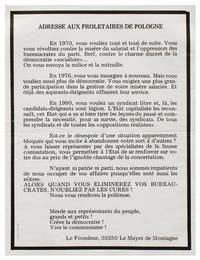
1981réf. 17271Le Mayet De Montagne: Le Frondeur N.d. ca 1981. Printed broadside 56cm x 43cm. Printed in black on thin uncoated stock. Faint fold-lines else Fine. Issued by the French anarchist collective "Le Frondeur" as both an encouragement and a critique of the Polish Solidarity movement. Accusing the striking workers of ".allowing the state to consolidate itself on your backs at the price of an ignoble blackmail of collaboration" the broadside concludes: "Fuck the representatives of the people large and small! Off Democracy! Long live communism! translation courtesy of Left Bank Books Seattle. Rare; no examples located via WorldCat; an on-line search discovers one copy in the collection of CIRA Centre International de Recherches sur l'Anarchisme Paris. Le Frondeur unknown books
2018réf. 4952018 - cartonné - Published by / wydawcw ECR Group (European Conservatives and Reformists Group) - 2018 - In-4 (26,5 x 21,5 cm) cartonné - Sans pagination - Nombreuses illustrations - ISBN : 9788365366856 - Ouvrage sous titré "Polish Modern Art in the Centennial Anniversary of the Restoration of Poland's Independence" / "Polska sztuka wpòłczesna w stulecie odzyskania niepodległości" - Adam KAMINSKI (Factual editor, coordinator / Redacja merytoryczna, koordynacja) - Texte en polonais et en anglais - Contient aussi un carton d'invitation
1733Venezia per Francesco Pitteri, MDCCXXXIII all’insegna della fortuna trionfante. (mm. 150 x 87). Cartonato marezzato coevo. Pp. 67 (le prime quattro bianche), 2 c. b. Rara edizione originale, in perfetto stato. Bibl: Ciampi, Bibliografia critica delle antiche reciproche corrispondenze politiche…. dell’Italia colla Russia, Polonia ed altre parti settentrionali, Firenze, 1834, pp. 94, n. 31.
1671In-4°,(8cc), 40pp, 2 illustrazioni calcografiche, legatura in cartonato.
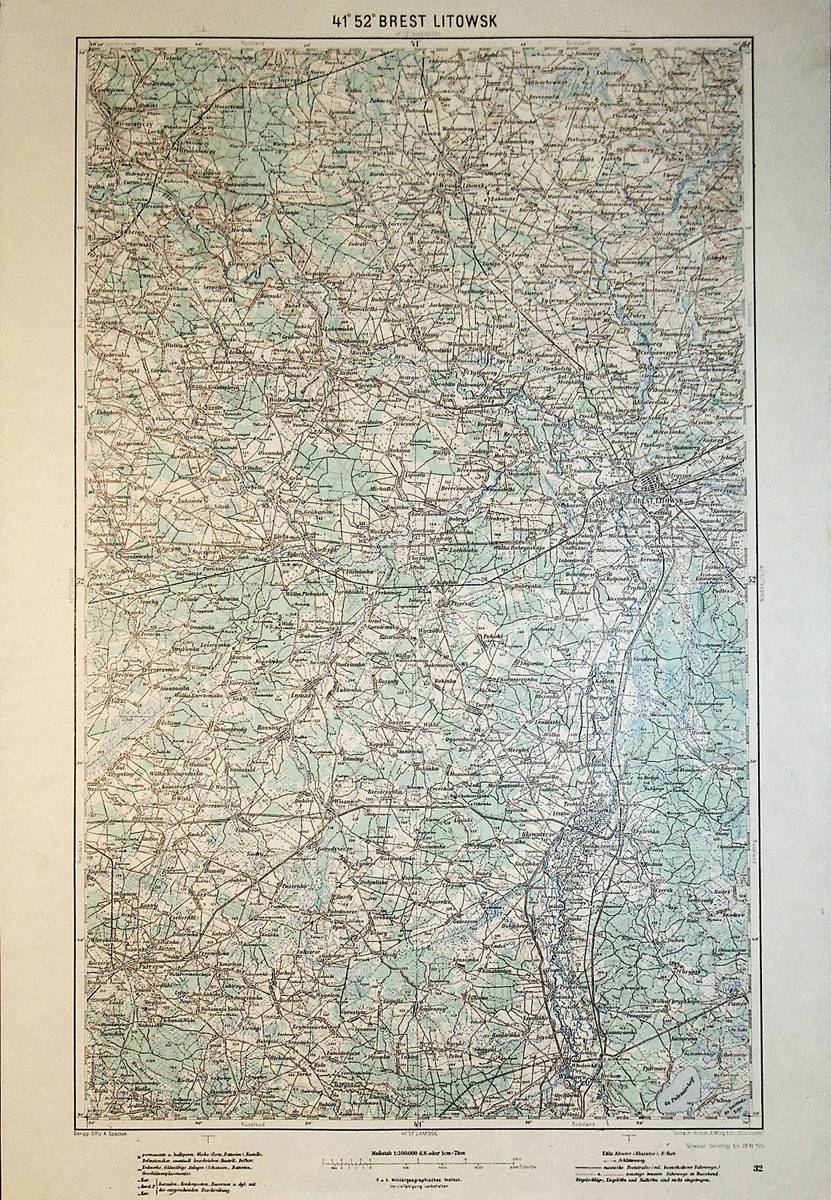
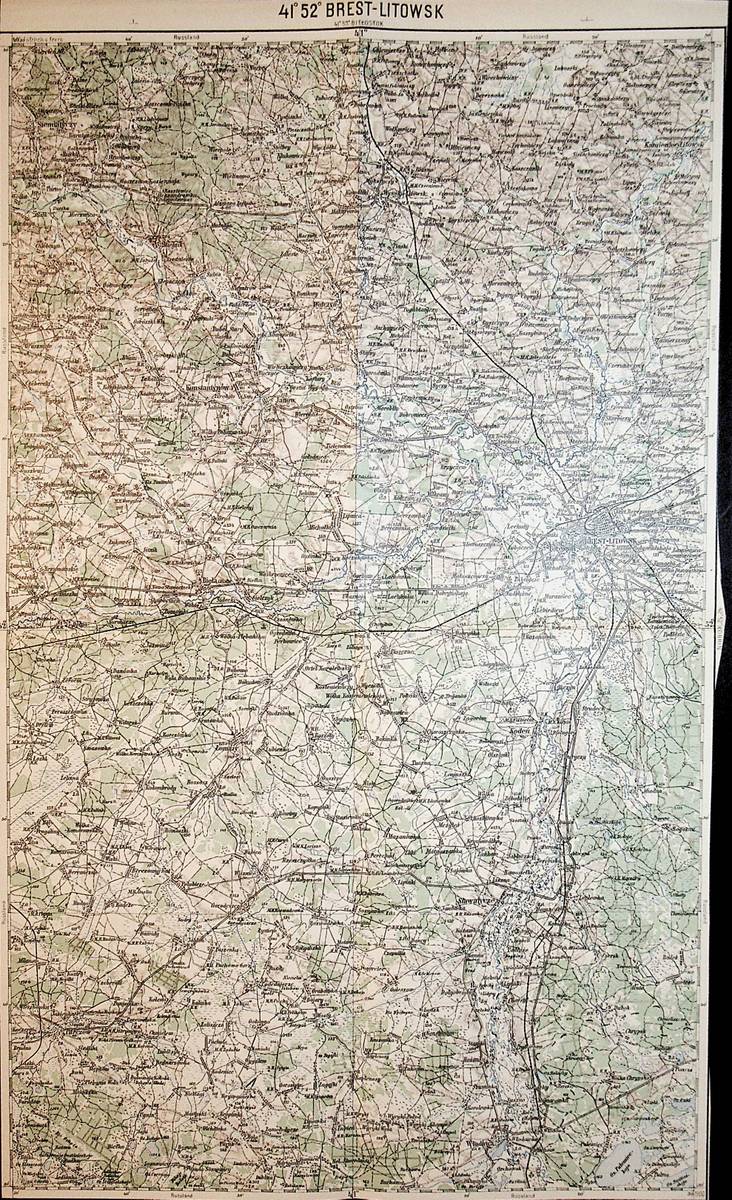
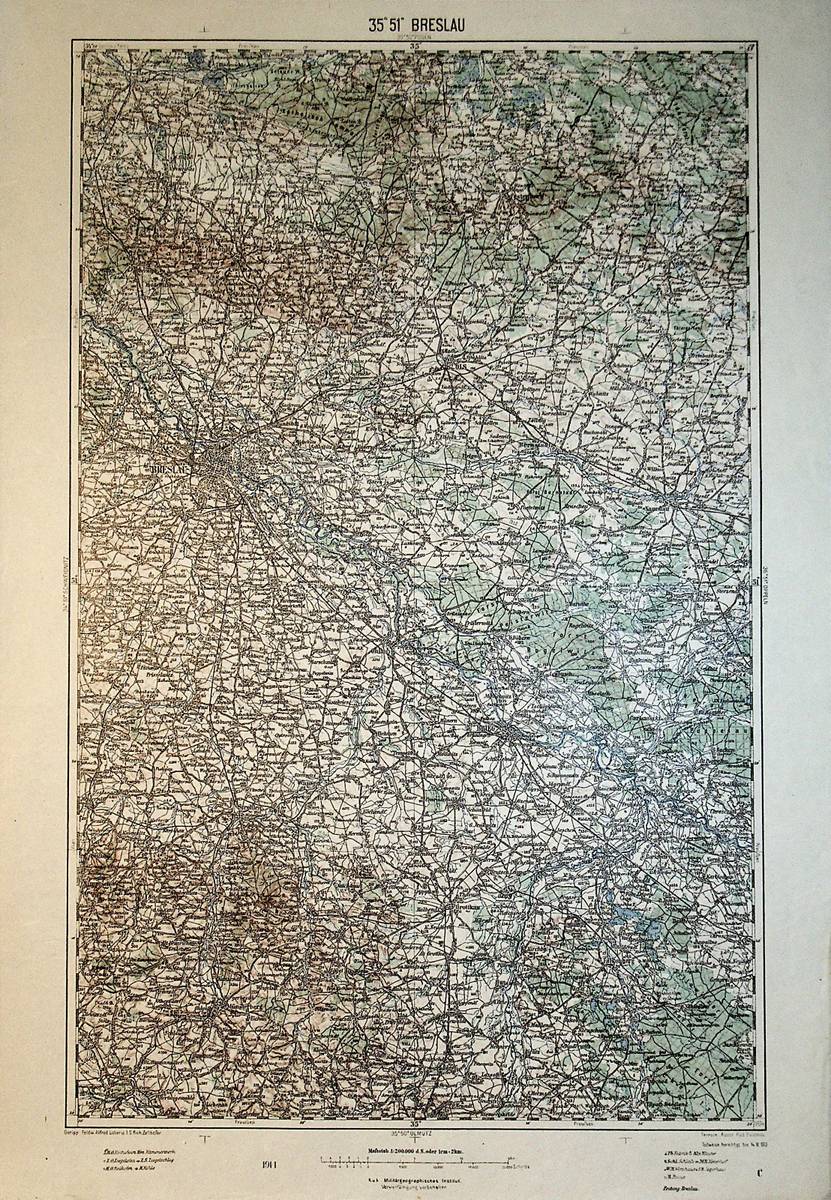
1914réf. A111-136Wien, Kaiserlich-K?nigliches Milit?r-Geographisches Institut, 1914. Hochformat, ca. 34 x 55 cm, Ausgabe: mehrf?rbig; Zustand: gut +
1900réf. A141-1197Wien, Kaiserlich-K?nigliches Milit?r-Geographisches Institut, 1900. Hochformat, ca. 34 x 55 cm, gefaltet zu 4 Segmenten, Ausgabe: mehrf?rbig; Zustand: gut +
198931 cm, br. ill. con risvolti; p. 117, numerose ill. in nero e col
1913réf. A111-076Wien, Kaiserlich-K?nigliches Milit?r-Geographisches Institut, 1913. Hochformat, ca. 34 x 55 cm, Ausgabe: mehrf?rbig; Zustand: gut +
1970Cm. (76x26) al vivo, riproduzione di stampa d’epoca, stampata a torchio, acquerellata a mano. In buono stato.
1986311 p., chiefly col. illus. 33 cm Hardcover Very good condition good
194321pp., gebroch., in de reeks "Mededeelingen van de Koninklijke Vlaamsche Academie voor Wetenschappen, Letteren en Schoone Kunsten van België", goede staat, B37335
1943réf. B37335Antwerpen, Standaard-Boekhandel 1943 21pp., gebroch., in de reeks "Mededeelingen van de Koninklijke Vlaamsche Academie voor Wetenschappen, Letteren en Schoone Kunsten van België", goede staat, B37335
19574to 11" - 13" tall; 4to, 220pages. ill. Maps (1 fold col. ) plans. 28 cm. A detailed pictorial record of wooden synagogues throughout Poland, many of which were destroyed by the Nazis. Includes almost 50 pages of text alongside pictures as well as 150+ pages of illustrations including photographs, structural designs and a foldout map showing the locations where wooden synagogues currently stand (or previously stood) in Poland. Includes 293 numbered photo illustrations & architectural plans and drawings, 36 text illustrations, 1 folding color map, and a 113-item bibliography. Previous owner's inscription, Very Good Condition with the attractive and scarce dust jacket (Jacket is in Good+ Condition ). (SPEC18-5)
19574to 11" - 13" tall; 4to, 220pages. ill. Maps (1 fold col. ) plans. 28 cm. A detailed pictorial record of wooden synagogues throughout Poland, many of which were destroyed by the Nazis. Includes almost 50 pages of text alongside pictures as well as 150+ pages of illustrations including photographs, structural designs and a foldout map showing the locations where wooden synagogues currently stand (or previously stood) in Poland. Includes 293 numbered photo illustrations & architectural plans and drawings, 36 text illustrations, 1 folding color map, and a 113-item bibliography. Water stains to top portions of several pages, but all text and images are clear. Front cover of attractive dust jacket is laid in as well. Good+ Condition. (SPEC18-6)
19574to 11" - 13" tall; 4to, 220pages. ill. Maps (1 fold col. ) plans. 28 cm. A detailed pictorial record of wooden synagogues throughout Poland, many of which were destroyed by the Nazis. Includes almost 50 pages of text alongside pictures as well as 150+ pages of illustrations including photographs, structural designs and a foldout map showing the locations where wooden synagogues currently stand (or previously stood) in Poland. Includes 293 numbered photo illustrations & architectural plans and drawings, 36 text illustrations, 1 folding color map, and a 113-item bibliography. Light soiling to cloth and outer edges. No jacket. Good+ Condition. (EE-3-17)