4.324 Ergebnisse
1944Best.-Nr. R110270Washington D.C., The Catholic University of America Press 1944 x + 432pp., with handwritten dedication and siganture by the author, 24cm., publisher's hardcover in cloth with gilt lettering (trace of removed label at lower enbd of spine), text in English, Doctoral Dissertation (A Dissertation submitted to the Faculty of the School of Sacred Theology of the Catholic University of America in partial fulfillment of the requirements for the degree of Doctor of Sacred Theology), stammp at verso of title page, text is clean and bright, weight: 1kg., R110270
Best.-Nr. 1528344995.Gpaperback. Good. Access codes and supplements are not guaranteed with used items. May be an ex-library book. paperback
19478vo; 1st edition. Original illustrated red boards, 8vo, 342 pages. In Yiddish. Title translates as, "The destruction of Vilna." Kaczerginski (19081954) was a Yiddish writer and cultural activist. Born in Vilna to a poor family and educated at that citys Talmud Torah, Shmerke (Pol., Szmerke) Kaczerginski lost both his parents during World War I. As a youth, he was involved with outlawed Communist groups and was arrested several times, serving a lengthy prison term. In the 1930s, two of his revolutionary poems became popular in Poland. He wrote short stories with a radical bent and was a correspondent and reporter for literary publications, including the semilegal leftist press in Poland and the New York Communist daily Morgn-frayhayt. Kaczerginski played a key role in shaping the writers and artists group Yung-Vilne; he organized its evening events and was the de facto publisher of its three miscellanies between 1934 and 1936. During the period of Soviet control over Lithuania in 19401941, he was even more active in the field of Yiddish culture, but at the same time experienced his first disappointments with the attitude of the Soviet regime toward Jewish culture. During the first period of Nazi occupation, Kaczerginski wandered through villages and towns posing as a deaf mute; after many difficulties, he ended up in the Vilna ghetto. Kaczerginski was very involved in the ghettos cultural activities. As a leader of its youth club, he wrote its Yugnt-himen (Youth Hymn), a song that immediately became popular. In 1943, he wrote the song Shtiler, shtiler in memory of the mass murders committed at Ponar. Set to music that Aleksander Volkoviski (later known as Aleksander Tamir) had submitted to a contest organized by the ghetto, the song was first heard at an evening performance there and over the years became one of the best-known songs of the Holocaust. With Avrom Sutzkever and others, Kaczerginski became part of a group of forced laborers whom the Germans designated to sort Jewish cultural treasures at YIVO and other locations. Known as the Papir-brigade (Paper Brigade), the groups members risked their lives to hide the most significant items, smuggling them back into the ghetto or entrusting them to non-Jewish acquaintances. Kaczerginski was a member of the Fareynikte Partizaner Organizatsye (United Partisans Organization; FPO), and, since YIVOs building was located outside the ghetto walls, he took part in smuggling weapons into the ghetto. In September 1943, Kaczerginski, along with Avrom and Freydke Sutzkever and other members of the FPO, escaped from the Vilna ghetto as part of an organized group of fighters just before its liquidation. They joined a Soviet partisan unit in the Naroch Forests, where Kaczerginski fought as a partisan until liberation in July 1944. Kaczerginskis books describe the destruction of Vilna, the partisan struggle, and his own experiences during the Holocaust period: Khurbn Vilne (The Destruction of Vilna; 1947), Partizaner geyen (Partisans on the Move; 1947), and Ikh bin geven a partizan (I Was a Partisan; 1952) (YIVO, 2010). Ex-library, spine sunned, otherwise very Good Condition. (HOLO2-89-3A)
1981Best.-Nr. 98132France-Empire 1981 In-12 broché. 253 pages. Bon état d’occasion.
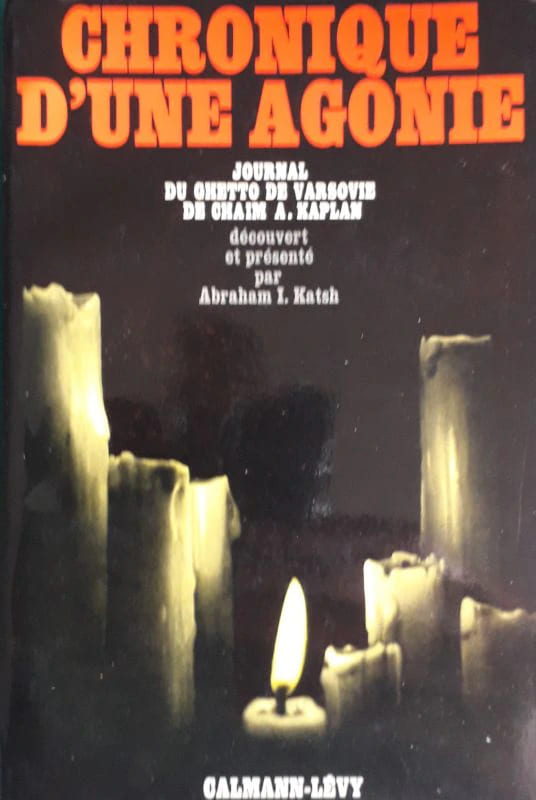
1966Best.-Nr. 64636Calmann-Lévy, 1966, in-8°, 422 pp, broché, couv. illustrée (lég. défraîchie), bon état
1957Broch?. 192 pages.
Cartonn?.255 pages.
190217,6X11,2 cm; (4), III, (1), 360 pp. e una c. di tav. con ritratto di Verlaine. Copia proveniente dalla celebre biblioteca del grande orientalista Fosco Maraini e del fratello artista Grato con firma autografa ,alla prima pagina bianca, della madre di Grato e Fosco, la scrittrice inglese di origine polacca, Yoi Pawlowska Crosse. Esemplare in barbe. Buono-ottimo stato di conservazione.
1939Best.-Nr. ABE-152547975894 PAGES FORMAT 43 CM X 60 CM-P1: NI PAR DISCOURS, NI PAR SOVIETS, PAR G.K.GUILLAUME-J'AI VU EVACUER UN VILLAGE LORRAIN LA DERNIERE MESSE DE MINUIT, PAR JEAN DE CUGNAC-P2: IL S'AGIT D'UNE VERITABLE TRAHISON-4 EMPLACEMENTS CENSURES-P3: GENS DE GUERRE 1939-CARREL, LE MAGICIEN BLANC-SUPPRIMERA-T-ON LES ABSINTHES?-P4: DE L'AUTRE COTE DU MUR, TCHECOSLOVAQUIE, BOLCHEVISATION (PJ1)
1936Best.-Nr. 5201936 Paris Société Française d'éditions littéraires et techniques 1936 Un volume in-12 broché 420 ppTRES BON ETAT
Best.-Nr. 13977930Charleroi, Paris: Maison d'éditions J. Dupuis (Bibliothèque grise n° 2), s.d. in-12, 208 pages. Broché. L'action est située en Pologne. (Bibliothèque grise n° 2).
1823550pp., dans la série "Chefs-d'oeuvre des théatres étrangers, traduits en français" 23e livraison, 20cm., reliure plein-cuir avec titre et faux-nerfs dorés au dos, feuilles de garde et tranches marbrées, qqs. rousseurs, bon état, Y88220
1823Best.-Nr. Y88220Paris, Ladvocat 1823 550pp., dans la série "Chefs-d'oeuvre des théatres étrangers, traduits en français" 23e livraison, 20cm., reliure plein-cuir avec titre et faux-nerfs dorés au dos, feuilles de garde et tranches marbrées, qqs. rousseurs, bon état, Y88220
196120x14. 349p. Firma anterior poseedor. Trad. M. Chrestien.
1961Best.-Nr. 303611961 Paris, Julliard, 1961, in 8° relié demi-toile rouge à coins, dos lisse muet (reliure d'amateur), 349 pages et 14 pages non chiffrées d'Index.
Best.-Nr. 61755P., Payot, 1939, in 8° broché, 223 pages, couvetrure illustrée.
Best.-Nr. 87880aafParis, Payot, 1939, in-8vo, 223 p., non rogné, brochure ill. originale.
1939Best.-Nr. vd1275Payot Documents et témoignages pour servir à l'histoire de notre temps Broché 1939 In-8 (14,5 x 23 cm), broché, 223 pages ; pliures au dos et sur les bords des plats, résidus d'étiquette papier au quatrième plat, quelques petites traces au premier plat, intérieur bruni, par ailleurs assez bon état général. Livraison a domicile (La Poste) ou en Mondial Relay sur simple demande.
2026Best.-Nr. x-1032621184Taylor & Francis Ltd 2026. Paperback. New. 156 pages. 6.14x0.37x9.21 inches. Taylor & Francis Ltd paperback
2014Best.-Nr. 62867U. S. Geological Survey USGS. VG. 2014. Hardcover. Hardback in Very Good condition without dust jacket. 279 X 216 X 38 millimeters. 438 pages. Clean tight volume with wear to board edges. Quick shipping excellent customer service. All books carefully packaged in boxes and ship with tracking information. . U. S. Geological Survey (USGS) hardcover
2015Best.-Nr. 61444Geological Survey USGS. NF. 2015. Hardcover. Hardback in Near Fine condition without dust jacket. 279 X 216 X 38 millimeters. 438 pages. Quick shipping excellent customer service. All books carefully packaged in boxes and ship with tracking information. . Geological Survey (USGS) hardcover
1790Carta geografica inserita nell'opera "Géographie Moderne, Historique et Politique" edita a Parigi nel 1790 con direzione di Louis Charles Desnos Ingegnere e Cartografo per i Globi e le Sfere. La carta, con coloritura coeva ai confini, presenta ai lati la descrizione dell'analisi applicata editorialmente
Best.-Nr. 235339Paris, Publications de la conciliation internationale, 1932 in-12, VI pp., 315 pp., [4] ff. n. ch., avec quelques cartes dans le texte, broché.
Roma,Librria dello Stato,1945. In 8°pp.188n. bross. editoriale usurata, illustr. piatto anteriore. Rinforzo al dorso. Numerose tavv. f.t.
1980MACCHIETTE/FIORITURE ALLA COPERTINA E NELLE PRIME PAGINE BIANCHE. SEGNI DEL TEMPO. MAI SFOGLIATO. 25 anni nel cinema polacco. Il viaggio esemplare di un cineasta dell'Est dentro i miti della Polonia, dentro la storia, dentro i fantasmi della letteratura e del quotidiano, dentro le contraddizioni di un cinema critico che vuole restare popolare. Informazioni bibliografiche Titolo: Cenere e diamanti. Il cinema di Andrzej Wajda Autore: Giandomenico Curi Editore: Roma: Edizioni E/O, 1980 Lunghezza: 267 pagine, 21 cm. Soggetti: Cinema, Registi cinematografici, Polonia, Est, Europa, Critica, Wajda, Andrzej, Saggi, Film Polski, Opere, Filmografia, Cultura yiddish, Romanticismo, Sociale, Cattolico, Socialismo, Ribellione, Comunismo, Varsavia, Borghesia, Letteratura, Montaggio, Nouvelle Vague, Fellini, Orson Welles, Teatro, Katyn, Le signorine di Wilko, L'uomo di ferro, Oscar, Palma d'oro, La terra della grande promessa, Cannes, Anni settanta, Zbigniew Cybulski, simbolismo, Generazione, I dannati di Varsavia, Lech Walesa, Orso d'oro, Berlino, Cultura, Pierscionek z orlem w koronie, Zemsta - La Vendetta, Solidarnosc, Solidarnosc..., Popiól i diament