2 643 résultats
réf. GF12989Photographie 7,5x4 cm - collée sur carton - vers 1900 -
réf. GF12990Photographie 7,5x4 cm - collée sur carton - vers 1900 -
réf. GF12979Photographie 7,5x4 cm - collée sur carton - vers 1900 -
réf. GF13110Photographie 7,5x4 cm - collée sur carton - vers 1900 -
réf. GF18699Photographie 7,5x4 cm - collée sur carton - vers 1900 -
réf. 500624A Genève, Chez J. J. Paschoud, 1807. In-8 cartonnage d'attente, titre manuscrit au dos, [2] ff.-VII-426 pp.
2008réf. 851302008 Sans lieu, Michel de Maule, 2008, in 8° broché, 254 pages ; illustrations et fac-similés hors-texte ; couverture illustrée.
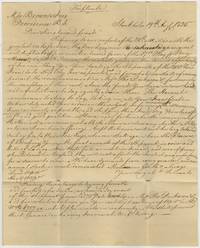
1825réf. BK0190Stockholm Sweden 1825. One large folded commercial sheet written on several panels with integral address panel to Messrs. Brown & Ives Providence Rhode Island endorsed "Pr. Brig Harvest" with Newport "SHIP" marking. Headed "Triplicate. Old folds and light handling wear very good. A commercial letter and account from the Stockholm mercantile house of Kantzow & Biel to Brown & Ives of Providence concerning the execution of a large order for Swedish iron. The firm reports that it is assembling a shipment of arranging its transport while the accounting on another portion of the same sheet records the value of the iron and related charges. The letter reports: "the contents giving us the desired opportunity of confirming you Your order for a Shipmt. of 200 Tons Iron to be ship'd & appointed and convoy which we shall of course prevail the commencement on." The letter dates from a period of rapid expansion in Swedish iron exports to the United States which had displaced Britain as Sweden's most important foreign market for bar iron. Britain had reduced its dependence on Swedish imports while American tariff legislation favored hammered iron from Sweden and Russia over British rolled iron. American demand became particularly important to the Swedish industry in the aftermath of the Napoleonic Wars. The United States purchased approximately three-fifths of Sweden's iron exports in 1822 with mainly American vessels engaged in the trade. The account also records a credit entered July 28 "By your proportion of dividend in payment from the Swedish Government". Brown & Ives had longstanding claims against Sweden arising from American property seized during the Napoleonic Wars including tobacco and rice belonging to the firm taken from the General Hamilton in 1810.1 The Swedish government finally settled the American claims in July 1825 following years of diplomatic representations concerning the confiscation and sale of American property at Stralsund. The credit recorded here appears to represent Brown & Ives's share of that indemnity entered less than two weeks after the settlement was formally concluded on July 16. The correspondence thus brings together two aspects of Swedish-American relations in the immediate postwar period: the expansion of an iron trade increasingly important to Sweden's economy and the settlement of commercial grievances dating back fifteen years. The shift reflected the changing geography of Atlantic commerce as Britain's increasingly mechanized iron industry reduced its dependence on Swedish imports while the rapidly industrializing United States emerged as Sweden's principal customer. However American iron production expanded enough to challenge Sweden's position in the American market particularly beginning in the 1830s and 1840s. 1 Calendar of the Miscellaneous Letters Received by the Department of State Government Printing Office 1897 47. . unknown
1825réf. BK0190Stockholm Sweden 1825. One large folded commercial sheet written on several panels with integral address panel to Messrs. Brown & Ives Providence Rhode Island endorsed "Pr. Brig Harvest" with Newport "SHIP" marking. Headed "Triplicate. Old folds and light handling wear very good. A commercial letter and account from the Stockholm mercantile house of Kantzow & Biel to Brown & Ives of Providence concerning the execution of a large order for Swedish iron. The firm reports that it is assembling a shipment of arranging its transport while the accounting on another portion of the same sheet records the value of the iron and related charges. The letter reports: "the contents giving us the desired opportunity of confirming you Your order for a Shipmt. of 200 Tons Iron to be ship'd & appointed and convoy which we shall of course prevail the commencement on." The letter dates from a period of rapid expansion in Swedish iron exports to the United States which had displaced Britain as Sweden's most important foreign market for bar iron. Britain had reduced its dependence on Swedish imports while American tariff legislation favored hammered iron from Sweden and Russia over British rolled iron. American demand became particularly important to the Swedish industry in the aftermath of the Napoleonic Wars. The United States purchased approximately three-fifths of Sweden's iron exports in 1822 with mainly American vessels engaged in the trade. The account also records a credit entered July 28 "By your proportion of dividend in payment from the Swedish Government". Brown & Ives had longstanding claims against Sweden arising from American property seized during the Napoleonic Wars including tobacco and rice belonging to the firm taken from the General Hamilton in 1810.1 The Swedish government finally settled the American claims in July 1825 following years of diplomatic representations concerning the confiscation and sale of American property at Stralsund. The credit recorded here appears to represent Brown & Ives's share of that indemnity entered less than two weeks after the settlement was formally concluded on July 16. The correspondence thus brings together two aspects of Swedish-American relations in the immediate postwar period: the expansion of an iron trade increasingly important to Sweden's economy and the settlement of commercial grievances dating back fifteen years. The shift reflected the changing geography of Atlantic commerce as Britain's increasingly mechanized iron industry reduced its dependence on Swedish imports while the rapidly industrializing United States emerged as Sweden's principal customer. However American iron production expanded enough to challenge Sweden's position in the American market particularly beginning in the 1830s and 1840s. 1 Calendar of the Miscellaneous Letters Received by the Department of State Government Printing Office 1897 47. . unknown books
réf. ORD-9762Firmin Didot. 1841. In-8 br. 567pp., 48 planches h.-t. pour la Suède, 12 h.-t. pour la Norvège et 1 carte dépliante. Complet des gravures. Exemplaire en partie débroché, quelques pages un peu tachées, des rousseurs. A relier.
1980réf. LFA-126748691Une revue de 24 pages, format 150 x 240 mm, illustrée, brochée, publiée en 1980, Société des Amateurs de Jardins Alpins, bon état
in-4° broche, 63 pages, illustrations. Bel exemplaire. [P-35] Premier numéro de la revue trimestrielle La Fenêtre ardente.
1955réf. 854701955 Paris, Genève, Nagel, 1971, in 12 relié pleine percaline rouge de l'éditeur, jaquette, 480 pages.
1953réf. 855451953 Paris, 1953, in 8° broché, 224 pages.
1976réf. 804421976 Paris, Laffont, 1976, in 8° broché, 271 pages.
réf. 63544Lausanne, Rencontre (L'Atlas des Voyages), 1968, grand in 8° cartonnage illustré de l'éditeur, 192 pages.
réf. 500431935, grand in 8° cartonnage illustré de l'éditeur, 32 feuillets non numéroté de photographies en noir.
1944réf. 745601944 Lyon, Agence Gutenberg, 1944, petit in 8° broché, 175 pages ; portrait en frontispice ; couverture illustrée (fanée).
réf. 14111Goteborg, Samuel Norberg, 1795. Petit in-12 de (3) ff., 224 pages. Demi-basane à coins début dix-neuvième, dos lisse orné de filets.
réf. 588593Hambourg, Chretien Herold, 1760. In-8, cartonnage de l’époque papier vert, dos orné et titré en doré, tranches rouges, [3]ff.-343 pp.
1999réf. LFA-126739058Un ouvrage de 160 pages, format 130 x 210 mm, illustré, broché, publié en 1999, Svenska Institutet, bon état
1739réf. 32143Stockholm: Pet. Momma 1739. Paperback. Good. Paperback. 6pp. Illustrated initial and headpiece. Some dampstaining and foxing section of loss to final leaf affecting some text else good. Regulations for factories and manufactories issued by the Swedish Parliament Riksens Standers board of trade. Uncommon example of early economic regulations that coincided with the onset of the early modern period. Pet. Momma paperback
1739réf. 32143Stockholm: Pet. Momma 1739. Paperback. Good. Paperback. 6pp. Illustrated initial and headpiece. Some dampstaining and foxing section of loss to final leaf affecting some text else good. Regulations for factories and manufactories issued by the Swedish Parliament Riksens Standers board of trade. Uncommon example of early economic regulations that coincided with the onset of the early modern period. Pet. Momma paperback books
1898réf. 42275Chicago: Svenska Tribunens Forlag 1898. Folio. 8 206 pp. 100s of text woodcut illusts. Blue cloth illust. on frnt cvr in blk gilt & red mnr chppng hd & ft of spine mnr bmpng to crnrs edgewear still a VG- copy from the library of A.nders G.ustaf Bergman b. 1865 a painter in Astoria who immigrated from Stockholm to Astoria in 1891 and later for 5 years lived near Cannon Beach. First edition of this lavishly illustrated travelogue through Sweden at the end of the 19th-century. Svenska Tribunens Forlag, hardcover
1861réf. 14757Np. nd ca.1861. A detailed description of the attractions industries and manufactures of Norrkoping a port town in Sweden in the district of Ostergotland. The attractive lithographic plates which illustrate various buildings and sites may be a product of one of the more notable industries of the town: lithography. The text includes descriptions of all aspects of life there with many statistics. Engraved title. Contemporary three quarter calf and boards spine gilt. Extremities rubbed corner of front board cracked neat bookplate foxed. Good. hardcover